Best Overall Value
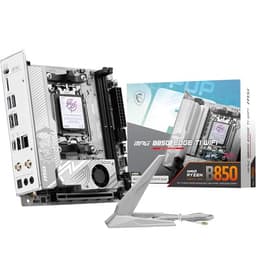
Under £100 for an AM5 board with Wi-Fi 7. That single line is why this sits at the top. Every other AM5 board on this list starts north of £85 and most cost double, yet the B840 puts you on AMD's current socket, on DDR5, with wireless built in, for a price that used to buy you a dead-end AM4 board. That's the compromise reframed as a win: you're buying into a socket AMD has promised to support for years, so a Ryzen 5 7500F now can become a Ryzen 9 later without a new board.
Here's where the price comes from, and it matters. The B840 chipset runs PCIe 4.0, not 5.0. So the primary x16 slot and the M.2 are Gen4, not Gen5. For anyone pairing this with an RTX 4060, 4070 or a Radeon in that class, that costs you nothing measurable, since no current GPU saturates a Gen4 x16 link. The place it bites is Gen5 M.2 drives, which run at Gen4 speeds here. Most owners will never notice, because Gen4 SSDs already load games faster than the games can use.
Wi-Fi 7 is the headline that undercuts boards twice the price. The B650 GAMING PLUS just below it in this list ships with the older Wi-Fi 6E, and costs over £120 more. Read that again. You get newer wireless for less money. The 2.5G wired LAN is standard fare and fine for any home connection. DDR5 memory boost is rated to 8000+ MT/s on paper, well beyond what a budget kit will run, so headroom isn't your worry here.
Owners consistently report a clean BIOS flash for the newest Ryzen chips straight out of the box, which used to be the AM5 headache in 2023. The listing specifies a single M.2 Gen4 slot and a straightforward heatsink over it. If you want the 80A VRM stages and Gen5 of the B850 Tomahawk, you pay for them. For a mainstream six or eight-core build, this is the one that leaves the most money in your pocket for the GPU that actually decides your frame rate.
Pros
- Cheapest route onto AM5 with wireless on this list
- Wi-Fi 7 undercuts pricier boards running older 6E
- Full AM5 upgrade path for future Ryzen chips
- ATX layout with proper spacing, not a cramped Micro-ATX
Cons
- PCIe 4.0 only, no Gen5 slot or Gen5 M.2
- Single M.2 slot limits multi-drive builds
- VRM is fine for mid-range chips, not a 16-core flagship
Buy on Amazon
Best for Gen5 Builds
If the B840's Gen4 ceiling is what stops you buying it, this is the answer, and it's the cheapest sensible way to get there. The B850 Tomahawk Max brings a PCIe 5.0 x16 slot and a Gen5 M.2 for around £219, roughly £125 more than the B840. Whether that's money well spent depends entirely on whether you'll ever run a Gen5 SSD or a Gen5 GPU, and honestly most 2026 buyers won't for a while yet.
Where the extra money is unarguably justified is the power delivery. This carries an 80A SPS VRM, a serious step up from the B840's stages. That's what lets you drop a Ryzen 9 9900X or 9950X in and hold boost clocks under a sustained all-core render without the board tapping out. The Tomahawk name has meant strong VRM and heatsinks for years, and owners of this generation report the same. The 5G LAN doubles the B840's 2.5G, which matters if you've a multi-gig connection or a fast NAS.
Wi-Fi 7 is shared with the B840, so that's not the reason to upgrade. The reason is the VRM and the Gen5 future-proofing together. We covered this board in detail in our MSI MAG B850 TOMAHAWK MAX WIFI review. For a high-core-count chip you plan to keep, it earns its place; for a Ryzen 5, the B840 saves you money you don't need to spend.
Pros
- 80A SPS VRM handles a Ryzen 9 without throttling
- PCIe 5.0 x16 and Gen5 M.2 for genuine future-proofing
- 5G LAN for multi-gig networks and fast NAS access
- Cheapest Gen5 board on this list
Cons
- Over twice the B840's price for features many won't use yet
- Same Wi-Fi 7 as cheaper boards, so wireless isn't the upgrade
Buy on AmazonRead full review
Best for Enthusiasts
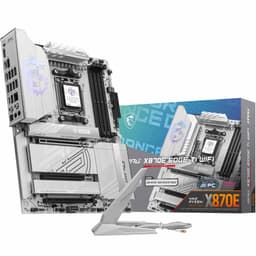
At around £269 this pushes right up against the £300 ceiling, and the question is what the X870 chipset buys you over the B850 sat above it. The headline is the second full x16 slot (PCIe 4.0 alongside the Gen5 primary), which the B850 lacks. That matters if you run an expansion card alongside your GPU, or want a second drive-heavy setup. For a single-GPU gaming build, it doesn't, and the B850 keeps £50 in your pocket.
The rest of the sheet mirrors the B850: the same 80A SPS VRM, the same Wi-Fi 7, the same 5G LAN. X870 also mandates USB4 support across the platform, which is the real differentiator if you plug in fast external storage or a docking setup. That's the checkable reason to step up here, not raw gaming performance, which is identical to the B850 for the same CPU.
We went deeper in our MSI X870 Tomahawk review. Buy it if you want the fuller connectivity and the second x16; if not, the B850 does the enthusiast job for less.
Pros
- Second full x16 slot the B850 doesn't offer
- USB4 support from the X870 chipset
- Same strong 80A VRM as the B850 for high-core chips
Cons
- £50 more than the B850 for gains many builds won't use
- Sits close to the £300 limit, tightening the budget elsewhere
Buy on AmazonRead full review
Best Dual-GPU-Slot AM5
This is the awkward one on the list, and the reason is pricing. At around £222 the B650 GAMING PLUS costs more than the far newer B840, yet gives you older Wi-Fi 6E instead of Wi-Fi 7, and the same PCIe 4.0 ceiling. What it adds over the B840 is a second PCIe 4.0 x16 slot and a second M.2 Gen4 slot. If you need those two drives and two slots, this earns its keep. If you don't, the B840 does more for less.
The 14+2 Duet Rail VRM is a genuine strength and runs cooler than the B840's arrangement under a heavy chip, so a Ryzen 7 or lower-tier Ryzen 9 sits happier here than on the cheaper board. Dual M.2 is the practical daily win: an OS drive and a games drive without adapters. We break the layout down in our MSI B650 review.
Buy this over the B840 only if the second M.2 and stronger VRM matter to you. Otherwise the price gap is hard to defend.
Pros
- Two PCIe 4.0 x16 slots and two Gen4 M.2 slots
- Stronger 14+2 VRM than the cheaper B840
- Full AM5 upgrade path
Cons
- Costs more than the newer B840 yet ships older Wi-Fi 6E
- No Gen5 despite the price
Buy on AmazonRead full review
Best for Intel
The only Intel board here, and that's exactly who it's for: anyone building around a 12th, 13th or 14th Gen Core chip rather than a Ryzen. At around £110 it sits just above the B840 in price and matches it closely on features, dual PCIe 4.0 x16, dual Gen4 M.2, 2.5G LAN and Wi-Fi 6E. The one thing to know going in is that LGA 1700 is Intel's previous socket, so like the AM4 boards below, it's a platform with no further CPU upgrades coming.
Against the B840, this isn't a rival so much as a fork in the road: you pick your CPU brand first, then the board follows. If you've a 13600K or 14700K in mind, or a cheap used one, this is your entry. DDR5 support keeps memory current, and owners report stable operation with 6000 MT/s kits. We cover the details in our MSI B760 GAMING PLUS review.
Pros
- Dual PCIe 4.0 x16 and dual Gen4 M.2 at a low price
- DDR5 with stable 6000 MT/s kit support
- Only Intel option here for existing LGA 1700 owners
Cons
- LGA 1700 is a dead-end socket, no CPU upgrade path
- Wi-Fi 6E rather than the newer 7
Buy on Amazon£92.50Read full review
Best Wired AM4 Workhorse
No Wi-Fi, no RGB, no fuss. The B550-A Pro is the plain-clothes AM4 board for someone who runs a wired connection and wants PCIe 4.0 for the GPU and one fast M.2. At around £109 it costs about the same as the far newer B840, which is the problem: you're paying AM5 money for a dead-end AM4 socket. The only reason to do that is if you already own a Ryzen 5000 chip and DDR4 kit.
USB 3.2 Gen 2 on the rear gives you 10Gbps for external drives, and the DP plus HDMI outputs suit an APU or troubleshooting without a GPU. Against the B550 Tomahawk further down, this drops the 2.5G LAN and second M.2 to save a good chunk of money. Owners rate it a reliable, boring board, which for a workhorse is a compliment. See our full MSI B550-A PRO review for the port layout.
Pros
- 10Gbps USB 3.2 Gen 2 on the rear I/O
- PCIe 4.0 x16 for the GPU on a budget AM4 build
- DP and HDMI outputs for APU use
Cons
- No Wi-Fi, wired-only
- AM5 money for a dead-end AM4 socket unless you own the parts already
Buy on Amazon£93.98Read full review
Best Under £50
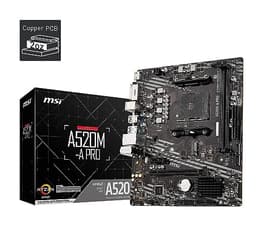
Under £50 for a working motherboard. That's the whole pitch, and it's a good one for the tightest builds. This Micro-ATX AM4 board pairs with a used Ryzen 5000 chip and DDR4 for a machine that costs less than some single components. The catch is PCIe 3.0, so a modern GPU runs on a narrower link than the B550-A Pro's 4.0, though for a budget card the real-world hit is small. DVI output shows the age here, handy for an old monitor. Basic, honest, cheap.
Pros
- Cheapest board on this list by a wide margin
- Compact Micro-ATX for small cases
- DVI output for older displays
Cons
- PCIe 3.0 only, unlike the B550-A Pro
- No Wi-Fi and slower USB 3.2 Gen 1 rear ports
Buy on Amazon£45.19Read full review
Best Cheapest AM5 Entry
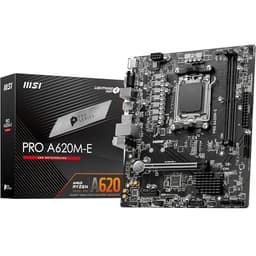
At around £86 this is the cheapest door onto AM5 and DDR5, in a compact Micro-ATX form. It undercuts the B840 by roughly £9, but you give up a lot for that saving: no Wi-Fi, a single M.2 slot, and a thinner VRM that caps how hot a chip you should run. Pair it with a Ryzen 5 or 7 and it's fine; a Ryzen 9 would push it. Against the B840, the extra few pounds for that board's Wi-Fi 7 and roomier ATX layout is money well spent for most people. Buy the A620M-E only if the small form factor or the absolute lowest AM5 entry price is the priority.
Pros
- Cheapest AM5 and DDR5 board here
- Compact Micro-ATX for small builds
- Full AM5 upgrade path despite the low price
Cons
- No Wi-Fi and only one M.2 slot
- Thin VRM limits high-core-count chips
Buy on Amazon£99.99Read full review
Best Legacy AM4 Build Quality
The B550 Tomahawk earned a legendary reputation for VRM and build quality, and owners still rate it years on. The trouble is the price: at over £230 it costs more than the B850 Tomahawk Max, a Gen5 AM5 board on a live socket. Paying more for a dead-end AM4 platform makes no sense in 2026 unless you already own the Ryzen and DDR4 to fill it. See our MSI B550 Tomahawk review for why it was so loved. Great board, wrong price now.
Pros
- Excellent VRM and heatsinks, a build-quality benchmark
- Dual M.2 and 2.5G LAN
Cons
- Costs more than the newer AM5 B850 Tomahawk
- Dead-end AM4 socket with no upgrade path
Buy on Amazon£229.35Read full review