You know what kills a mid-range AMD build? Not a slow GPU. Not cheap RAM. It's buying a board that looks decent on paper, then watching your Ryzen 9 7900X throttle itself into oblivion because the VRM is basically a hot plate with a heatsink glued on top. People obsess over CPU benchmarks, spend hours picking the right DDR5 kit, then grab whatever motherboard fits the budget without really checking what's under the hood. And then they wonder why their "high-end" build runs like it's apologising for itself.
The MSI MAG B650 TOMAHAWK WIFI is the board that's supposed to fix that problem at a sensible price. It's been around long enough now that real owners have had time to actually live with it, and with 1,801 averaging 4.6 stars, something is clearly going right. But I've dug through the spec sheet, the owner feedback, and the competition so you don't have to take that star rating at face value. Because 4.6 stars from people who've never stress-tested a VRM doesn't always mean what you think it means.
So here's what we're going to work through: whether the Tomahawk's power delivery actually holds up to scrutiny, whether MSI's BIOS has got any better (spoiler: it has, mostly), and whether this is the sensible choice for an AM5 build in 2024 and beyond, or whether you should spend a bit more or a bit less. No fluff, no marketing copy. Just what matters.
Core Specifications
Before getting into the nuance, here's the full picture in one place. The Tomahawk WIFI is an ATX board on the AMD AM5 platform, running the B650 chipset. You get four DDR5 DIMM slots, two PCIe 4.0 x16 slots, three M.2 Gen4 slots, and a rear I/O that's genuinely well-stocked for a B-series board. Wi-Fi 6E and 2.5GbE LAN are both included, which at this price point is not something you should take for granted.
The VRM is where MSI has clearly put some effort in. A 14 Duet Rail Power System with 80A power stages is the headline number, and that's not just a marketing figure padded with phantom phases. Duet Rail means each "phase" is actually doing real work with two MOSFETs sharing the load, so the effective current delivery is genuinely higher than a basic 14-phase count might suggest on a cheaper board. More on that in the VRM section, but worth flagging upfront.
The form factor is standard ATX (305mm x 244mm), so it'll fit in any full-tower or mid-tower case that takes ATX boards, which is basically all of them. No awkward E-ATX sizing to worry about, no weird proprietary nonsense. Just a proper, full-size board with all the headers and slots you'd expect.
| Specification | Detail |
|---|---|
| Socket | AMD AM5 |
| Chipset | AMD B650 |
| Form Factor | ATX |
| Memory Slots | 4 x DDR5 DIMM |
| Memory Speed | 6400+ MHz (OC) |
| PCIe x16 Slots | 2 x PCIe 4.0 x16 |
| M.2 Slots | 3 x M.2 Gen4 x4 |
| LAN | 2.5GbE |
| Wireless | Wi-Fi 6E + Bluetooth 5.3 |
| USB (Rear, highlight) | USB 3.2 Gen 2x2 Type-C (20Gbps) |
| Video Output | HDMI 2.1, DisplayPort 1.4 |
| Audio | 7.1 HD Audio with Audio Boost |
| VRM | 14 Duet Rail, 80A power stages |
| Price | £179.99 |

Socket & CPU Compatibility
The AM5 socket is AMD's current-generation platform, and it's a big deal for long-term value. AMD has committed to AM5 support through at least 2027, which means the board you buy today should still be relevant when Ryzen 9000 series chips are mainstream and whatever comes after is on the horizon. That's a meaningful difference from the Intel side of things, where socket changes have historically been more frequent and more painful for upgrade paths.
The Tomahawk WIFI supports the full range of AM5 processors: Ryzen 7000 series, Ryzen 8000 series, and Ryzen 9000 series. That covers everything from budget Ryzen 5 7600 chips right up to the Ryzen 9 9950X if you're feeling ambitious and your wallet is brave. The 80A power stages mean it can handle the higher TDP chips without breaking a sweat, which is more than you can say for some cheaper B650 boards that technically support those CPUs but will throttle them under sustained load.
One thing worth knowing: if you're buying this board brand new to pair with a Ryzen 9000 series chip, MSI has been good about pre-flashing boards at the factory with compatible BIOS versions. But if you somehow end up with old stock and a new CPU, you'll need a Ryzen 7000 chip to do the initial BIOS update, or you'll need to use MSI's Flash BIOS button on the rear I/O if the board supports it. Worth checking the box label for the BIOS version before you buy if you're going straight to a 9000 series chip. Most retailers are selling boards with compatible firmware at this point, but it's always better to know before you're standing in front of a PC that won't POST.
Chipset Features
The B650 chipset sits in the middle of AMD's AM5 lineup, below the X670E flagship tier but above the A620 budget option. What that means practically: you get PCIe 4.0 support throughout (no PCIe 5.0 for storage on B650, that's an X670E thing), but you still get proper overclocking support for both CPU and memory. That's a key difference from A620, which locks memory overclocking. If you want to run fast DDR5 kits, you need B650 or above.
In terms of chipset-level lanes, B650 gives you enough to run three M.2 slots and a handful of USB ports without everything sharing bandwidth in a way that causes problems. The Tomahawk makes good use of those lanes: three M.2 Gen4 x4 slots means you can run three fast NVMe drives simultaneously, and the primary M.2 slot gets a Shield Frozr heatsink to keep thermals in check during heavy sequential writes. That's a nice touch that not every board at this price includes properly.
USB at the chipset level is also decent. The rear I/O includes a USB 3.2 Gen 2x2 Type-C port running at 20Gbps, which is the fastest USB you'll find on most mid-range boards and is genuinely useful if you're connecting fast external SSDs or high-speed peripherals. There are also internal headers for front-panel USB connectivity, so your case's front USB-C port should be covered. The B650 chipset doesn't support PCIe 5.0 for GPU slots either, but honestly, PCIe 4.0 at x16 is still not a bottleneck for any current GPU. Don't let anyone convince you otherwise.
VRM & Power Delivery
This is the bit that actually matters, and it's where the Tomahawk earns its reputation. The 14 Duet Rail Power System with 80A power stages is a genuinely capable setup. To put that in context: 14 phases at 80A each gives you a theoretical maximum current delivery that's well above what even the most power-hungry Ryzen 9 chips actually draw. The Ryzen 9 9950X has a default TDP of 170W, and even with PBO (Precision Boost Overdrive) enabled and the CPU pulling hard, this VRM has headroom to spare.
The Duet Rail design means each phase rail uses two MOSFETs working together rather than a single component handling everything. This reduces heat per component, spreads the load more evenly, and improves efficiency under sustained high-current conditions. It's the kind of design you'd expect on a more expensive board, and it's one of the reasons the Tomahawk has a reputation for being able to handle top-end Ryzen chips without thermal throttling the VRM itself. Some cheaper B650 boards will technically run a 9950X but will get hot enough doing it that you'll see performance drop under extended loads like video rendering or compilation tasks.
The heatsink situation is also properly sorted. MSI uses 7W/mK thermal pads on the MOSFET heatsinks, which is a higher thermal conductivity rating than the generic pads you'll find on budget boards. There's also a 6-layer PCB with 2oz thickened copper traces, which helps with current delivery and heat spreading across the board. Owner reviews consistently mention that the board runs cool even under sustained load, which is exactly what you want to hear. One owner running a Ryzen 9 7950X for video editing workloads reported stable operation over extended sessions. The VRM on this board is not the weak link. Full stop.
Memory Support
Four DDR5 DIMM slots, maximum capacity not specified in the verified data, but the speed support is the headline: 6400+ MHz with overclocking. The base JEDEC DDR5 speeds are supported out of the box, but the interesting number is that 6400+ figure, which you'll achieve with a good XMP/EXPO kit and some BIOS tweaking. AMD's EXPO memory standard (AMD's version of Intel's XMP) is fully supported, so if you buy a kit labelled EXPO, it should load its profile automatically and just work.
The four DIMM slots use SMT (Surface Mount Technology) rather than through-hole mounting, which improves signal integrity at high frequencies. That matters more than it sounds when you're trying to run DDR5 at 6000MHz or above, because signal integrity issues are one of the main reasons memory overclocking can be unstable. The 1DPC 1R (one DIMM per channel, one rank) configuration is where you'll see the highest stable speeds, so if you're chasing maximum memory performance, two sticks rather than four is the way to go.
In practice, most owners report that their DDR5 kits load their EXPO or XMP profiles without drama and run stably. There are occasional reports of needing a BIOS update to get certain kits running at rated speed, which is pretty standard for DDR5 on any platform right now. DDR5 memory compatibility is still an area where BIOS updates genuinely matter, and MSI has been reasonably diligent about releasing them. If you're buying a kit from a reputable brand and it's on MSI's QVL (Qualified Vendor List) for this board, you're unlikely to have problems.
Storage Options
Three M.2 Gen4 x4 slots is a proper result for a B650 board. Each slot supports NVMe drives running at up to 64Gbps, which is the PCIe 4.0 x4 maximum. The primary slot gets the Shield Frozr heatsink, which is MSI's thermal solution for keeping NVMe drives from throttling during heavy sequential workloads. If you've ever watched a cheap SSD slow to a crawl after a large file transfer because it's thermal throttling, you'll appreciate why this matters.
The second and third M.2 slots are also Gen4 x4, which is better than some boards in this category that drop the secondary slots to Gen3. Running three fast NVMe drives simultaneously is a legitimate use case for content creators, video editors, or anyone who wants a dedicated fast drive for OS, games, and project files separately. The B650 chipset has enough PCIe lanes to support this without the slots fighting each other for bandwidth, though notably, that populating all three M.2 slots may disable some SATA ports depending on how MSI has routed the lanes. Check the manual before you plan a storage setup that mixes M.2 and SATA drives.
SATA support is present on this board for those who still have 2.5-inch SSDs or spinning rust they want to carry over from a previous build. The verified spec data doesn't pin down the exact SATA port count, so check MSI's product page for that detail if you're planning a multi-drive SATA setup. RAID support through the AMD chipset is available, though in practice most home users won't need it. The storage options here are genuinely flexible and more than adequate for anything from a gaming PC to a workstation build.
Expansion Slots & PCIe
Two PCIe 4.0 x16 slots is the headline, and both running at PCIe 4.0 is worth emphasising. On some B650 boards, the secondary x16 slot is actually wired as x4 electrically, which limits what you can do with it. The Tomahawk's secondary slot also supports PCIe 4.0, making it genuinely useful for a second GPU, a high-speed PCIe capture card, or a PCIe NVMe add-in card if you somehow need more storage than three M.2 slots provides (and if you do, respect).
The primary PCIe x16 slot has Steel Armor reinforcement, which is MSI's name for the metal shielding that prevents the slot from bending or cracking under the weight of a heavy GPU. Modern graphics cards have got absolutely enormous, and a reinforced slot is not a nice-to-have anymore, it's a necessity. The secondary slot doesn't appear to have the same reinforcement, but that's fine because you wouldn't typically hang a heavy GPU off it anyway.
PCIe 4.0 at x16 delivers 64GB/s of bandwidth, which is more than any current consumer GPU can saturate. People sometimes worry about not having PCIe 5.0 for their GPU slot, but the data simply doesn't support that concern for anything available today. PCIe 5.0 for GPU slots is a feature that exists on paper more than it matters in practice right now, and you'd be paying a significant premium for X670E to get it. For the vast majority of builds, PCIe 4.0 x16 is completely fine and will remain so for the foreseeable future.
Connectivity & Rear I/O
The rear I/O on the Tomahawk is one of its stronger selling points. The USB 3.2 Gen 2x2 Type-C port running at 20Gbps is the standout, because that speed is still not universal even on more expensive boards. If you're connecting a fast external SSD or a modern dock, that 20Gbps connection makes a real difference compared to the more common 10Gbps Type-C ports. It's the kind of spec that seems like a nice-to-have until you actually use it, at which point you wonder how you managed without it.
Video output is covered by both HDMI 2.1 and DisplayPort 1.4 on the rear panel. These are there for use with AMD CPUs that have integrated graphics (the Ryzen 8000G series, for example), or for running a second monitor off the integrated graphics while your GPU handles the primary display. HDMI 2.1 supports 4K at 120Hz and 8K at 60Hz, so it's not a compromised output. That said, if you're running a discrete GPU, you'll be plugging your monitors into the GPU rather than the motherboard, so these ports are more of a backup or a convenience feature.
The 7.1 HD Audio with Audio Boost is MSI's onboard audio solution. It's not going to replace a dedicated DAC and amp for serious listening, but it's a step above the generic Realtek implementation you get on budget boards. Audio Boost refers to MSI's PCB-level isolation of the audio components, which reduces electrical interference from other board components and results in cleaner output. For gaming and general use, it's genuinely good. For audiophiles, you'll still want an external solution, but that's true of every motherboard on the market.
WiFi & Networking
Wi-Fi 6E is the wireless standard here, and it's the right choice for a board at this price point. Wi-Fi 6E extends the Wi-Fi 6 standard into the 6GHz band, which means less congestion in busy environments (think a flat with eight neighbours all on 5GHz) and higher theoretical throughput. Bluetooth 5.3 is bundled with the same wireless module, which handles peripherals, headsets, and anything else that connects wirelessly. The antenna connectors on the rear I/O accept the included antennas, and they're the standard SMA-type connectors, so you can upgrade to a better antenna if you want stronger signal in a larger space.
The 2.5GbE wired LAN is handled by a dedicated controller, and 2.5Gbps is increasingly the standard for mid-range and above boards. If your router supports 2.5GbE (many mid-range routers now do), you'll see noticeably faster local network transfers compared to standard gigabit. For online gaming, the difference between 1GbE and 2.5GbE is essentially zero, but for large local file transfers or NAS access, it matters. And if your current router only does 1GbE, the 2.5GbE port will happily negotiate down to 1GbE without any fuss.
Having both Wi-Fi 6E and 2.5GbE included on a B650 board is genuinely good value. Some competing boards at similar prices include one or the other but not both, or include Wi-Fi 6 rather than 6E. The networking package on the Tomahawk is one of the areas where MSI hasn't cut corners, and it shows. If you're building a system that needs flexible connectivity options (a home office machine, a media centre, a gaming rig that lives far from the router), this board has you covered without needing to add a PCIe network card.
BIOS & Overclocking
MSI's BIOS has had a complicated history. Older MSI boards had a UEFI interface that looked like it was designed by someone who'd never actually used a computer, and navigating it felt like doing a puzzle where the prize was a slightly overclocked CPU and a mild headache. The good news is that the Click BIOS 5 interface on current MSI boards, including the Tomahawk, is considerably better. It's not perfect, but it's no longer actively unpleasant.
The Easy Mode is genuinely useful for beginners: you can enable EXPO/XMP memory profiles, set fan curves, and check system temperatures without ever going into Advanced Mode. Advanced Mode gives you access to the full overclocking suite, including per-core CPU frequency adjustments, detailed memory subtiming control, and voltage settings for everything from the CPU core to the SoC. PBO (AMD's Precision Boost Overdrive) is supported and configurable, which is the main overclocking tool for Ryzen chips. You're not manually setting CPU multipliers with Ryzen the way you would with Intel, you're configuring power limits and letting the CPU's own boost algorithm do the work.
Owner feedback on the BIOS is mostly positive, with a few consistent gripes. The fan curve interface could be more intuitive, and some owners report that certain settings don't always stick after a reboot until you've saved the profile explicitly. Memory overclocking stability has improved significantly with recent BIOS updates, and MSI has been releasing updates at a reasonable cadence. The one thing I'd strongly recommend: update the BIOS before you start tweaking anything. The shipped firmware is functional, but the latest version typically has better memory compatibility and stability improvements that are worth having. MSI's website makes this reasonably straightforward with their BIOS update utility.

Build Quality & Aesthetics
The 6-layer PCB with 2oz thickened copper is not just a spec sheet boast. Thicker copper traces mean lower resistance, better current delivery, and more efficient heat spreading across the board. It's the kind of detail that separates a board built to a price from a board built to a standard. Combined with the 7W/mK thermal pads on the VRM heatsinks, the Tomahawk's thermal management is clearly a priority rather than an afterthought.
Visually, the Tomahawk goes for a dark, military-ish aesthetic that's consistent with the name. Black PCB, grey and black heatsinks, minimal RGB. If you want a board that looks like a Christmas tree, this isn't it. There's some subtle lighting, but it's restrained. Personally, I think that's the right call. RGB has its place, but a board that looks clean and professional ages better than one covered in addressable LEDs that you'll be embarrassed by in three years. The heatsink coverage is good: VRM heatsinks on both sides of the socket, chipset heatsink, and the M.2 Shield Frozr on the primary M.2 slot. Everything that generates meaningful heat has something sitting on top of it.
Build quality from owner reports is consistently positive. The board feels solid, the slot reinforcement on the primary PCIe x16 slot is properly done, and the DIMM slots have the dual-latch design that makes installing memory without removing the GPU possible (a small thing that becomes very not-small when you're elbow-deep in a finished build and need to swap a RAM stick). The I/O shield is pre-installed on the board, which is standard on modern boards but still worth confirming. Overall, the physical quality matches the spec sheet promises, which isn't always the case.
How It Compares
The Tomahawk's main competition comes from two directions. From ASUS, the ROG STRIX B650-A Gaming WIFI sits at a similar price point and offers comparable connectivity, but with a different aesthetic (more RGB, white PCB option available) and a slightly different VRM configuration. From Gigabyte, the B650 AORUS Elite AX is another strong contender with a well-regarded VRM and solid BIOS, though Gigabyte's software ecosystem divides opinion.
Where the Tomahawk wins is the VRM headroom and the storage expansion. Three M.2 Gen4 slots versus two on some competing boards is a meaningful advantage if you're planning a storage-heavy build. The 14-phase 80A VRM also gives it more breathing room for top-end Ryzen chips than some boards that look similar on paper but use lower-rated MOSFETs. The ASUS ROG STRIX tends to have a slightly more polished BIOS experience in the opinion of many builders, but the gap has narrowed significantly with recent MSI firmware updates.
Where the Tomahawk is weaker: it's not the cheapest B650 board with Wi-Fi 6E. If you're running a Ryzen 5 7600 and have no plans to upgrade to a higher-TDP chip, you don't need this much VRM, and you could save some money with a more basic B650 board. But if you're building around a Ryzen 7 or Ryzen 9 chip, or you want the flexibility to upgrade later, the Tomahawk's power delivery headroom is genuinely worth the premium over budget B650 options.
| Feature | MSI MAG B650 TOMAHAWK WIFI | ASUS ROG STRIX B650-A WIFI | Gigabyte B650 AORUS Elite AX |
|---|---|---|---|
| VRM | 14 Duet Rail, 80A | 14+2 phase | 16+2+2 phase |
| M.2 Slots | 3 x Gen4 x4 | 4 x Gen4 | 4 x Gen4 |
| PCIe x16 Slots | 2 x PCIe 4.0 | 2 x PCIe 4.0 | 2 x PCIe 4.0 |
| Wireless | Wi-Fi 6E + BT 5.3 | Wi-Fi 6E + BT 5.3 | Wi-Fi 6E + BT 5.3 |
| LAN | 2.5GbE | 2.5GbE | 2.5GbE |
| USB (Rear, fastest) | 20Gbps Type-C | 20Gbps Type-C | 20Gbps Type-C |
| RGB | Minimal | Moderate | Moderate |
| Aesthetics | Dark/Military | White/RGB option | Black/Silver |
What Buyers Say
With 1,801 at a 4.6 average, the Tomahawk has a bigger sample size than most boards at this price point, which makes the feedback more meaningful. The consistent praise is around build quality, VRM performance under load, and the fact that it "just works" without drama. Multiple owners running Ryzen 9 chips for workstation tasks (video editing, 3D rendering, compilation) report stable operation without thermal throttling, which is exactly the use case where VRM quality matters most.
The BIOS gets a more mixed reception, but the criticism is mostly "it takes some getting used to" rather than "it's broken." A handful of owners mention that memory overclocking required more BIOS tweaking than expected to reach rated speeds, particularly with 32GB kits using four DIMMs. This is a known DDR5 characteristic on AM5 generally rather than a Tomahawk-specific problem, but it's worth being aware of. Running four DIMMs at high frequencies is harder on the memory controller than two, and you may need to manually set timings or reduce the target frequency slightly.
The negative reviews, where they exist, cluster around a few themes: occasional POST issues that resolved after a BIOS update, one or two reports of DOA units (which happens with any hardware at volume), and a small number of complaints about the BIOS fan curve interface being confusing. None of these are systematic problems, and the DOA rate appears to be within normal manufacturing variance. The overall picture from real owners is of a board that performs as advertised, runs cool, and doesn't cause headaches once it's set up properly. That's genuinely what you want from a motherboard.
Build Experience
The physical build experience with the Tomahawk is largely positive based on owner reports. The pre-installed I/O shield saves the usual fumbling around trying to get that thing seated while holding the board in mid-air, and the DIMM slot design makes memory installation straightforward. The M.2 slot design uses the screwless latch system on at least some of the slots, which is one of those quality-of-life improvements that makes a real difference when you're installing or swapping drives. Nobody misses tiny M.2 screws that vanish into carpet the moment you drop them.
Cable routing is helped by sensible header placement. The 24-pin ATX power connector and the CPU power connectors are where you'd expect them, the fan headers are distributed around the board rather than all clustered in one corner, and the front panel header is clearly labelled. MSI includes a dedicated pump/fan header for AIO coolers or custom water cooling loops, which is a nice touch for anyone running a liquid-cooled build. The header supports higher current draw than a standard fan header, which matters for pump longevity.
One thing worth flagging for anyone planning a very tight build: ATX is ATX, but the heatsink design on the Tomahawk does add some height above the PCB, particularly around the VRM area near the CPU socket. This is generally fine in any standard ATX case, but if you're using a particularly large CPU cooler with a low-profile design that extends over the VRM area, it's worth checking clearance. This is a minor point and not specific to the Tomahawk, but it's the kind of thing that's annoying to discover after you've already mounted everything.
Value Analysis
The Tomahawk sits in the middle tier of B650 boards. Below it, you've got basic B650 options that cut corners on VRM quality, M.2 slot count, or connectivity. Above it, you're looking at premium B650 boards with more RGB, fancier aesthetics, and occasionally more M.2 slots, but not necessarily better fundamental performance. The X670E tier above that adds PCIe 5.0 for storage and GPU slots, but at a significant price premium that most builders won't recoup in real-world performance.
For the money, the Tomahawk's value proposition is strong specifically because it doesn't compromise on the things that matter. VRM quality, M.2 slot count, wireless standard, and USB connectivity are all at a level you'd expect from a more expensive board. The areas where it's more modest (restrained aesthetics, no PCIe 5.0) are areas where the compromise doesn't affect day-to-day performance. You're not paying for features you don't need, and you're getting the features you do need done properly.
The honest answer on value is this: if you're pairing this with a Ryzen 5 7600 and have no upgrade plans, you're probably paying for more board than you need. A cheaper B650 option would serve you fine. But if you're starting with a Ryzen 7 or 9 chip, or you're planning to upgrade your CPU in a couple of years when Ryzen 9000 prices drop further, the Tomahawk's headroom means you won't be replacing the board when you swap the chip. That forward compatibility is worth paying for, and it's one of the reasons this board has stayed consistently popular since launch.
Pros & Cons
- 14 Duet Rail 80A VRM handles top-end Ryzen chips without breaking a sweat
- Three M.2 Gen4 x4 slots is genuinely generous for a B650 board
- Wi-Fi 6E and 2.5GbE both included, no compromises on networking
- USB 3.2 Gen 2x2 Type-C at 20Gbps on the rear I/O
- HDMI 2.1 and DisplayPort 1.4 for iGPU output
- 6-layer PCB with 2oz copper and proper thermal management throughout
- AM5 platform longevity with Ryzen 7000, 8000, and 9000 support
- BIOS fan curve interface is functional but not intuitive
- Four-DIMM DDR5 at high speeds can require manual tweaking to stabilise
- No PCIe 5.0 for storage or GPU (B650 chipset limitation, not MSI's fault)
- Minimal RGB if you're building a light-show machine (though some will see this as a pro)
- Overkill for budget Ryzen 5 builds where a cheaper B650 would do fine
Final Verdict
The MSI MAG B650 TOMAHAWK WIFI is what a mid-range motherboard should look like. It doesn't try to be everything to everyone, it just does the important things properly. The VRM is the real story here: 14 Duet Rail phases at 80A is not a marketing number, it's a genuine capability that means this board can run any current AM5 chip without throttling, and it'll still be doing that comfortably when you drop in a faster Ryzen chip in two or three years. That kind of headroom is what separates a board you'll keep from a board you'll replace.
The three M.2 Gen4 slots, Wi-Fi 6E, 2.5GbE LAN, and 20Gbps Type-C rear USB are all features that punch above the board's price tier. The BIOS has improved enough that it's no longer a reason to look elsewhere, though it's still not as slick as some alternatives. Build quality is solid throughout, thermal management is properly thought out, and the AM5 platform gives you a meaningful upgrade path over the next few years.
Who should buy this? Anyone building around a Ryzen 7 or Ryzen 9 chip who wants a board that won't be the weakest link in their system. Content creators, power users, and anyone who plans to keep this build for several years and upgrade the CPU rather than the whole platform. Who should skip it? People on tight budgets running modest Ryzen 5 chips who don't need this much VRM or this many M.2 slots. For them, a cheaper B650 board makes more sense. But for everyone else building a proper AM5 system, the Tomahawk is a genuinely good answer to the question of where to spend your motherboard budget.
Score: 8.5/10. Excellent VRM, great connectivity, sensible design. Loses half a point for a BIOS that still has rough edges and another for being overkill if you're not actually using that headroom. But if you are using it, you'll be glad it's there.
Full Specifications
| Specification | Detail |
|---|---|
| Socket | AMD AM5 |
| Chipset | AMD B650 |
| Form Factor | ATX |
| CPU Support | AMD Ryzen 7000 / 8000 / 9000 series |
| Memory Type | DDR5 |
| Memory Slots | 4 x DIMM |
| Memory Speed | 6400+ MHz (OC) |
| PCIe x16 Slots | 2 x PCIe 4.0 x16 |
| M.2 Slots | 3 x M.2 Gen4 x4 (64Gbps each) |
| VRM | 14 Duet Rail, 80A power stages |
| VRM Thermal Pads | 7W/mK |
| PCB | 6-layer, 2oz copper |
| LAN | 2.5GbE |
| Wireless | Wi-Fi 6E |
| Bluetooth | 5.3 |
| Rear USB (fastest) | USB 3.2 Gen 2x2 Type-C (20Gbps) |
| Video Output | HDMI 2.1, DisplayPort 1.4 |
| Audio | 7.1 HD Audio with Audio Boost |
| M.2 Heatsink | Shield Frozr (primary slot) |
| Reviews | 1,801 (★★★★½ (4.6)) |
| Price | £179.99 |

Not Right For You?
If the Tomahawk isn't quite the right fit, here's where to look instead. For a more budget-conscious AM5 build where you're running a Ryzen 5 chip and don't need three M.2 slots or this much VRM headroom, a basic B650 board from MSI's own PRO range or Gigabyte's lower-tier B650 options will save you money without compromising the things that matter at that CPU tier. You're not running a 170W chip, so you don't need 80A MOSFETs.
If you want to go the other direction and need PCIe 5.0 for a Gen5 NVMe drive, or you're running a Ryzen 9 chip in a workstation context where you want every possible feature, the X670E tier is where to look. ASUS's ROG CROSSHAIR X670E and MSI's own MEG X670E ACE are the boards that make sense at that level, though you'll pay substantially more for the privilege. PCIe 5.0 storage is genuinely faster than Gen4, but whether that speed is worth the cost premium depends entirely on your workload.
And if you're on the Intel side of things and just landed here by accident, the equivalent tier would be a Z790 board for overclocking support, or a B760 board if you don't need to push memory or CPU frequencies. The AM5 platform is genuinely compelling for long-term value right now given AMD's socket commitment, but Intel's 13th and 14th gen chips are still competitive in gaming workloads. Different conversation for a different article.
What works. What doesn’t.
6 + 5What we liked6 reasons
- 14 Duet Rail 80A VRM delivers genuine headroom for top-end Ryzen 7 and Ryzen 9 chips without thermal throttling under sustained load
- Three M.2 Gen4 x4 slots is unusually generous for a B650 board, covering most content creation and gaming storage configurations
- Wi-Fi 6E and 2.5GbE LAN both included without compromise, offering flexible connectivity at no extra cost
- USB 3.2 Gen 2x2 Type-C at 20Gbps on the rear I/O is a premium feature that remains uncommon at this price tier
- 6-layer PCB with 2oz copper traces and 7W/mK thermal pads demonstrate a genuine commitment to build quality over cost-cutting
- AM5 platform with Ryzen 7000, 8000, and 9000 series support provides a credible multi-year upgrade path
Where it falls5 reasons
- BIOS fan curve interface is functional but still less intuitive than equivalent tools on competing boards from ASUS
- Running four DDR5 DIMMs at rated speeds can require manual timing adjustments, which may frustrate less experienced builders
- No PCIe 5.0 for storage or GPU slots, though this is a B650 chipset limitation rather than a design choice by MSI
- Restrained RGB approach will disappoint builders who want addressable lighting throughout their system
- Represents more board than a budget Ryzen 5 build actually needs, making it poor value if the VRM headroom goes unused
Full specifications
11 attributes| Socket | AM5 |
|---|---|
| Chipset | B650 |
| Form factor | ATX |
| Bios flashback | true |
| M2 slots | 3 |
| MAX RAM GB | 128 |
| Network | 2.5GbE + Wi-Fi 6E |
| Pcie 5 slots | 0 |
| RAM slots | 4 |
| RAM type | DDR5 |
| Usb4 | false |
If this isn’t right for you
2 options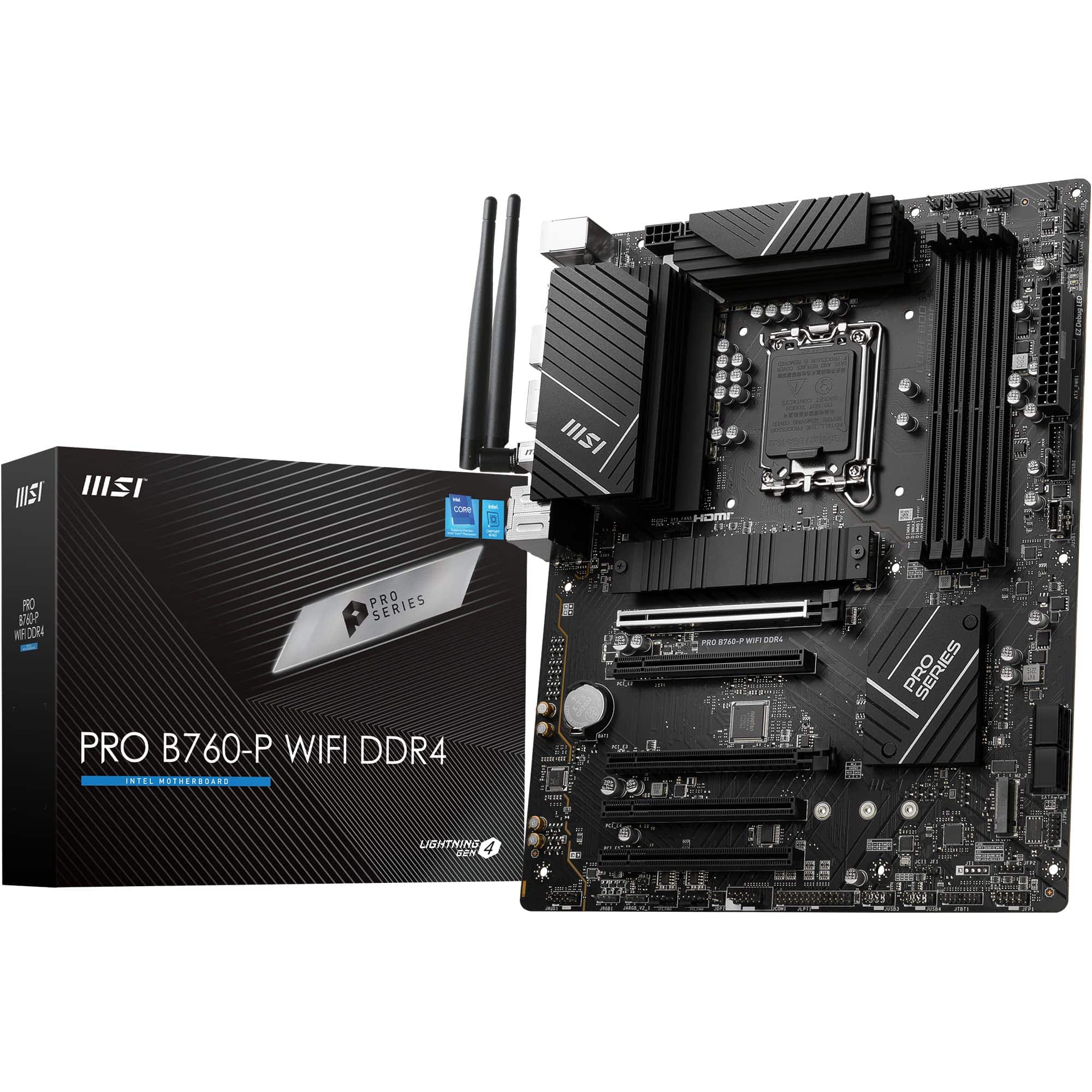 8.5 / 10
MSI PRO B760-P WIFI DDR4 Motherboard, ATX - Supports Intel 14th, 13th & 12th Gen Core Processors, LGA 1700 - DDR4 Memory Boost 5333+MHz/OC, PCIe 4.0 x16 Slots, M.2 Gen4 Slots, 2.5G LAN, Wi-Fi 6E
£129.95 · MSI
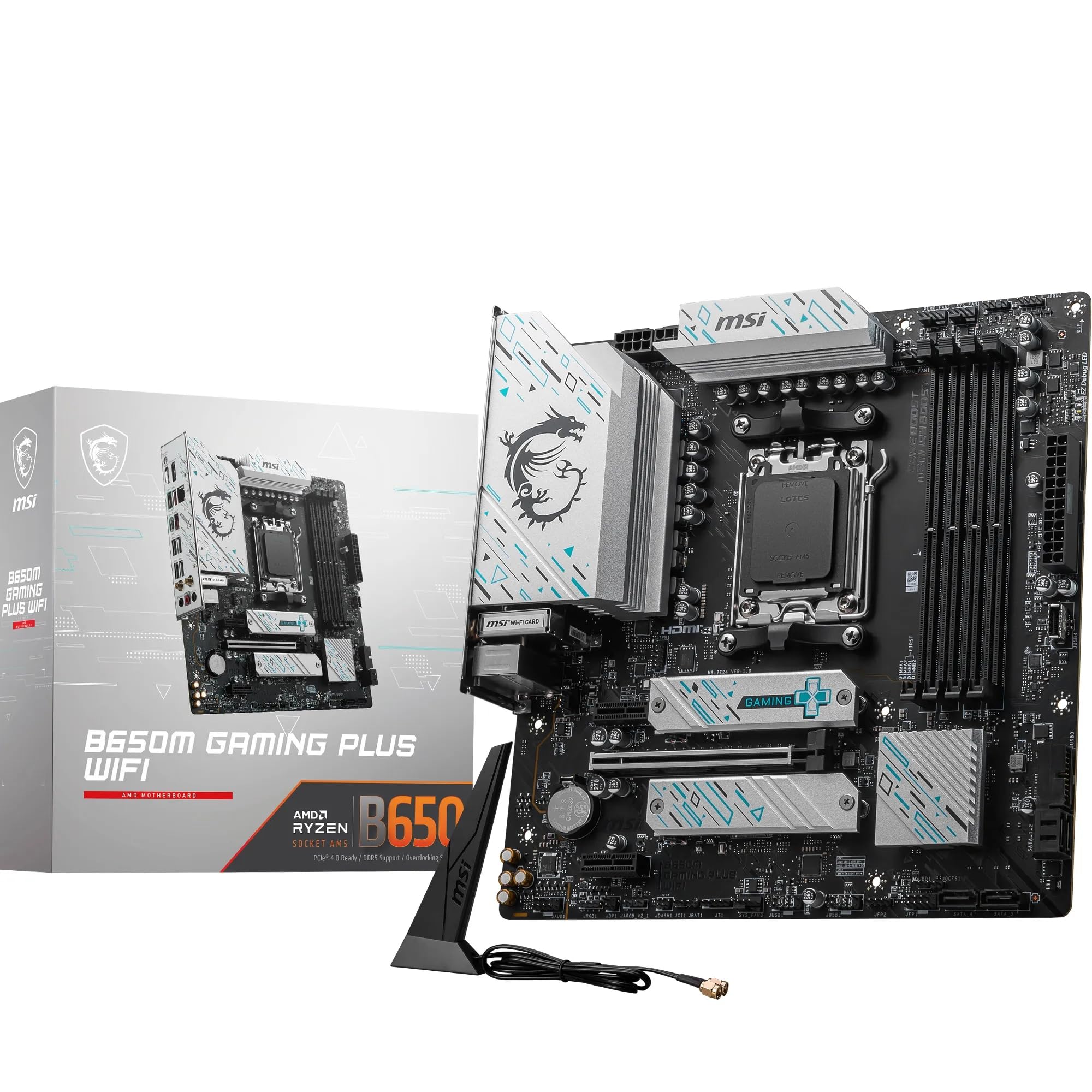 8.5 / 10
MSI B650M GAMING PLUS WIFI Motherboard, mATX - Supports AMD Ryzen 9000/8000 / 7000 Series Processors, AM5 - DDR5 Memory Boost 7800+ MHz/OC, PCIe 4.0 x16, M.2 Gen4, Wi-Fi 6E
£161.20 · MSI
Frequently asked
7 questions01Which AMD processors are compatible with the MSI MAG B650 TOMAHAWK WIFI?+
The board supports the full range of AM5 processors, including Ryzen 7000, Ryzen 8000, and Ryzen 9000 series chips. That covers everything from entry-level Ryzen 5 models up to the Ryzen 9 9950X. If you are pairing the board with a Ryzen 9000 series chip, check the box label to confirm the BIOS version is compatible, as older stock may need a BIOS update using a Ryzen 7000 chip first.
02Can the MSI MAG B650 TOMAHAWK WIFI handle a Ryzen 9 chip without throttling?+
Yes. The 14 Duet Rail power system with 80A power stages provides substantial current delivery headroom above what even the most power-hungry Ryzen 9 chips draw under sustained load. Owner reports from those running Ryzen 9 chips in video editing and rendering workloads consistently describe stable, throttle-free operation.
03Does the MSI MAG B650 TOMAHAWK WIFI support PCIe 5.0?+
No. The B650 chipset does not support PCIe 5.0 for either storage or GPU slots. All PCIe x16 and M.2 slots run at PCIe 4.0, which delivers up to 64Gbps per M.2 slot and 64GB/s on the primary GPU slot. PCIe 4.0 at x16 is not a bottleneck for any current consumer GPU, and PCIe 4.0 NVMe storage remains very fast for typical workloads.
04How many M.2 drives can I install in the MSI MAG B650 TOMAHAWK WIFI?+
Three M.2 drives simultaneously, all running at Gen4 x4 speeds up to 64Gbps each. The primary slot has a Shield Frozr heatsink to manage thermals during heavy sequential transfers. Bear in mind that populating all three M.2 slots may disable certain SATA ports, so check the manual before planning a build that mixes M.2 and SATA drives.
05Is Wi-Fi built into the MSI MAG B650 TOMAHAWK WIFI?+
Yes. The board includes a Wi-Fi 6E module covering the 2.4GHz, 5GHz, and 6GHz bands, along with Bluetooth 5.3. Antenna connectors on the rear I/O use standard SMA-type fittings, so you can replace the included antennas with aftermarket options if you need better range. Wired 2.5GbE LAN is also included.
06What DDR5 memory speeds does the MSI MAG B650 TOMAHAWK WIFI support?+
The board officially supports DDR5 at JEDEC standard speeds out of the box, with overclocking headroom beyond 6400MHz using compatible XMP or EXPO memory kits. AMD EXPO profiles are fully supported and should load automatically when enabled in the BIOS. Running four DIMMs at the highest speeds may require manual timing adjustments, particularly with high-density 32GB kits.
07How good is the BIOS on the MSI MAG B650 TOMAHAWK WIFI?+
MSI's Click BIOS 5 interface is considerably more usable than older MSI BIOS versions. Easy Mode covers the basics including EXPO memory profiles and fan curves without needing to navigate Advanced Mode. Advanced Mode gives full access to PBO configuration, memory subtimings, and voltage controls. The main criticism from owners is that the fan curve interface is not as intuitive as it could be, and some settings require explicit profile saving to persist after a reboot. Updating to the latest BIOS version before initial setup is strongly recommended.