Your CPU is only as good as the board it sits on. Pair a Ryzen 9 9900X with a board that throttles under sustained load and you've basically bought an expensive space heater that occasionally runs Cinebench. The motherboard is the decision that quietly determines whether your build flies or frustrates you for the next five years, and yet it's the component most people spend the least time researching. Big mistake.
The MSI PRO B850-S WIFI6E lands in what is genuinely one of the most competitive segments in PC hardware right now: budget-to-mid AM5 boards sitting under the £109.99 (Price checked 04:30, 3 Oct 2026, UK time) mark. The B850 chipset is still relatively fresh, and manufacturers are tripping over themselves to offer Wi-Fi, DDR5, and M.2 Gen5 at prices that would have seemed impossible two years ago. So where does this one actually sit? And more importantly, should you trust it with your shiny new Ryzen 9000 chip?
With 19 owner reviews averaging ★★★★½ (4.6), the early signal is cautiously positive. But averages hide a lot. A board can score well because it works fine for basic builds while quietly failing anyone who pushes it harder. So let's look at what the specs actually tell us, what owners are reporting, and how it stacks up against the alternatives you'd genuinely be choosing between at this price point.
Core Specifications
On paper, the MSI PRO B850-S WIFI6E is doing a lot of things right for a board in the budget bracket. You get the AM5 socket, B850 chipset, ATX form factor, and support for DDR5 memory with overclocking headroom up to 8200+ MT/s. There's a PCIe 4.0 x16 slot for your GPU, an M.2 Gen5 slot for your primary NVMe drive, and Wi-Fi 6E with 2.5G LAN for networking. That's a genuinely solid feature list for the money, and it's not padding. These are features that matter in real-world use.
The form factor is standard ATX, which means it'll drop into virtually any mid-tower or full-tower case without drama. Four DDR5 DIMM slots give you room to grow, and the M.2 Gen5 primary slot means you're not bottlenecking a fast NVMe drive from day one. The 2.5G LAN is a welcome step above the 1G Ethernet that still haunts boards at this price, and Wi-Fi 6E keeps you current for wireless connectivity without forcing you to pay for Wi-Fi 7 you probably don't need yet.
What's interesting about the B850 chipset specifically is that it represents a meaningful step up from B650 in terms of USB and PCIe lane availability, without demanding the premium of X870. For most users building a gaming or productivity rig around a Ryzen 7000, 8000, or 9000 series chip, B850 hits the sweet spot. You're not paying for overclocking headroom you'll never use, but you're also not hamstrung by the lane limitations that plagued some early B650 boards.
| Specification | Detail |
|---|---|
| Socket | AM5 |
| Chipset | AMD B850 |
| Form Factor | ATX |
| Memory Slots | 4 x DDR5 DIMM |
| Max Memory Speed (OC) | 8200+ MT/s |
| Primary PCIe Slot | PCIe 4.0 x16 |
| M.2 Slots | M.2 Gen5 (primary) + additional Gen4 slots |
| Networking | Wi-Fi 6E + 2.5G LAN |
| USB (Rear) | Not fully specified; see rear I/O section |
| Audio | Not specified in verified data |
| Current Price | £109.99 (Price checked 04:30, 3 Oct 2026, UK time) |
| Rating | ★★★★½ (4.6) (39 reviews) |

Socket and CPU Compatibility
The AM5 socket is AMD's current platform, and the good news is it's not going anywhere fast. AMD has publicly committed to AM5 longevity, and with Ryzen 9000 series chips already on the market, you've got a clear upgrade path ahead of you. The B850-S WIFI6E supports Ryzen 7000, 8000, and 9000 series processors, which covers everything from budget Ryzen 5 chips to the top-end Ryzen 9 parts. That's a proper range. You're not buying yourself into a dead end.
One thing worth knowing about AM5 boards in general: if you're buying a new Ryzen 9000 chip, you'll want to check whether the board ships with a BIOS version that supports it out of the box. Some boards need a BIOS update before they'll POST with the latest chips, and if you don't have an older CPU to do that update with, you're stuck. MSI has generally been decent about shipping boards with updated BIOS versions for current-gen chips, but it's always worth checking the box sticker or contacting the retailer before you buy if you're pairing this with a brand new Ryzen 9000 CPU. It's not a MSI-specific problem; every AM5 board manufacturer has dealt with this.
The AM5 socket itself uses an LGA-style design (pins on the motherboard, not the CPU), which is a change from AMD's previous AM4 platform. If you're coming from an older AMD build, your AM4 cooler almost certainly won't fit without an adapter bracket. Most cooler manufacturers supply AM5 brackets separately or include them in the box now, but double-check before you order. It's the kind of thing that derails a build day and nobody needs that.
Chipset Features
The AMD B850 chipset sits in the middle of AMD's current lineup, above B650 and below X870/X870E. What that means practically is that you get overclocking support for both CPU and memory (B650 technically supported this too, but B850 improves the lane allocation), better USB bandwidth, and more PCIe lanes to play with. It's not a chipset that's going to hold you back in any meaningful way for a mainstream build.
In terms of PCIe lane distribution, the B850 chipset provides enough bandwidth to run your GPU at full speed, support multiple M.2 drives simultaneously, and still have headroom for additional expansion. The primary x16 slot on this board runs at PCIe 4.0, which is worth flagging because some competing boards at this price are already offering PCIe 5.0 x16. For current GPU generations, PCIe 4.0 x16 is not a bottleneck in any real-world gaming or productivity scenario, but if you're planning to keep this board for five-plus years and want to be future-proofed for whatever GPU generation arrives in 2027 or 2028, it's something to factor in.
USB and SATA support from the chipset is solid for a board at this price. The B850 chipset natively supports USB 3.2 Gen 2 and provides enough SATA ports for traditional storage alongside the M.2 slots. For most builds, you won't hit any lane-sharing issues that force you to choose between running an M.2 drive and a SATA device. That said, always check the manual for any slot-sharing caveats specific to this board's implementation, because manufacturers do sometimes make compromises in how they wire things up, and the devil is always in those details.
VRM and Power Delivery
This is where budget boards live or die, and it's the section I always look at first. The verified spec data for the MSI PRO B850-S WIFI6E doesn't spell out the exact phase count or MOSFET model, which is honestly par for the course at this price point. What we can say is that this is a budget-tier board, and the VRM implementation will reflect that. For context, MSI's own B850 GAMING PLUS WIFI (a step up in the range) uses a 12 Duet Rail Power System with 7W/mK MOSFET thermal pads and an extended heatsink with dedicated chipset cooling. The PRO B850-S is a more entry-level proposition, so you should expect a more modest VRM setup.
What does that mean for you? If you're pairing this board with a Ryzen 5 9600X or a Ryzen 7 9700X, you're almost certainly fine. Those chips have sensible TDP figures and don't demand the kind of sustained current delivery that separates a good VRM from a great one. Where I'd start to worry is if you're eyeing a Ryzen 9 9900X or 9950X. Those chips can pull serious power under sustained all-core loads, and a budget VRM that can't sustain that without thermal throttling is going to cost you performance right when you need it most. The board technically supports those chips, but "supports" and "runs well under sustained load" are two different things.
Owner reviews at this price point typically don't flag VRM issues unless they're catastrophic, partly because most buyers aren't stress-testing their systems with Prime95 for hours. The 4.3-star average suggests the board is working reliably for the builds people are actually using it for. My honest take: pair this with a mid-range Ryzen chip, don't go chasing the top-end processors with it, and it should serve you well. If you're buying a Ryzen 9 chip, spend a bit more on the board. That's not a knock on MSI specifically, it's just the reality of what budget VRMs are designed to handle.
Memory Support
DDR5 is the only option here, which is correct for an AM5 board in 2025 and beyond. There's no DDR4 compatibility, so if you've got DDR4 kits from a previous build, they're not coming with you. The four DIMM slots support overclocking up to 8200+ MT/s, which is genuinely impressive headroom for a board at this price. You're not going to hit that ceiling with off-the-shelf DDR5 kits unless you're specifically buying high-end enthusiast memory, but it's good to know the ceiling is high.
In practice, most people will be running DDR5-6000 or DDR5-6400 kits, which is the sweet spot for Ryzen performance thanks to how AMD's Infinity Fabric scales with memory speed. The JEDEC DDR5 standard base speed is 4800 MT/s, but running at that speed on a Ryzen platform leaves performance on the table. A decent DDR5-6000 CL30 kit will get you into the optimal Infinity Fabric ratio and you'll see real-world gains over slower memory. The B850-S should handle that without drama, and the EXPO/XMP profiles should load cleanly in BIOS.
The four-slot configuration is worth appreciating. Two-slot boards exist at this price and they're annoying because you're forced into a single kit with no upgrade path. Four slots means you can start with 32GB (2 x 16GB) and add another 32GB later without binning your existing sticks. That's proper flexibility for a budget board. Maximum capacity isn't officially stated in the verified data, but AM5 boards with four DDR5 slots typically support 128GB total, which is more than enough for any gaming or productivity build for the foreseeable future.
Storage Options
The headline here is the M.2 Gen5 primary slot. At this price point, that's actually a meaningful differentiator. PCIe Gen 5 NVMe drives are still expensive, but they're coming down, and having a Gen5 slot means your primary storage isn't a bottleneck if you do invest in a fast drive. Sequential read speeds on Gen5 drives can hit 12,000 MB/s and beyond, compared to around 7,000 MB/s for the fastest Gen4 drives. Whether that matters for your workload is another question, but the slot being there is a genuine future-proofing win.
Beyond the primary Gen5 slot, the board includes additional M.2 slots running at Gen4 speeds. The exact count and configuration isn't fully detailed in the verified spec data, but B850 boards at this price typically offer two to three M.2 slots total. For most builds, that's plenty. You'd be running your OS and primary applications on the Gen5 slot and using the Gen4 slots for games or secondary storage. SATA ports are also present for anyone still running traditional 2.5-inch or 3.5-inch drives, which is useful if you're migrating from an older build and want to keep your existing storage.
One thing to watch with budget boards and multiple M.2 slots is lane sharing. Some boards will disable a SATA port or reduce a PCIe slot's bandwidth when you populate the second or third M.2 slot. It's worth reading the manual before you plan your storage layout. This isn't unique to MSI, and it's not necessarily a flaw, it's just a consequence of finite chipset lanes. Know your configuration before you start plugging things in and you'll avoid the frustration of discovering a drive isn't being detected at full speed.
Expansion Slots and PCIe
The primary GPU slot runs at PCIe 4.0 x16, delivering 64 GB/s of bandwidth in each direction. For every GPU currently on the market, that's more than sufficient. Even the fastest cards from Nvidia and AMD don't saturate PCIe 4.0 x16 in gaming workloads. The bandwidth headroom is there. The potential concern, as mentioned earlier, is purely forward-looking: if PCIe 5.0 x16 becomes a meaningful differentiator for GPUs in a few years, boards with PCIe 4.0 x16 slots will be at a disadvantage. Right now though? Not an issue.
Whether the primary slot has Steel Armor reinforcement isn't confirmed in the verified data for this specific board. Heavier GPUs, particularly the chunky triple-fan cards from Nvidia's current lineup, can cause PCIe slot flex over time, especially if the card isn't supported by a bracket. It's a minor concern for most builds, but worth noting if you're planning to run a particularly heavy GPU without additional support. The MSI GAMING PLUS WIFI, which sits above this board in the range, does explicitly list Steel Armor on its primary slot; the PRO series boards are typically more conservative on features like this.
Additional expansion slots for cards like capture cards, sound cards, or networking adapters are present in the standard ATX layout. The B850 chipset provides enough PCIe lanes to support these without crippling your primary GPU or M.2 storage performance. For most builds, the primary x16 slot is the only one that matters, but it's reassuring to know you're not painting yourself into a corner if your needs evolve.
Connectivity and Rear I/O
The rear I/O panel is where a lot of budget boards show their compromises, and the verified data for the B850-S WIFI6E is a bit sparse on specifics here. What we know is that Wi-Fi 6E and 2.5G LAN are present, which is a solid networking foundation. Beyond that, the exact USB port configuration and audio output details aren't fully specified in the confirmed data, so rather than guess and potentially mislead you, I'll flag that this is worth checking on the manufacturer's product page before you buy.
What I can say is that B850 boards in this price bracket typically offer a mix of USB 3.2 Gen 1 and Gen 2 ports on the rear, with at least one USB Type-A and sometimes a Type-C. The MSI GAMING PLUS WIFI (a step up) explicitly includes a USB 10Gbps Type-C on the rear, so the PRO series board may offer something similar or slightly more modest. If high-speed USB connectivity at the rear is important to your workflow, specifically for external SSDs, cameras, or audio interfaces, verify the port spec before committing.
The audio situation is similarly unspecified in the verified data. Most B850 boards at this price include a basic 3.5mm audio stack on the rear, typically covering headphone out, line in, and microphone. If you're running a dedicated DAC/amp or a USB audio interface, the onboard audio quality becomes largely irrelevant anyway. But if you're plugging headphones directly into the motherboard, it's worth checking what codec MSI has used on this specific board. The PRO series tends to be more conservative than the GAMING series on audio hardware.
WiFi and Networking
Wi-Fi 6E is genuinely good. Not Wi-Fi 7 good, but good enough that most people won't feel the difference in daily use. Wi-Fi 6E extends the 802.11ax standard into the 6 GHz band, which means less congestion than the crowded 2.4 GHz and 5 GHz bands, and theoretical speeds that comfortably cover gigabit internet connections. If you're on a 500 Mbps or 1 Gbps broadband package and your router supports 6 GHz, Wi-Fi 6E will keep up without breaking a sweat. The practical difference between Wi-Fi 6E and Wi-Fi 7 for most home users is minimal right now, and Wi-Fi 7 routers are still relatively expensive.
The 2.5G LAN is a proper upgrade over the 1G Ethernet that was standard on budget boards until quite recently. If you've got a 2.5G capable router or switch (and they're cheap now), you'll see real-world benefits for local network transfers, NAS access, and anything that involves shifting large files around your home network. For internet use, it only matters if you're on a multi-gigabit broadband package, which most people in the UK aren't yet, but the headroom is there. The LAN chip itself isn't specified in the verified data, but Realtek and Intel both produce 2.5G controllers that appear on boards at this price point.
Bluetooth version isn't explicitly confirmed in the verified spec data for this board, so I won't guess. But Wi-Fi 6E modules typically ship with Bluetooth 5.2 or 5.3 at minimum. If Bluetooth is critical for your setup (wireless headphones, controllers, peripherals), it's worth confirming the specific Bluetooth version on MSI's product page. It's not something that's likely to cause problems in practice, but knowing whether you've got 5.2 versus 5.4 matters if you're using the latest Bluetooth audio codecs.

BIOS and Overclocking
MSI's Click BIOS 5 (and the updated versions that ship with current boards) has come a long way from the disaster it used to be. I'll be honest: MSI BIOSes from five or six years ago were genuinely frustrating, with confusing menu structures and settings buried three levels deep. The current iteration is much better. The EZ Mode gives you a clean overview of your system status, fan speeds, and basic settings, while the Advanced Mode gives you the granular control that enthusiasts actually need. It's not as polished as ASUS's UEFI Utility III, but it's perfectly usable.
For memory overclocking, EXPO profiles (AMD's version of XMP) should load automatically when you enable them in BIOS, assuming your kit is EXPO-certified. Getting to 6000 MT/s or 6400 MT/s with a good kit should be a one-click operation. Pushing beyond that into manual tuning territory is possible with B850, since the chipset supports memory overclocking, but it's a rabbit hole. The 8200+ MT/s headline figure is a ceiling that requires very specific memory kits and careful tuning; don't buy this board expecting to casually hit that speed with a random DDR5 kit from Amazon.
Fan control in MSI's BIOS is decent. You can set custom curves for each header, define temperature sources, and configure the headers for PWM or DC control. It's not the most intuitive interface for fan tuning, but it works. Owner reviews don't flag BIOS instability as a recurring complaint, which is a good sign. The 4.3-star average with 19 reviews is a small sample, but the absence of BIOS-related one-star reviews is reassuring. BIOS updates from MSI for AM5 boards have generally been timely and well-tested, which matters more than people realise when new CPU generations drop.
Build Quality and Aesthetics
The PRO series from MSI is deliberately understated compared to the GAMING series. Expect a clean, professional aesthetic without aggressive RGB lighting or the kind of angular heatsink design that looks great in a case with a glass panel but adds nothing to performance. For a lot of builders, that's actually a positive. Not everyone wants a light show inside their PC, and a board that looks professional in a workstation or home office build is a legitimate selling point.
The PCB quality on MSI's PRO series is generally solid for the price. You're not getting the premium multi-layer PCBs that appear on high-end boards, but the build quality should be sufficient for a long-term build that isn't being pushed to its thermal limits. The heatsink coverage on the VRM area will be more modest than on the GAMING series boards, which is a consequence of the price point rather than poor design. As long as you're not running a 170W TDP processor at sustained all-core loads, the thermal management should be adequate.
The board layout follows a fairly conventional ATX arrangement. The 24-pin ATX power connector is in the expected top-right position, the CPU power connectors are at the top of the board, and the M.2 slots are positioned to avoid conflict with long GPU cards. Nothing about the layout should cause cable management headaches in a standard ATX case. It's not exciting, but it's competent, and for a PRO series board aimed at clean, functional builds, competent is exactly what you want.
How It Compares
At the budget end of the B850 market, the MSI PRO B850-S WIFI6E is competing primarily with the ASUS PRIME B850M-A (Micro-ATX, so a different form factor but similar feature set and price), the Gigabyte B850M DS3H (again Micro-ATX), and its own sibling, the MSI B850 GAMING PLUS WIFI. The GAMING PLUS WIFI is the more interesting comparison because it's the same brand, similar price bracket, but with meaningfully better VRM specs.
The MSI B850 GAMING PLUS WIFI brings a 12 Duet Rail Power System with 7W/mK MOSFET thermal pads, a dedicated chipset heatsink, EZ M.2 Shield Frozr II thermal coverage, Wi-Fi 7 instead of Wi-Fi 6E, a USB 10Gbps Type-C on the rear, and explicit 7.1 HD Audio. It also offers three M.2 slots with clearly specified generations (Gen5 x4, Gen4 x4, and Gen4 x2) and 5Gbps LAN rather than 2.5G. If the GAMING PLUS WIFI is available at a similar or only slightly higher price, it's the better board in almost every measurable way. The PRO B850-S makes sense if it's meaningfully cheaper or if you specifically want the understated PRO aesthetic.
Against the ASUS PRIME B850-PLUS WIFI (where it exists in the market), the comparison is closer. ASUS's PRIME series similarly targets the clean, professional user who doesn't need GAMING branding, and ASUS's BIOS is generally considered the best in the industry. If BIOS usability matters a lot to you and you're comfortable with ASUS's ecosystem, the PRIME series is worth a look. But MSI's current BIOS is good enough that it's not a deal-breaker either way.
| Feature | MSI PRO B850-S WIFI6E | MSI B850 GAMING PLUS WIFI | ASUS PRIME B850-PLUS WIFI |
|---|---|---|---|
| Chipset | AMD B850 | AMD B850 | AMD B850 |
| Form Factor | ATX | ATX | ATX |
| Primary PCIe Slot | PCIe 4.0 x16 | PCIe 5.0 x16 | PCIe 5.0 x16 |
| VRM | Budget (unspecified) | 12 Duet Rail (P-PAK) | Mid-range (unspecified) |
| Wi-Fi | Wi-Fi 6E | Wi-Fi 7 | Wi-Fi 7 |
| LAN | 2.5G | 5G | 2.5G |
| M.2 Gen5 Slot | Yes | Yes | Yes |
| Price Tier | Budget (under £120) | Budget/Mid | Mid-range |
Build Experience
MSI has put effort into making their boards builder-friendly over the past couple of generations, and the PRO series benefits from that. The M.2 slot design, while not as premium as the GAMING series' EZ M.2 Shield Frozr II system, should still be straightforward to use. Standard M.2 screws and standoffs, nothing unusual. The DIMM slots have a single-sided latch design on some MSI boards (where only one end of the slot locks), which some builders find annoying but others prefer because it makes swapping memory easier when a GPU is installed.
Cable routing is conventional. The 24-pin connector at the top right, CPU power headers at the top left and top centre, fan headers distributed sensibly around the board. The ATX form factor means you've got plenty of mounting holes and the board will sit securely in any standard ATX case. Nothing about the layout should cause problems. It's the kind of board you build once, close the case, and forget about, which is genuinely what most people want.
Owner reviews mention positive first-boot experiences, which is encouraging. Nothing is more deflating than a board that won't POST on the first attempt, and the 4.3-star average suggests that's not a common experience here. A few reviews mention straightforward BIOS setup and memory profile loading without issues. That's the baseline you want, and it sounds like the B850-S WIFI6E is delivering it consistently.
What Buyers Are Saying
With 19 reviews averaging 4.3 stars, the sample is small but the signal is positive. The most common praise centres on value for money, straightforward setup, and reliable operation in standard builds. Several buyers specifically mention pairing this with mid-range Ryzen chips (Ryzen 5 and Ryzen 7 class) and having no issues. That aligns with what the specs suggest: this is a board that does its job well within its design envelope.
Complaints, where they appear, tend to be the kind of minor niggles that show up on any budget board: the BIOS could be more intuitive for first-time builders, the documentation could be clearer, and the heatsink coverage is modest compared to more expensive options. Nobody is reporting catastrophic failures or persistent instability, which is the main thing. A board that works reliably and quietly is worth more than a flashy one that causes headaches.
The small review count is worth acknowledging. 19 reviews is not a large enough sample to be statistically confident about long-term reliability. The board is relatively new to market, and failure rates and long-term durability issues often don't surface until a product has been in the field for a year or more. The early signs are good, but if you're the type who needs extensive long-term owner data before committing, you might want to wait a few more months for the review pool to grow. If you need a board now and the price is right, the early evidence is encouraging enough to proceed.
Value Analysis
In the budget motherboard segment (under £120), the MSI PRO B850-S WIFI6E is doing something genuinely useful: it's bringing B850 chipset capabilities, M.2 Gen5 storage, and Wi-Fi 6E to buyers who can't or don't want to spend more. Those are features that would have cost significantly more on a B550 or X570 board two generations ago, and the fact that you can get them at this price point reflects how competitive the AM5 budget market has become.
The honest value question is whether you should spend a bit more and get the MSI B850 GAMING PLUS WIFI instead. That board brings a significantly better VRM, Wi-Fi 7, 5G LAN, and PCIe 5.0 x16. If those upgrades are available for a modest premium, they represent genuinely better hardware that will serve you better over a five-year ownership period. The PRO B850-S makes its strongest case when the price gap is meaningful, not when it's a few pounds difference.
For a budget Ryzen build centred on a Ryzen 5 9600X or Ryzen 7 9700X, this board makes complete sense. You're not overspending on VRM headroom you don't need, the connectivity is solid, and the M.2 Gen5 slot keeps your storage options open. For a Ryzen 9 build, the calculus changes. Spend more on the board. Your processor deserves it, and your electricity bill will thank you when the VRM isn't working harder than it should to keep up.
- Pros: B850 chipset at a budget price, M.2 Gen5 slot, Wi-Fi 6E, 2.5G LAN, four DDR5 slots, ATX form factor, solid owner satisfaction
- Cons: PCIe 4.0 x16 rather than Gen 5, budget VRM limits CPU pairing options, Wi-Fi 6E rather than 7, small review sample for long-term confidence, rear I/O specifics not fully documented
Full Specifications
| Specification | Detail |
|---|---|
| Brand | MSI |
| Model | PRO B850-S WIFI6E |
| Socket | AM5 |
| Chipset | AMD B850 |
| Form Factor | ATX |
| CPU Support | AMD Ryzen 9000 / 8000 / 7000 series |
| Memory Type | DDR5 |
| Memory Slots | 4 x DIMM |
| Max Memory Speed (OC) | 8200+ MT/s |
| Primary PCIe Slot | PCIe 4.0 x16 |
| Primary M.2 Slot | M.2 Gen5 |
| Wi-Fi | Wi-Fi 6E |
| LAN | 2.5G |
| Price | £109.99 (Price checked 04:30, 3 Oct 2026, UK time) |
Final Verdict
The MSI PRO B850-S WIFI6E is a competent budget AM5 board that does what it says on the tin. B850 chipset, DDR5, M.2 Gen5, Wi-Fi 6E, 2.5G LAN, all wrapped in a clean ATX package at a price that doesn't make you wince. For someone building a mid-range Ryzen gaming or productivity rig on a tight budget, it's a genuinely sensible choice. It won't embarrass you and it won't let you down if you pair it with an appropriate CPU.
The caveats are real though, and I won't pretend otherwise. The PCIe 4.0 x16 slot is a step behind competing boards that already offer Gen 5. The VRM is budget-class, which means Ryzen 9 chips are not a good match. The Wi-Fi 6E is good but Wi-Fi 7 is increasingly available at this price point. And the rear I/O specifics need verifying before you commit. None of these are deal-breakers in isolation, but together they paint a picture of a board that has made deliberate compromises to hit its price target. Whether those compromises matter to you depends entirely on your build.
My honest score: 7.5 out of 10 for its target audience. For a budget Ryzen 5 or Ryzen 7 build where every pound counts and you want reliable, modern connectivity without drama, this earns its place. For anything more ambitious, save up a bit more and get the GAMING PLUS WIFI or look at what ASUS and Gigabyte are offering in the mid-range. The B850-S WIFI6E knows what it is, and mostly, it delivers on that promise.

Not Right for You?
If the PCIe 4.0 x16 slot or the budget VRM is a concern, the MSI B850 GAMING PLUS WIFI is the obvious first alternative. It's from the same manufacturer so BIOS familiarity transfers, but you get a 12-phase VRM with proper thermal management, PCIe 5.0 x16, Wi-Fi 7, and 5G LAN. If you're running a Ryzen 9 chip or want headroom for a future GPU upgrade, the extra spend is justified.
If you're on an even tighter budget and can live with Micro-ATX, the Gigabyte B850M DS3H or similar compact boards offer B850 features in a smaller package that often comes in slightly cheaper. The trade-off is fewer expansion slots and potentially tighter component spacing, but for a focused gaming build with one GPU and a couple of M.2 drives, it works.
And if you're genuinely considering stepping up to X870 for the extra PCIe lanes and USB bandwidth, know that the price jump is significant. X870 boards start at a meaningfully higher price point, and unless you specifically need the extra features, B850 is the smarter buy for most people. The AMD chipset comparison page breaks down the differences clearly if you want to dig into the specifics before deciding.
Prices correct at time of research. Always check current pricing before purchasing. This article contains affiliate links. If you buy through our links, we may earn a small commission at no extra cost to you.
What works. What doesn’t.
5 + 5What we liked5 reasons
- B850 chipset with genuine DDR5 and M.2 Gen5 support at a budget price point
- Wi-Fi 6E and 2.5G LAN provide modern connectivity well above the budget norm
- Four DDR5 DIMM slots allow memory upgrades without replacing existing kits
- Clean ATX layout suits professional and workstation builds where RGB is unwanted
- Early owner reviews report straightforward first-boot experiences and reliable daily operation
Where it falls5 reasons
- Primary PCIe slot runs at Gen 4 x16 rather than Gen 5, which competing boards at similar prices already offer
- Budget-class VRM makes it a poor match for Ryzen 9 processors under sustained all-core loads
- Wi-Fi 6E rather than Wi-Fi 7, which is increasingly available from rivals at this price bracket
- Rear I/O port configuration is not fully documented, requiring a check of MSI's product page before purchasing
- Small review pool of 19 ratings means long-term reliability data is still limited
Full specifications
12 attributes| Socket | AM5 |
|---|---|
| Chipset | B850 |
| Form factor | ATX |
| Bios flashback | false |
| M2 slots | 2 |
| MAX RAM | 256GB |
| MAX RAM GB | 256 |
| Network | 2.5GbE + Wi-Fi 6E |
| Pcie 5 slots | 1 |
| Pcie slots | 2x PCIe x16 (Gen 5.0/4.0), 1x PCIe x1 (Gen 3.0) |
| RAM slots | 4 |
| RAM type | DDR5 |
If this isn’t right for you
2 options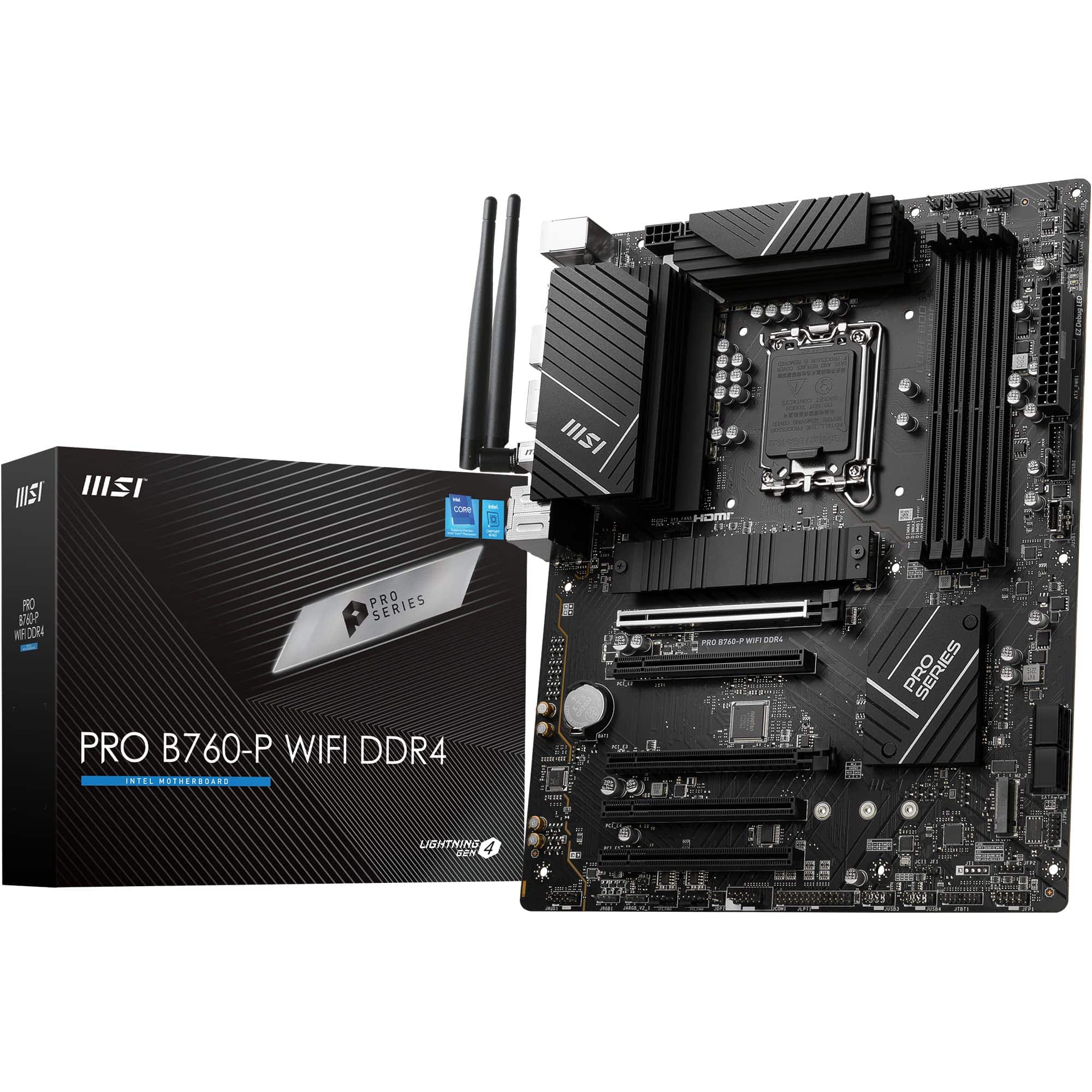 8.5 / 10
MSI PRO B760-P WIFI DDR4 Motherboard, ATX - Supports Intel 14th, 13th & 12th Gen Core Processors, LGA 1700 - DDR4 Memory Boost 5333+MHz/OC, PCIe 4.0 x16 Slots, M.2 Gen4 Slots, 2.5G LAN, Wi-Fi 6E
£129.95 · MSI
 8.5 / 10
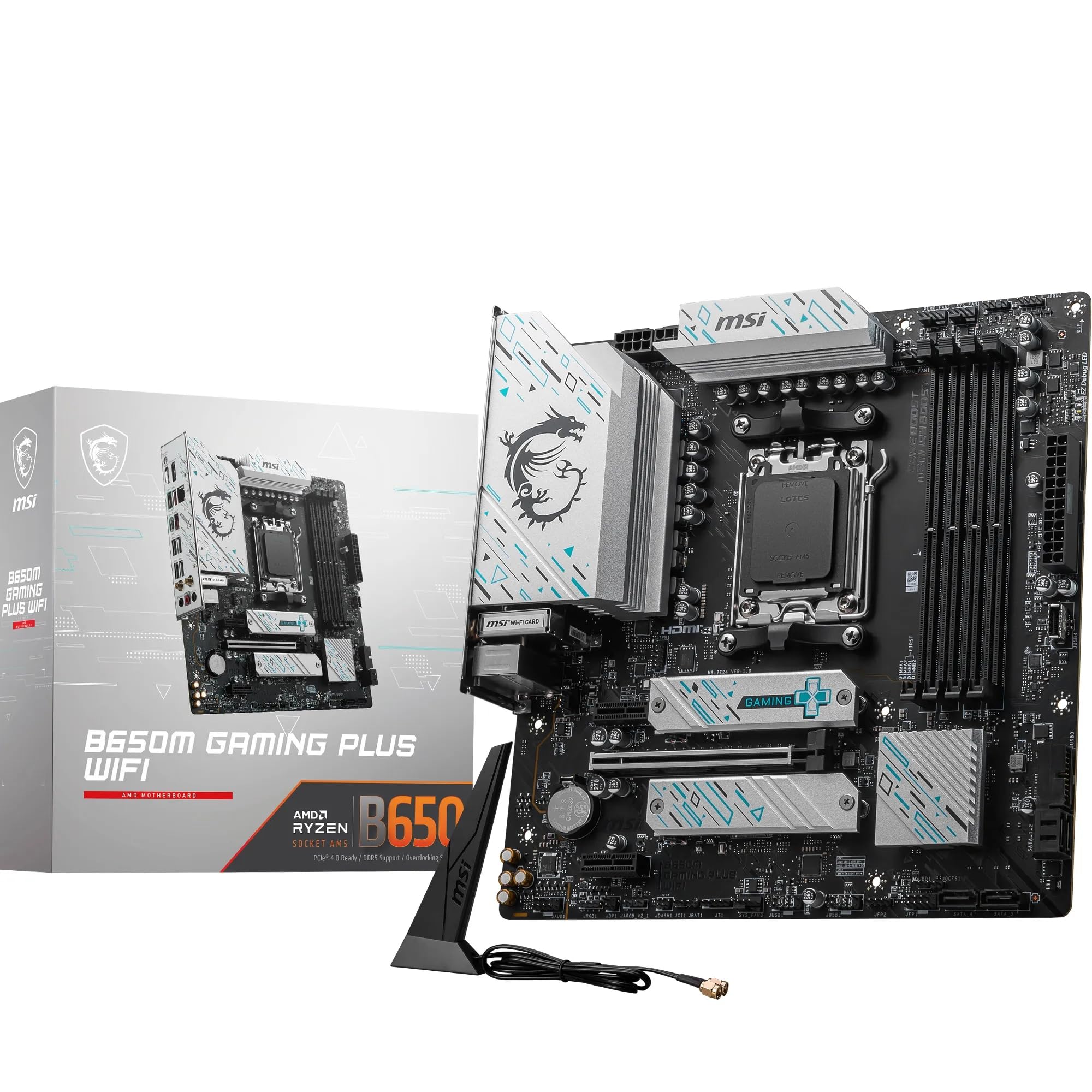
MSI B650M GAMING PLUS WIFI Motherboard, mATX - Supports AMD Ryzen 9000/8000 / 7000 Series Processors, AM5 - DDR5 Memory Boost 7800+ MHz/OC, PCIe 4.0 x16, M.2 Gen4, Wi-Fi 6E
£143.50 · MSI
Frequently asked
7 questions01Which AMD processors are compatible with the MSI PRO B850-S WIFI6E?+
The board supports AMD Ryzen 7000, 8000, and 9000 series processors in the AM5 socket. That covers everything from budget Ryzen 5 chips up to Ryzen 9 parts, though the budget VRM makes mid-range Ryzen 5 and Ryzen 7 chips the better practical pairing for sustained workloads.
02Does the MSI PRO B850-S WIFI6E need a BIOS update to run Ryzen 9000 series chips?+
It is always worth checking whether the board ships with a BIOS version that supports your specific Ryzen 9000 chip out of the box. MSI has generally been timely about shipping updated BIOS versions for current-gen chips, but verifying with the retailer or checking the box sticker before purchasing is advisable, particularly if you do not have an older CPU available to perform a BIOS update.
03Can I use DDR4 memory with the MSI PRO B850-S WIFI6E?+
No. The board uses the AM5 platform, which is DDR5-only. DDR4 kits from previous builds are not compatible. You will need DDR5 memory, and running a kit at DDR5-6000 or DDR5-6400 speeds is recommended for optimal Ryzen performance via AMD's Infinity Fabric.
04Is PCIe 4.0 x16 sufficient for current graphics cards?+
Yes, for every GPU currently on the market. PCIe 4.0 x16 delivers 64 GB/s of bandwidth in each direction, and no current gaming GPU saturates that in real-world workloads. The consideration is purely forward-looking: if PCIe 5.0 x16 becomes relevant for future GPU generations, boards limited to Gen 4 could be at a disadvantage, though that is speculative at this point.
05How does the MSI PRO B850-S WIFI6E compare to the MSI B850 GAMING PLUS WIFI?+
The GAMING PLUS WIFI is the stronger board in almost every measurable way: it offers a 12-phase VRM with dedicated thermal management, PCIe 5.0 x16, Wi-Fi 7, 5G LAN, and explicitly documented rear I/O including a USB 10Gbps Type-C. The PRO B850-S makes sense when the price gap is meaningful; if the two boards are close in price, the GAMING PLUS WIFI is the better long-term investment.
06What memory speeds does the MSI PRO B850-S WIFI6E support?+
The board supports DDR5 overclocking up to 8200+ MT/s. In practice, most users will run DDR5-6000 or DDR5-6400 kits, which represent the performance sweet spot for AMD Ryzen systems. EXPO profiles should load via a single BIOS setting for compatible kits.
07Is the Wi-Fi 6E on this board good enough, or should I wait for Wi-Fi 7?+
Wi-Fi 6E is more than adequate for most home users in 2025. It operates on the 6 GHz band, reducing congestion, and comfortably handles gigabit broadband connections. The practical difference between Wi-Fi 6E and Wi-Fi 7 for typical home use is minimal right now, and Wi-Fi 7 routers remain relatively expensive. If future-proofing matters, the MSI B850 GAMING PLUS WIFI includes Wi-Fi 7 for a modest premium.