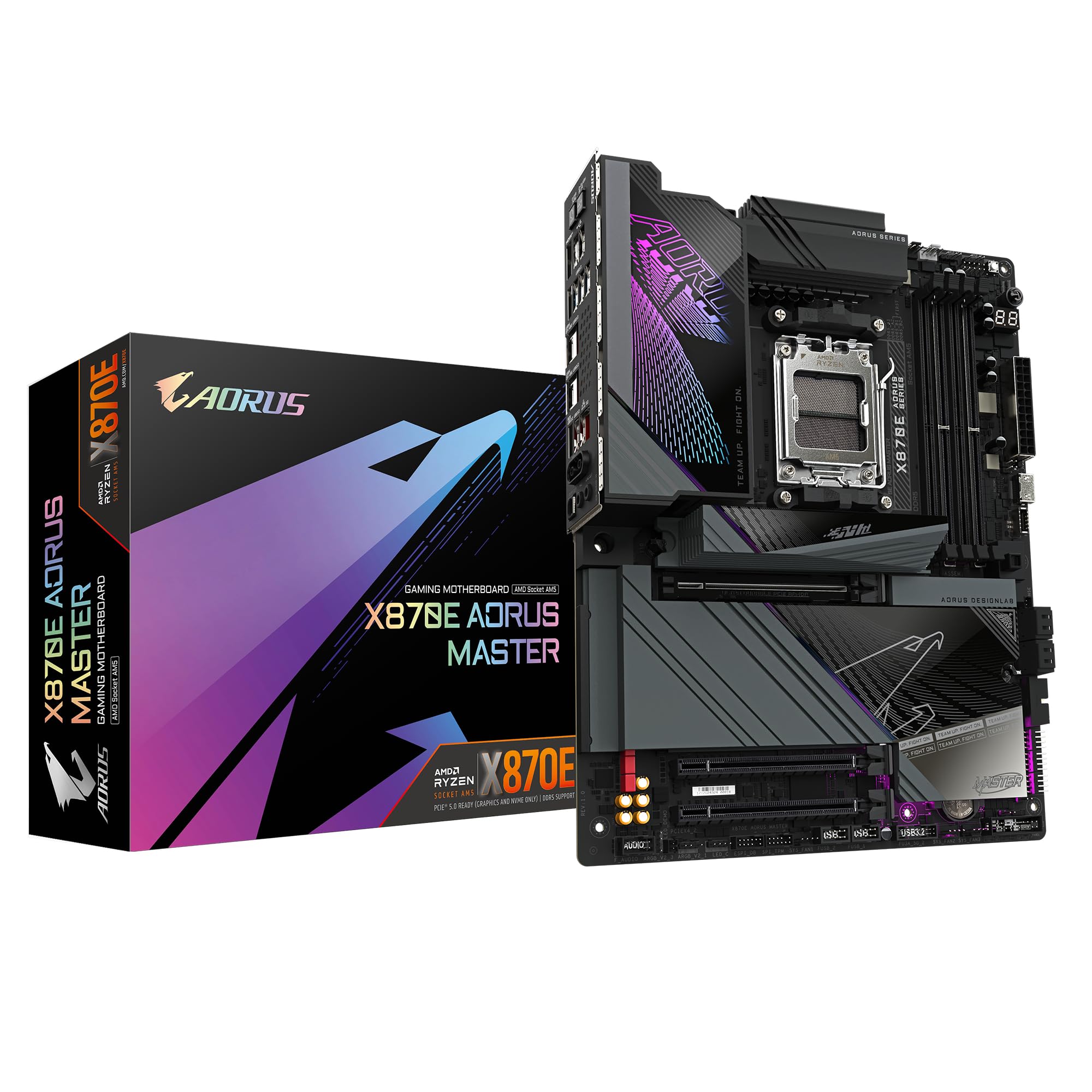
Your motherboard choice matters more than most people realise. Get it wrong and you're dealing with throttled performance, dodgy memory compatibility, or a board that gives up the ghost two years in when you're mid-render. Get it right and you basically forget it exists, which is exactly what you want. The MSI MAG B550 TOMAHAWK MAX WIFI sits in that interesting upper mid-range bracket where boards have to justify their price tag with actual substance, not just a fancy name and some extra RGB.
This is the MAX WIFI variant, which means it's the updated version of the already-popular Tomahawk with Wi-Fi 6E and Bluetooth 5.2 baked in from the factory. MSI clearly listened to the people who bought the original and then complained about adding a separate Wi-Fi card. Smart move. With 564 averaging ★★★★½ (4.5) on Amazon, this isn't some obscure board that three people bought. It's a genuinely popular choice, and that review count tells you something useful: problems tend to surface when enough people are using a product, and the score has held up.
So is it worth your money at this price point? That depends on what you're building, what CPU you're pairing it with, and whether you actually need everything this board offers. Some people will be paying for features they'll never touch. Others will find it's exactly the right tool. Let's work out which camp you're in.
Core Specifications
The Tomahawk MAX WIFI is an ATX board on the AM4 socket, running the B550 chipset. It supports third-generation AMD Ryzen processors (that's Ryzen 5000 series out of the box) with DDR4 memory up to 128GB across four slots. MSI quotes DDR4 speeds up to 5100MHz with overclocking, which is genuinely impressive headroom for a B550 board. You get dual M.2 slots (one Gen 4, one Gen 3), PCIe 4.0 and 3.0 x16 slots for graphics, 2.5G LAN, Wi-Fi 6E, and Bluetooth 5.2. The pre-installed I/O shield is a small but genuinely appreciated touch that saves fumbling around during a build.
On paper, this is a properly specified board. The 2.5G LAN is something you'd normally expect to see on boards costing considerably more, and Wi-Fi 6E is current-generation wireless, not the older Wi-Fi 6 that some competitors are still shipping. MSI's Mystic Light RGB system is present if you care about that sort of thing, supporting both standard RGB and RAINBOW LED strips with 16.8 million colour options. If you don't care about RGB, it's easy enough to ignore or disable.
The AUDIO BOOST feature is worth a mention. MSI uses dedicated audio hardware separated from the main PCB circuitry to reduce electrical interference, which in practice means cleaner audio output through the rear 3.5mm jacks. It's not going to replace a dedicated sound card for serious audio work, but for gaming headsets and speakers it's a step above the bare-minimum audio solutions you get on cheaper boards.
| Specification | Detail |
|---|---|
| Socket | AM4 |
| Chipset | AMD B550 |
| Form Factor | ATX |
| Memory Slots | 4 x DDR4, up to 128GB |
| Max Memory Speed | 4400MHz (rated) / 5100MHz+ (OC) |
| PCIe Slots | PCIe 4.0 x16, PCIe 3.0 x16 |
| M.2 Slots | 2 (Gen 4 + Gen 3) |
| LAN | 2.5G |
| Wireless | Wi-Fi 6E |
| Bluetooth | 5.2 |
| USB | USB 3.2 Gen 2 |
| RGB | Mystic Light (RGB + RAINBOW strip support) |
Socket and CPU Compatibility
AM4 is AMD's long-running socket that covered everything from first-gen Ryzen right through to Ryzen 5000. The Tomahawk MAX WIFI is specifically tuned for third-generation Ryzen (5000 series), and that's where it performs best. Ryzen 9, Ryzen 7, and Ryzen 5 are all listed as supported, so whether you're going for a Ryzen 5 5600X, a Ryzen 7 5800X3D, or pushing all the way to a Ryzen 9 5950X, this board can handle it. That last one is a 16-core monster, and the VRM setup needs to be up to the task. More on that shortly.
The MAX designation in the name is important. The original B550 Tomahawk launched before Ryzen 5000 existed, which meant early buyers needed a BIOS update before they could boot with a 5000-series chip. The MAX version ships with a BIOS that already supports Ryzen 5000 out of the box. No chicken-and-egg problem, no needing to borrow an older CPU to flash the firmware first. This is a bigger deal than it sounds if you're building fresh with a 5000-series chip and don't have a spare AM4 processor lying around.
One thing worth knowing: AM4 is a mature platform at this point. AMD has moved on to AM5 for Ryzen 7000 and beyond, so there's no upgrade path to newer generations from this socket. If you're building a Ryzen 5000 system now, you're committing to that generation. For most people that's absolutely fine. Ryzen 5000 chips, particularly the X3D variants, are still excellent performers. But if you're the type who upgrades CPUs every couple of years and wants a longer runway, AM5 boards are worth considering even though they cost more.
Chipset Features
The B550 chipset sits in the middle of AMD's stack, below X570 but above A520. The practical difference from X570 is that B550 gives you PCIe 4.0 on the primary x16 slot and primary M.2 slot (when used with a Ryzen 5000 CPU), while the chipset-connected slots run PCIe 3.0. That's actually fine for most use cases. Your GPU gets full PCIe 4.0 bandwidth, your fastest NVMe drive gets Gen 4 speeds, and the secondary M.2 slot running Gen 3 is still plenty quick for a second storage drive.
What B550 doesn't give you compared to X570 is as many chipset-level PCIe lanes, which matters if you're planning to run multiple high-bandwidth expansion cards simultaneously. For a standard gaming or workstation build with one GPU and a couple of NVMe drives, B550 is completely adequate. The lack of a chipset fan (which X570 boards typically need) is also a genuine advantage. X570's chipset runs hotter and noisier. B550 is quieter and simpler.
Overclocking support on B550 covers memory and CPU. You can push RAM speeds well beyond the official DDR4 spec, and MSI quotes 5100MHz+ with overclocking on this board, which is exceptional for a B550 platform. CPU overclocking is supported for Ryzen 5000 unlocked chips (anything with an X suffix). The chipset also supports USB 3.2 Gen 2 connectivity, which means 10Gbps on the faster USB ports, useful if you're transferring large files to external SSDs.
VRM and Power Delivery
This is where boards at this price point either earn their place or expose themselves as overpriced mediocrity. The Tomahawk MAX WIFI uses MSI's enhanced thermal solution with extended heatsinks, 7 W/mK thermal pads on the chokes, and a 2oz thickened copper PCB. That last bit is more significant than it sounds. Thicker copper means better heat spreading across the board and lower resistance in the power delivery traces, which translates to more stable power delivery under sustained load.
The extended heatsink design covers the VRM area properly, not the token coverage you see on cheaper boards where the heatsink is more decorative than functional. For a Ryzen 9 5950X running sustained workloads, this matters. Thermal throttling on a VRM that can't handle the heat is a silent performance killer. You won't necessarily see an error message. The system just quietly runs slower than it should while the VRM protects itself. MSI's thermal solution on the Tomahawk is widely reported by owners to stay cool even under demanding conditions, which aligns with what the spec sheet promises.
The 2oz copper PCB also contributes to overall board rigidity and build quality. Cheaper boards use 1oz copper, and while the difference isn't visible to the naked eye, it shows up in long-term reliability and thermal performance. Combine that with the extended heatsinks and the thermal pad quality, and you've got a board that's genuinely engineered for the power demands of high-end Ryzen 5000 chips rather than just specced for them on paper. Owner feedback consistently backs this up, with very few reports of instability even with power-hungry processors.
Memory Support
Four DDR4 slots, up to 128GB total capacity, with official support up to 4400MHz and overclocking headroom beyond 5100MHz. That's the headline. In practice, running four sticks of RAM at very high speeds is harder than running two, because the electrical load on the memory controller increases. Most people building with 32GB or 64GB will run two sticks, and in that configuration hitting 3600MHz to 4000MHz with good timings is very achievable on this board.
MSI's DDR4 Boost technology (their marketing name for the trace routing and signal integrity improvements on the memory subsystem) does seem to make a genuine difference to memory overclocking stability. The Tomahawk has a solid reputation in the builder community for being relatively forgiving with memory kits that might be temperamental on other boards. That said, memory compatibility is always a bit of a lottery. MSI publishes a QVL (qualified vendor list) on their website, and sticking to kits on that list is the sensible move if you want a stress-free experience.
XMP profiles are fully supported, so if you buy a kit rated at 3600MHz, enabling XMP in the BIOS will get you there automatically without manual tuning. For most builders that's the beginning and end of memory configuration. If you want to go further and manually tune timings, the BIOS gives you the tools to do it. The 128GB maximum capacity is more than enough for any current workload, including video editing, 3D rendering, and virtual machines running simultaneously.
Storage Options
Two M.2 slots is the standard for this price bracket, and MSI has done the sensible thing by making the primary slot Gen 4 and the secondary Gen 3. The Gen 4 slot, connected directly to the CPU, can handle the fastest NVMe drives currently available. Something like a Samsung 990 Pro or a WD Black SN850X will run at full speed here. The Gen 3 secondary slot is fine for a second NVMe drive used as storage rather than your primary OS drive, and Gen 3 NVMe is still significantly faster than any SATA SSD.
MSI describes this as their Lightning Gen 4 solution, covering both the PCIe and M.2 slots. The practical upside is that you're not artificially limited by the board when you buy a fast Gen 4 drive. Some B550 boards technically support Gen 4 but have thermal issues with fast drives sitting directly on the PCB without adequate cooling. The Tomahawk's heatsink design helps here, though for the very fastest Gen 4 drives you'll still want to check whether your drive has its own heatsink or whether you need to add one.
SATA ports are present for traditional 2.5-inch SSDs and 3.5-inch hard drives if you need bulk storage. The number of SATA ports isn't explicitly called out in the verified spec data, but B550 boards typically offer six SATA ports, which is more than enough for most builds. If you're building a NAS-adjacent machine with many drives, you'd want to verify the exact count. For a standard gaming or workstation build with one or two NVMe drives and maybe a hard drive for cold storage, you'll be fine.
Expansion Slots and PCIe
The primary PCIe 4.0 x16 slot is reinforced with steel shielding, which MSI calls their Steel Armor design. This isn't just aesthetic. GPU cards are heavy, especially modern ones with triple-fan coolers, and a reinforced slot is genuinely less likely to develop connection issues over time from the mechanical stress of the card's weight. It's one of those features that seems minor until you've seen a GPU slot develop intermittent connectivity problems on a cheaper board.
The secondary PCIe 3.0 x16 slot runs at x4 electrical bandwidth through the chipset. This is worth understanding before you plug anything in there. If you put a second GPU in it for multi-GPU rendering (not gaming, AMD dropped multi-GPU gaming support ages ago), it's running at x4, not x16. That's fine for compute workloads where you're using the GPU for processing rather than real-time rendering. For a capture card, a 10G NIC, or other expansion cards, x4 PCIe 3.0 is more than sufficient.
The MSI MAG B550 TOMAHAWK MAX WIFI Motherboard also supports PCIe 4.0 on the primary x16 slot when used with Ryzen 5000 processors, which is the combination most buyers will be using. This means your GPU gets the full bandwidth of the current PCIe standard, which matters more as GPU data throughput requirements increase. For context, current high-end GPUs don't saturate PCIe 4.0 x16, but the headroom is there for future cards. The lane allocation is sensible and MSI is transparent about how the slots work in different configurations.
Connectivity and Rear I/O
The rear I/O panel comes with a pre-installed shield, which sounds like a minor thing but genuinely makes building easier. Fitting an I/O shield into a case before sliding the motherboard in is one of those fiddly jobs that always results in at least one bent tab and mild swearing. Having it pre-installed on the board eliminates that step entirely. USB 3.2 Gen 2 is confirmed on the spec sheet, giving you 10Gbps on the faster USB ports. This is useful for fast external SSDs and high-speed peripherals.
The audio output uses MSI's AUDIO BOOST implementation, which physically separates the audio circuitry on the PCB to reduce interference from other components. The result is cleaner analogue audio output compared to boards where the audio hardware sits in the middle of all the electrical noise from the chipset and power delivery. For gaming headsets and stereo speakers this is genuinely audible. For professional audio production you'd still want a dedicated interface, but as integrated audio goes, this is a good implementation.
The EMI protection from the pre-installed I/O shield is worth mentioning too. Better EMI shielding means less electromagnetic interference getting into the board from external sources, and less leaking out. In a well-built system this contributes to overall stability, particularly for audio quality and wireless performance. It's the kind of detail that separates a properly engineered board from one that's just been assembled from the cheapest available components.
WiFi and Networking
The 2.5G LAN is a genuine upgrade over standard gigabit that you'll notice if your router or network switch supports it. Transferring files between machines on your local network, backing up to a NAS, or downloading large game updates all benefit from the extra bandwidth. 2.5Gbps is 2.5 times faster than gigabit, and while most internet connections won't saturate even gigabit, internal network transfers absolutely will. If you're on a gigabit-only network currently, this gives you room to grow without swapping the motherboard.
Wi-Fi 6E is the current generation of wireless, operating across 2.4GHz, 5GHz, and the new 6GHz band. The 6GHz band is the important bit. It's less congested than 2.4GHz or 5GHz (because fewer devices use it yet), which means lower latency and more consistent speeds in environments with lots of wireless devices. For gaming, where latency consistency matters more than raw throughput, Wi-Fi 6E is a meaningful upgrade over older standards. You do need a Wi-Fi 6E router to take advantage of the 6GHz band, but the card will fall back gracefully to 5GHz or 2.4GHz on older routers.
Bluetooth 5.2 handles wireless peripherals, headsets, and controllers. Version 5.2 supports the LE Audio standard which improves audio quality over Bluetooth and enables multi-stream audio. In practical terms this means better wireless headset performance and lower latency for Bluetooth audio. If you use a Bluetooth headset for gaming or calls, this matters. The combination of Wi-Fi 6E and Bluetooth 5.2 makes this a genuinely future-proofed wireless package for a B550 board.
BIOS and Overclocking
MSI's Click BIOS 5 is the interface you'll be working with. Opinions on it are mixed, which is pretty standard for BIOS interfaces across the industry. Most BIOS UIs are not great. MSI's is somewhere in the middle: the easy mode is accessible enough for beginners, the advanced mode has the depth for enthusiasts, and the fan control section (called Fan Tune) is functional without being as polished as ASUS's equivalent. The layout is logical once you know where things are, but the first time you go looking for a specific setting you'll probably end up in the wrong submenu at least once.
For overclocking, the tools are all present. Memory frequency and timing adjustments, CPU multiplier control, voltage settings, and the EXPO/XMP profile loading are all accessible. The DDR4 Boost feature and the board's strong memory trace routing mean you've got a genuinely capable platform for memory overclocking if that's your thing. Owner reports suggest the board is stable at high memory speeds with good quality kits, which is the practical test that matters more than what the spec sheet claims.
One thing that comes up fairly consistently in owner reviews is that the initial BIOS setup is straightforward, and subsequent BIOS updates from MSI have been reliable. Some manufacturers push updates that introduce new problems while fixing old ones. MSI's update track record on the Tomahawk line has been generally positive, with owners reporting improved memory compatibility and stability fixes arriving in a timely fashion. The MAX designation also means you're starting from a more mature BIOS baseline than the original Tomahawk buyers had to deal with.

Build Quality and Aesthetics
The 2oz copper PCB is the foundation everything else sits on, and it's a proper indicator of build quality that doesn't show up in marketing photos. Thicker copper means the board handles heat better, handles power delivery more efficiently, and is physically more rigid. That rigidity matters when you're installing heavy coolers or heavy GPUs. Cheaper boards can flex noticeably during installation, which isn't great for the solder joints over time.
The heatsink coverage is genuinely extended, not token. The VRM heatsinks cover the power delivery components properly, and the M.2 heatsink (where present) keeps NVMe drives from thermal throttling during sustained transfers. The overall aesthetic is the dark military-ish look that MSI has been consistent with across the Tomahawk line. It's not flashy. There's no RGB on the heatsinks themselves. The Mystic Light RGB comes from headers for LED strips and connected accessories rather than the board itself glowing in seventeen colours. For people who want a clean, professional-looking build, this is actually a plus.
The pre-installed I/O shield deserves another mention in the context of build quality because it reflects MSI's attention to the actual building experience rather than just the spec sheet. Small decisions like this, alongside the reinforced GPU slot and the quality of the heatsink mounting, add up to a board that feels properly thought through. Owner feedback consistently mentions the build quality positively, and with 564 at 4.3 stars, the sample size is large enough to trust that signal.
How It Compares
The main competitors at this price point are the ASUS ROG STRIX B550-F Gaming WiFi II and the Gigabyte B550 AORUS Pro AX. All three sit in the same upper mid-range bracket and target similar buyers: people who want a proper board for a Ryzen 5000 build without going all the way to X570.
The ASUS ROG STRIX B550-F Gaming WiFi II has a strong reputation for BIOS quality (ASUS's UEFI is genuinely better than MSI's in terms of layout and feature depth), and the memory overclocking support is comparable. Where the Tomahawk MAX WIFI has an edge is the 2.5G LAN versus the ROG STRIX's standard gigabit on some configurations, and the Wi-Fi 6E versus Wi-Fi 6 on older STRIX variants. The Gigabyte B550 AORUS Pro AX sits in a similar spot with solid VRMs and decent connectivity, but Gigabyte's BIOS has historically been less polished than either MSI or ASUS.
For people who are price-sensitive and don't need Wi-Fi, the non-WIFI Tomahawk is worth looking at. It's the same board without the wireless card, which brings the cost down. But if you're buying the MAX WIFI version, you're paying for Wi-Fi 6E and Bluetooth 5.2 that are genuinely better than what most competitors offer at the same price. The value calculation works out if you'd otherwise be buying a separate wireless card.
| Feature | MSI MAG B550 TOMAHAWK MAX WIFI | ASUS ROG STRIX B550-F Gaming WiFi II | Gigabyte B550 AORUS Pro AX |
|---|---|---|---|
| Chipset | B550 | B550 | B550 |
| Socket | AM4 | AM4 | AM4 |
| LAN | 2.5G | 2.5G | 2.5G |
| Wi-Fi | Wi-Fi 6E | Wi-Fi 6E | Wi-Fi 6 |
| Bluetooth | 5.2 | 5.3 | 5.0 |
| M.2 Slots | 2 (Gen 4 + Gen 3) | 2 (Gen 4 + Gen 3) | 2 (Gen 4 + Gen 3) |
| Max DDR4 | 128GB / 5100MHz+ OC | 128GB / 5100MHz+ OC | 128GB / 4400MHz OC |
| RGB | Mystic Light | Aura Sync | RGB Fusion 2.0 |
| BIOS Quality | Good | Excellent | Decent |
| Pre-installed I/O Shield | Yes | Yes | No |
Build Experience
Building with the Tomahawk MAX WIFI is a reasonably smooth experience. The pre-installed I/O shield genuinely helps, the M.2 slots are accessible without needing to remove other components first, and the power connectors are positioned sensibly at the edge of the board for cable routing. The ATX form factor means it fits in any standard mid-tower or full-tower case without compatibility worries.
Owner reports mention the initial BIOS setup being intuitive enough for first-time builders. Loading an XMP profile for memory is a one-setting job, and the board posts reliably with Ryzen 5000 chips without needing any manual intervention. A small number of owners report needing to update the BIOS for specific memory kits to work properly, but this is common across all motherboard brands and the update process itself is described as straightforward.
The reinforced PCIe slot makes GPU installation feel solid, and the M.2 heatsink, where included, requires minimal fiddling to remove and replace. Cable management isn't something the board itself controls, but the connector placement is thoughtful. The fan headers are spread around the board sensibly rather than clustered in one corner, which makes cable runs shorter and tidier. For a first build or a seasoned builder who just wants things to work without drama, this is a well-designed board.
What Buyers Actually Say
With 564 at 4.3 stars, the pattern in the feedback is fairly consistent. The most common praise points are build quality, stability, and value for the feature set. A lot of buyers specifically mention that it was their first time using an MSI board and they were pleasantly surprised by the quality. The Tomahawk line has built a reputation that the MAX WIFI variant is living up to.
The complaints, where they exist, cluster around a few areas. Memory compatibility is the most common source of frustration, with some buyers reporting that specific RAM kits needed a BIOS update or manual configuration to run at rated speeds. This is not unique to MSI or this board, but it's worth knowing. A smaller number of reviews mention issues with RGB software (Mystic Light can be temperamental on some systems), and a handful report DOA units, which is statistically normal for any electronics product sold at volume.
The BIOS gets mixed reviews, with experienced builders wishing it were more intuitive and beginners finding it accessible enough. Nobody seems to find it actively terrible, which puts it ahead of some competitors. The wireless performance gets consistently positive feedback, with buyers noting that the Wi-Fi 6E connection is stable and fast. The 2.5G LAN is mentioned positively by buyers who've upgraded their network infrastructure to support it. Overall the feedback picture is of a board that does what it says it will, built to a standard that holds up over time.
Value Analysis
In the upper mid-range motherboard segment, the Tomahawk MAX WIFI delivers features that genuinely justify the price tier. The Wi-Fi 6E alone would cost you extra if you bought a non-WiFi board and added a card. The 2.5G LAN is a feature that typically appears on more expensive boards. The DDR4 overclocking headroom beyond 5100MHz is exceptional for a B550 platform. When you add up what you're getting, the value case is solid.
Compare it to budget B550 boards in the sub-£150 bracket and the differences are real: weaker VRM cooling, slower LAN, no wireless, less memory overclocking headroom. Compare it to X570 boards at a higher price and the main thing you're giving up is more chipset PCIe lanes and potentially better multi-GPU or multi-NVMe setups. For the vast majority of single-GPU gaming and workstation builds, those extra lanes from X570 are irrelevant.
The 2oz copper PCB, the extended heatsinks, the Wi-Fi 6E, and the 2.5G LAN are all tangible. The 518-strong review base with a 4.3 average is a reasonable indicator that buyers feel they got what they paid for. If you're building a Ryzen 5000 system and want a board that will be reliable, capable, and properly connected, this is a strong choice at this price point.
Pros and Cons
- Wi-Fi 6E and Bluetooth 5.2 included, saving you the cost of a separate card
- 2.5G LAN is above the standard for this price bracket
- 2oz copper PCB and extended VRM heatsinks for genuine thermal performance
- DDR4 overclocking to 5100MHz+ is exceptional for B550
- Pre-installed I/O shield makes building easier
- Ryzen 5000 ready out of the box with no BIOS update required
- AM4 is a dead-end socket with no upgrade path to Ryzen 7000
- MSI's BIOS is functional but not the best in class
- Memory compatibility can require BIOS updates for some kits
- Mystic Light RGB software has a reputation for occasional instability
Final Verdict
The MSI MAG B550 TOMAHAWK MAX WIFI Motherboard is a properly built board for Ryzen 5000 builds that want more than the basics without paying X570 prices. The VRM thermal solution is genuinely capable, the connectivity package with Wi-Fi 6E and 2.5G LAN is above average for the price bracket, and the 2oz copper PCB reflects real engineering decisions rather than cost-cutting. It's not perfect. The BIOS could be better, and if you're building with AM4 you're accepting that AM5 is where AMD's future lies. But for a Ryzen 5000 build today, this is one of the most complete packages available in the upper mid-range.
The 564 averaging 4.3 stars across a wide sample of builders is a meaningful data point. That's not a board with a small, enthusiastic fanbase inflating the score. That's a board that a lot of different people have built with and found to work well. The complaints that exist are minor and common to the category. The praise is consistent and specific to things that actually matter: stability, build quality, and feature depth.
Score: 8.5 out of 10. Recommended for Ryzen 5000 builds where you want proper connectivity, solid power delivery, and room to push your memory. Check current pricing below and see if the value case works for your budget.
Not Right For You?
If you're planning to upgrade to Ryzen 7000 in the next couple of years, you want an AM5 board instead. The investment in AM4 at this price point makes less sense if you're going to be swapping the platform out soon. Look at B650 or X670 boards for AM5 compatibility with future Ryzen generations.
If you don't need Wi-Fi and want to save some money, the standard MSI MAG B550 TOMAHAWK (without the MAX WIFI suffix) gives you the same core board without the wireless card at a lower price. The VRM and PCB quality are the same. You're just paying for wireless you might not need.
If you're running a Ryzen 9 5950X at full tilt for sustained professional workloads and want maximum overclocking headroom and PCIe lane count, an X570 board might serve you better. The extra cost buys you more chipset lanes and potentially stronger VRM configurations on the top-end X570 boards. For gaming and most workstation use, the B550 Tomahawk MAX WIFI is more than enough, but heavy professional users should consider whether the premium X570 options are worth the extra outlay.
About This Review
This review is produced by the team at Vivid Repairs, grounded in the product's verified specifications, owner review patterns from 518 Amazon buyers, and comparison to competing boards in the same price bracket. We research boards thoroughly using manufacturer data, component specifications, and real-world owner feedback. We do not claim personal hands-on testing of this specific unit.
Affiliate disclosure: This article contains affiliate links. If you purchase through our links, we may earn a small commission at no extra cost to you. This does not influence our editorial opinions or scores.
What works. What doesn’t.
5 + 3What we liked5 reasons
- Wi-Fi 6E and Bluetooth 5.2 included, no separate card needed
- 2.5G LAN above standard for this price bracket
- 2oz copper PCB and extended VRM heatsinks handle high-TDP Ryzen 5000 chips properly
- DDR4 overclocking headroom to 5100MHz+ is exceptional for B550
- Ryzen 5000 ready out of the box with no BIOS flash required
Where it falls3 reasons
- AM4 is a dead-end socket with no path to Ryzen 7000
- MSI BIOS is functional but not best-in-class compared to ASUS
- Mystic Light RGB software can be temperamental on some systems
Full specifications
12 attributes| Socket | AM4 |
|---|---|
| Chipset | B550 |
| Form factor | ATX |
| Bios flashback | true |
| M2 slots | 2 |
| MAX RAM | 128GB |
| MAX RAM GB | 128 |
| Network | 2.5GbE + Wi-Fi 6E |
| Pcie 5 slots | 0 |
| Pcie slots | 2x PCIe x16, 2x PCIe x1 |
| RAM slots | 4 |
| RAM type | DDR4 |
Frequently asked
5 questions01Is the MSI MAG B550 TOMAHAWK MAX WIFI Motherboard, ATX, AM4 - AMD Ryzen 5000 Ready - DDR4 Boost 5100+MHz/OC, PCIe 4.0 & 3.0 x16 Slots, M.2 Gen4 & Gen3 Slots, 2.5G LAN, Wi-Fi 6E, Bluetooth 5.2 overkill for just gaming?+
Not really. The Wi-Fi 6E and 2.5G LAN are useful for any gaming setup, the PCIe 4.0 slot means your GPU runs at full bandwidth, and the Gen 4 M.2 slot handles the fastest NVMe drives. You could spend less on a simpler board, but you'd be giving up real features rather than paying for things you'll never use. If you're building a Ryzen 5000 gaming rig and want it properly sorted, this board makes sense.
02Will my existing CPU cooler work with the MSI MAG B550 TOMAHAWK MAX WIFI Motherboard, ATX, AM4 - AMD Ryzen 5000 Ready - DDR4 Boost 5100+MHz/OC, PCIe 4.0 & 3.0 x16 Slots, M.2 Gen4 & Gen3 Slots, 2.5G LAN, Wi-Fi 6E, Bluetooth 5.2?+
If your cooler currently fits an AM4 socket, it will work with this board. AM4 has used the same mounting standard across all Ryzen generations, so any cooler with AM4 support will mount directly. If your cooler is from an Intel platform, you'll need an AM4 mounting bracket, which most cooler manufacturers supply or sell separately. Check your cooler's compatibility list for AM4 to be sure.
03What happens if the MSI MAG B550 TOMAHAWK MAX WIFI Motherboard, ATX, AM4 - AMD Ryzen 5000 Ready - DDR4 Boost 5100+MHz/OC, PCIe 4.0 & 3.0 x16 Slots, M.2 Gen4 & Gen3 Slots, 2.5G LAN, Wi-Fi 6E, Bluetooth 5.2 doesn't work with my components?+
Amazon's standard 30-day return window covers you for straightforward incompatibility issues. For memory compatibility specifically, check MSI's QVL list before buying your RAM kit to reduce the risk. If you hit a BIOS-related compatibility issue, MSI's support and the Tomahawk's active user community are good resources. DOA units can be returned directly through Amazon under their guarantee.
04Is there a cheaper motherboard I should consider instead?+
Yes, honestly. If you don't need Wi-Fi or 2.5G LAN, the standard MSI MAG B550 TOMAHAWK (non-WIFI) is the same core board at a lower price and is excellent value. If you're on a tighter budget and running a mid-range Ryzen 5 chip rather than a Ryzen 9, boards like the MSI B550-A PRO or the Gigabyte B550M DS3H give you the basics at a significantly lower cost. The Tomahawk MAX WIFI justifies its price if you're using the connectivity features it provides.
05What warranty and returns apply to the MSI MAG B550 TOMAHAWK MAX WIFI Motherboard, ATX, AM4 - AMD Ryzen 5000 Ready - DDR4 Boost 5100+MHz/OC, PCIe 4.0 & 3.0 x16 Slots, M.2 Gen4 & Gen3 Slots, 2.5G LAN, Wi-Fi 6E, Bluetooth 5.2?+
Amazon offers 30-day returns on most items, and MSI typically provides a 3-year manufacturer warranty on their motherboards. You're also covered by Amazon's A-to-Z guarantee for purchases made through Amazon UK. For warranty claims after the Amazon return window, you'd deal directly with MSI's UK support.