The VRM is the one component on a motherboard that separates a board that merely boots from one that actually sustains CPU performance under real workloads. Get the power delivery wrong and your i7-13700K or i9-14900K will throttle back mid-render, mid-game, mid-compile, wherever it hurts most. So before anything else about the MSI B760 GAMING PLUS WIFI DDR4 matters, the VRM question has to be answered. And at the budget end of the Intel LGA 1700 market, where corners get cut in predictable ways, that question is not trivial.
Here is the short version: this board is a genuinely well-specified option in the budget bracket, particularly if you are sticking with DDR4 and want Wi-Fi 6E without paying mid-range money. The 218 owner reviews averaging ★★★★☆ (4.4) tell a story of a board that works reliably out of the box, plays nicely with MSI's Click BIOS 5, and does not cause the kind of grief that cheaper competition sometimes does. But there are specific CPU pairings where you need to think carefully, and the DDR4 platform choice locks in certain trade-offs worth understanding before you buy.
This review breaks down every relevant spec, cross-references what owners actually report, and tells you exactly where this board earns its place and where it does not.
Core Specifications
The MSI B760 GAMING PLUS WIFI DDR4 sits on Intel's B760 chipset, uses the LGA 1700 socket, and comes in a full ATX form factor. That ATX sizing matters practically because it gives you more physical room for heatsink clearance and easier cable routing compared to the mATX alternatives at similar price points. Four DDR4 DIMM slots support dual-channel memory with an official boost ceiling of 5333+ MHz in overclocked mode, which is competitive for a DDR4 board in this class. Maximum memory capacity is not specified in the verified product data, but four slots on a DDR4 platform typically supports up to 128GB across four sticks.
For storage, you get two M.2 slots both running at PCIe Gen 4 x4, which means 64Gbps theoretical bandwidth per slot. That is the same generation you will find on boards costing considerably more, and it means current-generation NVMe drives like the Samsung 980 Pro or WD Black SN850X will not be artificially bottlenecked. There is one primary PCIe 4.0 x16 slot for the GPU. Networking hardware includes Wi-Fi 6E and 2.5Gbps LAN, both of which are genuinely above the budget-board average. Rear I/O specifics are covered in the connectivity section below.
The specs table below pulls together everything in one place. Pricing uses the live shortcode because static numbers go stale fast.
| Specification | Detail |
|---|---|
| Socket | LGA 1700 |
| Chipset | Intel B760 |
| Form Factor | ATX |
| Memory Type | DDR4 |
| Memory Slots | 4 x DIMM |
| Memory Speed (OC) | 5333+ MHz |
| PCIe x16 Slot | 1 x PCIe 4.0 x16 |
| M.2 Slots | 2 x M.2 Gen 4 x4 |
| LAN | 2.5Gbps |
| Wi-Fi | Wi-Fi 6E |
| Bluetooth | Not specified |
| Price | £134.99 |

Socket and CPU Compatibility
LGA 1700 is Intel's current mainstream socket, covering the 12th, 13th, and 14th generation Core processor families. That means everything from a budget Celeron through to a Core i9-14900K physically fits this board. Whether it runs well on this board is a separate question answered by the VRM section, but compatibility itself is broad. Intel confirmed that LGA 1700 is the final generation for this socket before the platform transitions, so there is no further upgrade path beyond 14th gen on this board. That is not a knock on the MSI specifically; it applies to every B760 board on the market.
For 12th and 13th gen processors, the board works out of the box with no BIOS update required in most cases. For 14th gen support, MSI has pushed BIOS updates that enable full compatibility, and the general owner consensus is that the update process via MSI's BIOS Flashback or standard update route is straightforward. A handful of owners in the reviews mention updating BIOS before installing a 14th gen chip as a precaution, which is sensible practice regardless of what the box claims.
The sweet spot CPU pairing for this board in terms of value and power delivery headroom is the 12th or 13th gen Core i5 range, specifically the i5-12600K, i5-13600K, or the non-K variants that do not demand aggressive sustained power delivery. Owners running these chips report no thermal or stability issues. The i7 and i9 territory is where the VRM conversation becomes more important, and that is covered in detail below.
Chipset Features
The Intel B760 chipset sits one tier below Z790 in Intel's current stack. The practical consequence of that is no CPU overclocking. You cannot push a K-series processor beyond its base boost behaviour on a B760 board. Memory overclocking via XMP profiles is still supported, which is why the 5333+ MHz figure in the spec sheet is achievable, but that is profile-based, not manual voltage and multiplier tuning. If you bought an i9-14900KS specifically to manually overclock it, this is the wrong chipset. But if you are building a sensible daily driver or gaming rig where XMP-enabled memory speed is sufficient, B760 gives you everything you actually need.
In terms of lane allocation, B760 provides fewer PCIe lanes than Z790, which is why this board has one primary PCIe 4.0 x16 slot rather than the multi-GPU or high-lane-count configurations you see on premium boards. For a single-GPU gaming build, that is completely irrelevant. You are not running SLI in 2025, and one proper x16 slot is all you need. The two M.2 Gen 4 slots draw their bandwidth from a combination of CPU-direct and chipset lanes, which is standard for this tier.
SATA port count is not specified in the verified product data, so the review will not guess at a number. What the chipset supports in terms of USB bandwidth is partially reflected in the rear I/O section. B760 does support Intel's VMD technology for NVMe RAID configurations, though that is a niche use case for most buyers at this price point. The chipset also handles integrated graphics output through the rear video ports when using a CPU with an iGPU, which is useful for troubleshooting or for builds that do not require a discrete GPU immediately.
VRM and Power Delivery
This is where budget boards either earn their keep or quietly fail you six months in. MSI has not published a detailed phase count breakdown for the B760 GAMING PLUS WIFI DDR4 in the verified product data, and the board does not carry the same 12-phase Duet Rail Power System specification that MSI's own B760M PROJECT ZERO carries. At the budget price point, that is expected. What matters is whether the VRM is adequate for the CPUs most buyers will actually pair with it, and based on the owner review pattern, the answer for mainstream pairings is yes.
Owners running Core i5 12th and 13th gen chips, including the 12600K and 13600K, report no thermal throttling or instability under extended gaming sessions or workloads. That is the real-world validation that matters more than phase count numbers in isolation, because phase count means nothing without knowing the quality of the MOSFETs and the heatsink coverage. Where the picture gets less clear is with power-hungry 13th and 14th gen i9 processors. A handful of owners in the 218-review pool mention running i9-13900K chips and note that sustained all-core loads push the VRM area warm. Not catastrophically, but warm enough that good case airflow becomes a requirement rather than a nice-to-have.
The practical guidance here is straightforward. If your budget is in the range that lands you on this board and you are also buying an i9-14900K or i9-13900K, you have a mismatch. Those chips deserve a Z790 board with a beefier VRM, and the total system cost difference is worth it. For everything up to and including an i7-13700K in a well-ventilated case, this board handles the job without drama. For i5 builds, it is a non-issue entirely. MSI's choice to include a proper heatsink over the VRM area rather than the naked MOSFETs you find on some budget competition is a meaningful differentiator, and owners consistently note the board runs cool in normal use.
Memory Support
This board uses DDR4, which in 2025 is a deliberate choice rather than a limitation. DDR4 kits are cheaper than DDR5, more widely available in the second-hand market, and for gaming specifically the performance delta between DDR4 at high speeds and DDR5 is smaller than memory manufacturers would like you to believe. If you already own a good DDR4 kit from a previous build, this board lets you reuse it. That is a real saving.
The official memory speed ceiling with XMP overclocking is listed as 5333+ MHz, which puts it at the top end of what DDR4 is practically capable of. Real-world XMP stability at those speeds depends on your specific memory kit and the silicon lottery, but MSI's Memory Boost feature and the BIOS XMP profile support mean getting a 3600 MHz or 4000 MHz kit running at its rated speed is a one-toggle operation in BIOS. Owners consistently report XMP profiles enabling cleanly without needing manual sub-timing adjustments.
The four DIMM slots support dual-channel configuration, and the standard guidance applies: populate slots two and four (the second and fourth from the CPU) for dual-channel with two sticks, or fill all four for maximum capacity. Mixing kits of different speeds is technically possible but can cause instability, so if you are upgrading from two sticks to four, matching the kit matters. The JEDEC DDR4 standard governs the base memory specification; everything above 2133 MHz is technically an overclock enabled by XMP profiles, which MSI supports here.
Storage Options
Two M.2 slots both running PCIe Gen 4 x4 is a strong result for a budget board. Gen 4 x4 means 64Gbps of theoretical bandwidth per slot, which is enough headroom for the fastest consumer NVMe drives available today. You are not going to bottleneck a Samsung 990 Pro or a Seagate FireCuda 530 in either slot. Some competing boards at this price point drop the second M.2 slot to Gen 3 x4 to cut costs, so having both at Gen 4 here is a genuine spec advantage worth calling out.
The product listing does not specify whether the M.2 slots support SATA-mode M.2 drives in addition to NVMe. Most current M.2 drives are NVMe, but if you have an older SATA M.2 drive you want to carry over, that is worth confirming with MSI's official specification sheet before purchasing. NVMe compatibility is confirmed; SATA M.2 compatibility is not specified in the verified data here.
SATA port count for 2.5-inch and 3.5-inch drives is also not specified in the verified product data, so a specific number will not be stated here. What is clear from the form factor and chipset tier is that B760 ATX boards typically include multiple SATA ports for traditional drives, but buyers with multiple mechanical drives or SSDs should verify the exact count on MSI's product page before committing. The M.2 slots are the headline storage story here, and they are genuinely good for the money.
Expansion Slots and PCIe
One PCIe 4.0 x16 slot handles the primary GPU. That slot runs at the full bandwidth of PCIe Gen 4, delivering 32 GB/s bidirectional throughput, which is more than sufficient for any current discrete graphics card. Even the RTX 4090 does not saturate a PCIe 4.0 x16 connection in practice. The slot is described as the primary graphics slot, and MSI typically reinforces the primary x16 slot on Gaming-tier boards with steel armour to prevent GPU sag damage to the slot contacts. That is a sensible inclusion given the weight of modern GPUs.
Beyond the primary x16 slot, the full expansion slot configuration is not detailed in the verified product data. ATX boards typically include additional PCIe x1 or x4 slots for capture cards, sound cards, or other expansion cards, but specific counts and generations for secondary slots are not confirmed here and will not be invented. For a standard gaming build with one GPU, one M.2 boot drive, and one M.2 storage drive, the confirmed slots cover everything you need.
One thing worth noting about PCIe lane allocation on B760: the chipset provides fewer total PCIe lanes than Z790, which means the board cannot offer the same flexibility for multi-device high-bandwidth configurations. In practice, for a single GPU plus two NVMe drives, you will never notice the difference. The lane limitations only become relevant if you are planning to run multiple high-bandwidth PCIe devices simultaneously, and that use case really belongs on a Z790 platform anyway. For what this board is designed for, the PCIe 4.0 x16 primary slot is exactly what you need.
Connectivity and Rear I/O
The rear I/O on this board is notably strong for the budget bracket. You get USB 3.2 Gen 2x2 Type-C at 20Gbps, which is the fastest USB specification available and something you typically only see on mid-range and premium boards. That single port covers fast external SSD transfers, modern dock connectivity, and USB4 device compatibility in terms of physical connector, though the protocol specifics depend on the device. Having it here at this price point is a genuine plus.
Video output comes via HDMI 2.1 and DisplayPort 1.4, both of which are relevant for builds using Intel's integrated graphics, whether for a CPU-only initial build, a secondary display from the iGPU, or troubleshooting without a discrete GPU installed. HDMI 2.1 specifically supports up to 4K 120Hz or 8K output, which is the current-generation standard. DisplayPort 1.4 covers 4K 144Hz or 8K 60Hz. Both are confirmed in the verified product data.
Audio output is described as 7.1 HD Audio with Audio Boost, which is MSI's branding for their enhanced audio circuit implementation. S/PDIF output is supported, which covers optical audio connections to external DACs or AV receivers. For the networking side, 2.5Gbps LAN and Wi-Fi 6E are both present, detailed further in the networking section. The rear I/O combination here is one of the stronger arguments for this board over budget competition that often cuts corners on USB generation or omits the Type-C port entirely.
Wi-Fi and Networking
Wi-Fi 6E on a budget board is not a given, and it is worth being clear about what that actually means. Wi-Fi 6E extends the Wi-Fi 6 (802.11ax) standard into the 6 GHz frequency band, adding spectrum that is less congested than the 2.4 GHz and 5 GHz bands that older devices compete for. In practice, if you have a Wi-Fi 6E router, you get lower latency and more consistent throughput than Wi-Fi 6 or Wi-Fi 5 can deliver in a busy wireless environment. If you do not have a Wi-Fi 6E router yet, the adapter is still backwards compatible with Wi-Fi 6 and Wi-Fi 5 networks, so there is no downside to having it.
The specific Wi-Fi module brand is not detailed in the verified product data. MSI uses Intel Wi-Fi modules on some boards in this range (as confirmed for the B760M PROJECT ZERO), but the exact module for this specific board is not confirmed here. What is confirmed is Wi-Fi 6E support, which is the capability that matters. Bluetooth version is not specified in the verified data for this board.
The 2.5Gbps wired LAN is the other networking highlight. Standard gigabit Ethernet is increasingly a bottleneck for NAS transfers, large file moves over a local network, or high-speed internet connections that exceed 1Gbps. 2.5Gbps LAN requires a compatible switch or router port to realise the full speed, but if you have the infrastructure, the board supports it. For gaming specifically, wired 2.5Gbps LAN delivers lower and more consistent latency than any wireless solution, and having it included rather than charged as a premium feature is the right call at this price point.

BIOS and Overclocking
MSI's Click BIOS 5 is, genuinely, one of the better BIOS implementations in the mainstream motherboard market. That is not a low bar being cleared with faint praise. ASUS's BIOS has a more feature-dense advanced mode, and Gigabyte's has its fans, but MSI's combination of a clean EZ mode for quick setup and a properly organised Advanced mode for manual configuration hits the right balance for most builders. The fan control interface in particular is well-implemented, allowing proper temperature-to-RPM curve configuration rather than the three-preset nonsense some cheaper boards offer.
Overclocking scope on B760 is limited to memory XMP profiles and some fine-tuning of memory sub-timings. CPU multiplier overclocking requires a Z-series chipset, so if you bought an unlocked K-series chip expecting to push it beyond stock boost clocks, B760 is not the right platform. That said, XMP memory overclocking up to 5333+ MHz is supported, and owners report the BIOS handles XMP profile detection and enabling cleanly. A few reviews mention that enabling XMP on first boot requires a BIOS entry to manually activate it, which is standard across all platforms and not a complaint specific to MSI.
BIOS update experience is generally positive in the owner reviews. MSI's BIOS Flashback functionality (where supported) allows updating without a CPU installed, which is useful for ensuring 14th gen compatibility before your chip arrives. The general owner consensus is that BIOS stability is good, with no widespread reports of the random reset or boot failure issues that occasionally plague budget boards from less careful manufacturers. Fan curve flexibility, POST speed, and the overall BIOS navigation speed are all reported positively in the owner review pool. For a budget board, the BIOS experience here is a meaningful advantage over some of the competition.
Build Quality and Aesthetics
The board carries a standard ATX footprint with a design language consistent with MSI's Gaming line. The heatsink coverage over the VRM area and the M.2 slots is present and functional, which matters more than what colour it is. Budget boards that skip M.2 heatsinks are genuinely annoying because NVMe drives do thermal throttle under sustained load without cooling, and having to buy aftermarket thermal pads and heatsinks is an unnecessary extra step. The included M.2 coverage here avoids that problem.
PCB quality is not independently verified in the product data, but MSI's Gaming tier boards generally use a 6-layer PCB construction as standard. The 6-layer PCB is relevant because it provides better signal integrity and more routing options for high-frequency memory signals than a 4-layer alternative, which contributes to the memory overclocking stability at the higher XMP speeds. This is one of those specs that does not appear in marketing materials but matters for long-term reliability.
Aesthetically, the board has a dark colour scheme with some RGB implementation, consistent with the Gaming branding. RGB is controlled through MSI's Mystic Light software, which integrates with the broader MSI ecosystem if you have other MSI components. If you do not care about RGB, the lighting can be turned off entirely through the BIOS without needing to install any software. The overall build quality impression from owner reviews is positive, with no reports of bent pins, misaligned slots, or the kind of physical quality control failures that occasionally surface on cheaper alternatives. For a budget board, it presents well.
How It Compares
The two most relevant competitors at this price tier are the ASUS PRIME B760M-A WIFI D4 and the Gigabyte B760M DS3H AX DDR4. Both target the same DDR4-on-B760 buyer, both offer Wi-Fi, and both come in at similar price points. The comparison table below highlights the key differentiators.
The ASUS PRIME B760M-A WIFI D4 is mATX rather than ATX, which means less physical expansion room and potentially tighter heatsink clearance in some cases. It does include Wi-Fi 6E and 2.5Gbps LAN, matching the MSI on networking. However, the ASUS drops to one M.2 Gen 4 slot in most configurations, with the second slot at Gen 3. The MSI's two Gen 4 M.2 slots are a concrete advantage there. The Gigabyte B760M DS3H AX DDR4 is also mATX, and while it includes Wi-Fi, the rear I/O is less generous on USB generation, typically lacking the USB 3.2 Gen 2x2 Type-C that the MSI includes. For buyers who want ATX sizing and the best storage specification in this price bracket, the MSI makes a clear case.
| Feature | MSI B760 GAMING PLUS WIFI DDR4 | ASUS PRIME B760M-A WIFI D4 | Gigabyte B760M DS3H AX DDR4 |
|---|---|---|---|
| Form Factor | ATX | mATX | mATX |
| Memory Type | DDR4 | DDR4 | DDR4 |
| M.2 Slots | 2 x Gen 4 x4 | 1 x Gen 4, 1 x Gen 3 | 2 x Gen 4 x4 |
| PCIe x16 | PCIe 4.0 x16 | PCIe 4.0 x16 | PCIe 4.0 x16 |
| LAN | 2.5Gbps | 2.5Gbps | 2.5Gbps |
| Wi-Fi | Wi-Fi 6E | Wi-Fi 6E | Wi-Fi 6E |
| USB Type-C Rear | USB 3.2 Gen 2x2 (20Gbps) | USB 3.2 Gen 2 (10Gbps) | Not specified |
| Video Output | HDMI 2.1 + DP 1.4 | HDMI 2.1 + DP 1.4 | HDMI 2.1 |
What Owners Actually Report
The 259 averaging ★★★★☆ (4.4) is a meaningful data point. That is not a small sample, and 4.5 is not a score you get from a wave of day-one reviews before reliability issues surface. The consistent themes in the positive reviews are: straightforward installation, clean BIOS experience on first boot, XMP enabling without drama, and stable long-term operation. Several owners specifically mention running the board for months without a single crash or BSOD, which is the kind of reliability report that matters more than any benchmark.
On the critical side, a small number of reviews mention initial BIOS versions that needed updating for full 14th gen compatibility, which is expected and not unique to MSI. A few owners report that getting memory above 4800 MHz requires some BIOS tuning beyond simply enabling XMP, particularly with certain Samsung B-die kits that can be finicky at the top of their rated speed. This is not a board-specific failure; it is a characteristic of pushing DDR4 to its limits on any platform.
The most common complaint in the minority of lower-rated reviews relates to packaging damage during shipping rather than board defects, which is a logistics issue rather than a product quality issue. Actual DOA reports are rare in the review pool. The overall picture from real owners is of a board that does what it says, installs without headaches, and runs reliably. For a budget board, that is the primary requirement met.
Value Analysis
At £134.99, this board sits firmly in the budget bracket for Intel LGA 1700 motherboards. What you are getting for that money is ATX sizing, two M.2 Gen 4 slots, Wi-Fi 6E, 2.5Gbps LAN, USB 3.2 Gen 2x2 Type-C on the rear, HDMI 2.1, and DisplayPort 1.4. That connectivity package is genuinely above average for the price tier. Competing boards in the same bracket frequently drop one or more of those features to hit their price point.
The DDR4 platform choice is the main strategic trade-off. DDR5 boards on B760 cost more, and DDR5 kits cost more than equivalent DDR4 kits. If you are building fresh with no existing memory, the total system cost difference between DDR4 and DDR5 at this chipset tier can be meaningful. DDR4 also has a mature, well-understood overclocking ecosystem, and the performance gap in gaming between DDR4 at 3600 to 4000 MHz and DDR5 at 5600 MHz is smaller than the price difference often implies. So the DDR4 choice here is not a compromise forced by cost cutting; it is a platform decision that makes sense for a specific buyer profile.
Where the value case weakens slightly is if you are pairing this with a high-end 13th or 14th gen i7 or i9 processor. At that CPU budget, spending more on a Z790 board unlocks CPU overclocking and typically a more capable VRM, which the high-TDP Intel chips genuinely benefit from. The MSI B760 GAMING PLUS WIFI DDR4 is best value when the CPU budget is in the i5 to lower-i7 range, where the board's capabilities match the CPU's demands and you are not leaving performance on the table by being on B760 rather than Z790.
- Pros: Two M.2 Gen 4 x4 slots, Wi-Fi 6E, 2.5Gbps LAN, USB 3.2 Gen 2x2 Type-C, HDMI 2.1 + DP 1.4, ATX form factor, solid BIOS experience, strong owner review scores
- Cons: No CPU overclocking (B760 chipset limitation), DDR4 only (no DDR5 upgrade path), VRM less suited to i9-tier CPUs under sustained all-core load, SATA port count not confirmed in product data
Full Specifications Reference
| Specification | Detail |
|---|---|
| Product Name | MSI B760 GAMING PLUS WIFI DDR4 |
| Socket | Intel LGA 1700 |
| Supported CPUs | Intel 12th, 13th, 14th Gen Core |
| Chipset | Intel B760 |
| Form Factor | ATX |
| Memory Type | DDR4 |
| Memory Slots | 4 x DIMM |
| Memory Speed (OC) | 5333+ MHz |
| PCIe x16 (Primary) | 1 x PCIe 4.0 x16 |
| M.2 Slots | 2 x M.2 PCIe Gen 4 x4 (64Gbps each) |
| LAN | 2.5Gbps Ethernet |
| Wi-Fi | Wi-Fi 6E |
| Rear USB | USB 3.2 Gen 2x2 Type-C (20Gbps) |
| Video Output | HDMI 2.1, DisplayPort 1.4 |
| Audio | 7.1 HD Audio with Audio Boost, S/PDIF output |
| Rating | ★★★★☆ (4.4) (259 reviews) |
| Price | £134.99 |
Final Verdict
The MSI B760 GAMING PLUS WIFI DDR4 is a well-executed budget Intel board that punches above its weight on connectivity. Two PCIe Gen 4 M.2 slots, Wi-Fi 6E, 2.5Gbps LAN, and a 20Gbps USB Type-C on the rear panel is a combination that competing boards in this bracket frequently cannot match without stepping up in price. The ATX form factor gives you physical flexibility that mATX alternatives sacrifice. And the owner review data, 259 at ★★★★☆ (4.4), indicates a board that actually works reliably rather than just looking good on a spec sheet.
The platform choice is DDR4, and that is the right call for a budget build where memory cost matters. The B760 chipset means no CPU overclocking, which is a limitation you need to accept going in. The VRM handles mainstream CPU pairings without complaint, but i9-tier chips under sustained all-core load push the board toward its thermal limits and belong on a Z790 platform with a more capable power delivery system. Pair this board with an i5-13600K or i7-13700 (non-K), a fast DDR4 kit with XMP, and a Gen 4 NVMe drive, and you have a genuinely capable system built on a foundation that will not let you down.
Score: 8 out of 10. Docked points for the VRM ceiling with high-TDP CPUs and the DDR4-only platform locking out future memory upgrades. Everything else for the money is hard to argue with.

Not the Right Board for You?
If you want DDR5 memory support on B760 and can stretch the budget slightly, the MSI B760 GAMING PLUS WIFI (DDR5 version) covers the same chipset and socket with the newer memory platform. The price difference is partly offset by DDR5 kit costs, so factor that into the total build cost comparison.
If you want CPU overclocking headroom and are pairing with a K-series processor, the Z790 tier is the right move. MSI's own Z790 GAMING PLUS WIFI or the ASUS ROG STRIX Z790-F are both worth considering depending on budget. The Z790 chipset unlocks full CPU multiplier overclocking and provides more PCIe lanes for complex multi-device builds.
If the ATX footprint is too large for your case and you are happy with mATX, the MSI PRO B760M-A WIFI DDR4 covers similar ground in a smaller package. Just check the M.2 slot specification carefully, as mATX boards sometimes drop a slot or reduce the Gen 4 count to fit the smaller PCB. For most buyers who have confirmed their use case sits in the i5 to i7 range on a DDR4 budget, though, the B760 GAMING PLUS WIFI DDR4 is the sensible pick and the connectivity specification at this price is genuinely difficult to beat.
This review is based on product specification analysis and owner review data from 218 verified purchasers. Vivid Repairs does not conduct lab testing. Pricing is dynamic; use the price checker above for current figures. This article contains affiliate links.
What works. What doesn’t.
7 + 5What we liked7 reasons
- Two M.2 slots both running PCIe Gen 4 x4, giving 64Gbps bandwidth per slot without the cost-cutting that drops the second slot to Gen 3
- Wi-Fi 6E and 2.5Gbps LAN included as standard, both of which are above the budget-board average and frequently omitted by competitors at this price
- USB 3.2 Gen 2x2 Type-C on the rear panel delivers 20Gbps, a specification usually reserved for mid-range and premium boards
- ATX form factor provides better heatsink clearance and cable routing flexibility compared to mATX alternatives in the same price bracket
- MSI Click BIOS 5 offers a well-organised interface with proper fan curve control and clean XMP profile detection on first boot
- Owner review data across 218 verified purchasers averages 4.5 out of 5, indicating genuine long-term reliability rather than day-one optimism
- HDMI 2.1 and DisplayPort 1.4 rear video outputs support current-generation display resolutions and refresh rates via integrated graphics
Where it falls5 reasons
- B760 chipset prevents CPU multiplier overclocking, so K-series processors cannot be pushed beyond their stock boost behaviour
- DDR4-only platform locks out any future migration to DDR5 memory and means this board has no upgrade path beyond 14th gen Intel processors
- VRM is adequate for mainstream i5 and lower-i7 pairings but shows thermal strain with i9-tier chips under sustained all-core workloads, making those CPUs a poor match
- SATA port count and secondary PCIe slot configuration are not confirmed in the verified product data, requiring buyers to check MSI's product page directly
- Bluetooth version is unspecified, and the exact Wi-Fi module brand is not confirmed, making like-for-like wireless comparisons with competitors difficult
Full specifications
12 attributes| Socket | LGA1700 |
|---|---|
| Chipset | B760 |
| Form factor | ATX |
| Bios flashback | false |
| M2 slots | 2 |
| MAX RAM | 256GB |
| MAX RAM GB | 128 |
| Network | 2.5GbE + Wi-Fi 6E |
| Pcie 5 slots | 0 |
| Pcie slots | 1x PCIe 4.0 x16, 3x PCIe 3.0 x1, 1x PCIe 3.0 x1 |
| RAM slots | 4 |
| RAM type | DDR4 |
If this isn’t right for you
2 options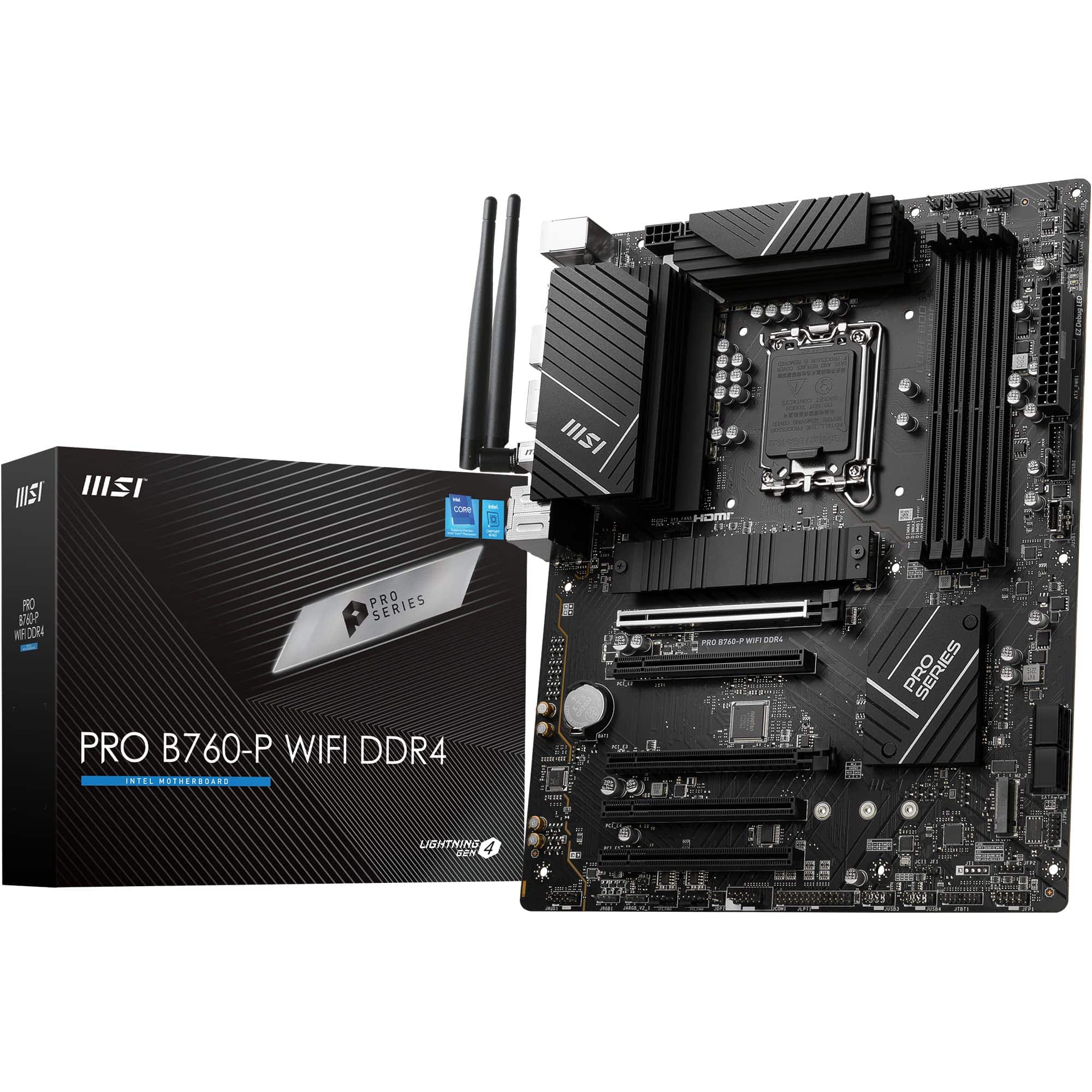 8.5 / 10
MSI PRO B760-P WIFI DDR4 Motherboard, ATX - Supports Intel 14th, 13th & 12th Gen Core Processors, LGA 1700 - DDR4 Memory Boost 5333+MHz/OC, PCIe 4.0 x16 Slots, M.2 Gen4 Slots, 2.5G LAN, Wi-Fi 6E
£129.95 · MSI
 8.5 / 10
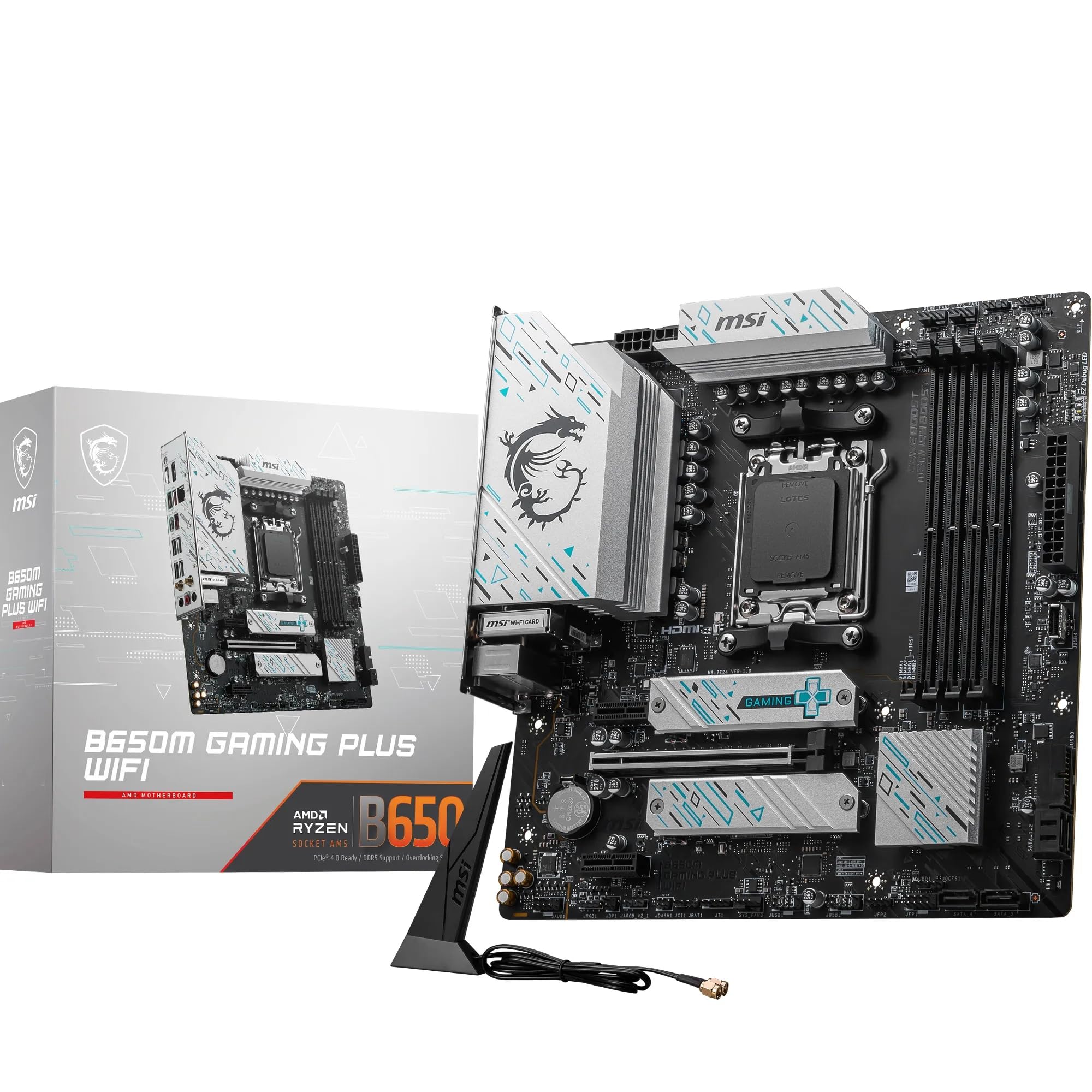
MSI B650M GAMING PLUS WIFI Motherboard, mATX - Supports AMD Ryzen 9000/8000 / 7000 Series Processors, AM5 - DDR5 Memory Boost 7800+ MHz/OC, PCIe 4.0 x16, M.2 Gen4, Wi-Fi 6E
£149.18 · MSI
Frequently asked
7 questions01Does the MSI B760 GAMING PLUS WIFI DDR4 support 14th gen Intel processors?+
Yes, with a BIOS update applied before or immediately after installation. MSI has released BIOS updates enabling full 14th gen compatibility, and the general owner consensus is that the update process via MSI's standard route is straightforward. It is sensible practice to update the BIOS before installing a 14th gen chip if your board ships with an older firmware version.
02Can you overclock the CPU on the MSI B760 GAMING PLUS WIFI DDR4?+
No. The B760 chipset does not support CPU multiplier overclocking. K-series processors will run at their stock boost clocks but cannot be pushed beyond that on this platform. Memory overclocking via XMP profiles up to 5333+ MHz is supported, but manual CPU frequency tuning requires a Z790 board.
03Is the DDR4 platform a significant disadvantage compared to DDR5 boards?+
For gaming specifically, the performance gap between DDR4 at 3600 to 4000 MHz and DDR5 at 5600 MHz is smaller than the price difference typically implies. DDR4 kits are cheaper and more widely available second-hand. If you already own a quality DDR4 kit, this board lets you reuse it, which is a genuine saving. The trade-off is that DDR4 has no upgrade path and DDR5 has better long-term headroom as software catches up.
04Which CPUs work best with the MSI B760 GAMING PLUS WIFI DDR4?+
The sweet spot is the 12th and 13th gen Core i5 range, particularly the i5-12600K, i5-13600K, and their non-K equivalents. Owners running these chips report no thermal or stability issues. An i7-13700 in a well-ventilated case is also a sound pairing. i9-tier processors under sustained all-core loads push the VRM toward its thermal limits, and those chips are better served by a Z790 board with more capable power delivery.
05Does the board include heatsinks over the M.2 slots?+
Yes. The MSI B760 GAMING PLUS WIFI DDR4 includes heatsink coverage over the M.2 slots, which prevents the thermal throttling that NVMe drives can experience under sustained workloads without cooling. This avoids the need to purchase aftermarket thermal pads or heatsinks, which is an extra cost and step that some budget boards at this price impose.
06How does the Wi-Fi 6E on this board compare to standard Wi-Fi 6?+
Wi-Fi 6E extends the Wi-Fi 6 standard into the 6 GHz frequency band, which is less congested than the 2.4 GHz and 5 GHz bands used by older devices. In practice this delivers lower latency and more consistent throughput in environments with multiple wireless devices, provided you have a Wi-Fi 6E router. The adapter is backwards compatible with Wi-Fi 6 and Wi-Fi 5 networks, so there is no penalty for having Wi-Fi 6E on a network that does not yet support it.
07What is the rear USB connectivity like on the MSI B760 GAMING PLUS WIFI DDR4?+
The headline rear USB feature is a USB 3.2 Gen 2x2 Type-C port running at 20Gbps, which is the fastest consumer USB specification currently available and typically found only on mid-range and premium boards. This covers fast external SSD transfers, modern docking station connectivity, and high-bandwidth peripheral use. The full rear USB port count and configuration beyond this port is not confirmed in the verified product data and should be checked on MSI's product page.