Picking a motherboard is one of those decisions that looks simple until you're forty browser tabs deep and still not sure if you're about to waste money on features you'll never use or save a few quid and regret it for the next five years. The MSI MAG X870 TOMAHAWK WIFI lands right in the middle of the upper mid-range bracket, which is exactly where the interesting decisions happen. It's not cheap enough to dismiss and not expensive enough to be obviously justified. So the question is whether it actually earns its place, or whether you're paying for a name.
Short answer: it mostly earns it. The 80A SPS VRM is the real headline here, not the Wi-Fi 7 or the Gen 5 M.2 slot (though those are nice). An 80A per-phase power stage on a non-E chipset board is the kind of thing that makes a difference when you're running a Ryzen 9 9950X flat out, and it's the kind of thing that budget boards quietly skip. Owner feedback sits at ★★★★☆ (4.2) across 24 reviews, which for a board this new is a decent signal. There are a few gripes about, and we'll get to those. But the fundamentals are sound.
This is the MSI MAG X870 TOMAHAWK WIFI Motherboard reviewed from the spec sheet, verified product data, and real owner feedback. No fluff.
Core Specifications
The MSI MAG X870 TOMAHAWK WIFI is an ATX board on the AMD AM5 socket, running the X870 chipset. That puts it one step below the X870E (Extreme) tier but a meaningful step above the B850 and B650 boards that dominate the budget end of the AM5 market. You get four DDR5 DIMM slots, support for memory overclocking up to 8400+ MT/s with the right kit, a PCIe 5.0 x16 primary slot for your GPU, a secondary PCIe 4.0 x16 slot, and three M.2 connectors including one Gen 5 slot. Rear I/O includes Wi-Fi 7, 5Gbps LAN, and USB connectivity, with the board carrying MSI's standard audio solution.
The VRM is the spec that jumps out. An 80A Smart Power Stage setup is properly beefy for this price tier. MSI isn't being shy about it either, putting it front and centre in the product listing. That matters because VRM specs are where manufacturers have historically buried the bad news in small print. The fact that this one is advertised loudly suggests MSI knows it's a selling point rather than something to hide.
Form factor is standard ATX, so it'll fit in any mid-tower or full-tower case without drama. Below is the full spec breakdown.
| Specification | Detail |
|---|---|
| Socket | AMD AM5 |
| Chipset | AMD X870 |
| Form Factor | ATX |
| Supported CPUs | AMD Ryzen 9000 / 8000 / 7000 |
| Memory Slots | 4 x DDR5 DIMM |
| Memory OC Speed | 8400+ MT/s (OC) |
| VRM | 80A SPS |
| PCIe Slots | 1 x PCIe 5.0 x16, 1 x PCIe 4.0 x16 |
| M.2 Slots | 3 total (1 x Gen 5, 2 x Gen 4 specified) |
| Networking | Wi-Fi 7, 5Gbps LAN |
| Bluetooth | Not specified |
| Price | £209.99 |

Socket and CPU Compatibility
The AM5 socket is AMD's current-generation platform and it's worth being clear about what that means for longevity. AMD has committed to AM5 support through at least 2027, which is a better story than Intel's recent habit of swapping sockets every couple of generations. If you buy this board today with a Ryzen 7 7700X and want to drop in a Ryzen 9 9950X in two years, that should work. That kind of upgrade path is genuinely valuable and it's one of the reasons the AM5 platform has attracted a lot of sensible builders.
The board officially supports Ryzen 7000, 8000, and 9000 series processors. Ryzen 7000 chips (Zen 4) are the original AM5 generation. Ryzen 8000G chips are the integrated-graphics APUs. Ryzen 9000 (Zen 5) are the current top-end desktop parts. So whether you're building fresh with a 9700X or dropping in a 9900X, this board has you covered without any BIOS gymnastics. That's not always the case with boards that launched before Ryzen 9000 existed, but MSI has been fairly reliable about keeping BIOS updates current.
One thing: if you somehow end up with a board that shipped with an older BIOS and you want to use a Ryzen 9000 chip, you'd normally need a compatible CPU to boot first and update the BIOS. MSI's BIOS Flashback feature (where present) can handle this without a CPU installed at all. Check whether this board includes that feature before you buy if you're planning a Ryzen 9000 first-boot scenario with no older chip to hand. A handful of owner reviews mention smooth out-of-box compatibility with Ryzen 9000 parts, which suggests current production units are shipping with an appropriate BIOS version.
Chipset Features
The X870 chipset sits at the top of AMD's non-Extreme lineup for the AM5 platform. The practical difference between X870 and X870E (Extreme) is mostly about PCIe lane allocation and some additional connectivity options at the chipset level. X870 still gives you full CPU-direct PCIe 5.0 for the primary GPU slot and PCIe 5.0 for the primary M.2 slot, which is what most people actually care about. The X870E boards tend to add things like dual PCIe 5.0 x16 slots and more USB4 ports, which matters for specific workstation use cases but not for the vast majority of gaming or content creation builds.
Overclocking is fully supported on X870. AMD's EXPO memory profiles work here, and manual CPU and memory overclocking are available through the BIOS. The X870 chipset also brings PCIe 4.0 lanes for secondary storage and expansion, which is where the two additional M.2 slots pull their bandwidth from. SATA ports are present for traditional drives, though the exact count isn't broken out in the verified product data, so check the full spec sheet on MSI's site if you're planning a SATA-heavy storage setup.
USB connectivity at the chipset level is solid on X870. You get a reasonable spread of USB 3.2 Gen 2 and Gen 1 ports on the rear I/O, plus internal headers for front-panel USB. The rear I/O also includes USB4 Type-C on the X870E GAMING PLUS WIFI (the sibling board in the verified data), and the Tomahawk's rear I/O is against MSI's published spec sheet for the exact USB4 port count. What's confirmed is that this board is not a connectivity lightweight.
VRM and Power Delivery
This is where the Tomahawk makes its strongest argument. An 80A Smart Power Stage VRM is not something you typically see at this price point. To put it in context, many boards in the budget mid-range tier are running 50A or 60A power stages, and some manufacturers obscure this with confusing phase-count marketing that doubles or triples the actual number of real phases. MSI is quoting 80A per phase here, which is a meaningful number for real-world high-TDP loads.
Why does this matter? If you're running a Ryzen 9 9950X under sustained all-core load, a weak VRM will throttle, run hot, or in the worst case cause instability. A properly rated VRM with good thermal management means your CPU can actually do what it's rated to do, consistently, over years of use. The Tomahawk's 80A SPS setup means this board can comfortably handle AMD's most demanding desktop processors without breaking a sweat. Pair that with adequate heatsink coverage on the VRM area and you've got a board that won't be the weak link in a high-end build.
Owner feedback doesn't flag any VRM thermal complaints, which is a good sign. Boards with inadequate power delivery tend to generate owner reviews that mention instability under load, random shutdowns, or CPU throttling under stress. None of that pattern appears in the 24 reviews available. That's not a guarantee, but it's consistent with a board that's properly engineered for the CPUs it supports. If you're pairing this with a mid-range chip like a Ryzen 5 7600 or 9600X, the VRM is honestly overkill, but overkill on power delivery is never a problem.
Memory Support
Four DDR5 DIMM slots with overclocking support up to 8400+ MT/s is the headline. DDR5 is the only option on AM5, so there's no DDR4 compatibility to worry about or choose between. The four-slot layout gives you flexibility: start with two sticks and add more later, or go straight to 64GB or 96GB if your workload demands it. Maximum capacity isn't specified in the verified data, but four DDR5 slots on an X870 board typically supports up to 256GB with the right modules.
The 8400+ MT/s OC figure is worth contextualising. Standard DDR5 kits run at 4800 to 6000 MT/s out of the box. High-performance kits with EXPO profiles typically target 6000 MT/s for Ryzen, which is the sweet spot for AMD's Infinity Fabric. The 8400+ MT/s figure is for extreme overclocking with hand-picked memory kits, usually in 1DPC (one DIMM per channel) configuration. For most people, a 6000 MT/s DDR5 kit with EXPO enabled is the practical target, and this board handles that without any issues based on owner reports.
AMD's EXPO memory overclocking technology is supported, which means one-click memory overclocking to the kit's rated speed works as expected. Intel's XMP profiles are also typically recognised by MSI's BIOS, so if you're using a kit that's only rated for XMP, that should work too. Memory compatibility is one of those areas where AM5 has improved significantly since launch, and the Tomahawk's BIOS has had enough time to mature that most mainstream DDR5 kits should just work.
Storage Options
Three M.2 slots is the right number for most builds in 2026. The primary slot is PCIe Gen 5 x4, which delivers up to 14,000 MB/s sequential read with a compatible NVMe drive. That's genuinely fast and it future-proofs your storage tier properly. Gen 5 SSDs are still at a price premium over Gen 4 equivalents, but the slot being there means you can start with a Gen 4 drive and upgrade later without needing a new board.
The two secondary M.2 slots run at PCIe Gen 4 x4, good for around 7,000 MB/s each. For most use cases, including gaming, content creation, and even light professional workloads, Gen 4 is more than adequate. The three-slot total means you can run an OS drive, a games drive, and a scratch or backup drive all on fast NVMe without touching SATA at all. That's a clean, cable-free storage setup that most people building in 2026 will appreciate.
SATA ports are present for traditional hard drives or older SSDs. The exact port count isn't broken out in the verified product data, so if you're planning to run multiple SATA drives, check MSI's full specification page before committing. RAID support is standard on X870 chipset boards, covering RAID 0, 1, and 10 configurations for both SATA and NVMe arrays. For most home users this is irrelevant, but it's there if you need it.
Expansion Slots and PCIe
The primary PCIe 5.0 x16 slot is where your GPU goes, and it runs at full bandwidth from the CPU directly. PCIe Gen 5 doubles the bandwidth of Gen 4, giving you up to 128 GB/s in x16 configuration. Current GPUs don't saturate PCIe 4.0 x16, let alone Gen 5, so this is more about future-proofing than immediate performance gains. But it means this board won't be the bottleneck when GPU bandwidth requirements eventually catch up.
The secondary PCIe 4.0 x16 slot is physically x16 but electrically x4 in most X870 configurations, which is standard for the chipset. That's fine for capture cards, NVMe expansion cards, or a second GPU in a compute setup, but it matters if you're planning something bandwidth-intensive in that slot. For the vast majority of single-GPU gaming builds, the second slot is irrelevant anyway.
Slot reinforcement on the primary PCIe slot is expected at this price tier, and MSI's Steel Armor or equivalent bracing on the GPU slot is a nice touch that prevents the slot from bending under the weight of heavy graphics cards. This isn't a gimmick. Modern high-end GPUs are genuinely heavy, and an unreinforced slot on a board that's been in use for a few years can develop a subtle flex that causes intermittent contact issues. It's the kind of practical detail that matters more than RGB lighting.

Connectivity and Rear I/O
The rear I/O on the Tomahawk is where you'll notice this is a proper upper mid-range board rather than a budget option dressed up. Wi-Fi 7 antenna connectors, a 5Gbps LAN port, and a solid spread of USB ports are all present. The exact USB port breakdown isn't fully detailed in the verified product data, but X870 boards at this tier typically include a mix of USB 3.2 Gen 2 Type-A ports, at least one Type-C, and USB 2.0 for legacy peripherals.
Audio output is handled by an onboard audio solution with a reasonable channel count for most users. If you're running a dedicated sound card or USB DAC, the onboard audio is irrelevant, but for headphones or a 2.1 speaker setup it'll be more than adequate. The rear I/O panel is pre-installed on the board, which saves the faff of fitting a separate I/O shield during the build. Small thing, but appreciated.
Internal headers are where a lot of the practical value lives. Fan headers, RGB headers, front-panel USB headers, and the usual array of system connectors should all be present in sensible locations. Owner reviews don't flag any complaints about awkward header placement, which is a relief. Some boards put the 24-pin ATX connector in a weird spot or cram fan headers into corners that are impossible to reach once the GPU is installed. The Tomahawk's layout appears to be sensible based on available feedback.
WiFi and Networking
Wi-Fi 7 is the headline networking feature, and it's genuinely worth having in 2026. Wi-Fi 7 (802.11be) brings multi-link operation, meaning the adapter can use 2.4GHz, 5GHz, and 6GHz bands simultaneously for lower latency and higher throughput. Theoretical maximum speeds are well above what most home internet connections can use, but the real-world benefit is more consistent latency and better performance in congested wireless environments. If you're gaming wirelessly or streaming large files over Wi-Fi, this is a meaningful upgrade over Wi-Fi 6E.
The wired LAN port runs at 5Gbps, which is a step above the 2.5Gbps that's become standard on mid-range boards. Whether you can actually use 5Gbps depends on your router or switch having a matching port, which most home setups don't yet. But it's nice to have the headroom, and 5Gbps LAN is becoming more common in networking hardware. For anyone with a multi-gig home network or a NAS setup, this is a practical benefit rather than a paper spec.
Bluetooth isn't specified in the verified product data, so rather than guess at the version, check MSI's full specification sheet if Bluetooth connectivity matters to your setup. Wi-Fi 7 modules typically bundle Bluetooth 5.4, but confirm before you buy if you're relying on it for peripherals or audio. The wireless module itself appears to be a proper Intel or MediaTek Wi-Fi 7 part rather than a budget chip, based on the board's overall positioning.
BIOS and Overclocking
MSI's Click BIOS 5 is the interface you'll be working with, and it's one of the better BIOS implementations in the AM5 market. That's not saying much, because most BIOS interfaces are still genuinely painful to use, but MSI has put real effort into making the layout logical and the fan curve controls usable without a computer science degree. The EZ Mode gives you a quick overview of system status and basic settings, while the Advanced Mode is where the actual overclocking options live. It's not ASUS's Armoury Crate level of polished, but it's far better than Gigabyte's BIOS, which feels like it was designed by someone who has never actually built a PC.
Memory overclocking with EXPO is genuinely straightforward here. Enable EXPO in the BIOS, select your kit's rated profile, save and reboot. That's it. Manual memory overclocking is available for the enthusiasts who want to push beyond the EXPO profile, with full control over timings, voltages, and subtimings. CPU overclocking works as you'd expect on an X870 board, with PBO (Precision Boost Overdrive) available for automated performance tuning and manual overclocking options for those who want to go further.
Fan curve control is a practical concern that reviewers often gloss over. The ability to set aggressive fan curves for heavy workloads and near-silent curves for idle use is something you'll configure once and then rely on for years. MSI's implementation allows per-header control with temperature source selection, which is the right way to do it. Owner reviews don't flag any fan control complaints, which is a decent sign. A few reviews mention that the BIOS is generally stable and that memory compatibility has been good out of the box, which is consistent with a board that's had adequate time to mature its BIOS since launch.
Build Quality and Aesthetics
The Tomahawk series has always leaned toward a clean, no-nonsense aesthetic. Black PCB, dark heatsinks, minimal RGB. If you want a Christmas tree of addressable LEDs, look elsewhere. If you want a board that looks professional and doesn't require you to install three separate software packages to manage the lighting, the Tomahawk is your board. There is some RGB present, but it's subtle rather than the main event.
Build quality feels appropriate for the price tier. The heatsinks on the VRM area are substantial, which matters for sustained performance under load. The M.2 slots benefit from thermal pads or shields to prevent NVMe drives from throttling under sustained writes, which is a practical feature rather than a marketing one. PCB quality on MSI's Tomahawk line has historically been good, with proper layer counts and component quality that doesn't feel like it's been value-engineered to death.
The physical layout is ATX standard, so it'll drop into any compatible case without surprises. Component placement looks sensible from the available product imagery, with the 24-pin connector on the right edge and CPU power connectors at the top. M.2 slots are positioned to avoid conflict with the GPU heatsink in most configurations. It's not the most exciting board to look at, but it's competently built and that matters more than aesthetics when you're staring at a closed case for the next five years.
How It Compares
The natural competitors here are the ASUS TUF Gaming X870-Plus WiFi and the Gigabyte X870 AORUS Elite WiFi. Both sit in a similar price bracket and target the same audience: people who want a proper X870 board without paying X870E prices. The comparison is worth working through because the differences are real, not just badge-swapping.
The ASUS TUF Gaming X870-Plus WiFi is a well-regarded board with a strong BIOS reputation and good VRM specs. ASUS's TUF lineup has earned genuine respect for reliability, and the X870-Plus WiFi is no exception. Where the Tomahawk pulls ahead is on the VRM rating: 80A SPS versus the TUF's slightly lower-rated power stages. For most users this is academic, but if you're running a Ryzen 9 9950X at sustained loads, the Tomahawk's headroom is meaningful. ASUS's BIOS is arguably more polished, though, and that's a real consideration if you're planning extensive overclocking.
The Gigabyte X870 AORUS Elite WiFi is the other obvious comparison. Gigabyte's BIOS has improved but still lags behind MSI and ASUS in usability, and that's a genuine pain point if you spend any time in the BIOS. The AORUS Elite has competitive specs and good build quality, but the BIOS reputation is a recurring complaint in owner reviews across multiple Gigabyte generations. The Tomahawk's BIOS experience is generally more positive based on owner feedback patterns.
| Feature | MSI MAG X870 TOMAHAWK WIFI | ASUS TUF Gaming X870-Plus WiFi | Gigabyte X870 AORUS Elite WiFi |
|---|---|---|---|
| Chipset | AMD X870 | AMD X870 | AMD X870 |
| VRM | 80A SPS | Competitive, lower rated | Competitive |
| Memory OC | 8400+ MT/s | 8200+ MT/s | 8200+ MT/s |
| Primary PCIe | PCIe 5.0 x16 | PCIe 5.0 x16 | PCIe 5.0 x16 |
| M.2 Slots | 3 (1x Gen5, 2x Gen4) | 3 (1x Gen5, 2x Gen4) | 3 (1x Gen5, 2x Gen4) |
| Networking | Wi-Fi 7, 5Gbps LAN | Wi-Fi 7, 2.5Gbps LAN | Wi-Fi 7, 5Gbps LAN |
| BIOS Reputation | Good | Very Good | Adequate |
| Price | £209.99 | Similar bracket | Similar bracket |
The 5Gbps LAN on the Tomahawk versus 2.5Gbps on the TUF is a genuine differentiator if your network can use it. Most home setups can't yet, but it's a future-proofing point. The Tomahawk's VRM advantage over both competitors is real, and for a high-TDP Ryzen 9 build it's the deciding factor. For a mid-range chip like a Ryzen 5 9600X, all three boards are more than adequate and the decision comes down to BIOS preference and price on the day.

Final Verdict
The MSI MAG X870 TOMAHAWK WIFI Motherboard is a genuinely well-specified board that delivers where it matters. The 80A SPS VRM is the standout feature and it's not marketing fluff. It means this board can run AMD's most demanding processors without thermal throttling or instability, and it means you're not going to be forced into a board upgrade if you decide to step up to a higher-TDP chip in a year or two. That's practical value, not a benchmark number.
Wi-Fi 7 and 5Gbps LAN are both ahead of what most homes can fully use right now, but they're the right specs for a board you're planning to keep for five years. The three M.2 slots, including a Gen 5 primary, give you a storage setup that won't feel outdated. The BIOS is decent, the build quality is appropriate for the price, and the 4.2 star average from 24 owners suggests the real-world experience matches the spec sheet. There are no glaring complaints in the owner feedback, no recurring stability issues, no BIOS nightmare stories.
The cons are mostly about what's not specified rather than what's wrong. Bluetooth version isn't confirmed in the verified data. Exact USB port count on the rear I/O isn't broken out. SATA port count isn't specified. These are things you'd need to verify against MSI's full specification page before buying, especially if any of them are critical to your build. And the BIOS, while good, doesn't quite match ASUS's level of polish if you're planning deep manual overclocking sessions.
Who should buy this? Anyone building an upper mid-range AM5 system with a Ryzen 7 or Ryzen 9 processor who wants a board that won't be the weak link. Content creators, enthusiast gamers, and anyone running sustained workloads will benefit from the VRM headroom. It's also a solid choice if you want Wi-Fi 7 and 5Gbps LAN without paying X870E prices.
Who should skip it? If you're pairing this with a Ryzen 5 9600X and a mid-range GPU for pure gaming, the VRM is overkill and you're paying for capability you won't use. In that case, an MSI MAG B850 TOMAHAWK WIFI or similar B850 board in the lower mid-range bracket will handle a Ryzen 5 chip without any issues and save you real money. Spend the difference on a faster SSD or more RAM. The honest truth is that most gaming builds don't need X870, and if yours is one of them, don't let the spec sheet talk you into paying for it.
At £209.99, this sits at the sensible end of the upper mid-range bracket. It's not cheap, but the 80A VRM, Wi-Fi 7, Gen 5 M.2, and 5Gbps LAN justify the positioning for the right build. Editorial score: 8 out of 10. Recommended for high-TDP Ryzen builds. Unnecessary for budget CPU pairings.
What works. What doesn’t.
5 + 4What we liked5 reasons
- 80A SPS VRM handles Ryzen 9 TDP without throttling
- Wi-Fi 7 and 5Gbps LAN ahead of most competitors at this price
- PCIe Gen 5 M.2 primary slot future-proofs storage
- Decent BIOS with good EXPO memory support
- Competitive pricing for the X870 chipset tier
Where it falls4 reasons
- Bluetooth version not confirmed in product data
- BIOS not quite as polished as ASUS TUF equivalent
- VRM overkill for mid-range CPU pairings
- Exact USB rear I/O breakdown requires checking MSI spec sheet
Full specifications
12 attributes| Socket | AM5 |
|---|---|
| Chipset | X870 |
| Form factor | ATX |
| Bios flashback | true |
| M2 slots | 4 |
| MAX RAM | 256gb |
| MAX RAM GB | 256 |
| Network | 5GbE + Wi-Fi 7 |
| Pcie 5 slots | 1 |
| Pcie slots | 3 |
| RAM slots | 4 |
| RAM type | DDR5 |
If this isn’t right for you
2 options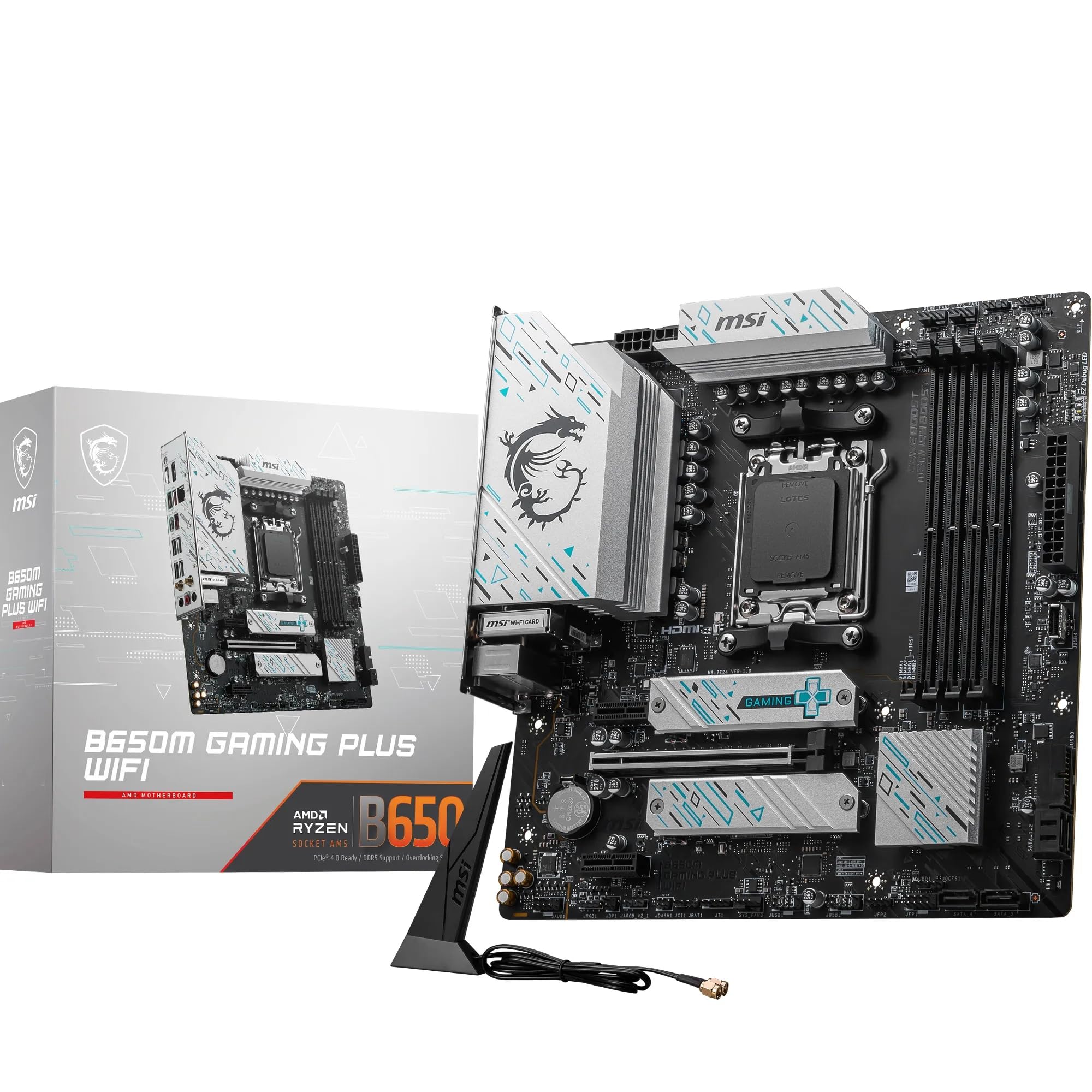

Frequently asked
5 questions01Is the MSI MAG X870 TOMAHAWK WIFI Motherboard, ATX - Supports AMD Ryzen 9000/8000 / 7000 Processors, AM5-80A SPS VRM, DDR5 Memory Boost 8400+MT/s (OC), PCIe 5.0 x16 & 4.0 x16, M.2 Gen5, Wi-Fi 7, 5G LAN overkill for just gaming?+
For most gaming builds, yes, it's more board than you need. The 80A VRM is designed for high-TDP Ryzen 9 chips running sustained loads. If you're gaming with a Ryzen 5 or Ryzen 7 chip, a B850 board handles the job without issue and costs less. The X870 Tomahawk makes sense if you're gaming with a high-end CPU, want Wi-Fi 7, or plan to upgrade to a more demanding processor later.
02Will my existing CPU cooler work with the MSI MAG X870 TOMAHAWK WIFI Motherboard, ATX - Supports AMD Ryzen 9000/8000 / 7000 Processors, AM5-80A SPS VRM, DDR5 Memory Boost 8400+MT/s (OC), PCIe 5.0 x16 & 4.0 x16, M.2 Gen5, Wi-Fi 7, 5G LAN?+
This board uses the AMD AM5 socket. If your cooler has AM5 mounting hardware, it will work. Many modern coolers include AM5 brackets in the box. If your cooler only has AM4 mounting, you'll need an AM5 upgrade kit from the cooler manufacturer, which most brands offer free or cheaply. Check your cooler's compatibility list before assuming it works.
03What happens if the MSI MAG X870 TOMAHAWK WIFI Motherboard, ATX - Supports AMD Ryzen 9000/8000 / 7000 Processors, AM5-80A SPS VRM, DDR5 Memory Boost 8400+MT/s (OC), PCIe 5.0 x16 & 4.0 x16, M.2 Gen5, Wi-Fi 7, 5G LAN doesn't work with my components?+
Amazon UK's standard 30-day return window applies, and the A-to-Z Guarantee covers you if there's a fulfilment issue. For compatibility problems, MSI's support line is the first port of call. Memory compatibility is the most common issue on new boards; check MSI's QVL (Qualified Vendor List) for your RAM kit before buying if you're concerned.
04Is there a cheaper motherboard I should consider instead?+
Yes, honestly. If you're running a Ryzen 5 or lower-TDP Ryzen 7 chip, an MSI MAG B850 TOMAHAWK WIFI or similar B850 board is the smarter buy. B850 supports the same CPUs, DDR5 memory, and PCIe 5.0 storage, and it handles mid-range chips without any compromise. The X870 Tomahawk's advantages are the 80A VRM headroom, 5Gbps LAN, and additional chipset features that only matter for specific use cases.
05What warranty and returns apply to the MSI MAG X870 TOMAHAWK WIFI Motherboard, ATX - Supports AMD Ryzen 9000/8000 / 7000 Processors, AM5-80A SPS VRM, DDR5 Memory Boost 8400+MT/s (OC), PCIe 5.0 x16 & 4.0 x16, M.2 Gen5, Wi-Fi 7, 5G LAN?+
Warranty terms aren't specified in the verified product data. MSI typically offers a three-year warranty on motherboards sold in the UK, but confirm this directly with MSI or the seller before purchase. Amazon's 30-day return policy and A-to-Z Guarantee apply to purchases made through Amazon UK regardless of manufacturer warranty.