Content creators have more demanding requirements from a motherboard than most users. Whether you are editing 4K or 8K video, rendering 3D scenes, running multiple virtual machines, or streaming while recording, you need a board that can sustain high CPU and memory bandwidth, offer fast storage connectivity, and handle the thermal demands of sustained all-core workloads. The landscape shifted considerably in 2024 and into 2025: AMD's AM5 platform matured significantly with B850 and X870 chipsets arriving to replace B650 and X670, DDR5 memory is now the standard on new builds, and PCIe 5.0 storage slots are becoming commonplace even on mid-range boards. Intel's Arrow Lake platform also landed, bringing the Z890 and B760 chipsets into play. This guide is aimed at creators who want to spend their money wisely, whether that means a budget AM5 board to pair with a Ryzen 9 9900X, or a flagship platform for a workstation that needs to last five or more years. We have selected six boards that represent genuinely different price points and use cases.
Quick Verdict
Best Overall: MSI MAG B850 TOMAHAWK MAX WIFI. It hits the sweet spot of price, feature set, and reliability for the majority of content creators building on AM5 in 2025.
Best Value: ASUS PRIME B850-PLUS WIFI. A capable AM5 board at a price that leaves budget for the CPU and GPU that actually do the creative work.
1. MSI MAG B850 TOMAHAWK MAX WIFI
The MSI MAG B850 TOMAHAWK MAX WIFI is the board we would recommend to the widest range of content creators in 2025. It sits at a price point that is accessible without feeling like a compromise, and it brings a feature set that would have been reserved for enthusiast boards just two years ago. The B850 chipset supports AMD's Ryzen 7000, 8000, and 9000 series processors on the AM5 socket, meaning you have a clear upgrade path for several years. For a video editor or 3D artist building a new workstation, that longevity matters.
The power delivery on the TOMAHAWK MAX is rated at a 16+2+2 phase configuration, which is more than sufficient to run a Ryzen 9 9950X at full load for extended rendering sessions without throttling. MSI has equipped this board with three M.2 slots, one of which is PCIe 5.0 for the kind of read speeds that make a real difference when scrubbing through large RAW video files or loading multi-gigabyte project assets. The remaining slots are PCIe 4.0, still fast enough for secondary drives holding project libraries.
Connectivity is where this board really earns its place in a creator's workflow. It ships with Wi-Fi 7, which is the latest standard and offers lower latency and higher throughput than Wi-Fi 6E, useful if you are transferring large files wirelessly to a NAS. The rear panel includes a USB4 40Gbps port, which can connect to external SSDs, high-resolution displays, or Thunderbolt 3 and 4 devices with appropriate cables. There is also a 2.5GbE LAN port for wired network transfers. Six SATA ports mean you can build out a large internal storage array for footage archives.
Memory support extends to DDR5 at speeds well above 6000 MHz with EXPO profiles, and four slots allow up to 256 GB of DDR5 RAM, which is relevant for creators working in applications like DaVinci Resolve or Cinema 4D that benefit enormously from large memory pools. The BIOS is mature and straightforward, and MSI's software ecosystem is reliable enough for a professional environment.
The TOMAHAWK MAX is not the cheapest B850 board available, but the addition of USB4, Wi-Fi 7, and the PCIe 5.0 M.2 slot over its predecessor justifies the price step. For most creators, this is the board to buy.
Pros
- USB4 40Gbps rear port for fast external storage and display connectivity
- PCIe 5.0 M.2 slot delivers maximum NVMe speeds for large media files
- Wi-Fi 7 and 2.5GbE cover both wireless and wired high-speed networking
- 16+2+2 phase VRM handles sustained all-core loads on Ryzen 9 CPUs without throttling
Cons
- Only two M.2 slots below PCIe 5.0 speed, so a third fast drive requires an add-in card
- Priced above entry-level B850 boards, which may push budget builders toward fewer CPU options
The ASUS PRIME B850-PLUS WIFI represents the most sensible entry point into AMD's current AM5 platform for creators who want to allocate the majority of their budget to the CPU, GPU, and RAM rather than the motherboard itself. At its price point it delivers a feature set that would have been considered mid-range territory just eighteen months ago, and it is a board that ASUS has positioned for reliability and straightforward operation rather than overclocking excess.
The B850 chipset here supports the full range of Ryzen 7000, 8000, and 9000 series processors, including the top-end Ryzen 9 9950X if you choose to go that route. The VRM configuration is a 14+2 phase design, which is adequate for a Ryzen 7 9700X or Ryzen 9 9900X under sustained creative workloads, though creators planning to run a 9950X at full all-core load for hours at a time should consider a board with a heavier power delivery stage. For the majority of users, this will not be a limitation.
Storage options include two M.2 slots, one of which supports PCIe 5.0 speeds. This is genuinely useful for a primary drive holding your operating system and active project files, where sequential read speeds above 10,000 MB/s make a tangible difference in application load times and large file operations. Four SATA ports cover additional mechanical or SATA SSD storage. The board also includes Wi-Fi 6E and a 2.5GbE LAN port, both of which are practical for a creative workstation that needs to transfer large files efficiently.
The rear panel includes a USB 3.2 Gen 2x2 Type-C port running at 20Gbps, which is fast enough for most external SSDs and docking stations, though it falls short of the USB4 40Gbps found on pricier boards. ASUS's BIOS is among the most user-friendly in the industry, and EXPO DDR5 memory profiles are supported up to very high speeds, allowing you to extract performance from fast memory kits without manual tuning.
For a creator building their first AM5 system on a budget, or upgrading from an older platform without wanting to spend heavily on the board itself, the PRIME B850-PLUS WIFI is the clear choice. It leaves money available for the components that directly drive creative performance.
Pros
- Competitive price for an AM5 board with PCIe 5.0 M.2 support
- ASUS BIOS is well-regarded for ease of use and stability
- Wi-Fi 6E and 2.5GbE included at this price point
Cons
- Only two M.2 slots, limiting high-speed storage expansion without additional hardware
- 14+2 phase VRM is adequate but not ideal for sustained Ryzen 9 9950X all-core workloads
- USB 3.2 Gen 2x2 rather than USB4 means slower external device throughput than pricier boards
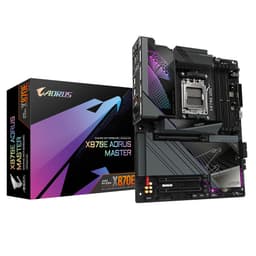
The GIGABYTE X870E AORUS MASTER is the flagship option in this selection and is aimed at professional content creators who want the absolute best AM5 platform available, regardless of cost. The X870E chipset is the top tier of AMD's current lineup, offering the maximum PCIe lane count, the highest memory bandwidth, and the most comprehensive connectivity of any AM5 board. This is a board for a serious workstation that needs to handle 8K video editing, large-scale 3D rendering, and professional audio production simultaneously.
The power delivery stage is a 20+2+2 phase design with 110A power stages, which is among the most capable VRM configurations available on any consumer motherboard. Running a Ryzen 9 9950X at full all-core load for 24-hour rendering sessions is entirely within the design envelope of this board. The heatsinks are large and effective, and the board has been designed with sustained professional workloads in mind rather than short-burst gaming benchmarks.
Storage connectivity is exceptional: five M.2 slots are present, with the primary slot supporting PCIe 5.0 at speeds above 14,000 MB/s sequential read. The remaining slots support PCIe 4.0. Six SATA ports add further capacity. For a creator managing terabytes of RAW footage, project files, and render outputs, this level of storage flexibility is genuinely useful. The board also supports USB4 at 80Gbps, which is double the speed of the 40Gbps USB4 found on most other boards in this selection, enabling connections to the fastest external storage devices currently available.
Networking is similarly premium: a 10GbE LAN port is included alongside Wi-Fi 7, which puts this board in a different class from the 2.5GbE offerings found elsewhere. For a studio environment with a 10GbE NAS or network switch, the ability to transfer a 100 GB project file in under two minutes over a wired connection is a meaningful workflow improvement. Thunderbolt 4 support is also present via a rear panel port.
DDR5 memory support extends to 9600 MHz and beyond with EXPO profiles, and four slots accommodate up to 256 GB. GIGABYTE's BIOS on the AORUS MASTER is feature-rich and well-documented, and the board benefits from strong community support and regular firmware updates. The price is high, but for a professional whose time has a clear monetary value, the AORUS MASTER is a justifiable investment.
Pros
- USB4 80Gbps rear port doubles the external bandwidth of standard USB4 boards for the fastest external SSDs
- 10GbE LAN enables genuinely fast wired transfers to NAS and studio network infrastructure
- 20+2+2 phase VRM with 110A stages handles sustained Ryzen 9 9950X all-core loads without compromise
- Five M.2 slots including PCIe 5.0 primary provide a complete high-speed storage solution
Cons
- Price is very high and difficult to justify unless the specific premium features are actively used in your workflow
- Physical size and weight of the board and its heatsinks require a large ATX case with good clearance
Buying Guide
Choosing the Right Chipset and Socket
The first decision for any content creator building a new workstation is platform choice. AMD's AM5 socket with B850 or X870 chipsets is the strongest recommendation for new builds in 2025. The platform supports current Ryzen 7000, 8000, and 9000 series processors and will continue to receive new CPUs for the foreseeable future, giving you a genuine upgrade path. The B850 chipset is the sweet spot for most creators: it supports PCIe 5.0 for storage, DDR5 memory, and USB4, without the additional cost of the X870 or X870E chipsets. Move to X870 if you need more M.2 slots or additional PCIe lanes for multiple high-speed devices. X870E is reserved for those who need the absolute maximum connectivity and are willing to pay for it.
Intel's Z890 and B760 platforms are valid choices for specific use cases. Z890 is worth considering if your workflow relies heavily on Thunderbolt 4 peripherals or if you specifically need Intel Quick Sync for hardware video encoding in applications that favour it. B760 on LGA1700 makes sense only if you are upgrading an existing Intel system rather than building from scratch, since the socket is end-of-life.
VRM and Power Delivery
Content creators should pay closer attention to VRM quality than gamers typically need to. Video rendering, 3D scene processing, and machine learning inference all place sustained all-core loads on the CPU for minutes or hours at a time. A board with an undersized or poorly cooled VRM will throttle the CPU under these conditions, extending render times. Look for boards with at least a 14-phase power delivery configuration for mid-range Ryzen 9 CPUs, and 16 phases or more for the Ryzen 9 9950X. Check that the VRM heatsinks are substantial and that the board has been validated for sustained workloads, not just peak benchmark performance.
Memory Capacity and Speed
DDR5 is the standard for new builds in 2025, and for content creation the capacity matters as much as the speed. DaVinci Resolve recommends 32 GB as a minimum for 4K work and benefits from 64 GB or more for 8K or complex timelines. Adobe After Effects is similarly memory-hungry. Choose a board with four DIMM slots rather than two, even if you start with two sticks, so you can expand later. EXPO profiles on AMD or XMP profiles on Intel allow you to run memory at its rated speed without manual tuning, which is important for a stable professional environment.
Storage Connectivity
For a content creation workstation, storage is arguably the most important specification after the CPU and RAM. You will want at minimum a fast NVMe drive for your OS and active projects, a secondary NVMe for scratch and cache, and additional capacity for footage archives. A board with three or more M.2 slots is preferable, and having at least one PCIe 5.0 slot for your primary drive provides meaningful performance for large file operations. SATA ports are useful for archive drives or migrating storage from an older system.
Connectivity and Networking
USB4 on the rear panel is increasingly important for creators who use external SSDs for project portability or who connect high-resolution displays via a single cable. Wi-Fi 7 is worth having on a new board even if you primarily use wired networking, as it provides a fast fallback option. For studios with network-attached storage, a 2.5GbE or 10GbE LAN port dramatically reduces file transfer times compared to standard gigabit ethernet. Consider whether you need Thunderbolt 4 for specific peripherals such as professional audio interfaces, capture cards, or external GPU enclosures, as this may influence your platform choice.
The MSI MAG B850 TOMAHAWK MAX WIFI is our overall winner for content creators in 2025. It combines a mature AM5 platform with USB4 40Gbps, Wi-Fi 7, a PCIe 5.0 M.2 slot, a robust 16+2+2 phase VRM, and six SATA ports at a price that is high enough to feel premium but low enough to leave meaningful budget for the CPU and memory that actually drive creative performance. It suits the widest range of creators, from video editors and motion graphics artists to 3D animators and podcasters building a capable all-round workstation.
For those on a tighter budget, the ASUS PRIME B850-PLUS WIFI delivers the essentials of the AM5 platform at a lower price, and for those who need the absolute best, the GIGABYTE X870E AORUS MASTER offers 10GbE networking, USB4 80Gbps, and a flagship VRM that no other board in this selection can match. The MSI MAG X870 TOMAHAWK WIFI is the right step up from the B850 TOMAHAWK for creators who need four M.2 slots, and the MSI MEG Z890 ACE serves Intel users who need Thunderbolt 4 and dual LAN. The MSI B760 GAMING PLUS WIFI rounds out the selection for those refreshing an existing Intel LGA1700 system rather than building new.