Spec sheets don't tell you whether a motherboard is any good. What actually matters is whether the VRM can handle a power-hungry CPU without throttling, whether the BIOS won't make you want to throw your monitor out the window, and whether real owners are reporting the kind of stability problems that only show up six months in. So that's what this review covers: the MSI PRO B760M-A WIFI assessed against its specs, its 48 owner reviews averaging ★★★★☆ (4.3), and where it sits against the competition at this price point.
The short version: this is a genuinely solid mid-range mATX board for Intel 12th and 13th Gen builds. The VRM is properly specced for this chipset tier, the connectivity list punches above its price bracket, and owners are largely happy with it. It's not exciting. But exciting motherboards are usually a bad sign. What you want is something that works, doesn't throttle your CPU, and doesn't require three BIOS updates before it'll POST. This one mostly delivers that.
There are caveats, and we'll get to them. But if you're building around a Core i5 or i7 on the B760 platform and you want Wi-Fi 6E, dual M.2 Gen4, and DDR5 support without paying Z790 money, the PRO B760M-A WIFI is worth your attention.
Core Specifications
The PRO B760M-A WIFI is built around Intel's B760 chipset on the LGA 1700 socket, in a Micro-ATX form factor. That means it'll fit in most mid-tower cases and all mATX cases, which is useful if you're building something compact without going full mini-ITX. Four DDR5 DIMM slots give you room to grow, and the dual M.2 Gen4 slots mean you're not stuck with a single fast drive. The rear I/O is genuinely good for this price tier, with multiple USB options, dual HDMI and DisplayPort outputs for Intel's integrated graphics, and 2.5Gbps LAN alongside Wi-Fi 6E.
The 12 Duet Rail Power System VRM is the headline power delivery spec here. MSI's Duet Rail design effectively doubles the phase count by splitting the power delivery across two rails per phase, which matters for thermal headroom under sustained load. The 7W/mK MOSFET thermal pads are a meaningful spec too. Cheaper boards in this bracket often use generic thermal pads with much lower conductivity, which means the heatsink isn't actually doing much. MSI has at least paid attention to this.
Most budget and lower mid-range boards use 4-layer PCBs. Six layers improves signal integrity and thermal dissipation across the board, not just at the VRM. It's the kind of spec that doesn't make for a flashy bullet point but contributes to long-term reliability. Owner reviews back this up: stability complaints are rare in the feedback pool.
| Specification | Detail |
|---|---|
| Form Factor | Micro-ATX (mATX) |
| Socket | LGA 1700 |
| Chipset | Intel B760 |
| CPU Support | 12th Gen (Alder Lake) and 13th Gen (Raptor Lake) Intel Core |
| Memory Slots | 4 x DDR5 DIMM |
| Memory Speed | Up to 6800+ MHz (1DPC 1R with Memory Boost) |
| PCIe x16 Slots | 2 x PCIe 4.0 x16 (primary with Steel Armor) |
| M.2 Slots | 2 x M.2 Gen4 x4 (64Gbps each) |
| LAN | 2.5Gbps |
| Wi-Fi | Intel Wi-Fi 6E |
| Bluetooth | 5.3 |
| Rear USB | USB 3.2 Gen 2 Type-A (10Gbps) |
| Video Outputs | 2 x HDMI 2.1, 2 x DisplayPort 1.4 |
| Audio | 7.1 HD Audio with Audio Boost |
| VRM | 12 Duet Rail Power System (P-PAK) |
| PCB | 6-layer, 2oz thickened copper |

Socket and CPU Compatibility
The LGA 1700 socket supports Intel's 12th Gen Alder Lake and 13th Gen Raptor Lake processors. That covers everything from the budget Core i3-12100 all the way up to the Core i9-13900K, at least in terms of socket compatibility. Whether the B760 chipset and its VRM design are appropriate for the very top-end chips is a separate question we'll address in the VRM section. But for the Core i5 and Core i7 range, which is where most sensible B760 builds land, you're well covered.
One thing to be clear about: the B760 chipset does not support CPU overclocking. You can't push your Core i5-13600K beyond its rated boost clocks on this board. That's a chipset limitation, not an MSI decision. If overclocking the CPU is part of your plan, you need a Z790 board and an unlocked K-series chip. What the B760M-A WIFI does support is memory overclocking via XMP profiles, which we'll cover in the memory section.
BIOS update requirements are worth a mention here. Both 12th and 13th Gen chips are supported out of the box on this board, so you won't need to hunt down an older CPU just to flash a BIOS update before your main chip will POST. That's a practical convenience that matters if you're building from scratch without a spare CPU lying around. MSI has been consistent about keeping LGA 1700 BIOS support current, and the PRO series boards have a decent track record for BIOS stability compared to some of MSI's more enthusiast-focused lines where early BIOS releases can be a bit rough.
Chipset Features
Intel's B760 chipset sits in the middle of the current Intel platform hierarchy, below the enthusiast-grade Z790 and above the entry-level H610. The key practical difference from Z790 is the lack of CPU overclocking support and a reduced number of chipset-provided PCIe and USB lanes. For most builders, this doesn't matter. You're not going to run out of bandwidth on a typical gaming or productivity build. But it's worth understanding what you're getting.
The B760 provides a sensible allocation of PCIe 4.0 and PCIe 3.0 lanes from the chipset, supplemented by the CPU's own direct lanes for the primary PCIe x16 slot and the M.2 slots. MSI has routed the two M.2 Gen4 x4 slots through the CPU's direct PCIe 4.0 lanes, which means you get full 64Gbps bandwidth per slot without any lane-sharing compromises. That's the right call and not every board at this price point handles it this way.
On the USB front, the rear I/O includes USB 3.2 Gen 2 Type-A running at 10Gbps. The B760 chipset can support a reasonable spread of USB headers for the front panel as well, though the exact internal header count isn't listed in the verified spec data. What's clear from the rear I/O spec is that MSI hasn't skimped on the external connectivity, which is usually where budget-conscious boards cut corners first. The 7.1 HD Audio with Audio Boost is a proper implementation rather than a bolted-on afterthought, using isolated audio circuitry to reduce electrical interference from the rest of the board.
VRM and Power Delivery
This is the section that actually determines whether a mid-range board is worth buying or not. A lot of boards in this price bracket look fine on paper until you stress-test them with a power-hungry CPU, at which point the VRM thermals climb, the board throttles the CPU to protect itself, and your benchmark scores tank. MSI's 12 Duet Rail Power System using P-PAK (Power PAK) MOSFETs is a meaningful step above the generic solutions you'd find on cheaper boards. The Duet Rail design effectively splits the power delivery load across paired rails, improving both efficiency and thermal headroom.
The 7W/mK MOSFET thermal pads are a genuinely good spec. For context, a lot of budget boards use thermal pads rated at 1W/mK or less, which means the heatsink is barely doing its job. At 7W/mK, heat is actually being transferred from the MOSFETs to the extended heatsink efficiently. Combined with the extended heatsink design and the active Frozr AI cooling system (which MSI describes as CPU and GPU responsive), the VRM thermal solution here is better than you'd typically expect at this price point.
For the target CPU range, specifically Core i5 and i7 processors within the 65W to 125W TDP range, this VRM is more than adequate. Owner reviews don't flag thermal throttling issues, which is the real-world validation you want. If you're planning to run a Core i9-13900K at full tilt, a B760 board is probably the wrong choice regardless of VRM quality, partly because of the chipset limitations and partly because that chip really benefits from a Z790 board's more comprehensive power delivery. But for everything below that, the PRO B760M-A WIFI's power delivery is properly sorted.
Memory Support
The PRO B760M-A WIFI is a DDR5-only board. There's no DDR4 support here, which is the right call for a board at this price point in 2026. DDR5 prices have normalised significantly since the platform launched, and the performance advantages are real, particularly in memory-bandwidth-sensitive workloads. Four DIMM slots give you a maximum configuration of four sticks, though the headline speed spec of 6800+ MHz applies specifically to a 1DPC 1R (one DIMM per channel, single rank) configuration.
Memory overclocking is supported via MSI's Memory Boost technology with isolated circuitry, which helps maintain signal integrity when pushing memory beyond its rated speeds. XMP profile support is included, so if you buy a kit rated at 6000MHz or 6400MHz, you can enable that profile in the BIOS and it should just work. The isolated memory circuitry is a practical feature rather than marketing fluff: it physically separates the memory traces from other board circuitry to reduce electrical noise, which matters when you're running memory at high frequencies. JEDEC's DDR5 specification defines the baseline, and XMP takes you well beyond it.
One practical note: if you're populating all four slots with high-speed memory, expect to potentially need to drop the frequency slightly from the single-DIMM maximum. This is a platform characteristic rather than a board flaw, and it applies across Intel DDR5 boards generally. For most users running a 2x16GB or 2x32GB kit, you'll have no issues hitting rated XMP speeds. The board's memory support is genuinely one of its stronger selling points in the mid-range bracket.
Storage Options
Two M.2 Gen4 x4 slots, each capable of 64Gbps throughput. That's the headline, and it's a good one. PCIe Gen 4 M.2 drives are now mainstream, with options from Samsung, WD, Seagate, and others available at reasonable prices. Having two of these slots means you can run a fast boot drive and a fast secondary storage drive without any bandwidth compromise. Both slots are covered by MSI's M.2 Shield Frozr heatsinks, which actively cool the drives and prevent thermal throttling during sustained writes.
The M.2 Shield Frozr is worth a mention because not every board at this price includes heatsinks on both M.2 slots. Some include one heatsink and leave the second slot bare, which means a hot drive in that slot will throttle under sustained load. MSI covering both slots is the right approach, and owners who've commented on drive temperatures report no issues with thermal throttling during normal use.
SATA port availability isn't specified in the verified product data, so we won't make a claim about the exact count. What's clear is that the two M.2 Gen4 slots are the primary storage feature here, and they're well implemented. For a build that's going all-NVMe, which is the sensible choice in 2026, this board gives you everything you need. The chipset heatsink is also included, which keeps the B760 chipset itself running cool and contributes to overall board stability.
Expansion Slots and PCIe
Two PCIe x16 slots, both running at PCIe 4.0. The primary slot is the one your GPU goes in, and it's reinforced with MSI's Steel Armor, which is a metal shroud that prevents the slot from flexing or cracking under the weight of a heavy graphics card. This matters more than it sounds: a heavy GPU in a system that gets moved around can eventually damage an unprotected PCIe slot. Steel Armor is a sensible inclusion.
The secondary PCIe x16 slot also supports PCIe 4.0, which is useful if you're running a capture card, a 10GbE NIC, or any other expansion card that benefits from PCIe 4.0 bandwidth. In practice, most users won't use the second slot at all, but having it available at PCIe 4.0 rather than PCIe 3.0 is a meaningful spec advantage over some competing boards. Lane sharing details between the slots aren't specified in the verified data, but the presence of two PCIe 4.0 x16 physical slots on a B760 board is.
For gaming builds specifically, the Steel Armor on the primary slot and the PCIe 4.0 x16 bandwidth mean there's no bottleneck at the GPU interface. Current-generation graphics cards, including the latest from Nvidia and AMD, operate well within PCIe 4.0 x16 bandwidth limits. PCIe 5.0 x16 would theoretically offer more headroom, but it's not a practical limitation for any GPU available today. The expansion slot configuration here is appropriate for a mid-range mATX board targeting gaming and productivity builds.

Connectivity and Rear I/O
The rear I/O on the PRO B760M-A WIFI is where this board genuinely earns points in the mid-range bracket. USB 3.2 Gen 2 Type-A at 10Gbps is the headline USB spec, which handles fast external drives and other high-bandwidth peripherals without issue. The video output selection is particularly generous: two HDMI 2.1 ports and two DisplayPort 1.4 ports, giving you up to four simultaneous display outputs from Intel's integrated graphics. That's useful for productivity setups or for anyone running an iGPU-only build temporarily.
The 7.1 HD Audio implementation with Audio Boost uses isolated audio circuitry, which in practice means the audio output is cleaner than you'd get from a board that just throws the audio codec on the main PCB without any shielding. For gaming headsets and decent speakers, this is perfectly adequate. You'd need to spend considerably more on a dedicated sound card to notice a meaningful difference. The audio implementation here is honest mid-range: good enough that you won't feel the need to upgrade it, not so impressive that it becomes a selling point on its own.
One thing: the dedicated pump-fan header is a useful inclusion for custom water-cooling setups. It's not something every mATX board includes, and it means you can connect a pump directly without having to bodge it through a standard fan header. The active Frozr AI cooling on the board itself responds to both CPU and GPU temperatures, which means the board's own heatsinks aren't running fans at full speed unnecessarily. Owners haven't flagged noise issues related to the board's own cooling, which is a good sign.
Wi-Fi and Networking
Intel Wi-Fi 6E with Bluetooth 5.3 is the wireless spec here, and it's a proper implementation rather than a budget Wi-Fi module. Wi-Fi 6E adds access to the 6GHz band alongside the standard 2.4GHz and 5GHz bands, which matters in dense wireless environments where the older bands are congested. If your router supports 6GHz, you'll get lower latency and higher throughput than Wi-Fi 6 or Wi-Fi 5 can offer. If it doesn't, the module falls back gracefully.
The Intel module is the right choice here. Third-party Wi-Fi modules on budget boards can be unreliable, with driver issues and inconsistent performance. Intel's Wi-Fi modules have a solid track record for stability and driver support on Windows, and the Bluetooth 5.3 implementation covers modern wireless peripherals without issue. For gaming specifically, the Wi-Fi 6E spec means low-latency wireless gaming is genuinely viable if you're not in a position to run an Ethernet cable.
The 2.5Gbps LAN is the other networking highlight. Standard Gigabit Ethernet is increasingly a bottleneck for anyone with a fast NAS, a multi-gig internet connection, or a home network that moves large files regularly. 2.5Gbps LAN is becoming the baseline expectation for mid-range boards, and MSI has included it here. The combination of 2.5Gbps wired and Wi-Fi 6E wireless means the networking provision on this board is genuinely future-proofed for the next few years.
BIOS and Overclocking
MSI's Click BIOS 5 is the interface you'll be working with, and it's one of the better mid-range BIOS implementations available. It's not perfect. The EZ Mode is fine for basic setup, and the Advanced Mode gives you access to the full range of settings including fan curves, XMP memory profiles, and the various power and performance options the B760 chipset allows. MSI has improved the BIOS UI significantly over the past couple of years, and the PRO series boards tend to get stable BIOS releases rather than the experimental updates that sometimes appear on the MEG and MPG enthusiast lines first.
Fan curve control is important for anyone who cares about noise levels, and the PRO B760M-A WIFI gives you per-header fan control with temperature source selection. You can tie a case fan to the GPU temperature rather than the CPU temperature, which is actually useful in builds where the GPU runs hotter than the CPU. The dedicated pump-fan header has its own control settings. This level of fan control is what you'd expect from a mid-range board, and MSI delivers it without burying the settings in obscure menus.
On overclocking: as mentioned in the chipset section, CPU overclocking isn't supported on B760. But memory overclocking via XMP is fully supported, and MSI's Memory Boost feature with isolated circuitry gives you a reasonable amount of headroom for pushing DDR5 beyond its rated speeds if you're so inclined. Owner reviews don't report BIOS instability issues, which is the main thing you want to know. A board that crashes during BIOS setup or loses settings after a power cut is a nightmare, and the PRO B760M-A WIFI doesn't have that reputation.
Build Quality and Aesthetics
The 6-layer PCB with 2oz thickened copper is the build quality highlight here. Standard budget boards use 4-layer PCBs with 1oz copper. The extra layers improve signal routing and power delivery efficiency, and the thicker copper improves thermal dissipation across the entire board. This isn't a spec that shows up in benchmark numbers, but it contributes to long-term reliability in ways that matter if you're planning to run this board for four or five years.
Aesthetically, the PRO series is deliberately understated. This is a professional-looking board without RGB lighting cluttering up the design. If you want a light show, MSI's gaming-focused MPG and MEG lines will sort you out. If you want a board that looks clean in a windowed case without requiring you to manage RGB software, the PRO B760M-A WIFI's muted aesthetic is actually a selling point. The heatsinks are well-fitted and the overall component layout is sensible, with the M.2 slots positioned to avoid blocking airflow to the GPU.
The Steel Armor reinforcement on the primary PCIe x16 slot is a practical quality feature rather than a cosmetic one. Heavy modern GPUs, particularly the larger triple-fan models, put real stress on PCIe slots. The M.2 Shield Frozr heatsinks on both M.2 slots are well-designed and easy to remove and refit, which matters when you're installing or replacing drives. Owner reviews don't report issues with component quality or build defects, and the 4.3-star average across 48 reviews suggests the quality control is consistent.
How It Compares
The two most relevant competitors at this price point are the ASUS PRIME B760M-A WIFI D4 and the Gigabyte B760M DS3H AX. The ASUS PRIME B760M-A is a well-regarded alternative with a similar feature set, while the Gigabyte DS3H AX sits slightly below in terms of VRM specification and connectivity. It's worth comparing all three to understand where the MSI PRO B760M-A WIFI actually sits.
Against the ASUS PRIME B760M-A, the MSI board's 12 Duet Rail VRM compares favourably to ASUS's implementation at this price tier. Both boards offer Wi-Fi 6E and 2.5Gbps LAN, and both support DDR5. The MSI board's 7W/mK thermal pads and extended heatsink design give it a marginal thermal advantage. The ASUS PRIME has a strong BIOS reputation as well, so this is genuinely a close call between two competent options. MSI's slightly more generous video output selection (four outputs versus ASUS's typical two to three) is a practical advantage for multi-monitor setups.
The Gigabyte B760M DS3H AX is a cheaper option that cuts corners on the VRM and uses a less capable Wi-Fi module in some configurations. If your budget is tight, the Gigabyte board is for lighter CPU loads. But if you're running a Core i5-13600K or anything more demanding, the MSI board's more capable power delivery is worth the price difference. Owner reviews across both boards reflect this: the MSI board gets fewer complaints about stability under sustained load.
| Feature | MSI PRO B760M-A WIFI | ASUS PRIME B760M-A WIFI | Gigabyte B760M DS3H AX |
|---|---|---|---|
| Chipset | Intel B760 | Intel B760 | Intel B760 |
| Form Factor | mATX | mATX | mATX |
| Memory | DDR5 up to 6800+ MHz | DDR5 | DDR5 |
| M.2 Slots | 2 x Gen4 x4 | 2 x Gen4 x4 | 2 x Gen4 x4 |
| Wi-Fi | Intel Wi-Fi 6E | Wi-Fi 6E | Wi-Fi 6E |
| LAN | 2.5Gbps | 2.5Gbps | 2.5Gbps |
| VRM Design | 12 Duet Rail P-PAK | Competitive | Basic |
| Thermal Pads | 7W/mK | Standard | Standard |
| PCB | 6-layer, 2oz copper | Standard | Standard |
| Video Outputs | 2x HDMI 2.1, 2x DP 1.4 | Varies | Varies |

Final Verdict
The MSI PRO B760M-A WIFI is a well-specced mid-range mATX board that earns its price in the mid-range bracket. The VRM is genuinely capable for Core i5 and i7 builds, the connectivity list is better than most competitors at this tier, and the 6-layer PCB with 2oz copper is a build quality detail that contributes to long-term reliability. Wi-Fi 6E, dual M.2 Gen4, DDR5 support up to 6800+ MHz, and four video outputs from the rear I/O make this a board that covers most sensible build scenarios without requiring you to spend Z790 money.
The 4.3-star average across 48 owner reviews is consistent with what the spec sheet suggests: a board that works as advertised, doesn't cause stability headaches, and doesn't have obvious hardware compromises. Owner complaints, where they exist, tend to be about minor BIOS learning curves rather than hardware failures or throttling issues. That's a good sign. Boards that get complaints about hardware problems are the ones to avoid; boards that get complaints about BIOS menus are the ones you learn once and forget about.
Who is this for? Anyone building a Core i5 or i7 system on the Intel 12th or 13th Gen platform who wants a reliable, well-cooled mATX board with proper Wi-Fi and fast storage without paying a premium for Z790 features they don't need. It's a good fit for gaming builds, home office machines, and light workstation use. The four video outputs make it particularly useful for multi-monitor productivity setups running on Intel integrated graphics.
Who should skip it? If you're planning to run a Core i9-13900K at full tilt and push it hard, spend the extra on a Z790 board with a beefier VRM. The B760 chipset's lack of CPU overclocking support is also a dealbreaker if that's on your agenda. And if your budget is genuinely tight and you're running a modest Core i3 or a locked Core i5, the Gigabyte B760M DS3H AX costs less and will handle light loads without breaking a sweat. The MSI board's advantages are most relevant when you're actually using a CPU that benefits from them.
Overall score: 8 out of 10. Solid, honest, well-specced for its price tier. Not glamorous. Doesn't need to be.
What works. What doesn’t.
5 + 3What we liked5 reasons
- 12 Duet Rail VRM with 7W/mK thermal pads - genuinely capable power delivery for Core i5/i7
- Dual M.2 Gen4 x4 slots both covered by M.2 Shield Frozr heatsinks
- Intel Wi-Fi 6E plus 2.5Gbps LAN - proper networking provision
- Four video outputs (2x HDMI 2.1, 2x DP 1.4) from rear I/O
- 6-layer PCB with 2oz thickened copper - above-average build quality for the price
Where it falls3 reasons
- No CPU overclocking support - chipset limitation of B760
- 48 owner reviews is a relatively small sample size for full confidence
- mATX form factor won't suit full-tower or mini-ITX build plans
Full specifications
12 attributes| Socket | LGA1700 |
|---|---|
| Chipset | B760 |
| Form factor | Micro-ATX |
| Bios flashback | false |
| M2 slots | 2 |
| MAX RAM | 256GB |
| MAX RAM GB | 256 |
| Network | 2.5GbE + Wi-Fi 6E |
| Pcie 5 slots | 1 |
| Pcie slots | 1x PCIe 4.0 x16 |
| RAM slots | 4 |
| RAM type | DDR5 |
If this isn’t right for you
2 options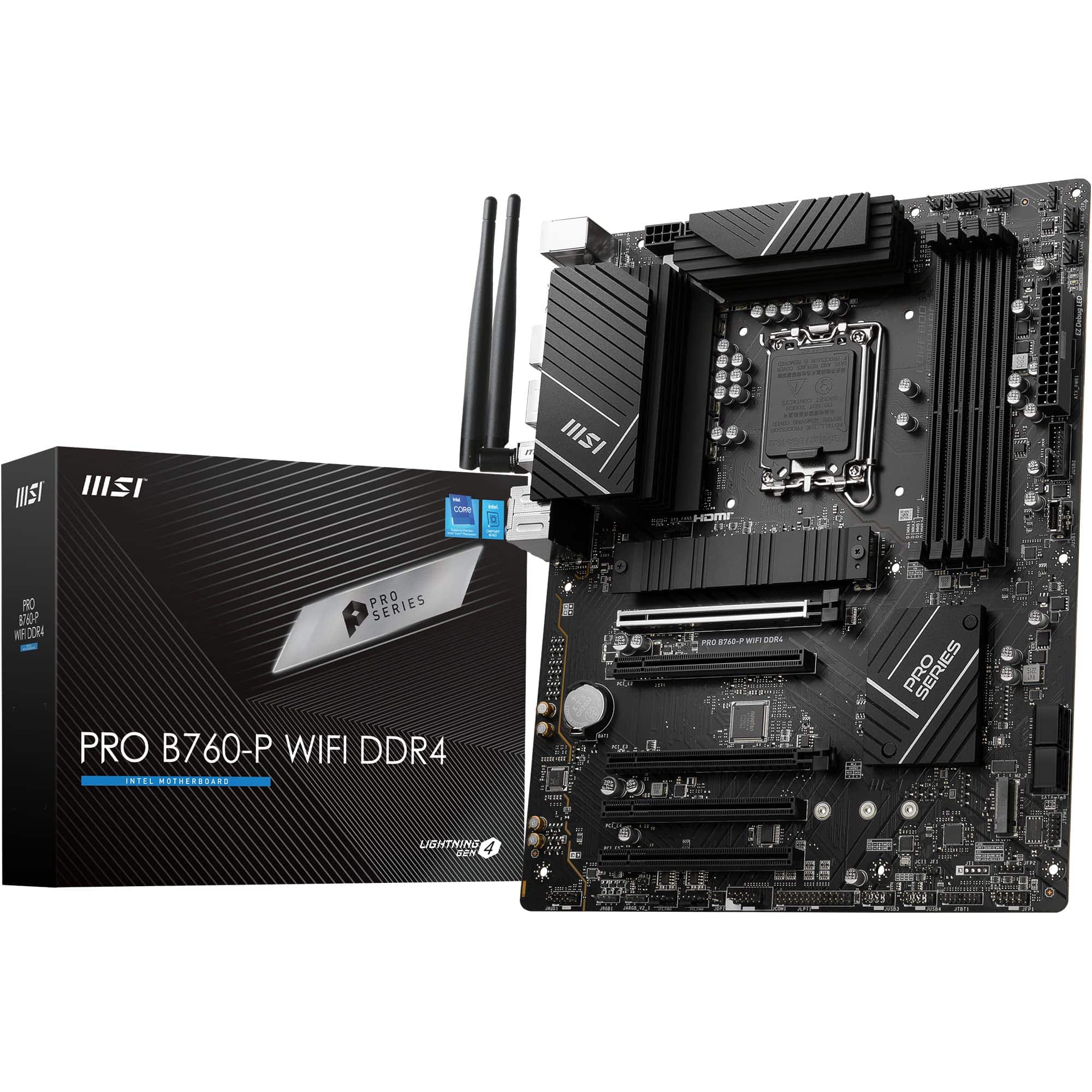 8.5 / 10
MSI PRO B760-P WIFI DDR4 Motherboard, ATX - Supports Intel 14th, 13th & 12th Gen Core Processors, LGA 1700 - DDR4 Memory Boost 5333+MHz/OC, PCIe 4.0 x16 Slots, M.2 Gen4 Slots, 2.5G LAN, Wi-Fi 6E
£129.95 · MSI
 8.5 / 10
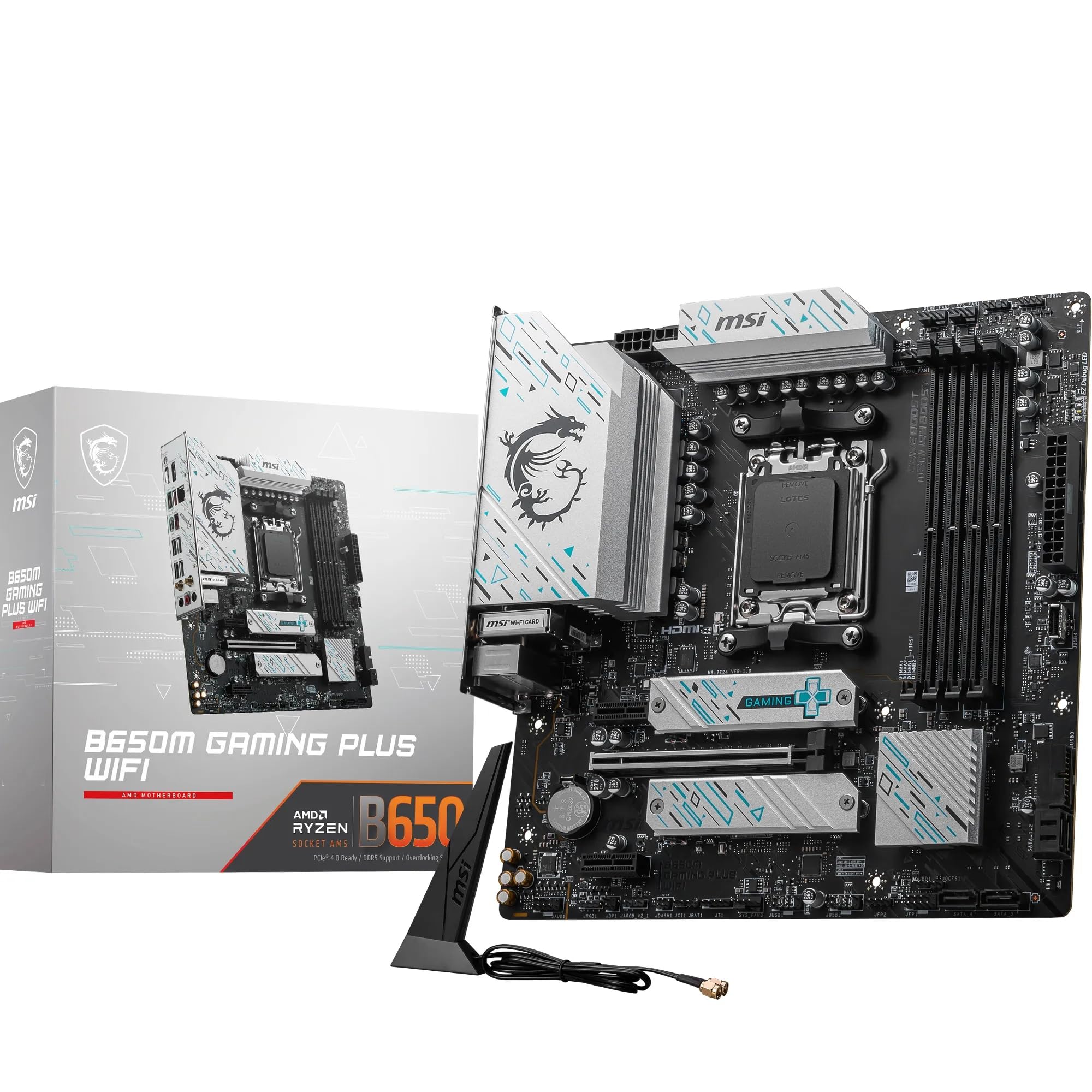
MSI B650M GAMING PLUS WIFI Motherboard, mATX - Supports AMD Ryzen 9000/8000 / 7000 Series Processors, AM5 - DDR5 Memory Boost 7800+ MHz/OC, PCIe 4.0 x16, M.2 Gen4, Wi-Fi 6E
£143.50 · MSI
Frequently asked
5 questions01Is the PRO B760M-A WIFI overkill for just gaming?+
Not really. The Wi-Fi 6E, dual M.2 Gen4 slots, and capable VRM are all features that benefit gaming builds. You're not paying for Z790 overclocking features you won't use. For a Core i5 or i7 gaming build, this board is well-matched rather than excessive.
02Will my existing CPU cooler work with the PRO B760M-A WIFI?+
The PRO B760M-A WIFI uses the LGA 1700 socket. Most coolers designed for LGA 1700 will be compatible, and many older LGA 1200 coolers can be used with an adapter bracket. Check your cooler manufacturer's compatibility list to confirm LGA 1700 support before buying.
03What happens if the PRO B760M-A WIFI doesn't work with my components?+
Amazon's standard 30-day returns policy applies, and purchases are covered by the Amazon A-to-Z Guarantee. If you have a genuine compatibility issue, contact Amazon within 30 days for a return or replacement. For component compatibility questions before buying, MSI's website lists the QVL (qualified vendor list) for compatible memory kits.
04Is there a cheaper motherboard I should consider instead?+
If you're running a modest CPU like a Core i3-12100 or a locked Core i5 and you don't need Wi-Fi 6E or dual Gen4 M.2, the Gigabyte B760M DS3H AX is worth a look at a lower price point. It cuts some corners on VRM quality and thermal pads, but for lighter loads it's perfectly adequate and saves you money for other components.
05What warranty and returns apply to the PRO B760M-A WIFI?+
Warranty terms are not specified in the verified product listing data. Amazon's 30-day return window and A-to-Z Guarantee apply to the purchase. For warranty specifics, check MSI's official support pages or the product listing at time of purchase.