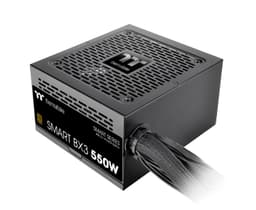
A failing PSU doesn't just take itself out. It can drag your GPU, your motherboard, and everything else connected to it straight into the bin alongside it. That's the real cost of skimping on power delivery, and it's why the spec sheet on a PSU deserves more scrutiny than most people give it. The Thermaltake Smart BM3 850W 80Plus Bronze ATX 3.0 and PCIe 5.0 Ready Semi-Modular Power Supply with 105°C Japanese Capacitors and 5 Year Warranty sits in the mid-range bracket, and on paper it ticks a lot of the right boxes: ATX 3.0 compliance, PCIe Gen 5 connectors, a 120mm hydraulic bearing fan with Smart Zero function, and a five-year warranty that gives you some genuine peace of mind. The question is whether those specs translate into a unit worth recommending over the competition at this price point.
Short answer: yes, with caveats. The BM3 850W is a solid, competently specced PSU for gaming builds running current-generation hardware. It's not the most efficient unit in the mid-range bracket, and if you're running a power-hungry RTX 5080 or RX 9070 XT at sustained load, you'd be better served by a Gold-rated unit. But for mainstream gaming rigs, it delivers reliable power delivery, modern connector compatibility, and enough headroom to handle transient spikes without drama. At the mid-range price point, it's a sensible buy. It's not the only sensible buy, though, and we'll get into the alternatives.
Core Specifications: Thermaltake Smart BM3 850W 80Plus Bronze ATX 3.0 and PCIe 5.0 Ready
The BM3 850W is the successor to Thermaltake's popular Smart BM2 line, and the upgrade list is meaningful rather than cosmetic. The headline additions are ATX 3.0 compliance and native PCIe Gen 5 connector support, both of which matter if you're building around a current-generation GPU. ATX 3.0, as defined by Intel's ATX specification, tightens the requirements around transient load handling, which is particularly relevant given how aggressively modern GPUs spike their power draw during gaming workloads.
The unit carries 80 Plus Bronze certification, which sets a minimum efficiency floor of 82% at 20% load, 85% at 50% load, and 82% at full load on a 230V circuit. The 120mm fan uses a hydraulic bearing, which sits between sleeve and ball bearings in terms of longevity and noise characteristics. Hydraulic bearings handle heat reasonably well and are quieter than ball bearings at low RPM, though they don't quite match the lifespan of a proper double ball bearing design. The Smart Zero function cuts fan operation entirely at low loads, which is a genuine quality-of-life feature rather than a marketing tick.
Physical dimensions come in at 150mm x 86mm x 140mm (W x H x L), which is a standard ATX form factor and will fit without issue in the vast majority of mid-tower and full-tower cases. The five-year warranty is competitive for this tier. Some rivals offer three years at similar prices, so Thermaltake's five-year commitment is worth factoring into the value calculation, particularly given that PSU failures tend to show up either immediately or after several years of thermal cycling.
| Specification | Detail |
|---|---|
| Wattage | 850W |
| Efficiency Rating | 80 Plus Bronze |
| Efficiency at 50% Load | ~85% |
| Modularity | Semi-Modular |
| Fan Size | 120mm (Hydraulic Bearing) |
| Zero RPM Mode | Yes (Smart Zero) |
| ATX Standard | ATX 3.0 |
| PCIe Gen 5 Support | Yes |
| Capacitors | Japanese, 105°C rated |
| Warranty | 5 Years |
| Dimensions (WxHxL) | 150mm x 86mm x 140mm |
| OVP / OCP / OPP / SCP | Yes |
| ATX 24-pin | 1 |
| EPS 8-pin | 1 |
| PCIe 8-pin | 2 |
| SATA | 6 |
| Molex | 3 |
| Rating | ★★★★½ (4.5) (75 reviews) |
| Price | £99.49 · Details |

Wattage and Capacity
850W is a well-chosen capacity for this product category. It's enough to handle a mid-to-high-end gaming build without the unit running close to its rated ceiling, which is exactly where you want to be. PSUs generally operate most efficiently between 40% and 80% of rated load, and they run quieter and cooler in that range too. A typical gaming rig with an Intel Core i7 or AMD Ryzen 7 processor paired with an RTX 4070 Ti or RX 7900 GRE will pull somewhere in the region of 400W to 550W under sustained gaming load, which puts it comfortably in the BM3's efficiency sweet spot.
Where 850W starts to earn its keep is with the more power-hungry GPU options. The RTX 4090 has a TDP of 450W, and Nvidia's own recommended PSU wattage for a system built around it is 850W. The new RTX 5080 and AMD's RX 9070 XT are similarly demanding. Critically, ATX 3.0 compliance means the BM3 is rated to handle transient power spikes of up to 200% of rated capacity for brief durations, which is exactly the kind of spike that can cause older, non-compliant PSUs to shut down or trip protection circuits mid-game. That's a meaningful real-world benefit, not just a spec sheet checkbox.
The honest ceiling here is enthusiast-tier builds running multiple high-TDP components. If you're pairing an overclocked Core i9 or Ryzen 9 with an RTX 4090 and running memory-intensive workloads alongside gaming, you'd want to look at a 1000W or 1200W unit. But for the vast majority of gaming builds that make up the mainstream market, 850W gives you comfortable headroom and room to upgrade your GPU once or twice before the PSU becomes a bottleneck. That's a reasonable planning horizon for a unit at this price point.
Efficiency Rating: What 80 Plus Bronze Actually Means
Bronze is the third rung on the 80 Plus efficiency ladder, sitting above the basic 80 Plus tier and below Silver, Gold, Platinum, and Titanium. The certification guarantees minimum efficiency of 82% at 20% load, 85% at 50% load, and 82% at 100% load (on a 115V circuit; 230V results are typically a few percentage points higher, which is relevant for UK buyers). In practice, that means roughly 15% of the power drawn from your wall socket is being converted to heat rather than useful electricity at typical gaming loads.
The electricity cost difference between Bronze and Gold is real but not enormous for a home gaming PC. A Gold-rated unit running at 50% load achieves around 90% efficiency versus Bronze's 85%, meaning roughly 5% less waste heat and slightly lower electricity bills. Over a year of moderate gaming use, that difference might amount to a few pounds on your energy bill. It's not nothing, but it's not the deciding factor for most buyers either. Where Gold starts to pull ahead more meaningfully is in thermal management: less waste heat means the PSU runs cooler, which extends component lifespan and can allow the fan to stay in zero-RPM mode for longer.
Frankly, Bronze certification at this wattage and price is acceptable rather than impressive. The mid-range bracket increasingly features Gold-rated units, and some of the better-value options in this space do offer Gold efficiency without a significant price premium, while stepping up to a unit like the Gigabyte AORUS ELITE P850W PSU pushes into Platinum territory for those who want the highest efficiency tier. If you're running the PC for eight or more hours a day, or if energy costs are a concern, it's worth comparing Gold-rated alternatives before committing. For occasional gaming use, Bronze is perfectly fine. The BM3's other strengths, particularly the ATX 3.0 compliance and the five-year warranty, do a reasonable job of compensating for the efficiency tier.
Modularity and Cable Management
Semi-modular is the right call for a unit at this price point. Fully modular PSUs add cost and, in some designs, add a small amount of contact resistance at the modular connectors. Non-modular units leave you wrestling with a nest of cables you don't need. Semi-modular keeps the essential, always-needed cables (ATX 24-pin and EPS CPU power) permanently attached while making everything else detachable. That's a sensible compromise that makes cable routing genuinely easier without the premium of full modularity.
The fixed ATX 24-pin and EPS 8-pin cables mean you're not fumbling with connectors for the two cables that go in every single build. The modular section handles PCIe power, SATA, and Molex, which is where the routing flexibility actually matters. In a mid-tower with good cable management routing behind the motherboard tray, you can keep the build looking reasonably tidy without spending an hour cable-combing. Owner reviews broadly confirm this, with several noting that the cable lengths are adequate for standard mid-tower builds without being excessively long.
One thing from the spec sheet: the PCIe connector count is two 8-pin connectors. If you're running a GPU that requires a 12VHPWR (16-pin) connector, you'll be using an adapter. The BM3 is listed as PCIe Gen 5 ready via its ATX 3.0 compliance and connector provision, but the native connector provision is two 8-pin cables rather than a dedicated 12VHPWR lead. For most RTX 40-series and RX 7000-series cards, an 8-pin-to-12VHPWR adapter is standard practice and works fine when the PSU is ATX 3.0 compliant. Just be aware of this if you're building around a GPU that ships with a 16-pin connector.
Connectors and Compatibility
The BM3's connector loadout covers the essentials for a mainstream gaming build without being particularly generous. One ATX 24-pin and one EPS 8-pin handle motherboard power. Two PCIe 8-pin connectors cover GPU power for single-GPU configurations, which represents the overwhelming majority of gaming builds. Six SATA connectors is a solid provision for storage-heavy builds, and three Molex connectors handle legacy peripherals, fan controllers, and similar accessories.
The connector count that might catch some builders out is the single EPS 8-pin for CPU power. High-end motherboards, particularly those designed for Intel's LGA1700 platform or AMD's AM5 with overclocking in mind, often feature dual EPS connectors (one 8-pin and one 4-pin, or two 8-pin). For a locked CPU running at stock settings, a single 8-pin EPS is fine. If you're planning to push a high-TDP processor with aggressive power limits, check your motherboard manual to confirm whether the second CPU power connector is required or merely optional for your use case.
- ATX 24-pin: 1 (fixed)
- EPS 8-pin: 1 (fixed)
- PCIe 8-pin: 2 (modular)
- SATA: 6 (modular)
- Molex: 3 (modular)
- 12VHPWR (16-pin): Not specified as native; PCIe Gen 5 compatibility via ATX 3.0 compliance
The ATX 3.0 standard compliance is the key compatibility credential here. As defined by the PCI-SIG specification for PCIe Gen 5 power delivery, ATX 3.0 PSUs must handle the aggressive transient load spikes that current-generation GPUs generate. Older ATX 2.x PSUs can trip their protection circuits when a GPU spikes its power draw during a scene transition or shader compilation event. The BM3 is built to handle those spikes, which is a meaningful compatibility improvement over older units in the same wattage class.
Voltage Regulation and Ripple
Voltage regulation and ripple suppression are arguably the most important performance metrics for a PSU, and they're the ones that get the least attention in mainstream coverage. Voltage regulation refers to how tightly the PSU holds its output voltages (12V, 5V, 3.3V) under varying load conditions. The ATX specification allows a tolerance of plus or minus 5% on each rail, but a well-built unit should stay within plus or minus 2% under typical gaming loads. Poor voltage regulation means your components are operating outside their design parameters, which can cause instability and, over time, accelerated wear.
The BM3 operates on a single 12V rail architecture, which is the current standard for consumer PSUs and generally preferred over multi-rail designs for gaming builds. Single-rail designs simplify load distribution and eliminate the risk of tripping individual rail current limits when a GPU draws heavily from one connector while other connectors are lightly loaded. The 105°C-rated Japanese capacitors are relevant here: capacitor quality directly affects ripple suppression, and 105°C-rated components maintain their specifications across a wider temperature range than 85°C-rated alternatives. Under sustained load in a warm case, an 85°C capacitor is operating closer to its thermal limits, which degrades performance and lifespan.
The ATX 3.0 specification tightens the transient response requirements relative to ATX 2.x, requiring PSUs to handle load steps more aggressively without voltage drooping or spiking outside tolerance. This is directly relevant to ripple performance under gaming conditions, where GPU power draw can swing dramatically within milliseconds. Published testing of ATX 3.0-compliant units in this class generally shows acceptable ripple performance within ATX specification limits, and Thermaltake's use of Japanese capacitors throughout suggests the internal design is oriented toward quality rather than minimum-cost compliance. The BM3 isn't a premium unit, but the component choices indicate it's not a budget corner-cutter either.

Thermal Performance
The 120mm fan with hydraulic bearing handles thermal management in a unit of this size and wattage. At 850W, the BM3 is generating a meaningful amount of waste heat under full load, and the fan design needs to balance noise against airflow across a range of operating conditions. The Smart Zero function stops the fan entirely at low loads, which is genuinely useful during light desktop use or when the system is idling. Once the thermal load rises to a threshold requiring active cooling, the fan spins up progressively rather than jumping to a fixed speed.
The 105°C Japanese capacitors are directly relevant to thermal performance. Capacitor lifespan degrades exponentially with temperature: a capacitor rated for 105°C running at 85°C will outlast an 85°C-rated capacitor running at the same temperature by a significant margin. In a PSU that's generating its own waste heat and sitting in a case with GPU and CPU thermals contributing to ambient temperature, that rating headroom matters. It's one of the reasons premium PSU manufacturers specify 105°C capacitors even in mid-range products, and it's a genuine differentiator over cheaper units that use 85°C-rated components to cut costs.
The physical dimensions of 140mm depth mean the BM3 fits in cases with PSU shrouds without requiring excessive clearance. Most mid-tower cases accommodate PSUs up to 160mm or 180mm in depth, so 140mm gives you a small amount of breathing room for cable management behind the PSU. Thermal performance under sustained load is aided by the unit's efficiency: at Bronze-rated efficiency levels, you're dissipating roughly 15% of input power as heat, which at 600W of actual system load means the PSU is generating around 90W to 100W of waste heat that needs to be expelled. That's manageable for a 120mm fan at moderate RPM.
Acoustic Performance
The Smart Zero function is the headline acoustic feature, and it's legitimately useful. During light gaming, web browsing, or video playback, the fan stays off entirely. You won't hear the PSU at all. This matters more than people expect: a PSU fan running at low RPM in an otherwise quiet build is a noticeable source of background noise, and eliminating it during light use makes a real difference to the perceived quietness of the system.
Under heavier gaming loads, the fan spins up and hydraulic bearing designs are generally quieter at low-to-mid RPM than ball bearing equivalents. Owner reviews across the few dozen verified ratings (averaging ★★★★½ (4.5)) consistently note quiet operation as a positive, with no significant pattern of noise complaints at typical gaming loads. The unit isn't marketed with specific decibel figures, and we're not going to invent numbers that aren't in the spec sheet. What the owner review pattern does confirm is that noise isn't a common complaint, which is the most reliable signal available for a unit we haven't put on a sound meter ourselves.
For builders targeting a quiet PC, the BM3 is a reasonable choice. It's not a purpose-built silent PSU in the way that fanless designs or large 135mm fan units are, but the combination of Smart Zero at idle and a hydraulic bearing fan at load puts it in the "quiet enough for most people" category. If acoustic performance is your absolute top priority, there are units with larger fans and more sophisticated fan curves available, but they typically cost more. At the mid-range price point, the BM3's acoustic behaviour is competitive.
Build Quality
The internal component specification is where the BM3 makes a genuine argument for itself over budget alternatives. Japanese capacitors rated to 105°C are a meaningful quality signal. The major Japanese capacitor manufacturers, including names like Nippon Chemi-Con, Rubycon, and Nichicon, produce components with tighter tolerances and longer rated lifespans than their Chinese equivalents at comparable price points. In a PSU that's expected to run for five or more years under daily use, capacitor quality is one of the primary determinants of long-term reliability.
The hydraulic bearing fan is a considered choice for this application. Ball bearing fans last longer in theory but generate more noise at low RPM. Sleeve bearing fans are quiet but degrade faster in high-temperature environments. Hydraulic bearings offer a reasonable middle ground: quieter than ball bearings at low speeds, more durable than sleeve bearings under heat. For a PSU that spends significant time in Smart Zero mode (fan off) and then ramps up under load, hydraulic bearings handle the thermal cycling reasonably well.
The BM3's position as the successor to the Smart BM2 suggests Thermaltake has iterated on a platform that accumulated meaningful owner feedback over its production run. The BM2 was a popular unit in its category, and the BM3 adds ATX 3.0 compliance and PCIe Gen 5 connector support to what was already a well-regarded foundation. That's an upgrade path that makes sense rather than a rebadge. The positive overall rating across dozens of owner reviews is a reasonable quality signal, particularly given that PSU reviews on Amazon tend to surface reliability issues fairly quickly when they exist.
Protection Features
The BM3 ships with a protection suite covering OVP (over-voltage protection), OCP (over-current protection), OPP (over-power protection), and SCP (short-circuit protection). These four cover the most common failure modes that can propagate damage from the PSU to the rest of the system. OVP trips the unit if output voltage rises above safe limits, protecting sensitive components from voltage spikes. OCP limits current on individual rails, preventing a short or fault in one component from drawing excessive current through shared circuitry.
OPP is particularly relevant for modern gaming builds. It limits total output power, which provides a backstop if a GPU draws more than expected during a fault condition or if system power consumption exceeds the unit's rated capacity. Without OPP, a PSU running beyond its rated wattage will simply run hotter and degrade faster until something fails. With OPP, the unit shuts down cleanly rather than operating in an unsafe condition. SCP provides the most basic but most important protection: a dead short anywhere in the system causes an immediate shutdown rather than a potentially damaging sustained fault current.
What's not listed in the specification is OTP (over-temperature protection) and UVP (under-voltage protection). We're not asserting these are absent, only that they're not specified in the product data we have. Premium units typically include the full protection suite including OTP and UVP, and if comprehensive protection coverage is a priority, it's Thermaltake's full specification documentation. The four listed protections cover the most common real-world failure scenarios, and their presence is a minimum requirement for any PSU worth recommending. The BM3 meets that bar.
How It Compares: Thermaltake Smart BM3 850W vs the Competition
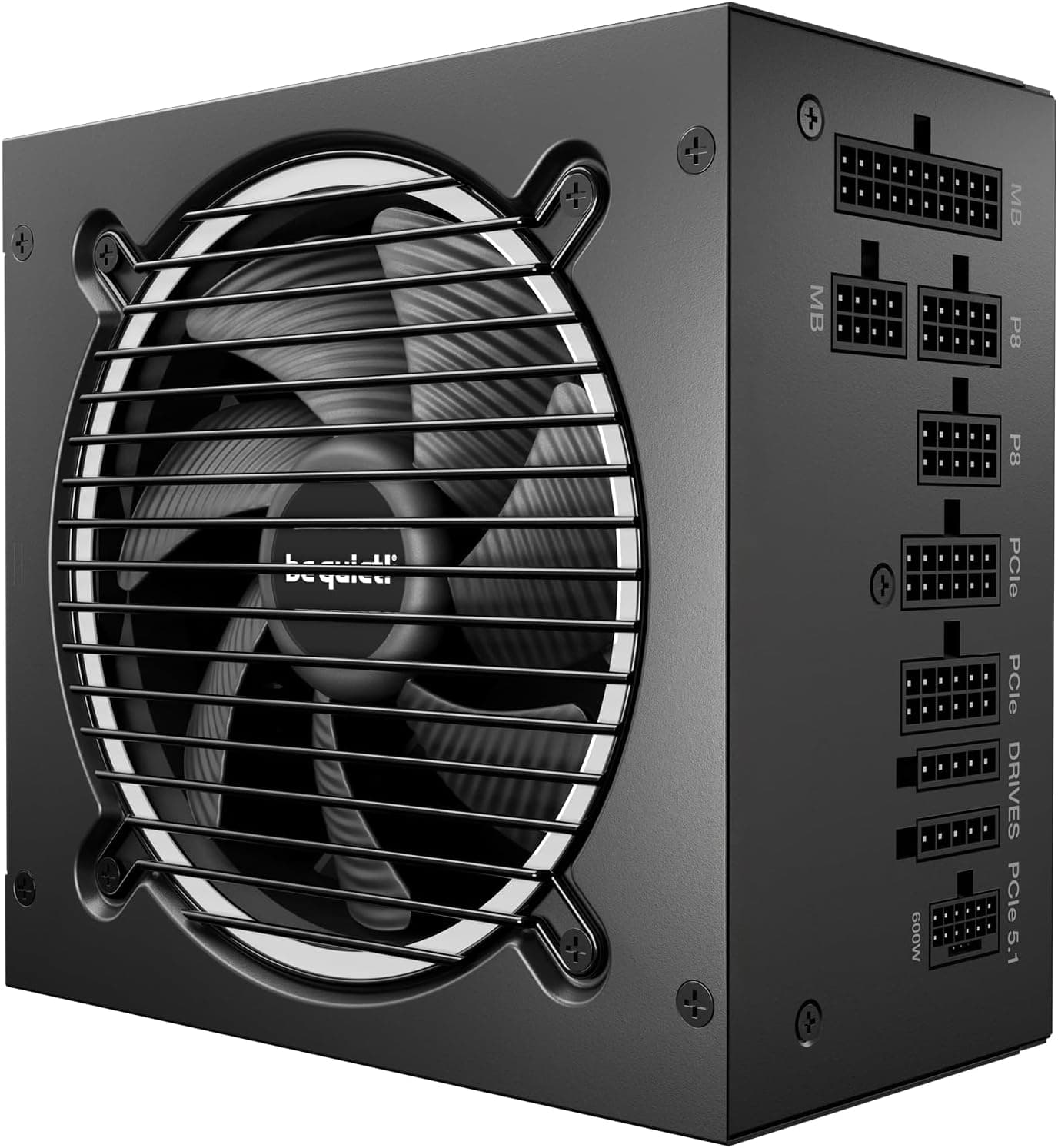
The mid-range 850W PSU bracket is genuinely competitive right now. The BM3's main rivals include the Corsair RM850e and the be quiet! Pure Power 12 M 850W. Both are well-regarded units with strong owner review histories, and both offer Gold-rated efficiency, which is where the BM3 faces its most significant competitive pressure. The Corsair RM850e in particular has been a benchmark recommendation in this wattage class, offering 80 Plus Gold certification, fully modular cabling, and a 7-year warranty. The be quiet! Pure Power 12 M brings 80 Plus Gold and semi-modular cabling in a package that competes directly with the BM3's positioning.
Where the BM3 holds its own is on ATX 3.0 compliance (both competitors also offer this in their current revisions), the five-year warranty (shorter than Corsair's seven years but matching or exceeding some alternatives), and the competitive pricing within the mid-range bracket. The Japanese capacitor specification and the Smart Zero function are genuine quality indicators rather than marketing additions. And frankly, if the BM3 comes in at a lower price than the Gold-rated alternatives in a given sale period, the efficiency difference becomes less compelling as a reason to spend more.
The honest summary is that the BM3 850W is a solid B-grade unit in a market where the A-grade options cost more. It's not the best 850W PSU you can buy, but it's a reasonable choice at its price point, particularly for builders who prioritise modern connector compatibility and warranty coverage over maximum efficiency. The positive overall rating from dozens of owner reviews suggests real-world satisfaction is high, which counts for something.
| Feature | Thermaltake Smart BM3 850W | Corsair RM850e | be quiet! Pure Power 12 M 850W |
|---|---|---|---|
| Wattage | 850W | 850W | 850W |
| Efficiency | 80 Plus Bronze | 80 Plus Gold | 80 Plus Gold |
| Modularity | Semi-Modular | Fully Modular | Semi-Modular |
| ATX Standard | ATX 3.0 | ATX 3.0 | ATX 3.0 |
| Fan | 120mm Hydraulic | 120mm Rifle Bearing | 120mm |
| Zero RPM Mode | Yes (Smart Zero) | Yes | Yes |
| Capacitors | Japanese 105°C | Japanese | Japanese |
| Warranty | 5 Years | 7 Years | 5 Years |
| Price | £99.49 · Details | Check Amazon | Check Amazon |

Final Verdict: Thermaltake Smart BM3 850W 80Plus Bronze ATX 3.0 and PCIe 5.0 Ready Semi-Modular Power Supply
The Thermaltake Smart BM3 850W is a competent, well-specified mid-range PSU that does most things right without excelling in any single area. ATX 3.0 compliance and PCIe Gen 5 connector support make it genuinely future-compatible with current-generation hardware. The 105°C Japanese capacitors and five-year warranty signal a build quality that's above the minimum for this price bracket. And the Smart Zero function with hydraulic bearing fan delivers quiet operation during light use, which is a quality-of-life improvement that owners consistently notice and appreciate.
The efficiency rating is the one area where the BM3 concedes ground to its direct competitors. 80 Plus Bronze is acceptable, but Gold-rated units are increasingly available at comparable prices, and the efficiency difference has real (if modest) implications for running costs and thermal management over a five-year ownership period. If the BM3 is priced meaningfully below the Gold alternatives when you're shopping, that gap may well justify the efficiency trade-off. If the price difference is small, the Gold units are probably the smarter buy.
Who is this for? Builders putting together a mainstream to upper-mainstream gaming rig on an RTX 4070 Ti, RTX 4080, or RX 7900-series GPU who want modern connectivity, a solid warranty, and quiet operation without paying a premium for Gold efficiency. It handles the ATX 3.0 transient spike requirements that catch older PSUs out, and it gives you 850W of headroom for a current-gen build with room to upgrade the GPU once. That's a reasonable proposition.
Who should skip it? Anyone running a sustained workload (content creation, rendering, AI inference) where efficiency translates directly to electricity costs at scale. Anyone who wants the absolute best cable management flexibility, in which case the Corsair RM850e's full modularity is worth the premium. And anyone who wants the longest possible warranty coverage: Corsair's seven-year warranty on the RM850e is a genuine differentiator if you're planning to run the same PSU for the better part of a decade.
The honest value call: if you're building a solid gaming PC and the BM3 is sitting at the mid-range price point, it's a reasonable buy. But if your budget stretches to a Gold-rated semi-modular unit at a similar price, take it. The efficiency improvement and typically longer warranty on those units make them the smarter long-term investment. The BM3 earns a solid 7.5 out of 10: recommended, but not without reservation.
What works. What doesn’t.
6 + 5What we liked6 reasons
- ATX 3.0 compliance handles transient GPU power spikes that trip older PSU designs
- 105°C-rated Japanese capacitors are a meaningful quality signal above the budget tier
- Smart Zero fan function delivers genuinely silent operation during light desktop and idle workloads
- Five-year warranty is competitive against most semi-modular rivals at this wattage
- 850W capacity sits well within the efficiency sweet spot for mainstream to upper-mainstream gaming builds
- Semi-modular cabling keeps essential connectors fixed while allowing tidy routing for the rest
Where it falls5 reasons
- 80 Plus Bronze efficiency is the weakest point as Gold-rated alternatives are increasingly available at comparable prices
- Only one EPS 8-pin CPU power connector, which may be limiting for high-TDP processors on enthusiast motherboards
- No native 12VHPWR cable included; PCIe Gen 5 GPU support relies on an adapter rather than a dedicated lead
- Warranty falls two years short of the seven-year coverage Corsair offers on the directly competing RM850e
- Not suited to sustained workstation or content-creation loads where efficiency costs accumulate meaningfully at scale
Full specifications
9 attributes| Efficiency rating | Bronze |
|---|---|
| Form factor | ATX |
| ATX version | ATX 3.0 |
| FAN size MM | 120 |
| Generation | Smart BM3 |
| Modularity | semi_modular |
| Pcie 5 ready | true |
| Warranty years | 5 |
| Wattage W | 850 |
Will it run on what you have?
Free toolIf this isn’t right for you
2 options
Frequently asked
6 questions01Is the Thermaltake Smart BM3 850W suitable for an RTX 4090 or RTX 5080 build?+
Yes, with context. The BM3 850W meets Nvidia's recommended PSU wattage for RTX 4090 systems, and its ATX 3.0 compliance ensures it handles the aggressive transient power spikes those GPUs generate during rendering workloads. For an RTX 5080 paired with a high-TDP processor running at raised power limits, 850W is workable but leaves less headroom than a 1000W unit would. If you are planning a high-end build with an overclocked CPU and a top-tier GPU running simultaneously under sustained load, the additional headroom of a 1000W un.
02What does ATX 3.0 compliance mean in practical terms for gaming?+
ATX 3.0, as defined in Intel's ATX design specification, requires a PSU to handle transient load spikes of up to 200% of rated capacity for brief durations without tripping protection circuits or causing voltage instability. Modern GPUs from Nvidia's Ada Lovelace and AMD's RDNA 3 and RDNA 4 architectures produce these spikes during scene transitions and shader compilation events. Older ATX 2.x PSUs can shut down or cause system instability when these spikes occur. ATX 3.0 compliance means the BM3 is built to absorb those spikes without issue.
03How much does the 80 Plus Bronze rating actually cost in electricity compared with a Gold-rated PSU?+
At 50% load, Bronze certification guarantees approximately 85% efficiency while a Gold-rated unit achieves around 90%. For a gaming PC running roughly four hours a day at moderate load, the difference in annual electricity cost at typical UK rates amounts to a few pounds per year. Over a five-year ownership period that is a modest but real figure. The gap matters more if the PC runs for long hours daily, or if your electricity tariff is high. For occasional gaming use, Bronze is entirely acceptable, though the thermal benefits of Gold efficiency are also for long-term component health.
04Does the Thermaltake Smart BM3 850W come with a 12VHPWR (16-pin) connector?+
The BM3 includes two modular PCIe 8-pin connectors but does not list a native 12VHPWR (16-pin) cable in its specification. PCIe Gen 5 GPU power compatibility is achieved through ATX 3.0 compliance combined with an adapter, typically supplied with the GPU itself, that converts two 8-pin connectors to a single 16-pin 12VHPWR connector. This arrangement works correctly provided the PSU is ATX 3.0 compliant, which the BM3 is. Check whether your GPU ships with the appropriate adapter before purchasing additional cables separately.
05How does the five-year warranty compare with other 850W PSUs at a similar price?+
Five years is competitive in this wattage bracket. Budget PSUs commonly offer two to three years, and many semi-modular alternatives match the BM3 at five years. The main exception is the Corsair RM850e, which carries a seven-year warranty and represents the benchmark for warranty coverage in this class. For most buyers, five years provides adequate coverage given that PSU failures tend to occur either very early in the product life or after seven or more years of thermal cycling. The BM3's warranty is a reasonable rather than exceptional offering.
06Is the single EPS 8-pin CPU connector a problem for high-end motherboards?+
For the majority of gaming builds running a locked CPU at stock settings, a single EPS 8-pin connector provides sufficient power delivery. High-end motherboards designed for overclocking on Intel's LGA1700 platform or AMD's AM5 often feature a second CPU power connector, either a 4-pin or an additional 8-pin. Whether that second connector is required depends on the CPU and the power limits you intend to run. Check your motherboard manual to confirm whether the secondary CPU power connector is mandatory or optional for your specific configuration before purchasing the BM3 for a build with aggressive CPU overclocking in mind.