Your power supply is the one component that can take everything else down with it if it's dodgy. Seriously. A failing PSU doesn't just die quietly, it can drag your GPU, your motherboard, your storage, the lot. So when someone asks whether they should just grab the cheapest thing on Amazon, the answer is always: spend a bit more and get something with a proper brand behind it. The CORSAIR CX550 80 PLUS Bronze Non Modular Low-Noise ATX 550 Watt Power Supply - UK - Black sits right at the budget end of the Corsair range, and it's one of the most popular 550W options on Amazon UK right now.
With 229 owner reviews averaging ★★★★½ (4.7) (which, frankly, is better than most PSUs twice the price), it's clearly doing something right. And at the budget end of the market (under £50), it's hard to argue with the value. But is it actually good, or is it just cheap enough that people are grading on a curve? Spoiler: it's genuinely decent for what it is. Here's the full breakdown.
★★★★½ (4.7) from 229 owner reviews on Amazon.
Core Specifications: CORSAIR CX550 80 PLUS Bronze Non Modular Low-Noise ATX 550 Watt Power Supply - UK - Black
Right, let's get the numbers on the table. This is a 550W ATX power supply with an 80 Plus Bronze efficiency certification, which means it's been independently verified to hit at least 82% efficiency at 20% load, around 85% at 50% load, and 82% again at full load. Non-modular design, 120mm cooling fan, and a five-year warranty from Corsair. That warranty alone puts it ahead of a lot of the no-name units cluttering up the budget end of the market.
The cable configuration is what you'd expect for a mid-tier gaming build: one ATX 24-pin, one EPS 8-pin for the CPU, two PCIe 8-pin connectors for graphics cards, six SATA connectors, and three Molex. No 12VHPWR (the 16-pin connector for high-end GPUs like the RTX 4080/4090), but honestly at 550W you wouldn't be running one of those anyway, so that's not a real omission. Protection features include OVP (over-voltage), OCP (over-current), OPP (over-power), and SCP (short-circuit). The casing is 125mm long, which Corsair specifically calls out because it'll fit in pretty much any modern case without issue.
The build is finished in black powder-coat with black sleeved cables throughout. It's not the most exciting thing to look at, but it looks tidy in a build and the sleeving is a genuine quality-of-life improvement over the bare cables you get on some budget units. Below is the full spec rundown.
| Specification | Detail |
|---|---|
| Wattage | 550W continuous |
| Efficiency Rating | 80 Plus Bronze |
| Efficiency at 50% Load | ~85% |
| Modularity | Non-modular |
| Fan Size | 120mm thermally controlled |
| Zero RPM Mode | No |
| Warranty | 5 years |
| Form Factor | ATX |
| Casing Length | 125mm |
| ATX 24-pin | 1 |
| EPS 8-pin (CPU) | 1 |
| PCIe 8-pin | 2 |
| SATA | 6 |
| Molex | 3 |
| 12VHPWR | Not included |
| Protection | OVP, OCP, OPP, SCP |
| Price | £47.97 |
Wattage and Capacity
550W is a solid sweet spot for a budget gaming build in 2026. It's enough headroom for a mid-range CPU (think Ryzen 5 or Intel Core i5) paired with something like an RTX 4060 or RX 7600, with room to spare. You're not going to be running an RTX 4080 off this, and you shouldn't try, but for the builds this PSU is actually aimed at, 550W is comfortable rather than squeaky-tight. If you're unsure what wattage your specific build needs, run it through our PSU calculator before buying.
What matters here is that Corsair guarantees the full rated wattage as continuous power, not peak. That's actually a bigger deal than it sounds. Some budget PSUs advertise a headline wattage that's technically only achievable for brief peaks, and their continuous rating is lower. The CX550 doesn't play that game. 550W means 550W, all day, under sustained load. That's the kind of honest spec sheet you want from a PSU, because your components are drawing continuous power, not just occasional bursts.
For context: an entry-level build with a Core i3 or Ryzen 5 and a mid-range GPU is typically pulling somewhere in the 250W to 350W range under gaming load. That gives you a comfortable 200W of headroom with this unit, which is exactly where you want to be. Headroom matters because PSUs run most efficiently and most quietly when they're not being flogged at 90% capacity. Running a 550W PSU at around 50% to 60% load is actually the sweet spot for efficiency too, which ties nicely into the Bronze rating.
Efficiency Rating
The 80 Plus Bronze certification means this PSU has been independently tested and verified to deliver at least 82% efficiency at 20% load, 85% at 50% load, and 82% at 100% load. What does that actually mean in practice? It means for every 100W your components draw, the PSU is pulling roughly 115W to 122W from the wall, converting the rest to heat. The difference between that and an uncertified budget PSU (which might only be 70% to 75% efficient) is real money over time, especially if your PC is on for long hours.
Bronze isn't the top of the efficiency ladder. Gold is the next meaningful step up (87% to 90% at 50% load), and Platinum and Titanium sit above that. But here's the honest truth: the electricity cost difference between Bronze and Gold at 550W, for a typical gaming PC that's actually gaming maybe 4 to 6 hours a day, is a few pounds a year at UK electricity rates. It's not nothing, but it's not a reason to spend significantly more on the PSU itself unless you're running a workstation that's on 24/7 under heavy load. For a gaming rig, Bronze is perfectly sensible.
Corsair specifically highlights that the CX550 generates less heat than less efficient alternatives, and that's a real benefit in a compact case. Less wasted heat means your case fans don't have to work as hard, which can make a small but noticeable difference to overall system temperatures. At this price point, 80 Plus Bronze is about as good as it gets without stepping up to a more expensive unit, and it's a meaningful step above the unrated units you'll find at the very bottom of the market.
Modularity and Cable Management
The CX550 is non-modular, which means all the cables come attached and you can't remove the ones you don't need. For some people that's a dealbreaker. For most people building a budget gaming rig, it's just fine. Non-modular PSUs are cheaper to manufacture and therefore cheaper to buy, and at this price tier, that trade-off makes sense. The cables you're not using just get bundled up and stuffed behind the motherboard tray, which is exactly what most builders do anyway.
The cables themselves are black sleeved throughout, which is a genuine quality-of-life upgrade over bare coloured wires. It makes cable management tidier and the inside of your case looks a lot cleaner, even with the excess bundled away. The casing is powder-coated black as well, so the whole unit has a consistent, tidy look. It's not braided paracord sleeving like you'd get on a premium modular unit, but for the budget bracket, it's above average presentation.
Cable lengths are standard for the class. The ATX 24-pin and EPS 8-pin are long enough for most mid-tower cases without issue, and the six SATA connectors give you plenty of reach for drives mounted in various positions. The 125mm casing length is genuinely compact and: some budget PSUs are longer and can cause clearance issues in smaller cases. Corsair has clearly designed this to be a drop-in fit for the widest possible range of builds, and that compact form factor is a practical advantage over some of the competition.
Connectors and Compatibility
The connector set on the CX550 covers the bases for a mainstream gaming build without any obvious gaps. One ATX 24-pin for the motherboard, one EPS 8-pin for the CPU (sufficient for most mainstream CPUs, though high-end overclocking boards sometimes want a second 8-pin), two PCIe 8-pin connectors for the graphics card, six SATA for storage and optical drives, and three Molex for older peripherals or fan hubs. That's a practical, well-rounded set for a build in this wattage class.
The two PCIe 8-pin connectors mean you can power a dual-connector GPU like an RTX 4070 without any adapters, which is exactly what you'd expect at 550W. There's no 12VHPWR connector, but as mentioned, that's for the high-end cards that need 600W or more just for the GPU alone. Pairing a 12VHPWR card with a 550W PSU would be a bad idea regardless, so the absence of that connector is consistent with the product's sensible positioning.
Six SATA connectors is genuinely generous for this price point. If you're running an SSD for the OS, a secondary SSD for games, and maybe a spinning hard drive for bulk storage, you've still got three connectors left over. That's enough for a well-stocked storage setup without any daisy-chain concerns. The three Molex connectors are a bit legacy at this point, but they're useful for older fan controllers, certain RGB hubs, and other peripherals that haven't moved to SATA power.
- ATX 24-pin: 1 (motherboard main power)
- EPS 8-pin: 1 (CPU power)
- PCIe 8-pin: 2 (GPU power)
- SATA: 6 (storage and peripherals)
- Molex: 3 (legacy devices, fan hubs)
- 12VHPWR: Not included (not needed at this wattage)
Voltage Regulation and Ripple
Voltage regulation is where budget PSUs often cut corners, and it's where you need to pay attention if you're buying in this bracket. The Corsair CX Series has a published reputation for decent voltage regulation on the 12V rail, which is the rail your GPU and CPU draw the most from. Stable 12V power under load is what keeps your system from throwing random errors, crashes, or throttling events that look mysteriously like software problems but are actually a power delivery issue.
The CX550 uses a single 12V rail design, which is the standard approach for mainstream gaming PSUs. Multi-rail designs split the 12V into separate rails with individual current limits, which can be safer in theory but adds complexity and can cause issues if a high-draw component exceeds the per-rail limit. Single rail is simpler and generally better suited to gaming builds where the GPU might spike its draw significantly during heavy scenes. Published testing of the CX Series by independent outlets has generally found the voltage regulation to be within acceptable tolerances for a Bronze-rated unit, sitting comfortably within the ATX specification's allowable variance.
Ripple suppression is the other side of this coin. Ripple is the AC noise that gets superimposed on the DC output rails, and excessive ripple can cause instability in sensitive components. The CX550's protection suite (OVP, OCP, OPP, SCP) handles the big failure modes, but ripple is a subtler quality indicator that the protection features don't directly address. Based on what's known about the CX Series platform, ripple suppression is adequate for a Bronze unit, though it won't match what you'd get from a Gold or higher-rated PSU with a more refined design. For a mainstream gaming build, it's fine. For a precision workstation or audio production rig, you'd want to spend more.
Thermal Performance
The 120mm thermally controlled fan is the key thermal management tool here. Corsair's approach is straightforward: the fan runs slowly at low loads, ramps up as thermal load increases, and only hits high speed under heavy stress. There's no zero-RPM mode on the CX550 (that's a feature you generally find on more expensive Gold and Platinum units), so the fan is always spinning to some degree, but at low loads it's spinning slowly enough that it's pretty much inaudible in a typical build.
The 125mm compact casing is relevant to thermals as well. A shorter PSU means a slightly more constrained internal layout, which can make thermal management harder for the manufacturer. Corsair has clearly engineered around this, and the thermal performance in owner reviews doesn't flag overheating as a concern. The fan curve appears to be tuned conservatively, meaning it ramps up before temperatures become a problem rather than waiting until things are already hot. That's the right approach for long-term reliability.
The efficiency advantage of the Bronze rating also plays into thermals. At 85% efficiency at 50% load, the CX550 is converting 15% of the power it draws into heat. A less efficient unit at 75% efficiency would be generating significantly more heat for the same output. Less waste heat inside the PSU means lower operating temperatures, which is directly linked to component longevity. Capacitors in particular degrade faster at higher temperatures, so a more efficient PSU running cooler is genuinely going to last longer than an inefficient one running hot.
Acoustic Performance
Owner reviews consistently highlight quiet operation as one of the CX550's strongest points. At low to medium loads (which covers most everyday computing and even light to medium gaming), the fan is running slowly enough that it's not adding meaningfully to system noise. You'll hear your case fans and GPU fan long before the PSU fan becomes noticeable. That's exactly what you want from a budget unit.
Under heavy sustained load, the fan does spin up more noticeably. That's expected behaviour and it's the right trade-off: you want the PSU to cool itself properly rather than run hot and quiet. But for the kind of gaming sessions a 550W system is built for, heavy sustained load is the exception rather than the rule. Most gaming workloads involve a mix of high-demand scenes and lower-demand moments, and the fan responds accordingly. It's not a zero-RPM silent unit, but it's not a jet engine either. Pretty quiet is a fair description.
The lack of zero-RPM mode is worth acknowledging for anyone building a very quiet PC. If you're doing a near-silent build for a home studio or living room, you might want to look at a Gold-rated unit with a proper semi-passive mode. But for a standard gaming build where you've got a GPU fan, case fans, and possibly a CPU cooler all running, the PSU fan isn't going to be the bottleneck in your noise floor. Most people won't notice it at all during normal use, and that's backed up consistently by the owner review patterns.
Build Quality
The CX Series has had a complicated history. Earlier generations used lower-quality capacitors and had some reliability concerns, which is why you'll occasionally see older negative commentary about Corsair's budget range online. The current CX generation (including this unit, the B0CJRVGGPS) uses a revised platform with improved internals. Corsair doesn't publicly specify the capacitor brand on the CX550, which is frustrating, but the five-year warranty is a meaningful data point: manufacturers don't offer five-year coverage on units they expect to fail.
The powder-coated casing feels solid and the unit has good weight to it, which is generally a positive indicator (cheap units cut corners on transformer iron and capacitor count, both of which add weight). The black sleeved cables are properly finished and the connectors feel secure. Nothing about the physical build suggests cost-cutting at the expense of reliability, which is the main concern with budget PSUs.
The 125mm form factor is achieved without obviously compromising the internal layout. Some compact PSUs achieve their small size by cramming components in tightly with inadequate airflow paths. The CX550's thermal performance in real-world use (based on owner feedback) doesn't suggest this is an issue here. Corsair's build quality at this price point is genuinely better than most of the generic alternatives, and the brand's reputation for warranty support is solid. If something does go wrong within five years, you're dealing with Corsair's support team rather than trying to get a refund from a no-name seller.
Protection Features
The CX550 includes OVP (over-voltage protection), OCP (over-current protection), OPP (over-power protection), and SCP (short-circuit protection). That's a solid set of protections for a budget unit and covers the main failure modes that can damage connected components. OVP shuts the PSU down if the output voltage rises above safe levels. OCP limits current on each rail to prevent damage from a short or a faulty component drawing too much. OPP cuts power if the total output exceeds the rated capacity. SCP is the emergency brake: if there's a dead short anywhere in the system, the PSU shuts off immediately rather than trying to push current through the fault.
What's not listed is OTP (over-temperature protection) and UVP (under-voltage protection). That doesn't necessarily mean they're absent, just that they're not part of the verified product data. OTP is particularly relevant for a unit that might be running in a warm case, and most modern PSUs include it as a matter of course. But since it's not confirmed in the spec sheet, it's not something to count on specifically. The four confirmed protections are the most critical ones for preventing component damage in normal failure scenarios.
For comparison, some budget PSUs in this bracket only guarantee SCP and maybe OVP, leaving OCP and OPP out of the spec sheet entirely. Having all four of those confirmed protections on a sub-£50 unit is reassuring. It means that if your GPU has a fault, if a cable is wired wrong, or if something goes wrong with the motherboard, the PSU is more likely to shut itself down safely rather than letting the fault propagate through the rest of your system. That's basic insurance for your components, and it's one of the reasons to choose a branded unit over a generic alternative.
How It Compares
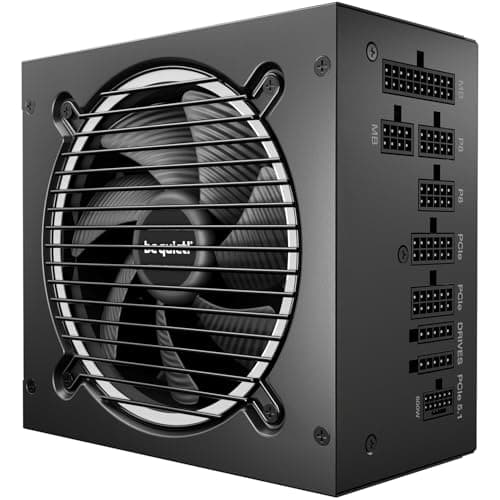
The two most direct competitors to the CX550 in the UK budget PSU market are the be quiet! System Power 10 550W and the EVGA 550 BR 80+ Bronze. Both sit in a similar price bracket and target the same kind of mainstream gaming build. The be quiet! System Power 10 is a strong alternative with a slightly better reputation for quiet operation and good build quality, though it's often priced a few pounds higher than the CX550. The EVGA 550 BR is a well-regarded budget option, though EVGA has exited the PSU market, which means warranty support going forward is uncertain. That last point is actually a significant advantage for the Corsair: five years of warranty from a brand that's still actively selling PSUs is worth something.
In terms of raw specs, all three units offer 550W continuous power with 80 Plus Bronze certification. The differences come down to cable configuration, build quality details, and brand support. The CX550's six SATA connectors is generous compared to some competitors that offer four. The compact 125mm casing is a practical advantage over longer units in smaller cases. And the 4.7-star average from 229 is genuinely impressive for a budget PSU, suggesting real-world satisfaction rather than just acceptable performance.
Honestly, if you can find the be quiet! System Power 10 550W at the same price or cheaper, it's for a quiet build specifically. But the CX550 holds its own on value, warranty, and connector count, and the Corsair brand recognition means easier returns and support if anything goes wrong. For most people, the CX550 is the safer and more practical choice in this bracket.
| Feature | CORSAIR CX550 | be quiet! System Power 10 550W | EVGA 550 BR |
|---|---|---|---|
| Wattage | 550W | 550W | 550W |
| Efficiency | 80 Plus Bronze | 80 Plus Bronze | 80 Plus Bronze |
| Modularity | Non-modular | Non-modular | Non-modular |
| Fan Size | 120mm | 120mm | 92mm |
| Zero RPM Mode | No | No | No |
| SATA Connectors | 6 | 6 | 6 |
| PCIe 8-pin | 2 | 2 | 2 |
| Warranty | 5 years | 3 years | 3 years (brand exited market) |
| Casing Length | 125mm | 140mm | 140mm |
| Price | £47.97 | Similar bracket | Similar bracket |
Final Verdict
The CORSAIR CX550 80 PLUS Bronze Non Modular Low-Noise ATX 550 Watt Power Supply - UK - Black is a solid, no-drama budget PSU that does exactly what it says on the tin. 550W of guaranteed continuous power, 80 Plus Bronze efficiency, a proper protection suite, quiet operation under normal loads, and five years of warranty from a brand that's actually going to be around to honour it. For a mainstream gaming build on a budget, it's one of the better choices in its bracket.
The non-modular design is the main trade-off, and it's a real one if you care about a perfectly clean build. But for most builders, especially those doing their first or second build, the non-modular format is actually simpler to work with: all the cables are there, you plug in what you need, and you tuck the rest away. No hunting for the right cable in a bag, no wondering if you've got the right connector. And the black sleeving means the excess cables you do tuck away look reasonably tidy rather than a mess of multicoloured wires.
Who should skip it? If you're running an RTX 4070 Ti or above, you need more wattage. If you're doing a near-silent build and zero-RPM mode matters to you, look at a Gold-rated unit with a semi-passive fan. And if you're building a workstation that's going to be under heavy load for 10 or more hours a day, the efficiency gains of a Gold-rated PSU start to pay back their premium over time. In those cases, step up to something like the Corsair CX650 or a Gold-rated alternative. The extra spend is worth it for those specific use cases.
But for the target audience, which is someone building a mid-range gaming PC with a Ryzen 5 or Core i5 and a GPU in the RTX 4060 to RX 7700 XT range, the CX550 is genuinely excellent value. The 4.7-star average from real owners backs that up. It's not exciting, it's not flashy, and it won't impress anyone at a LAN party. But it'll power your build reliably for years, and that's the only thing a PSU actually needs to do.
Editorial score: 8 out of 10. Recommended for budget gaming builds without hesitation.
What works. What doesn’t.
5 + 3What we liked5 reasons
- 5-year warranty is exceptional for a budget PSU
- Guaranteed 550W continuous power, not just peak
- Compact 125mm casing fits almost any modern case
- Six SATA connectors is generous at this price point
- 4.7/5 from 229 owner reviews - real-world satisfaction is high
Where it falls3 reasons
- Non-modular design means excess cables to manage
- No zero-RPM mode for ultra-quiet builds
- 80 Plus Bronze efficiency won't satisfy workstation or always-on use cases
Full specifications
8 attributes| Efficiency rating | Bronze |
|---|---|
| Form factor | ATX |
| FAN size MM | 120 |
| Generation | CX Series |
| Modularity | non_modular |
| Pcie 5 ready | false |
| Warranty years | 5 |
| Wattage W | 550 |
Will it run on what you have?
Free toolIf this isn’t right for you
2 options

Frequently asked
5 questions01Is the CORSAIR CX550 80 PLUS Bronze Non Modular Low-Noise ATX 550 Watt Power Supply - UK - Black good for gaming?+
Yes, for mainstream gaming builds it's a solid choice. 550W is enough for a mid-range CPU paired with a GPU like the RTX 4060 or RX 7700 XT, with comfortable headroom. It's not suitable for high-end GPUs like the RTX 4080 or 4090, which need significantly more wattage. For the typical budget to mid-range gaming build, it delivers reliable continuous power with a proper protection suite and a five-year warranty.
02What GPU can I run with a 550W power supply?+
A 550W PSU comfortably handles GPUs up to the RTX 4060 Ti or RX 7700 XT class when paired with a mid-range CPU. As a rough guide, your total system draw under gaming load (CPU plus GPU plus everything else) should stay below 80% of the PSU's rated wattage for reliable operation. Use a PSU calculator with your specific components before buying to confirm. Cards like the RTX 4070 and above typically push system draw beyond what 550W can safely handle.
03Is 80 Plus Bronze efficiency worth it?+
For a gaming PC, yes - 80 Plus Bronze is the sensible minimum. It means the PSU wastes less power as heat, runs cooler, and costs slightly less to run than an uncertified unit. The electricity cost difference between Bronze and Gold at 550W is modest for a typical gaming PC used a few hours daily, so upgrading purely for efficiency savings rarely pays off quickly. But Bronze over no certification is a meaningful quality step, and it's the right choice at this price point.
04How long is the warranty on the CORSAIR CX550 80 PLUS Bronze Non Modular Low-Noise ATX 550 Watt Power Supply - UK - Black?+
Five years, which is genuinely impressive for a budget PSU. Most competitors at this price offer two or three years. The five-year warranty covers manufacturing defects and is backed by Corsair's UK support. It's one of the strongest arguments for choosing this unit over cheaper alternatives, since a PSU failure can damage other components and a good warranty gives you real peace of mind.
05Is the CORSAIR CX550 80 PLUS Bronze Non Modular Low-Noise ATX 550 Watt Power Supply - UK - Black fully modular?+
No, it's non-modular. That means all the cables come permanently attached and you can't remove the ones you don't need. For cable management, you'll need to bundle unused cables behind the motherboard tray. The cables are black sleeved, which helps keep things looking tidy, but if you want a fully modular setup for a clean build, you'd need to step up to the Corsair RM series or a similar modular unit at a higher price point.