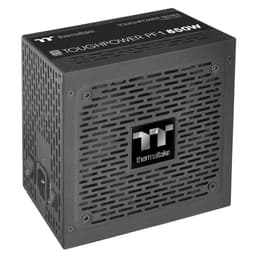
The PSU is the last thing most people think about when planning a build, and that's honestly a bit backwards. You'll agonise over which GPU to pick for weeks, then grab whatever power supply is on sale and hope for the best. The Thermaltake Toughpower GT 850W, with its ATX 3.1 compliance, PCIe Gen 5.1 connector, 80 Plus Gold efficiency, and fully modular cabling, is clearly aimed at people who don't want to think about their PSU ever again once it's in the case. Whether it earns that confidence is worth unpacking properly.
It's rated ★★★★½ (4.6) on Amazon. But a rating doesn't tell you whether it's the right PSU for your specific build. So let's get into the detail.
850W puts this squarely in the sweet spot for high-end gaming rigs. Pair it with an RTX 5080, a Ryzen 9 or Core Ultra 9, a couple of NVMe drives and some RGB fans, and you've still got comfortable headroom. The upper mid-range price bracket it sits in means you're not buying budget, but you're also not paying flagship money. The question is whether the spec sheet justifies that positioning.
Core Specifications: Thermaltake Toughpower GT 850W at a Glance
The Toughpower GT 850W is built to the current ATX 3.1 standard, which matters more than it might sound. ATX 3.1 revised the spec for transient power handling, which is critical for modern GPUs that can spike well above their rated TDP for short bursts. If your PSU isn't rated to handle those spikes, you get instability, crashes, or worse.
The 80 Plus Gold certification is the efficiency story here, and it's a meaningful one. Gold sits comfortably above the baseline Bronze and Silver tiers, meaning less wasted energy as heat and lower running costs over time. The fully modular design means you only plug in the cables you actually need, which keeps airflow clean and cable management from becoming a nightmare. And the 5-year warranty is Thermaltake putting their money where their mouth is on reliability.
The PCIe Gen 5.1 12+4 pin connector (the 12VHPWR successor) is included natively. No adapters, no daisy-chaining two 8-pin cables through a flimsy dongle. That's the correct way to power a current-gen GPU, and it's good to see it handled properly here rather than as an afterthought.
| Specification | Detail |
|---|---|
| Wattage | 850W |
| ATX Standard | ATX 3.1 |
| PCIe Connector | PCIe Gen 5.1 12+4 pin (450W) |
| Efficiency Rating | 80 Plus Gold |
| Modularity | Fully Modular |
| Fan Size | 120mm |
| Zero RPM Mode | Yes (Smart Zero Fan) |
| Warranty | 5 Years |
| ATX 24-pin | 1 |
| CPU 4+4 pin (EPS) | 2 |
| PCIe 6+2 pin | 4 |
| SATA | 6 |
| Molex | 4 |
| Protection | OVP, UVP, OCP, OPP, OTP, SCP |
| Price | £80.39 |

Wattage and Capacity: Is 850W Enough?
850W is a genuinely useful number in 2026. It's not the absolute ceiling (1000W and 1200W units exist for multi-GPU workstations and extreme overclocking rigs), but for the vast majority of gaming builds, it's more than sufficient. An RTX 5080 paired with a Ryzen 9 9900X or Intel Core Ultra 9 285K system, fully loaded, sits somewhere around 550W to 650W under real gaming load. That leaves you 200W of headroom for storage, cooling, RGB, and the occasional power spike from a GPU doing something aggressive during a shader compilation storm.
Where 850W becomes particularly relevant is with the ATX 3.1 transient load specification. Modern GPUs, especially Nvidia's Ada Lovelace and Blackwell architectures, are notorious for brief power excursions that can hit 150% or more of their rated TDP for milliseconds at a time. An ATX 3.1 compliant PSU is designed to handle these without flinching. Older units built to the ATX 2.x spec can trip protection circuits or cause system instability under the same conditions, even if their rated wattage looks adequate on paper. This is the real reason to care about ATX 3.1, not just the connector.
If you're running something more modest, like a mid-range build with an RTX 5070 or RX 9070, 850W is frankly overkill. You'd be perfectly fine with a quality 650W or 750W unit and you'd pay less for it. But if you're planning a high-end build and want to future-proof against the next GPU generation (which is almost certainly going to be even more power-hungry), 850W is a sensible place to land. It also gives you room to add a second NVMe drive, a capture card, or a USB hub without worrying about headroom. Use our PSU calculator to work out exactly what your build needs before committing.
Efficiency Rating: What 80 Plus Gold Actually Means
The 80 Plus certification scheme tests PSUs at 20%, 50%, and 100% load and requires them to convert at least a certain percentage of AC mains power into DC power for your components. The rest is lost as heat. Bronze requires roughly 82% to 85% efficiency across those load points. Gold requires 87% to 90%. Platinum pushes to 90% to 92%, and Titanium tops out at 92% to 94% at 50% load.
The efficiency difference between Gold and Platinum rarely pays back the price premium within the lifespan of a typical build. Gold is the sweet spot where you get genuinely good efficiency without paying over the odds for marginal gains.
What Gold certification also signals is component quality. Achieving consistent Gold efficiency across load points requires decent capacitors, a well-designed transformer, and a competent control circuit. It's harder to hit Gold with bargain-bin components, so the certification acts as a rough proxy for overall build quality. That's not a guarantee, but it's meaningful context.
Modularity and Cable Management: Fully Modular Done Right
Fully modular means every single cable, including the 24-pin ATX motherboard connector, detaches from the PSU. This is the best possible outcome for cable management. You pull the unit out of the box, figure out which cables you actually need for your specific build, and only plug those in. Everything else stays in the box. The result is a cleaner case interior, better airflow, and a build that doesn't look like a rat's nest behind the motherboard tray.
Semi-modular units (where the ATX 24-pin and one or two EPS cables are permanently attached) are fine, but they force you to stuff unused cables somewhere even if you don't need them. Non-modular units are, frankly, a pain in modern cases with windowed side panels. Full modularity at this price point is exactly what you'd expect, and Thermaltake delivers it here. Four cable straps are included for tidying the cables you do use.
One thing to check for your specific case is the EPS CPU power cable length if you're running a full tower with a top-mounted CPU power connector, but this is a consideration for any PSU rather than a specific criticism of this unit.
Connectors and Compatibility: What You're Working With
The connector lineup covers everything a high-end single-GPU gaming build needs. The headline addition is the native PCIe Gen 5.1 12+4 pin connector, which is the correct way to power current-gen GPUs. No adapters, no concerns about adapter-related fires (which made headlines with early 12VHPWR implementations on some third-party cables). Native is always better. One limit to know: Thermaltake rates the 12+4 pin cable at 450W. That's plenty for an RTX 5080, but a card that wants 600W through a single connector needs a bigger unit.
Beyond that, the configuration is practical. Four PCIe 6+2 pin connectors give you flexibility for older GPUs or supplementary power on cards that use both the 16-pin and traditional 8-pin connectors. Six SATA connectors is generous, enough for a full complement of SSDs and HDDs without needing to daisy-chain excessively. Four Molex connectors cover legacy devices, fans with Molex headers, and some older AIO pumps. And there are two CPU 4+4 pin connectors, so high-end boards that want dual CPU power are covered as well as standard consumer motherboards.
- 24-pin ATX: 1 (standard motherboard power)
- CPU 4+4 pin (EPS): 2 (covers boards that want dual CPU power)
- PCIe 6+2 pin: 4 (legacy GPU support or supplementary power)
- PCIe Gen 5.1 12+4 pin: 1 (native, no adapter needed)
- SATA: 6 (generous for storage-heavy builds)
- Molex: 4 (legacy and accessory power)
The PCIe Gen 5 specification from PCI-SIG defines the electrical requirements that the 12+4 pin connector is built around. Having a PSU that's certified to ATX 3.1 and ships with a native Gen 5.1 connector means you're not relying on an adapter cable that may have been manufactured to inconsistent tolerances. For a unit in this price bracket, that's the expected standard, and Thermaltake meets it.
Voltage Regulation and Ripple: The Boring Bit That Actually Matters
Voltage regulation is one of those specs that sounds dry until your system starts randomly crashing under load or your NVMe drive throws errors after six months. A PSU's job is to deliver stable, clean DC power at the rated voltages (12V, 5V, 3.3V) regardless of what the load is doing. The ATX specification allows for plus or minus 5% variation on the 12V rail, but well-built units typically hold much tighter than that, often within 1% to 2% across the load range.
The ATX 3.1 standard tightened the requirements for transient response specifically because modern GPUs create rapid, high-amplitude load spikes. A PSU that can't respond quickly enough will sag on the 12V rail during those spikes, which causes instability. Thermaltake's compliance with ATX 3.1 means the Toughpower GT has been designed and tested to handle these transients correctly.
Ripple suppression is the other half of this story. Ripple is the AC noise that rides on top of the DC output, and too much of it degrades component longevity over time. The ATX spec allows up to 120mV of ripple on the 12V rail. Gold-rated units from reputable manufacturers typically come in well below that. The 80 Plus Gold certification process doesn't directly test ripple, but achieving Gold efficiency consistently requires a well-designed filtering stage, which correlates with good ripple performance.
Thermal Performance: Keeping Cool Under Pressure
The Toughpower GT uses a 120mm fan, which is the standard size for ATX PSUs. Smaller fans have to spin faster to move the same volume of air, which means more noise. 120mm is a reasonable choice that balances airflow and acoustics. The fan bearing type matters for longevity, and this one uses a hydraulic bearing, which outlasts a sleeve bearing significantly.
The Smart Zero Fan feature is the thermal headline here. When activated, the fan stops completely below a certain load threshold. Thermaltake's manual says that with Smart Zero Fan switched on, the fan stays off until the unit reaches roughly 40% of its rated load, which is about 340W on this model. Under light loads (browsing, video playback, light productivity work), the PSU runs completely silently. The fan only spins up when the unit actually needs cooling, and it scales speed with demand rather than jumping straight to full blast.
Under sustained heavy load, the 120mm fan will spin up, and that's fine. That's what it's supposed to do. The thermal design of a PSU is about keeping the internal components within their rated temperature range, and a properly sized fan doing its job is preferable to a unit that runs hot and silent because it's cutting corners on airflow.
Acoustic Performance: How Quiet Is Quiet?
The Smart Zero Fan mode is the main acoustic story. Below moderate loads, the fan doesn't run at all. That means in a typical gaming rig at idle, desktop use, or even light gaming, you're getting zero PSU fan noise. Zip. The only sounds you'll hear are your CPU cooler, case fans, and GPU cooler. For people building in quiet cases or running open-air setups where PSU noise would be noticeable, this matters a lot.
When the fan does kick in under heavier load, the 120mm size means it doesn't need to spin particularly fast to move adequate air.
For context, some budget PSUs use smaller fans that have to spin at higher RPM to compensate, or they use basic sleeve bearing fans that develop a rattle over time. The combination of a properly sized fan, a hydraulic bearing, and a zero-RPM mode puts the Toughpower GT in a good position for quiet build use cases. If you're building a home theatre PC or a near-silent workstation, this is the kind of PSU behaviour you want.

Build Quality: What's Actually Inside
Thermaltake's spec sheet fills in some of the detail. It's a single +12V rail rated at 70.8A, so the full 849.6W is available to the GPU and CPU without juggling rails. Hold-up time is over 17ms at 80% load, MTBF is quoted at 100,000 hours, and it uses active PFC. The unit measures 150 x 86 x 140mm, a standard ATX depth, and the CPU cables run to 700mm, which helps in taller cases with the socket near the top. In the box you get the PSU, a mains cable, the manual, four mounting screws and four cable straps.
The 5-year warranty is a reasonable indicator of Thermaltake's confidence in the internals, because a warranty is ultimately a financial commitment against failure rates.
Protection Features: What Happens When Things Go Wrong
The Toughpower GT includes OVP (Over Voltage Protection), UVP (Under Voltage Protection), OCP (Over Current Protection), OPP (Over Power Protection), OTP (Over Temperature Protection), and SCP (Short Circuit Protection). These six cover the most common failure scenarios that can damage components. OVP trips if the output voltage climbs above safe limits, protecting your motherboard and GPU from voltage spikes. OCP limits current on individual rails to prevent a faulty component from drawing enough current to cause a fire or damage other components. SCP is the most critical, cutting power immediately if a short circuit is detected anywhere in the system.
OPP is particularly relevant for modern GPUs. If a GPU driver bug or hardware fault causes the card to draw significantly more power than it should, OPP will shut the system down before the PSU (or the GPU) is damaged. This is the protection feature that's most relevant to the ATX 3.1 context, because the standard also defines how OPP should behave relative to transient loads. A properly implemented OPP won't trip during legitimate GPU power spikes but will trip during genuine overcurrent events. Getting this balance right requires careful calibration, and it's one area where cheaper PSUs sometimes get it wrong (either tripping too easily under normal use or not tripping when they should).
UVP and OTP round out the set. UVP trips if an output rail sags below safe limits, and OTP shuts the unit down before its internals overheat.
Final Verdict: Should You Buy the Thermaltake Toughpower GT 850W?
The Thermaltake Toughpower GT 850W ATX 3.1 PCIe 5.1 80 Plus Gold Modular is a well-specced, properly modern PSU that does the right things. ATX 3.1 compliance is not a marketing checkbox here, it's a genuine engineering requirement for builds using current-gen GPUs. The native PCIe Gen 5.1 connector means you're not relying on an adapter. The 80 Plus Gold efficiency is the correct tier for a unit at this price point. And the fully modular design, Smart Zero Fan, and 5-year warranty round out a package that's hard to argue with on paper.
If you're building a high-end gaming rig with a current-gen GPU and you want a PSU you can install and forget about for the next five years, this is a solid choice in the upper mid-range bracket.
Who should skip it? If you're building a mid-range system with a GPU that draws under 300W, 850W is more than you need and you'd be better served saving money on a quality 650W unit. But for a current-gen high-end gaming build where ATX 3.1 compliance and a native 16-pin connector are the technically correct requirements, the Toughpower GT makes a strong case for itself. Rated 8.5 out of 10.
Is the Thermaltake Toughpower GT 850W good for gaming?
Yes, it's well suited to high-end gaming builds. 850W with ATX 3.1 compliance gives you comfortable headroom for current-gen GPUs like the RTX 5080 or RX 9070 XT, plus a full complement of storage and peripherals. The native PCIe Gen 5.1 connector means you're powering your GPU correctly without adapters.
What wattage PSU do I need for an RTX 5080 build?
Nvidia recommends at least 850W for RTX 5080 builds, and that's a sensible minimum. A system with an RTX 5080, a high-end CPU like a Ryzen 9 9900X, and typical storage and cooling will draw somewhere around 550W to 650W under gaming load. 850W gives you the headroom for transient spikes and future upgrades. Use our PSU calculator to check your specific component list.
What does 80 Plus Gold efficiency actually mean for my electricity bill?
Compared to an 80 Plus Bronze unit, you're saving maybe 3% to 4% of your power draw. On a gaming rig running 4 hours a day, that works out to a few pounds per year at UK electricity rates. The real value of Gold certification is the component quality it implies rather than the direct energy saving.
How long is the warranty on the Thermaltake Toughpower GT 850W?
5 years. Thermaltake's 5-year warranty covers manufacturing defects and component failures. It means Thermaltake is confident enough in the unit's reliability to back it for the typical lifespan of a gaming build. Keep your proof of purchase.

Is the Thermaltake Toughpower GT 850W fully modular?
Yes, it's fully modular. Every cable, including the 24-pin ATX motherboard connector, detaches from the PSU. This means you only install the cables your build actually needs, which makes cable management significantly easier and keeps your case interior cleaner. Unused cables go back in the box rather than getting stuffed behind the motherboard tray.
What works. What doesn’t.
4 + 1What we liked4 reasons
- ATX 3.1 compliant with native PCIe Gen 5.1 12+4 pin connector, so no adapters needed
- 80 Plus Gold efficiency is the right tier for this price bracket
- Fully modular cabling makes cable management genuinely easy
- Smart Zero Fan mode means silent operation under light loads
Where it falls1 reasons
- 850W is overkill for mid-range builds, where a 650W unit would suffice and cost less
Full specifications
9 attributes| Efficiency rating | Gold |
|---|---|
| Form factor | ATX |
| ATX version | ATX 3.1 |
| FAN size MM | 120 |
| Generation | Toughpower GT |
| Modularity | fully_modular |
| Pcie 5 ready | true |
| Warranty years | 5 |
| Wattage W | 850 |
Will it run on what you have?
Free toolIf this isn’t right for you
2 options
Frequently asked
5 questions01Is the Thermaltake Toughpower GT 850W good for gaming?+
Yes, it's well suited to high-end gaming builds. 850W with ATX 3.1 compliance gives you comfortable headroom for current-gen GPUs like the RTX 5080 or RX 9070 XT, plus a full complement of storage and peripherals. The native PCIe Gen 5.1 connector means you're powering your GPU correctly without adapters.
02What wattage PSU do I need for an RTX 5080 build?+
Nvidia recommends at least 850W for RTX 5080 builds. A system with an RTX 5080, a high-end CPU like a Ryzen 9 9900X, and typical storage and cooling will draw around 550W to 650W under gaming load. 850W gives you headroom for transient spikes and future upgrades.
03What does 80 Plus Gold efficiency mean for my electricity bill?+
Compared to an 80 Plus Bronze unit, you're saving roughly 3% to 4% of your power draw, a few pounds per year on a typical gaming rig. The real value is the component quality the certification implies.
04How long is the warranty on the Thermaltake Toughpower GT 850W?+
5 years. This covers manufacturing defects and component failures. Keep your proof of purchase, as you'll need it if you ever need to make a claim.
05Is the Thermaltake Toughpower GT 850W fully modular?+
Yes, fully modular. Every cable including the 24-pin ATX motherboard connector detaches from the PSU. You only install the cables your build actually needs, which makes cable management significantly easier and keeps your case interior clean. Unused cables go back in the box.