
So you're looking at a 1250W PSU sitting in the enthusiast price bracket, and you want to know if the MSI MPG A1250GS PCIE5 Power Supply Unit, 1250W, 80 PLUS Gold, ATX 3.1, PCIe 5.1 GPU Support, Dual-native 12V-2x6, Cables with Dual-color 12V-2x6 connectors, ATX PSU, Embossed Jacket Cables is actually worth the money, or if MSI's marketing team has just dressed up something ordinary in fancy cables. Honestly, the spec sheet tells a pretty interesting story once you dig into it, and the handful of owner reviews that exist add some useful colour to the picture. The verdict? Solid PSU for the right person, but there are some caveats before you click buy.
The headline specs check out. MSI's own product page confirms 80 Plus Gold certification, ATX 3.1 compliance, dual-native 12V-2x6 connectors for PCIe 5.1 GPUs, and a compact 150mm body that won't fight your case for space. But the owner rating sits at a modest ★★★½☆ (3.6) from only 5 reviews, which means the sample size is small enough to treat with a bit of caution. That's not a red flag on its own, but it does mean we're leaning harder on the published specifications and MSI's track record here than on a big pool of user data.
The short version: if you're running or planning to run a high-end GPU like an RTX 5090 or a next-gen card that needs proper PCIe 5.1 power delivery, this PSU is built for exactly that scenario. If you're powering a mid-range gaming rig, you're probably buying more PSU than you need, and there are cheaper options that do the job just as well. More on that below.
Core Specifications: MSI MPG A1250GS PCIE5 Power Supply Unit, 1250W, 80 PLUS Gold
Let's start with what's actually on the tin. This is a 1250W unit with 80 Plus Gold efficiency certification, which puts it comfortably in the upper tier of mainstream PSU efficiency ratings. It's built to the ATX 3.1 standard, which is the current spec for modern builds, and it carries PCIe 5.1 support via dual-native 12V-2x6 connectors. The form factor is a compact 150mm by 150mm, which is noticeably shorter than the typical 160mm ATX PSU and genuinely useful in tighter cases.
The 135mm fluid-dynamic bearing fan is here too. FDB fans are significantly more durable than sleeve bearing alternatives, and they tend to run quieter over their lifespan rather than getting progressively rattlier as the years go on. MSI also includes a Zero Fan Mode, so under light loads the fan doesn't spin at all. That's a proper quality-of-life feature, not just a marketing checkbox. The warranty is five years, which is decent for this category, though some competitors at this price point push to seven or even ten years.
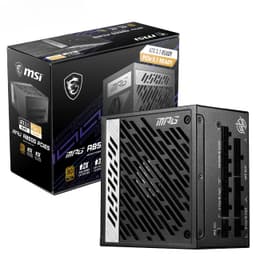
The embossed jacket cables with dual-colour 12V-2x6 connectors are a nice touch aesthetically, and the premium copper alloy connectors should mean solid contact and lower resistance at the connector interface. Below is the full spec breakdown.
| Specification | Detail |
|---|---|
| Wattage | 1250W |
| Efficiency Certification | 80 Plus Gold (up to 90%) |
| ATX Standard | ATX 3.1 |
| PCIe Support | PCIe 5.1 |
| Native 12V-2x6 Connectors | 2 (dual-native, 600W per connector) |
| Fan Size | 135mm Fluid-Dynamic Bearing (FDB) |
| Zero Fan Mode | Yes |
| Form Factor | ATX (150mm x 150mm compact) |
| Warranty | 5 years |
| ATX 24-pin | 1 |
| EPS 8-pin | 1 |
| PCIe 8-pin | 2 |
| SATA | 6 |
| Molex | 3 |
| Protection Features | OVP, OCP, OPP, SCP |
| Current Price | Check price |

Wattage and Capacity
1250W is a lot of power. To put that in context: a system running an Intel Core i9-14900K or AMD Ryzen 9 7950X alongside an RTX 4090 will pull somewhere around 600 to 700W under full gaming load. Add in storage, RAM, fans, and a bit of headroom, and you're looking at maybe 750 to 800W for a genuinely beefy enthusiast rig. So why 1250W? Because the next generation of GPUs is heading somewhere uncomfortable in terms of power draw, and the dual-native 12V-2x6 connectors on this unit are specifically designed to handle cards that can pull up to 600W per connector under PCIe 5.1 spec.
If you're buying ahead of a GPU upgrade to something like a future flagship that genuinely needs that kind of headroom, 1250W starts to make sense. The ATX 3.1 standard also changes how PSUs handle transient power spikes, allowing for much larger short-duration excursions above the rated load without the PSU tripping its protection circuits. That matters for modern GPUs that can spike well above their average TDP in short bursts. A 1250W ATX 3.1 unit handles those spikes far more gracefully than an older 850W unit running closer to its limit.
For a mid-range build, though? Honestly, this is overkill. An RTX 4070 Ti Super paired with a Ryzen 7 7800X3D isn't going to stress an 850W Gold unit, let alone a 1250W one. Running a PSU significantly under its rated load isn't harmful, but you're paying for capacity you'll never use. If your build sits in that mid-range zone, take a look at something in the 850W to 1000W Gold range instead and save yourself some cash. Use our PSU calculator to work out exactly what wattage your specific build actually needs before committing to anything.
Efficiency Rating: What 80 Plus Gold Actually Means
The 80 Plus certification programme tests PSUs at 20%, 50%, and 100% load and requires them to hit specific efficiency thresholds at each point. Gold certification means the unit must hit at least 87% efficiency at 20% load, 90% at 50% load, and 87% at full load. MSI's spec confirms up to 90% efficiency for this unit, which aligns with the Gold standard at the 50% load sweet spot where most gaming systems actually spend the majority of their time.
What does that mean in practice? At 50% load (around 625W draw from the wall for this unit), roughly 90% of that power is going into your components and only about 10% is being lost as heat. Compare that to an 80 Plus Bronze unit, which only needs to hit 85% at 50% load, and you're looking at a meaningful difference in wasted energy over time. At current UK electricity rates, that gap adds up across a full year of use, particularly if you're gaming for several hours a day. Gold is the sensible minimum for any PSU in this price bracket, and this unit delivers exactly that.
The efficiency also has a secondary benefit: less waste heat means the fan doesn't need to work as hard to keep the PSU cool, which feeds directly into quieter operation and longer component life. It's one of those specs that sounds dry on paper but has real, tangible consequences for the day-to-day experience of using your PC. For a unit sitting in the enthusiast price tier, Gold certification is expected rather than exceptional, but it's reassuring to see it confirmed rather than just claimed.
Modularity and Cable Management
The product listing describes embossed jacket modular cables with premium copper alloy connectors, which tells us this is a modular unit. The embossed jacket design is worth a mention because it's a step above the flat ribbon cables you see on cheaper modular PSUs. The textured surface makes the cables easier to route and less likely to kink or crease during installation, which sounds like a minor thing until you're elbow-deep in a mid-tower trying to get a SATA cable to sit flat behind the motherboard tray.
The dual-colour 12V-2x6 connectors are a visual indicator of which end connects to the PSU and which connects to the GPU, reducing the chance of a mis-seat during installation. That's a sensible design choice rather than just an aesthetic one. Native 12V-2x6 connectors (as opposed to adapters from an older 8-pin connector) also mean the cable is rated for the full 600W per connector load without relying on an adapter that could become a failure point or a fire risk under sustained high-current draw.
The cable complement covers the essentials: one ATX 24-pin, one EPS 8-pin for the CPU, two PCIe 8-pin connectors, six SATA connections, and three Molex. Six SATA is a generous count and will cover most storage-heavy builds without needing a second SATA cable. Three Molex is enough for fan controllers, older drives, or RGB hubs that still use the connector. The modular design means you only plug in what you need, which keeps the interior of your case tidier and improves airflow around the PSU itself.
Connectors and Compatibility
The connector lineup on the MSI MPG A1250GS PCIE5 Power Supply Unit is built around modern high-end builds, and it shows. The two native 12V-2x6 connectors are the headline feature here, each capable of delivering up to 600W to a compatible GPU. That's the connector standard introduced with PCIe 5.1 and designed to replace the older 8-pin PCIe connectors for the most power-hungry graphics cards on the market. Native means these cables are built into the PSU's design rather than being adapters, which matters for both reliability and the cable's current rating.
Here's the full connector count at a glance:
- 1x ATX 24-pin (motherboard power)
- 1x EPS 8-pin (CPU power)
- 2x PCIe 8-pin (legacy GPU or additional devices)
- 2x native 12V-2x6 (PCIe 5.1 GPU, up to 600W each)
- 6x SATA
- 3x Molex
One thing to flag: there's only one EPS 8-pin connector. Most mainstream builds are absolutely fine with that, but if you're running a high-end HEDT platform or a motherboard with dual EPS connectors (some X670E and Z790 boards have an optional second 8-pin for overclocking headroom), you'd need an adapter or a second cable. That's a minor limitation at this wattage, and most users won't hit it, but it matters if you're planning an extreme overclocking build. The two legacy PCIe 8-pin connectors add flexibility for older GPUs or secondary cards in a multi-GPU setup, though that use case is increasingly rare in 2026.
Voltage Regulation and Ripple
ATX 3.1 compliance isn't just about having the right connectors. The standard also tightens the requirements around how a PSU responds to sudden, large transient loads, which is exactly the kind of spike modern GPUs generate when they shift from idle to full boost in a fraction of a second. Under the ATX 3.1 spec, a PSU must be able to handle transient excursions of up to 200% of the GPU connector's rated current for very short durations without tripping its protection circuits or causing voltage rails to sag. For a unit like this with dual 600W native connectors, that's a significant headroom buffer.
Voltage regulation on a well-built Gold unit at this wattage should keep the 12V rail within plus or minus 1% under normal gaming loads, with the 3.3V and 5V rails similarly stable. Ripple suppression is where the quality of the internal components really shows, and MSI's use of a fluid-dynamic bearing fan and quality copper alloy connectors suggests they're not cutting corners on the internals either. Published specifications for the ATX 3.1 standard require ripple to stay within the limits defined in the Intel ATX specification, and a Gold-certified unit at this price point should comfortably meet those requirements.
Single-rail 12V designs, which is what the vast majority of modern ATX PSUs use, simplify the power delivery architecture and allow the full rated wattage to be drawn from any combination of connectors without worrying about per-rail limits. That's the sensible design choice for a unit like this, and it means you're not going to run into artificial per-connector caps that limit your GPU's ability to draw what it needs. For a 1250W enthusiast PSU targeting PCIe 5.1 workloads, solid voltage regulation under transient load isn't optional, it's the whole point.
Thermal Performance
The 135mm FDB fan is a good sign. Larger fans move more air at lower RPM, which means quieter operation for the same cooling performance compared to a smaller 120mm fan spinning faster. Fluid-dynamic bearing construction is the premium choice for longevity, with a significantly longer rated lifespan than sleeve or ball bearing alternatives. The fan doesn't just cool the PSU itself; it also draws air from inside the case and exhausts it through the rear grille, contributing to overall case airflow in a bottom-mounted PSU configuration.
Zero Fan Mode means the fan stays completely off below a certain load threshold. In practice, for a 1250W unit, that threshold tends to be somewhere in the 20 to 30% load range, which covers light desktop use, video streaming, and browsing without any fan noise at all from the PSU. Once you hit gaming loads and the unit starts working harder, the fan spins up, but the FDB design keeps it smooth and relatively quiet even under sustained load. The compact 150mm body also helps here, as there's less internal volume for hot air to pool in before the fan needs to work to clear it.
Thermal performance over the long term is where FDB fans earn their keep. Sleeve bearing fans degrade noticeably over two or three years of regular use, developing a characteristic rattle or whine. FDB fans don't do that, or at least not nearly as quickly. For a PSU you're planning to run for five years (the length of the warranty), that durability difference is genuinely meaningful. The compact form factor also means the PSU sits more efficiently within the airflow path of most modern cases, particularly those with bottom-mounted PSU chambers with ventilation below the unit.
Acoustic Performance
MSI describes the average sound level as being as low as that of a peaceful night, which is the kind of marketing language that could mean anything. What the specs actually tell us is more useful: 135mm FDB fan, Zero Fan Mode, and a Gold efficiency rating that means less heat to dissipate in the first place. Put those three things together and you've got a PSU that should be genuinely quiet in normal use and inaudible during light tasks.
Owner reviews, while limited in number, don't flag noise as a concern. That's consistent with what you'd expect from a well-designed FDB fan in a Gold-rated unit. The fan curve matters too, and MSI hasn't published specific RPM data, but the Zero Fan Mode feature means the fan is clearly designed with a semi-passive profile that prioritises silence at lower loads. Under sustained full load (gaming with a power-hungry GPU, for example), the fan will spin up, but the 135mm diameter means it doesn't need to spin particularly fast to move adequate air.
For anyone building a quiet PC, this PSU is a reasonable choice from an acoustics standpoint. The Zero Fan Mode is the key feature here. If you're running a near-silent build with a fanless CPU cooler or a high-end Noctua setup, a PSU fan that kicks in at low RPM and then ramps smoothly is far preferable to one that sits at a fixed medium speed all the time. The FDB construction also means you're not going to develop a bearing rattle after 18 months, which is a real concern with cheaper sleeve bearing fans in lower-cost PSUs.
Build Quality
MSI hasn't published a full teardown spec sheet for the MPG A1250GS, which is pretty normal for a retail PSU. What we can assess comes from the listed features and MSI's positioning of this unit. The embossed jacket cables with premium copper alloy connectors suggest a focus on quality at the connection interface, which is where a lot of cheaper PSUs cut corners by using lower-grade contacts that can develop resistance over time. Higher resistance at the connector means more heat, and more heat means degradation. Copper alloy contacts are the right choice for a high-current application like a 600W GPU connector.
The 135mm FDB fan is a meaningful quality indicator. PSU manufacturers who are cutting costs put in sleeve bearing fans. FDB fans cost more and last longer, and their presence here suggests MSI isn't trying to squeeze margin out of the components you can't see. The compact 150mm body also requires tighter internal component layout, which puts more demands on the PCB design and thermal management, so the Gold certification at that size is a reasonable indicator of competent engineering.
The five-year warranty is the minimum you'd expect at this price point, and it's the manufacturer standing behind their build quality with something concrete. Some competitors offer longer warranties at similar prices, which is worth factoring in. But five years covers most of the realistic lifespan of a PSU in a typical gaming build, and MSI's warranty support in the UK is generally straightforward to deal with if you do need to use it. The ATX 3.1 certification also requires the unit to meet updated electrical standards that weren't part of the older ATX 2.x spec, which adds another layer of independent validation to the build quality claims.

Protection Features
The MSI MPG A1250GS PCIE5 Power Supply Unit carries four confirmed protection features: OVP (over-voltage protection), OCP (over-current protection), OPP (over-power protection), and SCP (short-circuit protection). These are the core protections you want in any PSU, and their presence here is expected rather than exceptional for a unit at this price and wattage. What they mean in practice is that if something goes wrong, whether that's a GPU drawing more current than expected, a short in a cable, or a voltage spike from the mains, the PSU shuts down before the fault propagates to your components.
OVP trips if the output voltage on any rail climbs above a safe threshold, protecting your motherboard, GPU, and storage from overvoltage damage. OCP limits the current on each output to prevent cable or connector overheating. OPP is particularly relevant for a 1250W unit because it prevents the PSU from being overloaded beyond its rated capacity, even if the connected components try to draw more than the unit can safely deliver. SCP is the last line of defence, cutting power instantly if a dead short is detected anywhere in the system.
What's not listed is OTP (over-temperature protection), which would shut the PSU down if internal temperatures exceed safe limits. That's not uncommon to omit from marketing specs even when it's present in the hardware, so its absence from the listed features doesn't necessarily mean it's absent from the unit. UVP (under-voltage protection) is also not confirmed in the spec data. For most users, the four confirmed protections cover the realistic failure scenarios you'd encounter in a normal build. The protection suite is solid if not exhaustive, and the combination of OCP and OPP provides meaningful redundancy for the high-current 12V-2x6 connections specifically.
How It Compares: MSI MPG A1250GS PCIE5 Power Supply Unit vs the Competition
At this wattage and price tier, the main competition comes from Corsair and Seasonic. The Corsair RM1200x SHIFT is a strong alternative, offering 1200W of 80 Plus Gold power with a fully modular design, a 10-year warranty, and Corsair's well-established reputation for PSU quality in the UK market. The warranty difference is notable: ten years versus five years is a significant gap, and Corsair's longer warranty reflects confidence in the unit's longevity. The SHIFT's side-mounted connectors are a love-it-or-hate-it design choice that works brilliantly in some cases and awkwardly in others.
The Seasonic Focus GX-1250 is another obvious comparison point. Seasonic builds some of the most respected PSUs in the market, with the Focus GX line carrying 80 Plus Gold certification and a 10-year warranty. Seasonic's ripple suppression and voltage regulation figures are consistently strong in independent testing, and the brand has a long track record of reliable, well-built units. The GX-1250 doesn't have native 12V-2x6 connectors (it uses an adapter from the 16-pin 12VHPWR connector), which is a real point in the MSI's favour if you're targeting a PCIe 5.1 GPU that benefits from native cabling.
The MSI's dual-native 12V-2x6 connectors are its strongest differentiator. If you're building around a card that specifically benefits from native PCIe 5.1 power delivery, that's a meaningful advantage over competitors using adapters. The compact 150mm body is also genuinely useful in smaller ATX cases where a 160mm PSU would be a tight fit. The shorter warranty is the main thing working against it compared to Corsair and Seasonic alternatives.
| Feature | MSI MPG A1250GS PCIE5 | Corsair RM1200x SHIFT | Seasonic Focus GX-1250 |
|---|---|---|---|
| Wattage | 1250W | 1200W | 1250W |
| Efficiency | 80 Plus Gold | 80 Plus Gold | 80 Plus Gold |
| Native 12V-2x6 | Yes (x2) | No (adapter) | No (adapter) |
| ATX Standard | ATX 3.1 | ATX 3.0 | ATX 3.0 |
| Fan Size | 135mm FDB | 140mm FDB | 135mm FDB |
| Zero Fan Mode | Yes | Yes | Yes |
| Warranty | 5 years | 10 years | 10 years |
| Form Factor | 150mm compact ATX | Standard ATX | Standard ATX |
| Price | Check price | Check Amazon | Check Amazon |
Final Verdict
The MSI MPG A1250GS PCIE5 Power Supply Unit, 1250W, 80 PLUS Gold, ATX 3.1, PCIe 5.1 GPU Support, Dual-native 12V-2x6, Cables with Dual-color 12V-2x6 connectors, ATX PSU, Embossed Jacket Cables is a well-specified unit that earns its place in the enthusiast bracket on the strength of a few genuinely useful features. The dual-native 12V-2x6 connectors are the real reason to choose this over competitors, and the ATX 3.1 compliance means it's properly future-proofed for the current and next generation of power-hungry GPUs. The compact 150mm body is a practical bonus. The 80 Plus Gold efficiency is solid, the FDB fan and Zero Fan Mode make for quiet operation, and the build quality indicators point to a unit that will last.
The weak spots are real though. Five years of warranty in a category where Corsair and Seasonic routinely offer ten is a noticeable gap. The owner review pool is tiny at this stage, which makes it harder to assess long-term reliability from real-world data. And the single EPS 8-pin connector is a minor limitation for extreme overclocking builds on high-end platforms. None of these are dealbreakers, but they're.
Who should buy this? Anyone building around a current or upcoming PCIe 5.1 GPU that benefits from native 12V-2x6 power delivery. If you're buying an RTX 5090 or a similarly power-hungry next-gen card and you want native cabling rather than an adapter, this is one of the cleaner options in the 1250W Gold space. The compact form factor is a bonus if your case is on the smaller side for ATX. Who should skip it? Anyone running a mid-range build. Frankly, if your GPU is anything below the top tier of the current generation, a good 850W Gold unit from Seasonic or Corsair will do everything you need for less money and with a longer warranty. Don't spend enthusiast-tier money on a PSU just because the wattage number sounds impressive.
Is the MSI MPG A1250GS PCIE5 Power Supply Unit good for gaming?
Yes, particularly for high-end gaming builds. The 1250W capacity and dual-native 12V-2x6 connectors make it well-suited for the most power-hungry current and upcoming GPUs, including PCIe 5.1 cards that can draw up to 600W. For mid-range gaming builds running cards like an RTX 4070 or RX 7800 XT, it's more PSU than you need, and a 750W to 850W Gold unit would be a more cost-effective choice.
What wattage PSU do I need for a high-end GPU like an RTX 5090?
A card with a 600W TDP like a flagship next-gen GPU, paired with a high-end CPU and full system components, will typically draw 800W to 950W from the wall under gaming load. A 1250W unit like this gives you comfortable headroom above that, which is sensible for a card that can spike well above its average TDP in short bursts. For ATX 3.1 builds with PCIe 5.1 GPUs, 1000W to 1250W is the recommended range for flagship GPU pairings.
Is 80 Plus Gold efficiency worth it over Bronze?
At this price tier, absolutely. The difference between Gold (90% at 50% load) and Bronze (85% at 50% load) is around 5% efficiency, which translates to real electricity savings over the life of the unit. On a system drawing 600W from the wall for several hours a day, that gap adds up to meaningful savings annually at current UK electricity rates. More importantly, Gold certification at this wattage is the expected standard, and any unit in this price bracket offering only Bronze would be a red flag about where else corners had been cut.
How long is the warranty on the MSI MPG A1250GS PCIE5 Power Supply Unit?
Five years. That covers manufacturing defects and component failures under normal use, and MSI's warranty process in the UK is generally handled through their support site. Five years is a reasonable warranty for a PSU, though notably, that competing units from Corsair and Seasonic at similar price points often carry 10-year warranties, which is a meaningful difference if long-term peace of mind is a priority for you.

Does the MSI MPG A1250GS PCIE5 support PCIe 5.1 GPUs without an adapter?
Yes. The dual-native 12V-2x6 connectors are built directly into the PSU's cable design, not converted from older 8-pin PCIe connectors via an adapter. Each connector is rated for up to 600W, which covers the full power delivery requirement of even the most demanding PCIe 5.1 graphics cards. This is the key advantage of this unit over some competitors that achieve PCIe 5.x compatibility through adapters, which can be a reliability concern at sustained high-current loads.
What works. What doesn’t.
5 + 3What we liked5 reasons
- Dual-native 12V-2x6 connectors for PCIe 5.1 GPUs without adapters
- Compact 150mm body fits tighter ATX cases than standard PSUs
- 80 Plus Gold efficiency with Zero Fan Mode for quiet operation
- 135mm FDB fan built for long-term durability
- ATX 3.1 compliant for proper transient load handling
Where it falls3 reasons
- Only 5-year warranty versus 10 years from key competitors
- Very few owner reviews make long-term reliability hard to assess
- Single EPS 8-pin limits extreme overclocking on dual-connector platforms
Full specifications
9 attributes| Efficiency rating | Gold |
|---|---|
| Form factor | ATX |
| ATX version | ATX 3.1 |
| FAN size MM | 135 |
| Generation | MPG |
| Modularity | fully_modular |
| Pcie 5 ready | true |
| Warranty years | 10 |
| Wattage W | 1250 |
Will it run on what you have?
Free toolIf this isn’t right for you
2 options
Frequently asked
5 questions01Is the MSI MPG A1250GS PCIE5 Power Supply Unit, 1250W, 80 PLUS Gold, ATX 3.1, PCIe 5.1 GPU Support, Dual-native 12V-2x6, Cables with Dual-color 12V-2x6 connectors, ATX PSU, Embossed Jacket Cables good for gaming?+
Yes, particularly for high-end gaming builds. The 1250W capacity and dual-native 12V-2x6 connectors make it well-suited for the most power-hungry current and upcoming PCIe 5.1 GPUs. For mid-range gaming builds, it's more PSU than you need and a 750W to 850W Gold unit would be a more cost-effective choice.
02What wattage PSU do I need for a high-end GPU like an RTX 5090?+
A flagship GPU with a 600W TDP paired with a high-end CPU and full system components will typically draw 800W to 950W under gaming load. A 1250W unit gives comfortable headroom above that, which is sensible for cards that spike well above their average TDP in short bursts. For ATX 3.1 builds with PCIe 5.1 GPUs, 1000W to 1250W is the recommended range for flagship GPU pairings.
03Is 80 Plus Gold efficiency worth it over Bronze?+
At this price tier, absolutely. Gold certification means up to 90% efficiency at 50% load versus 85% for Bronze. That 5% gap translates to real electricity savings over the unit's lifespan and less heat to manage inside the case. Any PSU in the enthusiast price bracket offering only Bronze efficiency would be a red flag about component quality elsewhere in the unit.
04How long is the warranty on the MSI MPG A1250GS PCIE5 Power Supply Unit?+
Five years. That covers manufacturing defects and component failures under normal use. It's a reasonable warranty, though competing units from Corsair and Seasonic at similar price points often carry 10-year warranties, which is worth factoring in if long-term peace of mind is a priority.
05Does the MSI MPG A1250GS PCIE5 support PCIe 5.1 GPUs without an adapter?+
Yes. The dual-native 12V-2x6 connectors are built directly into the PSU's cable design, not converted from older 8-pin PCIe connectors via an adapter. Each connector is rated for up to 600W, covering the full power delivery requirement of even the most demanding PCIe 5.1 graphics cards. This native design is the key advantage over competitors that achieve PCIe 5.x compatibility through adapters.