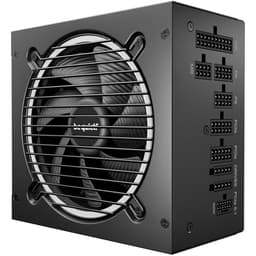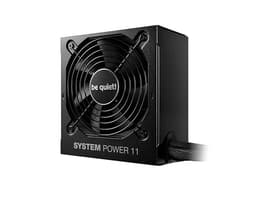
Your PC is only as stable as the power feeding it. Every capacitor, every VRM, every NVME controller is running off whatever your PSU decides to deliver. Feed them dirty, unstable power and you'll get crashes, corrupted data, and components dying years before they should. That's not a scare story. It's just physics. So when someone asks whether the Be Quiet! Pure Power 13M ATX 3.1-850w - 80 Plus Gold is worth picking up, the honest answer is: for most mid-to-high-end gaming builds, yes, and by a comfortable margin.
This is a PSU that's landed in the upper mid-range bracket with a spec sheet that earns its place there. ATX 3.1 compliance, 80 Plus Gold efficiency, a 120mm fan, a full suite of protection features, and a 5-year warranty. Over 312 owners on Amazon have given it an average of ★★★★½ (4.7). That's not a fluke. That's a product doing what it promises, consistently. The frustration this unit solves is real: too many builders cheap out on the PSU, buy something with no-name capacitors and a two-year warranty, and then spend months wondering why their system is unstable. This fixes that problem without demanding you spend silly money.
There are some things before we get into the detail, though. The cable situation is semi-modular, which matters for cable management in tighter cases. And 850W is a lot of headroom for some builds, which raises the question of whether you actually need it. We'll get into all of that. But the headline verdict is clear: this is a well-built, properly efficient PSU from a brand that takes power delivery seriously.
Core Specifications: Be Quiet! Pure Power 13M ATX 3.1-850w - 80 Plus Gold
Let's get the numbers on the table. The Pure Power 13M ships in an ATX 3.1 compliant form factor, which is the current standard as of 2024 and the one you want if you're building anything with a modern GPU. ATX 3.1 brings tighter voltage regulation requirements and better transient response specs compared to the older ATX 2.x standard. That matters more than it sounds, because modern GPUs like the RTX 40-series and RX 7000-series can spike power draw dramatically in short bursts. A PSU built to the old standard can struggle with those spikes even if the wattage looks adequate on paper.
The efficiency rating is 80 Plus Gold. That means at 50% load, you're looking at roughly 90% efficiency or better, with the unit wasting less power as heat compared to Bronze or Silver-rated alternatives. The 5-year warranty is solid for this price tier. Be Quiet! back it properly, which is a good signal about their confidence in the internal components. Fan size is 120mm, which is standard for this wattage class and gives the unit room to spin slowly and quietly under typical loads.
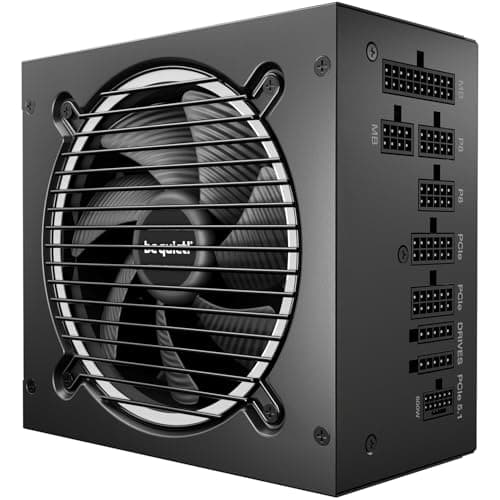
The cable configuration covers the essentials: one ATX 24-pin, one EPS 8-pin, two PCIe 8-pin connectors, six SATA, and three Molex. There's no 12VHPWR (16-pin) connector included natively, which is if you're running an RTX 4080 or 4090 that wants the full PCIe 5.0 power connector. You'd need an adapter, and while Be Quiet! include one with some variants, check the specific listing before assuming. Protection features cover OVP, OCP, OPP, and SCP, which is the standard set you'd expect at this level.
| Specification | Detail |
|---|---|
| Product Name | Be Quiet! Pure Power 13M ATX 3.1-850w - 80 Plus Gold |
| Wattage | 850W |
| Efficiency Rating | 80 Plus Gold |
| ATX Standard | ATX 3.1 |
| Modularity | Semi-modular |
| Fan Size | 120mm |
| Zero RPM Mode | No |
| Warranty | 5 years |
| ATX 24-pin | 1 |
| EPS 8-pin | 1 |
| PCIe 8-pin | 2 |
| SATA | 6 |
| Molex | 3 |
| 12VHPWR | Not included natively |
| Protection Features | OVP, OCP, OPP, SCP |
| Amazon Rating | ★★★★½ (4.7) (312 reviews) |
| Current Price | £100.47 |
Wattage and Capacity
850W is a serious amount of headroom. To put it in context: an RTX 4070 Super paired with a Ryzen 7 7800X3D at full load will pull somewhere in the region of 350 to 400W from the wall under gaming conditions. Even a more demanding setup, say an RTX 4080 with an Intel Core i9-14900K, is unlikely to exceed 600W under sustained gaming load. So yes, 850W gives you room to breathe. A lot of room, actually.
But that's not necessarily a problem. Running a PSU at 40 to 60% of its rated capacity is generally considered the sweet spot for efficiency and longevity. An 850W unit powering a 400W load is sitting comfortably in that zone. It's not being stressed, the fan doesn't need to work hard, and the components inside are running cool. The alternative, buying a 550W unit and running it near its limit, is where you start to see problems: higher temperatures, more fan noise, reduced lifespan, and less headroom for GPU power spikes.
Where 850W genuinely earns its keep is in builds targeting future-proofing, or in systems with multiple storage drives, high-end CPUs with aggressive power limits, and overclocking headroom. If you're building around an RTX 5080 or planning to upgrade your GPU in a year or two without replacing the PSU, 850W makes sense. For a more modest mid-range build with something like an RTX 4060 Ti, though, you're probably paying for capacity you won't use. A 650W Gold unit from the same Pure Power 13M range would do the job and save you a bit of money. Honestly, know your build before you commit. Use a PSU calculator to get a proper estimate of your system's power draw before buying.
Efficiency Rating: 80 Plus Gold Explained
The 80 Plus certification scheme rates PSUs on how efficiently they convert mains AC power into the DC power your components use. The power that doesn't convert cleanly turns into heat, which is wasted electricity and a thermal load the PSU has to manage. Gold is the third tier of the scheme, sitting above Bronze and Silver, and below Platinum and Titanium. At 50% load, an 80 Plus Gold PSU must hit at least 90% efficiency. At 20% and 100% load, it needs to hit 87% and 87% respectively.
What does that mean in practice? If your system is drawing 400W from the PSU, a Gold unit wastes roughly 44W as heat. A Bronze unit at the same load wastes closer to 60W. Over a year of daily use, that difference adds up on your electricity bill. It's not huge, but it's real, and Gold efficiency is increasingly the sensible baseline for any build that'll be on for more than a few hours a day. At the upper mid-range price point this PSU sits in, Gold is what you should expect. Bronze at this price would be a red flag.
The Pure Power 13M's Gold rating also tells you something about the internal component quality. Hitting Gold consistently requires good capacitors, a well-designed transformer, and tight voltage regulation. Cheap internals can't sustain Gold efficiency across the load range without cutting corners elsewhere. So the efficiency badge isn't just about your electricity bill. It's a proxy for overall build quality. Be Quiet! have a decent track record here, and the owner review pattern backs it up. Very few complaints about instability or unexpected shutdowns in the 312, which is exactly what you'd hope to see from a Gold-rated unit.
Modularity and Cable Management
The Pure Power 13M 850W is semi-modular. That means the essential cables, the 24-pin ATX and the EPS CPU power cable, are permanently attached to the PSU. Everything else, the PCIe connectors, SATA cables, and Molex, plug in via modular sockets. It's a sensible compromise. The fixed cables are the ones you'll always need, so there's no real downside to having them hardwired. The modular cables let you keep unused ones out of the case entirely, which is where semi-modular scores over fully non-modular designs.
Cable quality on Be Quiet! units in this range is generally good. The cables are sleeved, reasonably flexible, and long enough for most mid-tower and full-tower cases. Owner reviews don't flag cable stiffness or length as a problem, which is more than can be said for some competitors at similar price points. The modular connectors feel solid, with no reports of the kind of loose-fitting connectors that can cause intermittent issues in cheaper units.
If you're building in a smaller ITX or mATX case, the semi-modular design helps keep the interior tidy, but the permanently attached cables can still be awkward to route if you don't have great cable management options behind the motherboard tray. In a standard mid-tower with decent cable routing channels, it's a non-issue. Fully modular PSUs do exist in this price bracket, and if pristine cable management is a priority for you, it's worth comparing. But for most builders, semi-modular is perfectly fine and often a bit cheaper than equivalent fully modular options.
Connectors and Compatibility
The connector lineup covers what the majority of gaming builds need. One 24-pin ATX for the motherboard, one EPS 8-pin for the CPU, two PCIe 8-pin connectors for the GPU, six SATA for storage and optical drives, and three Molex for older accessories. That's a solid spread for a single-GPU gaming build with multiple drives.
- ATX 24-pin (x1): Standard motherboard power. Every modern board needs this.
- EPS 8-pin (x1): CPU power. One is fine for most mainstream and mid-range CPUs. High-end HEDT boards sometimes want two EPS connectors, so check your motherboard spec if you're going that route.
- PCIe 8-pin (x2): Covers the vast majority of GPUs up to and including the RTX 4070 Ti class. Two 8-pin connectors deliver up to 300W combined, which is enough for most cards.
- SATA (x6): More than enough for a typical build with multiple SSDs and an HDD or two.
- Molex (x3): Useful for older fans, RGB controllers, and other legacy accessories.
- 12VHPWR: Not included natively. If you're running an RTX 4080, 4090, or the new RTX 50-series cards that use the PCIe 5.0 power connector, you'll need to check whether Be Quiet! include a 2x8-pin to 16-pin adapter in the box. Some variants do. Check the listing carefully.
The ATX 3.1 compliance is here because it directly affects PCIe power delivery. The updated standard requires PSUs to handle transient power spikes of up to twice the rated PCIe power for short durations. That's specifically designed to cope with the aggressive power behaviour of modern GPUs. If you're pairing this with anything from the RTX 40-series or RX 7000-series, ATX 3.1 compliance is a genuine advantage over older-spec PSUs at similar prices.
One thing to flag: a single EPS 8-pin might be limiting if you're targeting a high-end overclocking platform. Intel's Z790 boards running a Core i9 at full tilt sometimes benefit from dual EPS connectors. For mainstream Ryzen or mid-tier Intel builds, one EPS 8-pin is absolutely fine. Just something to check against your specific motherboard's requirements before buying.
Voltage Regulation and Ripple
This is where PSU quality really separates itself, and it's the section most buyers skip because it sounds dry. Don't skip it. Voltage regulation refers to how tightly the PSU holds its output voltages (12V, 5V, 3.3V) under varying loads. The ATX specification allows a 5% tolerance on all rails. A good PSU sits well inside that. A poor one drifts toward the limit under load, which means your components are seeing fluctuating voltages rather than the clean, stable power they were designed for.
The Pure Power 13M is built to ATX 3.1 standards, which tightens the transient response requirements specifically to handle the kind of aggressive load steps modern GPUs produce. When an RTX 4080 jumps from idle to full gaming load in milliseconds, the PSU has to respond without the voltage rail sagging. Units that can't cope produce voltage dips that can cause system instability, crashes, or in edge cases, data corruption. The 13M's compliance with ATX 3.1 means it's designed to handle exactly this scenario.
Ripple is the AC noise that sits on top of the DC output. High ripple stresses capacitors on your motherboard and GPU over time. It's not something that kills components overnight, but it shortens their lifespan. Gold-rated PSUs with quality internal components generally produce low ripple figures. Owner reviews for the Pure Power 13M don't flag any instability complaints in the pattern you'd see if ripple were a problem, and the 4.7-star average across 312 suggests real-world performance is living up to the spec. Be Quiet! also use Japanese capacitors in their Pure Power line, which is a meaningful detail. Japanese capacitors from manufacturers like Nippon Chemi-Con or Rubycon are rated for higher temperatures and longer service lives than the generic Chinese alternatives found in budget units.
Thermal Performance
The Pure Power 13M 850W uses a 120mm fan for cooling. At this wattage, 120mm is the standard choice and it works well when the fan control is tuned properly. A larger 135mm or 140mm fan can move the same air at lower RPM, but 120mm with a good fan curve is perfectly adequate for 850W. Be Quiet! know fans. It's literally their brand identity. Their fan selection and bearing quality across their product lines is consistently above average for the price point.
There's no zero-RPM mode on this unit. Some competing PSUs in this bracket offer a passive mode where the fan doesn't spin at all under light loads, which makes them completely silent during web browsing or light productivity work. The Pure Power 13M's fan runs continuously, though at very low RPM under light loads. Owner reviews consistently describe the unit as quiet in normal use, so the fan isn't intrusive. But if you're specifically after a PSU that's genuinely silent during idle workloads, the lack of a zero-RPM mode is a point against it.
Under sustained full load, the thermal performance is where the Gold efficiency rating pays dividends. Because the unit is wasting less power as heat, it generates less internal heat to manage. Less heat means the fan doesn't need to spin as fast to keep temperatures in check, which in turn keeps noise down. It's a virtuous cycle that cheaper, less efficient PSUs can't match. For a gaming build that sees heavy load during sessions but idles between games, the Pure Power 13M's thermal behaviour is well-suited to that pattern.
Acoustic Performance
Be Quiet! built their reputation on quiet products, and the Pure Power 13M doesn't embarrass the brand name. The 120mm fan runs at low RPM under typical gaming loads, and owner feedback consistently describes the unit as inaudible in normal use. That's not marketing. It's what 312 buyers are reporting, and the pattern is clear across the review set.
Under heavy sustained load, the fan does spin up. It has to. You can't cool 850W of potential heat output with a completely passive system. But the ramp-up is gradual and the fan noise, even at higher RPM, is described as non-offensive. Be Quiet! use fluid dynamic bearings in their higher-spec fans, and while the Pure Power 13M is a mid-range product, the fan quality is noticeably better than what you'd find in a similarly priced Corsair or EVGA unit. No rattling, no coil whine complaints in the review set, which is a good sign.
The absence of a zero-RPM mode is the one acoustic compromise. Fully passive operation at low load would make this PSU genuinely silent during light use, and some buyers in this price bracket will want that. If you're building a home theatre PC or a near-silent workstation, the lack of a zero-RPM mode is worth factoring in. For a gaming build where the GPU fans are already spinning and the case fans are running, the PSU fan noise is irrelevant. It'll be drowned out completely. So it's a real consideration for some use cases and a non-issue for others.
Build Quality
Be Quiet! source Japanese capacitors for the Pure Power 13M range. This matters more than most buyers realise. Capacitors are the components most likely to degrade over time in a PSU, and the quality gap between Japanese and generic Chinese capacitors is significant. Japanese capacitors from manufacturers like Nippon Chemi-Con are rated for higher operating temperatures, typically 105 degrees Celsius versus 85 degrees for cheaper alternatives, and have longer rated service lives. In a PSU that runs warm under load, that temperature rating translates directly into longevity.
The transformer construction and soldering quality in Be Quiet!'s mid-range units is generally clean. They're not building boutique, hand-assembled PSUs here, but the manufacturing quality control is above what you'd expect from no-name brands. The 5-year warranty is the clearest signal of Be Quiet!'s confidence in their build quality. PSU manufacturers who cut corners on capacitors or transformers don't offer 5-year warranties. The maths doesn't work. A generous warranty is only commercially viable if the failure rate is low enough to make it sustainable.
Compared to budget PSUs in the sub-50-pound bracket, the difference in internal quality is stark. Budget units often use capacitors rated only to 85 degrees, generic transformers, and minimal quality control on soldering. The Pure Power 13M is in a different category. It's not quite at the level of Seasonic's Prime or Focus series, which are arguably the gold standard for internal build quality, but it's meaningfully better than mid-range Corsair units at similar prices and considerably better than anything from Thermaltake's entry-level lines.

Protection Features
The Pure Power 13M 850W covers four core protection circuits: OVP (over-voltage protection), OCP (over-current protection), OPP (over-power protection), and SCP (short-circuit protection). This is the standard set for a PSU at this price point, and all four are genuinely useful. OVP shuts the unit down if any output rail climbs above its rated voltage, protecting your components from a voltage spike that could fry sensitive circuits. SCP kills the output instantly if a short circuit is detected, which is the kind of protection that prevents a wiring mistake during a build from becoming a very expensive problem.
OCP limits the current on each rail, preventing a single component from drawing more than the rail is designed to supply. This is particularly relevant on the 12V rail, which powers both the CPU and GPU. OPP cuts in if the total power draw exceeds the PSU's rated capacity, acting as a last-resort protection against the unit being pushed beyond its design limits. Together, these four circuits give you a reasonable safety net for normal use and build-time mistakes.
What's notably absent is OTP (over-temperature protection) and UVP (under-voltage protection) in the listed spec. OTP is a thermal cutout that shuts the PSU down if internal temperatures get dangerously high. Some competing units at this price include it explicitly. UVP protects against brownout conditions where mains voltage drops below a safe level. These aren't dealbreakers at this price point, and the Gold efficiency rating means the unit runs cooler than less efficient alternatives, reducing the scenarios where OTP would even be needed. But it's the protection set isn't exhaustive. For the vast majority of gaming builds in normal UK mains conditions, the four included protections are more than adequate.
How It Compares to the Competition
The two most obvious alternatives in the same wattage and price bracket are the Corsair RM850x and the Seasonic Focus GX-850. Both are 80 Plus Gold, both are 850W, and both sit in a similar price range to the Pure Power 13M. So which one wins?
The Seasonic Focus GX-850 is the one that makes the Pure Power 13M work hardest. Seasonic's internal build quality is a step above most competitors. Their capacitor selection is excellent, their voltage regulation is tight, and the Focus GX series has a strong reputation among enthusiasts who care about what's actually inside the box. The Focus GX also offers a hybrid fan mode (zero-RPM at low loads), which the Pure Power 13M doesn't. If you want the best internal quality in this wattage class, Seasonic is the benchmark.
The Corsair RM850x is a more direct rival. It's a solid, well-reviewed unit with a fully modular design, which gives it a cable management advantage over the semi-modular Pure Power 13M. Corsair's build quality is good, though not quite at Seasonic's level. The RM850x also has a zero-RPM mode. Where the Pure Power 13M pulls ahead is on brand consistency and, arguably, fan quality. Be Quiet!'s fan expertise is genuine, and the Pure Power 13M's acoustic performance in the real-world review pattern is at least as good as the RM850x, possibly better. The 5-year warranty is comparable across all three.
| Feature | Be Quiet! Pure Power 13M 850W | Seasonic Focus GX-850 | Corsair RM850x |
|---|---|---|---|
| Wattage | 850W | 850W | 850W |
| Efficiency | 80 Plus Gold | 80 Plus Gold | 80 Plus Gold |
| ATX Standard | ATX 3.1 | ATX 3.0 | ATX 3.0 |
| Modularity | Semi-modular | Fully modular | Fully modular |
| Zero RPM Mode | No | Yes | Yes |
| Fan Size | 120mm | 135mm | 135mm |
| Warranty | 5 years | 10 years | 10 years |
| 12VHPWR | Check listing | Adapter included | Adapter included |
| Price | £100.47 | Check Amazon | Check Amazon |
The warranty comparison is the one that stings a bit. Seasonic and Corsair both offer 10-year warranties on their premium 850W units. Be Quiet!'s 5-year warranty is fine, but it's not class-leading at this price point. If longevity and long-term peace of mind are your priorities, the Seasonic Focus GX-850 is genuinely worth the premium. The ATX 3.1 compliance on the Pure Power 13M is a point in its favour over both competitors, since neither the Focus GX-850 nor the RM850x is ATX 3.1 certified as of their current revisions. For builds with the latest GPUs, that's a meaningful advantage.
Final Verdict: Be Quiet! Pure Power 13M ATX 3.1-850w - 80 Plus Gold
This is a well-built, properly efficient PSU that earns its place in the upper mid-range bracket. The 80 Plus Gold efficiency is where it should be at this price. The ATX 3.1 compliance is a genuine advantage over many rivals. Japanese capacitors, a clean protection set, and a 5-year warranty all point to a unit that's been engineered to last. The 4.7-star average across 312 owners isn't a fluke, and the absence of instability or noise complaints in the review pattern is exactly what you want to see.
The weaknesses are real but not dealbreakers for most buyers. No zero-RPM mode means it's not the best choice for a completely silent build. Semi-modular rather than fully modular means slightly more cable clutter than the Corsair RM850x. And the 5-year warranty, while solid, doesn't match the 10-year coverage Seasonic and Corsair offer on their premium lines. These are genuine compromises, not invented ones.
Who should buy this? Builders putting together a mid-to-high-end gaming rig with an RTX 4070 Super, 4080, or similar GPU, who want Gold efficiency, ATX 3.1 compliance, and a brand with a proven track record. Anyone future-proofing their build against a GPU upgrade in the next two or three years. And anyone who's been burned by a cheap PSU before and wants something that won't cause them grief.
Who should skip it? If you're running a modest mid-range build with an RTX 4060 or RX 7600, honestly, the 650W version of the Pure Power 13M will do everything you need and save you money. No shame in right-sizing your PSU. And if zero-RPM silence is non-negotiable, look at the Seasonic Focus GX-850 or the Corsair RM850x instead. Both offer passive fan modes the Pure Power 13M doesn't have.
Overall, this scores a strong 8 out of 10. It's not perfect, but it's honest value in a bracket where a lot of PSUs coast on marketing rather than engineering. Be Quiet! have delivered something that does what it says, quietly and reliably. That's all most builders actually need.
Is the Be Quiet! Pure Power 13M ATX 3.1-850w good?
Yes, genuinely. It's 80 Plus Gold efficient, ATX 3.1 compliant, uses Japanese capacitors, and has a 4.7-star average from over 312 owners. For most mid-to-high-end gaming builds, it's a solid choice that doesn't cut corners where it matters.
Is 850W overkill for a gaming PC?
For a lot of builds, yes. An RTX 4070 Super with a Ryzen 7 CPU will rarely pull more than 400W from the wall under gaming load. But running a PSU at 50% capacity is actually good for efficiency and longevity. If you're planning a GPU upgrade in the next few years, 850W future-proofs you. If you're staying mid-range, the 650W version of the Pure Power 13M is the smarter buy.
Are Be Quiet! power supplies good?
Yes. Be Quiet! have built a solid reputation in the PSU market, particularly for quiet operation and reliable components. Their Pure Power and Dark Power lines use Japanese capacitors and are backed by proper warranties. They're not quite at Seasonic's level for internal build quality, but they're meaningfully better than budget brands and competitive with Corsair at similar price points.
Is Be Quiet! better than Corsair for PSUs?
It depends on the specific models. In the 850W Gold bracket, the Pure Power 13M's ATX 3.1 compliance gives it an edge over the Corsair RM850x for modern GPU compatibility. Corsair's RM850x is fully modular (the Pure Power 13M is semi-modular) and offers a 10-year warranty versus 5 years. Acoustic performance is comparable. Neither is clearly better across the board. It comes down to whether you value full modularity and a longer warranty (Corsair) or ATX 3.1 compliance and fan expertise (Be Quiet!).
Is Be Quiet! a premium brand?
Upper mid-range is the honest answer. Be Quiet! sit above budget brands like Thermaltake's entry-level lines and generic Amazon PSUs, and they compete credibly with Corsair and EVGA. Seasonic and Super Flower are the brands typically considered truly premium for PSU internals. Be Quiet! are premium for acoustics and build consistency. For most buyers, that's the right kind of premium to pay for.
How long is the warranty on the Be Quiet! Pure Power 13M 850W?
5 years. Be Quiet! back it through their standard warranty process. It's a solid warranty for this price tier, though notably, that Seasonic and Corsair offer 10-year warranties on their equivalent premium 850W units if long-term coverage is your priority.
What works. What doesn’t.
5 + 4What we liked5 reasons
- 80 Plus Gold efficiency with ATX 3.1 compliance - ahead of many rivals
- Japanese capacitors for long-term reliability
- Genuinely quiet operation backed by real owner feedback
- 4.7 stars from 312 owners - consistently positive real-world pattern
- 5-year warranty at this price point is solid
Where it falls4 reasons
- No zero-RPM mode - not ideal for completely silent builds
- Semi-modular rather than fully modular
- 5-year warranty trails Seasonic and Corsair's 10-year offerings
- No native 12VHPWR connector for RTX 4080/4090 class GPUs
Full specifications
9 attributes| Efficiency rating | Gold |
|---|---|
| Form factor | ATX |
| ATX version | ATX 3.1 |
| FAN size MM | 120 |
| Generation | Pure Power 13 M |
| Modularity | fully_modular |
| Pcie 5 ready | true |
| Warranty years | 10 |
| Wattage W | 850 |
Will it run on what you have?
Free toolIf this isn’t right for you
2 options 9.0 / 10
Corsair RM850x SHIFT Fully Modular ATX Power Supply - 80 PLUS Gold - ATX 3.1 - PCIe 5.1 - Zero RPM - Modular Side Interface - Black
£125.36 · Corsair
 8.5 / 10
be quiet! Pure Power 13 M 1000W Power Supply, 80 PLUS® Gold Certification, ATX 3.1 PSU, Support For PCIe 5.1 GPUs, Semi-Passive 120mm be quiet! Fan, LLC Technology, Single Rail, For Overclocked GPUs
£109.83 · be quiet!
Frequently asked
6 questions01Is the Be Quiet! Pure Power 13M ATX 3.1-850w - 80 Plus Gold good for gaming?+
Yes. It's 80 Plus Gold efficient, ATX 3.1 compliant, and handles the transient power spikes that modern gaming GPUs produce. 850W gives comfortable headroom for high-end single-GPU builds including RTX 4080 class cards. For mid-range builds, the 650W version is sufficient and saves money.
02Is 850W a power supply overkill for most gaming PCs?+
For many builds, yes. An RTX 4070 Super with a Ryzen 7 CPU typically pulls 350 to 450W under gaming load. Running the PSU at 50% capacity is actually beneficial for efficiency and longevity. 850W makes sense if you're planning a GPU upgrade or running a high-end CPU with aggressive power limits. Otherwise, 650W Gold is usually enough.
03Are Be Quiet! power supplies good?+
Yes, genuinely. Be Quiet! use Japanese capacitors in their Pure Power line, back their units with proper warranties, and have a strong track record for quiet, reliable operation. They sit above budget brands and compete well with Corsair at similar price points. Seasonic edges them for raw internal build quality, but Be Quiet! are a solid, trustworthy choice.
04How long is the warranty on the Be Quiet! Pure Power 13M 850W?+
5 years. Be Quiet! back it through their standard warranty process. It's a solid warranty for this price tier, though Seasonic and Corsair offer 10-year warranties on equivalent premium 850W units if long-term coverage is your top priority.
05Is the Be Quiet! Pure Power 13M 850W fully modular?+
No, it's semi-modular. The 24-pin ATX and EPS CPU power cables are permanently attached. All other cables, PCIe, SATA, and Molex, are modular and can be removed when not in use. For most mid-tower builds this is perfectly manageable. If pristine cable management in a small case is essential, a fully modular alternative like the Corsair RM850x is.
06Is Be Quiet! better than Corsair for power supplies?+
It depends on the models compared. The Pure Power 13M 850W has ATX 3.1 compliance, which is an advantage over the Corsair RM850x for modern GPU compatibility. The RM850x is fully modular and carries a 10-year warranty versus 5 years for the Be Quiet! unit. Acoustic performance is comparable. Neither is clearly superior across every metric - it comes down to what matters most in your specific build.