Budget allocation in a PC build tends to follow a predictable pattern: maximum spend on the GPU, minimum spend on everything else, and somewhere in the middle a PSU gets picked almost at random. That approach works fine right up until it doesn't, and when a cheap PSU fails it tends to take components with it. The MSI MPG A850G PCIE5 Power Supply Unit sits in the mid-range bracket and makes a genuinely strong case for spending a bit more on the thing that powers everything else. The question worth asking isn't whether it's expensive. It's whether the specification justifies the price relative to what else is available.
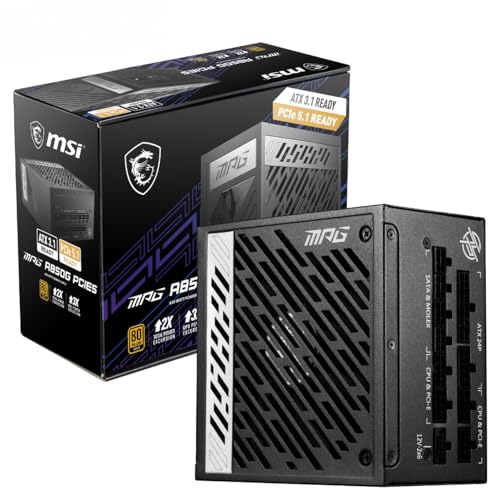
The short verdict: yes, it does. The MSI MPG A850G PCIE5 Power Supply Unit, UK Plug - 850W, 80 Plus Gold Certified, Fully Modular ATX 3.0, PCIe 5.0 GPU Support, Japanese 105°C Capacitors, 0% RPM Mode, Flat Cables - 10 Year Warranty is one of the more complete packages at this price point. You get ATX 3.0 compliance, a native 12VHPWR connector for PCIe 5.0 GPUs, a 10-year warranty that's genuinely unusual at this tier, and a 135mm FDB fan with a proper 0% RPM mode. Against competitors like the Corsair RM850x and the be quiet! Pure Power 12 M, it holds up well, and in some respects it pulls ahead. The hundreds of owner reviews averaging ★★★★½ (4.7) aren't a fluke either.
That said, this review will also tell you when a cheaper option makes more sense, because not every build needs 850W with PCIe 5.0 support. If your GPU is a mid-range card from the last generation, there's probably a more efficient use of your money. But if you're building around a current-gen flagship GPU or planning a system that'll stay relevant for several years, read on.
Core Specifications: MSI MPG A850G PCIE5 Power Supply Unit
The headline numbers are straightforward: 850W continuous output, 80 Plus Gold efficiency certification, fully modular cabling, and ATX 3.0 compliance. Those four things together in the mid-range price bracket is actually a fairly tight combination to find. Most PSUs at this price either drop to semi-modular or stop at ATX 2.x, which matters more than it used to now that modern GPUs can spike power draw dramatically over very short intervals.
The 80 Plus Gold certification means the unit is independently verified to hit at least 87% efficiency at 20% load, 90% at 50% load, and 87% again at full load (on a 115V supply; the 230V UK figures are slightly different but similarly strong). That's not marketing. The 80 Plus certification programme uses third-party testing to verify these numbers, so you're not just taking MSI's word for it. For context, 80 Plus Bronze sits at roughly 82% at 50% load, so Gold is a meaningful step up in real-world running costs.
The 10-year warranty deserves its own mention because it's genuinely rare at this price tier. Most competing PSUs in the mid-range bracket ship with 5 to 7 year warranties. A decade of coverage signals that MSI is confident in the internal component quality, and it also means you're buying a unit that should outlast two or three GPU generations without any anxiety about the PSU becoming the weak link.
| Specification | Detail |
|---|---|
| Wattage | 850W |
| Efficiency Rating | 80 Plus Gold (up to 90%) |
| Modularity | Fully Modular |
| Standard | ATX 3.0 |
| PCIe Connector | Native 16-pin 12VHPWR (PCIe 5.0) |
| Fan | 135mm Fluid Dynamic Bearing (FDB) |
| Zero RPM Mode | Yes (below 40% TDP, hardware toggle) |
| Capacitors | Japanese 105°C rated |
| Warranty | 10 years |
| Protections | OCP, OVP, OPP, OTP, SCP, UVP |
| Cable Style | Flat black, storage bag included |
| Price | £99.99 · Details |
Wattage and Capacity
850W is a sensible ceiling for the majority of enthusiast gaming builds in 2026. To put some numbers around that: an RTX 4080 Super has a TDP of around 320W, and a Ryzen 9 7950X pulls around 170W under full load. Add in storage, RAM, fans and a bit of headroom, and you're looking at a realistic peak system draw somewhere in the 600 to 650W range for that kind of build. 850W gives you a comfortable buffer without going overboard into 1000W territory, which tends to run less efficiently at typical gaming loads because you're operating at a lower percentage of rated capacity.
The ATX 3.0 specification changes the headroom conversation more than the raw wattage does. Under ATX 3.0, a PSU must handle transient power excursions of up to 2x total system power and 3x GPU power. In practice this means the MPG A850G can absorb short spikes well above its 850W continuous rating without tripping overcurrent protection. That's directly relevant to modern NVIDIA GPUs, which are known to pull significant transient spikes during the first few frames of a demanding scene. Older ATX 2.x units sometimes trip their protections under exactly these conditions, causing system instability or shutdowns that look like GPU driver crashes.
For build planning: this PSU is overkill for anything below a mid-range GPU like an RTX 4070 or RX 7800 XT. Those builds would be better served by a 650W or 750W unit. Where 850W makes proper sense is with a flagship GPU (RTX 4090, RTX 5080, RX 7900 XTX), a high-core-count CPU, or a system that's likely to be upgraded over time. The single-railed design means all 850W is available to whatever needs it, rather than being partitioned across multiple rails with individual current limits.
Efficiency Rating: 80 Plus Gold Explained
The 80 Plus Gold certification on the MSI MPG A850G PCIE5 Power Supply Unit is worth understanding properly rather than just treating as a badge. The certification means the unit converts at least 87% of the mains power it draws into usable DC power at 20% and 100% load, and at least 90% at 50% load. The remaining 10% or so is lost as heat. For an 850W unit running at 50% load (a realistic gaming scenario), that means drawing roughly 472W from the wall to deliver 425W to your components. A Bronze-rated unit at the same load might draw 500W or more for the same output.
Over a year of gaming, that efficiency gap adds up. Assuming 4 hours of daily gaming at 50% load, the Gold unit saves somewhere in the region of 40 to 50 kWh annually compared to a Bronze equivalent. At current UK electricity rates, that's not going to pay for the PSU, but it does reduce the effective running cost over the 10-year warranty period. The bigger practical benefit is thermal: a more efficient PSU generates less waste heat, which means the fan runs less aggressively, which means less noise and less thermal stress on internal components.
Gold is also the sweet spot in the efficiency tier hierarchy. Platinum and Titanium units exist and are measurably more efficient, but the price premium over Gold is significant and the real-world energy savings rarely justify it for a gaming PC that isn't running 24/7. Bronze is fine for budget builds but the efficiency gap at high loads is noticeable. For a mid-range to enthusiast build, Gold is the rational choice, and the MPG A850G hits that certification comfortably.
Modularity and Cable Management
Fully modular means exactly what it says: every cable detaches, including the 24-pin ATX motherboard connector. That matters for cable management because it means you only connect what you actually need, and unused cables go in the storage bag (which MSI includes in the box, which is a nice touch that not everyone bothers with). Semi-modular units leave the 24-pin and one or two EPS cables permanently attached, which isn't a disaster but does mean you're always routing cables you can't remove.
The flat black cable design is genuinely useful rather than cosmetic. Flat cables are easier to route through tight spaces behind the motherboard tray, they don't bunch up the same way round-sleeved cables do, and they sit flatter against surfaces when you're trying to hide them. Owner reviews consistently mention cable management as a highlight, with several noting that the cables are long enough to reach comfortably in full-tower cases without being so long that they create excess slack. That's a balance that some PSU manufacturers get wrong in both directions.
The storage bag for unused cables is again because it's one of those small details that reflects how a product is actually designed to be used. If you're building in a mid-tower with a single GPU and no optical drive, you might only use half the available cables. Having somewhere to put the rest, rather than stuffing them into the case or losing them in a drawer, is the kind of practical thinking that distinguishes a well-considered product from one that's just hitting spec targets. It's a small thing. But small things matter when you're building a system you'll open again in two years.
Connectors and Compatibility
The connector set on the MPG A850G is built around modern GPU requirements. The native 16-pin 12VHPWR connector is the headline: this is the PCIe 5.0 connector that can deliver up to 600W to a compatible GPU without requiring an adapter. NVIDIA's RTX 4000 and 5000 series cards use this connector natively, and AMD's RX 7000 series supports it via adapter. Using a native connector rather than an adapter cable reduces the risk of the connector overheating, which was a documented issue with early adapter cables used on RTX 4090 cards.
The full connector set breaks down as follows:
- 1x ATX 24-pin motherboard connector
- 1x EPS 8-pin CPU power connector
- 2x PCIe 8-pin connectors (for older GPU compatibility)
- 6x SATA power connectors
- 3x Molex connectors
- 1x Native 16-pin 12VHPWR (PCIe 5.0)
The single EPS 8-pin is for anyone planning a high-end build with a processor that benefits from dual EPS connectors (some Threadripper and HEDT motherboards have two CPU power sockets). For mainstream AM5 and LGA1700 builds, a single 8-pin EPS is standard and sufficient. The six SATA connectors cover most storage-heavy builds, and the three Molex connectors handle legacy peripherals and fan hubs. Overall the connector set is well matched to a flagship gaming build without being excessive.
Voltage Regulation and Ripple
The internal topology of the MPG A850G uses a half-bridge LLC resonant converter combined with a DC-to-DC converter stage. This is a well-established and respected topology for modern PSU design. The LLC stage handles the main power conversion efficiently across a wide load range, while the DC-to-DC stage generates the minor rails (3.3V and 5V) from the main 12V rail rather than from separate transformer windings. The result is tighter voltage regulation across all rails under varying load conditions.
Active Power Factor Correction (active PFC) is included, which is relevant for two reasons. First, it brings the power factor close to 1.0, meaning the unit draws clean, in-phase current from the mains rather than creating reactive load. Second, active PFC typically results in better voltage regulation under fluctuating load conditions, which is exactly what a gaming PC produces as the GPU cycles between idle and full load. The power factor correction also means the unit works correctly across a wider input voltage range, which matters if your mains supply isn't perfectly stable.
The single-rail 12V design simplifies the power distribution architecture. Rather than splitting the 12V output across multiple rails with individual current limits (which can cause one rail to trip while another has headroom to spare), all 850W of 12V capacity is available to any connected load. This is particularly relevant for high-power GPU configurations where the graphics card might draw its full rated current through the PCIe connectors. The DC-to-DC topology also tends to produce lower ripple on the 3.3V and 5V rails compared to traditional transformer-based minor rail generation, which benefits system stability under mixed loads.
Thermal Performance
The 135mm fluid dynamic bearing fan is larger than the 120mm fans found in many competing units at this price. A larger fan moves the same volume of air at lower RPM, which directly translates to lower noise. Fluid dynamic bearings are the preferred bearing type for PSU fans because they run quieter than sleeve bearings and last longer than ball bearings, with typical rated lifespans well above 50,000 hours. For a PSU with a 10-year warranty, that bearing longevity actually matters.
The 0% RPM mode is the more interesting thermal feature. Below 40% of rated TDP (so below roughly 340W of system draw), the fan stops entirely. The unit runs passively, relying on natural convection through the PSU housing to manage heat. For the majority of desktop tasks, web browsing, video playback, and light productivity, a system with this PSU will have zero fan noise coming from the power supply. The manual override button on the rear panel lets you disable this mode if you prefer the fan to always spin, which is useful if you're running the system in a particularly warm environment or pushing sustained loads that approach the 40% threshold.
Under sustained full load, the fan ramps up progressively rather than jumping to maximum speed immediately. Owner reviews note that the fan remains relatively quiet even under heavy gaming loads, with the system only becoming audible under extended stress scenarios. The thermal management benefits from the Gold efficiency rating too: less waste heat generated means the fan has less work to do, creating a positive feedback loop between efficiency and acoustics that cheaper, less efficient units can't replicate.
Acoustic Performance
Noise from a PSU comes from two sources: the fan and coil whine. The 135mm FDB fan on the MPG A850G addresses the first source directly. Larger diameter means lower RPM for equivalent airflow, and fluid dynamic bearings are inherently quieter than alternatives. The 0% RPM mode eliminates fan noise entirely below 40% load, which covers a substantial portion of typical desktop use. Owner feedback consistently describes the unit as quiet during normal gaming sessions, with the fan becoming noticeable only under extended, demanding workloads.
Coil whine is harder to predict from specifications alone because it depends on the specific inductors used and the switching frequency of the converter. The verified owner reviews for this unit don't show a pattern of coil whine complaints, which is a reasonable indicator that MSI's component selection and PCB layout have kept this under control. notably, that coil whine can also originate from the GPU or motherboard VRMs rather than the PSU itself, so any such reports need to be interpreted carefully.
For builders targeting a quiet system, the MPG A850G is a solid choice. The combination of the large FDB fan, passive mode below 40% load, and Gold efficiency (meaning less heat to dissipate) makes it genuinely well-suited to noise-sensitive environments. If you're building a home office machine that doubles as a gaming rig and you want it to be inaudible during work hours, this PSU won't be the component that lets you down. You can also use our PSU calculator to work out whether 850W is the right capacity for your specific component list, which affects how much of the time you'll be in passive mode.
Build Quality
Japanese 105°C capacitors are specified throughout. This matters more than it might seem. Capacitor quality is the primary determinant of PSU longevity, and the difference between Japanese-manufactured capacitors and cheaper alternatives is well documented in the industry. The 105°C temperature rating means the capacitors are rated to operate at that temperature continuously, which gives substantial headroom in a PSU that typically runs its internal components at 40 to 60°C under normal conditions. Lower-rated capacitors (85°C is common in budget units) age faster under thermal stress and are more likely to fail as the PSU ages.
The half-bridge LLC topology combined with DC-to-DC conversion represents current best practice in PSU design. The LLC resonant converter runs at a frequency that minimises switching losses, which contributes to the Gold efficiency figures and reduces thermal stress on the switching components. This topology is used in premium units across the market, and its presence in a mid-range PSU indicates that MSI hasn't cut corners on the fundamental architecture. The active PFC stage adds component count but improves overall power quality and input voltage tolerance.
The fully modular connector system uses quality connectors throughout, and the flat cables are properly crimped rather than using the cost-cutting approach of loose pin insertions that can cause intermittent connections. The storage bag for unused cables is a minor detail but it's indicative of the overall attention to the user experience. MSI's product page for the MPG A850G confirms the specification details and the 10-year warranty terms. Build quality is where the 10-year warranty becomes meaningful: MSI wouldn't offer that coverage on a unit built with marginal components.
Protection Features
The MSI MPG A850G PCIE5 Power Supply Unit covers the full set of standard protections: Over Current Protection (OCP), Over Voltage Protection (OVP), Over Power Protection (OPP), Over Temperature Protection (OTP), Short Circuit Protection (SCP), and Under Voltage Protection (UVP). That's a complete protection suite. Some budget PSUs omit UVP or OTP to reduce component cost, which leaves the system vulnerable to specific failure modes that are rare but genuinely damaging when they occur.
OCP limits the current on each rail to prevent overcurrent conditions from damaging connected components. On a single-rail design like this one, the OCP threshold is set high enough to allow the GPU to draw its full rated current without nuisance tripping, while still protecting against genuine fault conditions. OVP shuts the unit down if any rail voltage rises above its tolerance band, protecting sensitive components from overvoltage damage. SCP provides immediate shutdown in the event of a short circuit anywhere in the system, which is the protection that matters most during installation when accidental shorts are most likely.
OTP is the protection that's most relevant to long-term reliability. If the internal temperature of the PSU exceeds a safe threshold (typically due to inadequate case airflow or running at very high load in a warm environment), OTP shuts the unit down before thermal damage can occur. This is preferable to the alternative, which is letting the unit continue operating until a component fails. UVP protects against brownout conditions where mains voltage drops below the minimum input threshold, preventing the PSU from trying to deliver rated power with insufficient input voltage. Together, these six protections cover the realistic failure modes a PSU is likely to encounter over a decade of operation.
How It Compares
The two most relevant competitors at 850W in the mid-range bracket are the Corsair RM850x (2021 or 2023 revision) and the be quiet! Pure Power 12 M 850W. Both are well-regarded units with strong reputations, and both are if you're shopping at this wattage. The comparison below uses published specifications for all three units.
The Corsair RM850x is the most direct competitor. It's also 80 Plus Gold certified, fully modular, and uses a Zero RPM mode. Where the MSI pulls ahead is on the ATX 3.0 compliance and the native 12VHPWR connector: the older RM850x revisions are ATX 2.x units, which means they lack the transient handling specification that modern high-power GPUs benefit from. The 2023 RM850x revision does address this, but it typically commands a higher price than the MSI at this wattage. The be quiet! Pure Power 12 M is a solid mid-range option with good noise characteristics, but it ships with a 5-year warranty versus the MSI's 10 years, and its ATX 3.0 compliance varies by retailer stock revision.
Honestly, the 10-year warranty is the MSI's strongest differentiating argument when you put these three side by side. At equivalent pricing, that warranty advantage is difficult to ignore. The native PCIe 5.0 connector is the other factor: if your GPU uses 12VHPWR natively, avoiding an adapter cable is a genuine reliability benefit, not a cosmetic one.
| Feature | MSI MPG A850G PCIE5 | Corsair RM850x (2023) | be quiet! Pure Power 12 M 850W |
|---|---|---|---|
| Wattage | 850W | 850W | 850W |
| Efficiency | 80 Plus Gold | 80 Plus Gold | 80 Plus Gold |
| Modularity | Fully Modular | Fully Modular | Fully Modular |
| ATX Standard | ATX 3.0 | ATX 3.0 | ATX 3.0 |
| Native 12VHPWR | Yes (600W capable) | Yes | Yes |
| Fan | 135mm FDB | 120mm FDB | 120mm FDB |
| Zero RPM Mode | Yes (below 40% TDP) | Yes | Yes |
| Warranty | 10 years | 10 years | 5 years |
| Capacitors | Japanese 105°C | Japanese | Japanese |
| Price | £99.99 · Details | Typically higher | Typically similar |
Final Verdict: MSI MPG A850G PCIE5 Power Supply Unit
The MSI MPG A850G PCIE5 Power Supply Unit, UK Plug - 850W, 80 Plus Gold Certified, Fully Modular ATX 3.0, PCIe 5.0 GPU Support, Japanese 105°C Capacitors, 0% RPM Mode, Flat Cables - 10 Year Warranty is a well-specified, properly engineered PSU that earns its place in the mid-range bracket. The combination of ATX 3.0 compliance, native 12VHPWR connector, 80 Plus Gold efficiency, 135mm FDB fan with passive mode, and a 10-year warranty is genuinely competitive at this price point. The hundreds of owner reviews averaging ★★★★½ (4.7) from 460 reviewers reflect a unit that performs as advertised and doesn't develop problems after a few months in service.
Who should buy this? Anyone building around a current-generation flagship GPU (RTX 4090, RTX 5080, RX 7900 XTX or equivalent) who wants a PSU that won't need replacing when the next GPU generation arrives. The ATX 3.0 transient handling and PCIe 5.0 support mean this unit is genuinely future-proof in a way that older ATX 2.x units aren't. The 10-year warranty means you can buy it and forget about it. Builders who prioritise quiet operation will also appreciate the passive mode and the large FDB fan.
Who should skip it? If your build is centred around a mid-range GPU like an RTX 4070 or RX 7800 XT, 850W is more than you need and a 650W Gold unit will serve you just as well for less money. There's no point paying for headroom you won't use. Similarly, if you're on a tight budget and efficiency is less of a priority, a Bronze-rated 650W unit in the budget bracket will power a mid-range gaming PC without issue. Spend the saving on storage or RAM instead. But if you're going high-end, or you want a PSU that'll still be relevant and covered by warranty in 2034, the MSI MPG A850G PCIE5 is a straightforward recommendation.
What works. What doesn’t.
5 + 3What we liked5 reasons
- 10-year warranty is exceptional at this price tier
- ATX 3.0 compliance handles modern GPU power spikes properly
- Native 12VHPWR connector avoids adapter reliability concerns
- 135mm FDB fan with passive mode below 40% load is genuinely quiet
- Japanese 105°C capacitors throughout indicate serious build quality
Where it falls3 reasons
- 850W is overkill for mid-range GPU builds - 650W would be better value
- Single EPS 8-pin may limit compatibility with some HEDT motherboards
- Premium over basic Bronze units may not be justified for budget builders
Full specifications
9 attributes| Efficiency rating | Gold |
|---|---|
| Form factor | ATX |
| ATX version | ATX 3.0 |
| FAN size MM | 140 |
| Generation | MPG A-G Series |
| Modularity | fully_modular |
| Pcie 5 ready | true |
| Warranty years | 10 |
| Wattage W | 850 |
Will it run on what you have?
Free toolIf this isn’t right for you
2 options

Frequently asked
5 questions01Is the MSI MPG A850G PCIE5 Power Supply Unit good for gaming?+
Yes, it's well-suited to high-end gaming builds. The 850W output with ATX 3.0 transient handling covers flagship GPUs including the RTX 4090 and RTX 5080. The native 12VHPWR connector delivers up to 600W to a PCIe 5.0 GPU without an adapter. For mid-range GPU builds, a 650W unit would be more appropriately sized.
02What GPU can the MSI MPG A850G PCIE5 support?+
The MPG A850G supports any current GPU from NVIDIA or AMD. The native 16-pin 12VHPWR connector handles PCIe 5.0 GPUs up to 600W directly. Two PCIe 8-pin connectors cover older GPU generations. For an RTX 4090 paired with a high-end CPU, 850W provides comfortable headroom.
03What does 80 Plus Gold efficiency mean in practice?+
80 Plus Gold means the PSU converts at least 90% of mains power into usable DC output at 50% load. Compared to 80 Plus Bronze (roughly 82% at 50% load), Gold efficiency reduces heat generation and lowers running costs over time. The bigger practical benefit is less heat inside the PSU, meaning the fan runs less aggressively and the unit is quieter.
04How long is the warranty on the MSI MPG A850G PCIE5?+
The MSI MPG A850G PCIE5 carries a 10-year warranty. This is longer than most competitors at this price tier, which typically offer 5 to 7 years. The 10-year coverage reflects confidence in the Japanese 105°C capacitors and overall build quality, and means the unit should outlast multiple GPU upgrade cycles.
05Is the MSI MPG A850G PCIE5 fully modular?+
Yes, the MPG A850G is fully modular. Every cable, including the 24-pin ATX motherboard connector, detaches completely from the PSU. This makes cable management considerably easier than semi-modular designs. Unused cables can be stored in the included cable storage bag, and the flat black cable design makes routing cleaner than round-sleeved alternatives.