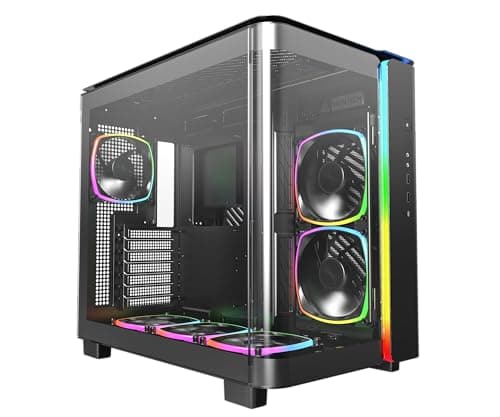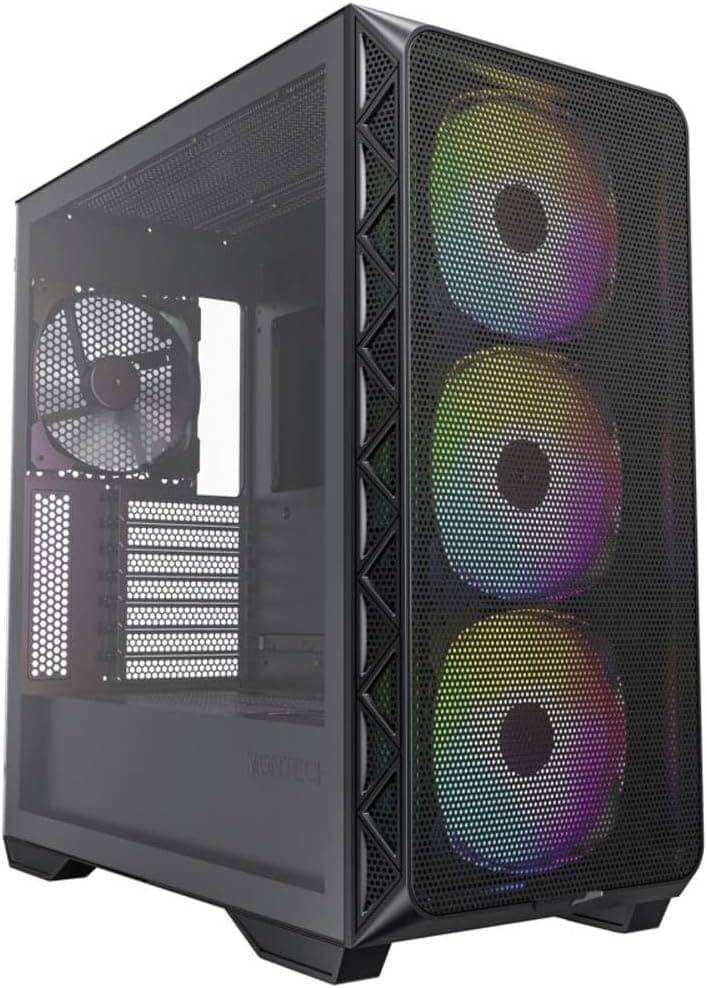
Picking a case at the enthusiast end of the market should be straightforward. You're paying more, so you expect more. But the spec sheet on a lot of cases in this price bracket is doing a lot of heavy lifting for what turns out to be a frustrating build experience. Sharp edges on the PSU shroud, cable routing channels that are too narrow for a proper modular PSU, tempered glass panels that need three hands to remove, radiator mounts that technically fit a 360mm but only if your RAM is shorter than 35mm. You know the drill. The ASUS TUF Gaming GT502 Horizon is trying to fix all of that in one go, and based on the spec sheet and what 175 owners have reported, it mostly does. This is an ASUS TUF Gaming GT502 case review that gets straight to the point: it's a genuinely well-sorted mid-tower with a dual-chamber layout, four included ARGB fans, USB-C at 20Gbps on the front panel, and enough clearance for modern hardware to breathe properly.
The verdict? If you're building a proper ATX system and you want something that looks sharp, ships with decent fans already installed, and won't have you swearing at the cable routing for an afternoon, this is a strong choice at the enthusiast price tier. The dual-chamber design is the headline feature and it earns its keep. PSU and storage live behind a partition, which keeps the main chamber clean and makes the whole build look far more intentional through that tempered glass side panel. Owner feedback backs this up consistently, with a 4.6 average across 255 and repeated mentions of how easy the build process is compared to more traditional layouts. There are caveats, and we'll get to them, but the overall picture is positive.
One thing upfront: this is a big case. The dual-chamber design adds footprint, and if your desk space is tight, you'll want to check the dimensions before committing. More on that shortly.
Core Specifications
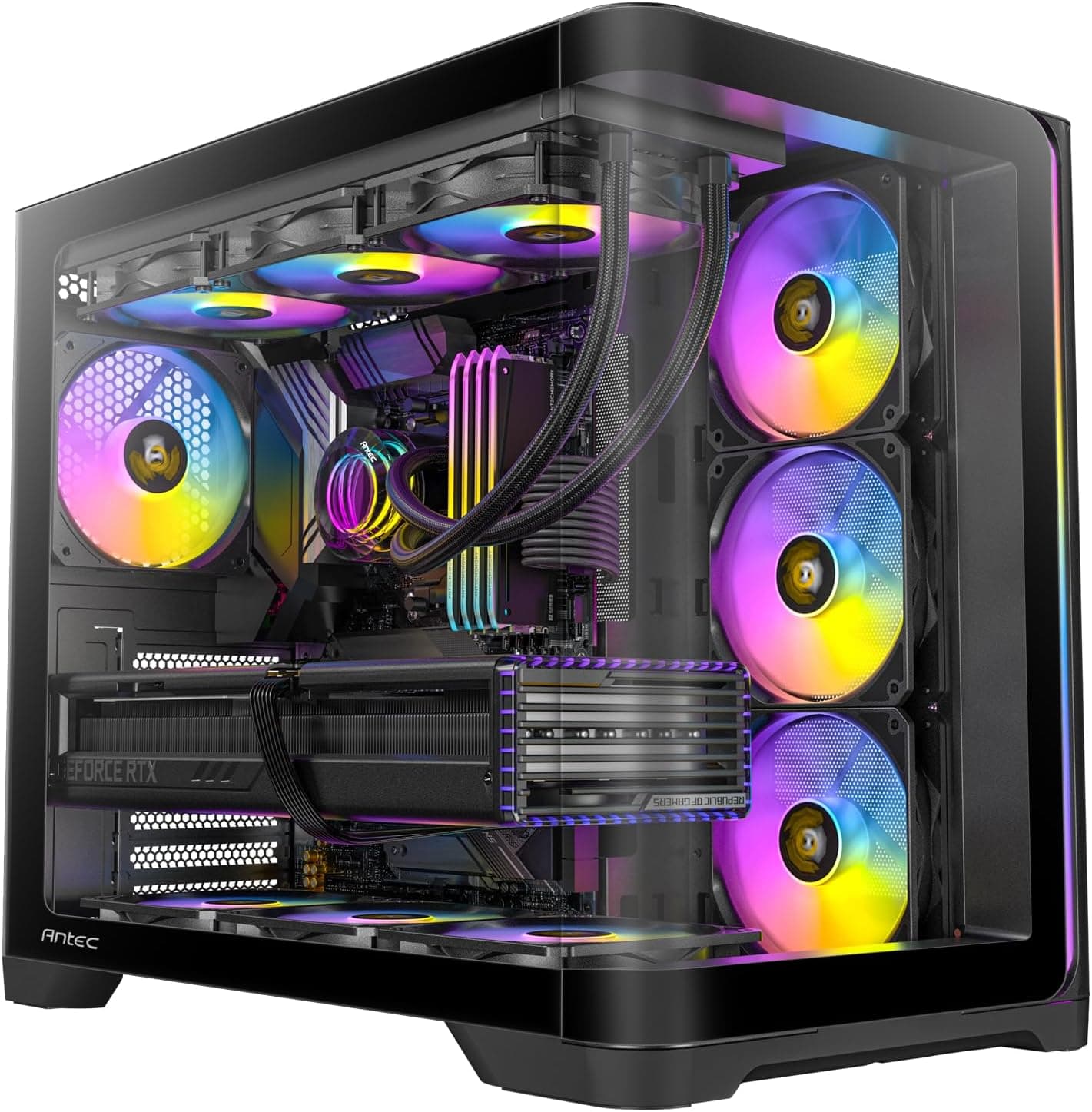
The GT502 Horizon is a mid-tower ATX case with a dual-chamber design, which is the central architectural decision everything else flows from. The main chamber holds the motherboard, GPU, and CPU cooling. The secondary chamber, separated by a modular partition, handles the PSU, drives, and the bulk of your cabling. ASUS rates it for ATX, Micro-ATX, and Mini-ITX motherboards, with the internal dimensions giving you 410mm of GPU clearance and 185mm of CPU cooler height. Radiator support goes up to 360mm at the front and 240mm at the top, which covers most AIO options you'd pair with a build at this price point.
Four ARGB fans are included in the box: three 120mm units at the front acting as intake and one 120mm at the rear as exhaust. These are ASUS-branded ARGB fans, and they connect to an included fan and RGB hub that supports up to six fans and four RGB headers. That hub is a genuinely useful inclusion because it means you're not hunting for spare motherboard headers when you want to add more fans later. The case weighs in at around 12.5kg without components, which tells you something about the steel gauge used throughout. This isn't a lightweight budget chassis dressed up with glass panels.
Front I/O is where the GT502 Horizon earns a specific callout. The USB-C port runs at USB 3.2 Gen 2x2, which means 20Gbps throughput. That's the fastest single-port USB-C spec available on a front panel right now, and it's something a lot of cases at this price still don't offer. You also get two USB-A 3.2 Gen 1 ports and a combined audio jack. The carry handles are a practical addition that owners mention appreciating more than they expected, particularly for anyone who takes their rig to LAN events.
| Specification | Detail |
|---|---|
| Form Factor | Mid-Tower ATX |
| Motherboard Support | ATX, Micro-ATX, Mini-ITX |
| Max GPU Length | 410mm |
| Max CPU Cooler Height | 185mm |
| Front Radiator Support | Up to 360mm |
| Top Radiator Support | Up to 240mm |
| Rear Radiator Support | 120mm |
| Included Fans | 4x 120mm ARGB (3x front intake, 1x rear exhaust) |
| Drive Bays (3.5") | 2 |
| Drive Bays (2.5") | 4 |
| Front I/O USB-C | USB 3.2 Gen 2x2 (20Gbps) |
| Front I/O USB-A | 2x USB 3.2 Gen 1 |
| Expansion Slots | 7 (plus 1 vertical) |
| PSU Clearance | Up to 220mm (standard ATX) |
| Dimensions (H x W x D) | Approx. 495 x 230 x 490mm |
| Weight | Approx. 12.5kg |
| Current Price | £179.99 |

Form Factor and Dimensions
The GT502 Horizon sits in the mid-tower class, but it's on the larger end of that bracket. At roughly 495mm tall, 230mm wide, and 490mm deep, this is not a compact machine. The dual-chamber layout is the reason for the extra depth. You need physical space behind that partition for the PSU, drive cages, and cabling, and ASUS hasn't tried to squeeze it into an unrealistically small footprint. The result is a case that feels purposeful rather than bloated, but you do need to measure your desk before ordering.
The 230mm width is actually on the slimmer side for a case with this much internal volume, which is an interesting design choice. It means the GT502 Horizon is reasonably narrow from the front, so it doesn't dominate a desk horizontally. The depth is where it takes up space, so if your desk is against a wall and you're running cables out the back, factor that in. Owners with smaller desks have flagged the footprint, though most report it's manageable once they've rearranged slightly.
The modular design ASUS talks about refers primarily to the internal partition between chambers, which can be reconfigured. The front glass panel and the tempered glass side panel are both tool-free removal, which is genuinely useful. The carry handles are integrated into the top of the chassis and feel like a proper structural feature rather than an afterthought. They're positioned well for lifting, and the case doesn't flex noticeably when carried by them, which tells you the top panel is properly reinforced. For anyone who moves their PC regularly, that's a real practical benefit.
Motherboard Compatibility
The GT502 Horizon officially supports ATX, Micro-ATX, and Mini-ITX motherboards. Standard ATX is the obvious sweet spot given the case's size and price. The standoff layout is pre-installed for ATX, which is standard practice and means you're not hunting through a bag of brass standoffs trying to figure out which holes to use. Micro-ATX builds will work fine, though you'll have more empty space in the main chamber, which some people actually prefer for airflow. Mini-ITX is technically supported but you'd be paying for a lot of case you're not using.
E-ATX is not officially supported. The GT502 Horizon maxes out at standard ATX (305mm x 244mm). If you're running a high-end HEDT platform on an E-ATX board, this isn't your case. But for the vast majority of enthusiast builds on Intel's mainstream platform or AMD's AM5 socket, standard ATX is exactly what you need, and the GT502 Horizon accommodates it without any awkward compromises around the top edge of the board or the rear I/O cutout.
The I/O cutout area is generously sized, and owners building with large ATX boards that have extensive rear I/O haven't reported any clearance issues there. The PCIe slot alignment is consistent with standard ATX positioning, and the seven expansion slots give you room for multi-GPU setups if you're running them, plus a dedicated vertical GPU mount slot. The vertical mount is a nice inclusion, though you'll need a separate riser cable to use it, which ASUS doesn't include in the box.
GPU Clearance
Four hundred and ten millimetres of GPU clearance is genuinely generous. To put that in context, a reference-length RTX 5090 Founders Edition sits at around 336mm, and most triple-slot aftermarket cards from the current generation land somewhere between 320mm and 380mm. Even the most aggressively sized AIB cards from ASUS's own ROG lineup or the larger Sapphire Nitro+ variants fit with room to spare. You're not going to be measuring twice and hoping for the best with modern flagship cards in this case.
The dual-chamber design actually helps GPU clearance indirectly. Because the PSU is isolated behind the partition, there's no PSU shroud eating into the bottom of the main chamber. The GPU sits in a clean, unobstructed space with airflow coming from the front fans below and around it. Owners running triple-slot cards have consistently reported no clearance issues, and the cable routing behind the motherboard tray means GPU power cables don't compete for space inside the main chamber.
Vertical GPU mounting is supported via the dedicated eighth expansion slot. As mentioned, you'll need a PCIe riser cable separately, and you'll want to check that the riser supports the PCIe generation your GPU needs. A PCIe Gen 4 riser is the minimum recommendation for current-gen cards to avoid bandwidth bottlenecks. The vertical mount position looks excellent through the side panel, and the GT502 Horizon's wide main chamber means a vertically mounted GPU doesn't end up uncomfortably close to the side glass.
CPU Cooler Clearance
The 185mm CPU cooler height limit is solid for air cooling. The Noctua NH-D15 sits at 165mm, the be quiet! Dark Rock Pro 5 comes in at 162mm, and even the chunkier Thermalright Peerless Assassin 120 SE is 155mm. You've got comfortable clearance for every mainstream tower cooler on the market without needing to check obsessively. Where you'd start to get nervous is with some of the taller single-tower designs that push 170mm or above, but those are rare and usually have lower-profile alternatives anyway.
AIO radiator support is where the GT502 Horizon really delivers. A 360mm radiator fits at the front, a 240mm fits at the top, and a 120mm fits at the rear. That front 360mm mount is the important one. It means you can run a high-end AIO on a hot CPU without compromise, and the three included 120mm front fans can be replaced by the radiator fans from your AIO kit. Owners running 360mm AIOs have reported straightforward installations, though a few note that RAM height becomes a consideration when mounting a top 240mm radiator simultaneously with a tall air cooler. RAM sticks over 40mm tall can cause clearance issues with a top-mounted radiator, so check your RAM height if you're planning that configuration.
The rear 120mm fan position doubles as a 120mm radiator mount for smaller AIOs, which is a useful option for more modest builds. The pump head mounting position on most modern AIOs is flexible enough to work with either front or top radiator placement in this case, and the cable routing from the pump head to the motherboard headers is clean given the generous space behind the motherboard tray. ASUS has thought about where the pump cable actually needs to go, which isn't always the case with cheaper chassis designs.
Storage Bay Options
Storage lives entirely in the secondary chamber, which is the right call for a dual-chamber design. You get two 3.5-inch drive bays and four 2.5-inch bays. The 3.5-inch bays support standard mechanical hard drives and are mounted on a removable cage, which means you can pull the cage out entirely if you're going all-SSD and want more airflow in the secondary chamber. The 2.5-inch bays are positioned on the back of the motherboard tray and on the secondary chamber wall, keeping them out of the way but accessible.
Tool-free drive installation is supported on the 3.5-inch bays with a tray-and-latch system. The 2.5-inch bays use screws, which is standard practice and not a complaint. M.2 drives live on your motherboard directly, so the case doesn't need to accommodate them separately. Most current ATX motherboards have two or more M.2 slots, so the two 3.5-inch bays and four 2.5-inch bays are really there for supplementary storage rather than primary.
Owners running heavy storage setups, think content creators with multiple large mechanical drives, have noted the cage design is easy to work with and the secondary chamber gives you enough room to route SATA cables without them bunching up. The modular partition between chambers has cable pass-through points that are positioned sensibly, so SATA data cables and power cables from the PSU reach the drive bays without needing to be routed awkwardly. It's one of those details that sounds minor until you've fought with a case that got it wrong.

Cable Management
This is where the dual-chamber design pays off most obviously. The secondary chamber handles the PSU and most of the bulk cabling, which means the main chamber stays clean. The gap behind the motherboard tray is reportedly around 25mm to 30mm, which is enough for a full modular PSU cable bundle without forcing the side panel. Velcro straps are included at multiple points along the cable channel, and the routing holes between the main and secondary chambers are rubberised, which is a nice touch that prevents cable wear and looks tidier through the glass.
The 24-pin ATX power cable route is well positioned, with a pass-through near the top-right of the motherboard tray that keeps the cable tight to the frame rather than dangling across the board. The EPS CPU power cable has a dedicated route along the top of the case, which is important for builds with large CPU coolers that can otherwise obstruct that cable path. Owners have specifically called out the cable management as one of the GT502 Horizon's strongest points, with several noting it's significantly easier than previous cases they've built in.
The PSU itself mounts in the secondary chamber at the bottom, facing downward onto a filtered intake. Standard ATX PSUs up to 220mm in length fit without issue, and most modular PSUs on the market are well within that. The PSU cables route through the partition into the secondary chamber space before going through pass-throughs into the main chamber, which keeps the visual clutter entirely hidden. If you've ever built in a case where the PSU cables had to snake through the main chamber to reach the drives, you'll appreciate how much cleaner this arrangement is.
Airflow and Thermal Design
The front panel is tempered glass, not mesh. That's the single biggest thermal trade-off in the GT502 Horizon's design, and it's worth being direct about it. A mesh front panel moves more air than a glass one. Full stop. The GT502 Horizon compensates with a gap around the front panel perimeter that allows air to enter from the sides and bottom, feeding the three front intake fans. It works, but it's not as efficient as a proper mesh front. If your build is thermally marginal, with a 250W-plus GPU and a hot-running CPU both running at sustained load, you might see slightly higher temperatures than you would in a mesh-front case at the same price.
That said, four ARGB fans included in the box is a strong starting point. Three front intakes pushing air across the GPU and CPU, one rear exhaust pulling it out. That's a positive pressure bias, which helps keep dust out of unfiltered gaps. Dust filters are present on the front intake and the PSU intake at the bottom, which is proper. The top panel has ventilation for the optional top radiator or additional fans, and that area also has a dust filter. Owner feedback on thermals is generally positive, with most reporting acceptable temperatures for gaming loads. The cases where people have flagged heat are typically builds with very high TDP components in warm rooms, which is a configuration that would stress any glass-front case.
The ARGB fans included are ASUS-branded units. They're not the highest-performance fans you can buy separately, but they're a step above the generic fans included with most cases at this price. The fan and RGB hub included in the box means they're all controlled together through a single connection to your motherboard's fan header, and ASUS's Aura Sync ecosystem means the RGB lighting integrates with compatible ASUS motherboards and GPUs without needing separate software. If you're not in the ASUS ecosystem, the fans still work fine, you just control them through the hub's built-in modes.
Front I/O and Connectivity
The front I/O panel sits at the top of the case, which is the standard position for a mid-tower. The layout is clean: power button, reset button, USB-C, two USB-A ports, and a combined headphone/mic jack. The power button has a satisfying tactile click according to owner reports, and the reset button is slightly recessed to prevent accidental presses. Small details, but they matter when you're reaching for the case daily.
The USB-C port running at USB 3.2 Gen 2x2 (20Gbps) is the standout feature here. To use the full 20Gbps speed, your motherboard needs a USB 3.2 Gen 2x2 internal header, which is a 20-pin connector. Most mid-range and high-end ATX motherboards from the last couple of years include this header, but it's your specific board before assuming. If your motherboard only has a Gen 2 (10Gbps) header, the port still works, just at half the rated speed. Either way, it's a future-proof inclusion. The USB-A ports at USB 3.2 Gen 1 (5Gbps) are standard for the price tier.
The carry handles at the top of the case integrate neatly with the I/O panel area without obstructing port access. Some cases with top handles end up with awkward port placement because the handles take up the prime real estate. ASUS has avoided that here. The handles are positioned toward the rear of the top panel, leaving the front I/O unobstructed. For LAN party regulars, this is a proper quality-of-life feature. The case is heavy when fully built, so having proper handles rather than just hoping your grip on the side panel holds is appreciated.
Build Quality and Materials
The steel used throughout the GT502 Horizon feels properly substantial. The main chassis doesn't flex when you push on the side panels, and the internal framework is rigid. At roughly 12.5kg empty, this is a case that's been built with material rather than saved on. The tempered glass panels, both the front and the side, are thick enough to feel premium rather than fragile. Owner feedback on build quality is consistently positive, with several people specifically mentioning that the panels align well and don't rattle, which is a common complaint on cheaper cases with glass panels.
The tool-free panel removal system uses a push-and-slide mechanism for the tempered glass side panel. Owner reports suggest it works reliably without feeling flimsy, though a small number of reviewers have noted the front glass panel requires a bit more force to remove initially, presumably because the fit is tight from the factory. That's preferable to a panel that's loose and rattles, but if you're planning to remove it frequently. The rear panel, which covers the secondary chamber, uses thumbscrews and is straightforward.
Sharp edges are the enemy of a pleasant build experience, and the GT502 Horizon has largely avoided them. The cable routing holes are all rubberised, the drive trays are smooth, and the internal edges are rolled rather than raw. A handful of owner reviews mention minor sharpness around the expansion slot covers, which is a common area even on premium cases. Nothing that's going to draw blood, but worth having a cloth or gloves nearby when you're working around that area. The overall fit and finish is what you'd expect from ASUS at this price point, which is to say it's good, consistently so, without quite hitting the level of something like a Lian Li O11 Dynamic in terms of premium feel.
How It Compares
The two most natural comparisons at this price tier are the Corsair 4000D Airflow and the Fractal Design Meshify 2. Both are well-regarded mid-towers with strong owner feedback and proven build experiences. The 4000D Airflow is the mesh-front alternative to the GT502 Horizon's glass-front design, and it will genuinely move more air through the front panel. If thermals are your absolute priority and you don't care about the glass aesthetic, the 4000D Airflow is worth a look. But it doesn't include fans in the box, it lacks a dual-chamber layout, and the front I/O USB-C is only 10Gbps rather than 20Gbps.
The Fractal Design Meshify 2 is the other strong contender. It has a mesh front, excellent build quality, and a clean interior layout. Again, no fans included, and no dual-chamber design. The Meshify 2 is arguably the better pure thermal performer because of the mesh front, and it has a slightly more understated aesthetic if ARGB lighting isn't your thing. But you're paying for fans separately and you're getting a more traditional single-chamber layout that requires more careful cable management to keep looking clean through the glass.
The GT502 Horizon's argument against both is essentially this: four fans included, dual-chamber cleanliness, 20Gbps USB-C, and carry handles, all in one package. If you value the out-of-the-box completeness and the clean build experience the dual-chamber design enables, the GT502 Horizon is genuinely competitive even against those strong alternatives. The glass front is a real trade-off on thermals, but for most gaming builds it's not a deal-breaker.
| Feature | ASUS TUF GT502 Horizon | Corsair 4000D Airflow | Fractal Meshify 2 |
|---|---|---|---|
| Front Panel | Tempered Glass | Mesh | Mesh |
| Dual Chamber | Yes | No | No |
| Included Fans | 4x ARGB 120mm | 2x 120mm | 3x 140mm (Dynamic variant) |
| Max GPU Length | 410mm | 360mm | 467mm |
| Max CPU Cooler | 185mm | 170mm | 185mm |
| Front Radiator | 360mm | 360mm | 360mm |
| USB-C Front I/O | 20Gbps | 10Gbps | 10Gbps |
| Carry Handles | Yes | No | No |
| ARGB Hub Included | Yes | No | No |
| Price Tier | Enthusiast | Mid-Range | Enthusiast |

Final Verdict: ASUS TUF Gaming GT502 Case Review
The ASUS TUF Gaming GT502 Horizon ARGB is a well-designed enthusiast mid-tower that solves real build frustrations rather than just stacking features on a spec sheet. The dual-chamber layout is the reason to buy this over a conventional mid-tower at the same money. It genuinely changes how a build looks through the glass and how much effort cable management takes. Combined with four ARGB fans in the box, a fan and RGB hub, 20Gbps USB-C on the front panel, and carry handles that actually work, this is one of the more complete packages you can get at the enthusiast price tier without buying a separate fan kit and RGB controller on top.
The glass front panel is the honest caveat. It's not a disaster thermally, and 175 owner reviews averaging ★★★★½ (4.7) suggest most people are perfectly happy with real-world temperatures. But if you're building a workstation or a gaming PC with a very hot GPU and CPU combination running sustained loads, a mesh-front alternative will serve you better thermally. The GT502 Horizon is designed for people who want the clean look of glass on both the front and side, and it's made enough design concessions, the perimeter air gap, the positive pressure fan setup, the good dust filtration, to make that glass front liveable for the majority of builds.
Score: 8.5 out of 10. Excellent value for what's included, genuinely thoughtful design, and owner feedback that backs up the spec sheet's promises. The only things holding it back from a higher score are the glass-front thermal trade-off and the fact that vertical GPU mounting requires a separately purchased riser cable. Neither is a dealbreaker, but both are things a competitor at this price could reasonably include or solve differently.
If you're not running ARGB lighting and don't need the dual-chamber layout, the Fractal Design Define 7 Compact or a be quiet! Pure Base 500DX in the mid-range tier will save you money and still give you a clean, well-built home for your components. But if the dual-chamber design and the out-of-the-box completeness appeal to you, the GT502 Horizon is the right call.
What works. What doesn’t.
5 + 4What we liked5 reasons
- Dual-chamber design makes cable management and clean builds genuinely easier
- Four ARGB fans plus a fan/RGB hub included in the box
- 20Gbps USB-C front I/O is ahead of most competitors at this price
- 410mm GPU clearance handles every current flagship card comfortably
- Carry handles are properly integrated and structurally sound
Where it falls4 reasons
- Glass front panel limits airflow compared to mesh-front alternatives
- Vertical GPU mount requires a separately purchased PCIe riser cable
- Large footprint due to dual-chamber depth - check desk space first
- E-ATX motherboards not supported
Full specifications
11 attributes| Form factor | Mid-Tower |
|---|---|
| CPU cooler clearance MM | 163 |
| Dimensions MM | 285 x 450 x 446 |
| Fans included | 4 |
| GPU clearance MM | 400 |
| MAX FAN count | 13 |
| MAX radiator MM | 360 |
| PSU support | ATX up to 200mm |
| Side panel | tempered glass front and left side |
| Supported motherboard | ATX, Micro-ATX, Mini-ITX |
| Weight KG | 11.9 |
If this isn’t right for you
2 options

Frequently asked
5 questions01Is the Asus TUF Gaming GT502 Horizon ARGB Case w/Glass Front & Side, ATX, Dual Chamber, Modular Design, 4x ARGB Fans, USB-C 20Gbps, Carry Handles, Black good for airflow?+
It's decent but not class-leading on airflow. The glass front panel is the limiting factor - air enters through a perimeter gap around the panel rather than through a full mesh surface, which is less efficient than dedicated mesh-front cases. ASUS compensates with three 120mm ARGB intake fans at the front and one 120mm exhaust at the rear, creating positive pressure that helps keep dust out. Dust filters are present on the front intake and PSU bottom intake. For typical gaming builds, owner feedback suggests temperatures are acceptable. For very high TDP configurations running sustained loads, a mesh-front alternative will perform better thermally.
02What's the GPU clearance on the Asus TUF Gaming GT502 Horizon ARGB Case w/Glass Front & Side, ATX, Dual Chamber, Modular Design, 4x ARGB Fans, USB-C 20Gbps, Carry Handles, Black?+
The GT502 Horizon supports GPUs up to 410mm in length. That covers every current flagship card on the market, including large triple-slot AIB cards. The RTX 5090 Founders Edition sits at around 336mm, and most large aftermarket cards from current GPU generations are in the 320mm to 380mm range, so you have comfortable clearance to spare. The dual-chamber design means there's no PSU shroud eating into the GPU space, giving the card a clean, unobstructed area. Vertical GPU mounting is also supported via a dedicated eighth expansion slot, though you'll need to purchase a PCIe riser cable separately.
03Can the Asus TUF Gaming GT502 Horizon ARGB Case w/Glass Front & Side, ATX, Dual Chamber, Modular Design, 4x ARGB Fans, USB-C 20Gbps, Carry Handles, Black fit a 360mm AIO?+
Yes. A 360mm radiator fits at the front of the case, which is the primary and most effective mounting position. A 240mm radiator fits at the top, and a 120mm radiator fits at the rear. The three included 120mm front fans can be replaced by the radiator fans from your AIO kit. One thing to watch: if you're planning to mount a 240mm radiator at the top simultaneously with a large air cooler or tall RAM, check your RAM height. Sticks over approximately 40mm can cause clearance issues with a top-mounted radiator. Front 360mm AIO installations have been widely reported as straightforward by owners.
04Is the Asus TUF Gaming GT502 Horizon ARGB Case w/Glass Front & Side, ATX, Dual Chamber, Modular Design, 4x ARGB Fans, USB-C 20Gbps, Carry Handles, Black easy to build in?+
Owner feedback consistently rates the build experience as one of the GT502 Horizon's strongest points. The dual-chamber layout separates the PSU and drives from the main motherboard area, which dramatically reduces cable clutter in the visible chamber. The rear cable management space behind the motherboard tray is around 25mm to 30mm deep, which is enough for a full modular PSU cable bundle. Velcro straps are included, cable routing holes are rubberised, and the 24-pin and EPS cable routes are well positioned. Tool-free panel removal works reliably. A small number of reviewers note the front glass panel requires a bit more force to remove initially, and there's minor sharpness around the expansion slot covers, but neither is a significant issue.
05What warranty and returns apply to the Asus TUF Gaming GT502 Horizon ARGB Case w/Glass Front & Side, ATX, Dual Chamber, Modular Design, 4x ARGB Fans, USB-C 20Gbps, Carry Handles, Black?+
ASUS typically provides a two-year manufacturer warranty on their TUF Gaming cases, but you should verify the specific warranty terms on the product listing or ASUS's official support pages for your region. When purchased through Amazon UK, you're also covered by Amazon's standard 30-day return window and the A-to-Z Guarantee, which provides additional protection if the item arrives damaged or not as described.