
Prebuilt PCs get a bad reputation, and honestly, a lot of the time that reputation is earned. Cheap PSUs, slow storage, single-channel RAM shoved in to hit a price point. But not every prebuilt is a trap. Sometimes the maths just works out, and for someone who doesn't want to spend a weekend sourcing parts, watching tutorials, and hoping they seated the RAM correctly, a prebuilt makes total sense. The question is whether this particular one is worth your money or whether you'd be better off building something yourself.
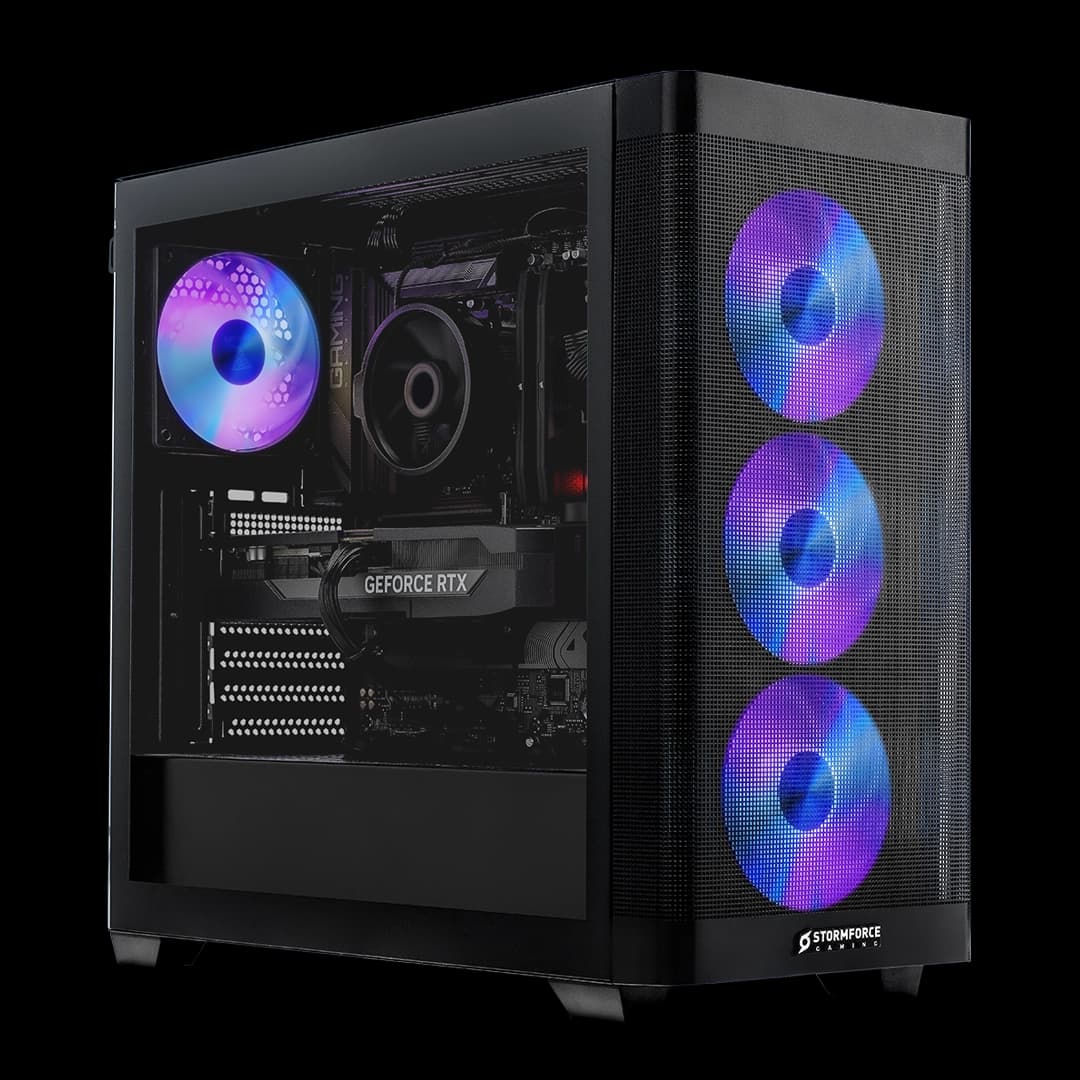
The Stormforce Gaming Onyx i3-12100F GTX 1650 is squarely a budget gaming PC. There's no pretending otherwise. The i3-12100F is a capable little processor, the GTX 1650 is the GPU you buy when you want to play games without spending a fortune, and the whole package comes in at a price that puts it firmly in entry-level territory. Whether that's a good thing depends entirely on what you need it to do. This Onyx i3-12100F GTX 1650 review is going to give you the straight answer on that.
There are no owner reviews to draw on here yet, so the analysis is grounded entirely in the spec sheet, what these components are known to deliver, and how the whole package stacks up against building something equivalent yourself. That's actually fine. The specs tell you most of what you need to know with a machine like this.
Core Specifications
The spec sheet for the Onyx is pretty straightforward. You get an Intel i3-12100F processor sitting on an H610 motherboard, paired with 8GB of DDR4 RAM and a 240GB NVMe SSD. Graphics come from a GTX 1650, the whole thing lives in a Coolermaster MB320L case, and a 350W PSU keeps the lights on. Windows 11 is pre-installed, and Stormforce Gaming backs it with a 3-year collect, repair and return warranty covering all parts and labour. Free fast UK delivery is included too.
The H610 chipset is worth flagging here. It's Intel's most basic 12th-gen platform chipset, which means no overclocking support (the 12100F is locked anyway, so that's not actually a loss), limited PCIe lanes compared to B660 or Z690, and typically just a couple of RAM slots. It keeps costs down, which is clearly the point, but it does put a ceiling on how far you can push things later. That's a trade-off worth understanding before you buy.
The 350W PSU is another number to pay attention to. It's adequate for this specific combination of CPU and GPU, both of which are relatively power-efficient. The GTX 1650 doesn't even need a PCIe power connector on most variants, and the i3-12100F has a 58W TDP. So the PSU isn't dangerously undersized for what's in the box right now. But if you're thinking about upgrading to a beefier GPU down the line, 350W is going to become a problem quickly. More on that in the upgrade section.
| Component | Specification |
|---|---|
| Processor | Intel i3-12100F |
| Graphics Card | GTX 1650 |
| RAM | 8GB DDR4 |
| Storage | 240GB NVMe SSD |
| Motherboard | H610 |
| Case | Coolermaster MB320L |
| PSU | 350W |
| Operating System | Windows 11 (pre-installed) |
| Warranty | 3 years, collect, repair and return |
| Delivery | Free fast UK delivery |
| Price | Check price |
CPU and Performance
The Intel i3-12100F is genuinely one of the better budget processors Intel has made in years. It's a four-core, eight-thread chip built on the Alder Lake architecture, and it punches well above what you'd expect from an i3. The 12th-gen redesign gave Intel a proper competitive product at the budget end, and the 12100F benefits from that. Base clock sits at 3.3GHz, boosting up to 4.3GHz, and the 12MB of L3 cache gives it decent headroom for gaming workloads that lean on cache performance.
For everyday tasks, it's more than capable. Web browsing, video streaming, office work, light photo editing, that kind of thing all runs without any drama. Even moderate video editing is manageable, though you'll feel the four-core limit if you're doing anything serious in Premiere or DaVinci Resolve. The "F" suffix means there's no integrated graphics, which is why the GTX 1650 is non-negotiable here. Pull the GPU and you've got a very expensive paperweight.
Where the 12100F really earns its keep is gaming. For titles that aren't heavily threaded, four cores at these clocks is genuinely fine. Older and less demanding games won't stress it at all. More modern titles that want six or eight cores might occasionally show a bottleneck, but at the resolution and settings the GTX 1650 is running, the GPU is almost always going to be the limiting factor before the CPU is. So in practice, for this specific use case, the 12100F is a sensible choice. Stormforce Gaming haven't cut corners on the processor, which is more than you can say for some prebuilt manufacturers at this price point.
One thing to be aware of is that the H610 motherboard means you're stuck with whatever RAM configuration comes in the box. No BIOS-level memory tweaking, no XMP profiles that push the DDR4 to its rated speed on some boards. Whether the RAM is running at its full rated speed depends on the specific board Stormforce Gaming has used. It's not a dealbreaker, but it's worth knowing that the platform has limits baked in from the start.
GPU and Gaming Performance
The GTX 1650 is a card that gets a lot of grief online, and some of it is fair. It's not a powerhouse. It's not going to run Cyberpunk 2077 at high settings or push 1440p in anything demanding. But framing it that way misses the point entirely. The GTX 1650 is a 1080p card for medium settings, and at that job, it's actually decent. Games like Fortnite, Valorant, Minecraft, Rocket League, and older titles in the GTA or Assassin's Creed series all run at playable frame rates on medium to high settings at 1080p. For someone stepping up from console or playing their first PC games, it's a legitimate starting point.
The GTX 1650 carries 4GB of GDDR6 VRAM (on the current revision). That 4GB limit is where things get uncomfortable in 2025. Modern titles are increasingly hungry for VRAM, and 4GB can cause stuttering or forced low texture settings in newer releases. Games like Call of Duty or Hogwarts Legacy will push that 4GB hard, and you may find yourself dropping settings lower than you'd like just to keep things stable. It's the card's most significant weakness, and it's not one that can be patched away.
Ray tracing is effectively off the table. The GTX 1650 doesn't support hardware ray tracing, and even if it did, the performance hit would make it unplayable. NVIDIA's DLSS upscaling is also not available on this card, which is a shame because DLSS 2 and 3 have become genuinely useful tools for extracting more performance on mid-range hardware. You're working with what the rasterisation pipeline gives you, full stop. At 1440p or 4K, this card simply isn't the right tool. Stick to 1080p, keep an eye on VRAM usage in settings menus, and it'll do the job it's designed for without complaint.
For the target audience of this machine, which is someone who wants to play popular multiplayer games, browse the web, and not spend a fortune doing it, the GTX 1650 makes sense. It's not exciting, but it works. And in the context of this whole package at this price, expecting an RTX 4070 would be daft.
Memory and Storage
Eight gigabytes of DDR4 RAM is the spec listed, and in 2025, that's the number that probably raises the most eyebrows. It's not disqualifying for light gaming and everyday use, but it's tight. Windows 11 itself uses a couple of gigabytes at idle, which leaves you with around 5 to 6GB free for everything else. Running a game, Discord, and a browser simultaneously is going to push that limit. Some games, particularly open-world titles, now recommend 16GB as a minimum. So if you're planning to game seriously, budgeting for a RAM upgrade sooner rather than later is sensible.
The good news is that DDR4 is cheap right now. Adding another 8GB stick to bring the system to 16GB won't cost much, and it'll make a noticeable difference to how the system handles multitasking. Whether the H610 board has a free slot available depends on the specific motherboard Stormforce Gaming has used, which isn't specified in the product listing. Worth checking before you assume you can just slot in an extra stick. If it's a two-slot board and both slots are occupied with a single 8GB module, you'd need to replace it rather than add to it.
Storage is 240GB via NVMe SSD, and that's where things get a bit squeaky. 240GB sounds fine until you install Windows (which eats around 30 to 40GB), a couple of modern games (some of which are 80 to 100GB each), and your usual apps. You'll be managing storage actively from day one. An external drive or a second internal SSD would be a near-immediate purchase for most users. The NVMe interface is the right choice over SATA for the primary drive, giving faster read and write speeds for the OS and primary applications, but the capacity is simply too small for comfortable long-term use without expansion. Again, the H610 platform may limit how many M.2 slots are available for expansion, so check the board specs if you're planning to add storage internally.
Cooling Solution
The i3-12100F has a rated TDP of 58W, which is quite manageable. Intel's box cooler for 12th-gen processors is actually decent, a step up from the flat, embarrassing coolers that came with older Core i3 chips. Whether Stormforce Gaming is using the stock Intel cooler or an aftermarket solution isn't specified, but given the 12100F's modest thermal output, either should cope fine under normal gaming loads. The chip doesn't run hot by modern standards, and it's not the kind of processor that needs an expensive cooler to stay stable.
The Coolermaster MB320L case is the housing for all of this, and Coolermaster cases generally have reasonable airflow design. The MB320L is a compact micro-ATX form factor case, which means there's less internal volume for heat to dissipate compared to a full-tower build. That's a trade-off you make with any small-form-factor machine. For the GTX 1650 and i3-12100F combination, the thermal load is low enough that this shouldn't be a problem in practice. These are not hot-running components.
Fan noise is harder to comment on without having the machine in front of you, and that's not something we can honestly speculate about in numbers. What can be said is that low-power components in a reasonably ventilated case tend to run quietly. The GTX 1650 is known for being a relatively cool and quiet card. If you're sitting in a quiet room, you'll probably hear the system under gaming load, but it's unlikely to be the kind of noise that drives you mad. That said, budget prebuilts sometimes use cheaper fans that can be noisier than you'd expect, so it's a variable worth being aware of.
Case and Build Quality
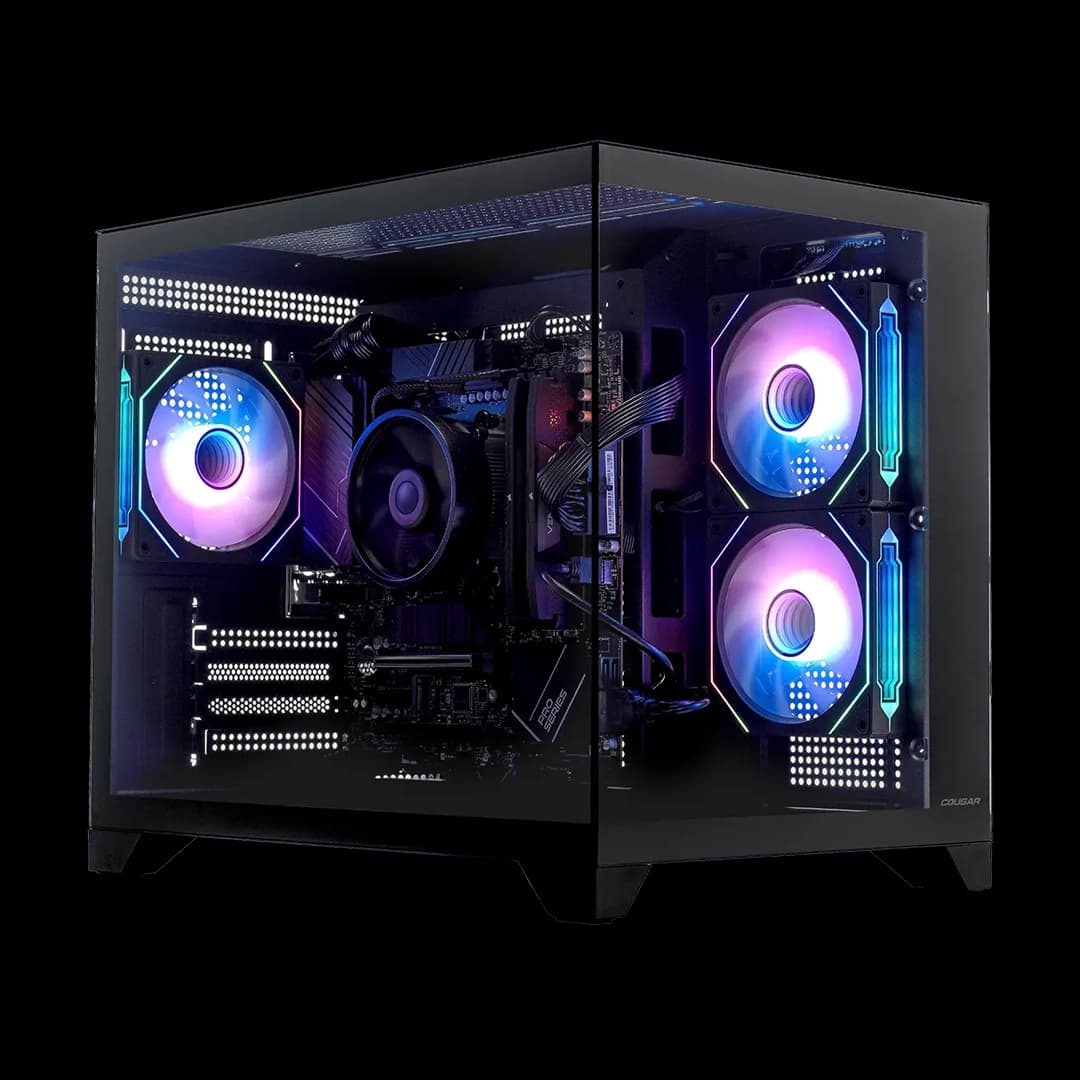
The Coolermaster MB320L is a legitimate case from a brand that knows what it's doing. Coolermaster has been making PC cases for decades, and even their budget-end products tend to be better than the no-name chassis that some prebuilt manufacturers stuff their components into. The MB320L is a compact case with a mesh front panel design that aids airflow, which is a sensible choice for a gaming system. It's not flashy, but it's proper.
Cable management in prebuilts is often where you see the real shortcuts. When a machine is built at volume in a factory, the priority is speed, not aesthetics. Cables might be routed adequately rather than beautifully. For most users this doesn't matter at all, the side panel goes on and stays on. But if you're planning to open it up and start swapping components, you might find things a bit messier than a hand-built custom PC. That's normal for prebuilts at this price, and it's not a reason to avoid the machine.
The RGB in the product name and imagery suggests there's some lighting involved, which is very much a matter of personal taste. The Coolermaster MB320L has a tempered glass side panel on some configurations, which lets you see the internals. Whether that's a selling point depends entirely on whether you care about how your PC looks sitting on your desk. Functionally it makes no difference whatsoever. What matters more is that the case is well-made enough to not flex alarmingly when you move it, and Coolermaster's build quality is generally solid at this tier.
Connectivity and Ports
The specific port layout for this machine isn't detailed in the verified spec data, so rather than guess and get it wrong, the honest answer is to check the Stormforce Gaming product page directly for the exact front and rear panel configuration. What can be said is that the H610 platform and the Coolermaster MB320L case both support standard connectivity options typical of micro-ATX builds in this tier.
The H610 chipset from Intel supports PCIe connectivity and USB ports as standard. The GTX 1650 typically outputs via DisplayPort and HDMI, which covers the vast majority of monitors people are actually using. If you're running a single 1080p monitor, you'll be absolutely fine. Dual monitor setups are also possible depending on the specific GPU variant installed.
Network connectivity on H610 boards typically includes a Gigabit Ethernet port as standard, which is what you want for stable online gaming. Whether this build includes Wi-Fi is not specified in the product data, so if wireless connectivity is important to you, that's worth confirming with Stormforce Gaming before purchasing. Wired Ethernet is always preferable for gaming anyway. Latency is lower, connection is more stable, and you won't have the Wi-Fi interference headaches that plague wireless setups in busy households.
Pre-installed Software and OS
Windows 11 comes pre-installed, which is exactly what you want. Not a trial, not an OEM key that expires, just a working copy of Windows 11 ready to go. That's worth something, particularly if you've ever had to deal with a Windows activation headache on a new build. The spec sheet confirms it's installed, and Stormforce Gaming is a UK-based builder with a proper warranty, so you're not getting a dodgy grey-market licence here.
Windows 11 is the right operating system for this hardware. The i3-12100F is a 12th-gen Intel chip, which is firmly in the supported hardware list for Windows 11. You won't hit any compatibility issues or forced upgrade prompts. The OS will receive security updates and feature updates as normal. For a gaming PC aimed at younger users or first-time PC owners, having everything set up and ready to go is a genuine convenience that has real value.
As for bloatware, Stormforce Gaming doesn't appear to be in the habit of loading machines with third-party software trials the way some larger OEMs do. That said, any prebuilt will have some manufacturer utilities installed. The best advice is to go through the installed programs list when you first set it up and remove anything you don't recognise or need. It takes twenty minutes and makes the system feel cleaner. Windows 11 itself has some built-in apps that can be uninstalled if they bother you, but nothing that meaningfully affects performance out of the box. If you ever want to start fresh and reset it back to a clean state, that option is built into Windows too.
Upgrade Potential
This is where the honest conversation gets a bit more complicated. The i3-12100F and H610 platform give you some upgrade headroom, but not unlimited. The CPU socket is LGA1700, which means you could theoretically drop in a higher-spec 12th or 13th-gen Intel processor if you wanted more cores down the line. An i5-12400F or even an i7-12700F would slot in, assuming the BIOS supports it and the cooling solution can handle the higher TDP. That's a meaningful upgrade path that a lot of budget prebuilts don't offer.
RAM is the most obvious and affordable upgrade. Getting to 16GB of DDR4 should be a priority for anyone planning to game seriously, and DDR4 is genuinely cheap right now. The H610 platform supports up to DDR4-3200 officially, and 16GB is a sweet spot that will serve you well for several years of gaming. Storage is the other easy win. Adding a second NVMe SSD or a large SATA drive for game storage would transform the usability of this machine. 240GB is just too small to live with comfortably if you're installing modern games.
The GPU is where the upgrade path gets awkward. The 350W PSU is the bottleneck. The GTX 1650 runs on very little power, which is exactly why 350W is adequate for the current setup. But the next meaningful GPU upgrade, something like an RTX 3060 or RX 6600, needs considerably more headroom. You'd be looking at replacing the PSU at the same time as the GPU, which adds cost and complexity. It's doable, but it's not as simple as just swapping the card. Anyone buying this machine with the intention of upgrading the GPU within a year or two should factor in the cost of a new PSU as part of that plan. The Coolermaster MB320L case should accommodate a standard ATX PSU, so at least the physical swap is straightforward.
The three-year warranty from Stormforce Gaming is worth mentioning here too. Any modifications you make, particularly swapping components, may affect warranty coverage. It's worth reading the warranty terms before you start pulling parts out. The 3-year collect, repair and return warranty covering all parts and labour is genuinely good for a budget prebuilt, and you don't want to accidentally void it by swapping the RAM in the first month.
How It Compares
The most useful comparison for a machine like this isn't against other prebuilts with invented prices, it's against the cost of building something equivalent yourself. That's the real question: is the convenience premium worth it?
Sourcing an i3-12100F, a GTX 1650, 8GB DDR4, a 240GB NVMe SSD, an H610 motherboard, a 350W PSU, a Coolermaster case, and a Windows 11 licence individually from UK retailers will cost you more than you might expect. Component prices have been volatile, and the cost of a retail Windows licence alone adds a meaningful chunk to any self-build. When you add up all the parts, a self-build equivalent often ends up costing a similar amount or more, and that's before you factor in the time, the risk of compatibility issues, and the fact that you get no warranty on the assembled system as a whole.
The 3-year collect, repair and return warranty from Stormforce Gaming is a real differentiator. If something fails, you're not hunting down which component is at fault and dealing with separate manufacturer warranties. One call, one collection, sorted. For someone who doesn't want to deal with that kind of hassle, or who doesn't have the knowledge to diagnose hardware faults, that warranty has genuine monetary value.
Against other prebuilts in the budget tier, the Onyx holds up reasonably well. Some competitors at similar prices use slower SATA SSDs instead of NVMe, or pair the i3-12100F with even less RAM. The Coolermaster MB320L is a better case than the generic no-name chassis that often shows up in budget prebuilts. Where the Onyx falls short compared to slightly pricier alternatives is the 240GB storage and 8GB RAM, both of which are below what most people would want for comfortable long-term use. But those are upgradeable, and the core platform is sound.
| Feature | Stormforce Onyx i3-12100F GTX 1650 | Comparable DIY Build | Typical Budget Prebuilt Rival |
|---|---|---|---|
| Processor | Intel i3-12100F (Alder Lake) | Same or similar | Varies, often older gen |
| GPU | GTX 1650 | Same | GTX 1650 or weaker integrated |
| RAM | 8GB DDR4 | Often 16GB for similar cost | 8GB DDR4 typical |
| Storage | 240GB NVMe SSD | 500GB to 1TB NVMe typical | 240GB to 512GB, often SATA |
| PSU | 350W | 500W+ recommended | 350W to 400W typical |
| Case | Coolermaster MB320L | Choice of brand | Often no-name generic |
| OS | Windows 11 included | Licence cost extra (£100 to £120) | Usually included |
| Warranty | 3 years, collect and return | Per-component, no whole-system cover | 1 to 2 years typical |
Final Verdict
The Stormforce Gaming Onyx i3-12100F GTX 1650 is a machine that does exactly what it says on the tin, and not much more. That's not an insult. At the budget end of the market, knowing what you're getting is actually valuable. This is a 1080p gaming PC for popular multiplayer titles and everyday computing. It'll run Fortnite, Valorant, CS2, Rocket League, and older single-player games without drama. It won't run the latest AAA releases at high settings, and it'll struggle with 4K or 1440p in anything demanding.
The i3-12100F is a genuinely good budget processor, and Stormforce Gaming have paired it with a real case from a real brand rather than a mystery chassis. The three-year warranty is the headline feature that sets this apart from many rivals, and for a first-time PC buyer or someone who just wants a machine that works without needing to understand the internals, that warranty is worth real money. The free fast UK delivery is a nice touch too.
The weak points are the 8GB RAM and 240GB storage. Both are too small for comfortable long-term use, and both will need addressing within the first few months of ownership. Budget for a RAM upgrade and an extra storage drive when you buy this, and factor those costs into your decision. The 350W PSU also limits future GPU upgrades, so if you're planning to grow the machine significantly, go in with your eyes open about what that will cost.
Who should buy this? Someone who wants a working Windows 11 gaming PC without the faff of building one, who plays popular multiplayer games at 1080p, and who values the peace of mind of a three-year warranty. First-time PC gamers stepping up from console, parents buying a gaming PC for a teenager, anyone who just wants it to work when they plug it in.
Who should skip it? Anyone who plays modern AAA titles and wants high settings. Anyone planning to run the machine at 1440p or above. Anyone who needs more than 240GB of storage from day one. And anyone who's comfortable building their own PC, because you'll get more for your money if you're willing to put in the time.
As a budget Onyx i3-12100F GTX 1650 review conclusion goes, this is a fair machine at a fair price. Not perfect, but honest about what it is. Current pricing is Check price, which puts it in line with what you'd spend sourcing equivalent parts yourself once you include a Windows licence. The warranty tips the balance in its favour for the right buyer.
What works. What doesn’t.
6 + 6What we liked6 reasons
- Intel i3-12100F is a genuinely capable budget processor that handles everyday tasks and 1080p gaming workloads well
- Three-year collect, repair and return warranty covering all parts and labour is well above average for a budget prebuilt
- Coolermaster MB320L is a legitimate branded case with mesh front airflow, a step above the generic chassis common at this price
- Windows 11 comes pre-installed and properly licenced, removing the cost and hassle of sourcing a retail key
- NVMe SSD rather than a slower SATA drive is the correct choice for the primary storage interface at this tier
- Free fast UK delivery included with no additional cost
Where it falls6 reasons
- 8GB of DDR4 RAM is tight for 2025 gaming, with modern titles and Windows 11 together pushing that limit quickly
- 240GB NVMe SSD is too small for comfortable long-term use once Windows, apps, and even a couple of modern games are installed
- 350W PSU is adequate for current components but will need replacing alongside any meaningful GPU upgrade, adding cost and complexity
- GTX 1650 lacks hardware ray tracing and DLSS support, limiting access to performance-enhancing technologies available on newer cards
- 4GB of VRAM causes forced texture quality reductions and stuttering in a growing number of 2025 titles
- H610 motherboard chipset limits RAM configuration flexibility and reduces the number of available M.2 and PCIe expansion slots
Full specifications
12 attributes| CPU | Intel i3-12100F |
|---|---|
| GPU | GTX 1650 |
| RAM | 8GB DDR4 RAM |
| Storage | 240GB Storage |
| Case | Coolermaster MB320L |
| Case size | mid-tower |
| Ethernet | 1GbE |
| Launch year | 2023 |
| MAX RAM GB | 64 |
| Motherboard | H610 Motherboard |
| Motherboard chipset | H610 |
| OS | Installed Windows 11 |
If this isn’t right for you
2 options 7.0 / 10
27 Inch All-in-One Computer FHD Desktop PC, Core i7 (Up to 3.0GHz), 16GB RAM, 512GB SSD, Rotatable Screen, Hidden Webcam, Dual-Band WiFi 6 & Bluetooth 5.3, All-in-One PC for Business & Creative Work
£499.98 · SUKOTOP
 6.5 / 10
SZTPS 23.8" FHD All in One PC Desktop Computer,i5-12450H 8 core Processor,16 GB RAM,256 GB SSD,WiFi,Bluetooth WiredKeyboard & Mouse,Windows 11 Pro PC (Curved panel)
£398.60 · SZTPS
Frequently asked
7 questions01What games can the Stormforce Onyx i3-12100F GTX 1650 run at 1080p?+
The GTX 1650 handles popular multiplayer titles such as Fortnite, Valorant, CS2, Rocket League, and Minecraft at 1080p medium to high settings with playable frame rates. Older single-player titles in series like GTA or Assassin's Creed also run well. More demanding 2024 and 2025 releases will require reduced settings, and some will push the 4GB VRAM limit, causing stuttering or forced low textures.
02Is 8GB of RAM enough for gaming in 2025?+
It is adequate for light gaming and everyday tasks but tight for serious use. Windows 11 consumes a couple of gigabytes at idle, leaving limited headroom when running a game, a browser, and Discord simultaneously. Many modern games now list 16GB as their recommended minimum. Upgrading to 16GB of DDR4 is an affordable and advisable early purchase that will noticeably improve multitasking and gaming stability.
03Can the GTX 1650 in this PC be upgraded later?+
Yes, but the 350W power supply unit is the limiting factor. The GTX 1650 draws very little power, which is why 350W is sufficient for the current build. The next meaningful GPU upgrades, such as an RTX 3060 or AMD RX 6600, require considerably more headroom and would necessitate replacing the PSU at the same time. The case should physically accommodate a standard ATX PSU replacement, but buyers should budget for both components when planning a GPU upgrade.
04Does the Stormforce Onyx i3-12100F GTX 1650 support DLSS or ray tracing?+
No. The GTX 1650 does not support hardware ray tracing, and NVIDIA's DLSS upscaling technology is not available on this card. Performance relies entirely on traditional rasterisation. This means you cannot use DLSS to boost frame rates in supported titles the way you could on RTX-series cards. For the target use case of 1080p multiplayer gaming, this is an acceptable limitation, but it is worth understanding before purchase.
05What warranty does the Stormforce Gaming Onyx come with?+
Stormforce Gaming provides a three-year collect, repair and return warranty covering all parts and labour. If something fails, Stormforce Gaming arranges collection, carries out the repair, and returns the machine. This whole-system warranty is a meaningful advantage over self-built PCs, where you would need to identify the faulty component and deal with each manufacturer's warranty separately. It is worth reading the warranty terms before modifying or swapping components, as changes may affect coverage.
06Is 240GB of SSD storage enough for a gaming PC?+
For most users, 240GB will feel restrictive very quickly. Windows 11 occupies approximately 30 to 40GB, and modern games can each require 50 to 100GB. After installing two or three titles alongside the operating system and standard applications, available space will be minimal. Adding an external drive or a second internal SSD is a near-immediate practical necessity for most buyers. The H610 motherboard may have limited M.2 slots, so checking the board specifications before purchasing internal storage is advisable.
07Does this PC come with Wi-Fi built in?+
Wi-Fi is not confirmed in the published specification for this model. The H610 chipset supports Gigabit Ethernet as standard, which provides a reliable wired connection preferred for online gaming due to lower latency and greater stability. If wireless connectivity is essential for your setup, it is worth confirming directly with Stormforce Gaming before purchasing, or budgeting for a USB Wi-Fi adapter as an additional accessory.