Building your own gaming PC is genuinely satisfying. It's also a rabbit hole that can eat a weekend, produce three returns to the retailer, and leave you questioning every component choice you made at 2am. So when a prebuilt lands with specs that actually make sense on paper, it's worth stopping to ask: is this a shortcut worth taking, or are you paying a premium for someone else's compromises? The Stormforce Gaming Obsidian Pro AMD sits squarely in the mid-range bracket, pairing AMD's capable Ryzen 7 5700X with NVIDIA's brand-new RTX 5060 Ti. That combination is interesting enough to deserve a proper look.
What makes this particular obsidian pro amd review worth reading is the timing. The RTX 5060 Ti is genuinely fresh silicon, and seeing it appear in a prebuilt at this price point is notable. Stormforce Gaming have built their reputation on sensible configurations rather than flashy marketing, and the spec sheet here reflects that. No wildly overclocked RAM. No mystery-brand SSD. The components listed are real, identifiable parts with known performance profiles, which makes it possible to give you an honest read on what you're actually getting.
There are no owner reviews to draw on yet, which is fair enough for a newer configuration. So the analysis here leans on the spec sheet, what we know about each component from AMD's and NVIDIA's own published data, and how the overall package stacks up against building something equivalent yourself. If you're weighing up whether to click buy or spend the next fortnight on PCPartPicker, this should help.
Core Specifications
The headline components are an AMD Ryzen 7 5700X processor paired with an NVIDIA GeForce RTX 5060 Ti carrying 8GB of VRAM. That sits on an A520 mATX platform, which is a budget-tier AM4 motherboard. System memory is 16GB of DDR4 running at 3200MHz, and storage is a 1TB Gen4 NVMe SSD. The whole thing runs Windows 11 Home out of the box, lives inside a Vortex Atlas M4 case with a tempered glass side panel, and connects to your network via WiFi 6 or Ethernet. Stormforce Gaming also throw in a two-month Xbox Game Pass trial, which is a nice touch if you're into that ecosystem.
The A520 platform is probably the most limiting choice here, and it's worth understanding what that means before you buy. A520 boards are the entry-level option for AM4, and while they're perfectly functional for everyday use and gaming, they don't support CPU overclocking and typically offer fewer PCIe lanes and expansion slots than B550 or X570 alternatives. For a gaming machine that you're going to use and not tinker with, it's a reasonable cost-saving measure. For someone who wants to push the CPU harder down the line, it's a ceiling you'll hit fairly quickly. That's a genuine trade-off, not a dealbreaker, but you should know it's there.
The 3-year collect, repair and return warranty covering all parts and labour is genuinely good. Stormforce Gaming list this prominently, and for a mid-range prebuilt it's one of the strongest arguments for buying rather than building. When something goes wrong with a self-build (and at some point, something always does), you're the support team. Here, you're not.
| Component | Specification |
|---|---|
| CPU | AMD Ryzen 7 5700X |
| GPU | NVIDIA GeForce RTX 5060 Ti 8GB |
| RAM | 16GB DDR4 3200MHz |
| Storage | 1TB Gen4 NVMe SSD |
| Platform | A520 mATX |
| Case | Vortex Atlas M4 (tempered glass, RGB) |
| Networking | WiFi 6, Ethernet |
| Operating System | Microsoft Windows 11 Home |
| Warranty | 3 Year collect, repair and return (all parts and labour) |
| Extras | Xbox Game Pass 2 Months Trial |
| Price | £1,249.99 |
CPU & Performance
The AMD Ryzen 7 5700X is an eight-core, sixteen-thread processor built on AMD's Zen 3 architecture. It's not the newest chip AMD make, and anyone keeping an eye on the AM5 platform will know that Ryzen 7000 and 9000 series parts exist. But "not the newest" doesn't mean "not good enough." Zen 3 is a mature, well-understood architecture with strong single-core performance, and the 5700X in particular is a chip that punches well for productivity tasks, streaming, and gaming workloads where the CPU is feeding a capable GPU.
For gaming specifically, the 5700X is not a bottleneck at 1080p or 1440p in the vast majority of titles. Games that are heavily CPU-bound, like some strategy titles or open-world games with complex simulation, will show the age of Zen 3 more than a straightforward shooter or RPG. But paired with an RTX 5060 Ti, you're unlikely to find yourself CPU-limited in the games most people actually play. The multi-core performance that Stormforce Gaming highlight in their spec table is the real strength here: content creation, video editing, and running multiple applications simultaneously all benefit from those eight Zen 3 cores.
The A520 platform does mean the 5700X runs at stock settings. There's no overclocking support on A520, so you're getting AMD's rated performance without any headroom to push further. For most buyers that's completely fine. Stock Zen 3 is quick, efficient, and well within the performance window this machine is targeting. The chip also runs relatively cool at stock clocks, which matters for a mATX build where thermal headroom can be tighter than in a full-tower design. AMD's own specifications for the 5700X put its TDP at 65W, which is genuinely modest and gives the cooling solution an easier job than a higher-wattage part would.
GPU & Gaming Performance
The NVIDIA GeForce RTX 5060 Ti is the most important component in this machine, and it's the reason this configuration is interesting right now. This is next-generation Blackwell architecture from NVIDIA, which means you're getting the latest ray-tracing hardware, updated AI acceleration for DLSS 4, and NVIDIA's current-generation encoder for anyone who streams. 8GB of VRAM is the configuration here, and that's a point worth discussing honestly rather than glossing over.
8GB of VRAM is sufficient for 1080p gaming and for most 1440p gaming at sensible settings in 2026. There are titles that push beyond this, particularly at higher resolutions with texture packs or ray-tracing enabled, and VRAM headroom is something that tends to matter more as games get more demanding over a GPU's lifespan. The RTX 5060 Ti 8GB is positioned as a 1080p to 1440p card, and within that scope it should handle current titles well, with DLSS 4's Frame Generation and Super Resolution helping maintain smooth performance in supported games. NVIDIA's DLSS technology has become genuinely useful rather than a gimmick, and on a 5060 Ti it's a meaningful tool for keeping frame rates up without a significant quality hit.
Ray tracing on the RTX 5060 Ti is a step up from the previous generation's 60-class cards, but it's still not the tier where you'd run demanding RT titles at maximum settings without leaning on DLSS. Think of it as a card that handles ray tracing in games that implement it well, rather than one that brute-forces it. For the price bracket this machine sits in, that's an honest and fair expectation. The Blackwell architecture also brings improved power efficiency compared to Ada Lovelace, which should help keep thermals and noise reasonable in the Atlas M4 case.
Memory & Storage
16GB of DDR4 at 3200MHz is the memory configuration here. Running in dual-channel is what matters for gaming performance, and Stormforce Gaming's spec sheet lists 16GB as the total. Assuming this is a 2x8GB configuration (which is the sensible way to populate a dual-channel board), you'd be getting the full bandwidth benefit of dual-channel memory. If it's a single 16GB stick, that's a different story and one that would genuinely impact GPU-fed frame rates in a noticeable way. The spec sheet doesn't explicitly confirm the channel configuration, so it's worth asking Stormforce Gaming directly if this matters to you. DDR4 3200MHz is the sweet spot for Zen 3, which is well documented by JEDEC's DDR4 specifications, and running at this speed rather than slower profiles makes a real difference to Ryzen's Infinity Fabric performance.
The storage is a 1TB Gen4 NVMe SSD. Gen4 here refers to the PCIe Gen 4 interface, which offers substantially higher sequential read and write speeds than Gen3 drives. In practical terms for gaming, the difference between Gen3 and Gen4 is less dramatic than the numbers suggest, since game loading is often bottlenecked elsewhere. But you do get faster Windows boot times, quicker application launches, and better performance in workloads that genuinely saturate the drive. 1TB is enough for Windows, a healthy library of games, and your applications, but anyone with a large Steam library will find themselves managing space or looking at an additional drive fairly quickly.
Upgrade headroom on the memory side depends on how many slots the A520 board provides. mATX A520 boards typically offer two or four DIMM slots. If there are two slots and both are occupied with a 2x8GB kit, you'd need to replace the existing sticks to upgrade to 32GB rather than simply adding more. If there are four slots and only two are populated, adding another 2x8GB kit later is straightforward and cheap. Again, worth clarifying with Stormforce Gaming before purchase if you think you'll want more RAM down the line. The NVMe situation is similar: A520 boards vary in how many M.2 slots they provide, and knowing whether there's a free slot for a second SSD is useful information for long-term planning.
Cooling Solution
The spec sheet doesn't name a specific CPU cooler, which is common for prebuilts at this price point. What we know is that the Ryzen 7 5700X has a 65W TDP, which AMD's own data confirms, and that it's housed in an mATX case designed with optimised airflow. A 65W chip is not a demanding cooling target. Even a modest air cooler handles Zen 3 at stock clocks without drama, and the 5700X doesn't have the kind of power spikes that catch cheaper coolers off guard the way some of Intel's recent chips have.
The Vortex Atlas M4 case is described by Stormforce Gaming as having optimised airflow, which is the kind of phrase that can mean a lot or very little depending on the actual fan configuration. What it does confirm is that the case was designed with thermal management in mind rather than purely aesthetics. The tempered glass side panel is a nice visual feature, and cases that prioritise airflow alongside glass panels do exist, though they require thoughtful fan placement to avoid the glass acting as a heat trap. The RGB accents suggest at least some case fans are included, though the exact count isn't specified in the verified data.
For the RTX 5060 Ti, the GPU cooler is whatever NVIDIA's board partners have fitted to the card Stormforce Gaming are using. Blackwell 5060 Ti cards have generally been designed with efficiency in mind, and the lower power draw compared to higher-end Blackwell parts means the card shouldn't be generating excessive heat in a case with decent airflow. In an mATX build with a 65W CPU and a mid-range GPU, thermal management should be manageable, but if you're planning to run sustained workloads like rendering or encoding for extended periods, it's worth knowing that mATX cases have less internal volume for heat dissipation than full-tower alternatives.
Case & Build Quality
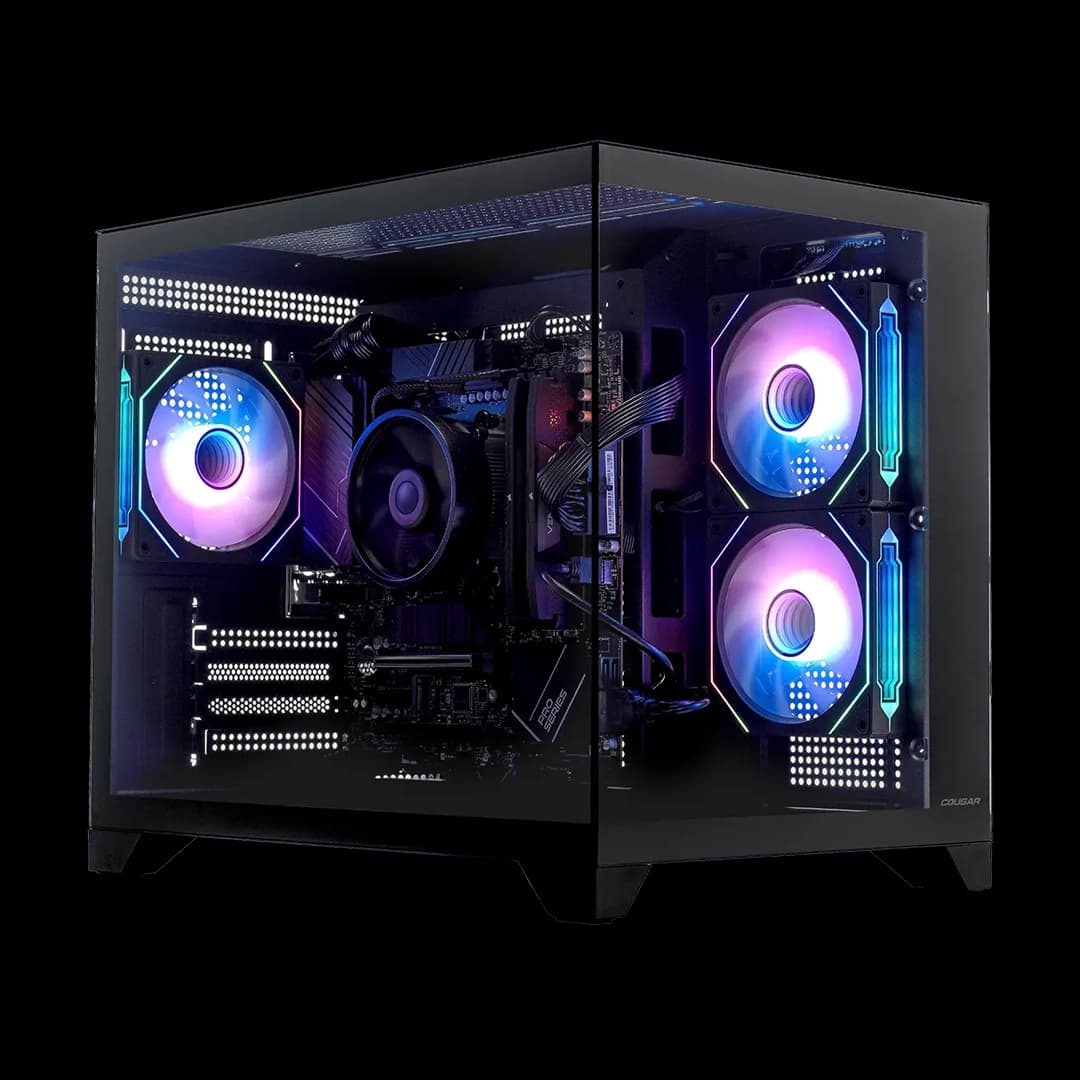
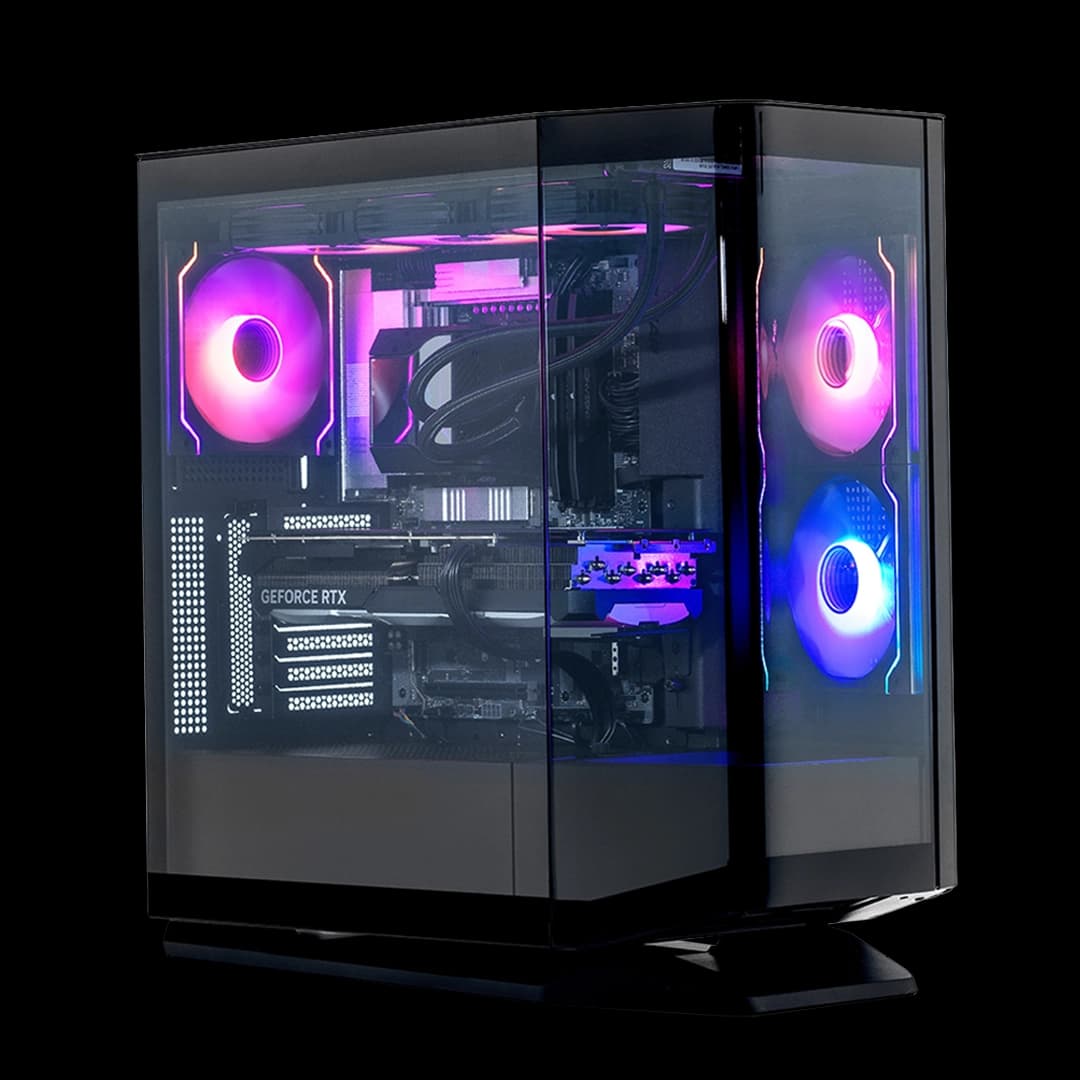
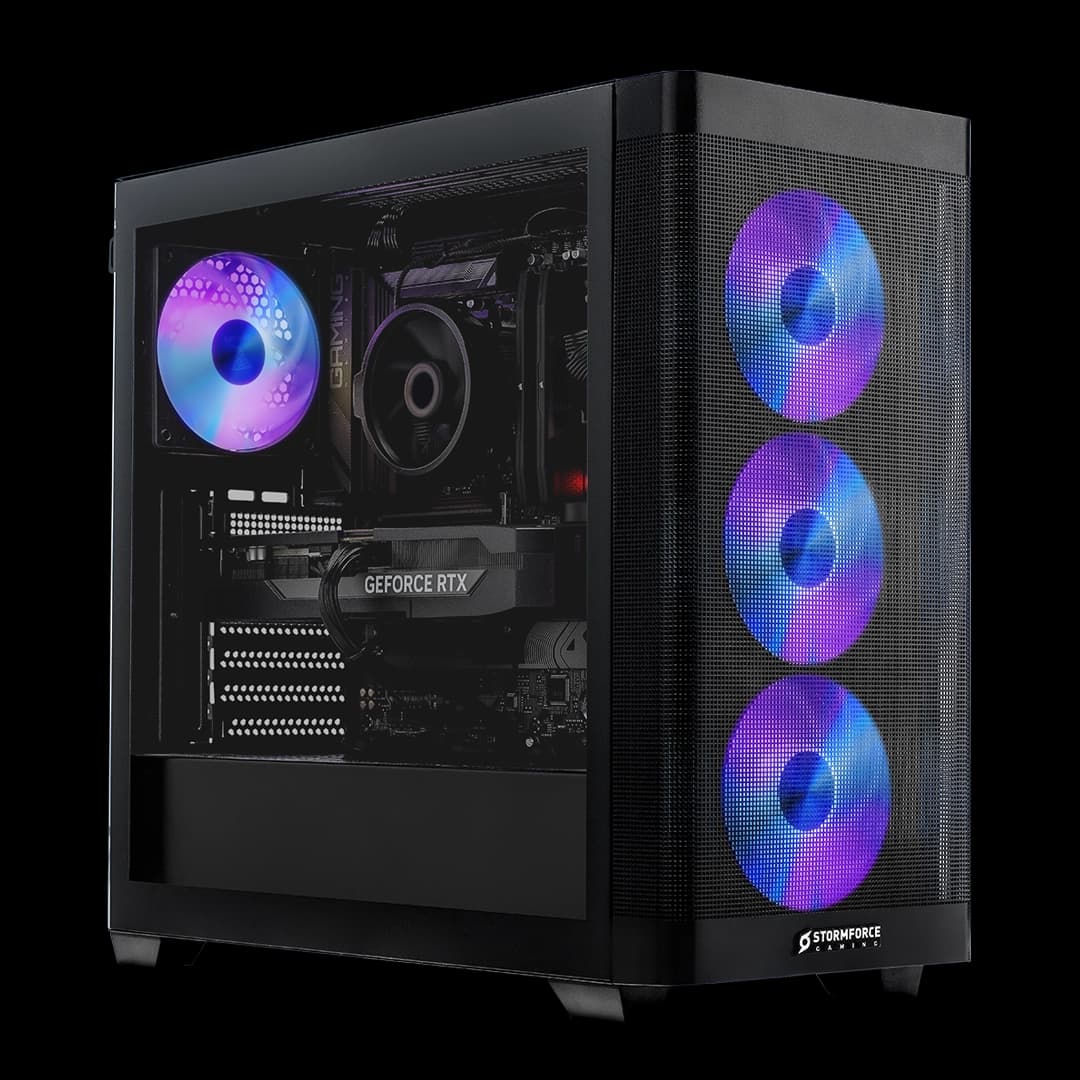
The Vortex Atlas M4 is the chassis Stormforce Gaming have chosen for this build, and it's their own branded case rather than a generic OEM box. That's a meaningful distinction. Branded cases from system builders tend to be purpose-built for their configurations, which usually means the cable routing, fan mounting positions, and GPU clearance are actually considered rather than an afterthought. The tempered glass side panel is a genuine feature rather than a gimmick at this price, letting you see the RGB lighting and the components inside. Whether you care about that is personal, but it does at least signal that Stormforce Gaming expect the build inside to look presentable.
RGB accents are listed as a feature of the Atlas M4. In practice, this typically means RGB fans and possibly an RGB strip or header on the motherboard that controls lighting. On an A520 platform, RGB control software support can be variable, since A520 boards don't always include AMD's full ARGB header support. It's unlikely to be a problem for basic lighting, but if you're hoping to synchronise everything through a single app, it's worth checking with Stormforce Gaming what software controls the lighting. This is a minor point, but the kind of thing that can be mildly annoying if you care about it.
Cable management in prebuilts is one of those things that varies enormously and is genuinely hard to assess without seeing inside the machine. Stormforce Gaming's builds have a reasonable reputation for internal tidiness, which matters both aesthetically (especially with a glass panel) and functionally (better cable management means better airflow). The mATX form factor does constrain internal space somewhat, so there's less room for cable routing than in a full ATX build. That's not a criticism specific to this machine, it's just the nature of smaller form factors. What you gain is a more compact footprint on your desk.
Connectivity & Ports
Networking is covered by both WiFi 6 and Ethernet. WiFi 6 (802.11ax) is the right standard for a gaming PC in 2026. It offers substantially better performance in congested wireless environments than WiFi 5, with improved latency characteristics that matter for online gaming. If you're running a wired connection, Ethernet is obviously the preferred option for stability, and having both means you're not forced into one or the other based on your setup. The Ethernet port is listed without a specific speed rating in the verified data, so whether it's Gigabit or 2.5 Gigabit isn't confirmed. For most home broadband connections, Gigabit Ethernet is more than sufficient.
The specific port layout on the front and rear of the case isn't detailed in Stormforce Gaming's verified spec data for this configuration. What the A520 mATX platform typically provides is a rear I/O with USB Type-A ports, a USB Type-C port in some configurations, audio jacks, and the video outputs from the GPU itself. The RTX 5060 Ti will handle the display outputs, and modern Blackwell cards support DisplayPort and HDMI, which covers virtually every monitor and TV you'd want to connect. For precise port counts and front panel connectivity, Stormforce Gaming's product page is the place to check.
Bluetooth is not listed in the verified spec data, so whether it's included alongside the WiFi 6 adapter isn't confirmed here. Many WiFi 6 adapters are combo cards that include Bluetooth, but since it's not specified, it would be worth confirming with Stormforce Gaming if Bluetooth connectivity matters to you, particularly if you're planning to use wireless peripherals. This isn't a criticism of the machine, just a gap in the published spec sheet that's worth filling before you buy.
Pre-installed Software & OS
Windows 11 Home comes pre-installed, which is the standard choice for a consumer gaming PC in this price bracket. Windows 11 Home covers everything a gamer needs: full DirectX 12 Ultimate support, Xbox Game Bar, Auto HDR for supported displays, and the general Windows gaming ecosystem. The step up to Windows 11 Pro adds features like BitLocker encryption, Remote Desktop hosting, and domain join support, none of which are relevant for the vast majority of gaming use cases. So Home is the right call here.
The two-month Xbox Game Pass trial is a genuinely useful inclusion. Game Pass gives you access to a large library of titles including day-one releases from Xbox Game Studios, and two months is enough time to work through several games before deciding whether a subscription is worth continuing. It's not a system-defining feature, but it adds real value for anyone who hasn't already subscribed. If you're already a Game Pass subscriber, it's less exciting, though you can sometimes gift trial codes or stack them onto an existing subscription depending on Microsoft's current terms.
Stormforce Gaming don't publicise a heavy bloatware load on their prebuilts, which is a point in their favour compared to some larger system builders who pre-install a collection of trials and utilities that you immediately uninstall. The honest answer is that the exact software load isn't detailed in the verified spec data, but the absence of a long list of "value-added" software in the marketing materials is usually a good sign. Windows 11 Home itself does come with Microsoft's own apps pre-installed (Edge, OneDrive, Teams), which some people find irritating, but that's a Microsoft decision rather than a Stormforce Gaming one.
Upgrade Potential
This is where the A520 platform creates the most meaningful constraints, and it's worth being direct about them. The AM4 socket itself is a positive: AMD's AM4 platform supports a wide range of processors up to the Ryzen 9 5950X, so if you wanted to drop in a faster chip like the Ryzen 9 5900X or 5950X in the future, the socket supports it. The A520 chipset, however, doesn't support CPU overclocking, which limits the performance ceiling for any chip you install. A BIOS update may be needed for newer Ryzen 5000 series chips, but the socket compatibility is there.
GPU upgrades are where prebuilts often hide their worst secrets, specifically in the PSU. Stormforce Gaming don't publish the PSU wattage or brand in the verified spec data for this configuration, which is genuinely frustrating for anyone trying to assess upgrade potential. The RTX 5060 Ti is a relatively power-efficient card, so the PSU fitted doesn't need to be enormous. But if you wanted to upgrade to a more powerful GPU in the future, knowing whether there's headroom in the power supply is essential. This is a question worth putting directly to Stormforce Gaming before purchase if GPU upgrades are part of your plan.
RAM upgrades depend on the DIMM slot configuration as discussed in the memory section. If there are free slots, adding more DDR4 3200MHz memory is cheap and straightforward. Storage expansion via an additional NVMe drive is possible if the A520 board has a free M.2 slot, and adding a SATA SSD or HDD is always an option if there are free SATA ports and drive bays in the Atlas M4 case. The mATX form factor does limit how many drives you can physically fit, but for most users, the 1TB NVMe plus one additional drive covers everything comfortably. The 3-year warranty also means you're not voiding coverage by opening the case for upgrades, which is worth confirming with Stormforce Gaming's warranty terms.
How It Compares
Comparing this machine to a DIY build is the most useful exercise here. The RTX 5060 Ti 8GB alone, at retail, sits at a price that makes the overall system cost look reasonable when you factor in the CPU, motherboard, RAM, SSD, case, Windows 11 licence, and the three-year warranty. Building an equivalent system yourself would require sourcing each component individually, and at current GPU prices, the convenience premium Stormforce Gaming are charging is genuinely modest rather than exploitative. This is not always true of prebuilts. At this particular configuration and price point, the maths work.
Against other prebuilts in the same mid-range bracket, the key differentiators are the RTX 5060 Ti (which is genuinely next-generation silicon rather than a refreshed older card) and the three-year collect, repair and return warranty. Many competitors at this price point offer one or two-year warranties with less comprehensive coverage, and some use older GPU architectures to hit a lower bill of materials. The Ryzen 7 5700X is a mature, proven chip rather than the absolute latest, which is the main area where a competitor might have an edge, particularly if they're shipping AM5 platform machines with Ryzen 7000 or 9000 series processors. AM5 offers a longer upgrade path and DDR5 memory, which is a real advantage for future-proofing.
The table below compares the Obsidian Pro AMD against a self-build equivalent and a generic mid-range prebuilt competitor using older GPU architecture, to give a sense of where this machine sits.
| Feature | Obsidian Pro AMD | DIY Equivalent Build | Older-Gen Mid-Range Prebuilt |
|---|---|---|---|
| CPU | Ryzen 7 5700X (Zen 3, 8-core) | Ryzen 7 5700X or similar | Typically Ryzen 5 5600 or similar |
| GPU | RTX 5060 Ti 8GB (Blackwell) | RTX 5060 Ti 8GB | RTX 4060 or RX 7600 (last-gen) |
| RAM | 16GB DDR4 3200 | 16GB DDR4 3200 or better | 16GB DDR4 (speed varies) |
| Storage | 1TB Gen4 NVMe | 1TB Gen4 NVMe | 512GB to 1TB (often Gen3) |
| OS | Windows 11 Home (included) | Windows 11 Home (extra cost) | Windows 11 Home (included) |
| Warranty | 3 years, collect and return | Component warranties only (1 to 3 years per part) | Typically 1 to 2 years |
| Networking | WiFi 6 + Ethernet | Depends on motherboard choice | WiFi 5 or WiFi 6 (varies) |
| Platform | A520 mATX (AM4) | B550 or X570 recommended | Varies, often budget chipset |
| Price | £1,249.99 | Higher (no assembly, no warranty) | Often similar or lower |
Final Verdict
The Stormforce Gaming Obsidian Pro AMD makes a solid case for itself in the mid-range prebuilt market, primarily because of the RTX 5060 Ti. Getting Blackwell architecture at this price tier is genuinely good timing, and the Ryzen 7 5700X is more than capable of keeping pace with it for 1080p and 1440p gaming. If you're the kind of buyer who wants a capable gaming machine, set up and ready to go, with a warranty that actually means something, this is a legitimate option rather than a compromise.
The A520 platform is the honest weak point. It's not a disaster, but it does cap your overclocking options and may limit upgrade flexibility compared to a B550-based build. The unspecified PSU is also a gap in the published data that matters if you're thinking long-term. And 16GB of RAM, while adequate today, is something you might want to expand in the next year or two as games get more demanding. None of these are reasons to walk away, but they're worth factoring in. This is a machine to buy if you want to game now, not a platform to build a dream system around over five years.
Who should buy this? Someone moving from console to PC for the first time. Someone whose old gaming PC has finally given up. Someone who knows what they want but doesn't want to spend a fortnight sourcing parts. The obsidian pro amd review verdict is straightforward: it's a well-configured mid-range machine with a genuinely current GPU, a decent warranty, and a sensible price for what you're getting. It's not perfect, but very few prebuilts at this price are. The RTX 5060 Ti alone justifies a serious look.
What works. What doesn’t.
6 + 6What we liked6 reasons
- RTX 5060 Ti Blackwell architecture brings genuinely current-generation GPU performance to the mid-range bracket, with DLSS 4 support included
- Three-year collect, repair and return warranty covering all parts and labour is among the strongest in this price tier and a compelling reason to choose a prebuilt over a self-build
- Ryzen 7 5700X offers eight Zen 3 cores that are more than sufficient for 1080p and 1440p gaming without acting as a bottleneck in most titles
- 1TB Gen4 NVMe SSD provides faster sequential speeds than Gen3 alternatives and gives a reasonable starting capacity for a gaming library
- WiFi 6 is the right networking standard for 2026, offering lower latency and better performance in congested wireless environments than WiFi 5
- Two-month Xbox Game Pass trial adds genuine short-term value for anyone not already subscribed
Where it falls6 reasons
- A520 chipset does not support CPU overclocking and offers fewer PCIe lanes and expansion options than B550 or X570 alternatives, capping long-term tinkering potential
- PSU wattage and brand are not published in the verified spec data, making it difficult to assess headroom for future GPU upgrades
- Memory channel configuration (single vs dual-channel) is not explicitly confirmed in the spec sheet, and this has a meaningful impact on gaming performance
- 8GB of VRAM on the RTX 5060 Ti may become restrictive over the card's lifespan as games grow more demanding at higher resolutions with ray tracing enabled
- mATX form factor limits internal volume for heat dissipation and reduces options for adding multiple storage drives compared to a full ATX build
- Bluetooth connectivity is not confirmed in the published specifications, which matters for users planning to use wireless peripherals
Full specifications
12 attributes| CPU | AMD Ryzen 7 5700X |
|---|---|
| GPU | NVIDIA GeForce RTX 5060 Ti 8GB |
| RAM | 16GB DDR4 3200 |
| Storage | 1TB M.2 NVMe SSD |
| Case | Vortex Atlas M4 ATX |
| Case size | micro-atx |
| Connectivity | WiFi 6, Ethernet |
| Cooling | Optimised Air Cooling |
| Ethernet | 1GbE |
| Motherboard | A520 |
| Motherboard chipset | A520 |
| OS | Windows 11 Home |
If this isn’t right for you
2 options
Frequently asked
7 questions01What GPU does the Stormforce Gaming Obsidian Pro AMD use?+
The machine uses an NVIDIA GeForce RTX 5060 Ti with 8GB of VRAM. This is based on NVIDIA's Blackwell architecture, which is the current generation as of 2026, and supports DLSS 4 including Frame Generation and Super Resolution.
02Can the CPU be overclocked in this prebuilt?+
No. The A520 chipset does not support CPU overclocking on AMD's AM4 platform. The Ryzen 7 5700X runs at AMD's rated stock speeds. If overclocking is important to you, a system built on a B550 or X570 motherboard would be required.
03Is the Ryzen 7 5700X still a good processor for gaming in 2026?+
For the majority of gaming workloads at 1080p and 1440p, yes. The Ryzen 7 5700X is an eight-core, sixteen-thread Zen 3 processor with strong single-core performance. It is not the newest AMD architecture available, but it is not a bottleneck when paired with a mid-range GPU like the RTX 5060 Ti in most mainstream titles. Heavily CPU-bound games, such as complex strategy or open-world simulation titles, may show the architecture's age more noticeably.
04What warranty does the Obsidian Pro AMD come with?+
Stormforce Gaming offer a three-year collect, repair and return warranty that covers all parts and labour. This means if something goes wrong, Stormforce Gaming arrange collection of the machine, carry out the repair, and return it to you. This is a notably comprehensive warranty for a prebuilt at this price tier.
05Is 16GB of RAM enough for gaming in 2026?+
16GB of DDR4 at 3200MHz is adequate for most gaming titles currently available, and it is the standard configuration at this price point. Some newer titles and future releases are beginning to recommend or require more, so expanding to 32GB at some point in the next year or two is a reasonable consideration. Whether this is straightforward depends on how many DIMM slots the A520 board in this specific build provides and how they are currently populated, which is worth confirming with Stormforce Gaming.
06Does the Obsidian Pro AMD include Bluetooth?+
Bluetooth is not explicitly confirmed in Stormforce Gaming's published specifications for this configuration. Many WiFi 6 adapters are sold as combination WiFi and Bluetooth modules, so it may well be present, but it is worth contacting Stormforce Gaming directly to confirm before purchase if Bluetooth connectivity is important to you.
07How does this prebuilt compare to building an equivalent PC yourself?+
At current component pricing, particularly for the RTX 5060 Ti, the total cost of sourcing an equivalent set of parts individually, plus a Windows 11 Home licence, brings the DIY route close to or above the prebuilt price once you account for assembly time and the absence of a unified three-year warranty. The main advantage of a self-build is the ability to choose a better chipset, such as B550, which would add overclocking support and greater upgrade flexibility. The prebuilt advantage is convenience, warranty coverage, and the fact that everything has been assembled and tested before delivery.