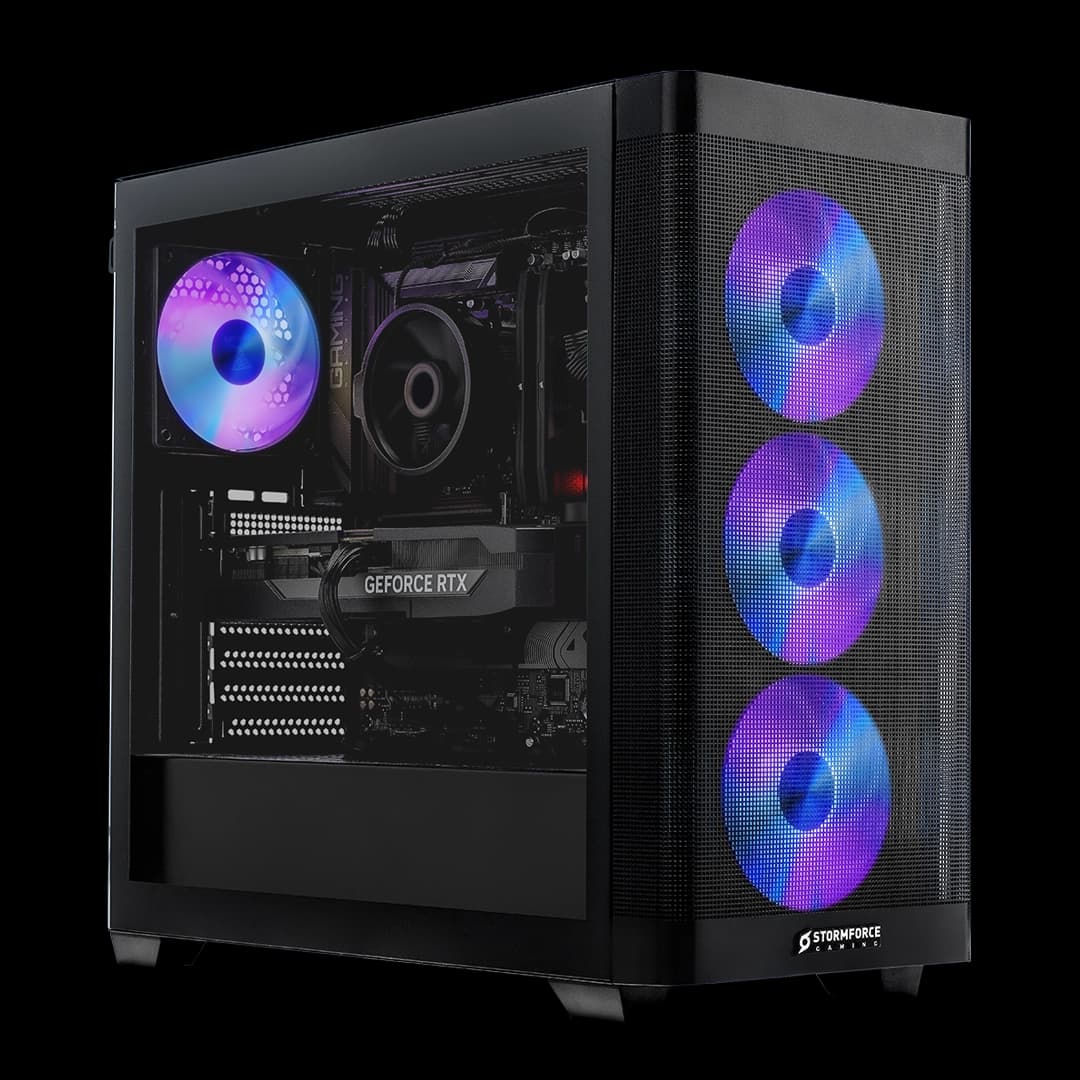
Prebuilt PCs get a bad reputation, and honestly, a lot of them deserve it. Cheap PSUs, throttled thermals, RAM running at half its rated speed, motherboards that look like an afterthought. But every now and then a prebuilt comes along where someone has actually thought about the parts list, and the Stormforce Gaming Titan Pulse AMD is one of those machines. This is a proper high-end build with a Ryzen 7 9850X3D and an RTX 5080, and it's aimed squarely at people who want elite gaming performance without spending a weekend sourcing components and watching cable management tutorials on YouTube.
So is it actually good value? That's the real question. At this price tier, you're not buying a prebuilt because you can't afford the parts. You're buying one because you want it done, done properly, and done now. The Titan Pulse AMD makes a strong case for itself on paper. Let's see if the spec sheet holds up to scrutiny. This is our full Titan Pulse AMD review, and the verdict comes first: if you want a no-compromise AMD gaming machine and you'd rather not spend a weekend in BIOS hell, this is one of the best-specced prebuilts at this level. But there are caveats, and they matter.
Core Specifications
The headline components are genuinely exciting. You've got AMD's Ryzen 7 9850X3D at the heart of it, paired with an NVIDIA RTX 5080 with 16GB of VRAM. That's not a budget pairing dressed up in a flashy case. That's a legitimately powerful combination that sits near the top of what you can buy right now. The memory is 32GB of DDR5 running at 6000MHz, which is exactly where you want DDR5 to be for Ryzen 9000 series chips. And the storage is a 2TB M.2 NVMe SSD, so you're not starting from a position of compromise on any of the major components.
Stormforce Gaming has also made sensible choices lower down the list. The motherboard is a B850 ATX, which gives you solid power delivery and high-speed memory support without the inflated cost of an X870E board. The cooling is a 360mm AIO liquid cooler with a triple-fan radiator, which is the right call for a chip with a 5.6GHz boost clock under sustained load. The PSU is an 850W 80+ Gold fully modular unit, which is properly sized for an RTX 5080 system and leaves breathing room if you ever want to upgrade. The case is the Cougar FV270 RGB ATX with panoramic tempered glass. And the OS is Windows 11 Home, which ships with DirectStorage and Auto HDR baked in.
Nothing in that list looks like a corner was cut. That's rarer than it should be in prebuilt land. The PSU in particular is where budget builders often slip in something sketchy, and 850W Gold fully modular is a legitimate choice here. Same goes for the 360mm AIO rather than a 240mm or, worse, a stock air cooler. These are the specs of a machine that was designed to actually perform, not just look good in a product listing.
| Component | Specification |
|---|---|
| CPU | AMD Ryzen 7 9850X3D (8 cores, 16 threads, 5.6GHz boost) |
| GPU | NVIDIA RTX 5080 16GB |
| RAM | 32GB DDR5 6000 |
| Storage | 2TB M.2 NVMe SSD |
| Motherboard | B850 ATX |
| Cooling | 360mm AIO Liquid Cooler |
| Case | Cougar FV270 RGB ATX |
| PSU | 850W 80+ Gold Fully Modular |
| OS | Windows 11 Home |
| Networking | WiFi 6, Ethernet |
| Price | £3,199.99 |

CPU & Performance: The Titan Pulse AMD Review Starts Here
The Ryzen 7 9850X3D is a chip that deserves a proper explanation, because "8 cores and 5.6GHz" doesn't tell the full story. The magic is in the 3D V-Cache technology, which stacks an additional layer of L3 cache directly on top of the CPU die. For gaming specifically, this dramatically reduces the time the CPU spends waiting for data from system memory. In games that are CPU-bound, particularly strategy titles, simulation games, and competitive shooters where frame pacing matters, this cache advantage translates into noticeably smoother performance at high frame rates. It's not a gimmick. The X3D architecture has been AMD's strongest gaming CPU line since the 5800X3D arrived and caught everyone off guard.
The 9850X3D sits on AMD's Zen 5 architecture, which brings genuine IPC improvements over Zen 4. Stormforce Gaming lists the boost clock at 5.6GHz, and with 16 threads available, this chip handles productivity work comfortably alongside gaming. Video editing, streaming, running a game server in the background, none of that is going to bring this machine to its knees. Where the 9850X3D is slightly different from a pure workstation chip is that the 3D V-Cache design prioritises gaming latency over raw multi-threaded throughput. If you're doing heavy 3D rendering or compiling enormous codebases all day, a standard Ryzen 9 9950X would edge ahead. But for gaming, even at high frame rates where the CPU becomes the bottleneck before the GPU does, the 9850X3D is the right tool.
The B850 motherboard pairing makes sense here. You're not overclocking a 3D V-Cache chip anyway (AMD locks the multiplier on X3D parts to protect the stacked cache from thermal stress), so you don't need an X870E with its premium VRM and overclocking features. The B850 still supports the DDR5 6000 memory speed, handles PCIe 5.0 for the GPU slot, and gives you a stable platform without adding unnecessary cost. It's a sensible call, not a cheap one.
GPU & Gaming Performance
The RTX 5080 is NVIDIA's second-tier flagship in the 50-series lineup, sitting below the RTX 5090 but well above the 5070 Ti. With 16GB of GDDR7 VRAM, it's built for 4K gaming at high settings, and NVIDIA's DLSS technology (now at version 4 with multi-frame generation) means you can push frame rates significantly beyond what raw rasterisation alone would deliver. At 1440p, this card is overkill in the best possible sense. You'll be hitting frame rate limits before the GPU breaks a sweat. At 4K with ray tracing enabled, you're finally in territory where the 5080 has to actually try, and that's where the 16GB VRAM becomes relevant for texture-heavy titles.
Ray tracing on the 5080 is in a different league from what the previous generation could manage. NVIDIA's hardware ray tracing acceleration on the 50-series uses an updated Blackwell architecture, and combined with DLSS 4's frame generation, games that would have been unplayable with full path tracing on a 4080 are now genuinely viable. That's not marketing spin, it's what the architectural improvements deliver. For a machine at this price point, you'd expect nothing less, and the 5080 delivers it.
One thing to be clear about: the RTX 5080 is a physically large card, and the Cougar FV270 is a full ATX case, so fitment isn't a concern. But if you're coming from a mid-range GPU and wondering whether 4K gaming is "really" different at this tier, the honest answer is yes, but only if you have a monitor to match. Pairing an RTX 5080 with a 1080p 60Hz display would be a waste. This machine is built for a high-refresh 1440p or 4K setup, and if you've got one, the GPU is absolutely the right choice for it.
Memory & Storage
32GB of DDR5 running at 6000MHz is the sweet spot for a Ryzen 9000 series gaming build right now. AMD's Ryzen 9000 chips have an internal memory controller that's optimised around the 6000MHz frequency, specifically because it keeps the memory fabric (the Infinity Fabric that connects the chiplets) running in a synchronised 1:1 ratio with the memory controller. Drop below 6000MHz and you lose some of that latency advantage. Go much higher and you start running into stability issues without careful tuning. Stormforce Gaming has hit the right number here, and it matters more than most people realise.
The 2TB M.2 NVMe SSD is a proper fast drive by design. NVMe over PCIe is orders of magnitude faster than a traditional SATA SSD for sequential reads and writes, and the practical difference in day-to-day use is real: games with large open worlds load noticeably faster, Windows boots quickly, and applications snap open. Two terabytes is a solid starting capacity for a gaming machine in 2026. You can fit a lot of modern games in 2TB, though if you're the type who keeps 30 titles installed at once, you'll eventually want to add more.
The B850 motherboard will have additional M.2 slots available, so expansion is possible without resorting to external drives or SATA bays. How many slots are free out of the box depends on the specific board Stormforce Gaming has used, and that's not specified in the verified data, so you'd want to confirm with them directly before buying a second NVMe drive. On the RAM side, 32GB in a gaming machine at this level is fine for most use cases, but if you're also running a virtual machine, doing professional video editing, or streaming at high bitrates simultaneously, 64GB is achievable on DDR5 platforms without drama. The B850 supports high-speed memory, so upgrading later is an option.
Cooling Solution
A 360mm AIO liquid cooler is the right call for the Ryzen 7 9850X3D. The chip boosts to 5.6GHz and has a reasonably high TDP under sustained all-core load. A 240mm AIO would cope, but you'd see higher temperatures under long gaming sessions or productivity workloads, and the fans would have to spin harder to compensate. The 360mm radiator with three fans gives you the thermal headroom to keep the chip cool without the cooler becoming audible at normal loads. That's the practical benefit of a larger radiator: the fans can run slower for the same heat dissipation, which means quieter operation most of the time.
The Cougar FV270 case is designed with airflow in mind. The panoramic tempered glass design isn't just aesthetic; it means the front panel isn't a solid chunk of plastic blocking intake airflow, which is a mistake a lot of cheaper cases make. Good intake airflow is what keeps the GPU cool in a gaming PC, because the GPU is almost always the hottest component under load, and it relies heavily on case airflow rather than its own cooler alone. A case with a restricted front panel can add meaningful temperature increases to a GPU even if the CPU cooler is excellent.
The 360mm AIO also means the radiator is almost certainly mounted at the top or front of the case, exhausting hot air directly out of the chassis rather than recirculating it. This is standard practice in a well-configured build, but it's not guaranteed in prebuilts where the integrator sometimes makes compromises for aesthetic reasons. The Stormforce spec table describes the cooler as having an "efficient pump design for maximum thermal performance", which suggests this has been thought about rather than bolted together. Whether the fan curve is configured aggressively out of the box or tuned for quiet operation is something you'd want to check in the software on first boot, but the hardware is there to do the job properly.
Case & Build Quality
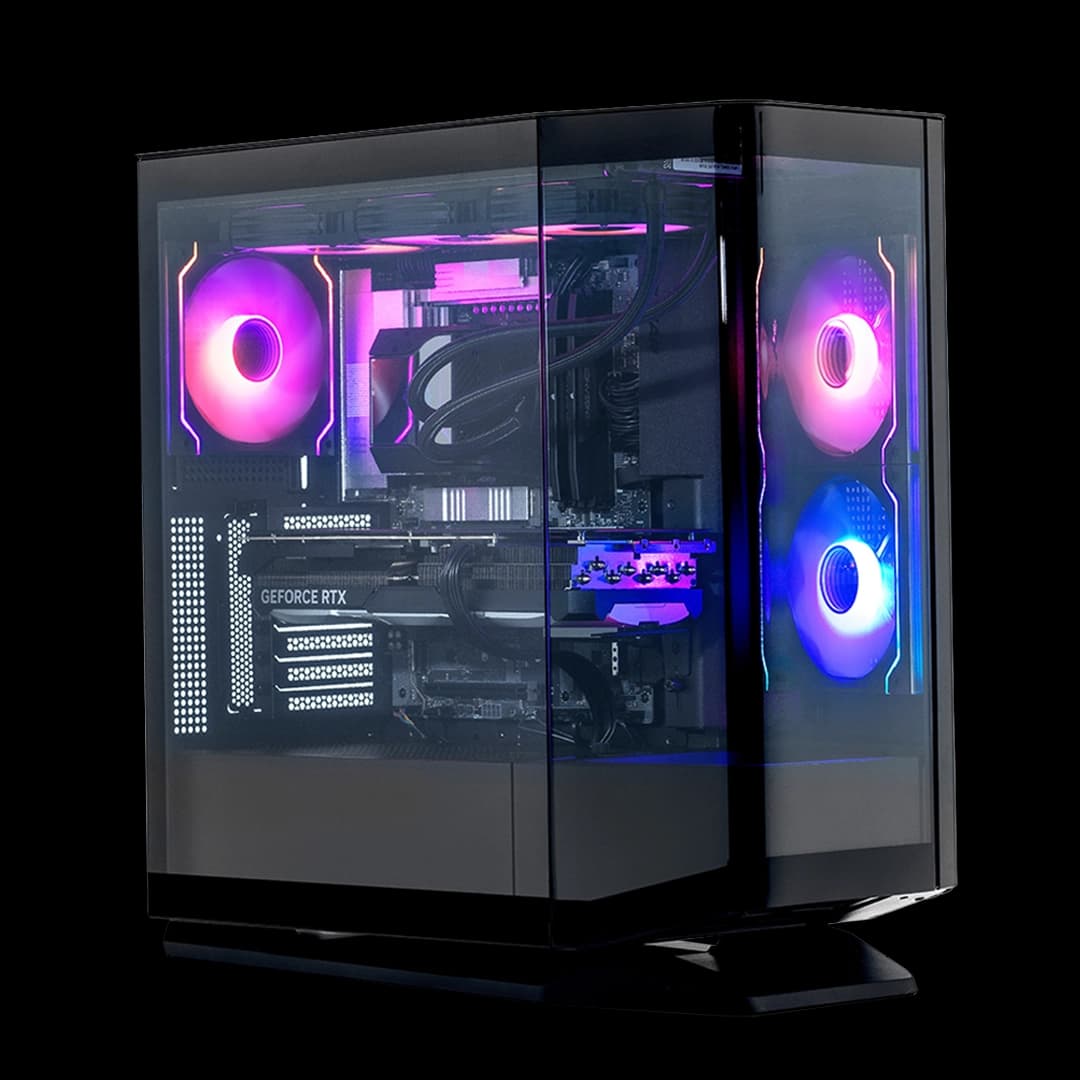
The Cougar FV270 RGB ATX is a proper mid-to-full tower with a panoramic tempered glass side panel and optimised airflow design. Cougar as a brand sits in the mid-range to enthusiast case market, and the FV270 is one of their more visually striking recent designs. The panoramic glass gives you a clear view of the internals, which matters if you're spending this much on a machine and want to actually see the RGB lighting doing its thing. It also means the side panel is tempered glass rather than acrylic, so it won't scratch from light cleaning and won't go yellow over time the way acrylic does.
RGB lighting is present throughout, which is standard for a machine at this price point and aimed at gaming. If you're not into RGB, you can typically turn it off or set it to a static colour through the motherboard's software, but it's definitely part of the aesthetic here. The Cougar FV270's design leans into the gaming PC look rather than trying to be understated, so if you want something that sits quietly in the corner looking like office equipment, this isn't it. That's not a criticism, just a description of what you're getting.
Cable management in prebuilts is a mixed bag across the industry. The fact that Stormforce Gaming has specced a fully modular PSU is a good sign here, because modular PSUs allow the integrator to run only the cables they need rather than bundling everything behind the motherboard tray in a mess. A fully modular 850W unit gives whoever built this machine the tools to do a tidy job. Whether they used those tools well is something owner feedback would normally confirm, but given the premium positioning of this machine, there's every reason to expect Stormforce Gaming has done this properly.

Connectivity & Ports
The Titan Pulse AMD ships with WiFi 6 and Ethernet for networking. WiFi 6 is the current mainstream standard, delivering up to 9.6Gbps theoretical throughput and significantly better performance in environments with lots of connected devices compared to WiFi 5. For gaming, the more relevant improvement is the reduced latency and better consistency under load, particularly if you're in a house with several devices competing for bandwidth. Ethernet is still the better choice for online gaming if you can run a cable, but WiFi 6 is a perfectly reasonable fallback for most people.
The specific port layout for front and rear USB, video outputs, and audio connections isn't detailed in the verified specification data, so rather than guess, you'd want to check the full specification on the Stormforce Gaming product page before buying. What the B850 ATX motherboard platform does guarantee is a solid rear I/O with USB-A and USB-C options, multiple video outputs from the RTX 5080 (HDMI and DisplayPort), and standard audio jacks. The RTX 5080 itself supports DisplayPort 2.1 and HDMI 2.1, which means you're covered for 4K at high refresh rates and for connecting to modern gaming monitors without an adapter.
For a machine at this level, the networking provision of WiFi 6 plus Ethernet is appropriate. If you're building a streaming or content creation workstation that pushes large files over the network regularly, a 2.5GbE Ethernet port would be preferable to standard gigabit, and whether the B850 board here includes that depends on the specific model. Again, that's a detail to confirm with Stormforce Gaming directly. For gaming, standard gigabit Ethernet is more than sufficient since no game server connection saturates a gigabit link.
Pre-installed Software & OS
Windows 11 Home is the operating system here, which is the right choice for a gaming machine in 2026. Windows 11 ships with DirectStorage, Microsoft's implementation of the NVMe direct-to-GPU asset streaming technology that bypasses the CPU for texture loading. On a machine with a fast NVMe SSD and a high-end GPU, DirectStorage can meaningfully reduce game loading times in supported titles. It's not universally supported across all games yet, but the library of compatible titles is growing, and having the hardware and OS to support it means you're ready when your games add it.
Auto HDR is also part of the Windows 11 package, which automatically applies HDR tone mapping to older DirectX 11 games that weren't built with HDR in mind. If you've got an HDR monitor (and at this price tier, you probably should), this extends the benefit to a much wider library of titles without needing developer patches. Microsoft's Copilot AI integration in Windows 11 is less relevant for gaming but useful for general productivity tasks, and it's there if you want it.
Stormforce Gaming's prebuilts typically ship with a clean Windows installation without excessive third-party bloatware, which is one of the things that separates a reputable system integrator from the budget end of the market. You're not going to boot up and find a dozen trial subscriptions and toolbar installers waiting for you. The machine should be ready to game from the moment you plug it in, with drivers installed and Windows activated. That's a basic expectation at this price point, and it's one Stormforce Gaming's reputation is built on delivering.
Upgrade Potential
One of the things that makes a good prebuilt different from a disposable one is whether you can improve it over time. The Titan Pulse AMD is in a strong position here. The 850W Gold PSU has meaningful headroom above what the current components draw, which means if NVIDIA releases a next-generation GPU in two or three years and you want to drop one in, the PSU can handle it without needing to be swapped out. That's not a small thing. A lot of prebuilts ship with a 650W unit that's fine for the GPU it came with but leaves you no room to upgrade without replacing the PSU too.
The B850 ATX motherboard supports high-speed DDR5 memory, so if you decide 32GB isn't enough for your workload, adding another 32GB or swapping to 64GB is straightforward. The AM5 socket that the Ryzen 7 9850X3D sits in is AMD's current platform, and AMD has committed to AM5 longevity, meaning future Ryzen generations should be compatible with the same socket. That's a genuine upgrade path that didn't exist with AM4 prebuilts in their later years, where the socket was already approaching end of life at purchase.
Storage expansion depends on the free M.2 slots on the B850 board, and as mentioned earlier, the exact count isn't in the verified data. But B850 motherboards typically offer at least two M.2 slots, and if one is occupied by the 2TB boot drive, you've likely got at least one free for a second NVMe drive. The Cougar FV270 case is a full ATX chassis, so there's physical space for additional components, and the airflow design means adding a second GPU cooler or case fan later won't be a problem. Overall, this is a machine you can grow with rather than one you outgrow.
How It Compares
The honest comparison for any prebuilt at this price tier is a DIY build with the same parts list. If you price up an AMD Ryzen 7 9850X3D, RTX 5080 16GB, 32GB DDR5 6000, 2TB NVMe SSD, B850 motherboard, 360mm AIO, 850W Gold modular PSU, and a decent ATX case, you're going to be very close to what Stormforce Gaming is charging, if not over it once you factor in Windows 11 Home as a retail licence. The GPU alone is carrying a significant portion of the system cost at current market prices, and RTX 5080 cards aren't sitting on shelves at MSRP. The convenience premium on this machine, if there is one, is smaller than you might expect.
Against other prebuilts at this level, the Titan Pulse AMD stands out for using the 3D V-Cache variant of the Ryzen 7 9850, rather than the standard 9700X or 9800X3D that some competitors pair with the same GPU tier. The 9850X3D's higher core count (8 cores versus the 9800X3D's 8 cores, but with a higher boost clock) makes it a stronger all-rounder for both gaming and productivity. Some prebuilts at similar prices also cut corners on the PSU or the AIO cooler size, and the Titan Pulse AMD doesn't do either of those things.
The comparison table below frames the Titan Pulse AMD against a theoretical self-build at the same spec and a lower-tier prebuilt for context. Specific rival prebuilt pricing isn't included because it changes too frequently to be accurate, but the component quality comparison is what matters here.
| Feature | Titan Pulse AMD | DIY Equivalent Build | Lower-Tier Prebuilt (RTX 5070 Ti) |
|---|---|---|---|
| CPU | Ryzen 7 9850X3D (3D V-Cache) | Same (if you choose it) | Typically Ryzen 7 9700X or similar |
| GPU | RTX 5080 16GB | Same (at market price) | RTX 5070 Ti 16GB |
| RAM | 32GB DDR5 6000 | Your choice | 32GB DDR5 (speed varies) |
| Storage | 2TB NVMe SSD | Your choice | Often 1TB |
| PSU | 850W Gold Fully Modular | Your choice | Often 750W, sometimes semi-modular |
| Cooling | 360mm AIO | Your choice | Often 240mm AIO or air cooler |
| Windows 11 | Included (Home) | Extra cost | Included (Home) |
| Build time | Ready to go | Several hours minimum | Ready to go |
| Warranty | Stormforce Gaming warranty | Per-component | Varies by brand |

Final Verdict: Is the Titan Pulse AMD Worth Buying?
The Titan Pulse AMD is a genuinely well-specced machine. The component choices are honest: a top-tier gaming CPU with 3D V-Cache, a second-tier flagship GPU that handles 4K without drama, memory running at exactly the right speed for the platform, a large-enough AIO to keep things cool, and a PSU with room to grow. None of the usual prebuilt compromises are obvious here. No underpowered PSU, no slow RAM, no 240mm cooler on a chip that deserves better. Stormforce Gaming has put together a parts list that a knowledgeable self-builder would recognise as sensible.
Who is this for? Primarily, it's for someone who wants a no-fuss, high-performance gaming PC at the premium end of the market and doesn't want to spend time sourcing parts, building, troubleshooting POST errors, and configuring BIOS settings. It's also for someone who values a single warranty covering the whole system rather than chasing down individual component warranties when something goes wrong. And honestly, given where GPU prices are right now, the value against a self-build is closer than it's been in years. The RTX 5080 isn't cheap anywhere.
Who should think twice? If you're a confident builder who enjoys the process and you've already got some components you can reuse (a case, a PSU, maybe some RAM), you'll likely build something comparable for less. And if you don't need the RTX 5080 specifically, a machine with an RTX 5070 Ti would save you a meaningful amount and still handle 4K gaming in most titles. The 5080 is the right GPU for someone who wants the best 4K experience outside of the 5090's price bracket, and for someone playing on a high-refresh 1440p monitor who wants every possible frame, but it's not necessary for 1080p gaming no matter how competitive you are.
The Titan Pulse AMD earns a strong recommendation at its price tier. The parts are right, the thermal design is right, and the PSU gives you room to breathe. If the current price on the Stormforce Gaming listing sits where it should relative to the component cost, this is one of the more honest prebuilts at this level of the market. Check the live price below and compare it against a fresh self-build quote before you decide, but don't be surprised if the gap is smaller than you expected.
What works. What doesn’t.
6 + 5What we liked6 reasons
- Ryzen 7 9850X3D with 3D V-Cache is the strongest gaming CPU AMD currently offers at this core count
- RTX 5080 with 16GB GDDR7 handles 4K gaming at high settings and benefits from DLSS 4 multi-frame generation
- DDR5 running at exactly 6000MHz keeps the Infinity Fabric in a synchronised 1:1 ratio for optimal Ryzen 9000 latency
- 850W 80+ Gold fully modular PSU is properly sized and leaves genuine headroom for a future GPU upgrade
- 360mm AIO liquid cooler is the right thermal solution for a chip boosting to 5.6GHz under sustained load
- 2TB NVMe SSD is a solid starting capacity and the B850 platform allows straightforward storage expansion later
Where it falls5 reasons
- The RTX 5080 is wasted on a 1080p or 60Hz display, so monitor investment is required to justify the GPU
- Specific motherboard model, front-panel port layout, and exact M.2 slot count are not confirmed in published specifications
- The Cougar FV270 leans heavily into the RGB gaming aesthetic, which will not suit buyers wanting a subtle or understated look
- Confident self-builders who already own some components may be able to replicate this spec for less
- The Ryzen 7 9850X3D prioritises gaming latency over raw multi-threaded throughput, so pure workstation users would be better served by a non-X3D chip
Full specifications
12 attributes| CPU | AMD Ryzen 7 9850X3D |
|---|---|
| GPU | NVIDIA RTX 5080 16GB |
| RAM | 32GB DDR5 6000 |
| Storage | 2TB M.2 NVMe SSD |
| Case | Cougar FV270 RGB ATX |
| Connectivity | WiFi 6, Ethernet |
| Cooling | 360mm AIO Liquid Cooler |
| Launch year | 2026 |
| Motherboard | B850 ATX |
| Motherboard chipset | B850 |
| OS | Microsoft Windows 11 Home |
| Other | Bundle: Dual Monitor Bundle, Premium Bundle, Standalone PC, Ultimate Bundle |
If this isn’t right for you
2 options

Frequently asked
7 questions01What is the difference between the Ryzen 7 9850X3D and a standard Ryzen 7 chip?+
The Ryzen 7 9850X3D uses AMD's 3D V-Cache technology, which physically stacks an additional layer of L3 cache on top of the CPU die. This substantially increases the amount of data the chip can access without going to system memory, reducing latency in gaming workloads. The result is noticeably smoother frame pacing at high frame rates, particularly in CPU-bound titles such as strategy games, simulations, and competitive shooters. The trade-off is that the stacked cache design means AMD locks the CPU multiplier, so manual overclocking is not possible.
02Is the RTX 5080 significantly better than the RTX 4080 Super for 4K gaming?+
The RTX 5080 is built on NVIDIA's Blackwell architecture, which brings improvements to hardware ray tracing acceleration and supports DLSS 4 with multi-frame generation. At native 4K with ray tracing enabled, the 5080 offers a meaningful step forward over the 4080 Super, particularly in titles that use path tracing. With DLSS 4 multi-frame generation active, frame rates in demanding titles can be pushed significantly higher than what the previous generation could deliver. The 16GB of GDDR7 VRAM also provides more headroom for high-resolution texture packs than the 4080 Super's 16GB GDDR6X.
03Why does the DDR5 run at 6000MHz specifically, and does the speed matter?+
AMD's Ryzen 9000 series processors have a memory controller optimised around 6000MHz DDR5 because this frequency allows the Infinity Fabric, which connects the CPU's internal chiplets, to run in a synchronised 1:1 ratio with the memory controller. Running memory below this threshold introduces additional latency as the fabric has to operate at a different ratio, which is measurable in gaming benchmarks. Running memory significantly above 6000MHz can introduce stability issues without careful manual tuning. The 6000MHz figure is the broadly recognised sweet spot for this platform, and Stormforce Gaming has specified it correctly.
04Can the Titan Pulse AMD be upgraded in the future, and what are the realistic upgrade paths?+
The machine has several genuine upgrade paths. The 850W Gold fully modular PSU has headroom above the current system draw, so a future GPU upgrade is feasible without replacing the power supply. AMD's AM5 socket has a published long-term roadmap, meaning future Ryzen generations should be compatible without a motherboard change. The DDR5 platform supports higher capacity modules, so increasing RAM from 32GB to 64GB is straightforward. Storage expansion depends on the number of free M.2 slots on the specific B850 board used, which is worth confirming with Stormforce Gaming before purchasing an additional NVMe drive.
05What does a fully modular PSU mean, and why does it matter in a prebuilt?+
A fully modular PSU allows the builder to connect only the power cables that are actually needed, rather than having all cables permanently attached to the unit. In a prebuilt, this means the system integrator can route a tidy set of cables without leaving unused bundles stuffed behind the motherboard tray. Tidier cable management improves airflow inside the case and makes future maintenance easier. It also signals that Stormforce Gaming has chosen a quality unit rather than a basic non-modular PSU, which is a common area where lower-cost prebuilts cut corners.
06Does the Titan Pulse AMD include WiFi, or does it require a wired Ethernet connection?+
The Titan Pulse AMD includes both WiFi 6 and Ethernet. WiFi 6 supports theoretical throughput up to 9.6Gbps and offers lower latency and better performance in congested wireless environments compared to WiFi 5. For online gaming, a wired Ethernet connection remains preferable where possible, but WiFi 6 is a capable alternative for most users. Whether the Ethernet port is standard gigabit or 2.5GbE depends on the specific B850 motherboard model used, and that detail is worth confirming with Stormforce Gaming if fast local network transfers are important to your use case.
07Is Windows 11 Home genuinely activated on this machine, or does it require a separate licence?+
The Titan Pulse AMD ships with Windows 11 Home included and activated. Stormforce Gaming's prebuilts are configured with the operating system ready to use from first boot. This is relevant to the overall value assessment because a retail Windows 11 Home licence represents an additional cost if you are pricing up a DIY equivalent build, making the convenience premium on a prebuilt like this smaller than it might initially appear.