Every prebuilt PC is basically a puzzle where the manufacturer has hidden a few of the pieces. The question isn't whether they cut corners. They always do somewhere. The real question is which corners, and whether those corners matter to you. So when the Stormforce Gaming Carbon Elite AMD landed on the radar at mid-range money, the first thing worth doing is pulling apart that spec sheet component by component and asking: where did the budget actually go, and where did they quietly save a few quid?
The short answer, and the carbon elite amd review verdict you're probably here for: this is a genuinely interesting machine built around AMD's Ryzen 7 8700G, which is one of the most capable integrated graphics processors ever put into a consumer desktop. At its current price (check below for the live figure), it sits in a peculiar spot. It's not a traditional gaming PC in the discrete GPU sense, but it's not pretending to be a basic office box either. It's a compact, upgradeable foundation with a processor that can actually handle light gaming right now, and a platform that can take a proper GPU later. Whether that's worth it over a DIY build at the same spec is where things get more complicated.
The carbon elite amd review picture gets clearer once you map each component against what you'd pay sourcing parts yourself. Spoiler: the gap is smaller than you'd expect, and the platform choices Stormforce made are mostly sensible. Mostly.
Core Specifications
The headline component is the AMD Ryzen 7 8700G, an eight-core, sixteen-thread processor built on Zen 4 architecture. It runs at 4.2GHz base and boosts up to 5.1GHz according to Stormforce Gaming's spec table. That's a proper chip. Not a cut-down OEM part, not a rebadged laptop processor shoved into a desktop chassis. A full-fat Ryzen 7 that you could buy at retail and drop into any AM5 board. That matters, because it tells you immediately that Stormforce aren't playing tricks with the CPU.
The graphics side is where this machine is unconventional. There's no discrete GPU. Instead, you get the Radeon 780M, which is the integrated graphics engine built into the 8700G die, based on RDNA 3 architecture. It's the fastest integrated graphics solution AMD has shipped in a desktop chip. That's not spin. It genuinely outperforms Intel's current integrated solutions and, in lighter titles at 1080p with settings dialled back, it can deliver playable frame rates. More on that in the GPU section.
The rest of the build is built around an A620 mATX motherboard on the AM5 platform, 16GB of DDR5 6000 memory, a 1TB Gen 4 M.2 NVMe SSD, a 350W Bronze-rated PSU, and the Cougar FV150 Mini mATX case with tempered glass. Windows 11 Home is included. That's the full picture. No GPU, but a solid foundation otherwise, and the AM5 platform means future CPU upgrades are on the table.
| Component | Specification |
|---|---|
| CPU | AMD Ryzen 7 8700G (8-core, 16-thread, 4.2GHz base, 5.1GHz boost, Zen 4) |
| GPU | Radeon 780M Integrated Graphics (RDNA 3) |
| RAM | 16GB DDR5 6000 |
| Storage | 1TB Gen 4 M.2 NVMe SSD |
| Motherboard | A620 mATX (AM5 platform) |
| Case | Cougar FV150 Mini mATX, tempered glass side panel |
| Cooling | Compact aluminium heatsink with integrated fan |
| PSU | 350W Bronze-rated |
| Connectivity | WiFi 6, Ethernet |
| Operating System | Microsoft Windows 11 Home |
| Price | £929.99 |

CPU & Performance
The Ryzen 7 8700G is the best thing about this machine, and it's not particularly close. Eight cores, sixteen threads, Zen 4 architecture, 5.1GHz boost. In practical terms, that means this is a processor that can genuinely multitask without complaint. Video editing, streaming, running a browser with forty tabs open while something renders in the background. It handles all of that without the CPU becoming the bottleneck. For productivity work, this is a proper workhorse chip, not a gaming-first compromise.
The Zen 4 architecture matters here beyond the headline clock speeds. AMD's Zen 4 cores deliver strong instructions-per-clock performance, which translates to snappy real-world responsiveness. The 5.1GHz boost clock is also notable because it means single-threaded tasks, the kind that still matter in plenty of older games and applications, get a proper push. AMD's own specification page for the 8700G confirms the core and clock figures Stormforce Gaming lists. Nothing here is being misrepresented.
Where the CPU story gets interesting is the relationship between the processor and the integrated graphics. The 780M GPU draws on system RAM, which means the DDR5 6000 specification isn't just a productivity nicety. It directly affects how much bandwidth the integrated GPU has to work with. Running faster memory means the 780M has more headroom. Stormforce Gaming have actually made a sensible call here by pairing the 8700G with DDR5 6000 rather than cheaper DDR5 4800. That's not a given with prebuilts. Some manufacturers will drop the cheapest possible RAM in and let you figure out you've been short-changed later.
GPU & Gaming Performance
There's no way to sugarcoat this: if you want to play demanding modern titles at 1440p or higher with high settings, this machine, as shipped, is not the right tool. The Radeon 780M is the best integrated graphics solution available in a desktop chip right now, but it's still integrated graphics. It shares system memory rather than having its own dedicated VRAM pool, and that ceiling is real. The 780M is genuinely impressive for what it is. But what it is, is an iGPU.
In practical terms, the 780M is capable of running lighter competitive titles, older games, and less demanding indie releases at 1080p with reasonable settings. Games like Fortnite, Rocket League, older titles from a few years back, or anything that isn't pushing modern rasterisation hard can be genuinely playable. The RDNA 3 architecture it's based on is the same generational tech as AMD's discrete cards, so the architectural efficiency is there. It's just limited by the memory bandwidth and the lack of dedicated VRAM that a discrete card would bring.
The reason this still makes sense as a purchase for some people is the upgrade path. The 350W PSU is the constraint here (more on that in the upgrade section), but the AM5 platform and the PCIe slot on that A620 board mean you can drop in a discrete GPU later. Buy this now, use the 780M for lighter work and gaming, then add a GPU in six or twelve months when your budget allows or when a good deal appears. That's a legitimate strategy. Just go in with eyes open about where the integrated graphics ceiling is.
Memory & Storage
The 16GB DDR5 6000 specification is one of the better decisions in this build. DDR5 6000 is widely considered the sweet spot for AMD's AM5 platform. It's fast enough to meaningfully feed the integrated GPU, and it's not so far above the memory controller's rated speed that you're paying for headroom you can't use. Stormforce Gaming have landed on the right spec here. A lot of prebuilts at this tier ship with DDR5 4800 or 5200 to save a few quid. The 6000 rating matters more on this particular machine than it would on a system with a discrete GPU, because the 780M is directly dependent on system memory bandwidth.
The 1TB Gen 4 M.2 NVMe SSD is another solid choice. PCIe Gen 4 NVMe drives offer read speeds that make Windows boot times and application loading genuinely fast. This isn't a budget SATA SSD quietly dropped in to hit a spec bullet point. A Gen 4 NVMe drive is the right storage for a machine in this price bracket, and 1TB is a reasonable starting capacity for most users. You won't be filling it with a massive game library overnight, but anyone with a large Steam collection will want to think about expansion.
The A620 motherboard is where the memory upgrade story gets a bit murky. The A620 chipset is AMD's entry-level AM5 offering, and it typically comes with two DIMM slots in mATX configurations. That means you're likely maxed at 32GB if you want to upgrade later, which is fine for most use cases. It's also that the A620 doesn't support CPU overclocking. The memory is running at its rated 6000 speed through AMD's EXPO profile, but if you were hoping to push the Ryzen 7 8700G beyond its stock clocks, the A620 won't let you. That's a known limitation of the chipset, not a Stormforce-specific decision.
Cooling Solution
The cooling setup is the part of this build that deserves the most scrutiny. Stormforce Gaming list it as "optimised air cooling with compact aluminium heatsink and integrated fan." That's doing a lot of work with careful language. What it means in practice is a relatively modest cooler that's designed to handle the 8700G's TDP within the constraints of the Cougar FV150's compact footprint. The 8700G has a 65W TDP by AMD's specification, which is manageable, but the chip can boost hard and generate real heat under sustained load.
The word "compact" in the cooler description is the thing to pay attention to. Compact coolers work fine for everyday tasks and lighter workloads. Where they start to show their limits is under extended heavy load, like a long rendering session or an intensive gaming run. The A620 motherboard's power delivery and the compact cooler together mean the system will likely pull the 8700G back from its peak boost frequencies when it gets hot. That's thermal throttling, and it's the predictable consequence of pairing a capable chip with a modest cooler in a small case. It's not a disaster. It's a trade-off.
The Cougar FV150 case has tempered glass side panels and is described as having efficient airflow, but in a compact mATX chassis, airflow is always a compromise. There's less room for large fans, less space for heat to dissipate, and the compact aluminium heatsink has less surface area than a tower cooler would. If you're planning to add a discrete GPU later, the thermal situation inside the case becomes more relevant, because a GPU will add significant heat load. For the machine as shipped, running integrated graphics only, thermals should be manageable. Just don't expect it to run whisper-quiet under sustained load.
Case & Build Quality
The Cougar FV150 Mini is a real case from a real manufacturer, not a generic white-label box with a Stormforce sticker on it. Cougar make a range of cases that sit in the mid-tier of the market, and the FV150 is their compact mATX offering. The tempered glass side panel is a genuine feature, not a plastic imitation. In a machine at this price point, that's because some manufacturers absolutely do use plastic panels and call them glass-adjacent.
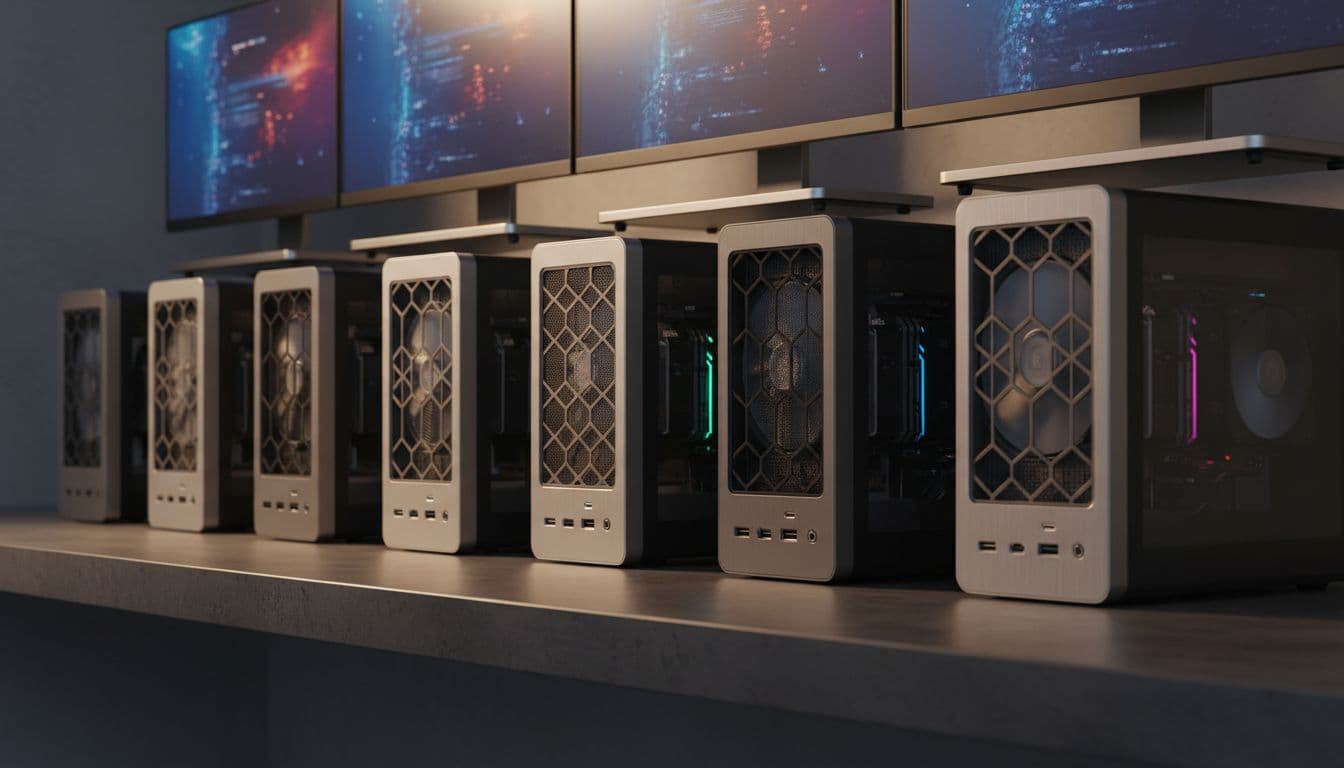
The mATX form factor means this isn't a full tower. It's a compact desktop that won't dominate a desk, which is part of the appeal. The trade-off is internal space. Cable management in mATX cases is always tighter than in mid-towers, and with a compact cooler and a 350W PSU, there's not a huge amount of room to manoeuvre. From what Stormforce Gaming's product imagery shows, the internal layout is clean enough for a prebuilt at this price. Whether cable management is tidy behind the motherboard tray is harder to assess without physically opening the machine, but the case design does include a side panel that shows off the internals, so they presumably haven't left it a complete mess.
There's no RGB lighting mentioned in the verified spec data, which is either a relief or a disappointment depending on your perspective. The Cougar FV150 focuses on the tempered glass aesthetic rather than a light show, which keeps the build looking clean. For a machine that's going to sit on a desk and be used as a productivity box with gaming on the side, that's probably the right call. The build is compact, it's presentable, and it's using real components from known manufacturers rather than anonymous OEM parts throughout.
Connectivity & Ports
Connectivity is one area where the Carbon Elite AMD does well without making a big fuss about it. WiFi 6 is included, which is the 802.11ax standard. That matters because WiFi 5 (802.11ac) is the previous generation, and at mid-range prices some prebuilts still ship with it. WiFi 6 brings better performance in congested environments, lower latency, and improved throughput compared to its predecessor. For anyone gaming wirelessly or streaming, that's a meaningful upgrade over what a cheaper machine might offer.
Ethernet is also included, as you'd expect. Wired networking is always preferable for gaming if you can run a cable, and having both options available means you're not locked into one approach. The A620 mATX motherboard will have its own rear I/O panel with USB ports, video outputs from the integrated graphics, and the network connections, though the specific port count and USB generations aren't broken out in Stormforce Gaming's verified spec data, so those details aren't something to speculate on here.
What the integrated Radeon 780M does mean for video output is that you'll have display connectivity through the motherboard's rear panel rather than a GPU bracket. The 780M supports multiple display outputs, which is useful if you want a dual-monitor setup for productivity. For gaming, you'd typically be running a single monitor anyway. The WiFi 6 and Ethernet combination, alongside the AM5 platform's I/O capabilities, means this machine is properly connected for a compact desktop in 2024 and beyond. It's not cutting corners on networking, which is more than can be said for some prebuilts at similar money.
Pre-installed Software & OS
Windows 11 Home is included, which is the standard consumer version of Microsoft's current operating system. It's not Windows 11 Pro, so if you need features like BitLocker drive encryption, Remote Desktop hosting, or Hyper-V virtualisation for professional use, you'd need to upgrade the licence separately. For the vast majority of home users and gamers, Windows 11 Home covers everything needed without restriction. The included licence is a genuine retail-equivalent copy tied to the hardware, not a grey-market key.
Stormforce Gaming's spec data doesn't detail any proprietary software bundle or manufacturer utility suite beyond the operating system itself. That's actually a good sign. Some prebuilt manufacturers load machines with their own monitoring software, update tools, and performance dashboards that range from mildly useful to actively annoying. The absence of a listed software bundle suggests the Carbon Elite AMD ships relatively clean. You'll get the standard Windows 11 setup experience plus whatever AMD's driver suite installs for the Ryzen 7 8700G and the Radeon 780M.
AMD's own software, specifically AMD Software: Adrenalin Edition, is the relevant driver package for the integrated graphics. It handles display settings, performance monitoring, and any graphics-related configuration. It's a mature piece of software at this point and considerably less irritating than it was a few years ago. For the CPU side, AMD's Ryzen Master utility is available as a free download if you want to monitor clock speeds and temperatures, though as noted earlier, the A620 chipset means overclocking the CPU itself isn't on the table. The software picture here is clean and standard, which is exactly what you want from a prebuilt.
Upgrade Potential
This is genuinely one of the more interesting aspects of the Carbon Elite AMD, and it's worth thinking through carefully. The AM5 platform is AMD's current generation socket, and AMD has committed to AM5 support through at least 2027. That means future CPU upgrades are a real option, not just marketing language. If AMD releases a more capable Ryzen chip on AM5 in the next couple of years, the A620 motherboard will support it (within the A620's power delivery limitations). That's a meaningful long-term consideration that cheaper Intel prebuilts on older platforms can't match.
The GPU upgrade path is where the 350W Bronze PSU becomes the most important constraint in the whole machine. A 350W PSU is fine for the 8700G running integrated graphics. It is not fine for pairing with a mid-range discrete GPU. Something like an RX 7600 or an RTX 4060 would push you right to or beyond the PSU's comfortable operating limit. So if adding a GPU is part of the plan, budget for a PSU upgrade at the same time. The Cougar FV150 mATX case will have physical space constraints for GPU length as well, so checking GPU dimensions against the case's maximum supported length before buying is essential.
Memory expansion is limited by the A620 mATX board's two DIMM slots. You're currently at 16GB in what is likely a dual-channel configuration (two 8GB sticks), which is the ideal setup for the 780M's memory bandwidth. You could upgrade to 32GB by swapping to two 16GB sticks, but you'd need to sell or discard the existing RAM. There's likely one M.2 slot occupied by the existing 1TB NVMe drive, and the A620 chipset typically supports at least one additional M.2 slot, so storage expansion should be possible. Overall the upgrade story is decent for an mATX prebuilt, but the PSU is the thing that needs addressing before any GPU goes in.
How It Compares
Comparing the Carbon Elite AMD against the prebuilt market and against a self-build requires being honest about what this machine is. It's not a discrete GPU gaming PC. It's a capable compact desktop with the best integrated graphics available in a desktop chip, on a platform you can build on. The relevant comparisons are therefore other iGPU-focused compact prebuilts, and what a DIY build at the same spec would cost you.
On the DIY front: the Ryzen 7 8700G at retail typically sits around £280 to £300. An A620 mATX board costs roughly £80 to £100. Two sticks of DDR5 6000 16GB comes in around £60 to £80. A 1TB Gen 4 NVMe drive is around £70 to £90. A decent mATX case with a 350W PSU adds another £80 to £100 depending on what you pick. Add Windows 11 Home at retail (around £100 to £120) and you're looking at a self-build cost of roughly £670 to £710 before accounting for your time, the risk of compatibility issues, and the absence of a warranty. The convenience premium on the Carbon Elite AMD is real but not outrageous for a prebuilt. You're paying for assembly, testing, and the Stormforce warranty.
Against other prebuilts in this tier, the Carbon Elite AMD's main differentiator is the quality of the integrated graphics. Many mid-range compact prebuilts at similar money use older Intel processors with weaker integrated graphics, or they use discrete entry-level GPUs that don't perform significantly better than the 780M in real-world lighter gaming while adding cost, heat, and power draw. The 8700G with 780M is a genuinely modern, efficient solution for someone who wants a capable everyday machine that can handle light gaming without a discrete GPU. The comparison table below frames the key decision points.
| Feature | Carbon Elite AMD (Stormforce) | DIY Build (Same Spec) | Typical Rival Prebuilt (Similar Price) |
|---|---|---|---|
| CPU | Ryzen 7 8700G (Zen 4, 8-core) | Ryzen 7 8700G (same) | Often older gen or lower tier |
| GPU | Radeon 780M iGPU (RDNA 3) | Radeon 780M (same) | Varies; may include entry discrete |
| RAM | 16GB DDR5 6000 | 16GB DDR5 6000 (same) | Often DDR5 4800 or 5200 |
| Storage | 1TB Gen 4 NVMe | 1TB Gen 4 NVMe (same) | Sometimes SATA SSD at this price |
| Platform | AM5 (future CPU upgrade path) | AM5 (same) | Mixed; some older platforms |
| PSU | 350W Bronze | Your choice (can size up) | Often similarly modest |
| OS | Windows 11 Home (included) | Extra cost (~£100 to £120) | Usually included |
| Warranty | Stormforce Gaming warranty | Per-component only | Varies by brand |
| Price | £929.99 | Approx. £670 to £710 parts only | Comparable range |

Final Verdict
The Stormforce Gaming Carbon Elite AMD is a machine that makes sense for a specific type of buyer, and it genuinely doesn't make sense for others. So let's be clear about which camp you're in before you click anything. If you want to play demanding modern titles at 1440p right now, out of the box, this is not your machine. The 780M is impressive for integrated graphics, but it has real limits, and you'd be disappointed within the first week if your expectations are set around a discrete GPU experience.
But if you're looking for a compact, capable everyday desktop that can handle productivity work, light gaming, and media consumption without a dedicated GPU, while sitting on a platform you can upgrade later? This is a thoughtful build. The Ryzen 7 8700G is a proper chip, not a compromise. The DDR5 6000 memory is the right spec for the platform. The Gen 4 NVMe storage is fast. The AM5 platform means you're not buying into a dead end. And the Cougar FV150 case is a real piece of kit, not a generic box. Stormforce Gaming have made sensible component choices throughout, which isn't always the case at this price point.
The 350W PSU is the most significant limitation if you're planning to add a GPU later. Factor in the cost of a 550W to 650W PSU upgrade when you're budgeting, because that's a necessary step before a discrete card goes in. The compact cooler is the second thing to keep an eye on under sustained heavy load. And the A620 chipset, while fine for this build, does close off CPU overclocking as an option. None of these are dealbreakers, but they're going in.
Against a DIY build at the same spec, the Carbon Elite AMD's convenience premium is reasonable once you factor in Windows 11 Home, assembly, and the warranty. If you're confident building a PC yourself and you're happy sourcing parts, you can save some money going the self-build route. But the gap isn't enormous, and a prebuilt warranty has genuine value if something goes wrong. For buyers who want the machine ready to go without the faff, the Carbon Elite AMD is a fair deal.
One honest note: if your budget is tighter and you don't need the Ryzen 7 8700G's eight cores, a Ryzen 5 8600G-based prebuilt at lower money would cover similar integrated graphics territory with fewer cores for less. The 8700G's extra cores and threads are genuinely useful for productivity and future-proofing, but if all you're doing is light gaming and browsing, you might not need to spend this much. Check what Stormforce Gaming have at a lower price point before committing.
For the right buyer, though, this is a well-specified compact desktop on a modern platform with the best integrated graphics AMD makes. That's a more interesting machine than most of the generic prebuilts cluttering up this price bracket.
What works. What doesn’t.
7 + 6What we liked7 reasons
- Ryzen 7 8700G is a full-fat, eight-core Zen 4 processor with no OEM compromises
- DDR5 6000 is the correct memory spec for the AM5 platform and meaningfully benefits the Radeon 780M
- AM5 platform offers a genuine future CPU upgrade path through at least 2027
- 1TB Gen 4 NVMe SSD is fast and appropriate for the price bracket
- WiFi 6 included as standard rather than the older WiFi 5 found in cheaper prebuilts
- Cougar FV150 uses a real tempered glass side panel, not a plastic substitute
- Clean software load with no apparent bloatware beyond the standard AMD driver suite
Where it falls6 reasons
- No discrete GPU means demanding modern titles at 1440p or higher are not achievable out of the box
- 350W Bronze PSU is a hard constraint that requires replacement before any discrete GPU can be added
- Compact aluminium cooler risks thermal throttling under sustained heavy workloads
- A620 chipset prevents CPU overclocking and limits memory expandability to two DIMM slots
- mATX chassis creates tight internal space that will complicate GPU installation and cable management later
- Specific rear I/O port count and USB generations are not confirmed in Stormforce's published spec data
Full specifications
12 attributes| CPU | AMD Ryzen 7 8700G |
|---|---|
| GPU | Integrated Graphics |
| RAM | 16GB DDR5 6000 |
| Storage | 1TB M.2 NVMe SSD |
| Case | Cougar FV150 Mini mATX |
| Connectivity | WiFi 6, Ethernet |
| Cooling | Optimised Air Cooling |
| Launch year | 2026 |
| Motherboard | A620 mATX |
| OS | Microsoft Windows 11 Home |
| Other | Bundle: Bundle, Complete Bundle, Dual Monitor Bundle, Standalone PC |
| PSU | 350w Bronze PSU |
If this isn’t right for you
2 options
Frequently asked
7 questions01Can the Stormforce Gaming Carbon Elite AMD run modern games?+
It can run lighter competitive titles, older releases, and less demanding indie games at 1080p with reduced settings, thanks to the Radeon 780M integrated graphics. Demanding modern titles at 1440p or high settings are beyond what the 780M can deliver. The machine is best understood as a productivity desktop with light gaming capability, not a primary gaming rig.
02Can I add a discrete GPU to the Carbon Elite AMD later?+
Yes, the A620 mATX motherboard has a PCIe slot and the AM5 platform supports discrete graphics cards. However, the 350W Bronze-rated PSU is the critical constraint. A mid-range GPU such as an RX 7600 or RTX 4060 would require a PSU upgrade to at least 550W or 650W at the same time. You would also need to check the GPU's physical length against the Cougar FV150 case's maximum supported GPU size before purchasing.
03Why does the Carbon Elite AMD use DDR5 6000 rather than cheaper DDR5 4800?+
DDR5 6000 is widely regarded as the sweet spot for AMD's AM5 platform. More importantly for this specific build, the Radeon 780M integrated graphics draws directly on system memory rather than dedicated VRAM, so higher memory bandwidth translates to meaningfully better graphics performance. Stormforce Gaming's choice of DDR5 6000 over cheaper alternatives is a deliberate and sensible decision that benefits the 780M more than it would a system with a discrete GPU.
04Does the A620 motherboard support CPU overclocking?+
No. The A620 is AMD's entry-level AM5 chipset and does not support CPU overclocking. The Ryzen 7 8700G will run at its rated stock frequencies, including the 5.1GHz boost clock, but you cannot push it beyond that. Memory can run at its rated DDR5 6000 speed via AMD's EXPO profile, but CPU clock manipulation is not available on A620 boards. This is a chipset limitation, not a Stormforce-specific decision.
05How does the Carbon Elite AMD compare to building the same spec yourself?+
Based on retail component pricing, a DIY build to the same specification would cost approximately £670 to £710 in parts alone, before accounting for your time and the risk of compatibility issues. That figure includes a retail Windows 11 Home licence at around £100 to £120. The Carbon Elite AMD's convenience premium covers assembly, testing, and the Stormforce Gaming warranty. The gap is modest rather than dramatic, so confident builders can save money going the self-build route, but those who prefer a ready-to-use machine with warranty cover will find the premium reasonable.
06What integrated graphics performance can I expect from the Radeon 780M?+
The Radeon 780M is the fastest integrated graphics solution currently available in a desktop processor. It is built on AMD's RDNA 3 architecture and outperforms Intel's current integrated graphics solutions. In practical terms, it can deliver playable performance in lighter competitive titles, older games, and less demanding releases at 1080p with settings adjusted accordingly. Its performance is directly tied to system memory bandwidth, which is why the DDR5 6000 specification in this build matters. It is not comparable to a mid-range discrete GPU and should not be evaluated as such.
07Is the Stormforce Gaming Carbon Elite AMD a good choice for productivity work?+
Yes. The Ryzen 7 8700G's eight cores and sixteen threads, combined with the Zen 4 architecture's strong instructions-per-clock performance, make this a capable machine for video editing, content creation, multitasking, and general productivity. The 1TB Gen 4 NVMe SSD keeps application load times fast, and the 16GB DDR5 6000 provides adequate headroom for most professional workloads. The main productivity caveat is that the A620 chipset prevents CPU overclocking, so performance is capped at stock frequencies.