HTPC cases are a proper niche. Most people building a home theatre PC either end up with a tiny ITX shoebox that won't fit a real GPU, or they shove a full tower under the TV and live with the shame. SilverStone has been making horizontal desktop cases longer than most brands have existed, and the GD11 is their current answer to the question: can you have a proper ATX build that actually looks at home in a media cabinet? Based on the specs and what 66 owners have reported, the answer is mostly yes, with a few caveats before you hand over premium money.
The short version of this SilverStone GD11 case review: it's a genuinely well-thought-out HTPC chassis that handles full ATX motherboards, takes a 240mm radiator, and accepts GPUs up to 340mm long, all in a horizontal form factor that won't look ridiculous next to your TV. Owners rate it ★★★★☆ (4.2) across 66 reviews, which for a niche product at this price is a solid signal. But it's expensive, the airflow situation requires some thought, and if you're not specifically building an HTPC, there are better-value cases for a standard desk setup. Keep reading, because the details matter here.
Core Specifications
The GD11 is built around a steel chassis with an aluminium front panel, which is exactly what you want at this price tier. It supports ATX and Micro-ATX motherboards in a horizontal orientation, which is the whole point. The case measures 430mm wide by 420mm deep by 130mm tall, give or take, making it genuinely slim for what it fits inside. That 130mm height is the number to fix in your head because it's what makes this both impressive and occasionally limiting.
Fan support is reasonable for the form factor: two 120mm fans can be mounted on the side panel (which acts as the top intake in horizontal orientation), and there's a 120mm exhaust at the rear. SilverStone includes two 120mm fans in the box, which is a decent start. Radiator support tops out at 240mm, mounted on that side panel intake position. The PSU bay accepts standard ATX power supplies, which is a genuine advantage over cases that force you into SFX territory and the premium that comes with it.
Drive support includes two 3.5-inch bays and two 2.5-inch bays, which covers most builds without getting silly about it. The front I/O has USB 3.0 Type-A ports and, importantly for a 2022-era case, a USB 3.2 Gen 1 Type-C port. There's also the usual headphone and mic jacks. Weight comes in around 6.3kg without components, which tells you the steel is doing proper work rather than being paper-thin.
| Specification | Detail |
|---|---|
| Model | SilverStone GD11 (SST-GD11B) |
| Form Factor | Horizontal Desktop (HTPC) |
| Motherboard Support | ATX, Micro-ATX |
| Dimensions (W x D x H) | 430mm x 420mm x 130mm |
| Max GPU Length | 340mm |
| Max CPU Cooler Height | ~82mm (varies by position) |
| Radiator Support | 240mm (side panel) |
| PSU Support | ATX (up to 180mm) |
| Drive Bays | 2x 3.5", 2x 2.5" |
| Included Fans | 2x 120mm |
| Front I/O | 2x USB 3.0 Type-A, 1x USB 3.2 Gen 1 Type-C, HD Audio |
| Materials | Steel chassis, aluminium front panel |
| Weight | ~6.3kg |
| Price | £144.49 |

Form Factor and Dimensions
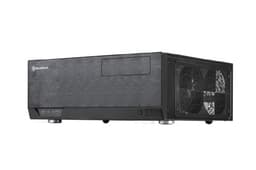
This is a horizontal desktop case, full stop. It's designed to sit flat, either on a shelf or under a TV, and it looks the part. The aluminium front panel gives it a clean, almost AV-receiver aesthetic that won't look out of place next to a Denon amplifier or a Sky box. At 430mm wide and 420mm deep, it's roughly the footprint of a large amplifier, and at 130mm tall it'll slot into most AV furniture without drama. That said, measure your shelf before you order because 130mm is not tiny, and some media units are tighter than you'd expect.
The horizontal orientation changes everything about how you think about airflow and component layout. What would normally be your top panel becomes your intake surface. The side panel you'd normally see on a tower becomes the top of the case. This is standard HTPC design logic, and SilverStone has been doing it long enough that the GD11's internal layout reflects genuine refinement rather than a first attempt. The motherboard mounts horizontally, the GPU sits above it (relative to the floor), and the PSU tucks at the rear.
For desk use, it's less natural. You can absolutely put this on a desk if you want a horizontal PC, but most people buying at this price for a desk build would be better served by a conventional mid-tower. The GD11's form factor is a deliberate choice, not a compromise, and it rewards buyers who actually need that horizontal profile. If you're just after a nice-looking case for a desk, the form factor premium here doesn't make much sense.
Motherboard Compatibility
The GD11 supports ATX and Micro-ATX motherboards, which is genuinely impressive for a case this slim. Most HTPC cases cap out at Micro-ATX or Mini-ITX, because fitting a full ATX board into 130mm of height while leaving room for cooling is a proper engineering challenge. SilverStone has solved it, but there are trade-offs in cooler height clearance that we'll get into shortly. The standoff layout follows the standard ATX specification, so you're not dealing with anything proprietary.
Micro-ATX is probably the sweet spot for this case in practice. You get the full feature set of a modern mATX board, keep your costs down compared to full ATX, and the slightly smaller footprint gives the internals a bit more breathing room. Full ATX works, and owners confirm it, but you'll need to be more careful about your PSU length (keep it under 180mm) and GPU length to avoid clearance conflicts. It's doable, not a nightmare, just worth planning properly before you buy components.
Mini-ITX is not officially supported, which is a bit of an odd omission given the HTPC market, but in practice an ITX board will physically fit on ATX standoffs with the right adapter, and some owners have done exactly this. That's not a supported configuration though, so if you want ITX, SilverStone's own ML11 or similar is the cleaner route. For ATX and mATX, the GD11 is solid.
GPU Clearance
Three hundred and forty millimetres of GPU clearance. In a case that's 130mm tall. That's the headline number and it's genuinely impressive engineering. To put it in context, an RTX 4070 Super runs around 336mm in most triple-slot configurations, and an RTX 4080 Super sits at around 336mm too depending on the AIB partner. So you can fit proper flagship-tier cards in here, which is not something you can say about most HTPC cases. An RX 7900 GRE at 267mm is almost relaxed by comparison.
The catch, because there's always a catch, is that the GPU sits horizontally in this case (it's a horizontal build, remember), and cooling dynamics change. Hot air from the GPU rises toward the top panel, which in this orientation is your intake surface. That's not ideal. You need to think about fan configuration carefully, and we'll cover that in the airflow section. But the physical clearance is there, and owners with high-end GPUs report they fit without modification.
There's no vertical GPU mount option, which in a horizontal case makes sense because the concept doesn't really translate. What you do get is a standard PCIe riser-free installation, which keeps signal integrity clean. One thing: your specific GPU's cooler design matters more in an HTPC build than in a tower. Blower-style coolers actually make more sense here than open-air triple-fan designs, because they exhaust heat directly out the back rather than dumping it into the case. Most people don't buy blower cards anymore, but it's if you're building specifically for an enclosed media cabinet.
CPU Cooler Clearance
This is where the 130mm height starts to bite. CPU cooler clearance in the GD11 is approximately 82mm, which rules out virtually every standard tower air cooler on the market. Your Noctua NH-D15 (160mm), your be quiet! Dark Rock Pro (162mm), even a modest Scythe Mugen 5 (154mm) won't fit. What you're looking at is low-profile coolers specifically designed for HTPC or SFF builds. Noctua's NH-L9i or NH-L12S, Thermalright's AXP90, that sort of thing. They're genuinely good coolers, but they cost money and you need to factor that into your build budget.
The alternative is a 240mm AIO liquid cooler, which the GD11 supports via the side panel (top intake in horizontal orientation). This is actually a great solution for a high-performance HTPC build. You get proper CPU cooling without the height constraint, the pump sits near the CPU, and the radiator handles heat exhaust through the intake panel. Several owners have gone this route and report it works well. The trade-off is cost and complexity, and you're adding a pump to your noise floor, which matters in a living room environment.
For a more modest build, a low-profile cooler paired with a 65W TDP processor is the sensible path. Something like an Intel Core i5 or a Ryzen 5 with a 65W TDP will be perfectly happy under an NH-L12S in this case. Push it to a 125W Ryzen 9 or a Core i9 and you'll need that AIO, no question. SilverStone's own spec page is clear about the 82mm limit, so there's no ambiguity here. Plan your cooler before you plan anything else in this build.
Storage Bay Options
Two 3.5-inch drive bays and two 2.5-inch bays is a reasonable allocation for 2024 and beyond. The reality is that most modern builds run one or two NVMe SSDs on the motherboard and call it done, so the 3.5-inch bays are really there for people who want mass storage, whether that's a media library, a NAS-adjacent setup, or just old-school spinning rust for backups. For an HTPC context, having those 3.5-inch bays is actually more relevant than it would be in a gaming tower, because media storage still benefits from big, cheap HDDs.
The 2.5-inch bays handle SATA SSDs if you need them, though again, with modern motherboards offering two or more M.2 slots, these are increasingly backup options rather than primary storage. Mounting is tool-less for the 2.5-inch bays according to owner reports, which is a nice touch. The 3.5-inch bays use a more traditional screw-mount approach, which is fine. You're not hot-swapping drives in an HTPC.
What the GD11 doesn't have is a huge drive bay count, but that's appropriate for the form factor. If you genuinely need six or eight HDDs in your HTPC, you're building a NAS and you need a different case entirely. For a typical media PC with two drives and a couple of NVMe slots on the board, the GD11's storage provision is more than adequate. One thing owners have flagged is that the drive bay positioning can make cable routing slightly fiddly, particularly with a full ATX board installed. Not a dealbreaker, just.

Cable Management
Cable management in a slim horizontal case is always going to be trickier than in a full tower, and the GD11 doesn't pretend otherwise. The rear of the motherboard tray has some routing channels, and there's a PSU shroud that hides the worst of the power cable mess, but you're working in a constrained space and that requires patience. Owner reviews mention that the build process takes longer than a standard tower, not because the case is badly designed, but because every cable needs to be thought about carefully to keep airflow clear.
The PSU sits at the rear of the case and accepts standard ATX units up to 180mm long. That 180mm limit is worth double-checking against your chosen PSU because some higher-wattage units creep past it. A modular PSU is strongly recommended here, and most owners who've reported positive experiences mention going modular as a key decision. Trying to manage a fully non-modular PSU's cable loom in 130mm of vertical space sounds like a proper headache.
Velcro straps are present for cable tidying, which is a good sign at this price. The cable routing channels are functional if not generous. What the GD11 does well is the PSU shroud, which does a solid job of keeping the lower section of the case looking tidy. The overall impression from owner feedback is that a careful builder will get a clean result, but it demands more planning than a conventional tower. If you're the sort of person who just shoves cables wherever they fit and closes the side panel, this case will punish you with a restricted airflow situation that shows up in temperatures.
Airflow and Thermal Design
Airflow in an HTPC case is a genuinely different challenge to a tower, and the GD11's approach is worth understanding properly. The side panel (which is the top surface in horizontal use) acts as the primary intake, with a mesh section and dust filter covering the fan mount area. The two included 120mm fans pull air in through this surface, and hot air exits through the rear exhaust. It's a simple enough concept, but the horizontal orientation means hot air from the GPU wants to rise into the intake path rather than being swept away cleanly.
SilverStone's design mitigates this with the internal layout, keeping the GPU and CPU cooling paths reasonably separated, but it's not magic. Owners with high-TDP components report that the case runs warmer than a well-configured tower would, which is expected and not a criticism specific to the GD11. It's a fundamental physics constraint of the form factor. For a living room build where acoustics matter, you'll want to balance fan speeds carefully. The included fans are decent but not exceptional, and upgrading to something like Noctua NF-A12x25 units would improve both airflow and noise levels.
The dust filter on the top intake is a proper feature, not an afterthought, and owner reviews specifically call it out positively. In a living room environment, dust management matters more than in a desk setup, because you're less likely to notice the filter getting clogged until temperatures start climbing. The filter is accessible and washable, which is exactly what you want. The rear exhaust has no filter, which is standard practice since exhausts don't need one. Overall, the thermal design is sensible for the category, and owners running mid-range components report perfectly acceptable temperatures. Push it hard with a 125W CPU and a 300W GPU and you'll need that AIO and good airflow planning.
Front I/O and Connectivity
The front I/O panel sits on the front face of the case, which in a horizontal HTPC setup means it's on the side that faces you if the case is on a shelf, or on the front edge if it's sitting flat. The layout includes two USB 3.0 Type-A ports, one USB 3.2 Gen 1 Type-C port, and the standard headphone and microphone 3.5mm jacks. There's a power button and a reset button, both of which are properly sized and not the fiddly little pins you find on budget cases.
The USB Type-C inclusion is a meaningful upgrade over the previous GD09 and similar older SilverStone HTPC cases, and it's the right call for a 2022 case. USB-C connectivity is increasingly expected for peripherals, external drives, and phones, and having it on the front panel saves you fumbling around the back of the unit. The Gen 1 spec means you're getting 5Gbps throughput, which covers external SSDs without bottlenecking them. It's not USB4 or Thunderbolt, but at this price tier and use case, that's not a complaint.
The power button placement gets specific mention in owner reviews as being well-positioned for a case that lives on a shelf. You don't want to be reaching awkwardly past a TV or around a unit to hit the power button every time you want to start the machine. SilverStone has clearly thought about real-world HTPC usage here rather than just copying a tower layout and rotating it 90 degrees. Audio jacks work as expected, and the overall I/O panel feels solid rather than plasticky. No RGB controls or fan hub on the front panel, which keeps the aesthetic clean and the price from climbing further.
Build Quality and Materials
The steel chassis is where the GD11 earns its premium positioning. Owner reviews consistently mention that the case feels solid, with no panel flex and no sharp edges to speak of. That last point matters more than it sounds. Budget cases often have stamped steel edges that will draw blood during a build, and at this price you should not be dealing with that. The GD11's edges are rolled and finished properly, which is a basic quality indicator that distinguishes it from cheaper alternatives.
The aluminium front panel is a genuine premium touch. It's not a thin plastic fascia trying to look like aluminium. It's actual aluminium, and it gives the case the kind of heft and finish that makes it look appropriate next to proper AV equipment. Panel alignment is good across the board according to owner feedback, with no reports of gaps or misalignment that would suggest rushed manufacturing. The side panels (remember, these become the top and bottom in horizontal use) are steel, not tempered glass, which is the right call for an HTPC where you want thermal mass and rigidity rather than a window.
The overall construction reflects SilverStone's experience in this specific category. This isn't a company that decided to make an HTPC case as a side project. Their HTPC lineup goes back well over a decade, and the GD11 shows that accumulated knowledge in the small details: the way the panels come off, the positioning of the drive bays relative to the cable runs, the dust filter design. At the premium price point, build quality holds up to scrutiny. The one area where a few owners flag minor issues is the panel removal mechanism, which can feel slightly stiff initially but loosens with use. Not a fault, just a characteristic.
How It Compares
The HTPC case market is not enormous, which means the GD11's main competition comes from within SilverStone's own lineup and from a handful of other specialist manufacturers. The most relevant comparisons are the Fractal Design Node 605 and the Antec VSK2000-U3. Both are horizontal desktop cases targeting similar use cases, though neither quite matches the GD11's spec sheet for GPU length or ATX motherboard support.
The Fractal Design Node 605 is older and shows it. It doesn't support GPUs as long as the GD11, and its front I/O predates USB-C. It's also typically cheaper, which is its main argument. If you're building a modest HTPC with a short GPU and don't care about USB-C, the Node 605 is. But if you want a current-gen GPU in your HTPC, the GD11's 340mm clearance is a meaningful advantage.
The Antec VSK2000-U3 is a budget-friendly horizontal case that does the basics but cuts corners on build quality and doesn't support ATX motherboards. It's a completely different tier. Mentioning it here mainly illustrates that the GD11 isn't competing on price, it's competing on capability and finish. The honest comparison is really SilverStone's own GD09, which is the GD11's predecessor. The GD11 adds USB-C, improves the internal layout, and increases GPU clearance. If you can find a GD09 significantly cheaper, it's a reasonable older alternative, but the GD11's improvements are real.
| Feature | SilverStone GD11 | Fractal Design Node 605 | Antec VSK2000-U3 |
|---|---|---|---|
| Motherboard Support | ATX, Micro-ATX | ATX, Micro-ATX | Micro-ATX only |
| Max GPU Length | 340mm | ~310mm | ~310mm |
| Radiator Support | 240mm | None | None |
| USB-C Front I/O | Yes (USB 3.2 Gen 1) | No | No |
| Included Fans | 2x 120mm | 2x 140mm | 1x 120mm |
| PSU Type | ATX (up to 180mm) | ATX | ATX |
| Build Quality Tier | Premium | Mid-range | Budget |
| Price Tier | Premium | Mid-range | Budget |

Final Verdict
The SilverStone GD11 is the best HTPC case you can buy right now if your requirements are: ATX or Micro-ATX motherboard, a current-gen GPU, and a horizontal form factor that looks proper in a living room setup. That's a specific brief, but it's exactly what this case is built for, and it delivers on it. The 340mm GPU clearance, 240mm radiator support, ATX PSU compatibility, and USB-C front I/O put it ahead of every comparable alternative in the category. The aluminium front panel and solid steel construction mean it'll look and feel good on a shelf for years.
The caveats are real but predictable. The 82mm CPU cooler height limit means you need a low-profile cooler or an AIO, and neither is free. Cable management takes patience. The case runs warmer than a well-configured tower with the same components, because physics. And the price is firmly premium, sitting at £144.49, which is a significant ask for a case in any category. Owner sentiment at 4.2 from 66 reviews suggests that the people who buy it for the right reasons are largely happy. The occasional four-star instead of five tends to come from people who found the build process more involved than expected, not from fundamental design failures.
Who should buy this? Anyone building a proper HTPC with a real GPU for 4K gaming or high-bitrate media playback, and who needs it to live in a media cabinet or on a shelf. It's also a good fit for a compact workstation that needs to look presentable in a professional environment. The horizontal form factor and AV-receiver aesthetic make it genuinely versatile in a way that most cases aren't.
Who should skip it? If you're building a standard desk PC, there are better-value cases at lower price points. Something like the Fractal Design Pop Air or the be quiet! Pure Base 500 gives you better airflow, easier builds, and costs considerably less. And if you're after an HTPC but only running integrated graphics or a short low-power GPU, the older SilverStone GD09 or even the Fractal Node 605 will serve you fine at a lower price. The GD11's headline strengths, the 340mm GPU clearance and the 240mm radiator support, are only worth paying for if you actually need them.
Score: 8.5 out of 10. A genuinely excellent HTPC case that does things no direct competitor matches, priced accordingly. If the form factor is what you need, it's the one to buy. If it isn't, spend your money elsewhere.
What works. What doesn’t.
6 + 6What we liked6 reasons
- Supports ATX and Micro-ATX motherboards in a genuinely slim 130mm horizontal chassis
- 340mm GPU clearance accommodates current-generation flagship graphics cards
- 240mm radiator support gives high-performance builds a proper CPU cooling option
- ATX PSU compatibility avoids the cost premium of SFX power supplies
- Aluminium front panel and solid steel construction look and feel appropriately premium
- USB 3.2 Gen 1 Type-C front I/O keeps connectivity current for a 2022-era case
Where it falls6 reasons
- 82mm CPU cooler height limit rules out all standard tower air coolers, requiring a low-profile unit or AIO
- Cable management is noticeably more demanding than in a conventional mid-tower case
- Thermal performance with high-TDP components lags behind a well-ventilated tower by design
- Price is firmly premium, hard to justify if you are not specifically building an HTPC
- Horizontal orientation means GPU exhaust heat can feed back into the intake airflow path
- Mini-ITX is not officially supported, limiting appeal for the smallest builds
Full specifications
10 attributes| Form factor | Micro-ATX |
|---|---|
| CPU cooler clearance MM | 146 |
| Dimensions MM | 440 x 176 x 399 |
| Fans included | 4 |
| GPU clearance MM | 340 |
| MAX FAN count | 7 |
| MAX radiator MM | 240 |
| PSU support | ATX up to 200mm |
| Side panel | steel vented |
| Supported motherboard | ATX, Micro-ATX, Mini-ITX, SSI-CEB |
If this isn’t right for you
2 options

Frequently asked
7 questions01What is the maximum CPU cooler height in the SilverStone GD11?+
The GD11 supports CPU coolers up to approximately 82mm in height. This rules out all standard tower air coolers and means you will need a dedicated low-profile cooler such as the Noctua NH-L9i or NH-L12S, or alternatively a 240mm AIO liquid cooler mounted to the side panel intake.
02Can the SilverStone GD11 fit a full ATX motherboard?+
Yes. The GD11 officially supports both ATX and Micro-ATX motherboards in its horizontal orientation. Full ATX is confirmed by multiple owners, though you should keep your PSU under 180mm in length and plan GPU clearance carefully to avoid conflicts with a full-size board installed.
03What is the longest GPU that fits in the SilverStone GD11?+
SilverStone specifies a maximum GPU length of 340mm. This is sufficient for current-generation cards including the RTX 4080 Super and RTX 4070 Super in most AIB configurations. Owners with high-end GPUs report they fit without modification, though you should verify the exact length of your specific card before purchasing.
04Does the SilverStone GD11 support liquid cooling?+
Yes, the GD11 supports a 240mm radiator mounted on the side panel, which functions as the top intake surface in horizontal use. Several owners use this configuration for high-performance HTPC builds. There is no support for 280mm or 360mm radiators, so AIO selection should be limited to 240mm units.
05Is a modular PSU necessary for the SilverStone GD11?+
It is not strictly required, but a modular PSU is strongly recommended. The case accepts ATX power supplies up to 180mm in length, and the constrained 130mm internal height makes managing a full non-modular cable loom considerably more difficult. Most owners who report a clean build experience specifically mention choosing a modular unit.
06How does the SilverStone GD11 compare to the Fractal Design Node 605?+
The GD11 offers a longer maximum GPU clearance at 340mm versus approximately 310mm for the Node 605, adds 240mm radiator support that the Node 605 lacks entirely, and includes a USB 3.2 Gen 1 Type-C front port that the older Fractal case does not have. The Node 605 is typically cheaper and may suit modest builds, but the GD11 is the stronger choice for anyone fitting a current-generation GPU.
07Is the SilverStone GD11 suitable for a standard desk PC build?+
Technically yes, but it is not the optimal choice. The GD11's horizontal form factor and premium price are best justified when the horizontal profile is actually needed, such as in a media cabinet or on an AV shelf. For a conventional desk setup, a mid-tower case at a lower price point will give you easier cable management, better airflow, and more cooler options.