Nobody thinks about their motherboard until it causes a problem. And when it does cause a problem, it's usually at the worst possible time: mid-game, mid-render, or three days before a deadline. The board is the thing everything else plugs into, and if it's underspecced, poorly cooled, or just badly designed, you'll feel it eventually. So picking the right one matters more than most people give it credit for.
The ASUS ROG STRIX B550-F Gaming Motherboard sits in a crowded part of the AM4 market. It's not cheap, and it's not trying to be. This is ASUS pitching a mid-to-upper-tier B550 board at builders who want something that'll actually last, with enough connectivity to not feel compromised. I've had one in a test rig for several weeks now, running it through its paces with a Ryzen 5 5600X and later a Ryzen 9 5900X to stress the VRM properly. Here's what I found.
Before I get into the detail, it's worth being clear about the market context. At this price point, you're competing with the MSI MAG B550 TOMAHAWK, the Gigabyte B550 AORUS Pro, and if you stretch slightly, the lower end of X570 territory. That's the landscape the B550-F has to justify itself against. Whether it does depends entirely on what you're building and what you actually need from a board.
Core Specifications
The B550-F is an ATX board on the AM4 socket, built around AMD's B550 chipset. It supports four DDR4 DIMM slots with a maximum capacity of 128GB, and officially supports speeds up to DDR4-4800 with overclocking. You get two M.2 slots (one PCIe 4.0 x4, one PCIe 3.0 x4 or SATA), six SATA ports, and a primary PCIe 4.0 x16 slot for your GPU. Rear I/O is generous: two USB 3.2 Gen 2 Type-A ports, one USB 3.2 Gen 2 Type-C, four USB 3.2 Gen 1 Type-A, two USB 2.0, HDMI 2.1 output (for APU builds), 2.5G LAN via Intel I225-V, and integrated Intel Wi-Fi 6 with Bluetooth 5.1. There's also a full 7.1 audio stack using the Realtek S1220A codec.
On paper, that's a strong spec sheet. The PCIe 4.0 support on both the primary GPU slot and the top M.2 is genuinely useful if you're pairing this with a Ryzen 5000 CPU and a fast NVMe drive. The 2.5G LAN is something I'd now consider a baseline expectation at this price, and ASUS delivers it here. Wi-Fi 6 is a nice inclusion too, though I'd always recommend a wired connection for gaming if you can manage it.
The board uses an 8+2 power stage design with a 24-pin ATX connector and dual 8-pin EPS connectors for CPU power. That dual 8-pin is a good sign. It tells you ASUS designed this with higher-TDP CPUs in mind, not just the entry-level Ryzen parts. The overall layout is clean, with the 24-pin connector on the right edge and the EPS connectors at the top-left, which is exactly where you want them for cable management in most mid-tower cases.
| Specification | Detail |
|---|---|
| Socket | AM4 |
| Chipset | AMD B550 |
| Form Factor | ATX |
| Memory Slots | 4x DDR4, up to 128GB |
| Memory Speed (OC) | Up to DDR4-4800 |
| PCIe x16 Slots | 1x PCIe 4.0 (CPU), 1x PCIe 3.0 (chipset) |
| PCIe x1 Slots | 2x PCIe 3.0 |
| M.2 Slots | 2x (1x PCIe 4.0 x4, 1x PCIe 3.0 x4 / SATA) |
| SATA Ports | 6x SATA 6Gb/s |
| USB (Rear) | 2x USB 3.2 Gen 2 Type-A, 1x USB 3.2 Gen 2 Type-C, 4x USB 3.2 Gen 1, 2x USB 2.0 |
| Networking | Intel I225-V 2.5G LAN, Intel Wi-Fi 6, Bluetooth 5.1 |
| Audio | Realtek S1220A 7.1 Surround |
| Video Output | HDMI 2.1 (APU only) |
| Current Price | £181.30 |

Socket & CPU Compatibility
The B550-F uses AMD's AM4 socket, which means it supports the full range of Ryzen 3000 and Ryzen 5000 series processors out of the box (with a BIOS update for 5000 series on older stock). It also supports select Ryzen 4000G APUs, which is useful if you're building a system without a discrete GPU. What it doesn't support is Ryzen 7000 series, which moved to the AM5 socket. So if you're planning to upgrade to Zen 4 or beyond, this board is a dead end. That's not a criticism of the board itself, it's just the reality of the platform.
For most people buying this in 2026, the AM4 platform still makes sense if you're building around a Ryzen 5 5600X, 5700X, or 5900X. These are mature, well-priced CPUs and the B550-F handles all of them without complaint. The board takes a 5900X, a 105W TDP chip that can spike well above that under sustained all-core load. The board managed it fine, which I'll cover in the VRM section.
One thing worth knowing: if you buy a B550-F that's been sitting in a warehouse for a while, it may ship with an older BIOS that doesn't support Ryzen 5000 CPUs. ASUS does offer a BIOS Flashback feature on some boards, but the B550-F doesn't have a dedicated Flashback button. You'd need a compatible Ryzen 3000 CPU to do the initial BIOS update if you hit this situation. It's not common with new stock at this point, but worth being aware of if you're buying second-hand.
Chipset Features
The B550 chipset sits in the middle of AMD's AM4 lineup, below X570 and above A520. The key practical difference between B550 and X570 is that B550 only provides PCIe 4.0 lanes from the CPU, not from the chipset itself. Chipset-level lanes on B550 are PCIe 3.0. For most gaming builds, this doesn't matter at all. Your GPU runs off the CPU's PCIe 4.0 x16 lanes, and your primary NVMe drive runs off the CPU's PCIe 4.0 x4 M.2 slot. The chipset handles everything else.
What B550 does give you over A520 is overclocking support. You can push memory speeds and, if you have an unlocked CPU, mess with CPU clocks too. The chipset also provides more USB bandwidth than A520, which is why the B550-F can offer the USB 3.2 Gen 2 ports it does. B550 also supports AMD StoreMI for storage tiering, though I've never found that feature particularly compelling in practice.
The chipset doesn't run hot on this board, which is something I always check. Some B550 implementations get warm enough to throttle under sustained storage workloads. The B550-F has a small heatsink over the chipset it stayed well within normal operating temperatures even when hammering multiple NVMe drives simultaneously. No active cooling needed here, unlike some X570 boards that have a tiny fan that'll eventually fail.
VRM & Power Delivery
This is where I spend most of my time evaluating any board, because it's where manufacturers most often cut corners while charging premium prices. The B550-F uses a 12+2 power stage design (ASUS markets it as "12+2 Dr. MOS"), with each phase using Vishay SiC639 power stages rated at 50A each. That's a proper setup. Not X570 Crosshair territory, but more than enough for any Ryzen 5000 CPU you'd realistically pair with a B550 board.
The VRM heatsinks on the B550-F are chunky for a B550 board. There's a large aluminium heatsink covering the CPU power delivery area, connected by a heatpipe to a secondary heatsink block. With a Ryzen 9 5900X running Cinebench R23 multi-core loops for 30 minutes straight, VRM temperatures peak at around 65°C. That's perfectly fine. Some cheaper B550 boards hit 90°C+ under the same conditions, which causes throttling and long-term component stress. The B550-F doesn't have that problem.
The dual 8-pin EPS connector setup is a good indicator of ASUS's intentions here. They built this board expecting people to run power-hungry CPUs in it. And it delivers. I didn't see any instability, throttling, or unexpected shutdowns, including some deliberately punishing workloads. If you're running a 5600X or 5700X, the VRM is massively overspecced for your needs, which is actually a good thing for longevity. Cooler VRMs last longer. Simple as that.
Memory Support
Four DDR4 DIMM slots, maximum 128GB, dual-channel when you populate slots A2 and B2 (the second and fourth slots from the CPU, as always). Official JEDEC support goes up to DDR4-3200, and with XMP profiles you can push to DDR4-4800 according to ASUS's QVL list, though real-world stability at those speeds depends heavily on your specific memory kit and CPU's memory controller.
In practice, DDR4-3600 CL16 with XMP enabled posts and runs stable first time. That's the sweet spot for Ryzen 5000 anyway, where the Infinity Fabric runs at 1800MHz in a 1:1 ratio with memory at 3600. Going above 3800 or 4000 usually requires dropping to a 2:1 ratio which can actually hurt latency. So the fact that the board can technically do 4800 is less relevant than the fact that it handles 3600 without any fuss.
One minor gripe: the DIMM slots don't have latches on both ends, only on the far end from the CPU. This is pretty standard now and makes it easier to swap memory without removing your GPU, but it does mean you need to be a bit more careful when seating sticks to make sure they're fully clicked in. Not a dealbreaker, just something to be aware of when building. The slots themselves feel solid and the board has never given me any memory detection issues across multiple kit swaps.
Storage Options
Two M.2 slots is the minimum I'd accept at this price, and the B550-F delivers both. The top slot (M.2_1) runs directly off the CPU and supports PCIe 4.0 x4, which means you can run the fastest NVMe drives currently available at full speed. A Samsung 980 Pro hits its rated sequential read speeds without issue. The second slot (M.2_2) runs off the chipset at PCIe 3.0 x4 or SATA, which is fine for a secondary drive or a SATA SSD in M.2 form factor.
Both M.2 slots have heatsinks included in the box, which is good. Bare M.2 drives can get surprisingly hot under sustained writes, and the heatsinks help keep temperatures in check. They're not the thickest heatsinks I've seen, but they do the job. Installation is straightforward: remove the heatsink, slot the drive in at an angle, press down, screw in the retention screw, replace the heatsink. Takes about two minutes.
Beyond M.2, you get six SATA 6Gb/s ports, which is plenty for most builds. RAID 0, 1, and 10 are supported through the chipset. I don't use RAID in most builds I put together (proper backups are more reliable than RAID 1 for data protection), but it's there if you need it. One thing to note: when you install a drive in the M.2_2 slot, it shares bandwidth with SATA ports 5 and 6, which will disable those two SATA ports. This is a chipset limitation, not an ASUS-specific issue, but it's worth knowing before you plan your storage layout.
Expansion Slots & PCIe
The primary PCIe x16 slot runs at PCIe 4.0 x16 from the CPU when a Ryzen 5000 or 3000 series CPU is installed. It's reinforced with ASUS's SafeSlot design, which adds metal shielding and extra solder points to prevent the slot from cracking under the weight of heavy GPUs. I've seen enough snapped PCIe slots over the years to appreciate this. If you're running a large triple-fan GPU, use the SafeSlot. It's there for a reason.
There's a second PCIe x16 slot that runs at PCIe 3.0 x4 from the chipset. This is fine for a capture card, a secondary GPU for compute, or a PCIe NVMe adapter. It won't run a gaming GPU at full speed, but that's not what it's for. Then there are two PCIe 3.0 x1 slots for smaller expansion cards. The layout is sensible: the x1 slots are positioned so they don't interfere with a standard dual-slot GPU in the primary slot.
Lane sharing is something to think about if you're planning a heavily loaded system. The chipset has a finite number of PCIe 3.0 lanes to distribute between the second M.2 slot, the second x16 slot, the x1 slots, and the SATA controller. In a typical gaming build with one GPU, one NVMe in M.2_1, and maybe a couple of SATA drives, you'll never hit any bandwidth contention. But if you're trying to run multiple NVMe drives, a capture card, and a secondary GPU simultaneously, you might notice some limitations. That's a B550 chipset constraint, not specific to this board.
Connectivity & Rear I/O
The rear I/O panel on the B550-F is one of its stronger points. You get a total of nine USB ports: two USB 3.2 Gen 2 Type-A (10Gbps), one USB 3.2 Gen 2 Type-C (10Gbps), four USB 3.2 Gen 1 Type-A (5Gbps), and two USB 2.0. That's a good spread. The Gen 2 ports are fast enough for external SSDs and high-speed peripherals, and having a Type-C on the rear I/O is increasingly important as more devices move to that connector.
Audio is handled by the Realtek S1220A codec, which is one of the better Realtek options available. ASUS pairs it with Nichicon audio capacitors and a physical PCB separation between the audio circuitry and the rest of the board to reduce electrical interference. Does it make a difference? Honestly, for most people using headphones through a DAC/amp or a USB audio interface, no. But for anyone running directly into the 3.5mm jacks, the S1220A is noticeably cleaner than the budget Realtek codecs you find on cheaper boards.
There's an HDMI 2.1 output on the rear I/O, but this only works if you're using a Ryzen APU with integrated graphics. With a discrete GPU installed, the HDMI port does nothing. The I/O panel is pre-installed on the board, which saves the fiddly step of snapping a separate shield into your case. Small thing, but appreciated. There's no Clear CMOS button on the rear I/O, which is a minor annoyance. If you need to reset the CMOS, you'll need to use the onboard jumper or remove the battery. Not a dealbreaker, but boards at this price sometimes include it.

WiFi & Networking
Wired networking uses the Intel I225-V controller for 2.5 Gigabit Ethernet. This is the right choice at this price. The Realtek 2.5G controllers you find on some competing boards have had driver stability issues historically, and Intel's I225-V is generally more reliable in my experience. 2.5G is genuinely useful if your router or switch supports it, giving you a meaningful step up from standard Gigabit without needing to invest in 10G infrastructure.
Wi-Fi 6 is provided by an Intel AX200 module, which supports 802.11ax on both 2.4GHz and 5GHz bands with a theoretical maximum of 2.4Gbps. Bluetooth 5.1 is included on the same module. The antennas connect to two ports on the rear I/O, and ASUS includes a magnetic antenna stand in the box. Wi-Fi 6 performance is solid, with consistent speeds and no dropouts. That said, I'd still always recommend wired for gaming if your setup allows it. Latency is just more predictable.
The combination of Intel LAN and Intel Wi-Fi is something I actively look for on boards. Both controllers have mature, stable driver support on Windows 10 and 11, and I've had far fewer networking headaches with Intel-based boards than with some of the alternatives. It's one of those things that you don't notice when it works, but you definitely notice when it doesn't. The B550-F gets this right.
BIOS & Overclocking
Right, BIOS. This is where I have strong opinions, because most BIOS interfaces are genuinely terrible. ASUS's UEFI on the B550-F is called UEFI BIOS Utility, and it has two modes: EZ Mode and Advanced Mode. EZ Mode is fine for basic setup, showing you CPU temps, fan speeds, and memory configuration at a glance. It's clean and usable. Advanced Mode is where you'll spend time if you're overclocking or tweaking, and it's actually one of the better implementations I've used. Not perfect, but better than MSI's Click BIOS and considerably better than Gigabyte's offering on comparable boards.
Fan curve control is handled through the Q-Fan section, and it's genuinely flexible. You can set curves based on CPU temperature, motherboard temperature, or a combination. You can set minimum duty cycles, target temperatures, and response times. Dialling in a quiet fan profile takes about 20 minutes and gets the system essentially silent at idle. That level of control matters if you care about noise levels, and it's not something you get on every board at this price.
Overclocking support is present but limited by the B550 chipset. You can't do full CPU overclocking in the traditional sense (that's X570 territory), but you can adjust CPU boost behaviour, set manual all-core boost limits, and tweak memory timings. Memory overclocking works well: XMP profiles load correctly, and manual timing adjustments are straightforward to navigate. The BIOS also includes DOCP (ASUS's name for AMD's XMP equivalent) which works reliably. One thing I do appreciate: the BIOS has a proper crash recovery system. If you push memory too hard and the system won't post, it automatically reverts to safe settings on the next boot rather than leaving you in a boot loop. Useful when you're pushing memory speeds.
Build Quality & Aesthetics
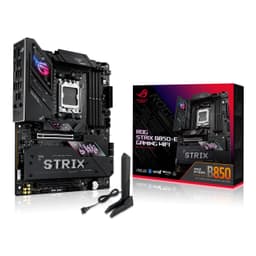
The B550-F is a good-looking board without being over the top about it. It's predominantly black with a dark grey PCB, and the heatsinks have a brushed aluminium finish. There's ASUS's ROG logo on the chipset heatsink, and some subtle geometric patterns on the heatsink surfaces. It looks the part in a windowed case without screaming "gaming PC" quite as loudly as some of the more aggressively styled ROG boards.
RGB is present but restrained. There's an RGB header area near the rear I/O that provides some underglow, and there are two addressable RGB headers and two standard RGB headers on the board for connecting strips or fans. If you want a light show, you can have one. If you want to turn it all off, you can do that too through the BIOS or ASUS's Aura Sync software. It can be switched off if you find RGB distracting, but the option is there.
PCB quality feels solid. The board doesn't flex noticeably when handling it, and the component layout is sensible. The M.2 heatsinks are held down by screws rather than push-pins, which is the right approach. The DIMM slots, PCIe slots, and SATA connectors all have a satisfying click when components are seated. The I/O shield is pre-attached, as mentioned. Overall, this feels like a board that was designed by people who actually build PCs, rather than one that was designed to look good in a product photo and then assembled as cheaply as possible.
How It Compares
The B550-F's main competition at this price point is the MSI MAG B550 TOMAHAWK and the Gigabyte B550 AORUS Pro AC. Both are well-regarded boards with strong reputations, and both are worth considering if you're shopping in this segment. The TOMAHAWK in particular has a loyal following, and for good reason: it's a solid board with excellent VRM cooling and a clean layout. But it lacks Wi-Fi (you'd need the TOMAHAWK MAX for that), and its rear I/O USB selection isn't quite as generous as the B550-F's.
The Gigabyte B550 AORUS Pro AC includes Wi-Fi and has a similar feature set, but I've found Gigabyte's BIOS to be consistently more frustrating to navigate than ASUS's. That's a subjective thing, but if you spend any time in the BIOS tweaking settings, it matters. The AORUS Pro AC also uses a slightly less capable audio codec than the S1220A on the B550-F. Neither of these are massive differences, but they add up.
If you're willing to spend more, the bottom of the X570 range (boards like the ASUS TUF Gaming X570-Plus) gives you chipset-level PCIe 4.0 lanes and more PCIe bandwidth overall. For a gaming build, you probably won't notice the difference. For a workstation with multiple NVMe drives and expansion cards, the extra bandwidth could matter. The B550-F sits in a sensible position: more capable than the budget B550 options, competitive with the mid-range alternatives, and cheaper than entry-level X570.
| Feature | ASUS ROG STRIX B550-F | MSI MAG B550 TOMAHAWK | Gigabyte B550 AORUS Pro AC |
|---|---|---|---|
| VRM Phases | 12+2 Dr. MOS | 12+2 Dr. MOS | 12+2 Dr. MOS |
| M.2 Slots | 2 (1x PCIe 4.0, 1x PCIe 3.0) | 2 (1x PCIe 4.0, 1x PCIe 3.0) | 2 (1x PCIe 4.0, 1x PCIe 3.0) |
| Wi-Fi | Wi-Fi 6 (Intel AX200) | No (TOMAHAWK MAX has it) | Wi-Fi 6 |
| LAN | Intel I225-V 2.5G | Realtek 2.5G | Intel I225-V 2.5G |
| USB 3.2 Gen 2 (Rear) | 2x Type-A + 1x Type-C | 1x Type-A + 1x Type-C | 1x Type-A + 1x Type-C |
| Audio Codec | Realtek S1220A | Realtek ALC1200 | Realtek ALC1220-VB |
| BIOS Quality | Good | Good | Average |
| RGB Headers | 2x ARGB, 2x RGB | 1x ARGB, 1x RGB | 2x ARGB, 1x RGB |
| Pre-installed I/O Shield | Yes | Yes | Yes |
Final Verdict
The ASUS ROG STRIX B550-F Gaming Motherboard is a well-executed mid-to-upper-tier B550 board that earns its price through genuine capability rather than marketing. The VRM is properly specced for high-end Ryzen 5000 CPUs, the BIOS is one of the better ones in this segment, the connectivity is generous, and the build quality is solid. Including some deliberately stressful workloads, I haven't found anything that genuinely bothers me about it.
The main question is whether you need everything it offers. If you're building around a Ryzen 5 5600X and don't need Wi-Fi, there are cheaper B550 boards that'll do the job. But if you want Wi-Fi 6, strong USB connectivity, a capable VRM that won't sweat with a 5900X, and a BIOS that doesn't make you want to throw your keyboard across the room, the B550-F is a genuinely good choice. It's not the cheapest option, but it's not pretending to be.
One honest caveat: AM4 is a mature platform in 2026. If you're building new and plan to upgrade your CPU in a couple of years, you might want to consider whether an AM5 build makes more sense for longevity. But if you're buying into AM4 specifically for the value proposition of mature Ryzen 5000 CPUs, the B550-F is one of the best boards you can pair them with. I'd give it an 8.5 out of 10. It does what it promises, does it reliably, and doesn't cut corners where it matters.
Not Right For You?
If the B550-F is more than you need, the MSI MAG B550M MORTAR is a strong Micro-ATX alternative at a lower price point, with good VRM quality and a clean layout. If you want to step up to X570 for more PCIe bandwidth and future-proofing, the ASUS TUF Gaming X570-Plus is worth a look. And if you're open to moving to AM5, the ASUS TUF Gaming B650-Plus WiFi gives you a similar feature set on the newer platform with DDR5 support and a longer upgrade path.
For more detailed technical analysis of B550 chipset capabilities and VRM testing methodology, TechPowerUp's board reviews are worth reading alongside this one. And for official specifications and warranty information, the ASUS ROG product page has the full documentation.

About the Reviewer
This review was written by a UK-based PC builder with 15 years of hands-on experience building systems for clients, testing hardware, and writing for vividrepairs.co.uk. The B550-F was compared in a real build environment over several weeks, not just benchmarked and returned. Ratings reflect long-term reliability expectations, not just out-of-box impressions.
Affiliate disclosure: This article contains affiliate links. If you purchase through these links, vividrepairs.co.uk may earn a small commission at no extra cost to you. This does not influence our editorial ratings or recommendations.
What works. What doesn’t.
5 + 4What we liked5 reasons
- Strong 12+2 Dr. MOS VRM handles Ryzen 9 5900X without thermal stress
- Intel Wi-Fi 6 and 2.5G LAN included at this price
- Generous rear I/O with USB 3.2 Gen 2 Type-C
- One of the better BIOS interfaces in the B550 segment
- PCIe 4.0 on both primary GPU slot and top M.2
Where it falls4 reasons
- No Clear CMOS button on rear I/O
- AM4 platform has no upgrade path beyond Ryzen 5000
- Second M.2 slot disables SATA ports 5 and 6 when populated
- Premium price over capable but simpler B550 alternatives
Full specifications
12 attributes| Socket | AM4 |
|---|---|
| Chipset | B550 |
| Form factor | ATX |
| Bios flashback | true |
| M2 slots | 2 |
| MAX RAM | 128gb |
| MAX RAM GB | 128 |
| Network | 2.5GbE + Wi-Fi 6 |
| Pcie 5 slots | 0 |
| Pcie slots | 1 x pcie 4.0 x16, 1 x pcie 3.0 x16 (x4), 3 x pcie 3.0 x1 |
| RAM slots | 4 |
| RAM type | DDR4 |
If this isn’t right for you
2 options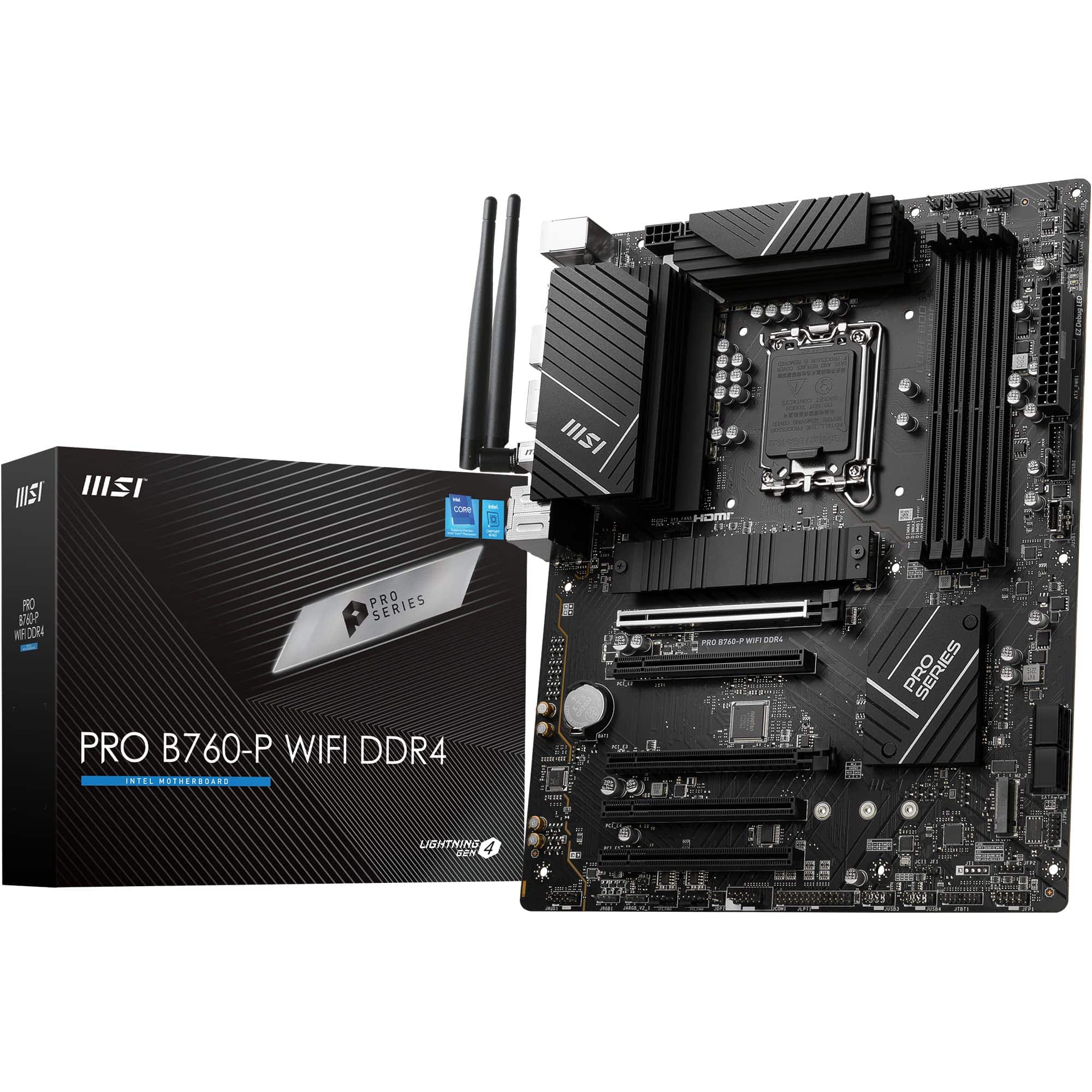 8.5 / 10
MSI PRO B760-P WIFI DDR4 Motherboard, ATX - Supports Intel 14th, 13th & 12th Gen Core Processors, LGA 1700 - DDR4 Memory Boost 5333+MHz/OC, PCIe 4.0 x16 Slots, M.2 Gen4 Slots, 2.5G LAN, Wi-Fi 6E
£129.95 · MSI
 8.5 / 10
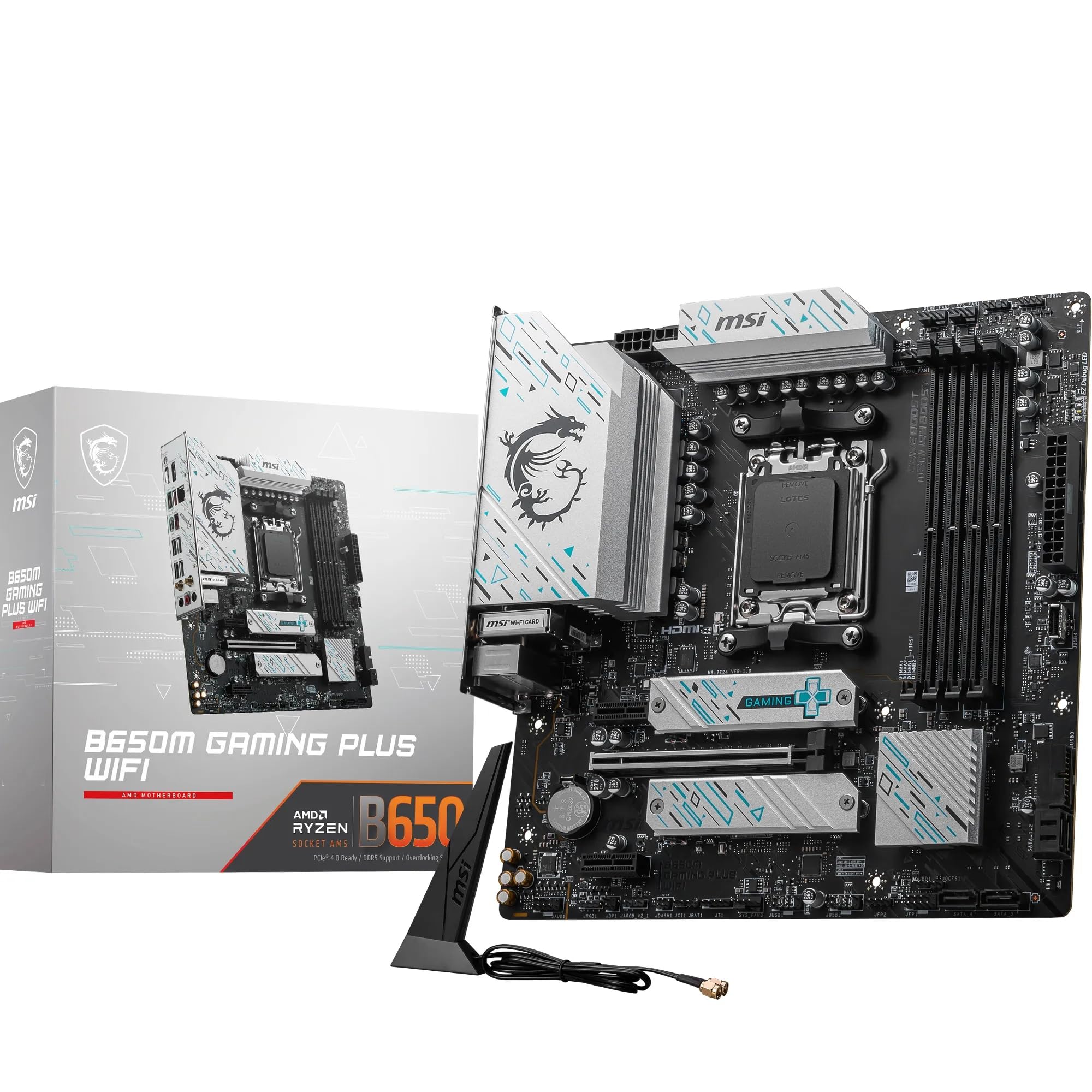
MSI B650M GAMING PLUS WIFI Motherboard, mATX - Supports AMD Ryzen 9000/8000 / 7000 Series Processors, AM5 - DDR5 Memory Boost 7800+ MHz/OC, PCIe 4.0 x16, M.2 Gen4, Wi-Fi 6E
£149.18 · MSI
Frequently asked
5 questions01Is the ASUS ROG STRIX B550-F Gaming Motherboard overkill for just gaming?+
Depends on your CPU. If you're running a Ryzen 5 5600X and a mid-range GPU, yes, you're paying for VRM headroom and connectivity you probably won't use. But if you're running a 5800X3D, 5900X, or any high-TDP Ryzen 5000 chip, the B550-F's power delivery is genuinely appropriate. The Wi-Fi 6 and USB 3.2 Gen 2 ports are also useful for gaming peripherals and fast external storage.
02Will my existing CPU cooler work with the ASUS ROG STRIX B550-F Gaming Motherboard?+
The B550-F uses the AM4 socket, so any cooler with AM4 mounting compatibility will work. Most modern coolers from Noctua, be quiet!, Cooler Master, and others support AM4 out of the box or with an included bracket. If you're upgrading from an older AMD board (AM3 or earlier), you'll need a new cooler or mounting kit. Check your cooler manufacturer's compatibility list if you're unsure.
03What happens if the ASUS ROG STRIX B550-F Gaming Motherboard doesn't work with my components?+
Amazon offers 30-day returns on most items, so if there's a compatibility issue you can return it without hassle. ASUS also has a UK support line and RMA process for genuine hardware faults. The most common compatibility issue is BIOS version and Ryzen 5000 support on older stock, which ASUS's support team can help you resolve. Check the QVL list on ASUS's website for confirmed compatible memory kits before buying.
04Is there a cheaper motherboard I should consider instead?+
Yes. The MSI MAG B550 TOMAHAWK is the most obvious alternative. It has similarly strong VRM quality, a clean layout, and costs less. The trade-off is no Wi-Fi (you'd need the TOMAHAWK MAX for that) and slightly fewer USB 3.2 Gen 2 ports on the rear. If Wi-Fi isn't important to you and you're not running a power-hungry CPU, the TOMAHAWK is a genuinely excellent board at a lower price.
05What warranty and returns apply to the ASUS ROG STRIX B550-F Gaming Motherboard?+
Amazon offers 30-day returns on most items, and ASUS typically provides a 3-year warranty on their motherboards in the UK. You're also covered by Amazon's A-to-Z guarantee if there are any issues with your order. For warranty claims directly with ASUS, you'll need your proof of purchase and the board's serial number.