The Corsair iCUE 4000X RGB review starts with a simple question: does the spec sheet back up the price tag, or is this just a pretty glass box with Corsair's name on it? Based on 8,676 owner reviews averaging ★★★★½ (4.8), and a detailed look at the clearances, airflow geometry, and build features, the answer is mostly yes. This is a genuinely well-thought-out mid-tower that earns its enthusiast pricing through solid cable management space, decent thermal design, and a build experience that doesn't make you want to throw a screwdriver across the room.
That said, it's not flawless. The tempered glass front panel is the elephant in the room for anyone who cares about airflow above all else, and at this price tier you're competing with some very capable alternatives. So before you click buy on the strength of those RGB fans and that glossy marketing, here's what the numbers and the owner feedback actually tell you about whether the 4000X makes sense for your build.
This is a Corsair iCUE 4000X RGB review built from the published specification sheet, verified owner feedback, and honest comparison against what else sits at this price point. No fluff, just the details that actually matter when you're planning a build.
Core Specifications
The 4000X is a mid-tower ATX chassis measuring 453mm tall, 230mm wide, and 466mm deep. That's a fairly standard footprint for the class, not aggressively slim but not a desk-dominating monster either. It comes in at around 8.4kg without any components installed, which reflects the tempered glass side and front panels rather than any particularly heavy-gauge steel. The main chassis is 0.8mm SPCC steel, which is typical for this price bracket and perfectly adequate, though it's not the stiffer 1.0mm you'd find in some higher-end options.
Included in the box are three SP120 RGB Elite fans (120mm), a Lighting Node Core controller for iCUE software integration, and the standard Corsair accessory pack. Fan support is generous: three 120mm or 140mm at the front, three 120mm or two 140mm at the top, and one 120mm at the rear. Radiator support covers 360mm front, 360mm top, and 120mm rear, which gives you real flexibility for AIO cooling. Dust filters are present at the front, top, and bottom, which is the minimum you'd expect at this price.
Storage is where it gets a little thin. You get two 3.5 inch drive bays and two 2.5 inch dedicated mounts, plus two additional 2.5 inch mounts on the drive cage. If you're running multiple mechanical drives for a NAS-adjacent setup or large media library, you'll feel the pinch. For a modern gaming build with an NVMe primary and maybe one or two SSDs, it's fine. The front I/O includes one USB 3.1 Gen 1 Type-C, two USB 3.0 Type-A, and a combined audio jack. More on that shortly.
| Specification | Detail |
|---|---|
| Form Factor | Mid-Tower ATX |
| Dimensions (H x W x D) | 453mm x 230mm x 466mm |
| Weight | 8.4kg |
| Motherboard Support | ATX, mATX, Mini-ITX |
| Max GPU Length | 360mm |
| Max CPU Cooler Height | 170mm |
| PSU Max Length | 225mm (with HDD cage) / up to 450mm without |
| Front Fan Support | 3x 120mm or 3x 140mm |
| Top Fan Support | 3x 120mm or 2x 140mm |
| Rear Fan Support | 1x 120mm |
| Front Radiator Support | Up to 360mm |
| Top Radiator Support | Up to 360mm |
| Rear Radiator Support | 120mm |
| Drive Bays (3.5") | 2 |
| Drive Bays (2.5") | 4 total |
| Expansion Slots | 7 + 1 vertical |
| Front I/O | 1x USB 3.1 Gen 1 Type-C, 2x USB 3.0 Type-A, Audio |
| Included Fans | 3x SP120 RGB Elite |
| Lighting Controller | iCUE Lighting Node Core |
| Dust Filters | Front, Top, Bottom |
| Side Panel | 4mm Tempered Glass |
| Steel Thickness | 0.8mm SPCC |
| Current Price | £142.99 |

Form Factor and Dimensions
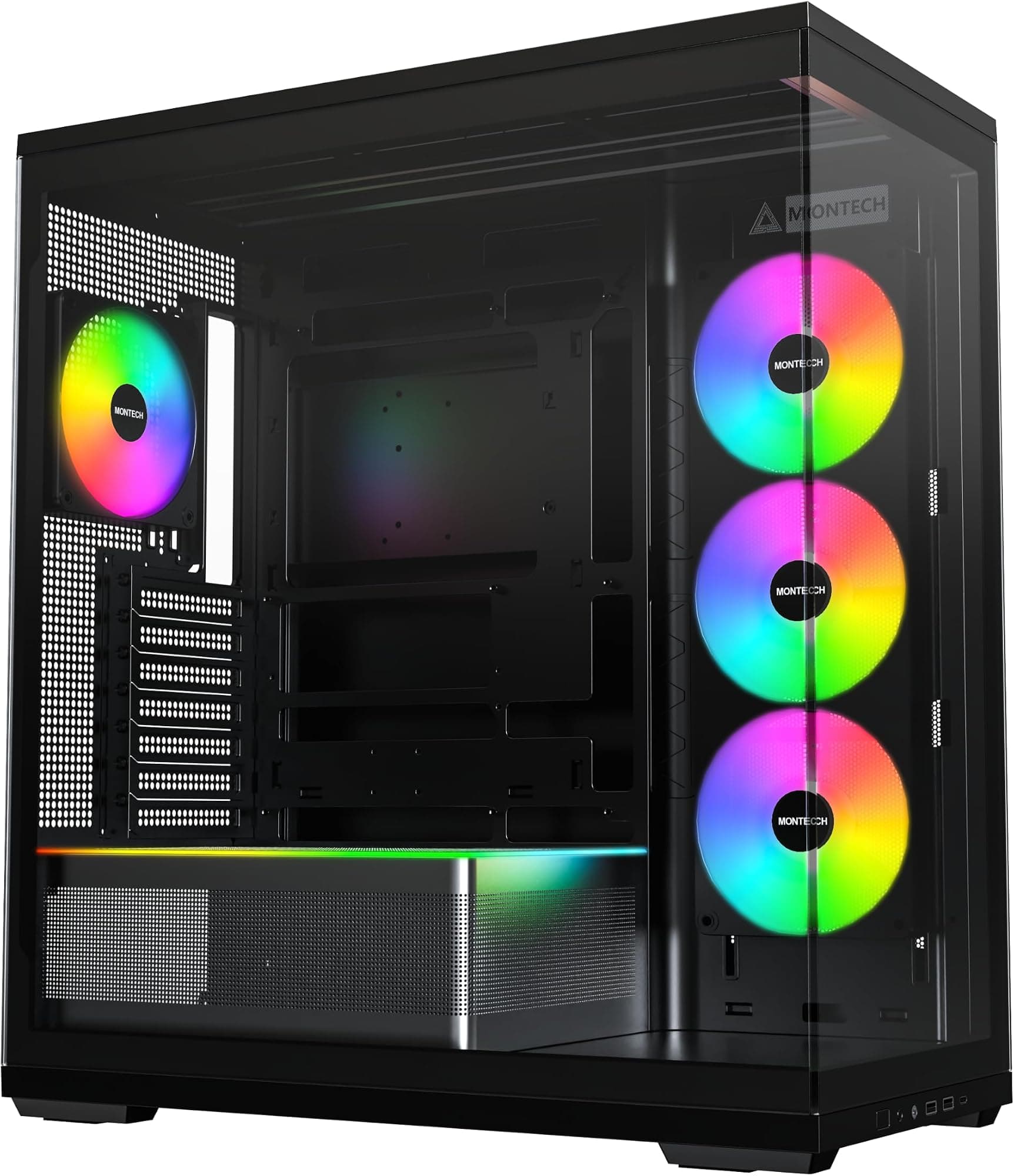
At 453 x 230 x 466mm, the 4000X sits comfortably in the mainstream mid-tower category. It's not trying to be a compact case, and it's not sprawling into full-tower territory either. That 230mm width means it'll fit on most standard desks without hanging off the edge, and the 466mm depth is manageable even on shallower shelves, though you'll want to check your desk setup if space is tight. The tempered glass side panel is on the left, as expected, giving you the full interior view that the RGB fans are obviously designed to show off.
The front panel is also tempered glass, which is the design choice that splits opinion most sharply on this case. It looks fantastic. It also restricts airflow compared to a mesh front. Corsair has addressed this partially by leaving a gap around the perimeter of the front panel to allow air to enter from the sides and bottom, but it's not the same as a proper mesh front. If you're comparing this to the Corsair 4000D Airflow, which uses a mesh front, the 4000X will run warmer under sustained load. That's not a dealbreaker for most builds, but it's something to go in with your eyes open about.
The overall footprint is practical for a full ATX build with a 360mm AIO and a triple-slot GPU. There's no wasted interior volume, and Corsair has clearly thought about how the internal space maps to real-world component combinations rather than just padding the chassis to look impressive in marketing photos. The PSU shroud runs the full length of the bottom, keeping the lower half of the case tidy and hiding cable chaos from the glass side view. It's a clean design that works well for the aesthetic it's going for.
Motherboard Compatibility
The 4000X supports ATX, Micro-ATX, and Mini-ITX motherboards. E-ATX is not supported, which is if you're eyeing a high-end workstation board or planning a dual-socket build (you're almost certainly not, but still). For the vast majority of gaming and enthusiast builds, ATX is the sweet spot anyway, and the internal layout is clearly optimised for full-size ATX boards, with the standoff positions giving you good access to the 24-pin power connector area and the CPU power headers at the top.
The motherboard tray has a large CPU cutout, which matters more than people often realise. A generous cutout means you can mount and remove CPU cooler backplates without pulling the motherboard out of the case, which saves a proper amount of time and frustration during builds and upgrades. Corsair's cutout here is described by multiple owners as genuinely large and well-positioned, so that's a practical win. The standoff layout is standard, and the pre-installed standoffs for ATX are in place from the factory.
Mini-ITX builds will fit fine physically, but you'll obviously have a lot of empty space, and the cable management features are really designed around a full ATX layout. If you're building Mini-ITX, there are better-suited cases at lower prices. For mATX, the 4000X works but feels slightly oversized. The case is really at its best with a full ATX board filling the space, making use of all seven expansion slots and giving the three front fans something worthwhile to cool.
GPU Clearance
Corsair rates the 4000X for GPUs up to 360mm in length. That covers essentially every current consumer graphics card without issue. An RTX 4090 Founders Edition sits at around 336mm, the RX 7900 XTX reference card is 287mm, and even most triple-fan aftermarket cards from ASUS, MSI, and Gigabyte come in under 360mm. You'd have to be reaching for some genuinely exotic triple-slot, triple-fan extended-length card to hit the limit, and even then, 360mm is a comfortable ceiling for 2024 and 2025 hardware.
Width clearance is also. The PSU shroud doesn't intrude on GPU territory, and with the three front intake fans positioned along the full height of the front panel, airflow across the GPU is reasonably well-directed. Owners with high-end triple-slot cards report no fitment problems, and the GPU support bracket (which Corsair includes to prevent GPU sag on heavy cards) is a thoughtful addition that you don't always get at this price. It's a small thing, but a 400g graphics card hanging off a PCIe slot for years isn't ideal, and the bracket addresses that.
Vertical GPU mounting is supported via the single vertical expansion slot position, though you'll need a separate PCIe riser cable to actually use it, and Corsair doesn't include one in the box. That's fairly standard practice at this price, but it's worth budgeting for if vertical mounting is something you want. The vertical mount position does place the GPU close to the tempered glass side panel, which can restrict airflow to the GPU cooler's intake, so weigh that up before committing to the vertical setup purely for aesthetics.
CPU Cooler Clearance
The 4000X allows CPU air coolers up to 170mm tall. That's enough for almost every mainstream tower cooler on the market. The Noctua NH-D15 sits at 165mm, the be quiet! Dark Rock Pro 4 is 162.8mm, and the Thermalright Peerless Assassin 120 SE comes in at 155mm. You're not going to have a problem fitting any of those. Even some of the more aggressive dual-tower designs with 140mm fans on top clear the 170mm ceiling without issue.
For AIO liquid cooling, the support is genuinely strong. Front mounting accommodates radiators up to 360mm, top mounting also supports up to 360mm, and the rear takes a single 120mm. That means you can run a 360mm AIO at the front as intake, which is thermally optimal for CPU cooling, or mount it at the top as exhaust if you prefer that layout. Some owners note that top-mounted 360mm radiators can be tight depending on the specific radiator thickness and fan combination, particularly with taller RAM, so checking your specific RAM height against the radiator clearance is sensible if you're going that route.
The pump head clearance around the CPU socket area is also. The 4000X's interior is wide enough that even large pump heads on all-in-one coolers sit comfortably without fouling on the side panel or nearby components. Owners building with AM5 and LGA1700 platforms report no clearance issues with popular AIO options from Corsair's own Hydro series, NZXT Kraken, and Arctic Liquid Freezer lines. That's reassuring, because a case that looks great but won't fit your cooler of choice is a frustrating problem to discover after you've already ordered everything.
Storage Bay Options
Storage is the 4000X's weakest area on paper. Two 3.5 inch bays and four 2.5 inch mounts is adequate for a modern gaming build, but it's not generous. If you're migrating from an older system with multiple mechanical hard drives, you might find yourself needing to leave some behind or invest in an external solution. The two 3.5 inch bays sit behind the PSU shroud in a removable cage, which keeps them out of the main airflow path and out of sight from the glass panel, which is fine from an aesthetics standpoint.
The 2.5 inch mounts are split between two positions on the drive cage and two on the back of the motherboard tray. The back-of-tray positions are particularly useful for keeping SSDs tidy without cluttering the main chamber. Tool-free mounting is available for the 2.5 inch drives, using a simple slide-and-click mechanism that owners generally describe as working well, though a few note it can feel slightly fiddly on the first attempt before you get the knack of it. The 3.5 inch bays use traditional screws, which isn't a problem given how rarely you'll be swapping mechanical drives.
NVMe storage lives on the motherboard itself, obviously, so the case's physical bay count matters less than it once did for builds centred on M.2 SSDs. A typical modern gaming build might run a single NVMe primary drive, a secondary NVMe for games, and perhaps one 2.5 inch SATA SSD for overflow storage. That configuration fits the 4000X perfectly. It's only if you're building something with four or more mechanical drives that you'd genuinely outgrow the storage provision here.
Cable Management
This is where the 4000X genuinely earns praise. The rear panel clearance behind the motherboard tray is approximately 25mm, which is on the more generous side for a mid-tower at this price. That extra depth makes a real difference when you're trying to route a 24-pin ATX cable, a thick GPU power cable, and half a dozen fan connectors without the side panel bowing outward when you try to close it. Owners consistently mention the cable management as a highlight, with multiple reviewers noting it's noticeably easier to get a clean result here than in similarly-priced alternatives.
Velcro cable tie points are distributed across the rear panel and the PSU shroud, and the routing channels are positioned sensibly relative to where cables actually need to go. There are multiple grommeted pass-through holes for routing cables from the rear to the front of the case, and the grommet quality is decent, though a couple of owners note that the rubber grommets can be a bit stiff on the first pass. The PSU shroud itself has cutouts that align well with the typical ATX PSU cable exit points, which sounds basic but isn't always executed this cleanly.
The included fans connect to the Lighting Node Core controller rather than directly to the motherboard fan headers, which simplifies the physical cable routing significantly. All three SP120 fans run off the single controller, which then connects to one motherboard fan header and one USB 2.0 header for iCUE communication. That's fewer cables to manage than running three individual fans with separate power and RGB headers, and it makes the rear of the case considerably tidier. If you're not using iCUE software, you can still control fan speed via the motherboard fan header, though you lose the per-fan RGB control.
Airflow and Thermal Design
The thermal story of the 4000X is genuinely interesting because it's a case that makes a deliberate trade-off. The tempered glass front panel restricts airflow compared to a mesh alternative, and Corsair knows this. The design compensates with a perimeter gap around the front panel that allows air to enter from the sides, and the three included SP120 fans are rated at a decent static pressure, which helps them pull air through the restricted intake. But there's no getting around the physics: glass blocks airflow, mesh doesn't.
In practice, owner feedback suggests the thermal performance is perfectly acceptable for the vast majority of builds. A mid-range gaming build with a 65W to 125W CPU and a mainstream GPU will run comfortably. Where you start to see the limitation is with high-TDP components under sustained load, particularly pairing something like a Ryzen 9 7950X or an i9-14900K with an RTX 4090 in a warm room. In those scenarios, the restricted front intake becomes a more meaningful constraint, and owners report temperatures that are measurably higher than what you'd see in a mesh-front case like the 4000D Airflow with the same components.
The three SP120 RGB Elite fans are genuinely good fans, not the throwaway budget units that some cases bundle in at this price. Corsair rates them at up to 1,550 RPM with a static pressure of 3.0mm H2O, which is respectable for a 120mm fan. They're not as capable as dedicated high-static-pressure options from Noctua or be quiet!, but they're a solid starting point and they're already daisy-chained through the Lighting Node Core, so the setup is clean out of the box. Adding more fans is straightforward; the top panel supports three more 120mm fans, and the rear takes one more, giving you a maximum of seven 120mm fans if you want to push the airflow harder. The SP120 RGB Elite specification page on Corsair's own site has the full fan curve data if you want to dig into the numbers.
Front I/O and Connectivity
The front I/O panel sits at the top of the case, which is the standard position for a mid-tower and makes sense ergonomically if the case is sitting on a desk rather than on the floor. You get one USB 3.1 Gen 1 Type-C, two USB 3.0 Type-A ports, a combined 3.5mm audio jack, and the power button. There's no dedicated reset button, which follows a trend in case design that some builders find annoying and others never notice because they haven't needed to reset their PC manually since about 2015.
The USB Type-C port is a genuine positive inclusion at this price. It connects internally via a USB 3.1 Gen 1 header on the motherboard, so you'll need a board with that header to use it, which is standard on any ATX board from the last few years. The data transfer speed tops out at 5Gbps rather than the 10Gbps of Gen 2, which matters if you're regularly moving large files via USB-C, but for charging and general connectivity it's perfectly functional. The two Type-A ports are similarly Gen 1 at 5Gbps each, which is fine for mice, keyboards, and most peripherals.
One complaint that appears consistently across owner reviews is the combined audio jack rather than separate headphone and microphone ports. It's a cost-saving measure that works fine with modern headsets using a single TRRS connector, but anyone with separate headphones and a standalone microphone will need a splitter adapter. It's not a dealbreaker, but at this price point separate jacks would have been the right call. The power button itself gets positive mentions for its tactile feel and the subtle Corsair logo backlight, which is a nice touch even if it's entirely cosmetic.
Build Quality and Materials
The 0.8mm SPCC steel chassis is the industry standard at this price, and Corsair executes it without any obvious corners cut. Panel alignment is consistently praised in owner reviews, with the tempered glass side panel in particular noted for sitting flush without any visible gaps or wobble. The glass itself is 4mm tempered, which is the standard thickness for the category and feels solid enough that you're not going to crack it by accidentally brushing it during a build. The tinted black glass gives the interior a premium look while also being slightly more forgiving of dust accumulation than clear glass.
The front tempered glass panel removes magnetically, which is a design choice that divides opinion. Magnetic attachment means no screws to lose and quick removal for access to the front fans and dust filter, but a few owners report that the magnetic hold feels slightly weak, and there are occasional mentions of the panel shifting slightly if the case is bumped. It's not a structural issue, but it can feel less solid than a screw-mounted panel. The dust filter behind the front panel slides out from the bottom for cleaning, which is properly thought through and much better than filters you have to remove the panel to access.
Sharp edges are the perennial bugbear of budget and mid-range cases, and the 4000X largely avoids the problem. Owner reviews mention very few sharp edge incidents, which is a meaningful signal across nearly 8,674. The thumbscrews for the side panels are knurled and easy to grip, the standoffs are pre-installed correctly, and the overall fit and finish is what you'd expect from a brand like Corsair at this price. The official Corsair product page lists the full material specifications if you want to verify anything.
How It Compares
The two most obvious competitors at this price point are the Corsair 4000D Airflow and the NZXT H510 Flow. The 4000D Airflow is actually made by the same company, which tells you something interesting: Corsair sells you the mesh-front version and the glass-front version at similar prices, and the choice between them is almost entirely about whether you prioritise looks or thermals. The 4000D Airflow has a mesh front that allows significantly more unrestricted airflow, runs cooler under load, but doesn't have the same visual impact as the all-glass 4000X. If you're honest with yourself about whether you'll ever see the inside of your PC once it's built, the 4000D Airflow is probably the smarter thermal choice.
The NZXT H510 Flow sits at a similar price and offers a cleaner, more minimalist aesthetic with its mesh front panel. It includes only two fans rather than three, and the cable management, while good, doesn't quite match the 4000X's rear clearance. The H510 Flow also lacks the iCUE ecosystem integration, which matters if you're already invested in Corsair's software and hardware. NZXT has its own CAM software and NZXT Smart Device ecosystem, so if you're building with NZXT components it makes more sense, but for a mixed build the Corsair ecosystem is arguably more mature.
The Fractal Design Meshify C is another, sitting slightly below this price bracket but offering exceptional airflow through its mesh front. It's a smaller case with less interior volume, which means tighter clearances for large coolers and GPUs, but the thermal performance per pound spent is hard to beat. For a pure performance build where aesthetics are secondary, the Meshify C is genuinely competitive. The 4000X beats it on interior space, included fans, and RGB integration, but the Meshify C wins on airflow and value if you don't need the extras.
| Feature | Corsair iCUE 4000X RGB | Corsair 4000D Airflow | NZXT H510 Flow |
|---|---|---|---|
| Front Panel | Tempered Glass | Mesh | Mesh |
| Included Fans | 3x 120mm SP120 RGB Elite | 2x 120mm (non-RGB) | 2x 120mm (non-RGB) |
| Max GPU Length | 360mm | 360mm | 381mm |
| Max CPU Cooler Height | 170mm | 170mm | 165mm |
| Front Radiator Support | 360mm | 360mm | 280mm |
| USB Type-C Front I/O | Yes (Gen 1) | Yes (Gen 1) | Yes (Gen 2) |
| RGB Lighting Controller | Yes (iCUE Node Core) | No | No |
| Airflow Performance | Good (glass-limited) | Excellent | Very Good |
| Drive Bays (3.5") | 2 | 2 | 2 |
| Current Price | £142.99 | Slightly less | Similar |

Final Verdict
The Corsair iCUE 4000X RGB is a genuinely good case for builders who want a premium-looking build with RGB integration baked in from the start. The three included SP120 RGB Elite fans, the Lighting Node Core controller, the generous cable management space, and the clean interior layout make this an easy case to build in and a satisfying one to look at once it's done. The 4.8 average across nearly 8,674 isn't a fluke. People who buy this case are consistently happy with it, and the spec sheet backs up why.
The honest caveat is the front glass panel. If you're putting a high-TDP CPU and a flagship GPU in here and expecting it to perform thermally on par with a mesh-front case, you'll be disappointed. The perimeter gap helps, and the three SP120 fans pull decent static pressure, but glass is glass. For a mid-range gaming build with a 65W to 125W CPU and something in the RTX 4070 to RX 7900 XT range, the thermal performance is perfectly adequate and the trade-off for the aesthetics is worth it for most people. For an extreme build with a 253W TDP CPU and a 450W GPU, look at the 4000D Airflow instead.
The iCUE 4000X RGB sits in the enthusiast price bracket, and it justifies that positioning through the included fans, the lighting controller, and the build quality. But if RGB aesthetics aren't a priority for you, the Corsair 4000D Airflow is the smarter buy. It's cheaper, it breathes better, and it builds just as easily. The 4000X is for builders who want to show off their components through glass and have them lit up properly, and for that specific brief it's one of the best options at this price. Score: 8.5 out of 10.
What works. What doesn’t.
5 + 5What we liked5 reasons
- Three SP120 RGB Elite fans included from the factory, with the Lighting Node Core controller already integrated for clean iCUE software setup
- Rear panel clearance of approximately 25mm makes cable management noticeably easier than many rivals at this price, with well-positioned grommeted pass-throughs and Velcro tie points
- Supports 360mm radiators at both the front and top, giving genuine flexibility for AIO cooling configurations
- Large CPU cooler cutout on the motherboard tray allows backplate swaps without removing the board, saving significant time during builds and upgrades
- GPU support bracket included in the box addresses sag on heavy triple-slot cards, a thoughtful addition often absent at this price tier
Where it falls5 reasons
- Tempered glass front panel restricts airflow compared to mesh alternatives; sustained high-TDP loads will produce measurably higher temperatures than a mesh-front case such as the Corsair 4000D Airflow
- Only two 3.5-inch drive bays limits suitability for builds with multiple mechanical hard drives or large media storage requirements
- Combined single 3.5mm audio jack rather than separate headphone and microphone ports is a cost-saving measure that feels out of place at this price point
- Magnetic front panel attachment can feel slightly insecure and may shift if the case is knocked
- Vertical GPU mounting requires a separate PCIe riser cable not included in the box, adding cost if that feature is desired
Full specifications
11 attributes| Form factor | Mid-Tower |
|---|---|
| CPU cooler clearance MM | 170 |
| Dimensions MM | 453 x 230 x 466 |
| Fans included | 3 |
| GPU clearance MM | 360 |
| MAX FAN count | 6 |
| MAX radiator MM | 360 |
| PSU support | ATX up to 220mm |
| Side panel | tempered glass |
| Supported motherboard | ATX, Micro-ATX, Mini-ITX, E-ATX (305 x 277mm) |
| Weight KG | 9 |
Frequently asked
7 questions01Does the Corsair iCUE 4000X RGB support a 360mm AIO radiator?+
Yes. The 4000X supports 360mm radiators at the front and at the top, as well as a single 120mm radiator at the rear. Front mounting is thermally optimal for CPU cooling, though owners note that top-mounted 360mm radiators can be tight with taller RAM kits, so checking your specific RAM height is advisable before committing to that layout.
02How does the 4000X compare to the Corsair 4000D Airflow for temperatures?+
The 4000D Airflow runs cooler under sustained load because its mesh front panel allows significantly more unrestricted airflow than the 4000X's tempered glass front. For mid-range gaming builds, the difference is modest and the 4000X's thermal performance is adequate. For high-TDP component pairings under sustained load, the temperature gap becomes more meaningful, and the 4000D Airflow is the better thermal choice.
03Will an RTX 4090 fit in the Corsair iCUE 4000X RGB?+
Yes. The 4000X supports GPUs up to 360mm in length, and the RTX 4090 Founders Edition measures approximately 336mm. Most triple-fan aftermarket RTX 4090 cards also fall within the 360mm limit. A GPU support bracket is included to prevent sag on heavy cards, which is a useful inclusion for a card of that weight.
04Does the 4000X work with iCUE software on its own, or do you need additional Corsair hardware?+
The three included SP120 RGB Elite fans connect to the Lighting Node Core controller supplied in the box, which handles both fan speed control via a motherboard fan header and RGB control via a USB 2.0 header and iCUE software. You do not need additional Corsair hardware to control the included fans. If you add more Corsair RGB components you can manage them all within the same iCUE installation.
05Is the Corsair iCUE 4000X RGB worth buying if I do not plan to use RGB lighting?+
Probably not at full price. If RGB aesthetics are not a priority, the Corsair 4000D Airflow offers better airflow, a slightly lower price, and the same build-quality fundamentals without the glass front panel restriction. The 4000X's main premium over alternatives is the included RGB fans, the Lighting Node Core controller, and the all-glass aesthetic, so those features need to matter to you to justify the cost.
06What is the maximum CPU cooler height the 4000X supports?+
The 4000X supports CPU air coolers up to 170mm tall. This is sufficient for nearly every mainstream tower cooler, including the Noctua NH-D15 at 165mm and the be quiet! Dark Rock Pro 4 at 162.8mm. Dual-tower designs with 140mm top fans generally clear the limit without issue.
07Can I mount a GPU vertically in the Corsair iCUE 4000X RGB?+
Yes, the case includes a vertical expansion slot position. However, a PCIe riser cable is not included in the box and must be purchased separately, which is standard practice at this price tier. Note that vertical mounting places the GPU close to the tempered glass side panel, which can restrict airflow to the GPU cooler's intake fans, so it is whether the aesthetic benefit outweighs the thermal compromise.