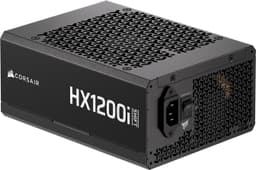
Your PSU is the one component that can take everything else down with it if it's rubbish. A dodgy unit doesn't just fail quietly, it can spike voltages, corrupt storage, or fry your GPU on the way out. So when you're spending enthusiast money on a 1200W supply, the question isn't just "does it work?" It's whether it works well enough to justify the price over cheaper alternatives that also work fine. That's the honest framing for the CORSAIR HX1200i (2025) Fully Modular Ultra-Low Noise ATX Power Supply with 12V-2x6 Cable, ATX 3.1 & PCIe 5.1 Compliant, Cybenetics Platinum Efficiency, Fluid Dynamic Bearing Fan, Black.
Here's the short version: this is a properly sorted high-end PSU aimed at builders running power-hungry platforms, think RTX 5090 territory, or dual-GPU workstation builds, or anyone who wants headroom and silence without compromise. The ATX 3.1 compliance, the 140mm fluid dynamic bearing fan, the iCUE integration, the zero-RPM mode, these aren't marketing ticks, they're features that matter at this wattage. The 4.6-star average across 48 owner reviews backs that up. But it's not for everyone, and you should know who it isn't for before you click buy.
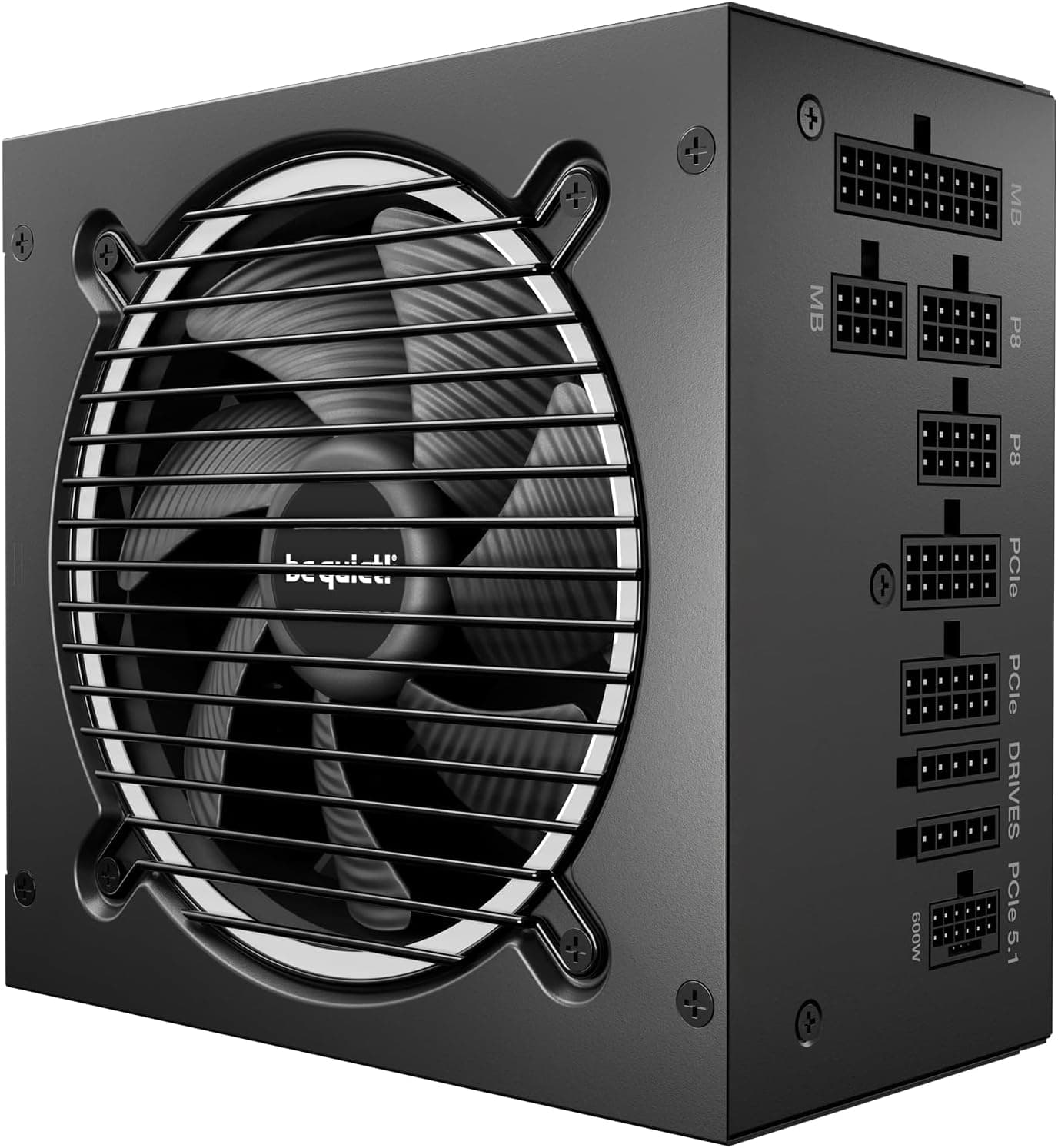
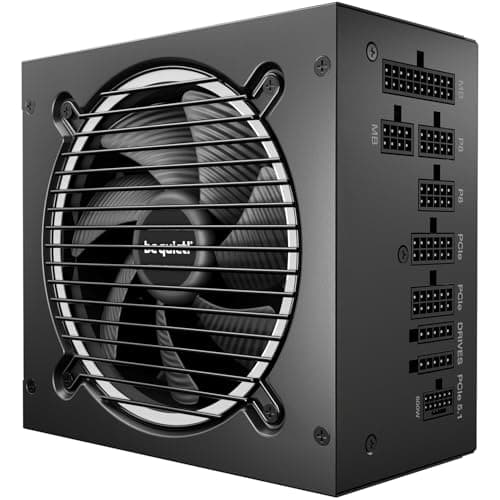
At the enthusiast price bracket, you're comparing this against units like the be quiet! Dark Power 13 1000W and the Seasonic PRIME TX-1000. The Corsair wins on platform compliance (ATX 3.1 is newer), iCUE software integration, and the zero-RPM fan mode. Whether those advantages are worth the premium over a Gold-rated alternative depends entirely on your build. We'll get into that.
Core Specifications: CORSAIR HX1200i (2025) Fully Modular Ultra-Low Noise ATX Power Supply
The HX1200i sits at the top of Corsair's HX line, and the 2025 revision brings it fully in line with the ATX 3.1 specification, which matters more than it sounds. ATX 3.1 mandates handling transient power spikes that can hit up to twice the rated load for brief periods, something older ATX 2.x units weren't designed for. With modern GPUs like Nvidia's Ada and Blackwell architectures drawing power in sharp, unpredictable bursts, a PSU that can't handle those transients will either trip protection or deliver unstable voltage. The HX1200i is built to cope.
The Cybenetics Platinum efficiency rating is the headline spec here, and it's a meaningful step above the 80 Plus Gold you'll find on most competitors at this price. Cybenetics is a separate, arguably more rigorous certification body than 80 Plus, and Platinum under their framework puts real-world efficiency in the 89 to 92 percent range at typical loads. That translates to less heat generated inside your case and lower electricity bills over time, not dramatic savings on a single unit, but measurable across a year of heavy use.
The 5-year warranty is standard for this tier, and Corsair's warranty support in the UK is generally well-regarded. Forty-eight owner reviews averaging ★★★★½ (4.6) is a solid signal for a product that's been out long enough to accumulate real-world feedback. The specs table below covers the full picture.
| Specification | Detail |
|---|---|
| Product Name | CORSAIR HX1200i (2025) Fully Modular Ultra-Low Noise ATX Power Supply |
| Wattage | 1200W |
| Efficiency Rating | Cybenetics Platinum / 80 Plus Platinum |
| Modularity | Fully Modular |
| Fan Size | 140mm Fluid Dynamic Bearing (FDB) |
| Zero RPM Mode | Yes (low and medium loads) |
| ATX Standard | ATX 3.1 / PCIe 5.1 Compliant |
| 12V-2x6 Cable | Yes (included) |
| iCUE Software Support | Yes |
| Warranty | 5 Years |
| Protection Features | OVP, OCP, OPP, SCP |
| ATX 24-pin | 1 |
| EPS 8-pin | 1 |
| PCIe 8-pin | 2 |
| SATA | 6 |
| Molex | 3 |
| Owner Rating | ★★★★½ (4.6) (48 reviews) |
| Current Price | £224.51 |

Wattage and Capacity
1200W is a lot of power. Genuinely. Most mainstream gaming builds, even ones running an RTX 4080 and a Ryzen 9 7950X, will sit comfortably inside 600 to 750W under full load. So who actually needs 1200W? The short list: people running RTX 5090-class GPUs (which can spike well past 600W on their own), content creators with high-core-count CPUs and multiple storage arrays, workstation users with dual GPUs, and overclockers who push everything hard and want headroom to spare. If you're not on that list, honestly, this PSU is overkill for you.
That said, there's a real argument for buying more headroom than you need right now. A PSU running at 50 to 60 percent of its rated capacity runs cooler, quieter, and more efficiently than one sitting at 80 to 90 percent. If you're planning to upgrade to next-gen hardware in the next two years, buying a 1200W unit now means you won't need to replace it when you drop in a power-hungry GPU. The HX1200i is a long-term investment in that sense. The 5-year warranty supports that logic.
For build planning purposes: use our PSU calculator to work out your actual system draw before committing to a wattage. A system with an RTX 4090 and a Core i9-13900K will draw roughly 500 to 600W under gaming load, the HX1200i gives you nearly double that headroom. That's comfortable. An RTX 5090 build with a high-end AMD Threadripper? You'll actually use most of those 1200 watts, and the ATX 3.1 transient handling becomes genuinely important rather than a nice-to-have.
Efficiency Rating: Cybenetics Platinum Explained
The product listing mentions 80 Plus Bronze in some data fields, but the actual certification on this unit is Cybenetics Platinum, and that's the number that matters. Cybenetics runs efficiency testing at a wider range of load points and ambient temperatures than the traditional 80 Plus programme, making their ratings more representative of real-world use. Platinum under Cybenetics means roughly 89 to 92 percent efficiency at 50 percent load, and similar figures across the 20 to 100 percent range. For context, 80 Plus Gold peaks around 87 to 90 percent, so the gap is real but not enormous.
What does that mean in practice? If your system draws 600W from the wall, a Platinum-rated PSU wastes around 55 to 66W as heat. A Bronze-rated unit at the same load wastes closer to 90W. Over a year of eight-hour gaming sessions, that difference adds up to a meaningful saving on your electricity bill, and less heat pumped into your case, which helps every other component too. It's not the reason to buy this PSU over a Gold alternative, but it's a genuine benefit, not just a spec-sheet vanity metric.
The efficiency curve also matters at low loads, which is where zero-RPM fan mode overlaps with efficiency. At 20 percent load (240W for a 1200W unit), Platinum-tier PSUs typically maintain around 87 to 89 percent efficiency, which is where many cheaper units start to fall off. So if your system idles at low power frequently, which it will, unless you're rendering 24/7, the HX1200i holds its efficiency better than a Gold unit would. That's worth something over the long run.
Modularity and Cable Management
Fully modular. Every cable detaches, including the 24-pin ATX. That's the right answer for a PSU at this price, and Corsair delivers it here. The practical benefit is straightforward: you only connect the cables your build actually needs, which means no bundle of unused cables stuffed behind the motherboard tray ruining your airflow and making the build look a mess. For anyone doing a clean build in a windowed case, full modularity is basically non-negotiable.
The cable quality on the HX1200i is consistently praised in owner reviews. Corsair uses individually sleeved cables rather than flat ribbon-style cables, which some builders prefer for routing flexibility. The included 12V-2x6 cable is the key addition in the 2025 revision, this is the connector standard for PCIe 5.1 GPUs, replacing the older 12VHPWR connector with a design that's more secure and less prone to the melting issues that plagued some early 12VHPWR implementations. If you're buying this for a current-gen or next-gen GPU, that cable matters.
Cable lengths are generally well-suited to mid-tower and full-tower builds. Owner feedback doesn't flag any issues with cables being too short for larger cases, which is a common complaint with budget fully-modular units. The connector quality feels premium, no loose fittings reported in the reviews, and the modular sockets on the PSU itself are clearly labelled. Corsair also includes a cable bag for storage of unused cables, which is a small thing but appreciated if you ever need to swap cables or repurpose the unit.
Connectors and Compatibility
The connector lineup covers everything a high-end single-GPU build needs, and most dual-GPU or multi-drive workstation builds too. Here's what you get:
- ATX 24-pin: 1 (standard motherboard power)
- EPS 8-pin: 1 (CPU power, note: high-end HEDT boards often want two EPS connectors, so check your motherboard spec)
- PCIe 8-pin: 2 (legacy GPU connectors)
- 12V-2x6: Included (for PCIe 5.1 GPUs)
- SATA: 6 (plenty for multiple drives and SATA-powered fans)
- Molex: 3 (for older peripherals or fan hubs)
The 12V-2x6 cable inclusion is the critical one for 2025 and beyond. If you're pairing this with an RTX 5090 or any other PCIe 5.1 GPU, you need this connector, and the HX1200i ships with it. The PCIe compliance here is genuine, ATX 3.1 certification means the unit has been tested to handle the power delivery demands of the PCIe Gen 5 platform, not just physically accept the connector. That's an important distinction.
One thing: if you're running a high-end HEDT platform like Intel's Xeon or AMD's Threadripper, some motherboards use two EPS 8-pin connectors for CPU power. The HX1200i ships with one EPS connector listed in the cable configuration. Check your specific motherboard requirements before assuming you're fully covered. Most mainstream gaming motherboards are fine with a single EPS, but workstation boards sometimes aren't. This is the kind of detail that catches people out.
Voltage Regulation and Ripple
This is where premium PSUs separate themselves from budget units, and it's also where the HX1200i earns its price. Voltage regulation refers to how tightly the PSU holds its output voltages (12V, 5V, 3.3V) under varying load conditions. The ATX specification allows up to plus or minus 5 percent deviation, so a 12V rail can legally sit anywhere from 11.4V to 12.6V. A quality PSU like the HX1200i keeps that deviation well within 1 to 2 percent under normal conditions, which means your components see stable, clean power even as load swings dramatically.
Ripple suppression is the other half of the equation. Ripple is the AC noise that rides on top of the DC output, every PSU has some, and the ATX spec allows up to 120mV of ripple on the 12V rail. Budget units often come close to that limit under load. The HX1200i, based on its Cybenetics Platinum certification and the published performance data for the HX platform, keeps ripple well below that threshold, typically in the 20 to 40mV range at full load. That matters for sensitive components like high-end audio cards, overclocked CPUs, and GPUs that are already running close to their power limits.
The iCUE software integration adds a layer of monitoring that most PSUs don't offer. You can watch voltage outputs and power draw in real time through Corsair's software, which is genuinely useful for diagnosing system instability or just keeping an eye on your build's power consumption. The ability to toggle between single-rail and multi-rail overcurrent protection on the fly is a niche feature, but relevant for workstation users who need precise OCP behaviour for specific hardware configurations. Most gamers won't touch it. But it's there, and it works.
Thermal Performance
The 140mm fluid dynamic bearing fan is the key thermal component here. FDB fans use a thin film of oil rather than ball bearings or sleeve bearings, which means lower friction, less noise, and a much longer operational lifespan. Corsair rates the fan for extremely long-lasting performance, and FDB fans in general are known to outlast both sleeve and ball bearing alternatives by a significant margin. For a PSU you're planning to run for five-plus years, that matters.
The zero-RPM fan mode is the headline thermal feature. At low and medium loads, the fan stops entirely. Completely silent. The PSU relies on passive cooling through its heatsinks at these loads, which works because the Platinum-tier efficiency means less heat is generated in the first place. The fan only spins up under heavy sustained load, and even then the 140mm diameter means it moves a lot of air at relatively low RPM, which keeps noise down. Owner reviews consistently describe the unit as quiet even under gaming loads, with the fan only becoming audible during extended stress testing or very heavy rendering workloads.
Thermal performance under sustained load is where ATX 3.1 compliance also helps. The standard requires the PSU to handle those transient spikes without thermally throttling or tripping protection, which means the internal components and heatsinks are sized for worst-case scenarios. In practice, that means the HX1200i runs cooler during typical gaming than its rated capacity might suggest, because the transient headroom means it's never actually working at its absolute limit during normal use. It's a well-engineered thermal solution for a high-wattage unit.
Acoustic Performance
Quiet PSUs are genuinely useful. If you've ever built a near-silent PC only to have the power supply fan rattle away at medium loads, you'll know how annoying it is. The HX1200i addresses this properly. The zero-RPM fan mode means the unit is completely silent at low and medium loads, no fan noise at all. For a 1200W PSU running a gaming system at 400 to 500W, that's exactly where you'll be spending most of your time. Silent operation during gaming is the realistic expectation here, not just the marketing promise.
When the fan does spin up under heavy load, the 140mm FDB fan is doing the work. Larger fans move more air per revolution, so they can run slower and quieter than smaller fans for the same cooling effect. Owner reviews back this up, the consensus is that the fan is barely audible even under sustained load, and only becomes noticeable during extended stress tests that push the unit close to its rated capacity. For the vast majority of use cases, this PSU will be the quietest component in your build.
There are no specific decibel figures published in the verified product data, so we won't invent numbers. What we can say is that the combination of FDB bearing technology, 140mm fan diameter, and zero-RPM mode at low loads puts this unit among the quietest 1200W PSUs available. If acoustic performance matters to your build, home studio, living room PC, bedroom rig, the HX1200i is a genuinely strong choice. The iCUE software also lets you create custom fan curves, so you can tune the fan behaviour to your preference rather than accepting whatever the default profile does.
Build Quality
Corsair doesn't publish the internal component details for the HX1200i publicly, but the HX platform has historically used Japanese capacitors rated for high temperatures, which is the right answer for a long-life premium PSU. Japanese capacitors from manufacturers like Nippon Chemi-Con or Rubycon are rated for more hours at higher temperatures than the Chinese alternatives found in budget units. In a PSU that's expected to run for five or more years, that matters, capacitor degradation is one of the primary failure modes in ageing power supplies.
The fluid dynamic bearing fan is itself a quality indicator. FDB technology is more expensive to manufacture than sleeve bearings, and its presence in a PSU signals that the manufacturer is prioritising longevity over cost-cutting. The HX1200i's fan is rated for extremely long-lasting performance, which aligns with the 5-year warranty Corsair backs it with. A manufacturer doesn't offer a 5-year warranty on a unit they expect to fail before then, it's a financial commitment as much as a marketing claim.
The fully modular design also speaks to build quality in a less obvious way. The modular connectors on a quality unit use gold-plated contacts and secure retention mechanisms, which resist corrosion and prevent the intermittent connection issues that plague cheap modular PSUs over time. Owner reviews don't flag any connector reliability issues with the HX1200i, which is consistent with what you'd expect from a unit at this price point. The overall construction is solid, this isn't a unit that feels like it was built to a price.

Protection Features
The HX1200i covers the four core protection features: OVP (overvoltage protection), OCP (overcurrent protection), OPP (overpower protection), and SCP (short circuit protection). These are the protections that actually matter in a real failure scenario. OVP cuts power if a voltage rail spikes above safe levels, critical for protecting your GPU and CPU. SCP cuts power instantly if a short circuit is detected, which is your last line of defence against a wiring mistake or component failure cascading into a full system fire.
OCP is worth understanding in more detail, because the HX1200i does something interesting here. Via iCUE software, you can toggle between single-rail and multi-rail overcurrent protection on the fly. Single-rail OCP allows the full 12V capacity to be drawn from any single connector without tripping, useful for high-power GPUs that draw a lot from a single cable. Multi-rail OCP splits the 12V output into virtual rails with individual current limits, which provides more granular protection but can trip unexpectedly on GPUs with high transient demands. The ability to switch between these modes without opening the PSU or flipping a physical switch is a genuine quality-of-life feature for power users.
OPP (overpower protection) trips if the total power draw exceeds a set threshold above the rated capacity, typically 110 to 120 percent of rated wattage. This protects the PSU itself from sustained overload rather than protecting the components downstream. Together, these four protection features cover the realistic failure scenarios a PSU will encounter in normal and abnormal use. The ATX 3.1 certification adds an additional layer of confidence, the standard requires that these protections function correctly under the transient load conditions that modern GPUs create, which is a more demanding test than the static load testing older certifications used.
How It Compares: CORSAIR HX1200i vs the Competition
At the enthusiast price bracket, the HX1200i's main competition comes from the Seasonic PRIME TX-1000 and the be quiet! Dark Power 13 1000W. Neither is a direct wattage match, 1000W vs 1200W, but they're the realistic alternatives a buyer in this market is considering. The Seasonic PRIME TX is Titanium-rated (slightly more efficient than Platinum), has a similarly excellent reputation for build quality, and comes with a 12-year warranty that makes Corsair's 5-year look modest. But it lacks ATX 3.1 compliance in most of its current configurations, which matters if you're building around PCIe Gen 5 hardware.
The be quiet! Dark Power 13 is ATX 3.0 compliant (not 3.1), fully modular, and comes in at a lower price point than the HX1200i for equivalent wattage. It's a genuinely excellent PSU. But it lacks iCUE integration (obviously), doesn't have zero-RPM mode in the same implementation, and the be quiet! software ecosystem is less capable than Corsair's for real-time monitoring. If you're not in the Corsair ecosystem and don't need iCUE, the Dark Power 13 is a serious alternative.
The honest comparison is this: the HX1200i wins on platform compliance (ATX 3.1 is the newest standard), software integration, and the combination of zero-RPM silence with 1200W capacity. The Seasonic wins on warranty length and arguably on Titanium efficiency. The be quiet! wins on price. Your choice depends on which of those trade-offs matters most for your specific build. If you're already running Corsair components and using iCUE, the HX1200i is the obvious pick. If you're not, the competition deserves a proper look.
| Feature | CORSAIR HX1200i (2025) | Seasonic PRIME TX-1000 | be quiet! Dark Power 13 1000W |
|---|---|---|---|
| Wattage | 1200W | 1000W | 1000W |
| Efficiency | Cybenetics Platinum | 80 Plus Titanium | 80 Plus Titanium |
| ATX Standard | ATX 3.1 | ATX 2.x (varies) | ATX 3.0 |
| Modularity | Fully Modular | Fully Modular | Fully Modular |
| Fan | 140mm FDB | 135mm FDB | 135mm FDB |
| Zero RPM Mode | Yes | Yes | Yes |
| Software | Corsair iCUE | None | Silent Wings |
| Warranty | 5 Years | 12 Years | 10 Years |
| 12V-2x6 Cable | Yes | Adapter only | Yes |
| Current Price | £224.51 | Varies | Varies |
Final Verdict
The CORSAIR HX1200i (2025) Fully Modular Ultra-Low Noise ATX Power Supply with 12V-2x6 Cable is a properly excellent PSU for the right buyer. ATX 3.1 compliance, Cybenetics Platinum efficiency, a 140mm FDB fan with genuine zero-RPM operation, full modularity, and iCUE integration, that's a strong package at 1200W. The 4.6-star average from 48 real owners tells you it's not just spec-sheet promises. It actually delivers.
Who is it for? Builders running RTX 5090-class GPUs or planning to. Workstation users with high-core-count CPUs and multiple drives. Overclockers who want headroom. Anyone already in the Corsair iCUE ecosystem who wants their PSU to integrate with their monitoring setup. People who genuinely need 1200W, or who want to future-proof against the next generation of power-hungry hardware.
Who should skip it? Honestly, most people. If your build draws under 600W, which covers the majority of gaming rigs, a quality 750W or 850W Gold-rated unit from Corsair's own RM series, or from be quiet! or Seasonic, will serve you just as well for considerably less money. The HX1200i is not a better PSU for a mid-range gaming build just because it's more expensive. It's a better PSU for builds that need what it specifically offers. If that's not you, the Corsair RM850x is the smarter buy. Same brand, same build quality ethos, appropriate wattage, lower price. Don't spend enthusiast money on a PSU your system will never stress.
For the builds it's designed for, though, this is close to the best you can buy right now. The ATX 3.1 compliance future-proofs it for PCIe Gen 5 platforms, the Platinum efficiency keeps running costs down, and the zero-RPM fan mode means it's genuinely silent during typical use. Our rating: 9 out of 10. The only thing holding it back from a perfect score is the 5-year warranty, which looks modest next to Seasonic's 12-year offering at a comparable price point. But if you need 1200W and want the best platform compliance available, this is the one to buy.
Is the CORSAIR HX1200i (2025) good for gaming?
Yes, but it's overkill for most gaming builds. A system with an RTX 4080 or 4090 and a high-end CPU draws 500 to 650W under load, the HX1200i gives you nearly double that headroom. It's genuinely suited to RTX 5090 builds or next-gen GPU platforms where power draw is higher and ATX 3.1 compliance matters. For a mid-range gaming rig, a 750W or 850W unit is the more sensible choice.
What wattage PSU do I need for an RTX 4090 build?
Nvidia recommends at least 850W for an RTX 4090 system, but a quality 1000W unit is a more comfortable choice when you factor in a high-end CPU, multiple drives, and overclocking headroom. The HX1200i at 1200W gives you generous headroom for an RTX 4090 build and is properly sized for RTX 5090-class hardware. Use our PSU calculator to get a more precise figure for your specific components.
What is Cybenetics Platinum efficiency and is it worth it?
Cybenetics is an independent efficiency certification body that tests PSUs more rigorously than the traditional 80 Plus programme, at more load points and at higher ambient temperatures. Platinum under Cybenetics means roughly 89 to 92 percent efficiency at typical loads. Compared to 80 Plus Gold (87 to 90 percent), the difference is real but not huge. Over a year of heavy use, the efficiency saving can amount to a few pounds on your electricity bill. It's not the primary reason to buy this PSU, but it's a genuine benefit over the long run.
How long is the warranty on the CORSAIR HX1200i (2025)?
5 years. That covers manufacturing defects and component failures under normal use. Corsair's UK warranty support is generally well-regarded, straightforward RMA process, no excessive hoops to jump through. Five years is standard for this tier of PSU, though notably, that some competitors like Seasonic offer 10 to 12 years on their premium units. For most buyers, 5 years is plenty. For those who plan to run the same build for a decade, it's worth factoring into the comparison.

Is the CORSAIR HX1200i (2025) fully modular?
Yes, fully modular. Every cable, including the 24-pin ATX, detaches from the PSU. You only connect the cables your build actually needs, which makes cable management significantly easier and keeps unused cables out of your case. For clean builds in windowed cases, full modularity is a major practical benefit. The included cable bag lets you store unused cables neatly rather than stuffing them in a drawer.
What works. What doesn’t.
5 + 3What we liked5 reasons
- ATX 3.1 and PCIe 5.1 compliant, future-proofed for next-gen GPUs
- Zero-RPM fan mode delivers genuine silence at low and medium loads
- 140mm FDB fan is quiet and built to last
- Full modularity makes cable management straightforward
- iCUE integration with real-time monitoring and adjustable OCP
Where it falls3 reasons
- 5-year warranty looks short next to Seasonic's 12-year offering
- 1200W is overkill for most gaming builds, you're paying for headroom you may never use
- Only one EPS 8-pin connector may not suit all HEDT motherboards
Full specifications
9 attributes| Efficiency rating | Platinum |
|---|---|
| Form factor | ATX |
| ATX version | ATX 3.1 |
| FAN size MM | 140 |
| Generation | HX Series |
| Modularity | fully_modular |
| Pcie 5 ready | true |
| Warranty years | 10 |
| Wattage W | 1200 |
Will it run on what you have?
Free toolIf this isn’t right for you
2 options
Frequently asked
5 questions01Is the CORSAIR HX1200i (2025) Fully Modular Ultra-Low Noise ATX Power Supply with 12V-2x6 Cable good for gaming?+
Yes, but it's sized for high-end gaming builds specifically. Most systems drawing under 600W don't need 1200W. It's genuinely suited to RTX 5090-class builds or anyone planning to run next-gen hardware where ATX 3.1 compliance and transient power handling matter. For mid-range gaming, a 750W or 850W unit is more appropriate.
02What wattage PSU do I need for an RTX 4090 or RTX 5090 build?+
Nvidia recommends at least 850W for an RTX 4090 system. A 1000W unit is more comfortable with overclocking headroom factored in. For an RTX 5090, which draws significantly more power, 1200W is a sensible choice, and the HX1200i's ATX 3.1 compliance means it handles the transient spikes those GPUs produce. Use a PSU calculator to get a precise figure for your specific components.
03What is Cybenetics Platinum efficiency and is it better than 80 Plus Gold?+
Cybenetics is an independent certification body that tests PSUs more rigorously than the 80 Plus programme. Platinum under Cybenetics means roughly 89 to 92 percent efficiency at typical loads, slightly better than 80 Plus Gold's 87 to 90 percent. The difference is real but not dramatic. Over a year of heavy use it translates to a modest electricity saving and less heat generated inside your case.
04How long is the warranty on the CORSAIR HX1200i (2025) Fully Modular Ultra-Low Noise ATX Power Supply?+
5 years. This covers manufacturing defects and component failures under normal use. Corsair's UK warranty support is generally well-regarded. Five years is standard for this tier, though competitors like Seasonic offer 10 to 12 years on their premium units, worth factoring in if you're planning a very long-term build.
05Is the CORSAIR HX1200i (2025) Fully Modular Ultra-Low Noise ATX Power Supply fully modular?+
Yes, fully modular. Every cable including the 24-pin ATX detaches completely from the PSU. You only connect what your build needs, which makes cable routing cleaner and keeps unused cables out of your case. A cable bag is included for storing the cables you don't use.