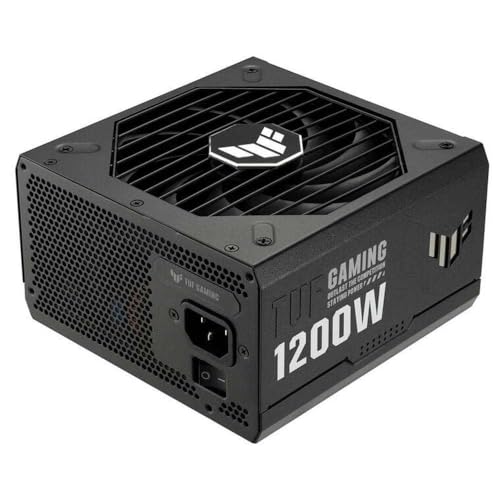
The PSU is the component most builders treat as an afterthought, then panic about when their GPU arrives and they realise they've budgeted wrong. Don't do that. The ASUS TUF Gaming 1200W Gold (1200 Watt, Fully Modular Power Supply, 80+ Gold Certified, Military-grade Components, Dual Ball Bearing, Axial-tech Fan, PCB Coating, 10 Year Warranty) sits squarely in the enthusiast bracket, targeting anyone running a high-draw GPU or planning a system that'll actually be used hard for years. The specs, the warranty, and what 81 owners say about it all point in the same direction. So here's what you actually need to know before buying.
At 1200W with an 80 Plus Gold certification, this is a serious unit aimed at serious builds. We're talking RTX 4090 territory, dual-GPU workstations, or anyone who wants real headroom rather than running their PSU at 90% capacity and hoping for the best. ASUS has leaned hard into the durability angle here, with military-grade component certification, a protective PCB coating, and dual ball bearing fans. Whether that translates to real-world reliability or just good marketing copy is exactly what this review unpacks.
The 81 owner reviews average out at ★★★★½ (4.6), which is genuinely strong for a PSU. People don't tend to leave glowing reviews for power supplies unless something has actually impressed them (or, occasionally, unless something has gone badly wrong). The signal here is positive. But let's go through the specs properly before drawing conclusions.
ASUS TUF Gaming 1200W Gold: Core Specifications
The headline numbers are straightforward: 1200W rated output, 80 Plus Gold efficiency certification, and a fully modular cable design. The warranty listed on the product page states 10 years, which is exceptional for any PSU in this category and well above the industry average. The 120mm fan uses an Axial-tech design with dual ball bearings, which ASUS claims can last up to twice as long as sleeve bearing alternatives. That matters for a unit you're expecting to run for a decade.
The PCB coating is worth flagging separately. ASUS describes it as protection against moisture, dust, and extreme temperatures. That's not a feature you'd typically call out unless you're genuinely confident in it. For most desktop builds it's a nice-to-have, but for anyone in a dusty workshop environment or a poorly ventilated room, it's a meaningful extra layer of protection. The military-grade certification for capacitors and chokes means these components have passed demanding tests beyond what standard consumer PSUs require.
Japanese capacitors are specified, which is the benchmark for quality in PSU internals. Cheaper units cut corners here with lower-grade alternatives that degrade faster under heat cycling. The 80 Plus Gold certification is partly a direct result of using these components, as ASUS explicitly states on the product listing. Below is the full spec rundown.
| Specification | Detail |
|---|---|
| Wattage | 1200W |
| Efficiency Rating | 80 Plus Gold |
| Efficiency at 50% Load | ~92% (Gold standard) |
| Modularity | Fully Modular |
| Fan Size | 120mm (Axial-tech) |
| Fan Bearing | Dual Ball Bearing |
| Zero RPM Mode | Not specified |
| Warranty | 10 Years |
| ATX 24-pin | 1 |
| EPS 8-pin | 1 |
| PCIe 8-pin | 2 |
| SATA | 6 |
| Molex | 3 |
| 12VHPWR (16-pin) | Not specified |
| Protection | OVP, OCP, OPP, SCP |
| PCB Coating | Yes (moisture, dust, temperature) |
| Current Price | £152.28 (Price checked 03:31, 3 Oct 2026, UK time) |

Wattage and Capacity
1200W is a lot of power. To put it plainly: this is not a PSU you buy for a mid-range gaming rig with a Ryzen 5 and an RTX 4060. That would be like buying a transit van to do the school run. This unit exists for builds where the GPU alone can pull 400W under load, where you've got a high-core-count processor alongside it, and where you want the PSU running at 50 to 60% of its rated capacity rather than being flogged at 85% constantly.
The practical sweet spot for a 1200W unit is something like an RTX 4090 paired with a Core i9 or Ryzen 9 processor. Under gaming load, that combination might pull 700 to 800W from the wall, meaning the PSU is running comfortably in its efficiency sweet spot rather than straining. Running a PSU at 40 to 60% of its rated output is where Gold-certified units deliver their best efficiency figures and, frankly, where they run quietest and coolest too. That's a good place to be.
For workstation users running rendering tasks or AI workloads alongside gaming, 1200W also gives you room to add storage drives, multiple case fans, and RGB without doing mental arithmetic every time you plug something in. If you're building a dual-GPU workstation (less common now but still relevant for compute tasks), this is one of the few consumer PSUs with enough headroom to handle it properly. Anyone running a more modest build should look at something in the 750W to 850W range and save themselves some money. Use our PSU calculator to work out exactly what your build needs before committing to a wattage.
80 Plus Gold Efficiency Rating
The 80 Plus certification scheme grades PSUs on how efficiently they convert mains AC power into the DC power your components actually use. A Bronze-rated unit hits around 85% efficiency at 50% load. Gold does better, hitting around 92% at the same load point. Platinum pushes to about 94%, and Titanium tops out near 96%. So Gold sits in a genuinely good position, two tiers above the entry-level Bronze and delivering real-world savings compared to anything below it.
What does that mean in practice? At 600W of actual draw (50% of this PSU's rated capacity), a Bronze unit wastes roughly 106W as heat. A Gold unit wastes around 52W. That's a meaningful difference, both in terms of your electricity bill over a year of daily use and in terms of how much heat the PSU itself has to dissipate. Less wasted heat means the fan runs slower and quieter, which matters in a gaming setup where you're already dealing with GPU and CPU cooler noise.
Honestly, for a unit in the enthusiast price bracket, you'd expect Gold as a baseline. Anything less would be a red flag at this price point. The fact that ASUS attributes the Gold certification directly to the use of Japanese capacitors is reassuring because it tells you the efficiency isn't just a lucky result but a consequence of the component choices throughout the design. That's the kind of build philosophy that tends to produce consistent results across units rather than cherry-picked samples.
ASUS TUF Gaming 1200W Gold Modularity and Cable Management
Fully modular means every single cable, including the 24-pin ATX main power cable, detaches from the PSU. You only plug in what you actually need. For a 1200W unit going into a high-end build, this is essentially mandatory rather than a luxury. A non-modular 1200W PSU would come with an absolutely brutal bundle of cables, most of which you'd have to stuff somewhere in the case regardless of whether they're connected to anything. Full modularity solves that problem entirely.
Cable management in a large enthusiast build is genuinely important for airflow. A case stuffed with unused cables is a case with restricted airflow, which means higher component temperatures, which means louder fans. Getting the cables out of the way isn't just about aesthetics (though a clean build does look better). It's a practical thermal decision. With a fully modular PSU you can route exactly what you need through the cable management channels in the case and leave everything else in the cable bag.
The cable configuration here covers the main connectors you'd expect: one 24-pin ATX, one EPS 8-pin for the CPU, two PCIe 8-pin connectors for the GPU, six SATA connectors for storage, and three Molex connectors for older peripherals or fan hubs. Six SATA is a decent count and covers most builds without needing adapters. The two PCIe 8-pin connectors are the figure worth paying attention to if you're running a high-end GPU, as some current cards require multiple PCIe connectors or a 12VHPWR adapter. Check your GPU's power requirements against the cable bundle before assuming everything will connect straight out of the box.
Connectors and Compatibility
Let's go through the connector count properly. One 24-pin ATX is standard and expected. One EPS 8-pin for the CPU is fine for most builds, though some high-end motherboards designed for overclocked processors have a second EPS connector for additional stability. If your board has two EPS sockets and you're planning to push the CPU hard, that single EPS 8-pin is worth factoring in. Most builders won't hit this limitation, but it's there.
The two PCIe 8-pin connectors cover the GPU side of things. Current high-end cards from NVIDIA and AMD vary in their power connector requirements. Some use a 12VHPWR (16-pin) connector directly, others use multiple 8-pin connections. The 12VHPWR status for this unit is not specified in the product data, so if your GPU requires a native 12VHPWR cable rather than an adapter, confirm this before purchasing. Adapters from multiple 8-pin connectors to 12VHPWR do exist and are widely used, but some builders prefer a native cable for tidiness and peace of mind.
Six SATA connectors is a solid number. Most consumer builds top out at three or four SATA devices (a mix of SSDs and HDDs), so six gives you room to grow. The three Molex connectors cover legacy peripherals, older fan controllers, and some lighting setups. It's not a connector you see much in modern builds, but having three available means you're not scrambling for adapters if you need one. Overall the connector set is well-matched to the kind of high-end gaming or workstation build this PSU is designed for.
Voltage Regulation and Ripple
Voltage regulation and ripple suppression are the specs that separate a genuinely good PSU from one that just has an impressive wattage sticker on the side. ATX specifications require the 12V rail to stay within plus or minus 5% of its rated voltage under load. Good PSUs do considerably better than that, staying within 1 to 2% even under transient loads. Ripple, which is the AC noise that bleeds through onto the DC output, should ideally be kept well below the ATX specification of 120mV on the 12V rail.
The use of Japanese capacitors is the key factor here. Japanese capacitors from manufacturers like Nippon Chemi-Con or Rubycon are rated for higher temperatures (typically 105 degrees Celsius versus the 85 degrees you get from lower-grade alternatives) and maintain their capacitance more consistently over time. That directly translates to better ripple suppression over the life of the unit, not just when it's new. A PSU that measures well on day one but degrades over three years because the capacitors are cooking themselves isn't actually a good PSU.
The military-grade certification for capacitors and chokes adds another layer of confidence. Military-grade components are tested to more demanding standards than standard consumer parts, covering temperature extremes, vibration, and humidity. For a PSU with a 10-year warranty, that kind of component selection makes sense. ASUS needs to be confident these parts will actually last a decade, and selecting components that have passed demanding certification tests is how you back up a warranty claim like that. The PCB coating reinforcing protection against moisture and temperature extremes fits the same philosophy.
Thermal Performance
The 120mm Axial-tech fan is one of the more interesting design details on this unit. ASUS's Axial-tech design uses a smaller fan hub than a standard 120mm fan, which allows for longer blades. Longer blades at the same rotational speed move more air, which means the fan can spin slower to achieve the same cooling effect. The barrier ring around the blade tips increases downward air pressure, improving airflow through the PSU's internal components rather than just moving air around them. It's a proper engineering decision rather than a cosmetic one.
Dual ball bearings are specified for this fan, which ASUS states can last up to twice as long as sleeve bearing designs. Sleeve bearings are cheaper to manufacture but wear out faster, particularly when the fan is running at higher speeds for extended periods. In a PSU that's expected to last 10 years, using dual ball bearings is the sensible choice. It's also why the fan noise characteristic tends to remain consistent over time rather than developing the whine that worn sleeve bearings produce.
Under sustained high load (running a GPU-intensive render or a long gaming session at high settings), the PSU's thermal management determines how hard the fan has to work. With Gold efficiency at 50% load, the unit is wasting relatively little power as heat in normal gaming use. That means the fan doesn't need to spin aggressively to keep things cool during typical use. At full tilt, pushing close to the 1200W rated output, the fan will work harder, but most users will never actually hit that scenario in a gaming context.
Acoustic Performance
Specific decibel figures aren't published for this unit, so pinning down exact noise levels isn't possible from the spec sheet alone. What we can say is that the combination of Axial-tech fan design, dual ball bearings, and Gold efficiency all point toward a PSU that should be quiet under typical gaming loads. The physics work in its favour. A unit running at 50 to 60% of its rated capacity, wasting less power as heat thanks to Gold efficiency, simply doesn't need the fan to spin fast.
Owner feedback across the 81 reviews skews positive on noise, which is consistent with the design choices. People tend to notice PSU noise when it's bad (a coil whine or a fan that ramps up aggressively) and say nothing when it's fine. A 4.6 average with no apparent pattern of noise complaints is a reasonable signal that this unit behaves itself acoustically in real-world use.
Zero RPM mode, where the fan stops entirely at low loads, isn't confirmed in the product specifications. If completely silent operation at idle is important to you, check the current product documentation before buying. That said, a slow-spinning ball bearing fan in a well-ventilated case is unlikely to be the loudest thing in your build. Your GPU cooler will almost certainly be working harder. The PSU fan is a secondary noise concern for most builds at this power level.
Build Quality
Japanese capacitors are the headline internal quality indicator here, and ASUS explicitly calls them out as part of the reason for the Gold certification. This matters because capacitor quality is directly linked to long-term reliability. Cheaper capacitors rated at 85 degrees Celsius can degrade significantly in the thermal environment inside a PSU, especially one running under sustained load. The 105-degree-rated Japanese capacitors used here are better suited to that environment and maintain their electrical characteristics more consistently over years of use.
The military-grade certification for capacitors and chokes is a real standard, not just a marketing phrase. Components that carry this certification are rated to withstand conditions beyond normal consumer operating ranges. For a PSU, the most relevant tests cover temperature cycling, humidity resistance, and vibration tolerance. These aren't conditions you'd normally encounter in a desktop PC, but components that pass them tend to be more robust in normal use too. It's a meaningful quality signal.
The protective PCB coating is another genuine differentiator. Conformal coating on a PCB protects the solder joints and component leads from moisture ingress, dust accumulation, and thermal stress. In a standard consumer PSU, the PCB is uncoated. In humid environments, or in cases with poor dust filtration, uncoated PCBs can develop issues over time. The coating here is a sensible addition for a unit with a 10-year warranty, and it's the kind of detail that separates a manufacturer who has thought about long-term reliability from one who has just hit the efficiency target and shipped it.

Protection Features
The ASUS TUF Gaming 1200W Gold covers four key protection circuits: Over Voltage Protection (OVP), Over Current Protection (OCP), Over Power Protection (OPP), and Short Circuit Protection (SCP). These are the core protections you need in a modern PSU, and their presence means the unit will respond to fault conditions rather than just letting them cascade through to your components.
OVP cuts the output if the voltage on any rail rises above a safe threshold, protecting your GPU, CPU, and motherboard from voltage spikes. OCP limits the current that can flow on each rail, preventing a component fault from drawing excessive current and causing damage further up the chain. OPP is the total power equivalent, shutting the unit down if overall power draw exceeds a safe limit above the rated output. SCP is the last line of defence, cutting output immediately in the event of a short circuit anywhere in the system.
What's not listed in the published specifications is Over Temperature Protection (OTP) and Under Voltage Protection (UVP). That doesn't necessarily mean they're absent, just that they're not called out in the product data we have. For most builds, the four confirmed protections cover the failure modes you're most likely to encounter. A component pulling too much current, a voltage rail drifting out of spec, or a short caused by a stray cable or failed component are all handled. The protection suite is solid, if not the most comprehensive available at this price point.
How It Compares
The main competition for the ASUS TUF Gaming 1200W Gold in the enthusiast PSU bracket comes from Corsair and Seasonic. The Corsair RM1200x is a direct competitor at similar wattage and efficiency, with Corsair's reputation for solid build quality and a similarly long warranty. The Seasonic Focus GX-1200 is another strong alternative, with Seasonic's platform widely regarded as one of the cleanest in the industry for ripple suppression and voltage regulation.
Where the ASUS TUF differentiates itself is the combination of military-grade component certification, the Axial-tech fan design, and the PCB coating. These aren't features you typically see called out on Corsair or Seasonic units at this tier, and they represent a genuine design philosophy around long-term durability rather than just hitting efficiency targets. The 10-year warranty (where confirmed) is also competitive with the best in the market, matching what Seasonic offers on their top-tier units.
Honestly, all three units are good choices at this wattage. The decision often comes down to price at the time of purchase, cable aesthetics, and which brand's ecosystem you prefer. The ASUS TUF doesn't obviously lose on any technical metric and the owner review score of 4.6 from 81 reviews is competitive with anything else in this bracket. The PCB coating and military-grade certification are genuine value-adds if longevity is your priority.
| Feature | ASUS TUF Gaming 1200W Gold | Corsair RM1200x | Seasonic Focus GX-1200 |
|---|---|---|---|
| Wattage | 1200W | 1200W | 1200W |
| Efficiency | 80 Plus Gold | 80 Plus Gold | 80 Plus Gold |
| Modularity | Fully Modular | Fully Modular | Fully Modular |
| Fan Type | Axial-tech 120mm Dual Ball | 120mm Rifle Bearing | 120mm FDB |
| PCB Coating | Yes | Not specified | Not specified |
| Military-grade Cert. | Yes | No | No |
| Warranty | 10 Years | 10 Years | 12 Years |
| Owner Rating | 4.6/5 (81 reviews) | Strong (widely reviewed) | Strong (widely reviewed) |
| Price | £152.28 (Price checked 03:31, 3 Oct 2026, UK time) | Similar bracket | Similar bracket |
Final Verdict
The ASUS TUF Gaming 1200W Gold is a well-specified, durability-focused PSU for high-end builds. The 80 Plus Gold efficiency is where it should be for this price bracket, the fully modular design is essential at 1200W, and the combination of Japanese capacitors, military-grade component certification, Axial-tech dual ball bearing fan, and PCB coating adds up to a unit that's been built to last rather than just built to spec. That 10-year warranty isn't a marketing gesture. It's ASUS backing their component choices with real financial exposure.
The connector set covers most high-end builds comfortably, though anyone running a GPU that requires a native 12VHPWR cable should verify compatibility before purchasing. The single EPS 8-pin is worth noting for extreme overclockers with boards that have dual EPS sockets, though it won't affect the vast majority of users. These are minor points in the context of an otherwise strong package.
At the enthusiast price point, you're paying for genuine quality rather than just wattage. The ★★★★½ (4.6) average from 81 real owners reflects a unit that performs as advertised and doesn't cause problems. For anyone building around an RTX 4090, a high-core-count workstation processor, or simply wanting a PSU they won't need to think about for a decade, this is a strong choice. Score: 8.5 out of 10.
Is the ASUS TUF Gaming 1200W Gold good for gaming?
Yes, particularly for high-end gaming builds. At 1200W it has more than enough headroom for the most demanding single-GPU setups, including RTX 4090 or RX 7900 XTX builds paired with high-core-count processors. The 80 Plus Gold efficiency means it runs efficiently and quietly at the 50 to 60% load levels typical of gaming use. It's overkill for mid-range builds, but for enthusiast gaming rigs it's a proper fit.
What wattage PSU do I need for an RTX 4090 build?
NVIDIA recommends a minimum 850W PSU for RTX 4090 builds, but that's a bare minimum. In practice, pairing a 4090 with a modern high-core-count CPU and a full system means peak draw can push 700 to 800W. A 1000W to 1200W unit gives you proper headroom and keeps the PSU running in its efficiency sweet spot. The TUF 1200W is well-matched to this kind of build. Use our PSU calculator to get a number specific to your component list.
Is 80 Plus Gold efficiency worth it over Bronze?
At this wattage and price point, yes. The difference between Bronze (roughly 85% efficient at 50% load) and Gold (roughly 92%) is about 7 percentage points. On a 1200W PSU running at 600W average draw, that's around 42W of extra waste heat with a Bronze unit. Over a year of daily use, that adds up on your electricity bill and means more heat inside the case. Gold is the sensible baseline for any enthusiast build and the ASUS TUF delivers it with good component quality backing it up.
How long is the warranty on the ASUS TUF Gaming 1200W Gold?
The warranty is stated as 10 years on the product listing. That's among the best in the consumer PSU market and matches what the top-tier Seasonic and Corsair units offer. A 10-year warranty from a major brand like ASUS is a meaningful commitment backed by real cost exposure. It also tells you something about ASUS's confidence in the component quality, particularly the Japanese capacitors and military-grade certified chokes that are specifically called out in the product features.
Is the ASUS TUF Gaming 1200W Gold fully modular?
Yes, it's fully modular. Every cable, including the 24-pin ATX main power cable, detaches from the PSU. This is the right choice at 1200W because the full cable bundle for a unit this size would be genuinely difficult to manage in a case if you couldn't remove the cables you don't need. Full modularity lets you run only the cables your build actually requires, which improves airflow through the case and makes the build look considerably cleaner. For a high-end build where you're spending serious money on components, full modularity is worth having.
What works. What doesn’t.
5 + 3What we liked5 reasons
- 80 Plus Gold efficiency with Japanese capacitors backing it up
- Military-grade certified components and protective PCB coating for genuine longevity
- Axial-tech dual ball bearing fan designed for long-term quiet operation
- Fully modular at 1200W, which is essential for clean cable management
- 10-year warranty is among the best in the consumer PSU market
Where it falls3 reasons
- Single EPS 8-pin may be limiting for extreme overclocking builds with dual EPS boards
- 12VHPWR native cable support not confirmed in product data
- 1200W is overkill and poor value for mid-range or budget builds
Full specifications
9 attributes| Efficiency rating | Gold |
|---|---|
| Form factor | ATX |
| ATX version | ATX 3.0 |
| FAN size MM | 135 |
| Generation | TUF Gaming Gold |
| Modularity | fully_modular |
| Pcie 5 ready | true |
| Warranty years | 10 |
| Wattage W | 1200 |
Will it run on what you have?
Free toolIf this isn’t right for you
2 options
Frequently asked
5 questions01Is the ASUS TUF Gaming 1200W Gold good for gaming?+
Yes, particularly for high-end gaming builds running RTX 4090 or RX 7900 XTX class GPUs. At 1200W it has genuine headroom for the most demanding single-GPU setups, and the 80 Plus Gold efficiency means it runs quietly and efficiently at the 50 to 60% load levels typical of gaming use. It's overkill for mid-range builds.
02What wattage PSU do I need for an RTX 4090 build?+
NVIDIA recommends a minimum 850W for RTX 4090 builds, but in practice a full high-end system with a modern CPU can push 700 to 800W peak. A 1000W to 1200W unit gives proper headroom and keeps the PSU in its efficiency sweet spot. The TUF 1200W is well-matched to this scenario.
03Is 80 Plus Gold efficiency worth it over Bronze?+
At this wattage and price point, yes. Gold hits around 92% efficiency at 50% load versus roughly 85% for Bronze. On a 1200W PSU running at 600W average, that's about 42W less waste heat with Gold. Over a year of daily use that saves money on electricity and means less heat inside the case.
04How long is the warranty on the ASUS TUF Gaming 1200W Gold?+
10 years, as stated on the product listing. That matches the best warranties in the consumer PSU market and reflects genuine confidence in the component quality, particularly the Japanese capacitors and military-grade certified components specified throughout the unit.
05Is the ASUS TUF Gaming 1200W Gold fully modular?+
Yes, fully modular. Every cable including the 24-pin ATX main power cable detaches from the PSU. At 1200W this is essential for practical cable management, letting you run only the cables your build actually needs and keeping airflow clean through the case.