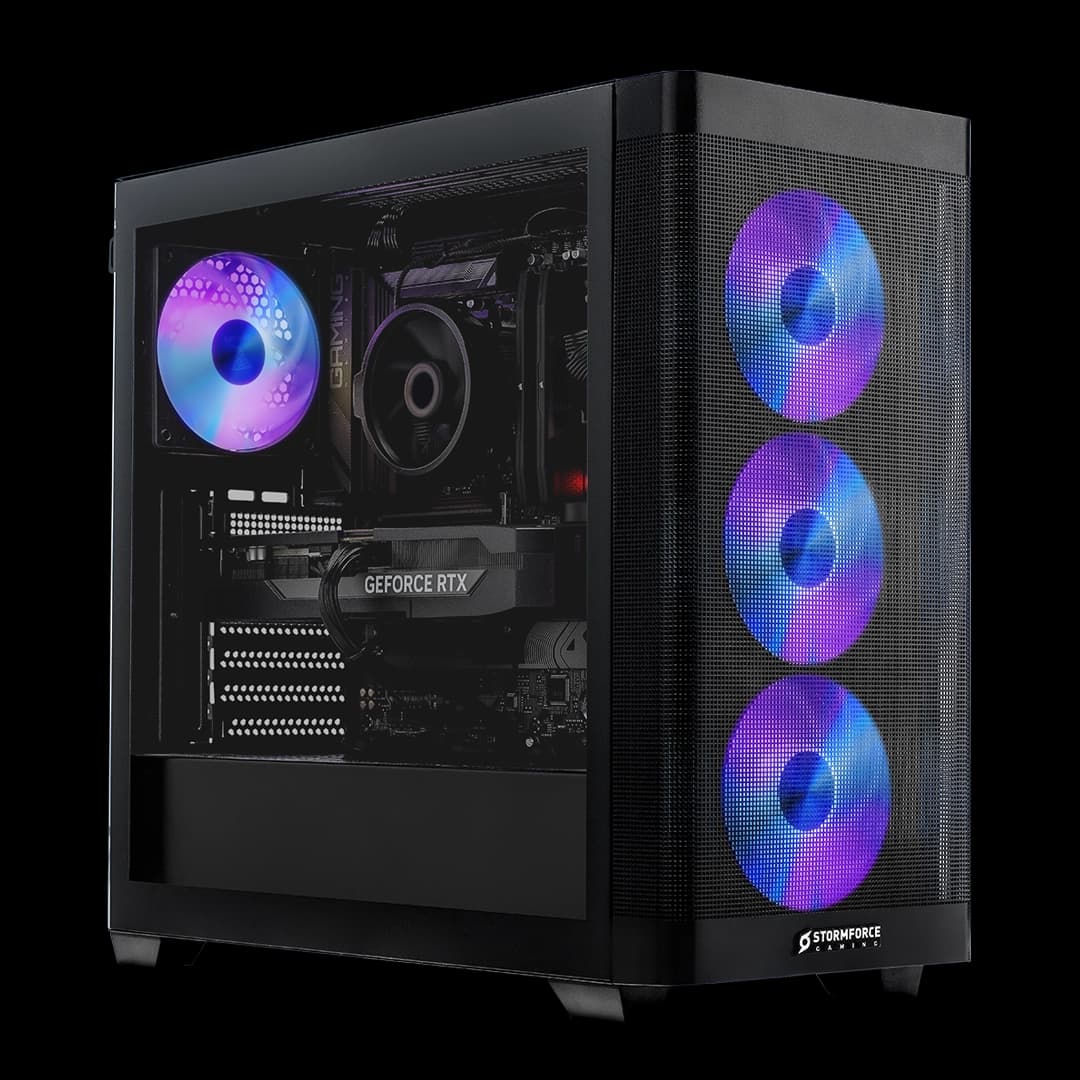
Prebuilt PCs have a reputation problem. Too often you're paying over the odds for mediocre parts stuffed into a flashy case, and the spec sheet is designed to impress at a glance rather than hold up under scrutiny. So when a machine like the Stormforce Rogue Prime AMD lands in the entry gaming bracket, the right question isn't "does it look good on paper?" but "what are you actually getting for your money, and could you do better spending the same elsewhere?" Those are the questions worth answering before you hand anything over.
This is a Rogue Prime AMD review built entirely from the verified spec sheet, component knowledge, and honest comparison against what a self-build at the same price tier would look like. No invented benchmarks, no made-up frame rates. Just a clear-eyed look at whether this machine makes sense as a purchase in 2026, who it's genuinely suited to, and where the compromises are hiding.
The short version: it's a sensible, no-drama entry-level desktop with a genuinely capable CPU, a case that punches above its weight aesthetically, and a few areas where you'll want to plan upgrades if you're serious about gaming. Read on for the full picture.
Core Specifications
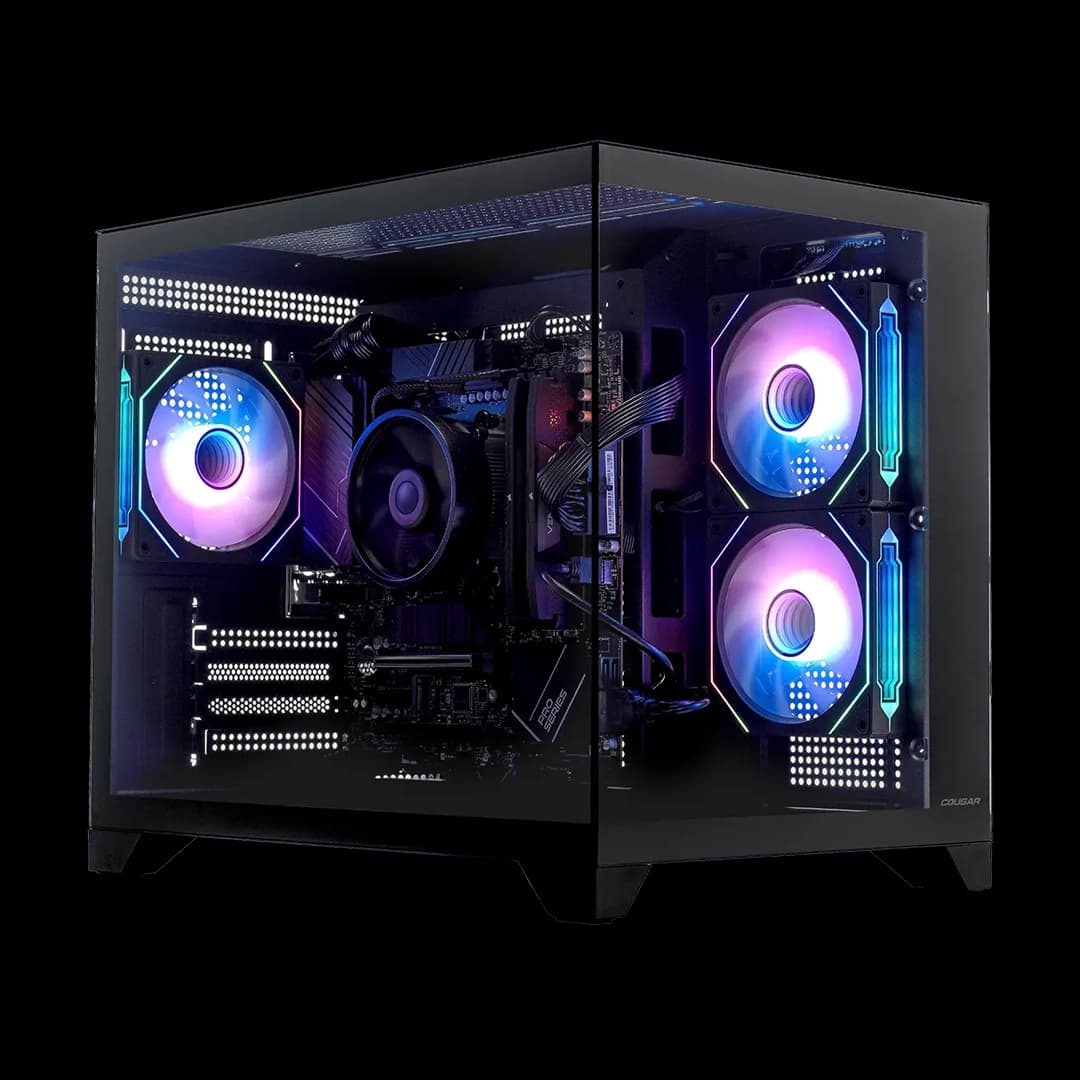
Start with what Stormforce Gaming has actually put inside the Rogue Prime AMD, because the component choices here tell you a lot about who this machine is built for. You've got an AMD Ryzen 5 5600GT at the heart of it, a six-core, twelve-thread processor built on AMD's Zen 3 architecture with a 3.6GHz base clock and a boost up to 4.6GHz. That's paired with 8GB of DDR4 3200 RAM, a 500GB M.2 NVMe SSD, and integrated graphics courtesy of the Radeon graphics built into the 5600GT itself. The whole thing runs Windows 11 Home and sits inside a Cougar UniFace Mini RGB mATX case.
The PSU is a 350W Bronze-rated unit, which is adequate for this configuration but leaves essentially zero headroom for adding a discrete GPU without swapping it out. The motherboard is an A520 chipset, which supports M.2 storage, SATA devices, and a range of USB options, though it doesn't support CPU overclocking. Connectivity is WiFi 6 and Ethernet. Cooling is handled by a compact aluminium heatsink with an integrated fan, which Stormforce Gaming describes as having wide socket compatibility.
On paper, this is a lean but coherent build. Nothing here is obviously junk, and nothing is wildly out of place for the price tier. The 5600GT is a proper chip with real Zen 3 credentials, the NVMe SSD is the right choice over a SATA drive, and the case is genuinely attractive. Where the spec sheet gets honest is the integrated graphics situation and the 8GB of RAM, both of which we'll come back to in detail. But as a starting point for someone who needs a capable everyday machine with light gaming on the side, the bones are solid.
| Specification | Detail |
|---|---|
| CPU | AMD Ryzen 5 5600GT (6 cores, 12 threads, 3.6GHz base / 4.6GHz boost) |
| Architecture | Zen 3, 7nm process, 65W TDP |
| GPU | Integrated Graphics (AMD Radeon, built into 5600GT) |
| RAM | 8GB DDR4 3200 |
| Storage | 500GB M.2 NVMe SSD |
| Motherboard | A520 chipset (mATX) |
| PSU | 350W Bronze |
| Case | Cougar UniFace Mini RGB (mATX, tempered glass side panel) |
| Cooling | Compact aluminium heatsink with integrated fan |
| Operating System | Microsoft Windows 11 Home |
| Connectivity | WiFi 6, Ethernet |
| Price | £549.99 |

CPU & Performance: The Rogue Prime AMD's Strongest Card
The Ryzen 5 5600GT is the headline reason to take this machine seriously. Six cores and twelve threads on Zen 3 is still a genuinely competitive configuration for productivity in 2026. The 4.6GHz boost clock is quick enough for snappy single-threaded work, which means everyday tasks like browser tabs, video calls, document editing, and light content creation feel responsive rather than sluggish. AMD's Zen 3 architecture brought meaningful improvements in instructions-per-clock over its predecessors, and the 5600GT inherits all of that.
What makes the 5600GT specifically interesting is the "GT" suffix. Unlike the standard 5600G, the 5600GT includes improved integrated Radeon graphics, which is the whole reason this machine can function as a light gaming rig without a discrete GPU. The 65W TDP and 7nm process mean it runs cool and efficient under typical workloads, which matters for a compact mATX build where thermal headroom is tighter than in a full tower. Stormforce Gaming rates the base clock at 3.6GHz, with that 4.6GHz boost available when the chip needs to stretch its legs.
For productivity, this CPU is more than adequate at this price point. Multitasking across a dozen browser tabs, running a video call while editing a spreadsheet, or doing light photo editing in something like Lightroom? All fine. Where you'll start to feel the limits is in heavily threaded workloads like video rendering or 3D work, where a chip with more cores would pull ahead. But for the target audience of this machine, that's probably not the use case. This is a solid workhorse CPU, and it's the component Stormforce Gaming has got most right here.
GPU & Gaming Performance: Honest About the Limits
Right, this is the section where we need to be straight with you, because "integrated graphics" covers a wide spectrum and it matters enormously for gaming expectations. The Rogue Prime AMD uses the Radeon graphics built into the Ryzen 5 5600GT, which is meaningfully better than the integrated graphics you'd find in a standard Intel Core i5 or even AMD's older APUs. But it is not a discrete GPU, and it will not behave like one.
What the 5600GT's integrated Radeon can handle: older and less demanding titles, esports games at reduced settings, emulation, casual gaming, and media playback. Think Minecraft, older Call of Duty titles at low settings, Rocket League, or games from a few years back that don't demand much from the GPU. For those use cases, the integrated graphics is a practical and energy-efficient solution, as Stormforce Gaming's own spec sheet describes it. You're not going to be running modern AAA titles at 1080p high settings and expecting smooth frame rates. That's just not what this hardware is designed to do.
The honest framing here is that the Rogue Prime AMD is not really a gaming PC in the traditional sense. It's a capable everyday computer that can handle light gaming, and the integrated graphics is what keeps the price accessible. If your gaming ambitions extend beyond esports titles or older games, the upgrade path is clear: add a discrete GPU later. The 350W PSU is the limiting factor there, and we'll cover that in the upgrade section. But for the right buyer, the integrated graphics is not a deal-breaker. It's a deliberate choice that keeps this machine affordable and power-efficient.
Memory & Storage: Functional, With Room to Grow
Eight gigabytes of DDR4 3200 RAM is the spec that will generate the most debate in 2026. It's not disqualifying for light use, but it is tight. Windows 11 itself will consume two to three gigabytes at idle, leaving you five or six for actual applications. Run a browser with a handful of tabs, a video call, and a game simultaneously, and you'll start to feel the pinch. Stormforce Gaming's spec sheet says 8GB DDR4 3200, and that's what you get.
The good news is that DDR4 RAM is cheap right now, and adding another 8GB (or swapping to a 16GB kit) is one of the most cost-effective upgrades you can make to any machine. The A520 motherboard supports DDR4, and assuming there's a free slot available, doubling the RAM to 16GB would transform the day-to-day experience meaningfully. It's the first upgrade I'd recommend to anyone who buys this machine. The 3200MHz speed is fine for the platform, and the 5600GT's integrated graphics shares system memory, so more RAM also benefits the GPU side of things.
Storage is a brighter spot. The 500GB M.2 NVMe SSD is the right choice over a traditional SATA drive or a spinning hard disk. NVMe drives offer dramatically faster read and write speeds compared to SATA SSDs, which translates to quicker boot times, faster application launches, and snappier file transfers. Five hundred gigabytes is on the smaller side for a primary drive in 2026, especially once Windows and a handful of games are installed, but the A520 motherboard supports additional M.2 and SATA storage, so expansion is straightforward. If storage space is a concern, an external drive or a secondary internal drive are both viable options down the line.
Cooling Solution: Compact and Adequate
The cooling setup on the Rogue Prime AMD is described by Stormforce Gaming as an "optimised air cooling" solution: a compact aluminium heatsink with an integrated fan, rated for wide socket compatibility. For a 65W TDP processor like the Ryzen 5 5600GT, this is a reasonable match. The 5600GT is not a power-hungry chip. Under typical workloads, it runs well within the thermal envelope that a compact cooler can manage, and the Zen 3 architecture is known for being efficient rather than running hot.
The mATX form factor of the Cougar UniFace Mini case does impose some constraints on airflow compared to a full tower. That said, the 5600GT's relatively modest TDP means the compact cooler shouldn't be working particularly hard under everyday use. Where you'd want to pay more attention is under sustained heavy load, such as extended gaming sessions or leaving a render running for hours. In those scenarios, a compact heatsink and fan combination can reach its limits faster than a larger tower cooler would. The aluminium construction helps dissipate heat quickly, but there's a reason enthusiast builds go for larger coolers.
Noise is harder to predict without independent testing, but compact coolers with smaller fans tend to spin faster to move the same volume of air, which can mean more audible operation under load. For a machine sitting on a desk in a home office or living room. If whisper-quiet operation is important to you, this cooler may not be the last word on the subject. But for the target use case of light gaming and everyday productivity, the thermal solution is fit for purpose and shouldn't cause problems during normal use.
Case & Build Quality: The Cougar UniFace Mini Earns Its Keep
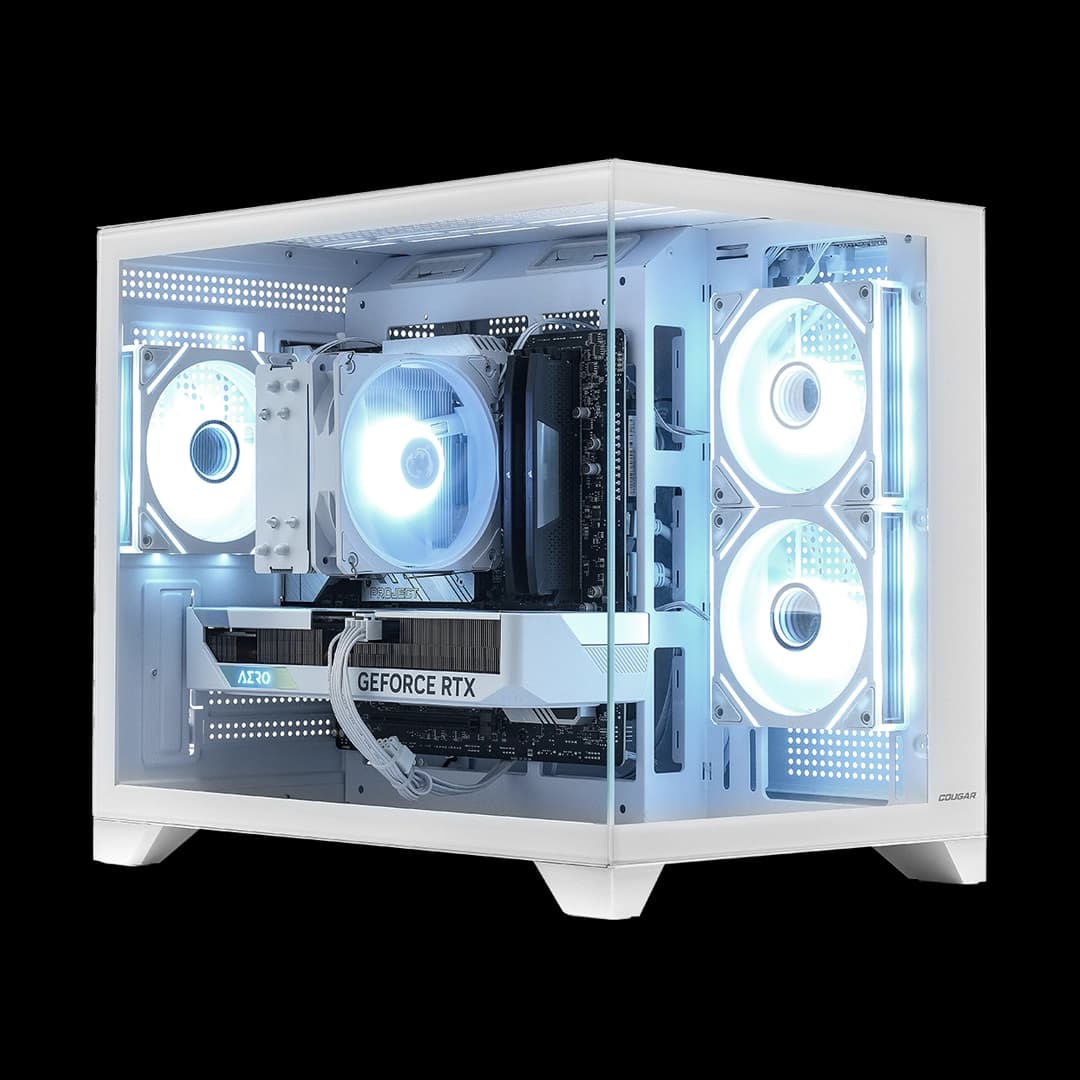
The Cougar UniFace Mini RGB mATX case is genuinely one of the more attractive chassis choices at this price point. The tempered glass side panel lets you see inside the machine, which is either a selling point or irrelevant depending on how much you care about RGB lighting. The integrated RGB lighting adds some visual flair without requiring separate fans or strips, which keeps the build cleaner. It supports Micro ATX and Mini ITX motherboards, so the A520 mATX board fits neatly.
Cougar as a brand has a reasonable reputation for producing cases that look more expensive than they are, and the UniFace Mini fits that pattern. The tempered glass panel is a proper glass panel rather than acrylic, which means it's less prone to scratching and looks sharper. The mATX format keeps the overall footprint compact, which is useful if desk or floor space is limited. It won't dominate a room the way a full tower would.
Cable management inside a compact mATX case is always a compromise. There's less room to route cables neatly compared to a mid or full tower, and prebuilt manufacturers don't always prioritise tidy internals the way a careful self-builder would. Stormforce Gaming doesn't make specific claims about cable routing quality in their spec sheet, so it's reasonable to expect functional rather than immaculate. The airflow design of the UniFace Mini should support the 5600GT's thermal needs without drama, but if you're planning to add a discrete GPU later, you'll want to check that airflow paths remain unobstructed.

Connectivity & Ports
Connectivity on the Rogue Prime AMD covers the essentials. WiFi 6 is a genuine upgrade over older wireless standards, offering lower latency and better performance in congested environments (think flats with lots of neighbouring networks, or homes with multiple devices hammering the same router). For everyday use and light online gaming, WiFi 6 is more than sufficient, and the low-latency characteristics make it a reasonable wireless solution even for gaming where a wired connection isn't practical.
Ethernet is also included, which is the right call for anyone who can run a cable. Wired connections are always preferable for gaming and video calls where stability matters. Having both options available means you're not forced into a wireless-only setup, which is a basic requirement that some budget prebuilts have skimped on in the past. The spec sheet confirms WiFi 6 and Ethernet are both present, and that's the right combination for 2026.
What the spec sheet doesn't detail is the full port layout on the front and rear panels, including USB counts, video output types, or audio jacks. The A520 motherboard supports a range of USB options according to Stormforce Gaming's listing, and the Cougar UniFace Mini typically includes front panel USB ports, but specific port counts and types aren't confirmed in the verified data. If you have specific connectivity requirements (a particular USB standard, multiple display outputs, or a specific audio setup), it's the full spec sheet on the Stormforce Gaming product page directly before buying. The integrated graphics in the 5600GT does support display outputs, but the exact configuration depends on the motherboard's rear I/O.
Pre-installed Software & OS
Windows 11 Home is the operating system, which is the standard choice for a consumer desktop in 2026. It's a fully licensed copy, which matters more than it might seem. Some budget prebuilts have historically shipped with OEM licences tied to hardware that makes reinstallation awkward, but a legitimate Windows 11 Home licence is the baseline expectation here and Stormforce Gaming lists it as such. Windows 11 Home covers everything the target user needs: gaming via Steam or the Microsoft Store, productivity apps, media playback, and general web browsing.
What Stormforce Gaming doesn't specify in the verified data is whether the machine ships with any additional software, manufacturer utilities, or bloatware beyond the OS itself. In general, boutique UK prebuilt builders like Stormforce Gaming tend to ship cleaner installs than the major OEMs (your HPs, Dells, and Lenovos of the world), but that's a generalisation rather than a guarantee. If a clean Windows install matters to you, it's easy enough to do a fresh install yourself once the machine arrives, and the legitimate Windows licence means you won't lose anything in the process.
AMD's own software ecosystem is here. The Ryzen 5 5600GT benefits from AMD's driver support and the AMD Software: Adrenalin Edition suite for managing the integrated graphics, which includes display settings, performance monitoring, and upscaling features. AMD's FidelityFX Super Resolution (FSR) is compatible with the integrated Radeon graphics and can help squeeze more performance out of supported games by rendering at a lower resolution and upscaling intelligently. It's not a magic bullet, but it's a useful tool that's available out of the box with the right driver install.
Upgrade Potential: Plan Ahead or Pay Later
This is where the Rogue Prime AMD's long-term value proposition either holds up or falls apart, depending on your plans. The A520 motherboard is the first thing to understand. It's a capable board for what it does, supporting the Ryzen 5 5600GT, M.2 NVMe storage, SATA devices, and a range of USB options. But the A520 chipset does not support CPU overclocking, which means you can't squeeze more performance out of the 5600GT by pushing the clocks higher. It also has more limited PCIe lane allocation than the B550 or X570 chipsets, which is relevant if you're planning to add a GPU.
The 350W Bronze PSU is the more immediate constraint. It's adequate for the current configuration, which draws relatively little power with integrated graphics and a 65W TDP CPU. But add a discrete GPU, even a modest one like an RX 6600 or RTX 3060, and 350W becomes tight very quickly. A GPU upgrade would almost certainly require a PSU swap as well, which adds to the total cost of the upgrade path. It's not impossible, but it's a two-part job rather than a simple slot-in upgrade. Budget for that if you're buying this machine with the intention of adding a GPU later.
RAM is the easy win. If there's a free DDR4 slot available (which is likely but not confirmed in the spec sheet), adding another 8GB stick to reach 16GB is straightforward and inexpensive. Storage expansion is similarly accessible: the A520 board supports additional M.2 and SATA drives, so adding a secondary drive for games or media is a simple job. The compact mATX case has physical space constraints, but for the most common upgrades (RAM and storage), it shouldn't be a barrier. The CPU itself is on an AM4 socket, which means there's a range of compatible processors available if you ever wanted to step up to a Ryzen 7 or higher, though the A520 board limits which chips you can run at their full potential.
How It Compares: Prebuilt vs Self-Build and the Competition
The most relevant comparison for the Rogue Prime AMD isn't against another prebuilt with a similar spec sheet. It's against what you'd spend building the same machine yourself. A Ryzen 5 5600GT, 8GB DDR4 3200, 500GB NVMe SSD, A520 motherboard, 350W PSU, and a decent mATX case with a Windows 11 licence would cost you meaningfully more in individual parts by the time you've sourced everything separately, paid for a Windows key, and factored in the time to build it. Prebuilt pricing at the entry level has become genuinely competitive in recent years, and Stormforce Gaming's current asking price sits in a range where the convenience premium is relatively small.
That said, a self-build at the same budget gives you choices the Rogue Prime AMD doesn't. You could opt for a B550 motherboard instead of A520, giving you better overclocking support and more upgrade flexibility. You could choose a larger PSU from the start, making a future GPU upgrade easier. And you could pick 16GB of RAM rather than 8GB, which would be my first recommendation to anyone building from scratch at this tier. The trade-off is time, knowledge, and the absence of a warranty on the complete system. Stormforce Gaming provides a warranty on the Rogue Prime AMD as a complete unit, which has real value for buyers who don't want to troubleshoot component failures themselves.
Against other prebuilts in the entry gaming bracket, the Rogue Prime AMD's main differentiator is the 5600GT's integrated graphics, which is stronger than what you'd find in an Intel-based machine at a similar price without a discrete GPU. The Cougar UniFace Mini case is also a cut above the generic chassis that some competitors use at this price point. Where it loses ground is the 8GB RAM and 350W PSU, both of which are tighter than ideal. Some competitors at similar prices include a discrete GPU (often an older or lower-tier card), which changes the gaming proposition significantly. If gaming is the primary goal, it's worth comparing what's available in the same budget from other builders before committing.
| Feature | Rogue Prime AMD | Self-Build (Same Budget) | Entry Prebuilt with Discrete GPU |
|---|---|---|---|
| CPU | Ryzen 5 5600GT (Zen 3) | Flexible (B550 + Ryzen 5) | Varies (often older gen) |
| GPU | Integrated (Radeon in 5600GT) | Your choice | Discrete (older/budget tier) |
| RAM | 8GB DDR4 3200 | 16GB DDR4 (recommended) | 8 to 16GB (varies) |
| Storage | 500GB NVMe SSD | Flexible | Varies (sometimes HDD) |
| PSU | 350W Bronze | 500W+ (recommended) | Varies |
| Motherboard | A520 (no OC) | B550 (OC capable) | Varies |
| Warranty | Stormforce Gaming warranty | Per-component only | Manufacturer warranty |
| Case Quality | Cougar UniFace Mini (good) | Your choice | Often generic |
| Gaming at 1080p (modern AAA) | Not suited | Depends on GPU choice | Possible at low/medium |

Final Verdict: Rogue Prime AMD Review
The Stormforce Rogue Prime AMD is a machine that knows what it is, and that's actually refreshing. It's not pretending to be a gaming powerhouse. It's a compact, attractive, well-specified everyday desktop with a genuinely strong CPU, fast NVMe storage, WiFi 6 connectivity, and integrated graphics that can handle light gaming without embarrassing itself. For a home office machine, a family PC, a student's workhorse, or someone returning to PC gaming after a long break who wants to start somewhere sensible, it makes a coherent case for itself.
The areas that need honest attention are the 8GB of RAM (upgrade it as soon as possible, it's cheap and the difference is significant), the 350W PSU (fine now, a constraint if you add a GPU later), and the integrated graphics (capable for its purpose, but not a substitute for a discrete card if gaming is your main priority). The A520 motherboard is a workable platform but not the most upgrade-friendly foundation if you're planning to grow the machine significantly over time. None of these are surprises at this price tier. They're the expected compromises, and Stormforce Gaming hasn't hidden them.
What Stormforce Gaming has got right is the CPU choice and the case. The Ryzen 5 5600GT is a proper Zen 3 chip with real-world performance credentials, not a budget filler processor. And the Cougar UniFace Mini with its tempered glass panel and integrated RGB looks considerably more expensive than the machines it's competing against. The WiFi 6 inclusion is the right call for 2026, and the NVMe SSD over a SATA drive is exactly the storage decision that should be made at this price point.
Who should buy this? Someone who needs a reliable, fast everyday computer, does light gaming on the side (older titles, esports games, casual play), and wants something that looks decent on a desk without spending serious money. Someone who's comfortable adding 8GB of RAM themselves within the first month of ownership. Someone who values the convenience of a complete system with a single warranty rather than sourcing and building individual parts.
Who should skip it? Anyone whose primary goal is playing modern AAA games at 1080p with decent settings. For that, you need a discrete GPU, and this machine doesn't have one. You'd be better served by a machine in the same bracket that includes an entry-level dedicated graphics card, even if it means a slightly older or less impressive CPU. The integrated graphics in the 5600GT is better than most, but it's not a gaming GPU and shouldn't be treated as one. If that's your use case, look at prebuilts in the same budget that include a discrete card, or consider a self-build where you can prioritise the GPU from the start.
Overall, the Rogue Prime AMD review verdict is straightforward: solid value for the right buyer, honest about its limits, and built around a CPU that genuinely earns its place. It's not trying to be everything to everyone, and that's exactly what makes it worth recommending to the audience it's designed for. Check the current price below and decide whether the spec makes sense for what you actually need it to do.
What works. What doesn’t.
6 + 6What we liked6 reasons
- AMD Ryzen 5 5600GT on Zen 3 architecture is a genuinely competitive six-core CPU for the price tier
- 500GB M.2 NVMe SSD is the correct storage choice, offering fast boot times and snappy application launches
- Cougar UniFace Mini with tempered glass panel and integrated RGB looks considerably more expensive than it is
- WiFi 6 inclusion is the right call for 2026, with lower latency and better performance in congested environments
- Integrated Radeon graphics in the 5600GT is meaningfully stronger than standard Intel integrated graphics for light gaming
- Complete system warranty from Stormforce Gaming adds genuine value over a per-component self-build
Where it falls6 reasons
- 8GB of DDR4 RAM is tight in 2026, with Windows 11 consuming two to three gigabytes at idle before you open anything
- 350W Bronze PSU leaves no headroom for adding a discrete GPU without also swapping the power supply
- A520 motherboard does not support CPU overclocking and offers more limited upgrade flexibility than a B550 platform
- Integrated graphics cannot handle modern AAA titles at 1080p with decent settings, limiting the gaming proposition significantly
- Full port layout including USB counts and video output types is not confirmed in the verified spec sheet
- Compact mATX cooler may become audible under sustained heavy load due to smaller fan size
Full specifications
12 attributes| CPU | AMD Ryzen 5 5600GT |
|---|---|
| GPU | Integrated Graphics |
| RAM | 8GB DDR4 3200 |
| Storage | 500GB M.2 NVMe SSD |
| Case | Cougar UniFace Mini RGB mATX |
| Connectivity | WiFi 6, Ethernet |
| Cooling | Optimised Air Cooling |
| Motherboard | A520 |
| Motherboard chipset | A520 |
| OS | Microsoft Windows 11 Home |
| PSU | 350w Bronze PSU |
| RAM GB | 8 |
Frequently asked
7 questions01Can the Stormforce Rogue Prime AMD run modern AAA games?+
Not at acceptable settings for most modern titles. The integrated Radeon graphics in the Ryzen 5 5600GT is stronger than standard Intel integrated graphics, but it is not a discrete GPU. It handles older titles, esports games, and casual gaming at reduced settings, but demanding modern releases at 1080p are beyond what integrated graphics can manage smoothly.
02Can I add a dedicated graphics card to the Rogue Prime AMD later?+
Physically, yes, the A520 motherboard has a PCIe slot for a discrete GPU. However, the 350W Bronze PSU is a significant constraint. Even a modest card such as an RX 6600 or RTX 3060 would push that PSU very close to its limits. A GPU upgrade would almost certainly require a simultaneous PSU replacement, so budget for both when planning that path.
03Is 8GB of RAM enough for the Rogue Prime AMD in 2026?+
It is functional but tight. Windows 11 uses two to three gigabytes at idle, leaving limited headroom for applications and games running simultaneously. Adding a second 8GB stick to reach 16GB total is one of the most cost-effective upgrades available for this machine and would noticeably improve day-to-day performance. DDR4 RAM is inexpensive at present.
04Which socket does the Rogue Prime AMD use, and can I upgrade the CPU?+
The Ryzen 5 5600GT uses AMD's AM4 socket. The A520 motherboard is compatible with a range of AM4 processors, including higher-tier Ryzen 7 chips. However, the A520 chipset does not support CPU overclocking and has more limited PCIe lane allocation than B550 or X570 boards, which constrains how much you can extract from a faster processor in this platform.
05Does the Rogue Prime AMD come with a warranty?+
Yes, Stormforce Gaming provides a warranty on the Rogue Prime AMD as a complete system. The precise terms and duration should be confirmed directly on the Stormforce Gaming product page, but a complete-system warranty is one of the genuine advantages of buying a prebuilt over assembling individual components, where each part carries only its own manufacturer warranty.
06Does the Rogue Prime AMD support AMD FSR for gaming?+
Yes. The integrated Radeon graphics in the Ryzen 5 5600GT is compatible with AMD FidelityFX Super Resolution, which is accessible through the AMD Software Adrenalin Edition driver suite. FSR can render supported games at a lower resolution and upscale intelligently, helping to recover some frame rate performance in compatible titles. It is not a substitute for a discrete GPU but is a useful tool within the hardware's limits.
07How does the Rogue Prime AMD compare to building a PC yourself at the same budget?+
A self-build with equivalent components would likely cost more once individual part prices, a Windows 11 licence, and assembly time are factored in, making the prebuilt pricing reasonably competitive at this tier. However, a self-build allows you to choose a B550 motherboard for better upgrade flexibility, a larger PSU from the start, and 16GB of RAM rather than 8GB. The trade-off is time, technical knowledge, and the absence of a single complete-system warranty.