Building your own PC used to be the obvious move if you wanted decent value. Source the parts, watch a few guides, spend a Saturday afternoon with a screwdriver and a mild sense of dread. But component prices have shifted, prebuilt margins have tightened, and some manufacturers are actually putting together sensible machines at sensible prices. The question is whether Stormforce Gaming's Recon Core AMD is one of them, or whether you're paying a convenience tax for mediocre parts in a shiny box.
The short answer: this is a genuinely decent mid-range gaming PC, not a perfect one. The RTX 5050 is a legitimate step forward for 1080p gaming, the Ryzen 5 5500 is a capable chip, and the Gen 4 NVMe SSD is the kind of storage you'd actually want rather than the budget SATA drives some prebuilts sneak in. There are compromises, and we'll get into all of them. But if you want a machine that'll run modern games properly at 1080p without a weekend of assembly anxiety, the Recon Core AMD makes a reasonable case for itself. This Recon Core AMD review will tell you exactly what you're getting and whether the price makes sense.
Core Specifications
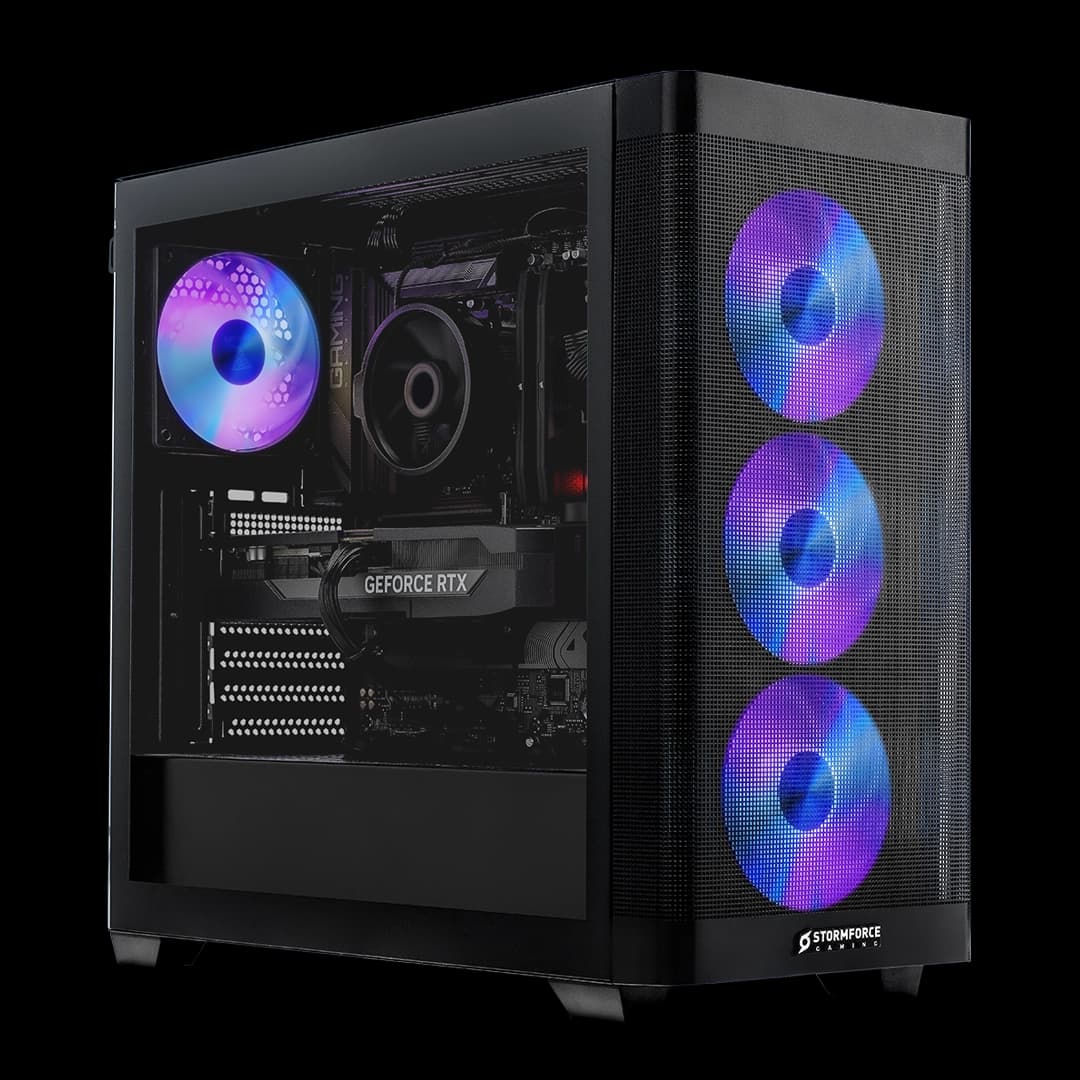
The Recon Core AMD is built around AMD's Ryzen 5 5500, a six-core, twelve-thread processor sitting on the Zen 3 architecture with a base clock of 3.6GHz and a boost up to 4.2GHz. Paired with it is an NVIDIA GeForce RTX 5050 with 8GB of VRAM, 16GB of DDR4 3200 RAM, and a 1TB Gen 4 M.2 NVMe SSD. The whole thing runs Windows 11 Home, lives in a Vortex Athena M3 ATX case with tempered glass side panels, and draws power from a 500W Bronze-rated PSU. Connectivity covers WiFi 6, Ethernet, and Bluetooth with MU-MIMO technology.
The motherboard is an A520, which is an entry-level AMD platform. It supports modern Ryzen processors, M.2 storage, SATA devices, and a range of USB options, but it's not a board that's going to offer a lot of room for future tinkering. That's a common prebuilt compromise and not a dealbreaker at this price tier, but it does set a ceiling on certain upgrade paths that we'll come back to later. Cooling is handled by an optimised air solution with a compact aluminium heatsink and integrated fan, which is functional without being exciting.
What stands out in this spec sheet relative to the price tier is the Gen 4 NVMe SSD. A lot of prebuilts at this level sneak in a Gen 3 drive or, worse, a SATA SSD and dress it up with vague marketing language. Stormforce Gaming specifies Gen 4 M.2 NVMe here, which means faster sequential reads and writes than the older standard, and noticeably snappier boot times and game loading. That's a small but real quality-of-life win. The RTX 5050 is also a newer GPU generation, which matters for driver support and longevity even if the raw performance ceiling isn't sky-high.
| Component | Specification |
|---|---|
| CPU | AMD Ryzen 5 5500 (6-core, 12-thread, 3.6GHz base / 4.2GHz boost) |
| GPU | NVIDIA GeForce RTX 5050 8GB |
| RAM | 16GB DDR4 3200 |
| Storage | 1TB Gen 4 M.2 NVMe SSD |
| Motherboard | A520 |
| Case | Vortex Athena M3 ATX (tempered glass side panel) |
| Cooling | Compact aluminium heatsink with integrated fan |
| PSU | 500W Bronze |
| Connectivity | WiFi 6, Ethernet, Bluetooth (MU-MIMO) |
| Operating System | Microsoft Windows 11 Home |
| Price | £1,029.99 |
CPU & Performance: The Recon Core AMD Review Case for Ryzen 5 5500
The Ryzen 5 5500 is a chip that gets a bit of a raw deal in conversations about modern processors, mostly because it's been around for a while and sits in the shadow of newer Ryzen 7000 series parts. But context matters. This is a six-core, twelve-thread processor built on AMD's Zen 3 architecture, which was genuinely excellent when it launched and hasn't suddenly become rubbish. The 4.2GHz boost clock is respectable, and 16MB of L3 cache keeps frequently accessed data close to the cores where it counts. For gaming at 1080p, the CPU is rarely the bottleneck anyway. The GPU does the heavy lifting; the processor just needs to feed it frames consistently.
Where the 5500 does start to show its age is in productivity workloads. Video editing, 3D rendering, heavy multitasking with lots of browser tabs and applications open simultaneously, these tasks benefit from more cores and higher cache counts than this chip offers. If you're buying this purely as a gaming machine and occasionally want to do some light streaming or content creation on the side, it's fine. If you want a proper creative workstation that also games, you'd want to look at something with a Ryzen 7 or Ryzen 9 at its heart.
One thing the Ryzen 5 5500 does have going for it in a prebuilt context is that it's a mature, well-understood chip with stable driver support and no nasty surprises. AMD's specification for this processor is clear and consistent, and Stormforce Gaming has paired it with enough RAM (16GB at DDR4 3200) to avoid the kind of memory bottlenecks that can make even a good CPU feel sluggish. The 5500 won't win any benchmarks against 2025's finest, but it'll run games, handle Discord, stream music, and keep up with general desktop use without complaint. For a mid-range gaming PC aimed at someone who wants to play games rather than compile software, it does the job.
GPU & Gaming Performance
The RTX 5050 is the headline component here, and it's the one that needs the most explanation because it's a newer card that a lot of people haven't had the chance to read much about yet. NVIDIA positions it as a 1080p gaming GPU, and that framing is accurate. Stormforce Gaming lists it as capable of reliable 1080p gameplay, and based on where it sits in NVIDIA's lineup, that's a fair description. You're getting 8GB of VRAM, which is the minimum you'd want for modern titles, and the card supports NVIDIA's DLSS AI upscaling technology along with real-time ray tracing.
DLSS is genuinely useful at this tier. It lets the card render at a lower internal resolution and use AI to reconstruct the image at a higher one, which means you can get better frame rates without a significant visual penalty. For 1080p gaming, DLSS Quality mode can give you frame rates that feel closer to what a more expensive GPU would deliver natively. Ray tracing on an RTX 5050 is more of a "yes it technically works" feature than a "turn it on in everything" one. In lighter titles it'll be fine; in demanding ray-traced games you'll want to be selective about what settings you push.
At 1440p, the RTX 5050 will struggle in more demanding titles unless you're leaning on DLSS heavily. It's not designed for 1440p as a primary target, and pushing it there in something like Cyberpunk 2077 with the settings cranked will result in frame rates that don't feel great. The honest position is that this GPU is a solid 1080p card and an occasional 1440p card with DLSS doing a lot of the work. If 1440p is your primary target, you'd need to budget for a more capable GPU. But for 1080p gaming across the broad range of popular titles, from shooters to RPGs to strategy games, the RTX 5050 has enough headroom to keep things feeling smooth.
Memory & Storage
Sixteen gigabytes of DDR4 at 3200MHz is the right amount of RAM for a gaming PC in 2026. It's not extravagant, but it's not cutting corners either. Some games are starting to push into 16GB territory under heavy load, and having exactly 16GB means you're at the threshold rather than comfortably above it. The good news is that the A520 motherboard supports RAM expansion, so if you find yourself wanting more headroom in a year or two, adding another 16GB is a realistic option. The speed of 3200MHz is solid for DDR4 and won't create any meaningful bottleneck with the Ryzen 5 5500, which is the important thing.
The storage situation is genuinely good for this price tier. A 1TB NVMe SSD on the Gen 4 interface means you're getting fast sequential read and write speeds that make a real difference to boot times and game loading. The jump from a SATA SSD to a Gen 4 NVMe isn't always dramatic in everyday use, but it's a meaningful step up from the SATA drives or Gen 3 NVMe units that some prebuilts include at similar prices. Stormforce Gaming has specified Gen 4 here, which is a better choice than they needed to make at this price point, and it's one of the things that makes the Recon Core AMD feel like a reasonably honest build rather than a spec-sheet-padding exercise.
One terabyte is enough to get started, but modern games are enormous. A single AAA title can eat 100GB or more, so you'll fill that drive faster than you might expect. The A520 motherboard does support additional M.2 storage and SATA devices, which means adding a second drive later is straightforward. You're not locked into 1TB forever. But if you have a large existing game library you want to migrate immediately, factor in the cost of a secondary drive from the start rather than treating it as a surprise later.
Cooling Solution
The cooling setup here is a compact aluminium heatsink with an integrated fan. Stormforce Gaming describes it as optimised air cooling, and that phrasing is doing a bit of work. What you're getting is a stock-style air cooler, which is adequate for the Ryzen 5 5500 under normal gaming loads but isn't going to impress anyone who's used to aftermarket coolers. The 5500 has a rated TDP of 65W, which is manageable for a modest cooler, but sustained heavy workloads like prolonged rendering or extended gaming sessions in a warm room could push temperatures higher than you'd see with a beefier solution.
For the target use case of gaming, this cooler should be fine. The Ryzen 5 5500 isn't a particularly hot or power-hungry chip, and the Vortex Athena M3 case is specified to have optimised airflow, which helps. The case's internal cable management channels mean that airflow isn't being choked by a rats' nest of cables, which is a genuine advantage over some cheaper prebuilts where the cable routing looks like an afterthought. Proper airflow through the case reduces the thermal load on every component, not just the CPU.
If you're the kind of person who pushes a PC hard for long periods and cares about keeping temperatures as low as possible, upgrading to an aftermarket air cooler down the line is an easy and relatively cheap improvement. Something like a decent 120mm tower cooler would give the 5500 more thermal headroom and likely run quieter under load. But for most users buying this machine to game on, the stock cooling solution will do what it needs to do without causing problems. Stormforce Gaming hasn't cut corners on the case airflow design, which is the more important factor anyway.
Case & Build Quality
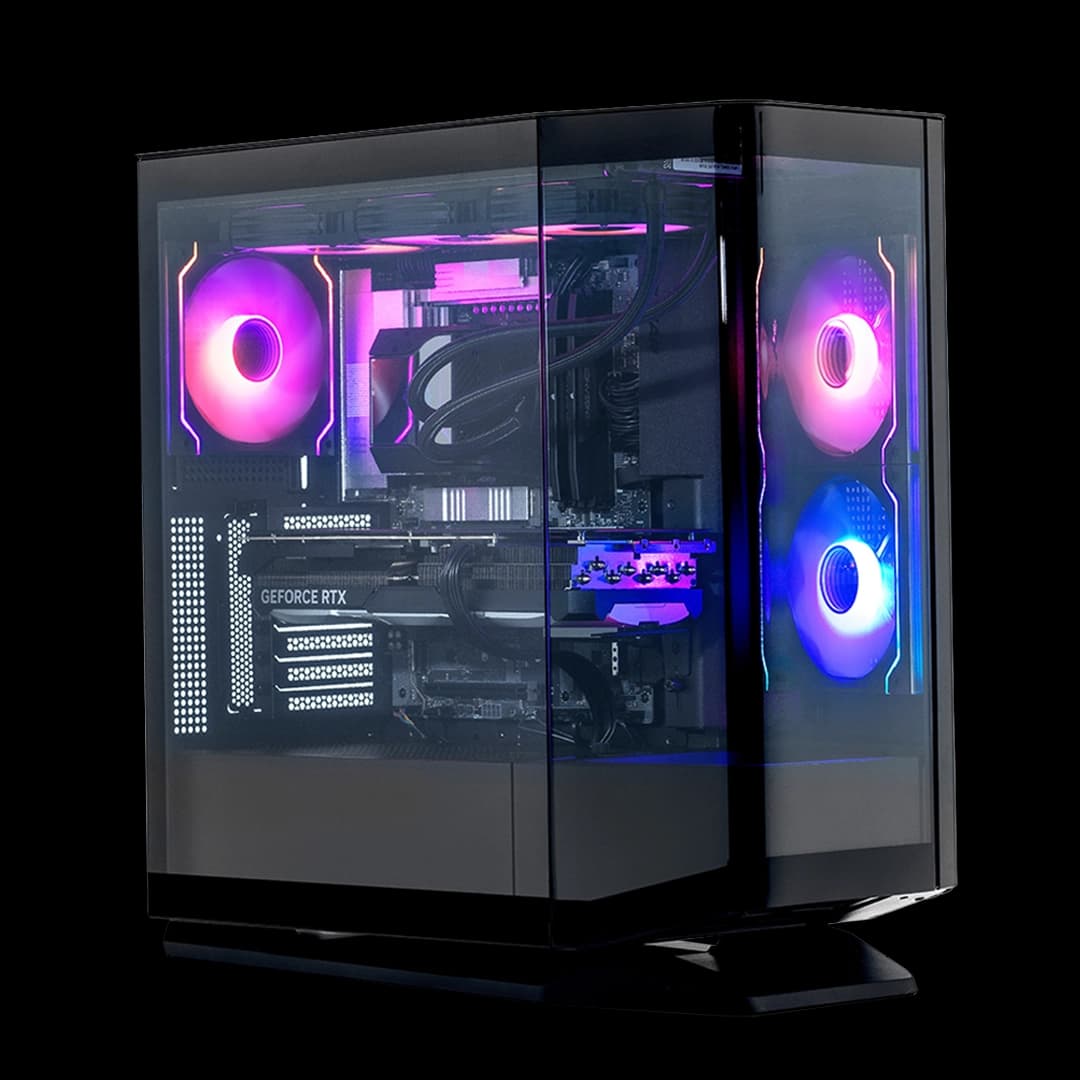
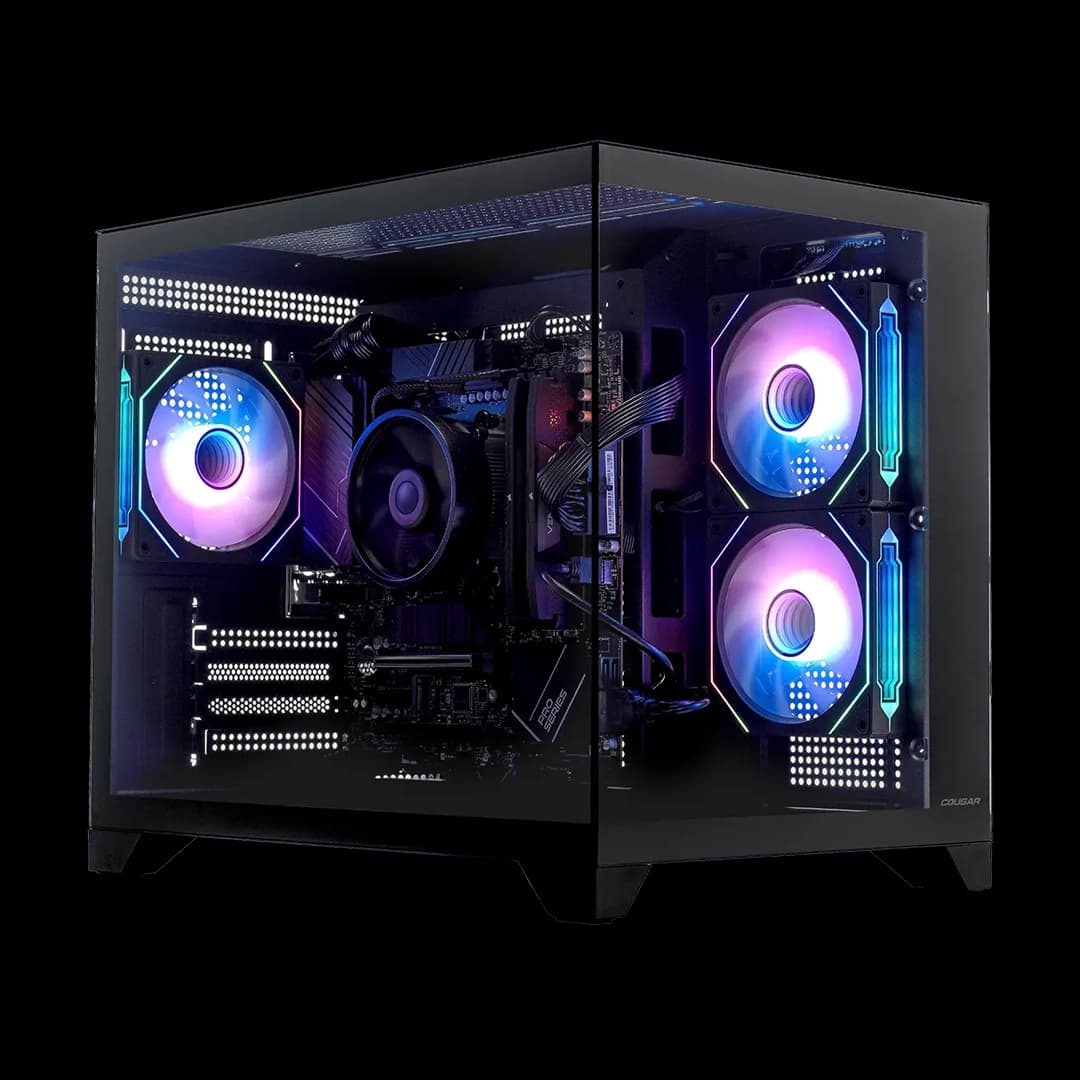
The Vortex Athena M3 is an ATX case with a tempered glass side panel, which means you can see the components inside. Whether that matters to you depends entirely on your personality, but it does mean the build needs to look reasonably tidy, and Stormforce Gaming has included internal cable management channels to help with that. Cable management in a prebuilt is one of those things that's easy to neglect because the customer can't see it until they open the case, so the fact that it's called out as a feature suggests some genuine care has been taken here.
The Athena M3 is described as having optimised airflow, which in practical terms means the case has been designed with intake and exhaust in mind rather than just being a box that holds components. Good case airflow keeps GPU temperatures down, reduces fan noise because the fans don't have to work as hard, and extends component lifespan. It's not the most glamorous spec to talk about, but it matters more than RGB lighting in terms of long-term performance. The ATX form factor also means there's physical space for future upgrades without the cramped conditions you'd get in a smaller case.
There's no RGB mentioned in the spec sheet, which will disappoint some buyers and delight others. The tempered glass panel gives you a view of the internals, but what you're looking at is a functional build rather than a light show. If you want a desk ornament that pulses in seventeen colours, this isn't it. If you want a machine that looks clean and professional and gets on with the job, the Athena M3 case is a solid choice. The aluminium heatsink is visible through that glass panel and has its own understated appeal, if that sort of thing matters to you.
Connectivity & Ports
The connectivity spec is one of the stronger points of this build. WiFi 6 with MU-MIMO technology means you're getting the current mainstream standard for wireless networking, not the older WiFi 5 that some prebuilts still ship with. WiFi 6 offers better throughput, lower latency under congestion, and improved performance in environments with lots of devices on the same network. For online gaming, that last point matters more than raw speed: a router serving a house full of people on WiFi 6 devices handles the traffic more efficiently than WiFi 5, which means more consistent ping rather than the occasional spike when someone else starts a video call.
Ethernet is also present, which is always the right choice for gaming if you can run a cable. Wired connections are more stable and consistent than wireless regardless of WiFi generation, and having the option is important. Bluetooth is included too, which covers wireless headsets, controllers, and keyboards without needing a separate dongle. The A520 motherboard supports a range of USB options, and while the specific port count and configuration isn't broken down in the verified spec data, the platform is well understood and typically offers a practical mix of front and rear USB connectivity.
What's not specified in the verified data is the video output configuration on the RTX 5050, so we won't guess at port counts or specific connector types. The GPU will have display outputs as standard for any discrete NVIDIA card, but for exact connector details you'd want to check Stormforce Gaming's spec table directly. The network connectivity picture is clear and genuinely good: WiFi 6 with MU-MIMO, wired Ethernet, and Bluetooth together give you every connection option you'd want from a modern gaming desktop.
Pre-installed Software & OS
Windows 11 Home comes pre-installed, which is exactly what you'd expect and exactly what most users want. It's the current mainstream version of Windows, it's compatible with modern games and applications, and it's the operating system that game developers and peripheral manufacturers are actively supporting. Windows 11 Home versus Pro is rarely a meaningful distinction for a gaming PC buyer: the Pro features (BitLocker, Remote Desktop, domain join) are enterprise tools that most home users never touch. So Home is the right call here.
Stormforce Gaming doesn't advertise any bloatware bundled with the system, which is a refreshing change from some prebuilt manufacturers who load machines with trial software, antivirus subscriptions, and manufacturer utilities that add more confusion than value. A clean Windows install is genuinely preferable to one cluttered with third-party software you didn't ask for and will spend your first hour removing. Whether the Recon Core AMD ships completely clean or with any Stormforce-specific utilities isn't detailed in the verified spec data, but the absence of any bloatware marketing language is at least a neutral signal.
NVIDIA's driver ecosystem is worth a mention here because it's relevant to the RTX 5050 experience. GeForce Experience (or the newer NVIDIA App) handles driver updates and gives you access to DLSS settings, game-specific optimisation profiles, and performance overlays. It's not mandatory, but it makes managing the GPU's features more straightforward. AMD's Ryzen chipset drivers are similarly mature and stable on Windows 11. The software stack around both the CPU and GPU is well established, which means you're unlikely to run into the kind of driver instability that occasionally plagues newer or more exotic hardware configurations.
Upgrade Potential
The A520 motherboard is where the upgrade story gets complicated. It's a budget AMD platform, which means it supports current Ryzen 5000 series processors and will let you upgrade within that family if you want more cores or cache. But the A520 doesn't support PCIe 4.0 for the GPU slot on all configurations, and it won't support Ryzen 7000 series chips (which use the AM5 socket rather than AM4). So the upgrade ceiling on the CPU side is the top of the Ryzen 5000 range, which includes some very capable chips like the Ryzen 7 5800X3D if you wanted to push performance later.
RAM expansion is straightforward. The platform supports DDR4, and going from 16GB to 32GB is a simple slot-and-go upgrade that doesn't require any BIOS expertise. Storage is similarly expandable: the A520 supports additional M.2 drives and SATA devices, so adding a secondary drive for game storage is easy. The 500W Bronze PSU is the more interesting question for GPU upgrades. A 500W supply is adequate for the current RTX 5050 build, but if you wanted to drop in a significantly more powerful GPU in the future, you'd likely need to upgrade the PSU at the same time. That's a double cost and a bit of faff, but it's not unusual for a prebuilt at this price tier.
The Vortex Athena M3 ATX case is a genuine asset for upgradeability. ATX cases have space for full-size GPU cards, multiple storage devices, and aftermarket coolers, none of which you'd take for granted in a smaller form factor build. The cable management channels mean the interior isn't a tangled mess that makes adding components a nightmare. If you buy this machine and want to add an aftermarket CPU cooler, a second NVMe drive, and eventually a new GPU, the case won't get in your way. That's a better foundation than some prebuilts offer, where the case is so cramped or awkwardly designed that upgrades become a genuine ordeal.
How It Compares
The most useful comparison for any prebuilt is against a self-build at the same spec. If you were to source a Ryzen 5 5500, an RTX 5050 8GB, 16GB of DDR4 3200, a 1TB Gen 4 NVMe SSD, an A520 motherboard, a 500W Bronze PSU, and a decent ATX case with a tempered glass panel individually, you'd be looking at component costs that don't leave much room for the prebuilt premium to feel unreasonable. GPU prices in particular have been volatile, and the RTX 5050 is a newer card where retail pricing is still settling. The convenience of a pre-assembled, Windows-installed machine with a warranty attached has real value, especially if you've never built a PC before or simply don't want to.
Against other prebuilts in the same price bracket, the Recon Core AMD holds up reasonably well on the storage front (Gen 4 NVMe is a genuine differentiator) and on connectivity (WiFi 6 with MU-MIMO rather than cheaper WiFi 5 solutions). Where it's more typical of the category is the A520 motherboard and the stock air cooling, both of which are sensible cost-saving choices that don't hurt the day-one experience but do limit the upgrade ceiling. Some competitors at similar prices offer B550 motherboards, which have better PCIe lane allocation and slightly more upgrade flexibility, so that's worth factoring in if long-term expandability is a priority for you.
The honest framing is that this is a mid-range prebuilt doing mid-range prebuilt things. It's not trying to be something it isn't. The component choices are coherent, the GPU is a current-generation card with proper AI upscaling support, and the storage is better than average for the tier. If you compare it to a budget prebuilt with an older GPU and a SATA SSD, the Recon Core AMD is clearly the better machine. If you compare it to a higher-end prebuilt with a Ryzen 7, a B550 or X570 board, and an RTX 5070, you're comparing different price points and different ambitions entirely.
| Feature | Recon Core AMD | Typical Budget Prebuilt | Typical Upper-Mid Prebuilt |
|---|---|---|---|
| CPU | Ryzen 5 5500 (6C/12T) | Ryzen 5 4600G or similar | Ryzen 7 5700X or newer |
| GPU | RTX 5050 8GB | RTX 4060 or older | RTX 5060 / RTX 5070 |
| RAM | 16GB DDR4 3200 | 8 to 16GB DDR4 | 16 to 32GB DDR4/DDR5 |
| Storage | 1TB Gen 4 NVMe | 512GB SATA SSD or Gen 3 NVMe | 1TB Gen 4 NVMe or better |
| Motherboard | A520 | A320 or A520 | B550 or B650 |
| WiFi | WiFi 6 with MU-MIMO | WiFi 5 or no WiFi | WiFi 6 or WiFi 6E |
| PSU | 500W Bronze | 400 to 500W unrated | 600 to 750W Bronze/Gold |
| Primary target resolution | 1080p | 1080p (lower settings) | 1080p to 1440p |
Final Verdict: Recon Core AMD Review
The Recon Core AMD is a solid mid-range gaming PC that doesn't try to punch above its weight and doesn't embarrass itself at its price point. The RTX 5050 is the right GPU for 1080p gaming in 2026, DLSS gives it frame rate headroom that older cards at this tier simply don't have, and the Gen 4 NVMe SSD is a better storage choice than Stormforce Gaming needed to make here. WiFi 6 with MU-MIMO is another above-average call. These aren't flashy decisions, but they're the right ones.
The compromises are real but predictable. The A520 motherboard limits your long-term upgrade path compared to a B550 board. The 500W Bronze PSU is fine for now but will need replacing if you ever want a significantly more powerful GPU. The stock air cooler is adequate rather than impressive. And the Ryzen 5 5500, while a capable gaming chip, is an older design that will show its age faster in productivity tasks than in games. None of these are reasons to walk away, but they're reasons to go in with clear expectations.
Who should buy this? Someone who wants to play modern games at 1080p on a machine that's ready to go, doesn't want to build their own PC, and isn't planning to do heavy video editing or 3D rendering on the side. It's a gaming machine first, general desktop second, creative workstation a distant third. The price is competitive for the spec, the warranty gives you a safety net that self-builders don't get, and the Vortex Athena M3 case gives you room to grow if you want to add storage or swap the cooler later.
Who should skip it? If 1440p is your primary gaming target, you'd be better served by a machine with an RTX 5060 or better at its heart. If you're a confident self-builder, the component cost comparison is worth doing before you commit: the prebuilt premium might not be justified if you're comfortable sourcing and assembling parts yourself. And if you need a proper productivity machine that also games, a Ryzen 7 or Ryzen 9 build would give you meaningfully more headroom for demanding workloads.
The Recon Core AMD earns a solid 7 out of 10. It's not the most exciting machine on the market, but it's an honest one. The spec choices are coherent, the GPU is genuinely current-generation, and the storage is better than you might expect at this tier. For a first gaming PC or a living room machine that needs to be plug-in-and-play, it's a reasonable choice. If your budget stretches further and you want better upgrade headroom, look at machines built on B550 or B650 boards with a Ryzen 7 processor. But if the current price sits comfortably in your budget and 1080p gaming is your primary goal, the Recon Core AMD will do what it promises without drama.
What works. What doesn’t.
5 + 6What we liked5 reasons
- RTX 5050 is a current-generation GPU with DLSS support, giving genuine frame rate headroom at 1080p
- Gen 4 NVMe SSD is a better storage choice than many competing prebuilts at this price tier
- WiFi 6 with MU-MIMO is an above-average connectivity specification for this price bracket
- ATX case with tempered glass and cable management channels leaves room for future upgrades
- Windows 11 Home ships pre-installed with no advertised bloatware
Where it falls6 reasons
- A520 motherboard limits the long-term upgrade path compared to B550 alternatives
- 500W Bronze PSU will likely need replacing alongside any significant GPU upgrade
- Stock air cooler is adequate for normal loads but offers little thermal headroom under sustained workloads
- Ryzen 5 5500 is an older Zen 3 design that will feel its age in productivity and creative workloads
- 16GB of DDR4 sits at the threshold rather than comfortably above modern gaming requirements
- 1TB storage fills quickly given the size of modern AAA titles
Full specifications
12 attributes| CPU | AMD Ryzen 5 5500 |
|---|---|
| GPU | NVIDIA RTX 5050 8GB |
| RAM | 16GB DDR4 3200 |
| Storage | 1TB M.2 NVMe SSD |
| Bluetooth | 5.0 |
| Case | Vortex Athena M3 ATX |
| Case size | mid-tower |
| Connectivity | WiFi 6, Ethernet, Bluetooth |
| Cooling | Optimised Air Cooling |
| Ethernet | 1GbE |
| Launch year | 2024 |
| Motherboard | A520 |
If this isn’t right for you
2 options
Frequently asked
7 questions01What resolution is the Stormforce Gaming Recon Core AMD designed for?+
The Recon Core AMD is designed primarily for 1080p gaming. The RTX 5050 has enough headroom to handle a broad range of modern titles at 1080p, and DLSS can boost frame rates further. At 1440p it will struggle in demanding titles unless DLSS is doing a significant amount of the work.
02Can the RAM be upgraded later?+
Yes. The A520 motherboard supports DDR4 RAM expansion, so going from 16GB to 32GB is a straightforward upgrade. You would need to check the motherboard's specific slot configuration to confirm whether additional sticks can be added or whether existing sticks need replacing.
03Does the Recon Core AMD support ray tracing?+
Yes, the RTX 5050 supports real-time ray tracing. However, at this performance tier ray tracing is a selective rather than universal feature. It works well in lighter titles, but in more demanding ray-traced games you would want to adjust settings carefully to maintain acceptable frame rates.
04What is the upgrade ceiling for the CPU on this machine?+
The A520 motherboard uses the AM4 socket, which supports AMD Ryzen 5000 series processors. You could upgrade to a higher-tier Ryzen 5000 chip such as the Ryzen 7 5800X3D, but you cannot move to AMD's Ryzen 7000 series, which requires the newer AM5 socket. The upgrade path is present but limited.
05Is the 500W PSU sufficient for future GPU upgrades?+
The 500W Bronze-rated PSU is adequate for the RTX 5050 in its current configuration. However, if you plan to upgrade to a significantly more powerful GPU in the future, you would likely need to replace the PSU at the same time, as more capable graphics cards typically require 650W or more depending on the model.
06Does the Recon Core AMD include Bluetooth?+
Yes, Bluetooth is included alongside WiFi 6 and Ethernet. This means you can connect wireless headsets, controllers, and keyboards without needing a separate USB dongle, which is a practical convenience for a gaming desktop.
07How much storage space does 1TB realistically offer for gaming?+
One terabyte is enough to get started, but modern AAA games can occupy 100GB or more each, so a library of ten to fifteen large titles can fill the drive quickly. The A520 motherboard supports additional M.2 and SATA storage devices, so adding a secondary drive later is straightforward if you need more space.