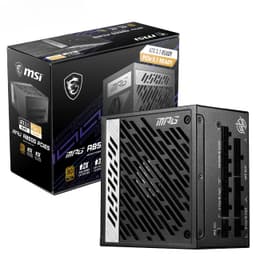
The PSU is the one component that can fry everything else in your build if you cheap out badly. Most builders agonise over GPU choices for weeks, then grab the first power supply they see that's cheap enough. That's a genuinely risky approach. The MSI MAG A650BN Power Supply Unit, UK Plug - 650W, 80 Plus Bronze Certified, ATX PSU, 12V Single-Rail, DC-to-DC Circuit, 120mm Fan - 5 Year Warranty sits firmly in the budget bracket, but the question worth asking is whether "budget" here means "sensible value" or "false economy."
At 650W with an 80 Plus Bronze certification, a DC-to-DC circuit, and a five-year warranty, this unit is pitching itself squarely at mainstream gaming builds. Over 970 owners on Amazon have weighed in with an average of ★★★★½ (4.6), which is a pretty healthy signal for a PSU at this price point. That's not a number you can fake with a handful of planted reviews. So there's clearly something working here.
What we're going to do is go through every spec and feature that actually matters for a PSU at this level, compare it against what else you can buy, and give you a straight answer on whether it belongs in your next build or not.
MSI MAG A650BN Core Specifications
The headline numbers are straightforward enough. You're getting 650W of continuous output power, 80 Plus Bronze efficiency certification, a 12V single-rail design, a DC-to-DC circuit for minor rail regulation, and a 120mm sleeve bearing fan for cooling. The warranty is five years, which is genuinely above average for this price tier. Most budget PSUs ship with two or three years at best.
The cable configuration covers the essentials without going overboard. You get one ATX 24-pin connector, one EPS 8-pin for the CPU, two PCIe 8-pin connectors for graphics cards, six SATA connectors, and three Molex connectors. There's no 12VHPWR (the 16-pin connector for RTX 40-series and RX 7000-series cards), which is expected at this wattage and price point. We'll cover what that means for GPU compatibility in the connectors section.
The protection suite includes OCP (overcurrent), OVP (overvoltage), OPP (overpower), SCP (short circuit), and OTP (overtemperature). That's a solid set of protections for the money. The unit carries the MSI MAG branding, which is the brand's mainstream gaming line, and it comes with a UK plug as standard, so no adapter faff required.
| Specification | Detail |
|---|---|
| Wattage | 650W |
| Efficiency Rating | 80 Plus Bronze |
| Fan Size | 120mm sleeve bearing |
| Zero RPM Mode | No |
| Single Rail | 12V single-rail |
| Circuit Design | DC-to-DC |
| ATX 24-pin | 1 |
| EPS 8-pin | 1 |
| PCIe 8-pin | 2 |
| SATA | 6 |
| Molex | 3 |
| 12VHPWR | Not included |
| Protections | OCP, OVP, OPP, SCP, OTP |
| Warranty | 5 years |
| Price | £44.99 |

Wattage and Capacity
650W is a sensible sweet spot for a mainstream gaming build in 2026. It's enough to run a mid-range GPU (think RTX 4060, RX 7600, or thereabouts) alongside a modern mid-range CPU without any headroom anxiety. You're not going to be pushing an RTX 4080 or a Ryzen 9 through this unit, and honestly you shouldn't try, but for the kind of build most people are actually putting together, 650W is a comfortable fit.
The practical rule of thumb is that your PSU should run at roughly 50 to 70 percent of its rated capacity under typical gaming load. That's where efficiency peaks and thermals stay comfortable. A mid-range gaming rig with something like an RTX 4060 and a Ryzen 5 or Core i5 processor will typically draw 300 to 400W under load, which puts you nicely in that efficiency sweet spot on a 650W unit. You're not starving the system and you're not wasting money on excess capacity.
Where things get tighter is if you're pairing this with a more demanding GPU. An RTX 4070 can spike past 200W on its own, and a modern CPU under full load adds another 65 to 125W on top. That's still within the 650W ceiling, but the headroom shrinks. For anything above an RTX 4070 or RX 7700 XT, you'd want to look at 750W or 850W units instead. Use our PSU calculator to check your specific component combination before committing.
MSI MAG A650BN Efficiency Rating: What 80 Plus Bronze Actually Means
The 80 Plus certification scheme measures how efficiently a PSU converts AC power from the wall into DC power for your components. Anything that doesn't convert cleanly gets lost as heat. Bronze certification means the unit hits at least 82 percent efficiency at 20 percent load, around 85 percent at 50 percent load, and roughly 82 percent again at full load. The MSI MAG A650BN is rated up to 87 percent efficiency, which sits at the upper end of the Bronze band.
In practical terms, at 50 percent load (around 325W draw from your components), the unit will pull roughly 380W from the wall. The difference, around 55W, is wasted as heat. Compare that to a Gold-rated PSU at the same load, which might waste closer to 35W. Over a year of gaming, that gap in electricity cost is real but fairly modest for most UK households. Bronze isn't Gold, but it's not embarrassing either, and at this price point it's the expected tier.
Where Bronze efficiency matters more is in thermal terms. More wasted energy means more heat inside the PSU, which means the fan has to work harder to compensate. This is why PSUs with better efficiency ratings often run quieter under sustained load. The 87 percent peak figure for this unit is genuinely decent for Bronze, and the DC-to-DC circuit design helps keep the minor rails (3.3V and 5V) stable without drawing excess current, which contributes to that efficiency figure at real-world loads.
Modularity and Cable Management
The MSI MAG A650BN is a non-modular unit. All cables are permanently attached. That's the trade-off you make at this price point, and frankly it's the right one. Modular connectors add cost and introduce a small but real resistance increase at each connection point. For a budget PSU, fixed cables are the sensible engineering choice.
The practical consequence is that cable management takes more effort. You'll have all those SATA and Molex cables rattling around inside your case whether you're using them or not. In a case with decent cable routing channels and tie-down points, this is manageable. In a smaller or cheaper case with limited routing space, it can get messy. If you're building in a compact mid-tower with a side panel window and you care about aesthetics, this is worth factoring in.
The cable lengths are what you'd expect from an ATX unit aimed at standard mid-tower cases. The ATX 24-pin and EPS 8-pin should reach without issue in most builds. The PCIe cables are the ones to check against your specific case, particularly if your GPU slot is on the lower end of a tall case. The six SATA connectors are useful for storage-heavy builds, and three Molex connectors covers older peripherals and fans that haven't moved to SATA power yet. There's no cable sleeving on this unit, which again is normal at this price tier.
Connectors and Compatibility
The connector set covers everything a standard mid-range gaming build needs. One ATX 24-pin for the motherboard, one EPS 8-pin for the CPU (note: if your motherboard has a dual 8-pin or 4+8-pin CPU power connector, you'll only be able to populate one of them), two PCIe 8-pin connectors for the GPU, six SATA connectors for drives, and three Molex for legacy peripherals. That's a clean, practical lineup.
The two PCIe 8-pin connectors are the key figure for GPU compatibility. Most mid-range cards up to the RTX 4070 or RX 7700 XT use one or two 8-pin connectors, so you're covered. High-end cards that use the 12VHPWR 16-pin connector (RTX 4080, RTX 4090, RX 7900 series) are not a match for this unit, both because of the missing native connector and because 650W isn't sufficient headroom for those GPUs anyway. That's not a criticism, it's just the intended market segment.
- ATX 24-pin: 1 (motherboard power)
- EPS 8-pin: 1 (CPU power)
- PCIe 8-pin: 2 (GPU power, covers most mid-range cards)
- SATA: 6 (storage and peripherals)
- Molex: 3 (legacy devices, some fan controllers)
- 12VHPWR: Not included (not needed at this wattage tier)
Six SATA connectors is genuinely generous for this price point. If you're building a system with multiple SSDs and an optical drive (yes, some people still use them), you won't be hunting for a SATA splitter. For a typical gaming build with two or three drives, you'll have connectors to spare. The Molex count is also solid for anyone running older case fans or a fan hub that predates SATA power.
Voltage Regulation and Ripple
The 12V single-rail design is one of the more interesting choices here, and it's a good one for gaming builds. A single 12V rail delivers all available current through one path rather than splitting it across multiple rails with individual current limits. The practical benefit is that under heavy GPU load, you won't hit an artificial per-rail current cap that throttles delivery even when total wattage headroom remains. For gaming builds where the GPU can spike hard and fast, single-rail designs tend to handle transient loads more cleanly.
The DC-to-DC circuit design handles the minor rails (3.3V and 5V) by converting down from the main 12V rail rather than generating them independently from the transformer. This approach generally produces tighter voltage regulation on those rails, meaning the voltage delivered to your motherboard and storage stays closer to spec under varying loads. Voltage sag on the 3.3V and 5V rails used to be a common failure point in budget PSUs. DC-to-DC largely solves that problem, which is why it's become standard even at this price tier.
Ripple suppression (the unwanted AC noise on DC output lines) is harder to quantify without published ripple measurements for this specific unit, but the combination of DC-to-DC design and active power factor correction (PFC) contributes positively here. Active PFC also improves compatibility with UPS units and reduces harmonic distortion on the mains supply. The ATX specification allows up to 120mV of ripple on the 12V rail and 50mV on the minor rails. Budget PSUs sometimes push those limits; the DC-to-DC design here is a meaningful step toward staying well within them.
Thermal Performance
The 120mm sleeve bearing fan (which MSI describes as FDB, fluid dynamic bearing, in their product listing) is the unit's primary thermal management. There's no zero RPM mode, so the fan spins from the moment you power the system on. That's not unusual for budget PSUs. Zero RPM modes are more common on Gold and Platinum units where the reduced heat generation at light loads makes passive cooling viable. At Bronze efficiency levels, keeping the fan spinning at low speed from the start is the safer thermal choice.
The self-regulating fan curve means the fan speed responds to internal temperature rather than running at a fixed speed. Under light loads, it'll spin slowly and quietly. Under sustained heavy gaming loads, it'll spin up to maintain safe operating temperatures. The active OTP (overtemperature protection) is the safety net: if internal temps exceed safe limits, the unit shuts down rather than cooking itself or your components.
For a standard mid-tower gaming build with reasonable airflow, this unit should manage thermals without drama. PSUs in this wattage class running at 50 to 70 percent load don't generate extreme heat. The concern would be in a poorly ventilated case, or in a build where the PSU is mounted fan-down without clearance for air intake. Standard case placement with the fan drawing in cool air from outside the case is the right approach, and in that configuration the thermal performance should be perfectly adequate for the intended use case.
Acoustic Performance
MSI describes this as quiet operation, and the 120mm fan size supports that claim. Larger fans move the same volume of air at lower RPM compared to smaller fans, which translates directly to less noise. A 120mm fan at 800 RPM is noticeably quieter than an 80mm fan at the same RPM. At light to moderate loads, the fan runs slowly enough that it's unlikely to be the loudest thing in your case.
Under sustained full load, the fan will spin up and become more audible. That's unavoidable physics. But for typical gaming workloads where the PSU runs at 50 to 60 percent of rated capacity, the fan noise should stay in the background. Owner reviews consistently mention quiet operation as a positive, which aligns with what the 120mm fan specification suggests. No zero RPM mode means you won't get complete silence at idle, but the low-speed fan noise at idle is generally inaudible over typical case fan noise anyway.
If you're building a genuinely silent PC (home theatre PC, bedroom build, recording studio machine), you'd want to look at fanless or semi-passive PSUs at Gold or higher efficiency ratings. But for a gaming build where you're wearing headphones or have speakers running, this unit's acoustic profile is a non-issue. The self-regulating fan curve is the right approach for balancing noise and thermal management without requiring manual intervention.
Build Quality
At the budget price point, build quality is always the question mark. MSI's MAG line sits in their mainstream gaming tier, and the internal construction reflects that positioning. The DC-to-DC circuit design is a meaningful quality indicator: it requires a more complex PCB layout than a traditional group-regulated design, and it produces better output quality as a result. Budget PSUs that skip DC-to-DC tend to show more voltage instability on the minor rails, particularly under mixed loads.
The active PFC circuit is another positive signal. Passive PFC or no PFC at all is a cost-cutting measure that some very cheap units still employ. Active PFC adds cost but improves efficiency, reduces harmonic distortion, and improves compatibility across different mains supply conditions. Finding it in a unit at this price point is worth noting. The sleeve bearing fan (or FDB, as MSI labels it) is a reasonable choice for a unit at this tier. Ball bearing fans last longer but cost more; sleeve bearings are quieter at low speeds and perfectly adequate for the expected lifespan of a budget PSU.
The five-year warranty is the most telling build quality signal of all. Manufacturers who use genuinely poor components don't offer five-year warranties because the warranty claim rate would destroy margins. MSI backing this unit for five years suggests reasonable confidence in the component quality. That's not a guarantee of perfection, but it's a meaningful data point. For context, many competing budget PSUs at this price tier ship with two or three year warranties. Five years at this price point is a genuine differentiator.
Protection Features
The protection suite on the MSI MAG A650BN covers OCP (overcurrent protection), OVP (overvoltage protection), OPP (overpower protection), SCP (short circuit protection), and OTP (overtemperature protection). That's a comprehensive set for this price tier. Some budget units skip OTP entirely, which is the protection you most want active in a poorly ventilated build or during a summer heatwave. Having all five here is reassuring.
OCP prevents any individual rail from delivering more current than it's rated for, protecting downstream components from current surges. OVP shuts the unit down if output voltage exceeds safe limits, which protects your motherboard, CPU, and GPU from damaging overvoltage. SCP is the basic safety net that kills output immediately if a short circuit is detected, preventing a wiring fault from becoming a fire hazard. These are the protections that matter most in day-to-day use.
OPP (overpower protection) is worth calling out specifically. It prevents the unit from being pushed beyond its rated wattage output, which is relevant if you've built a system that turns out to draw more than expected under specific workloads. Rather than trying to deliver power it can't safely provide, the unit shuts down. That's the right behaviour. Combined with the five-year warranty and MSI's support infrastructure, the protection suite here gives reasonable confidence that this unit won't be the thing that kills your build. That's genuinely the baseline requirement for any PSU, and this one meets it.
How It Compares to the Competition
The budget 650W PSU market is crowded. The main alternatives worth considering are the Corsair CV650 and the be quiet! System Power 10 650W. Both sit in a similar price bracket and target the same mainstream gaming build audience. The Corsair CV650 is also 80 Plus Bronze certified, non-modular, and ships with a three-year warranty. The be quiet! System Power 10 carries 80 Plus Bronze as well, with a three-year warranty and be quiet!'s reputation for acoustic performance.
The MSI MAG A650BN's five-year warranty is the clearest differentiator. Two extra years of coverage at the same price point is a concrete advantage. The DC-to-DC circuit design is also a meaningful technical edge over some competitors in this tier that still use group regulation. Where the MSI unit is less distinctive is in modularity (none of these units are modular at this price) and in raw acoustic performance (be quiet! has a stronger reputation for fan noise, though the difference at light loads is marginal).
Honestly, the 4.6 average from 1,099 is the strongest argument for the MSI unit. The Corsair CV650 has more reviews overall (it's been on the market longer), but the MSI's rating at this review volume is a solid indicator of real-world satisfaction. For a first build or a budget gaming rig where you want reliable power delivery and a long warranty without spending mid-range money, the MSI MAG A650BN holds its own against both alternatives.
| Feature | MSI MAG A650BN | Corsair CV650 | be quiet! System Power 10 650W |
|---|---|---|---|
| Wattage | 650W | 650W | 650W |
| Efficiency | 80 Plus Bronze (up to 87%) | 80 Plus Bronze | 80 Plus Bronze |
| Modularity | Non-modular | Non-modular | Non-modular |
| Fan | 120mm FDB | 120mm | 120mm |
| Zero RPM | No | No | No |
| Warranty | 5 years | 3 years | 3 years |
| DC-to-DC | Yes | Not specified | Not specified |
| Price | £44.99 | Similar tier | Similar tier |
Final Verdict
The MSI MAG A650BN Power Supply Unit, UK Plug - 650W, 80 Plus Bronze Certified, ATX PSU, 12V Single-Rail, DC-to-DC Circuit, 120mm Fan - 5 Year Warranty does what a budget PSU should do: it delivers stable, protected power to a mainstream gaming build without demanding a premium price. The 80 Plus Bronze certification is honest about what it is (not Gold, not Platinum, but competent), the DC-to-DC circuit is a genuine quality feature at this tier, and the five-year warranty is the strongest argument for choosing this over near-identical alternatives.
The non-modular design is the practical limitation most builders will feel. Cable management takes more effort, and in a small or window-panel case it can look untidy. That's the trade-off for keeping the price in the budget bracket, and it's a fair one. The absence of a 12VHPWR connector is a non-issue at this wattage: if you're buying a card that needs one, you need a bigger PSU anyway.
Over 970 owners rating this at ★★★★½ (4.6) is a meaningful data point. PSU reviews tend to skew negative when units fail (and people are motivated to warn others), so a high rating at significant volume suggests this unit is genuinely reliable in real-world use. For a first build, a budget gaming rig, a home office PC, or a secondary machine, this is a solid, sensible choice. Our rating: 8 out of 10. Loses points only for the non-modular design and the lack of a Gold efficiency rating, both of which are expected at this price point rather than genuine flaws.
Is the MSI MAG A650BN good for gaming?
Yes, for mainstream gaming builds. The 650W output comfortably handles mid-range GPUs (RTX 4060, RX 7600, and similar) paired with a modern mid-range CPU. The 12V single-rail design handles GPU power spikes cleanly. For high-end GPUs drawing over 250W, you'd want to step up to a 750W or 850W unit.
What graphics cards is 650W suitable for?
650W covers most mid-range cards including the RTX 4060, RTX 4060 Ti, RX 7600, and RX 7700 XT without issue. An RTX 4070 is workable but leaves less headroom. Cards above that tier (RTX 4070 Ti, RTX 4080, RX 7900 series) need more wattage. Check your specific component combination with our PSU calculator.
Is 80 Plus Bronze efficiency worth it versus a cheaper unrated unit?
Yes, unambiguously. Unrated PSUs often have poor voltage regulation and no meaningful protection features. The 80 Plus Bronze certification means the unit has been independently tested and verified to meet minimum efficiency and quality standards. The electricity cost difference versus Gold is modest; the quality difference versus unrated is significant.
How long is the warranty on the MSI MAG A650BN?
Five years, covered by MSI directly. That's above average for this price tier, where two or three years is more typical. A five-year warranty on a budget PSU is a genuine confidence signal about component quality and MSI's expectation of the unit's reliability.

Is the MSI MAG A650BN fully modular?
No, it's non-modular. All cables are permanently attached to the unit. This means you'll have unused cables (particularly some SATA and Molex leads) sitting in your case even if you don't need them. Good cable routing channels in your case make this manageable. If modularity is important to you, you'd need to look at a higher price tier where semi-modular and fully modular options become available.
What works. What doesn’t.
5 + 3What we liked5 reasons
- Five-year warranty is well above average for this price tier
- DC-to-DC circuit improves minor rail voltage stability
- 12V single-rail handles GPU power spikes cleanly
- Six SATA connectors is generous for a budget unit
- 4.6/5 average from over 970 real owners
Where it falls3 reasons
- Non-modular design makes cable management harder
- No zero RPM mode for silent idle operation
- Only one EPS 8-pin CPU connector
Full specifications
8 attributes| Efficiency rating | Bronze |
|---|---|
| Form factor | ATX |
| FAN size MM | 120 |
| Generation | MAG A650BN |
| Modularity | non_modular |
| Pcie 5 ready | false |
| Warranty years | 5 |
| Wattage W | 650 |
Will it run on what you have?
Free toolIf this isn’t right for you
2 options

Frequently asked
5 questions01Is the MSI MAG A650BN Power Supply Unit, UK Plug - 650W, 80 Plus Bronze Certified, ATX PSU, 12V Single-Rail, DC-to-DC Circuit, 120mm Fan - 5 Year Warranty good for gaming?+
Yes, for mainstream gaming builds. The 650W output comfortably handles mid-range GPUs like the RTX 4060 or RX 7600 paired with a modern mid-range CPU. The 12V single-rail design handles GPU power spikes cleanly. For high-end GPUs drawing over 250W, step up to a 750W or 850W unit.
02What graphics cards is 650W suitable for?+
650W covers most mid-range cards including the RTX 4060, RTX 4060 Ti, RX 7600, and RX 7700 XT without issue. An RTX 4070 is workable but leaves less headroom. Cards above that tier (RTX 4070 Ti, RTX 4080, RX 7900 series) need more wattage. Always check your specific component combination with a PSU calculator.
03Is 80 Plus Bronze efficiency worth it versus a cheaper unrated unit?+
Yes. Unrated PSUs often have poor voltage regulation and no meaningful protection features. The 80 Plus Bronze certification means the unit has been independently tested and verified to meet minimum efficiency standards (up to 87% for this unit). The electricity cost difference versus Gold is modest; the quality difference versus unrated is significant.
04How long is the warranty on the MSI MAG A650BN Power Supply Unit, UK Plug - 650W, 80 Plus Bronze Certified, ATX PSU, 12V Single-Rail, DC-to-DC Circuit, 120mm Fan - 5 Year Warranty?+
Five years, covered by MSI directly. That's above average for this price tier where two or three years is more typical. MSI's five-year warranty covers manufacturing defects and is a genuine confidence signal about the unit's expected reliability.
05Is the MSI MAG A650BN Power Supply Unit, UK Plug - 650W, 80 Plus Bronze Certified, ATX PSU, 12V Single-Rail, DC-to-DC Circuit, 120mm Fan - 5 Year Warranty fully modular?+
No, it is non-modular. All cables are permanently attached to the unit. This means unused cables (particularly some SATA and Molex leads) will sit inside your case even if you don't need them. Good cable routing channels in your case make this manageable, but if modularity is important to you, you'll need to look at a higher price tier.