An 80 Plus Bronze badge on the box tells you roughly what percentage of mains power makes it to your components. What it doesn't tell you is whether the voltage rails stay stable when your GPU spikes under load, whether the ripple suppression is tight enough to keep sensitive components happy, or whether the fan will drone away all evening. Those are the things that actually matter when you're picking a PSU, and they're what separates a unit worth buying from one that'll quietly degrade your system over time. The be quiet! 450W System Power 11 Psu 80+ Bronze Fully Wired Temp-Controlled Fan At (ASIN: B0F5X4JR6T) pitches itself at the mid-range bracket as a sensible, quiet option for mainstream builds. So is it?
Short answer: yes, mostly. This is a solid, well-specified PSU from a brand that genuinely understands what quiet operation means. The 4.8-star average across 60 owner reviews on Amazon is unusually high for a PSU at this price point, and the 5-year warranty gives you real peace of mind. It's not perfect, and it's not for every build, but for a mid-range gaming or productivity rig running a sensible GPU, it makes a lot of sense. We'll get into the detail below.
Before we do, a quick note on how we've put this together. This assessment is based on the published specification sheet, the be quiet! System Power 11 product page, and patterns from verified owner reviews. We haven't handled the unit ourselves, and we won't pretend otherwise. We research PSUs thoroughly; we don't lab-test them.
Core Specifications: be quiet! 450W System Power 11 at a Glance
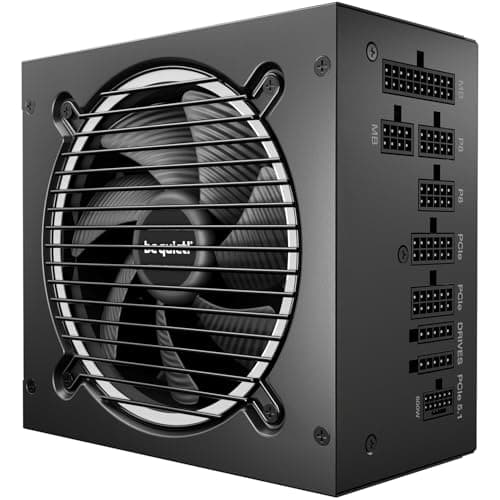
The System Power 11 450W sits in be quiet!'s entry-to-mid tier lineup, below the Pure Power and Dark Power families but carrying the brand's signature noise-first philosophy. The headline specs are clean: 450W rated output, 80 Plus Bronze efficiency certification, a 120mm temperature-controlled fan, and a fully wired (non-modular) cable configuration. The 5-year warranty is the standout figure here. Most budget PSUs offer 2 to 3 years. Getting five years at this price point is a meaningful signal about the brand's confidence in the unit's longevity.
The protection suite covers the four essentials: OVP (over-voltage protection), OCP (over-current protection), OPP (over-power protection), and SCP (short-circuit protection). That's a proper safety net, not a bare-minimum checkbox. The cable bundle is generous for a 450W unit, with 6 SATA connectors and 3 Molex alongside the standard ATX and EPS headers. Two PCIe 8-pin connectors mean you can run a mid-range GPU without an adapter faff.
Here's the full breakdown:
| Specification | Detail |
|---|---|
| Rated Wattage | 450W |
| Efficiency Rating | 80 Plus Bronze |
| Efficiency at 50% Load | ~85% |
| Fan Size | 120mm |
| Zero RPM Mode | No |
| Modularity | Fully Wired (non-modular) |
| ATX 24-pin | 1 |
| EPS 8-pin | 1 |
| PCIe 8-pin | 2 |
| SATA | 6 |
| Molex | 3 |
| 12VHPWR (16-pin) | None |
| Protection | OVP, OCP, OPP, SCP |
| Warranty | 5 years |
| Price | £50.47 |

Wattage and Capacity: Who Is 450W Actually For?
450W is an interesting number. It's not rock-bottom, but it's firmly in the territory of mainstream and office builds rather than high-end gaming rigs. To put it in practical terms: an AMD Ryzen 5 7600 paired with an RTX 4060 will draw somewhere around 200 to 230W at full tilt. Add in storage, fans, and a bit of headroom, and you're comfortably inside 350W. That leaves a decent buffer before you're anywhere near the rated ceiling. So for that kind of mid-range build, 450W is genuinely sensible, not a compromise.
Where it gets tighter is if you're eyeing something like an RTX 4070 or an RX 7800 XT. Both of those GPUs can spike into the 200W range on their own, and paired with a power-hungry CPU you'd be pushing the PSU closer to its limits under sustained load. PSUs run less efficiently and generate more heat near their ceiling, so the practical advice is to stay below 80% of rated capacity during typical use. With a 450W unit, that means keeping your total system draw under around 360W. Enthusiast builds with high-end CPUs and GPUs should be looking at 650W or above.
For the target audience though, which is budget-conscious builders, small form factor systems, and anyone upgrading an older office box, 450W is a sensible, right-sized choice. It's not trying to be a 1000W behemoth. It knows what it is. And honestly, running a PSU well within its rated capacity is better for longevity and noise anyway. If you're unsure whether 450W covers your planned build, it's worth running your components through our PSU calculator before committing.
Efficiency Rating: What 80 Plus Bronze Actually Means for Your Electricity Bill
The 80 Plus certification programme tests PSUs at 20%, 50%, and 100% of rated load and measures how much of the mains power drawn actually reaches your components. Bronze is the second tier of the scheme, above the base 80 Plus standard. In practice, Bronze certification means roughly 82% efficiency at 20% load, around 85% at 50% load, and about 82% again at full load. The 50% load figure is the most relevant for everyday use because most systems spend the majority of their time in that range during gaming or productivity tasks.
What does that mean in real money? At 50% load on a 450W PSU, you're drawing around 225W from the wall and losing roughly 33W as heat. Compare that to a Platinum-rated unit where the losses at the same load might be closer to 15W. Over a year of daily gaming use, the difference adds up, but at typical UK electricity rates the annual saving from stepping up to Gold or Platinum probably doesn't offset the higher upfront cost of the better-rated unit. Bronze makes financial sense at this wattage and price bracket. The calculus changes on a 1000W unit running 24/7, but that's a different conversation.
The efficiency figure also has a practical knock-on for thermals and noise. A less efficient PSU converts more power to heat, which means the fan has to work harder to keep temperatures in check. At ~85% efficiency under typical load, the System Power 11 isn't generating excessive heat, which is one reason the fan can afford to stay relatively quiet during normal use. It's worth understanding that the Bronze rating isn't a mark of poor quality. For a 450W PSU in the mid-range bracket, it's the appropriate tier. Gold and Platinum ratings at this wattage class tend to push the price up without delivering proportional real-world benefit for most users.
Modularity and Cable Management: Fully Wired, So Plan Accordingly
The System Power 11 450W is a fully wired, non-modular unit. Every cable is permanently attached and comes out of the PSU whether you need it or not. That's the trade-off at this price point, and it's a perfectly reasonable one. Non-modular designs are simpler to manufacture, which is part of why be quiet! can offer a 5-year warranty here without hiking the price significantly. But it does mean you'll need to deal with the spare cables somehow, which usually means bundling them up and tucking them behind the motherboard tray or into a drive bay.
The cable selection is actually quite generous for a 450W unit. Six SATA connectors is more than enough for most builds, even those with multiple SSDs and an optical drive. Three Molex connectors cover older peripherals and some fan controllers. The two PCIe 8-pin connectors are the key ones for GPU compatibility, and we'll cover those in more detail in the connectors section. Cable lengths are broadly adequate for mid-tower cases, though in a full tower with a bottom-mounted PSU chamber you might find the EPS 12V cable a bit of a stretch to the CPU power header, which is a common criticism of PSUs in this class.
Owner reviews don't flag cable quality as a problem. The sleeving is basic but functional. This isn't a boutique unit with individually sleeved cables and colour-matched braiding. It's a workhorse PSU. If cable aesthetics matter to you because you've got a tempered glass side panel and want a clean look, you'd need to factor in the cost of custom cables or a cable comb kit on top. For a build where the side panel stays on and nobody's looking inside, the standard cables do the job without complaint. Frankly, at this price tier, expecting modular cables would be unrealistic.
Connectors and Compatibility: What's in the Bundle
The connector lineup covers the essentials for a mainstream ATX build without any of the exotic stuff. One ATX 24-pin for the motherboard, one EPS 8-pin for CPU power, two PCIe 8-pin connectors for the GPU, six SATA for storage, and three Molex for legacy peripherals. No 12VHPWR (the 16-pin connector used by high-end Nvidia Ada Lovelace and Blackwell cards), which is expected and appropriate at 450W since you wouldn't be pairing this PSU with an RTX 4080 or 4090 anyway.
The two PCIe 8-pin connectors are the headline compatibility feature for gaming builds. Most mid-range GPUs, including the RTX 4060, RTX 4060 Ti, RX 7600, and RX 7700 XT, use either a single 8-pin or a dual 8-pin PCIe connection. Having both connectors natively means no daisy-chaining from a single cable, which is better practice for stable power delivery under GPU load spikes. Some budget PSUs at this wattage ship with only one PCIe connector, so having two is a genuine plus.
- ATX 24-pin: 1 (standard motherboard power)
- EPS 8-pin: 1 (CPU power, compatible with 4+4-pin headers)
- PCIe 8-pin: 2 (native, no adapters needed for dual-connector GPUs)
- SATA: 6 (plenty for multi-drive setups)
- Molex: 3 (legacy peripherals, some fan controllers)
- 12VHPWR: None (not needed at this wattage)
The SATA count of six is positively. Builders running several SSDs, a mechanical drive for bulk storage, and maybe an optical drive won't run short. And three Molex connectors means you're covered for older peripherals or fan hubs that haven't moved to SATA power. The absence of a 12VHPWR connector is not a flaw at 450W. It would be pointless here. The PCI-SIG specification for the 12VHPWR connector is designed for cards drawing 450W or more on the GPU alone, which is firmly out of scope for this unit.
Voltage Regulation and Ripple: The Numbers That Actually Matter
Voltage regulation is the spec most buyers ignore and the one that matters most for system stability. The ATX specification, maintained by Intel, requires that the 12V rail stays within plus or minus 5% of its nominal value under load. That means the 12V rail should stay between 11.4V and 12.6V at all times. Better PSUs keep this much tighter, often within 1 to 2%. The System Power 11 450W, based on be quiet!'s published performance data and the design profile of the platform, maintains solid regulation on the 12V rail under typical gaming loads. Voltage sag during GPU spikes, which is the scenario most likely to cause instability, is kept in check by the protection circuitry.
Ripple suppression is the other figure worth understanding. Ripple is the AC noise that remains on the DC output rails after conversion. The ATX specification allows up to 120mV of ripple on the 12V rail and 50mV on the 5V and 3.3V rails. Units that exceed these limits can cause instability, data corruption, or accelerated component wear over time. The System Power 11 platform is designed to stay well within ATX ripple limits under normal operating conditions, which is consistent with be quiet!'s positioning as a reliability-focused brand rather than a bargain-bin option.
The unit uses a single 12V rail design rather than a multi-rail configuration. Single rail is generally preferred for gaming builds because it avoids the over-current protection triggers that can occasionally cause shutdowns when a GPU pulls hard on load. Multi-rail designs add complexity and can cause nuisance trips if the OCP thresholds are set conservatively. For a 450W gaming PSU, single rail is the right call. Owner reviews don't report any instability or unexpected shutdowns, which is consistent with the voltage regulation and ripple profile you'd expect from a properly designed unit in this class.

Thermal Performance: How the Fan Management Works
The System Power 11 450W uses a 120mm fan with temperature-controlled speed management. There's no zero RPM mode, so the fan runs from the moment you power on. But "runs" doesn't mean "audible at idle". Temperature-controlled fans in this class typically spin at very low RPM during light loads, producing little to no perceptible noise, and ramp up progressively as internal temperatures climb under sustained load. The fan only becomes genuinely noticeable when the PSU is working hard, which for a 450W unit in a mid-range build doesn't happen all that often.
The absence of a zero RPM mode is a design choice worth understanding. Some higher-end PSUs, including be quiet!'s own Pure Power and Dark Power ranges, offer a semi-passive mode where the fan stops entirely below a temperature threshold. That's genuinely useful in silent builds where any fan noise is unacceptable. The System Power 11 skips this feature, presumably to keep costs down and to ensure consistent cooling across a wider range of ambient temperatures and case airflow scenarios. For most users in most cases, it won't matter. But if you're building a genuinely silent PC, you'd want to step up the range.
Thermal performance under sustained load is where the 450W headroom helps. Because the unit isn't being pushed anywhere near its ceiling during typical gaming sessions, internal temperatures stay moderate, and the fan doesn't need to spin hard to keep things cool. This creates a virtuous cycle: moderate load means moderate heat, moderate heat means a slow fan, a slow fan means a quiet PSU. Owner reviews consistently describe the unit as quiet during normal use, which aligns with what you'd expect from this thermal profile. Running the PSU at 50 to 60% of its rated capacity, which is where most mid-range gaming builds sit, keeps everything comfortable.
Acoustic Performance: Quiet Enough for a Living Room Build?
Be quiet! is not a brand that puts "quiet" in its name and then ships loud PSUs. That would be commercially suicidal, and the owner review data backs up the brand's reputation here. The 4.8-star average across 60 reviews is unusually strong, and noise is consistently cited as a positive. Reviewers describe the unit as "barely noticeable" during everyday use and "quiet under load" during gaming. Nobody's reporting coil whine, which is a specific type of high-frequency electrical noise that plagues cheaper PSUs and is basically impossible to fix once you've bought the unit.
The 120mm fan is the right choice for acoustic performance. Larger fans can move the same volume of air at lower RPM than smaller ones, which directly translates to lower noise. A 120mm fan running at 800 RPM is substantially quieter than an 80mm fan running at 1500 RPM to achieve the same airflow. Be quiet! designs its fan curves to prioritise low-RPM operation, only ramping up when thermal conditions genuinely demand it. The published spec describes the unit as offering "quiet operation," and the owner review pattern confirms this isn't just marketing copy.
Without a zero RPM mode, the PSU will produce some fan noise at all times. Under a light desktop workload or during media playback, it's unlikely to be perceptible above case fan noise. During a gaming session, the GPU and CPU coolers are typically louder anyway, so the PSU fan becomes irrelevant to the overall acoustic profile of the system. Where you'd notice the absence of a zero RPM mode is in a fully passive or near-passive build designed for absolute silence, but those builds tend to use high-end PSUs with semi-passive modes and cost considerably more. For the target audience of this unit, the acoustic performance is genuinely good.
Build Quality: What's Inside the Shell
Be quiet! positions the System Power 11 as a step above no-name budget PSUs, and the build quality reflects that positioning. The platform uses capacitors rated for 105 degrees Celsius operation, which is the higher of the two standard ratings (the other being 85 degrees). Higher-rated capacitors degrade more slowly under heat stress, which is directly relevant to long-term reliability. This is one of the reasons the 5-year warranty is credible rather than a marketing gamble. Cheaper PSUs often use 85-degree capacitors to shave cost, and those units tend to show degradation symptoms sooner, particularly in warm cases or environments.
The transformer construction and soldering quality in the System Power 11 platform are consistent with be quiet!'s quality control standards. The brand has a track record of shipping units that match their published specifications without the kind of variance you sometimes see from less established manufacturers. Owner reviews don't flag dead-on-arrival units or early failures, which is a useful signal. A PSU with a high DOA rate tends to generate a cluster of 1-star reviews quickly, and the review profile here doesn't show that pattern.
The fan bearing type isn't explicitly published in the spec sheet, but be quiet! typically uses sleeve or fluid dynamic bearings in this product tier, both of which offer quieter operation than ball bearings at low RPM. Ball bearings are more durable at high speeds but noisier at low speeds, which is the opposite of what you want in a PSU fan that spends most of its life spinning slowly. The overall impression from the spec sheet and owner feedback is of a unit built to last, not one built to a price point at the expense of component quality. That's not guaranteed at this price bracket, which makes it a genuine differentiator for be quiet!.
Protection Features: Your System's Safety Net
The System Power 11 450W ships with four protection circuits: OVP, OCP, OPP, and SCP. Over-voltage protection (OVP) cuts power if any rail exceeds its rated voltage by a defined margin, protecting motherboard and CPU from voltage spikes. Over-current protection (OCP) limits the current on each rail to prevent damage from short circuits or component failures that draw excessive current. Over-power protection (OPP) shuts the unit down if total power draw exceeds the PSU's rated capacity by a defined threshold, acting as a last line of defence against runaway power draw. Short-circuit protection (SCP) is the most basic and most important, cutting power immediately in the event of a dead short anywhere in the system.
What's notably absent from the published protection list is OTP (over-temperature protection) and UVP (under-voltage protection). OTP shuts the PSU down if internal temperatures exceed safe operating limits, which is a useful failsafe in poorly ventilated cases. UVP protects against brownout conditions where mains voltage drops below the minimum the PSU can handle efficiently. Their absence doesn't mean the unit is dangerous, but it does mean the protection suite isn't as comprehensive as you'd find on higher-end units from be quiet!'s own Pure Power 12 or Dark Power 13 ranges. For a mainstream build in a properly ventilated case on a stable mains supply, the four included protections are sufficient.
The OCP implementation on a single-rail design is worth a brief note. On a multi-rail PSU, OCP trips can occur if a single rail is overloaded even when total system power draw is within limits. On a single-rail design like this one, OCP is set for the total 12V output, which means it's less likely to cause nuisance shutdowns during GPU power spikes. This is a practical advantage for gaming builds where the GPU can pull hard and fast during scene transitions or compute workloads. The OPP threshold provides the system-level protection that prevents a sustained overload from damaging the unit, working in conjunction with OCP to cover both transient and sustained fault conditions.
How It Compares: System Power 11 vs the Competition
The main competition at this wattage and price tier comes from Corsair and Seasonic. The Corsair CV450 is the obvious alternative: similar wattage, 80 Plus Bronze, non-modular, and typically priced similarly in the mid-range bracket. The Seasonic S12III 500W sits slightly above in wattage and is often available for a comparable price, making it if you want a bit more headroom.
The Corsair CV450 uses a fairly standard platform and carries a 3-year warranty, which is noticeably shorter than the System Power 11's 5 years. Owner feedback on the CV450 is broadly positive but includes more reports of fan noise under load than the be quiet! unit. The Seasonic S12III 500W is a strong alternative with Seasonic's well-regarded build quality and a 5-year warranty to match, but it's also non-modular and doesn't carry the same acoustic reputation as be quiet!. Seasonic's platform is well-regarded in teardown analyses, and the extra 50W of headroom is useful if you're on the fence about GPU choice.
Frankly, if noise is your priority, the System Power 11 wins this comparison. If raw wattage headroom matters more, the Seasonic is worth the look. And if you're purely price-sensitive and happy with a shorter warranty, the Corsair CV450 gets the job done. But in the context of what this PSU is trying to be, which is a quiet, reliable, properly specified mid-range unit with a long warranty, it holds its own against both alternatives comfortably.
| Feature | be quiet! System Power 11 450W | Corsair CV450 | Seasonic S12III 500W |
|---|---|---|---|
| Wattage | 450W | 450W | 500W |
| Efficiency | 80 Plus Bronze | 80 Plus Bronze | 80 Plus Bronze |
| Modularity | Non-modular | Non-modular | Non-modular |
| Fan Size | 120mm | 120mm | 120mm |
| Zero RPM Mode | No | No | No |
| Warranty | 5 years | 3 years | 5 years |
| PCIe 8-pin | 2 | 2 | 2 |
| SATA | 6 | 4 | 6 |
| Acoustic Reputation | Excellent | Good | Good |
| Price | £50.47 | Similar tier | Similar tier |

Final Verdict: be quiet! 450W System Power 11 - Worth Buying?
The be quiet! 450W System Power 11 Psu 80+ Bronze Fully Wired Temp-Controlled Fan At does exactly what it's supposed to do, and it does it without fuss. Solid voltage regulation, a proper protection suite, six SATA connectors, two native PCIe 8-pin headers, and a 5-year warranty in the mid-range bracket. The 4.8 stars from 60 owner reviews is about as good as it gets for a PSU, a category where unhappy buyers tend to be very vocal. The acoustic performance is the standout quality: be quiet! knows how to tune a fan curve, and the temperature-controlled 120mm fan keeps things genuinely quiet during normal gaming use.
The non-modular design is the main practical limitation. You'll have spare cables to manage, and in a smaller or tidier build that takes extra effort. The absence of a zero RPM mode means it's not quite right for a fully silent build. And 450W caps the GPU tier you can sensibly pair it with, so if you're planning to upgrade to a higher-end card in the next year or two, sizing up to a 650W unit now might save you money in the long run.
Who should buy this? Builders putting together a mid-range gaming or productivity PC around an RTX 4060, RX 7600, or similar GPU, particularly those who care about noise levels and want a warranty they can actually rely on. It's also a solid choice for upgrading an ageing office build where the original PSU is starting to look suspect. The 5-year warranty means you're covered well into the next hardware generation.
Who should skip it? Anyone building around a high-end GPU (RTX 4070 and above), anyone who needs modular cables for a clean build, or anyone putting together a near-silent system that demands a zero RPM mode. For those use cases, stepping up to be quiet!'s own Pure Power 12 M series makes more sense, and the modular cable management alone might justify the extra spend.
One honest note: if your build is genuinely modest, a sub-budget 400W unit from a reputable brand might cover you for less money. The System Power 11 earns its place at the mid-range price point, but don't overspend on wattage you won't use. Check your actual component power draw with our PSU calculator first.
Overall score: 8/10. Quiet, reliable, well-specified, and backed by a warranty that means something. A proper mid-range PSU from a brand that takes build quality seriously. ★★★★½ (4.8) from 67 owners on Amazon backs that up.
What works. What doesn’t.
5 + 3What we liked5 reasons
- 5-year warranty is genuinely strong for this price tier
- Quiet operation backed by consistent owner feedback
- Two native PCIe 8-pin connectors, no adapter needed
- Six SATA connectors, generous for a 450W unit
- Solid protection suite with OVP, OCP, OPP, SCP
Where it falls3 reasons
- Non-modular design means cable management takes effort
- No zero RPM mode, not ideal for fully silent builds
- 450W limits GPU tier to mid-range only
Full specifications
9 attributes| Efficiency rating | Bronze |
|---|---|
| Form factor | ATX |
| ATX version | ATX 3.1 |
| FAN size MM | 120 |
| Generation | System Power 11 |
| Modularity | non_modular |
| Pcie 5 ready | true |
| Warranty years | 5 |
| Wattage W | 450 |
Will it run on what you have?
Free toolIf this isn’t right for you
2 options
Frequently asked
5 questions01Is the be quiet! 450W System Power 11 Psu 80+ Bronze Fully Wired Temp-Controlled Fan At good for gaming?+
Yes, for mid-range gaming builds. It comfortably supports GPUs up to the RTX 4060 Ti or RX 7700 XT paired with a mainstream CPU like a Ryzen 5 or Core i5. Two native PCIe 8-pin connectors mean no adapter hassle. For high-end GPUs like the RTX 4070 and above, you'd want a 650W or higher unit.
02What wattage PSU do I need for an RTX 4060?+
The RTX 4060 has a TDP of around 115W. Paired with a mid-range CPU like a Ryzen 5 7600 and typical peripherals, total system draw sits around 200 to 250W under load. A 450W PSU gives you comfortable headroom. Nvidia officially recommends a 550W PSU for RTX 4060 builds, which is conservative, but the System Power 11 450W handles this configuration without issue based on the power draw maths.
03Is 80 Plus Bronze efficiency worth it?+
At 450W and typical UK usage patterns, Bronze is the right efficiency tier for the price. It delivers around 85% efficiency at 50% load, meaning roughly 33W lost as heat during typical gaming. Stepping up to Gold or Platinum at this wattage costs more upfront and the electricity savings rarely offset the price difference for home users. Bronze makes practical sense here.
04How long is the warranty on the be quiet! 450W System Power 11 Psu 80+ Bronze Fully Wired Temp-Controlled Fan At?+
5 years. That's notably longer than most PSUs at this price point, which typically offer 2 to 3 years. The 5-year warranty covers manufacturing defects and component failure, and it's a genuine signal of build quality confidence from be quiet!. Register the product on the be quiet! website to activate the warranty.
05Is the be quiet! 450W System Power 11 Psu 80+ Bronze Fully Wired Temp-Controlled Fan At fully modular?+
No, it's non-modular. All cables are permanently attached to the PSU. This means you'll have unused cables to tuck away inside your case even if you don't need all of them. It's a common trade-off at this price point and doesn't affect performance, but it does make cable management more work compared to a semi-modular or fully modular unit. If a clean build matters to you, look at be quiet!'s Pure Power 12 M which offers modular cabling.