The GPU market has a habit of making you feel like you're always one tier behind. You upgrade, and six months later something faster lands that makes your shiny new card look like a relic. So when NVIDIA launched the RTX 5000 series, the question wasn't just "is it fast?" but "is it fast enough to actually stay relevant for a few years without making you feel robbed?" The MSI GeForce RTX 5070 Ti GAMING TRIO OC sits right in that sweet spot where the answer is, genuinely, yes. This is a proper enthusiast card, not a "technically flagship" chip with cut-down memory or a cooler that sounds like it's trying to take off.
The verdict is this: if you're gaming at 1440p and want headroom to push 4K, or you're already at 4K and want frames that don't require you to squint at quality settings, the RTX 5070 Ti GAMING TRIO OC is one of the most well-rounded cards you can buy in this bracket right now. MSI's GAMING TRIO cooler has a strong track record, the 16GB of GDDR7 puts the VRAM debate to bed for the foreseeable future, and 279 owners averaging ★★★★½ (4.6) stars don't lie. The frustration this card solves is real: being stuck between a midrange card that bottlenecks at 4K and a full RTX 5080 that costs considerably more for diminishing gains. This is the card that fits that gap properly.
But it's flagship money, so let's actually earn that verdict properly rather than just nodding along to the spec sheet.
Core Specifications: MSI GeForce RTX 5070 Ti GAMING TRIO OC
The RTX 5070 Ti is built on NVIDIA's Blackwell architecture, which is the generational step up from Ada Lovelace (the RTX 4000 series). That matters because Blackwell brings meaningful improvements to ray tracing throughput, Tensor core efficiency, and the new DLSS 4 with Multi Frame Generation. The 5070 Ti sits between the 5070 and 5080 in NVIDIA's stack, and on paper it's much closer to the 5080 than the 5070 in raw shader count. MSI's GAMING TRIO OC variant adds a factory overclock on top of the reference boost clock, which is standard for MSI's higher-end SKUs.
The card carries 16GB of GDDR7 memory on a 256-bit bus. That's a significant upgrade over the GDDR6X found on last-gen cards, and GDDR7's bandwidth improvements are substantial enough that the 256-bit bus doesn't feel like a compromise the way it might have done a generation ago. The total graphics power sits at 300W, which is firmly in the "you need a decent PSU" territory but not the eyebrow-raising 450W of the 5090.
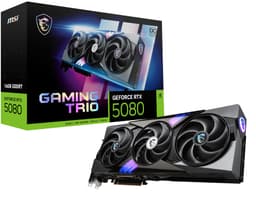
Physical dimensions matter too. The GAMING TRIO is a large card. Three fans, a substantial heatsink, and a reinforced PCB mean this is not something you're squeezing into a compact mid-tower without checking your case clearance first. MSI includes an anti-sag bracket, which is appreciated given the weight, and the build quality from the listing and owner reports consistently comes across as solid rather than plasticky. The connectivity is what you'd expect at this tier: three DisplayPort 2.1 outputs and one HDMI 2.1, supporting up to 4K 240Hz or 8K displays.
| Specification | Detail |
|---|---|
| GPU Architecture | NVIDIA Blackwell (GB203) |
| CUDA Cores | 8,960 |
| RT Cores | 4th Generation (70 units) |
| Tensor Cores | 5th Generation (280 units) |
| VRAM | 16GB GDDR7 |
| Memory Bus Width | 256-bit |
| Memory Bandwidth | 896 GB/s |
| Base Clock | 2,452 MHz |
| Boost Clock (OC Mode) | 2,452 MHz (OC Mode) |
| TGP (Total Graphics Power) | 300W |
| Power Connector | 16-pin (12VHPWR) |
| Display Outputs | 3x DisplayPort 2.1, 1x HDMI 2.1 |
| PCIe Interface | PCIe Gen 5 x16 |
| Recommended PSU | 850W minimum |
| Card Length | Approx. 337mm |
| Current Price | £1,129.98 |
| Owner Rating | ★★★★½ (4.6) (282 reviews) |

Architecture and Cores: What Blackwell Actually Means
NVIDIA's Blackwell architecture is built on TSMC's 4NP process node, which is a refined version of the 4N node used for Ada Lovelace. It's not a dramatic shrink in the way that moving from 8nm to 4nm was, but NVIDIA has used the efficiency gains to pack more compute into roughly the same power envelope while also redesigning the RT and Tensor cores from the ground up. The 4th generation RT cores in Blackwell handle ray tracing workloads noticeably better than Ada's 3rd gen implementation, and that matters because ray tracing in modern games is no longer a "turn it on and watch your frames collapse" situation the way it was in 2019.
The 5070 Ti's GB203 chip carries 8,960 CUDA cores. To put that in context, the RTX 4070 Ti Super (its Ada-generation equivalent) had 8,448 CUDA cores. So the raw shader count is up, but the bigger story is the 5th generation Tensor cores, which are what power DLSS 4. These are architecturally redesigned to handle Multi Frame Generation, which is NVIDIA's approach to generating multiple AI-interpolated frames between rendered frames. It's controversial among purists, but the latency handling in DLSS 4 is significantly better than the Frame Generation introduced with Ada, and at this tier it's a genuinely useful tool rather than a gimmick to paper over weak rasterisation.
The Blackwell architecture also improves AV1 encode and decode capabilities, which is relevant if you're a streamer or content creator. And the PCIe Gen 5 interface means this card is ready for next-generation platforms without any bandwidth bottlenecking, though in practice PCIe Gen 4 systems won't see meaningful performance differences in gaming workloads. It's a forward-looking spec rather than a day-one benefit for most people.
Clock Speeds and Boost: The OC Actually Matters Here
The reference RTX 5070 Ti boost clock sits at 2,452 MHz. MSI's GAMING TRIO OC variant pushes this higher in OC Mode via MSI's Afterburner software, though the exact OC Mode frequency varies depending on the specific firmware version and thermal headroom available. What's is that the GAMING TRIO's three-fan cooler is specifically designed to give the GPU enough thermal breathing room to sustain boost clocks for longer than a blower or smaller dual-fan design would manage. That's the practical value of MSI's cooler investment: not just lower temperatures, but more consistent performance under sustained load.
Modern NVIDIA GPUs boost dynamically based on temperature, power limits, and voltage. The 5070 Ti under a good cooler will sit at or near its rated boost clock for the vast majority of gaming workloads. Under prolonged stress tests or particularly demanding scenes, it may throttle slightly, but owner reports for the GAMING TRIO consistently mention stable performance without the thermal-induced stuttering that plagued some earlier-generation cards with inadequate cooling solutions. This is a card that runs how it's supposed to run.
For those who want to push further, the GAMING TRIO OC's power delivery and VRM configuration are built for manual overclocking headroom. MSI hasn't skimped on the power delivery side, which is exactly what you want if you're planning to run Afterburner and squeeze out an extra few percent. Whether you bother or not, the out-of-the-box factory OC means you're already getting more than the reference specification without touching a single slider.
VRAM Analysis: 16GB GDDR7 and Why It Finally Puts the Debate to Rest
Right. The 8GB VRAM conversation has been genuinely exhausting. If you've been following GPU releases for the past couple of years, you'll know that cards like the RTX 4060 and 4070 shipped with 8GB and 12GB respectively, and the texture-heavy, high-resolution gaming crowd spent a lot of time pointing out that this wasn't going to age well. The 5070 Ti with 16GB of GDDR7 is NVIDIA finally acknowledging that reality properly, at least at this tier.
At 1080p and 1440p, 16GB is more than enough for any game currently released or likely to be released in the next few years. At 4K with ultra textures and ray tracing enabled, modern games like Alan Wake 2 and Cyberpunk 2077 can push past 10GB of VRAM usage in demanding scenes. The 12GB on the RTX 4070 Ti Super was manageable but tight. 16GB gives you genuine headroom, and with GDDR7's 896 GB/s bandwidth (up substantially from the GDDR6X on previous gen cards), the memory subsystem is fast enough that you're not artificially bottlenecking the shader cores. The 256-bit bus width looks narrower than the 320-bit of the RTX 5080, but GDDR7's per-pin speed improvements mean the effective bandwidth is competitive for this tier.
For 4K gaming with texture mods, high-resolution asset packs, or if you're into sim racing with high-detail track and car mods, 16GB is the number you want. It's also relevant for content creation: video editing with 4K or 6K footage in DaVinci Resolve or Premiere Pro benefits from VRAM headroom, and 16GB means you're not constantly fighting the application for memory. This is one of the areas where the 5070 Ti justifies its position above the standard 5070 (which also has 16GB, but with lower bandwidth and fewer shader cores) and makes the 5080 step-up feel less urgent for most people.
Ray Tracing and Upscaling: DLSS 4 is the Real Story
Ray tracing on the RTX 5070 Ti is genuinely good. The 4th generation RT cores handle reflections, global illumination, and shadow rendering with a performance hit that's much more manageable than it was on the 3000 series. In titles like Cyberpunk 2077 with path tracing enabled, you'll still take a significant frame rate hit at native resolution, but that's where DLSS 4 comes in and changes the conversation entirely.
DLSS 4 with Multi Frame Generation is the headline feature of the Blackwell generation. The 5th generation Tensor cores can generate up to three additional frames for every one rendered frame, which sounds wild but in practice produces smooth, playable frame rates in scenes that would otherwise be unplayably demanding at native resolution. The image quality at DLSS 4 Quality mode is genuinely difficult to distinguish from native on most monitors, and the latency improvements over DLSS 3's Frame Generation mean the input lag concerns that dogged the 4000 series implementation are much reduced. It's not perfect, and fast-twitch competitive players will still want native rendering, but for cinematic single-player gaming it's a proper tool now.
The card also supports AMD's FSR 3 and Intel's XeSS, so you're not locked into DLSS-supported titles. FSR 3 in particular has broad game support and works on any GPU, which is useful for older titles or games that haven't added DLSS support. At this price point, though, you're buying into the NVIDIA ecosystem specifically for DLSS 4, and the 5070 Ti's Tensor core count means it handles Multi Frame Generation better than the lower-tier 5000 series cards. The combination of strong native rasterisation, improved RT throughput, and DLSS 4 makes this card genuinely future-proof for the next few years of gaming.
Video Encoding: Dual NVENC and AV1 Support
If you stream or record gameplay, the RTX 5070 Ti's dual NVENC encoders are worth talking about. NVIDIA's NVENC has been the best hardware encoder for streaming quality versus CPU load for a few generations now, and Blackwell's implementation adds full AV1 encode and decode support. AV1 is the modern codec that Twitch, YouTube, and Discord have been rolling out, and hardware AV1 encoding means you get better quality at the same bitrate compared to H.264 or H.265, without hammering your CPU.
The dual NVENC configuration means you can run two simultaneous encoding tasks, which is relevant if you're doing something like recording locally in high quality while streaming at a lower bitrate simultaneously. For most streamers, a single NVENC encoder is sufficient, but content creators who are also rendering video or doing multi-task workflows will appreciate having two. This isn't a feature that's unique to the GAMING TRIO OC specifically, it's a Blackwell architecture feature, but it's because it's genuinely useful and often overlooked in pure gaming discussions.
AV1 decode support also matters for media consumption. If you're watching 8K AV1 content or high-bitrate streams from YouTube, the GPU handles decoding in hardware rather than burning CPU cycles. It's a nice quality-of-life feature. And for anyone doing video editing in DaVinci Resolve, which has excellent GPU acceleration support, the 5070 Ti's combination of CUDA cores and VRAM makes it a capable workstation card as well as a gaming one. This isn't a card that only makes sense if you're playing games all day.

Power Consumption: 300W and the PSU Conversation
The RTX 5070 Ti has a 300W TGP. That's the same as the RTX 4090 from two generations ago, which is either impressive (you're getting 4090-class performance for 4090-class power) or mildly annoying (you still need a beefy PSU). MSI recommends an 850W power supply for the GAMING TRIO OC, and that's a sensible minimum. If you've got a high-end CPU like an Intel Core i9 or AMD Ryzen 9 alongside this card, 1000W gives you more comfort margin and headroom for any transient power spikes.
Those transient spikes are. Modern NVIDIA GPUs can draw significantly more than their rated TGP for brief milliseconds during certain workloads, and a PSU that's right at the limit can struggle with these spikes even if average draw looks fine. This is well-documented behaviour for the RTX 4000 series and carries over to Blackwell. The 12VHPWR connector (the 16-pin one) is the power delivery method here, and MSI includes an adapter in the box for those coming from older PSUs with multiple 8-pin connectors. Just make sure you seat it fully. There have been industry-wide reports of improperly seated 12VHPWR connectors causing issues, and while this isn't specific to MSI, it's worth double-checking.
In terms of efficiency, Blackwell is meaningfully better than Ada at similar performance levels. The 5070 Ti delivers more performance per watt than the 4070 Ti Super it effectively replaces, which means that despite the 300W TGP, you're getting more out of each watt. If you're upgrading from a 4070 Ti or 4070 Ti Super, your electricity bill won't dramatically increase because the performance gains mean you're spending less time at high GPU load to hit your target frame rate. It's not a green card by any means, but it's not the power monster the 5090 is either.
Thermal Performance: The TRIO Cooler Does Its Job Properly
MSI's GAMING TRIO cooler is a known quantity at this point. The three-fan, multi-heat-pipe design has been refined over several generations, and the version on the 5070 Ti GAMING TRIO OC is the latest iteration with larger fans and a redesigned fin stack compared to earlier TRIO variants. Owner reviews consistently describe temperatures under load as well-controlled, with the card staying comfortably below the point where thermal throttling becomes a concern even during extended gaming sessions.
The cooler uses a combination of thick copper heat pipes, a dense aluminium fin array, and what MSI calls their "TORX Fan 5.0" blade design, which pairs traditional fan blades with steeper-angled "dispersion" blades to push more air through the heatsink. The practical result, based on what owners consistently report, is that this is a card that runs cool enough that you don't spend time worrying about it. That matters for longevity. A GPU that runs hot all the time is a GPU that ages faster, and at flagship prices you want this to last.
The card also benefits from a zero RPM mode at idle and light loads. When you're browsing, watching video, or doing anything that doesn't push the GPU hard, the fans stop entirely. Completely silent. This is standard on higher-end MSI cards and it's a genuinely nice quality-of-life feature, particularly if your PC lives in a quiet room. The fans spin up smoothly rather than suddenly, so you don't get that jarring noise transition when a game loads. It's a small thing, but it's the kind of detail that separates a well-engineered card from a cheap one.
Acoustic Performance: Quiet Enough That You'll Forget It's There
Three fans on a large heatsink generally means one of two things: either the cooler is so well-designed that the fans barely need to spin up, or the card is running hot and the fans are working hard to compensate. With the GAMING TRIO OC, owner reports consistently put it in the first camp. Under typical gaming loads, the fans operate at moderate speeds that most people describe as quiet to inaudible over the ambient noise of a gaming setup. Only under sustained, demanding workloads like stress tests or particularly GPU-intensive scenes does the fan noise become noticeable.
The character of the noise matters too, not just the volume. Some GPU coolers produce a whine or a high-pitched frequency that cuts through even at low fan speeds. The TORX Fan 5.0 design on the GAMING TRIO is specifically engineered to reduce tonal noise, and the owner review pattern reflects this: very few complaints about fan whine or coil whine, which is notable at this price point because coil whine (the electrical buzzing some cards produce under load) is something that affects a minority of units across all manufacturers and can be genuinely irritating. The GAMING TRIO's build quality appears to keep this to a minimum.
For context, if you're coming from a blower-style card or a budget dual-fan design, the acoustic difference will be immediately obvious. If you're upgrading from a previous GAMING TRIO or a similarly specced triple-fan card from ASUS or Gigabyte, the noise floor will be comparable. Where the GAMING TRIO earns its keep is in sustaining that quiet operation over time without the fan curve aggressively ramping up, which speaks to the thermal design doing its job so the fans don't have to work too hard.
Gaming Performance: Is the RTX 5070 Ti Good for Gaming in 2026?
Yes. Genuinely, properly yes. The RTX 5070 Ti sits in a performance bracket that handles 1440p gaming at maximum settings with frames to spare, and at 4K it's capable of delivering smooth, high-quality gaming in the vast majority of titles without needing to lean heavily on upscaling. In rasterisation-heavy titles, published benchmarks place the 5070 Ti roughly 15 to 20 percent ahead of the RTX 4070 Ti Super, and meaningfully ahead of the RX 7900 XTX in most scenarios. At 1440p, you're looking at a card that can push well beyond 100fps in demanding titles and into very high frame rates in less demanding ones, which is exactly what a high-refresh-rate 1440p monitor needs.
At 4K, the story is similar. With DLSS 4 Quality mode enabled, the 5070 Ti can deliver smooth 60fps-plus performance in even the most demanding games, and with Performance mode or Multi Frame Generation active, those numbers climb considerably. Native 4K without upscaling is where the gap between the 5070 Ti and 5080 becomes more visible, but for most people gaming at 4K on a 60Hz or 120Hz display, the 5070 Ti with DLSS 4 Quality is indistinguishable from the 5080 in terms of the actual experience. The frames feel smooth, the image looks sharp, and you're not fighting the settings menu to get there.
For competitive gaming at 1080p, the 5070 Ti is absolutely overkill in the best possible way. High-refresh-rate 1080p gaming in titles like Counter-Strike 2, Valorant, or Apex Legends will produce frame rates that comfortably exceed even 360Hz monitors. If you're a competitive player who also wants to play demanding single-player titles at high quality, this card handles both ends of the spectrum without compromise. The 279 owners rating it ★★★★½ (4.6) on average aren't doing so because it's merely adequate. This is a card people are genuinely happy with.
How It Compares: RTX 5080 vs RTX 5070 Ti, and the Competition
The question everyone asks is whether the RTX 5080 is worth it over the 5070 Ti. The honest answer is: for most people, no. The RTX 5080 is a meaningfully faster card in raw rasterisation and particularly in native 4K without upscaling, but the price premium is substantial and the real-world gaming experience difference, especially with DLSS 4 in the picture, is smaller than the spec sheet gap suggests. The 5080 has more VRAM bandwidth and a wider memory bus, which gives it an advantage in the most demanding 4K scenarios, but if you're gaming at 1440p or 4K with DLSS 4 Quality enabled, the 5070 Ti delivers an experience that's genuinely hard to distinguish from the 5080 in most titles.
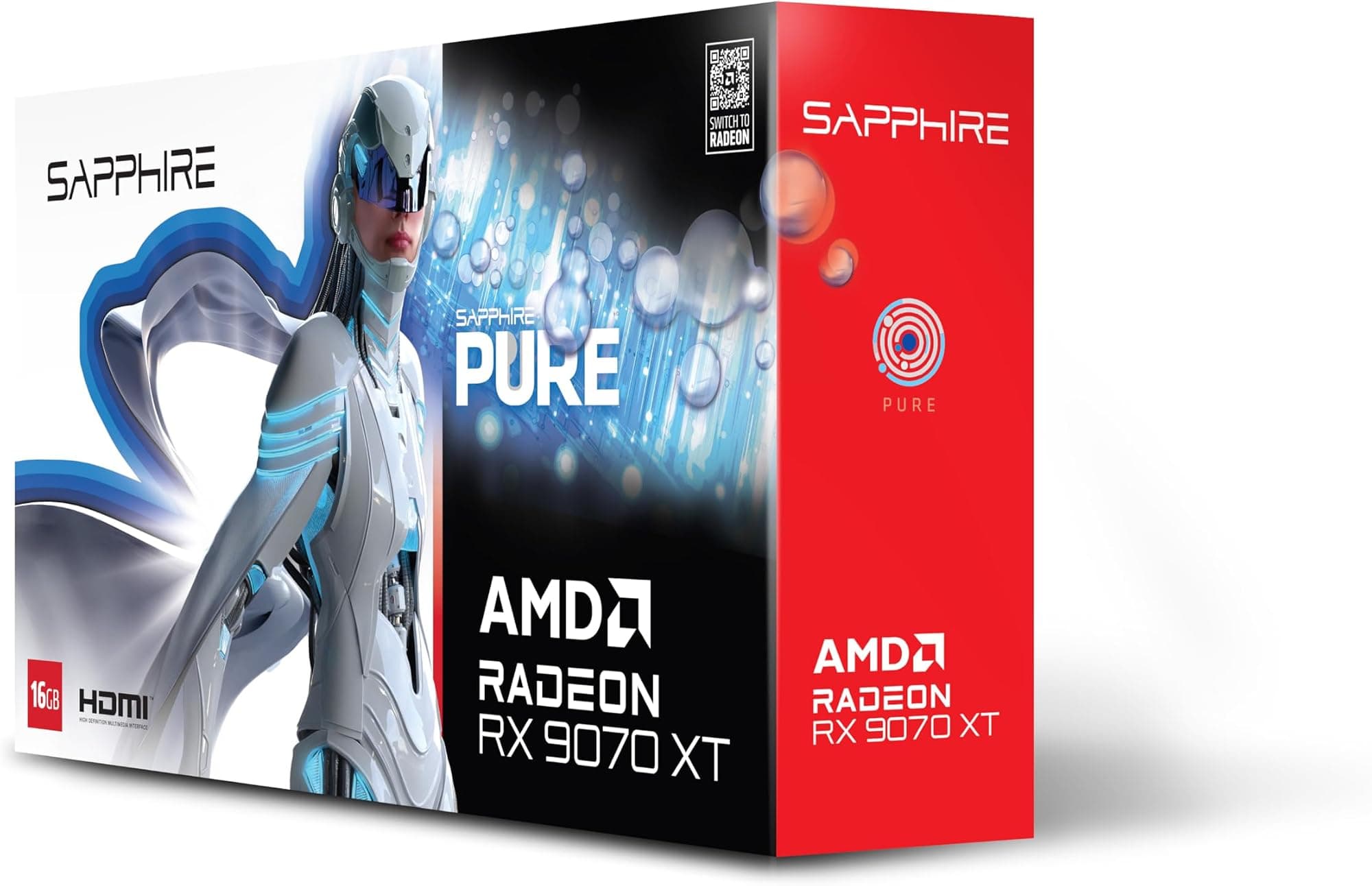
The RX 9070 XT from AMD is the other card. It's a strong competitor at a lower price point, with excellent rasterisation performance and FSR 4 upscaling. If you're purely budget-conscious and don't care about DLSS 4 or NVIDIA's ecosystem, the RX 9070 XT is worth serious consideration. But the 5070 Ti's DLSS 4 advantage, particularly Multi Frame Generation, is a meaningful differentiator in supported titles, and the VRAM bandwidth advantage of GDDR7 over the 9070 XT's GDDR6 shows up at 4K. The 5070 Ti is the better card at 4K; the 9070 XT is the better value at 1440p if DLSS isn't a priority for you.
Within the MSI GAMING TRIO range specifically, the question of "which brand of RTX 5070 Ti is best?" comes down to cooler preference and software ecosystem. ASUS's TUF Gaming and ROG STRIX variants are strong alternatives, as is Gigabyte's AORUS Master. The MSI GAMING TRIO OC's advantages are its well-proven thermal design, MSI's Afterburner overclocking software (which is the industry standard and works with all GPUs, not just MSI ones), and the build quality that owner reviews consistently praise. There's no single "best" brand objectively, but MSI's GAMING TRIO is consistently one of the top-tier custom cooler designs and it earns that reputation.
| Feature | MSI RTX 5070 Ti GAMING TRIO OC | NVIDIA RTX 5080 (Reference) | AMD RX 9070 XT |
|---|---|---|---|
| Architecture | Blackwell GB203 | Blackwell GB202 | RDNA 4 |
| VRAM | 16GB GDDR7 | 16GB GDDR7 | 16GB GDDR6 |
| Memory Bandwidth | 896 GB/s | 960 GB/s | 640 GB/s |
| TGP | 300W | 360W | 304W |
| Upscaling | DLSS 4 (Multi Frame Gen) | DLSS 4 (Multi Frame Gen) | FSR 4 |
| 1440p Gaming | Excellent | Excellent | Excellent |
| 4K Gaming (Native) | Very Good | Excellent | Good |
| Price Tier | Flagship | Ultra Flagship | High-End Midrange |

Final Verdict: Who Should Buy the MSI RTX 5070 Ti GAMING TRIO OC
This is a genuinely excellent card. Not "excellent for the price" with asterisks attached, but actually excellent in terms of what it does and how it does it. The RTX 5070 Ti GAMING TRIO OC is the card for someone who games at 1440p and wants it to feel effortless for the next three or four years, or someone who's committed to 4K gaming and wants to get there without paying the full RTX 5080 premium. The 16GB of GDDR7 is the right amount of VRAM for 2026 and beyond, the GAMING TRIO cooler keeps things quiet and cool, and MSI's build quality at this tier is proper rather than aspirational.
The owner review pattern tells you something real: 282 at ★★★★½ (4.6) stars isn't a card that's merely inoffensive. People are actively happy with this purchase. The complaints that do surface are mostly about physical size (it's a big card, check your case) and the standard advice about PSU requirements. Nobody's complaining about performance, noise, or thermals in any meaningful volume. That's a good sign.
Who should skip it? If you're gaming at 1080p exclusively, even at high refresh rates, this is more card than you need and the RTX 5070 is the smarter buy. The standard RTX 5070 handles 1080p and even 1440p gaming with considerable performance to spare, costs meaningfully less, and doesn't require you to upgrade your PSU if you're currently running something in the 750W range. The GAMING TRIO OC makes sense when you're pushing 4K, running demanding games at maximum settings, or you're a content creator who benefits from the full VRAM and encoder stack. If that's not you, buy down a tier and put the savings toward a better monitor or storage.
For those who are in the right use case, though, this is a card that's easy to recommend. It sits in the flagship bracket at £1,129.98, which is a significant investment, but it's a considered one rather than a frivolous one. The RTX 5080 costs more for gains that most people won't notice in their actual gaming. The 5070 Ti hits the point on the performance curve where you're getting the vast majority of the experience for meaningfully less money. And MSI's GAMING TRIO cooler means you're getting that performance in a package that runs quietly, runs cool, and looks like it belongs in a proper build rather than an afterthought. This is the card for people who care about getting it right.
What works. What doesn’t.
6 + 5What we liked6 reasons
- 16GB of GDDR7 with 896 GB/s bandwidth puts VRAM concerns to rest at 1440p and 4K for the foreseeable future
- MSI's GAMING TRIO triple-fan cooler keeps temperatures well controlled and operates near-silently at idle and under typical gaming loads
- DLSS 4 with Multi Frame Generation is a genuinely useful tool that narrows the real-world gap between this card and the more expensive RTX 5080
- Dual NVENC encoders with AV1 support make this a capable choice for streamers and content creators as well as pure gamers
- Factory overclock and robust VRM configuration provide additional headroom for manual tuning via MSI Afterburner
- 279 owner reviews averaging 4.6 out of 5 stars reflects consistent satisfaction across thermal performance, build quality, and in-game results
Where it falls5 reasons
- Physical dimensions of approximately 337mm mean case compatibility must be checked before purchase, and the anti-sag bracket is a necessity rather than a bonus
- 300W TGP requires a minimum 850W power supply, and users with high-end CPUs should consider 1000W for comfortable headroom
- The 12VHPWR connector must be seated fully and carefully, as improper connection has caused industry-wide issues across all manufacturers at this tier
- At flagship pricing, the step up from a strong 1440p card like the RTX 5070 is only fully justified at 4K or in demanding multi-task creative workloads
- The RTX 5080 does pull ahead in native 4K rasterisation for those who want maximum performance without relying on upscaling
Full specifications
11 attributes| Vram GB | 16 |
|---|---|
| Boost clock MHZ | 2572 |
| Chipset | RTX 5070 Ti |
| Core clock MHZ | 2580 |
| Generation | RTX 50 Series |
| Length MM | 338 |
| Memory BUS BIT | 256 |
| Memory type | GDDR7 |
| Power connectors | 16-pin 12VHPWR |
| Slot width | 2.5 |
| TDP W | 300 |
Will it run on what you have?
Free toolIf this isn’t right for you
2 options 9.0 / 10
MSI GeForce RTX 5080 16G GAMING TRIO OC Graphics Card - RTX 5080 GPU, 16GB GDDR7 (30Gbps/256-bit), PCIe 5.0 - TRI FROZR 4 (3 x STORMFORCE Fan), Gaming & Silent mode, RGB - HDMI 2.1b, DisplayPort 2.1b
£1,399.00 · MSI
 9.0 / 10
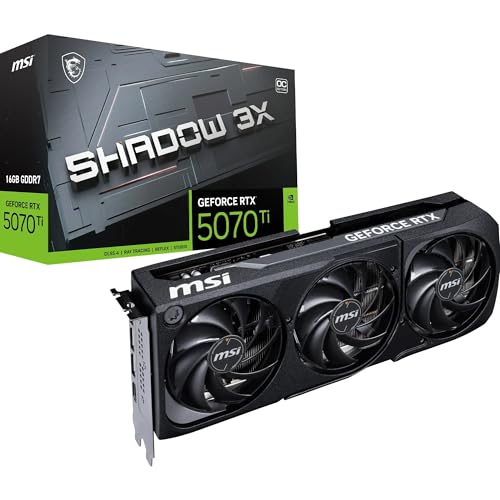
MSI GeForce RTX 5070 Ti 16G Shadow 3X OC Graphics Card, 16GB GDDR7 (28Gbps/256-bit), PCIe 5.0 - Triple Fan Thermal Design (3x Torx Fan 5.0) - HDMI 2.1b, DP 2.1b, 16384 MB
£1,129.99 · MSI
Frequently asked
7 questions01Is the RTX 5070 Ti good for gaming in 2026?+
Yes, it is one of the strongest gaming cards available in 2026. The RTX 5070 Ti handles 1440p at maximum settings with considerable performance to spare, and at 4K it delivers smooth, high-quality gaming in the vast majority of titles, particularly with DLSS 4 Quality mode active. The 16GB of GDDR7 and Blackwell architecture mean it should remain relevant for several years without feeling underpowered.
02Is the RTX 5070 Ti worth buying in 2026?+
For the right buyer, yes. If you are gaming at 1440p on a high-refresh-rate monitor, pushing 4K, or doing content creation work that benefits from VRAM and NVENC encoding, the 5070 Ti is a considered purchase. If you are gaming at 1080p or on a tighter budget, the standard RTX 5070 or AMD RX 9070 XT may be more appropriate. The 5070 Ti earns its price at 4K and in demanding workloads, but it is not the value choice.
03Which RTX 5070 Ti model is the best?+
There is no single objectively best model, as several manufacturers offer strong custom cooler designs. The MSI GAMING TRIO OC, ASUS TUF Gaming, ASUS ROG STRIX, and Gigabyte AORUS Master are all well-regarded options. The MSI GAMING TRIO OC's advantages include its proven triple-fan thermal design, MSI Afterburner software compatibility, and consistently positive owner feedback on build quality and noise levels. Choose based on your case clearance, aesthetic preference, and any regional pricing differences.
04Which brand of RTX 5070 Ti is best?+
MSI, ASUS, and Gigabyte all produce top-tier RTX 5070 Ti variants. MSI's GAMING TRIO OC is well regarded for its thermal performance, quiet operation, and build quality. ASUS's ROG STRIX typically competes closely in cooling performance and appeals to those invested in the ASUS Aura RGB ecosystem. Gigabyte's AORUS Master is another strong option. Owner review scores and long-standing reputation for cooler design quality make MSI and ASUS the most consistently recommended brands at this tier.
05Which is better, the RTX 5080 or the RTX 5070 Ti?+
The RTX 5080 is the faster card, particularly in native 4K rasterisation without upscaling, and it has more memory bandwidth due to its wider 320-bit memory bus. However, for most people the real-world gaming experience difference is smaller than the price gap suggests, especially when DLSS 4 Quality mode is active. At 1440p and 4K with upscaling enabled, the two cards are difficult to distinguish in most titles. The 5080 is the better choice if you prioritise native 4K performance above all else or want the outright fastest non-5090 option. The 5070 Ti is the better value choice for the majority of gamers.
06How large is the MSI RTX 5070 Ti GAMING TRIO OC, and will it fit in my case?+
The card measures approximately 337mm in length and uses a triple-slot cooler. You will need to check your case's GPU length clearance before purchasing. Most full-tower and larger mid-tower cases will accommodate it, but compact mid-towers may not. MSI includes an anti-sag bracket in the box, which is advisable given the card's weight. Check your case specifications against the 337mm figure before ordering.
07What power supply do I need for the MSI RTX 5070 Ti GAMING TRIO OC?+
MSI recommends a minimum 850W power supply. If you are running a high-end CPU such as an Intel Core i9 or AMD Ryzen 9 alongside this card, a 1000W unit provides more comfortable headroom and accounts for transient power spikes that modern NVIDIA GPUs can draw briefly above their rated TGP. The card uses a 16-pin 12VHPWR connector, and MSI includes an adapter for those using older PSUs with 8-pin connectors. Ensure the connector is fully seated.