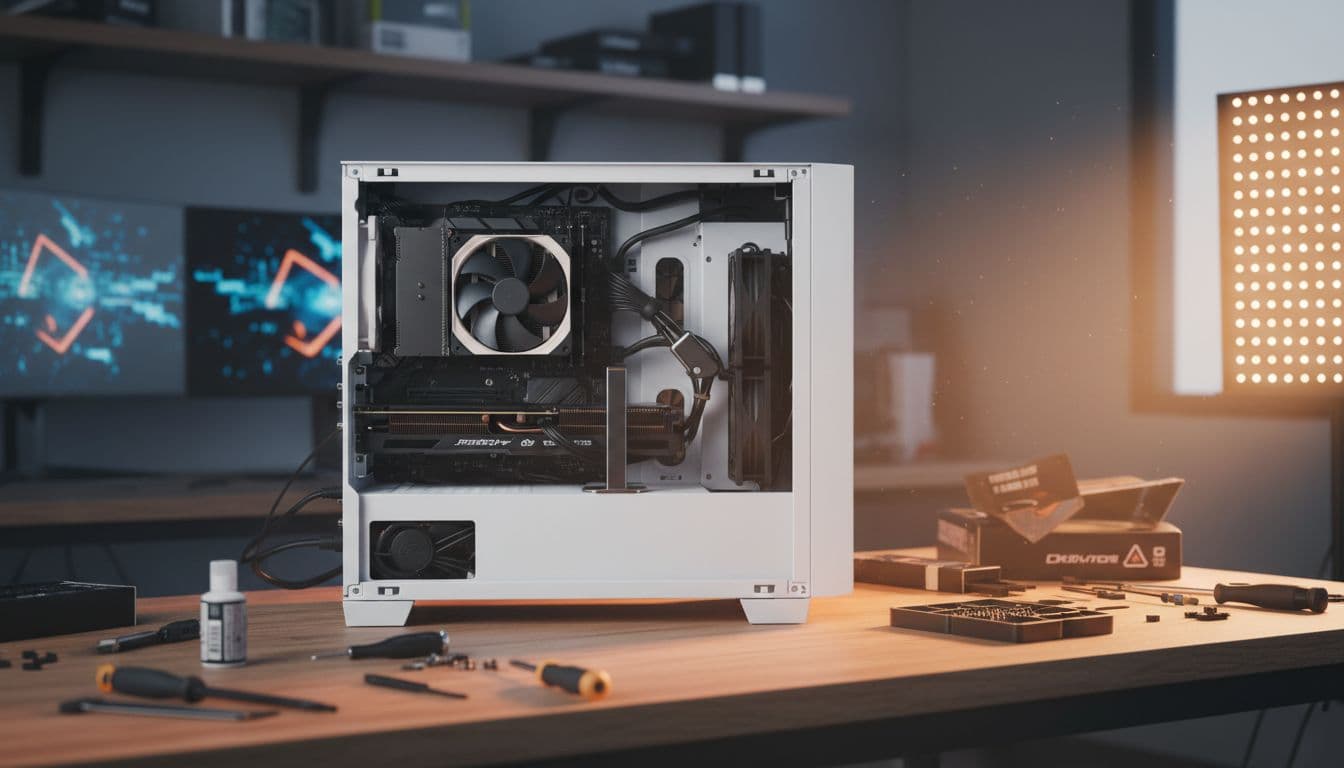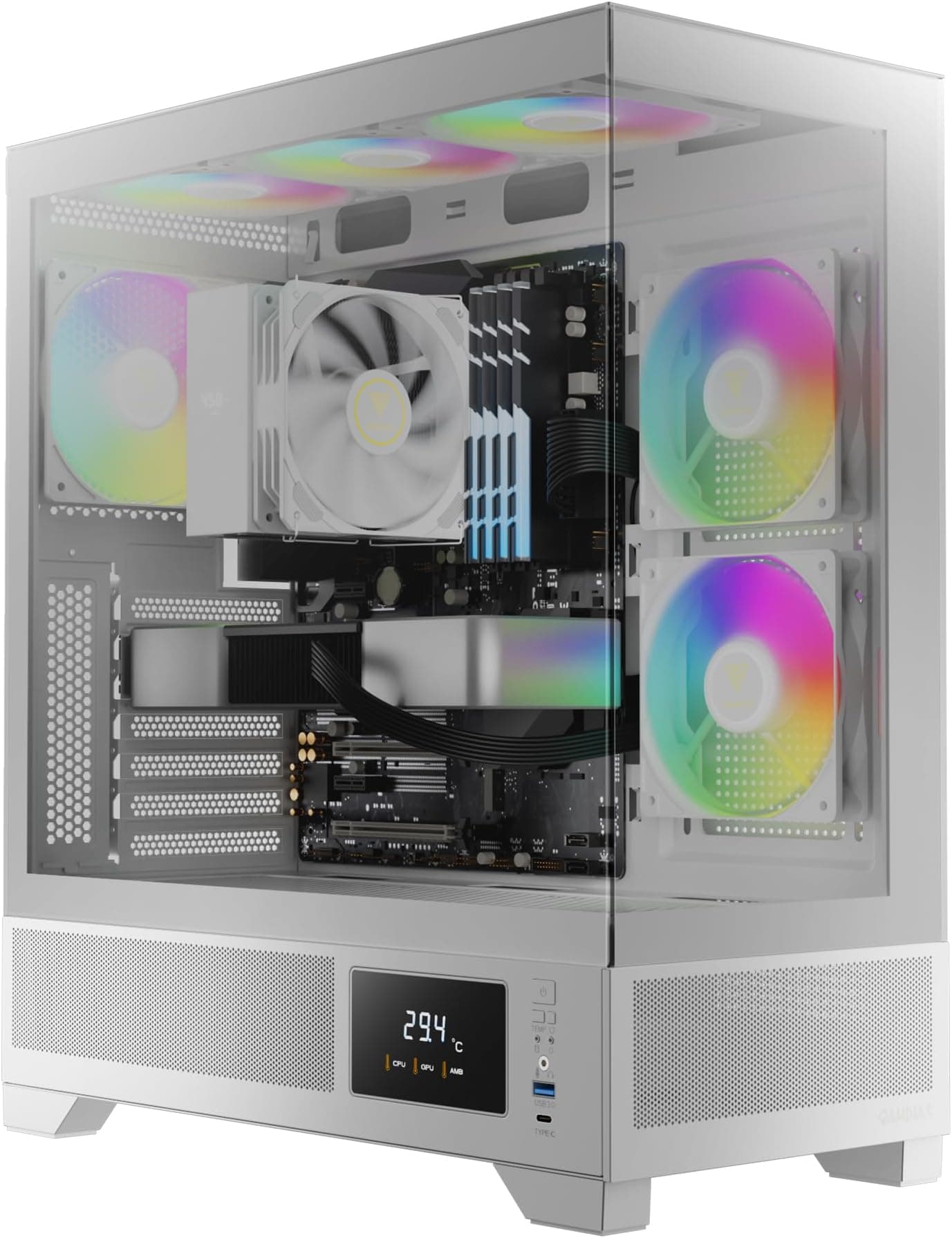
Budget cases have a way of making you pay twice. You save forty quid on the chassis, then spend an afternoon fighting cable routing that was clearly designed by someone who has never actually built a PC, discover the front panel USB-C header is missing, and end up with a system that runs ten degrees hotter than it should because the airflow is an afterthought. The HYTE X50 in Matcha Milk sits in mid-range territory and, based on the spec sheet and what 37 owners have reported back with an average of ★★★★½ (4.8), it is specifically trying to solve those problems. Whether it succeeds is what this HYTE X50 review is here to work out.
The short version: yes, it is good. Genuinely good, not "good for the price" good. The airflow design is properly thought through, the cable management space is generous, and the build quality is a step above what you would normally expect at this price tier. The Matcha Milk colourway is also, frankly, brilliant. Green cases are rare and this one does it without looking like a gaming peripheral from 2009. But there are a few things to know before you hand over your money, and this review covers all of them.
HYTE built their reputation on the Y60 panoramic case, which was a bold design statement that polarised builders. The X50 is a more conventional mid-tower, but it carries the same philosophy: clean lines, considered airflow, and a build experience that does not make you want to throw a screwdriver across the room. The Matcha Milk finish is a matte green with cream accents, and the owner photos back up what the listing suggests: it photographs beautifully and looks even better with a white or cream build inside.
Core Specifications
The X50 is a standard ATX mid-tower, which means it will sit comfortably on most desks without dominating the room. The dimensions come in at approximately 465mm tall, 215mm wide, and 430mm deep. That is a fairly typical footprint for the class, not as compact as something like the Corsair 4000D Airflow, but not a bruiser either. Steel construction throughout the main chassis, with a tempered glass side panel on the left and a mesh front panel. Weight is around 7.5kg without components, which feels solid without being awkward to move around.
Fan support is where the X50 starts to differentiate itself. You get three 120mm fans included in the box (front intake), with support for up to six 120mm fans or four 140mm fans across the front, top, and rear positions. Radiator support is strong: 360mm at the front, 240mm or 360mm at the top, and 120mm at the rear. That covers virtually every AIO configuration you might want to run, including the increasingly popular 360mm top-mounted setups. Dust filters are present on the front and bottom, which is the minimum you should expect at this price but not every brand delivers it.
Storage is two 3.5-inch drive bays and two 2.5-inch dedicated mounts, with additional 2.5-inch mounting points on the back of the motherboard tray. PSU clearance is up to 220mm, which is enough for any standard ATX power supply including the longer Corsair HX and EVGA SuperNOVA units. GPU length support is up to 400mm. CPU cooler height clearance sits at 175mm. The front I/O includes USB 3.0 Type-A ports and a USB 3.2 Gen 2 Type-C port, plus the standard headphone and microphone jacks.
| Specification | Detail |
|---|---|
| Form Factor | ATX Mid-Tower |
| Supported Motherboards | ATX, Micro-ATX, Mini-ITX |
| Dimensions (H x W x D) | ~465 x 215 x 430mm |
| Weight | ~7.5kg |
| Max GPU Length | 400mm |
| Max CPU Cooler Height | 175mm |
| Max PSU Length | 220mm |
| Included Fans | 3 x 120mm (front) |
| Fan Support | Up to 6 x 120mm or 4 x 140mm |
| Radiator Support (Front) | Up to 360mm |
| Radiator Support (Top) | Up to 360mm |
| Radiator Support (Rear) | 120mm |
| Drive Bays (3.5") | 2 |
| Drive Bays (2.5") | 2 dedicated + additional tray mounts |
| Front I/O | USB 3.0 x2, USB 3.2 Gen 2 Type-C x1, HD Audio |
| Side Panel | Tempered Glass (left) |
| Front Panel | Mesh |
| Dust Filters | Front and bottom |
| Colour | Matcha Milk (Green) |
| Current Price | £99.00 |

Form Factor and Dimensions
Mid-tower is the right call for most builders, and the X50 is a sensible example of the format. At 215mm wide it will fit on a standard desk without hanging over the edge, and the 430mm depth means it will clear most monitor stands and desk risers. The 465mm height is tall enough to accommodate full-size ATX boards and large coolers without the cramped feeling you get in some "compact" mid-towers that sacrifice internal space in the name of a smaller external footprint. It is not a small case, but it is not trying to be.
The Matcha Milk colourway deserves a proper mention here because it is genuinely unusual. Most case manufacturers offer black, white, and occasionally a dark grey if they are feeling adventurous. Green cases exist, but they tend to be either aggressively gamer-coded with RGB trim and angular styling, or they are limited edition runs that disappear quickly. The X50's Matcha Milk is a muted, almost sage green with cream or off-white accents. It reads as mature and considered rather than shouty. Owner photos on the listing confirm the colour is accurate to the marketing images, which is not always the case (no pun intended).
On a desk it sits well. The feet are rubber-padded and wide enough that the case does not wobble or slide around during those moments when you are connecting cables from the back. The power button placement is on the top panel, which is a sensible location that keeps the front face clean. Some builders prefer a front-mounted power button for floor-standing setups, so if your case lives under your desk. But for desk-top placement, top-mounted controls are genuinely more convenient day to day.
Motherboard Compatibility
The X50 supports ATX, Micro-ATX, and Mini-ITX motherboards. E-ATX is not on the list, which is not unusual for a mid-tower at this price point. E-ATX boards tend to need either a full tower or a purpose-built wide mid-tower, and the market for E-ATX at this budget is fairly niche anyway. If you are running a standard ATX board, which covers the vast majority of mainstream Intel and AMD platforms including Z890, X870, B850, and B760 boards, you are fine.
The standoff layout is pre-installed for ATX, which is the right default. Micro-ATX and Mini-ITX builders will need to move or add standoffs, but this is standard practice and HYTE includes the necessary hardware. The motherboard tray itself has a large CPU cutout behind it, which matters for cooler installation. A generous cutout means you can swap out your cooler backplate without pulling the motherboard, and owner reviews specifically mention this as a positive. It is one of those details that sounds minor until you have spent twenty minutes uninstalling a board because the cutout was too small.
Cable routing holes around the motherboard area are grommetted, which keeps the cable management looking tidy from the glass side. The positioning of those holes is well thought out: there are cutouts in the right places for the 24-pin ATX power connector, the EPS CPU power connector (there are two cutouts here, which matters for boards with dual EPS connectors), and the main GPU power runs. This is the kind of layout planning that separates cases designed by people who actually build PCs from cases designed by people who have only seen pictures of PCs.
GPU Clearance
Four hundred millimetres of GPU clearance is generous. To put that in context: an NVIDIA RTX 4090 Founders Edition is 336mm long, and even the longest third-party 4090 cards from ASUS and MSI top out around 360mm. The X50's 400mm limit means you can fit literally any current-generation GPU without having to measure twice and hope. That includes triple-fan cards, which often cause problems in shorter mid-towers that claim GPU support but only really mean it for dual-fan designs.
The GPU mounting area is standard PCIe slot-based, with no vertical mount option included in the base configuration. Vertical GPU mounting has become popular for showing off cards through the tempered glass panel, but it typically requires a riser cable and sometimes a bracket, neither of which is in the box here. If you want vertical mounting you can add it with a third-party riser, but it is not a plug-and-play feature on the X50. For most builders this will not matter at all, but if a vertical GPU display is a priority, factor in the additional cost.
Owner reviews do not flag any issues with GPU installation or clearance, which is the best possible signal. When a case has clearance problems, builders notice immediately and say so loudly. The silence on this front, combined with the 400mm spec, suggests the real-world clearance matches what HYTE claims. There is also no reported interference between the GPU and the front radiator or fan mounts, which can be a problem in cases where the front fan bracket sits too close to the PCIe slots. That is a genuine design win.
CPU Cooler Clearance
A 175mm CPU cooler height limit is solid for this class of case. The most popular high-performance air coolers sit comfortably within that limit: the Noctua NH-D15 is 165mm, the be quiet! Dark Rock Pro 5 is 163mm, the DeepCool AK620 is 160mm. You would have to be reaching for something genuinely unusual to hit the ceiling. The Thermalright Peerless Assassin 120 SE, which is arguably the best value air cooler on the market right now, comes in at 155mm. Plenty of room.
AIO radiator support is where the X50 really pulls ahead. Front support for 360mm radiators is the headline number, and that covers the full range of popular AIOs including the Arctic Liquid Freezer III 360, the Corsair iCUE H150i, and the NZXT Kraken 360. Top support for up to 360mm is the more interesting spec, because top-mounted AIOs exhaust heat directly out of the case rather than recirculating it through the GPU zone. Some builders prefer this configuration specifically for that reason. Having both options available gives you genuine flexibility depending on your component layout and thermal priorities.
The rear fan/radiator position supports 120mm, which is standard.: when you run a 360mm radiator at the front, the three included fans can be repurposed as radiator fans, which saves you buying additional fans for the AIO. That is a practical benefit that does not always get mentioned in spec comparisons but absolutely affects the real cost of the build. The CPU cutout on the motherboard tray is large enough to accommodate most cooler backplates without board removal, as mentioned by multiple owners, which makes future cooler swaps much less painful.
Storage Bay Options
Two 3.5-inch bays and two dedicated 2.5-inch mounts covers the needs of most modern builds. The reality is that NVMe M.2 SSDs have replaced 2.5-inch SATA SSDs as the default storage choice for primary drives, and 3.5-inch HDDs are increasingly used only for bulk storage or media libraries. Two 3.5-inch bays is enough for most people, and if you are running a pure NVMe setup with no spinning disks at all, the 3.5-inch cages can be removed to improve airflow and cable tidiness.
The 2.5-inch mounts are positioned on the back of the motherboard tray, which keeps them out of the main airflow path and out of sight through the glass panel. This is the right approach. Nobody wants to see a SATA SSD mounted on a bracket in the middle of their carefully lit build. The tool-free mounting on the 2.5-inch bays is a nice touch: you slide the drive in and it clips into place without needing a screwdriver. Whether the clips are robust enough for long-term use is something that only time will tell, but owner reviews do not flag any issues with drives working loose, so the mechanism seems solid.
For builders with larger storage requirements, the removal of the HDD cages does open up additional space that could theoretically accommodate aftermarket drive caddies or additional cable routing. It is not a case that was designed with ten-drive NAS builds in mind, and nor should it be at this price and size. But for a gaming or workstation build with two or three drives, the storage provision is entirely adequate. If you need more than two 3.5-inch bays, you probably already know you need a different case entirely.

Cable Management
This is where the X50 earns genuine praise, both from the spec sheet and from owner reports. The rear panel clearance behind the motherboard tray is listed at around 25mm, which is enough to route and velcro-strap cables without the side panel bowing out when you close it. That might sound like a low bar, but plenty of cases in this price range offer 15 to 18mm of clearance, which means you are essentially compressing cables against the panel every time you close it. Over time that stresses connectors and looks messy even when you have tried your best.
Velcro straps are included in the accessories, which is a detail that some manufacturers still charge extra for or omit entirely. The cable routing holes are positioned logically relative to the main connection points on a standard ATX board, and the grommets keep things looking tidy from the glass side. Multiple owners specifically mention the cable management as a highlight, with comments about how clean the finished build looks. When builders with varying skill levels all report good results, it suggests the design genuinely makes cable management easier rather than just providing the space and leaving you to figure it out.
The PSU shroud covers the bottom of the case and hides the power supply and most of the main cable bundle. This is standard on mid-range cases now, but the execution matters. The X50's shroud has a cutout at the front to allow the modular cable connections to pass through cleanly, and there is a cable routing channel along the bottom of the case behind the shroud. The PSU itself mounts from the back, which is the right approach: it means you can install and connect the PSU with the case lying on its side before standing it up, rather than fighting with it through the front or top.
Airflow and Thermal Design
Mesh front panel, three 120mm fans included, dust filters on the front and bottom. That is the core of the X50's airflow story and it is a good one. A mesh front is the single most important airflow decision a case manufacturer makes, and HYTE has made the right call here. Solid or glass front panels restrict intake airflow significantly, which forces the system to pull air through smaller gaps and raises temperatures across the board. The X50's mesh front allows the three included fans to pull in a proper volume of cool air without restriction.
The three included 120mm fans are positioned as front intakes. Combined with a rear 120mm exhaust (you will need to add one, as only three fans are included), you get a positive pressure setup that pushes more air in than out, which helps keep dust out of unfiltered gaps. The dust filters on the front and bottom are removable for cleaning, which matters for long-term maintenance. A dust filter you cannot easily clean is almost worse than no filter, because it restricts airflow as it fills up and nobody bothers to clean it because it is too fiddly.
Owner thermal reports are positive. Builders running mid to high-end configurations including RTX 4070 and 4080 cards with 360mm AIOs report comfortable temperatures under load. This is not surprising given the airflow design, but it is reassuring to see the real-world results align with what the spec implies. The tempered glass right side panel does not restrict airflow because the intake is at the front, not the side. The glass is there purely for aesthetics, which is the right reason to have it. Some mesh-front cases also add mesh panels on the side or top, and while that can improve airflow further, it complicates the aesthetic. The X50 keeps it clean.
Front I/O and Connectivity
Two USB 3.0 Type-A ports and one USB 3.2 Gen 2 Type-C port. That is a good front I/O specification for a mid-range case. The Type-C port is increasingly important as peripherals, phones, and external drives move to the connector, and USB 3.2 Gen 2 means it supports up to 10Gbps transfer speeds rather than the slower 5Gbps of standard USB 3.2 Gen 1. Your motherboard will need a USB 3.2 Gen 2 Type-C header to use it at full speed, which is present on most mid-range and high-end boards but if you are on a budget B-series board.
The headphone and microphone jacks are HD Audio standard, which is what you want. The alternative, AC'97, is an older standard that some budget cases still use. HD Audio supports modern audio codecs and works properly with headsets that have a combined TRRS jack via an adapter. The power button is on the top panel alongside the I/O ports, which keeps the front face completely clean. There is no reset button visible in the listed specifications, which is a minor omission but one that most builders will never miss (when did you last actually press a reset button?).
The placement of the top I/O panel is towards the front of the top surface, which means it is accessible without reaching awkwardly to the back of the case. This sounds obvious but plenty of cases put the I/O at the rear of the top panel, which is fine when the case is on a desk but annoying when it is at floor level. The overall I/O provision compares well to the competition at this price. The Corsair 4000D Airflow, for example, includes a USB-C port but at a lower Gen 1 speed on the base model. The NZXT H5 Flow includes USB-C as well. The X50 matches or exceeds both on the Type-C front.
Build Quality and Materials
Steel chassis, tempered glass side panel, mesh front. The steel is mid-range thickness, which means it is not going to flex noticeably under normal handling but it is not the heavier gauge you find in premium cases from Fractal Design or Lian Li. Owner reviews do not flag any sharp edges, which is always the first thing builders mention when a case has quality control issues. Sharp edges on cable routing holes and panel edges are a genuine hazard and a sign of sloppy manufacturing. The absence of complaints here is a good sign.
The tempered glass panel attaches with thumb screws rather than a tool-free latch mechanism. Some builders prefer latches for quick access, others prefer screws for a more secure fit. Thumb screws are the middle ground: no tools required, secure when tightened, and they do not develop the rattle that some latch mechanisms acquire over time. The glass itself is standard 4mm tempered, which is the norm for the price. It is not the thicker 5mm glass you find on premium cases, but 4mm is perfectly adequate and unlikely to shatter under normal use.
The Matcha Milk finish is a powder coat on the steel, and owner photos suggest it is applied evenly without the orange peel texture that sometimes appears on budget cases. The cream accents on the front panel and I/O area are a nice design touch that elevates the overall look. Panel alignment is reported as good across owner reviews, with no mentions of gaps or misalignment between the front panel, top panel, and chassis. That kind of fit and finish consistency is harder to achieve than it sounds, especially at mid-range pricing, and it is one of the things that separates a properly designed case from one that was value-engineered to the point of cutting corners on tooling.
How It Compares
The X50 sits in a competitive part of the market. The two most obvious alternatives at a similar price are the Corsair 4000D Airflow and the NZXT H5 Flow. Both are well-regarded, widely available, and have large communities of builders who have used them. So how does the X50 stack up?
The Corsair 4000D Airflow is probably the benchmark mid-range airflow case. It has excellent mesh front airflow, good cable management, and Corsair's build quality reputation behind it. But it comes in black or white, and the included fans are two 120mm units rather than three. The NZXT H5 Flow is similarly well-built with a clean aesthetic and good airflow, and NZXT's ecosystem of software and accessories is a genuine plus if you are already invested in CAM. But again, the colour options are conservative. Neither offers anything close to the Matcha Milk colourway.
The X50 matches both on the specs that matter most: mesh front, good radiator support, decent cable management space. It includes three fans versus the Corsair's two, which is a practical advantage. The USB 3.2 Gen 2 Type-C front port is competitive with both. Where the X50 might lag slightly is brand recognition: HYTE is newer to the mainstream mid-tower market than Corsair or NZXT, and the owner review count of 37 is lower than either competitor. But a 4.8 average from 37 reviews is a strong signal, and the spec sheet backs it up.
| Feature | HYTE X50 (Matcha Milk) | Corsair 4000D Airflow | NZXT H5 Flow |
|---|---|---|---|
| Form Factor | ATX Mid-Tower | ATX Mid-Tower | ATX Mid-Tower |
| Front Panel | Mesh | Mesh | Mesh |
| Included Fans | 3 x 120mm | 2 x 120mm | 2 x 120mm |
| Max GPU Length | 400mm | 360mm | 381mm |
| Max CPU Cooler Height | 175mm | 170mm | 165mm |
| Front Radiator Support | 360mm | 360mm | 360mm |
| Top Radiator Support | 360mm | 240mm | 280mm |
| Front USB-C | USB 3.2 Gen 2 (10Gbps) | USB 3.2 Gen 1 (5Gbps) | USB 3.2 Gen 2 (10Gbps) |
| Drive Bays (3.5") | 2 | 2 | 2 |
| Colour Options | Matcha Milk (Green) | Black, White | Black, White |
| Rear Clearance (Cable Mgmt) | ~25mm | ~23mm | ~20mm |
| Price Tier | Mid-range | Mid-range | Mid-range |
A few things jump out of that table. The X50's 400mm GPU clearance is the best of the three by a meaningful margin. The top radiator support of 360mm is also the best here: the 4000D Airflow caps at 240mm on top, which rules out 360mm top-mounted AIOs. And the USB-C speed advantage over the 4000D Airflow base model is real, even if it only matters when you are transferring large files. The Matcha Milk colourway is genuinely unique in this comparison. If you want a green case at this price, the X50 is essentially the only serious option.

Final Verdict
The HYTE X50 in Matcha Milk is a properly good mid-range case. It does the fundamentals right: mesh front for real airflow, three fans included so you are not immediately buying extras, 400mm GPU clearance that covers every current card, 360mm radiator support at both front and top, and cable management space that owner after owner describes as genuinely easy to work with. The 4.8 average from 37 owners is not a fluke. This is a case that delivers on its promises.
The colourway is a legitimate differentiator. If you are building a themed system and green is the direction, the X50 is not just the best green case at this price, it is basically the only serious contender. The Matcha Milk finish is tasteful and distinctive without being aggressive, which is harder to pull off than it sounds. It will look good in five years in a way that aggressively styled RGB cases often do not.
Are there any caveats? A few. No vertical GPU mount out of the box if that matters to you. No reset button, which is minor. The brand is newer to this market segment than Corsair or NZXT, so the long-term track record on things like replacement parts availability is less established. And if you are running a build that does not need 400mm GPU clearance, top 360mm radiator support, or a distinctive colourway, the Corsair 4000D Airflow is slightly cheaper in some configurations and has a longer track record. Honest answer: if the Corsair is meaningfully cheaper when you check, and you are not fussed about the colour or the top 360mm radiator option, it is a sensible alternative.
But if the X50 is priced competitively with the 4000D Airflow, as it often is, the HYTE wins on fans included, GPU clearance, and top radiator support. And it wins outright on style. For a builder who wants a case that looks as considered as it performs, the X50 Matcha Milk is an easy recommendation. Editorial score: 8.5 out of 10.
What works. What doesn’t.
5 + 4What we liked5 reasons
- 400mm GPU clearance fits every current flagship card including triple-fan designs
- 360mm radiator support at both front and top, beating most mid-range rivals
- Three 120mm fans included, saving you an immediate extra purchase
- Matcha Milk colourway is genuinely distinctive and tastefully executed
- Cable management space and grommetted routing holes praised consistently by owners
Where it falls4 reasons
- No vertical GPU mount included, requires third-party riser if you want that look
- Newer brand means less established long-term parts availability than Corsair or NZXT
- No reset button on the front panel
- Only 37 owner reviews so far, though the 4.8 average is strong
Full specifications
10 attributes| Form factor | Mid-Tower |
|---|---|
| CPU cooler clearance MM | 170 |
| Dimensions MM | 485 x 510 x 255 |
| Fans included | 0 |
| GPU clearance MM | 430 |
| MAX FAN count | 10 |
| MAX radiator MM | 360 |
| PSU support | ATX up to 223mm |
| Side panel | tempered glass |
| Supported motherboard | E-ATX (up to 10.6"), ATX, M-ATX, Mini-ITX |
Frequently asked
5 questions01Is the Hyte X50 Modern Performance ATX Mid-Tower PC Gaming Case - Matcha Milk (Green) good for airflow?+
Yes, genuinely so. The mesh front panel is the key design decision here, and HYTE made the right call. Three 120mm fans are included as front intakes, pulling air through the mesh without restriction. Dust filters are present on the front and bottom, both removable for cleaning. The case supports up to six 120mm fans total across front, top, and rear positions. Owner reports back up the spec: builders running RTX 4070 and 4080 configurations with 360mm AIOs report comfortable temperatures under load. It is not a case that will throttle your components.
02What's the GPU clearance on the Hyte X50 Modern Performance ATX Mid-Tower PC Gaming Case - Matcha Milk (Green)?+
The HYTE X50 supports GPUs up to 400mm in length. To put that in context, the NVIDIA RTX 4090 Founders Edition is 336mm, and the longest triple-fan third-party 4090 cards from ASUS and MSI reach around 360mm. The X50's 400mm limit means every current-generation GPU fits without any clearance concerns. Owner reviews do not report any GPU installation issues, which confirms the real-world clearance matches the specification. There is no reported interference between the GPU and front radiator or fan mounts either.
03Can the Hyte X50 Modern Performance ATX Mid-Tower PC Gaming Case - Matcha Milk (Green) fit a 360mm AIO?+
Yes, and this is one of the X50's strongest features. It supports 360mm radiators at the front and up to 360mm at the top, plus 120mm at the rear. The top 360mm support is particularly notable because many competing mid-range cases cap top radiator support at 240mm or 280mm, ruling out top-mounted 360mm AIOs. Popular 360mm units including the Arctic Liquid Freezer III 360, Corsair iCUE H150i, and NZXT Kraken 360 all fit. The three included 120mm fans can also be used as radiator fans for a front-mounted AIO, saving you buying additional fans separately.
04Is the Hyte X50 Modern Performance ATX Mid-Tower PC Gaming Case - Matcha Milk (Green) easy to build in?+
Based on the spec sheet and owner feedback, yes. The rear panel clearance of approximately 25mm is enough to route and velcro-strap cables without the side panel bowing. Velcro straps are included. Cable routing holes are grommetted and positioned logically relative to standard ATX board connection points. The motherboard tray has a large CPU cutout for cooler backplate access without board removal. Multiple owners specifically highlight the cable management as a positive, with comments about how clean the finished build looks. No sharp edge complaints appear in the owner reviews, which is always the first thing builders flag when a case has quality control issues.
05What warranty and returns apply to the Hyte X50 Modern Performance ATX Mid-Tower PC Gaming Case - Matcha Milk (Green)?+
Specific warranty terms for the HYTE X50 are not listed in the verified product data available to us. As a purchase made through Amazon UK, you are covered by Amazon's standard 30-day returns policy and the Amazon A-to-Z Guarantee, which provides protection if the item is not as described or does not arrive. For manufacturer warranty details beyond the Amazon returns window, we recommend checking directly with HYTE via their official website or contacting the seller listed on the product page before purchasing.