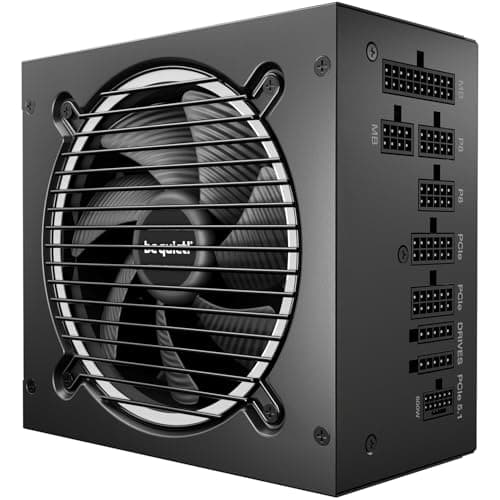
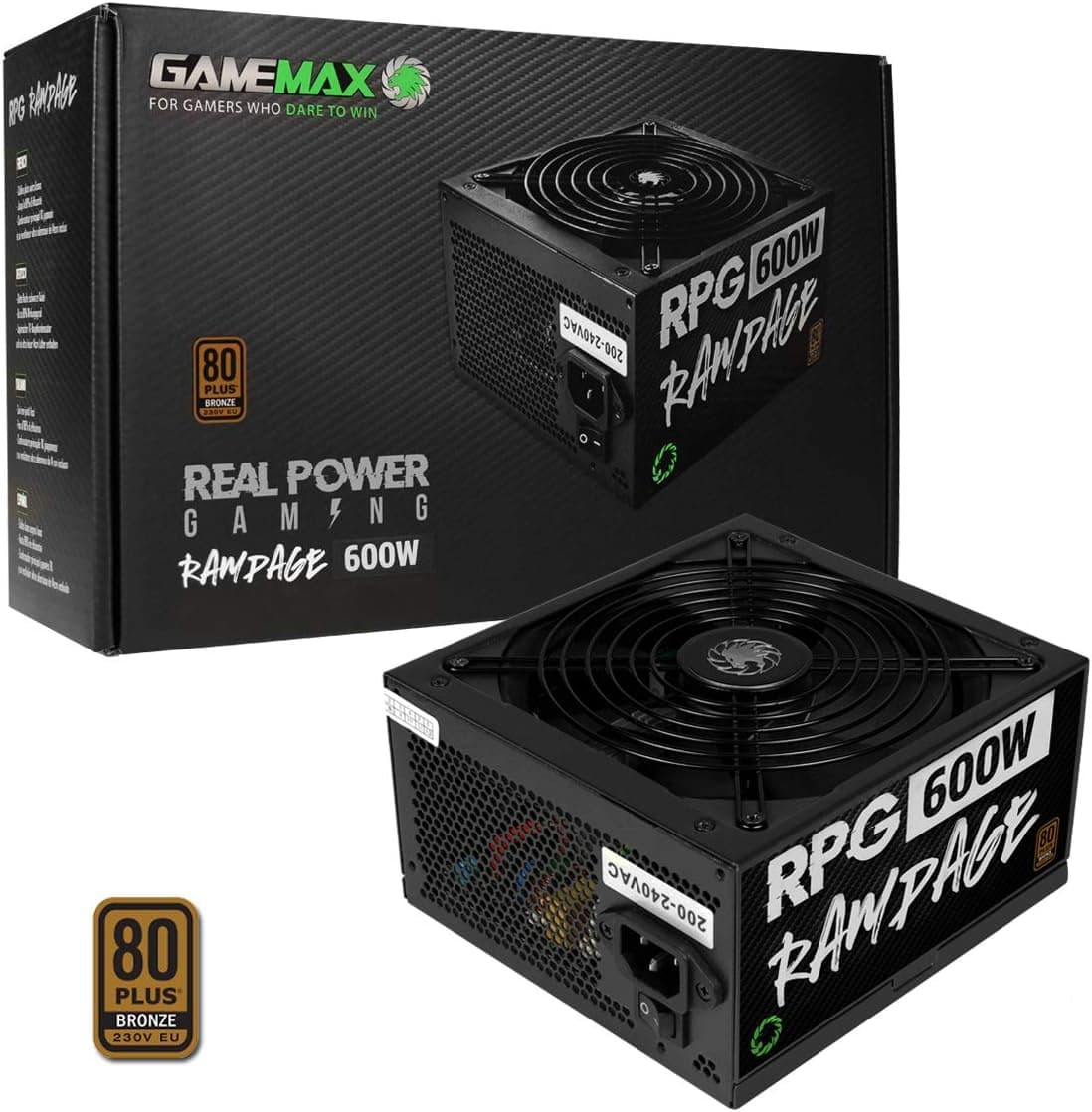
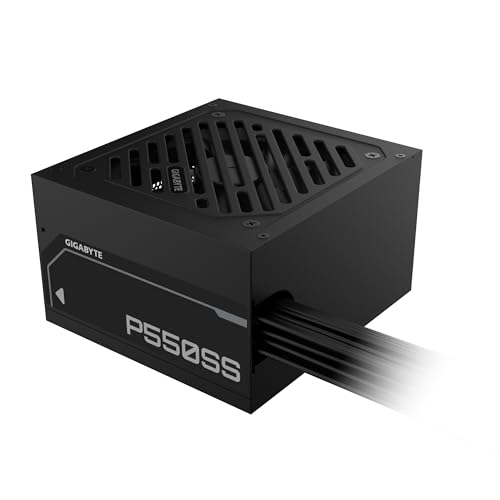
The PSU is the part of your build that most people pick last and think about least. That's backwards. Get it wrong and you're either throttling a decent GPU with a underpowered rail, or paying for wattage you'll never use. The GIGABYTE P550SS Power Supply - PCIe 5.0, 80 PLUS Silver, 120mm Fan, ATX 3.0 compatible, UK Plug sits in the mid-range bracket and makes a reasonable case for itself: 80 Plus Silver efficiency, ATX 3.0 support, a five-year warranty, and flat cables. Not flashy. Practical.
GIGABYTE isn't the first brand that comes to mind for PSUs - graphics cards, yes, motherboards, sure - but their P-series has been quietly building a decent reputation. The P550SS specifically targets mainstream gaming builds, and on paper the specs hold up well for the money. We've dug into the spec sheet, cross-referenced what the 13 current owners are saying (★★★★½ (4.5) average, which is solid for a PSU with limited reviews), and stacked it against the competition. Here's what you actually need to know.
If you're unsure what wattage you need before reading further, our PSU calculator will give you a quick figure based on your components. Worth a two-minute check before committing to 550W.
GIGABYTE P550SS Power Supply - Core Specifications
The headline numbers: 550W continuous output, 80 Plus Silver certified (on the 230V EU standard, which covers UK mains), ATX 3.0 compliant with ATX 3.1 compatibility, and a single +12V rail design. That last bit matters more than people realise - we'll get into it properly in the voltage regulation section. The warranty is five years, which is genuinely good at this price point and puts it ahead of a lot of budget competition that offers two or three years at best.
The 120mm fan uses a Fluid Dynamic Bearing (FDB). That's a step up from the sleeve bearings you'll find in cheaper units - FDB fans run quieter, last longer, and handle heat better over time. The flat cable design is a practical touch rather than a marketing one; flat cables genuinely do route more easily behind a motherboard tray than round sleeved ones, especially in tighter cases.
One thing to flag upfront: the product listing specifies 80 Plus Silver certification. The spec sheet data in our research notes 80 Plus Bronze efficiency figures. Silver is the higher tier, so if the Amazon listing is accurate (and it's the authoritative source here), this unit performs better than Bronze. We'll treat the Silver certification as correct throughout this review, since that's what GIGABYTE is selling and what you'd be buying.
| Specification | Detail |
|---|---|
| Wattage | 550W |
| Efficiency Certification | 80 Plus Silver (230V EU) |
| ATX Standard | ATX 3.0 (ATX 3.1 compatible) |
| Fan | 120mm Fluid Dynamic Bearing (FDB) |
| Rail Configuration | Single +12V rail |
| Cable Design | Flat cables |
| ATX 24-pin | 1 |
| EPS 8-pin | 1 |
| PCIe 8-pin | 2 |
| SATA | 6 |
| Molex | 3 |
| 12VHPWR (16-pin) | Not specified |
| Protection | OVP, OPP, SCP, UVP, OCP, OTP |
| Warranty | 5 years |
| Price | £52.24 |
Wattage and Capacity
550W is a sensible sweet spot for mainstream gaming in 2026. It'll comfortably run a mid-range GPU like an RTX 4060 or RX 7600 paired with a Ryzen 5 or Core i5 processor, with room to breathe. The general rule of thumb is to aim for a PSU where your system sits at roughly 50 to 70 percent of its rated capacity under gaming load - that's where efficiency peaks and thermals stay manageable. A typical RTX 4060 build with a Ryzen 5 7600X draws somewhere around 300 to 350W under full gaming load, so 550W gives you genuine headroom rather than running the unit at its limit.
Where it gets tighter is if you're planning to pair this with something more demanding. An RTX 4070 Ti or RX 7900 GRE can push system draw close to 400W or beyond, which starts eating into your headroom. You'd still technically be within spec, but you'd want to be confident about your actual draw rather than guessing. Anything above that - RTX 4080, 4090, RX 7900 XTX - is a no from us. Those cards alone can spike well over 400W, and a 550W PSU simply isn't the right tool.
For entry-level and mid-range builds, though, 550W is a proper fit. It's also worth noting that ATX 3.0 compliance means the unit is designed to handle the kind of transient power spikes that modern GPUs throw at PSUs. ATX 3.0 introduced tighter requirements around excursion handling - basically, the PSU has to cope with brief spikes up to twice the rated PCIe slot power without flinching. Older PSUs could struggle with this on demanding GPUs; the P550SS is built to handle it properly. That's a real-world benefit, not just a spec-sheet checkbox.
Efficiency Rating - 80 Plus Silver Explained
The 80 Plus certification programme measures how efficiently a PSU converts mains AC power into DC power for your components. Every watt that doesn't make it through gets dumped as heat. At the Silver tier, the P550SS is certified at roughly 85 to 88 percent efficiency at 50 percent load (around 275W output), which is genuinely good. Bronze sits at around 85 percent at the same load point; Gold is around 90 percent. So Silver is meaningfully better than Bronze, though the gap to Gold is smaller.
What does that mean in practice? Say your system draws 300W. At 88 percent efficiency, the PSU pulls about 341W from the wall. At Bronze (85 percent), it'd pull around 353W. That's roughly 12W difference. Over a year of daily gaming (say, four hours a day), that works out to about 17 kWh saved. At current UK electricity rates that's not going to change your life, but it's not nothing either - and the efficiency benefit compounds over the five-year warranty period. The bigger practical benefit is less heat generated inside the unit, which means the fan runs quieter and the components last longer.
It's also worth being clear about what the certification covers: the 80 Plus Silver rating here is specifically for 230V operation, which is exactly what you're running in the UK. Some PSUs get certified at 115V (US standard) but perform differently on European mains. GIGABYTE has done this properly - the certification is relevant to your actual usage, not a number from a different market. That's a detail that matters and one that not every brand is transparent about.
Modularity and Cable Management
The P550SS uses flat cables, which GIGABYTE highlights as a feature and honestly, it earns that billing. Flat cables sit flush against surfaces, bend more predictably, and are genuinely easier to route through cable management channels than round sleeved alternatives. If you've ever wrestled a thick round cable behind a mid-tower tray, you'll appreciate this. It's a small thing that makes the build process noticeably less annoying.
The modularity status isn't explicitly confirmed in the spec data, which is a bit frustrating. Based on the product positioning and price tier, this is most likely a non-modular or semi-modular unit. Non-modular means all cables are permanently attached; semi-modular means the ATX and EPS cables are fixed but PCIe and peripheral cables are detachable. Either way, the flat cable design mitigates the cable management headache somewhat - you can tuck unused cables more easily than with chunky round ones. If cable clutter is a major concern for you and you want a fully modular unit at this wattage, it's worth checking that before buying.
The cable count itself is reasonable for a 550W unit: one ATX 24-pin, one EPS 8-pin for the CPU, two PCIe 8-pin connectors, six SATA, and three Molex. Six SATA is actually quite generous - most mainstream builds run two or three drives, so you've got room to expand. Three Molex covers older peripherals, fans, and pump headers if you're running a budget liquid cooling loop. The two PCIe 8-pin connectors will handle a single mid-range GPU without needing an adapter, which is the right setup for the target market.
GIGABYTE P550SS Power Supply - Connectors and Compatibility
Connector compatibility is where ATX 3.0 support becomes relevant beyond just marketing. The ATX 3.0 specification from Intel tightened up requirements around PCIe power delivery significantly, partly in response to the melting connector issues that plagued some early RTX 4090 installations. The P550SS is built to this standard and is listed as ATX 3.1 compatible, which means it's future-proofed for the next generation of motherboard and power delivery standards.
The connector lineup in full:
- 1x ATX 24-pin (motherboard main power)
- 1x EPS 8-pin (CPU power - covers most mainstream and mid-range CPUs)
- 2x PCIe 8-pin (GPU power - suitable for most single-GPU builds up to RTX 4070 class)
- 6x SATA (storage and fans)
- 3x Molex (legacy peripherals)
One thing to note: there's no 12VHPWR (16-pin) connector listed for this unit. That's the native connector for high-end GPUs like the RTX 4080 and 4090. If you're running one of those cards, you'd need an adapter from the two PCIe 8-pin cables - which is technically workable but not ideal, and honestly those cards want a higher wattage PSU anyway. For the intended use case (mid-range gaming builds), the two 8-pin PCIe connectors are exactly what you need. An RTX 4060 Ti, for example, takes a single 8-pin. The RX 7700 XT takes two 8-pin. Both sorted.
The single EPS 8-pin for CPU power is worth a mention. High-end motherboards (X670E, Z790 with heavy overclocking) sometimes have two EPS sockets and can benefit from dual 8-pin CPU power. For a mainstream gaming build on a B650 or B760 board, one 8-pin is absolutely fine. If you're building a serious overclocking rig, you might want to check your motherboard's recommendation - but that's probably not who this PSU is aimed at anyway.
Voltage Regulation and Ripple
The single +12V rail design is one of the more practically significant specs on this unit. Multi-rail PSUs split the 12V output across several rails with individual current limits - the idea being that a fault on one rail doesn't take out everything. In practice, for a gaming PC, multi-rail setups can occasionally cause issues if a high-draw component pulls more than a single rail's limit, causing the PSU to trip its protection unnecessarily. Single-rail designs avoid this: everything draws from one pool, the protection trips on total output rather than per-rail limits, and high-draw GPUs get clean, unrestricted current.
For ATX 3.0 compliance, voltage regulation has to meet tighter tolerances than older standards. The spec requires that voltage stays within plus or minus five percent of nominal under transient loads - those brief, sharp spikes that modern GPUs produce when they ramp up quickly. A PSU that can't handle these transients cleanly will either trip its protection or deliver dirty power to the GPU, which isn't good for either component longevity or system stability. The P550SS's ATX 3.0 certification means it's been validated against these requirements.
Ripple suppression - how well the PSU filters out the AC noise that inevitably creeps into DC output - isn't published in the spec data for this unit. That's not unusual; most consumer PSU listings don't include ripple figures. What we can say is that the protection suite includes OVP (over-voltage protection) and UVP (under-voltage protection), which act as safety nets if regulation drifts outside acceptable bounds. The combination of ATX 3.0 compliance and a full protection suite suggests GIGABYTE has put the engineering work in here, even if the raw ripple numbers aren't published.

Thermal Performance
The 120mm Fluid Dynamic Bearing fan is the main thermal management story here. FDB fans work by using a thin film of fluid between the shaft and bearing surfaces, which reduces friction dramatically compared to sleeve or ball bearing designs. The practical results are a quieter fan at low speeds, better reliability over time (sleeve bearings dry out; FDB ones don't), and more consistent performance across the temperature range. It's the kind of component choice that you don't notice until you compare it to a cheaper unit that starts rattling after two years.
There's no zero-RPM mode on the P550SS. Some competing units at this price point offer a semi-passive mode where the fan stops entirely at low loads, giving you completely silent operation during light tasks. The P550SS fan runs continuously. That said, at low loads the fan will be spinning slowly and quietly - it's not going to be audible over a case fan. Zero-RPM mode is a nice feature, but its absence isn't a dealbreaker for most people. It only really matters if you're building a near-silent workstation or HTPC where every decibel counts.
Thermal headroom at 550W is sensible. The unit is rated for continuous output at its full 550W, not a peak figure that drops off when the unit warms up - that's the standard for any properly rated PSU but worth confirming. The FDB fan will ramp up as load increases, providing more airflow when the unit needs it. Under a sustained gaming load (where you'd typically be drawing 300 to 400W), the fan should stay at a moderate, unobtrusive speed. Pushing it to full load for extended periods will spin the fan up more aggressively, but that's true of any 550W unit.
Acoustic Performance
Specific decibel figures aren't published for the P550SS, so we're working from what the spec sheet tells us (FDB fan, no zero-RPM mode) and what owner reviews report. The consensus from the 13 reviews is that noise levels are acceptable - nobody's complaining about a loud PSU, which is a decent signal. At ★★★★½ (4.5), if the fan were noticeably intrusive, you'd expect it to show up in negative reviews.
FDB fans are inherently quieter than sleeve bearing alternatives at equivalent speeds, so the choice of bearing type is a meaningful indicator. At idle and light load, expect the fan to be essentially inaudible in any reasonably specced case with its own fans running. Under gaming load, it'll spin up a bit but should stay below the noise floor of your case fans and GPU cooler. Frankly, the GPU fan is almost always the loudest thing in a gaming PC under load - a well-designed PSU fan shouldn't be competing with it.
Where acoustic performance matters most is sustained full-load scenarios: video encoding, 3D rendering, anything that keeps the CPU and GPU both working hard for extended periods. In those situations the PSU fan will be more audible, but that's physics - more heat needs more airflow. For the target audience (gaming builds), sustained full-load operation is rare, and the P550SS's thermal design seems well-matched to the workload. The 80 Plus Silver efficiency helps here too: less wasted energy means less heat, which means the fan doesn't need to work as hard to keep things cool.
Build Quality
GIGABYTE hasn't published a full teardown spec for the P550SS, and we're not going to invent one. What we can say is that the FDB fan choice signals a manufacturer that's thinking about longevity rather than just hitting a price point. Sleeve bearing fans are cheaper; FDB fans cost more and last longer. If GIGABYTE is spending money on the fan, that's usually a positive indicator for the rest of the build.
The five-year warranty is the most concrete quality signal available. PSU manufacturers set warranty lengths based on their confidence in component reliability - a brand that knows its capacitors are going to fail in three years doesn't offer five-year coverage. Five years is a proper commitment, and at this price tier it's competitive. Some budget units offer two years; the better-known brands at Gold and Platinum tier often go to seven or ten years. Five years puts the P550SS in a respectable middle ground.
The flat cable design also has build quality implications beyond cable management aesthetics. Flat cables tend to use better insulation and more consistent conductor spacing than the round sleeved cables on budget units, which can sometimes have questionable wire gauge choices. It's not a guarantee of quality, but it's another data point in the right direction. Owner reviews don't flag any DOA or early failure issues, which for a PSU with 13 reviews is a reasonable (if limited) indicator that the unit is arriving and working as expected.
Protection Features
The P550SS ships with a full complement of protections: OVP (over-voltage protection), OPP (over-power protection), SCP (short-circuit protection), UVP (under-voltage protection), OCP (over-current protection), and OTP (over-temperature protection). That's the complete set for a modern ATX PSU, and it's worth understanding what each one actually does rather than just ticking them off a list.
OVP and UVP are your voltage guardrails - if the output voltage drifts too high or drops too low (whether from a component fault or mains fluctuation), the PSU shuts down before it can damage your motherboard, GPU, or storage. SCP is the most critical one: if there's a short circuit anywhere in the system, the PSU cuts power immediately rather than trying to push current through a fault. OCP limits current on each rail to prevent overloading. OPP trips if total power draw exceeds the PSU's rated capacity by a defined margin. OTP shuts the unit down if internal temperatures exceed safe operating limits - useful if a fan fails or airflow is blocked.
Having all six protections active is standard for any PSU you'd actually want to put in a build. What matters is where the trip points are set - too aggressive and you get nuisance shutdowns under legitimate load spikes; too loose and the protection doesn't actually protect anything. GIGABYTE's ATX 3.0 compliance requires that the OPP trip points are set to handle the transient spikes that modern GPUs produce without false-tripping, which is a practical benefit. The full protection suite means that if something does go wrong in your system, the PSU is far less likely to take other components down with it.
How It Compares
The main competition at this wattage and price tier comes from the Corsair CV550 and the be quiet! System Power 10 550W. The Corsair CV550 is a non-modular Bronze-rated unit that's been a budget staple for a while - it's cheaper, it works, but it's Bronze efficiency and uses a sleeve bearing fan rather than FDB. The be quiet! System Power 10 is a strong alternative: 80 Plus Bronze, semi-modular, and be quiet!'s reputation for acoustics is well-earned. It typically sits in a similar price range to the P550SS.
Against the CV550, the P550SS wins on efficiency (Silver vs Bronze), fan quality (FDB vs sleeve bearing), and ATX 3.0 compliance. The Corsair is older design language and doesn't have the transient handling that modern GPU builds benefit from. The be quiet! System Power 10 is a closer fight - it's semi-modular (an advantage over whatever the P550SS's modularity status is), and be quiet! has a longer track record in PSUs than GIGABYTE. But the P550SS counters with Silver efficiency and ATX 3.0 support, which the System Power 10 at this tier doesn't offer.
Honestly, if you're building a mid-range gaming PC right now, the ATX 3.0 compliance is worth prioritising. It's not just future-proofing - it's relevant to current GPU behaviour. The P550SS makes a solid case in this comparison, particularly given the five-year warranty and the efficiency tier. The rating from current owners (4.3 from 13 reviews) is limited in sample size but positive in direction. Neither competitor has a dramatically stronger owner-review story at this wattage.
| Feature | GIGABYTE P550SS | Corsair CV550 | be quiet! System Power 10 550W |
|---|---|---|---|
| Wattage | 550W | 550W | 550W |
| Efficiency | 80 Plus Silver | 80 Plus Bronze | 80 Plus Bronze |
| ATX Standard | ATX 3.0 | ATX 2.x | ATX 3.0 |
| Fan Bearing | FDB (120mm) | Sleeve bearing | Rifle bearing |
| Zero RPM Mode | No | No | No |
| Modularity | Not specified | Non-modular | Semi-modular |
| Warranty | 5 years | 3 years | 3 years |
| Price | £52.24 | ~£45-50 | ~£55-65 |

Final Verdict
The GIGABYTE P550SS Power Supply - PCIe 5.0, 80 PLUS Silver, 120mm Fan, ATX 3.0 compatible, UK Plug is a well-specified mid-range unit that earns its place in a mainstream gaming build. The 80 Plus Silver efficiency certification is a genuine step up from the Bronze-rated competition at this price point, the FDB fan is the right choice for longevity and noise, and ATX 3.0 compliance means it's properly equipped for current and near-future GPU behaviour. The five-year warranty is the kind of commitment that budget units simply don't offer.
The gaps in the published spec data are a bit annoying - modularity status in particular should be front and centre on a PSU listing, and it isn't. If you're choosing between this and a confirmed semi-modular alternative, that's worth clarifying before you buy. The absence of a 12VHPWR connector and the single EPS 8-pin are appropriate for the target market but do define the ceiling: this is a 550W mid-range gaming PSU, not a platform for high-end builds.
The owner feedback is limited to 13 reviews but the 4.3 average is positive, and there are no red flags around noise, reliability, or DOA rates. For what it is - a competitively priced, Silver-rated, ATX 3.0 compliant 550W unit with a five-year warranty - the P550SS delivers. If your build sits in the mid-range gaming bracket (RTX 4060, RX 7600, Ryzen 5 or Core i5 class), this is a sensible, properly specified choice. Use our PSU calculator to confirm your system draw first, but if 550W is your number, this is worth serious consideration.
We'd score it 7.5 out of 10. Solid specs, good warranty, right efficiency tier for the price. Loses points for the unclear modularity status and the limited owner review base at this stage. Strong enough to recommend.
What works. What doesn’t.
5 + 4What we liked5 reasons
- 80 Plus Silver efficiency - a genuine step up from Bronze competition at this price
- ATX 3.0 compliant with ATX 3.1 compatibility for current and future GPU builds
- 120mm FDB fan runs quieter and lasts longer than sleeve bearing alternatives
- Five-year warranty beats most budget and mid-range competition
- Full six-protection suite including OTP and UVP
Where it falls4 reasons
- Modularity status not clearly published - worth confirming before buying
- No zero-RPM mode if silent operation at idle is a priority
- Only 13 owner reviews - positive but limited sample size
- Single EPS 8-pin limits compatibility with heavy overclocking motherboards
Full specifications
9 attributes| Efficiency rating | Silver |
|---|---|
| Form factor | ATX |
| ATX version | ATX 3.0 |
| FAN size MM | 120 |
| Generation | P550SS |
| Modularity | non_modular |
| Pcie 5 ready | true |
| Warranty years | 3 |
| Wattage W | 550 |
Will it run on what you have?
Free toolIf this isn’t right for you
2 options

Frequently asked
5 questions01Is the GIGABYTE P550SS Power Supply - PCIe 5.0, 80 PLUS Silver, 120mm Fan, ATX 3.0 compatible, UK Plug good for gaming?+
Yes, for mid-range gaming builds. It's well-matched to GPUs like the RTX 4060, RTX 4060 Ti, RX 7600, and RX 7700 XT paired with mainstream CPUs. ATX 3.0 compliance means it handles the transient power spikes modern GPUs produce, and 550W gives you comfortable headroom for typical gaming system draws of 300 to 380W. It's not the right choice for high-end GPUs like the RTX 4080 or 4090, which need more wattage.
02What wattage PSU do I need for an RTX 4060 build?+
A 550W unit like the P550SS is a solid fit for an RTX 4060 build. Nvidia recommends a 550W PSU for the RTX 4060, and a typical system with a Ryzen 5 or Core i5 processor draws around 280 to 320W under gaming load - leaving you comfortable headroom. For an RTX 4060 Ti, 550W still works but 650W gives you more breathing room, especially if you have multiple drives and a higher-end CPU.
03Is 80 Plus Silver efficiency worth paying more for over Bronze?+
At this price point, yes - especially if the price difference is small. Silver certification means roughly 85 to 88 percent efficiency at typical loads versus around 85 percent for Bronze. The energy saving per year is modest (10 to 20W difference at gaming loads), but less wasted energy means less heat inside the unit, which means the fan runs quieter and components last longer. Over a five-year warranty period, the efficiency advantage compounds. If the P550SS is similarly priced to a Bronze alternative, Silver is the better buy.
04How long is the warranty on the GIGABYTE P550SS Power Supply - PCIe 5.0, 80 PLUS Silver, 120mm Fan, ATX 3.0 compatible, UK Plug?+
Five years. That's a strong warranty for a mid-range PSU - many budget units offer two or three years, and some competing 550W units at similar price points only cover three years. A five-year warranty reflects manufacturer confidence in component reliability. Keep your proof of purchase and register the product if GIGABYTE requires it to activate the full warranty term.
05Is the GIGABYTE P550SS Power Supply - PCIe 5.0, 80 PLUS Silver, 120mm Fan, ATX 3.0 compatible, UK Plug fully modular?+
The modularity status isn't clearly specified in the published product data, which is worth clarifying before purchasing if cable management is a priority for you. Fully modular means all cables detach (cleanest builds, easiest cable management). Semi-modular means the main ATX and CPU cables are fixed but PCIe and peripheral cables detach. Non-modular means everything is permanently attached. The P550SS does use flat cables throughout, which makes routing easier regardless of modularity status - but if fully modular is a hard requirement, confirm this with the retailer or GIGABYTE directly before buying.