There's a particular kind of frustration that comes from watching the GPU market eat itself. VRAM counts ballooning past what most games actually need, prices that make your eyes water, driver updates that break more than they fix, and thermals that turn your PC into a radiator. The Gigabyte GeForce GTX 1660 OC 6G sits in a different world from all that noise. It's a card that was designed when 1080p gaming was the target, not an afterthought, and whether that makes it a smart buy or a relic depends entirely on what you're actually trying to do with it.
Here's my verdict upfront, because that's how this works: if you're building or upgrading a budget 1080p rig and you don't care about ray tracing, the Gigabyte GeForce GTX 1660 OC 6G is a genuinely solid choice in its price bracket. Over 968 owner reviews and a 4.7-star average don't lie, and that kind of sustained satisfaction across a large sample tells you something real. But there are caveats, and they matter, so read on before you click buy.
The frustration this card solves is simple: you want smooth 1080p gaming without spending serious money, without a card that sounds like a hairdryer, and without a power supply upgrade eating into your budget. That's the pitch. Let's see if the spec sheet and the real-world evidence back it up.
Core Specifications: Gigabyte GeForce GTX 1660 OC 6G
The GTX 1660 is built on NVIDIA's Turing architecture, which was a meaningful step forward from Pascal when it launched. It's not the same Turing you get in the RTX 20-series cards though. The GTX line strips out the dedicated RT cores and Tensor cores that make the RTX branding meaningful, so you get the efficiency and IPC improvements of Turing without the ray tracing hardware. For pure rasterisation at 1080p, that's a reasonable trade-off at this price point.
The 6GB of GDDR5 memory sits on a 192-bit interface, which is a decent bus width for this tier. It's not GDDR6 like the 1660 Super or the 1660 Ti, which does put it at a bandwidth disadvantage compared to those siblings, but for 1080p gaming at mainstream settings it's rarely the bottleneck. The Gigabyte OC variant bumps the clocks slightly above reference, which we'll get into properly in the clock speeds section.
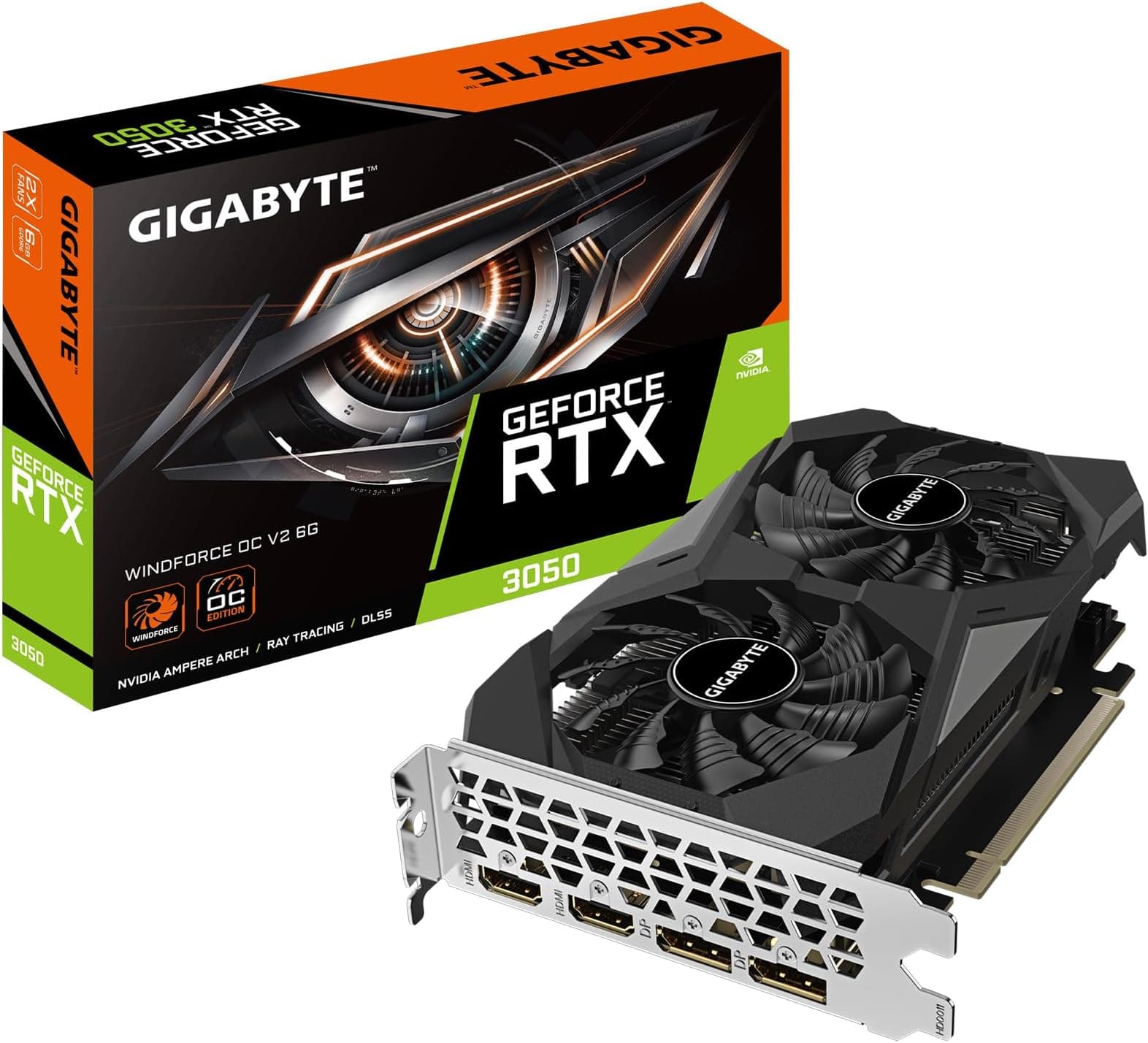
The WINDFORCE 2X cooling system is the headline feature of this particular board partner variant. Two 90mm fans with alternate spinning behaviour, meaning they spin in opposite directions to reduce turbulence between them and improve airflow through the heatsink. It's a proper dual-fan setup, not a single fan with a decorative second one, and that matters for thermals in a card you might be running for hours at a stretch. Gigabyte also integrates this with GeForce Experience, so driver updates and optimisation profiles are handled through NVIDIA's software ecosystem.
| Specification | Detail |
|---|---|
| GPU Architecture | NVIDIA Turing (TU116) |
| VRAM | 6GB GDDR5 |
| Memory Interface | 192-bit |
| Cooling | WINDFORCE 2X, dual 90mm alternate-spin fans |
| Software | GeForce Experience |
| Current Price | £219.00 |
| Rating | ★★★★½ (4.7) (968 reviews) |

Architecture and Cores: What Turing Actually Means Here
The Turing architecture, built on TSMC's 12nm FinFET process, was NVIDIA's big generational leap before Ampere arrived and made everything before it look a bit dated. For the GTX 1660 specifically, you're getting the TU116 die, which is purpose-built for the mainstream segment. NVIDIA designed it without the RT and Tensor core blocks that take up significant die area in the RTX variants, which means more of the chip's transistor budget goes towards pure shader throughput. Whether that was the right call depends on your perspective, but for someone who genuinely doesn't care about ray tracing, it's a reasonable architecture decision.
What Turing brought to the GTX line that Pascal didn't have is the new shader execution model, specifically concurrent execution of floating point and integer operations. In practice, this improves performance in a range of modern game engines that mix FP and INT workloads, which older Pascal cards handled less efficiently. It's not a dramatic difference in isolation, but it's part of why the 1660 punches above what its core count alone would suggest when compared to older generation cards.
The TU116 also supports DirectX 12 Ultimate features at the API level, though without dedicated hardware acceleration for ray tracing, any DX12 RT workloads will run on shader cores. That's slow. Don't try it. But for standard rasterised rendering, the architecture is genuinely capable and holds up well against the workloads that 1080p gaming actually throws at it in 2026. The Turing efficiency improvements over Pascal are real, and they show up in power consumption as much as in raw performance.
Clock Speeds and Boost: The OC Edition Difference
The "OC" in the name signals that Gigabyte has pushed the clocks beyond NVIDIA's reference specification for the GTX 1660. Factory overclocks at this tier are typically modest, a few percent above reference boost speeds, but they're applied consistently and they do make a small real-world difference compared to baseline models. The OC variant isn't going to transform the card into something it isn't, but it means you're getting a slightly faster card than the cheapest 1660 available, without having to fiddle with overclocking software yourself.
NVIDIA's Turing architecture has a well-documented boost behaviour where the GPU dynamically adjusts its clock speed based on thermals, power headroom, and workload. In practice this means the card will often sustain clocks above its rated boost speed when thermals are in check, which is where the WINDFORCE 2X cooler earns its keep. A card that runs cool boosts higher and sustains it longer. The relationship between cooling and clock speed is direct, and it's one of the reasons picking a decent board partner variant matters even on a budget card.
What this means for gaming is that the OC edition will generally edge out the reference GTX 1660 in sustained workloads, particularly longer gaming sessions where thermal headroom becomes the limiting factor. The gains are incremental rather than transformative, but in a competitive price bracket, incremental gains are what separate the good board partner variants from the mediocre ones. Gigabyte has a solid track record with the WINDFORCE cooling system, and the 90mm fans on this card are a step up from the smaller fans you sometimes see crammed onto cheaper alternatives.
VRAM Analysis: Is 6GB GDDR5 Enough in 2026?
This is the section where honestly, with you, because the VRAM situation on the GTX 1660 is genuinely the biggest question mark hanging over it in 2026. Six gigabytes of GDDR5 on a 192-bit bus was a reasonable configuration when this card launched, and for 1080p gaming at mainstream texture settings it still holds up in a lot of titles. But the trend in modern games is unmistakably towards higher VRAM usage, and 6GB is increasingly the point where some games start making uncomfortable decisions about what to load into memory.
The GDDR5 part is also separately from the capacity. The 1660 Super and 1660 Ti both use GDDR6, which delivers meaningfully higher memory bandwidth from the same bus width. The standard 1660 with GDDR5 has lower bandwidth than those siblings, and while it's rarely the primary bottleneck at 1080p, it does show up in bandwidth-hungry scenarios like high-resolution texture streaming. If you're committed to 1080p and keeping texture quality at high rather than ultra, you'll be fine most of the time. Push to ultra textures in the most demanding modern titles and you may start seeing stutters as the card runs out of headroom.
The 192-bit interface is at least a decent bus width for this tier. Compare it to cards with 128-bit interfaces and you can see NVIDIA made a sensible choice here, giving the GDDR5 enough lanes to breathe. Future-proofing is the real concern though. By 2027, 6GB VRAM cards are going to be increasingly marginalised in new releases, and that's a real consideration if you're planning to keep this card for three or four years. For a shorter-term 1080p solution or a secondary build, it's fine. As a long-term investment? Less confident.
Ray Tracing and Upscaling: The Hard Truth
There's no gentle way to say this. The GTX 1660 does not have dedicated RT cores. Ray tracing is technically possible through shader-based computation, but the performance hit is severe enough that it's not a practical option in any real gaming scenario. If ray tracing is on your list of must-haves, this is not your card. Full stop. The RTX 20-series starts where you'd need to be looking, and even those older cards struggle with RT in demanding titles without DLSS doing the heavy lifting.
DLSS is similarly off the table. Without Tensor cores, the GTX 1660 can't run NVIDIA's AI-based upscaling technology. This is a genuinely significant omission in 2026, because DLSS has become one of the most useful tools for getting performance out of mid-range hardware. Games like Cyberpunk 2077, Alan Wake 2, and a growing list of modern titles lean on DLSS to make their performance targets achievable. The 1660 can't participate in that ecosystem at all.
AMD's FidelityFX Super Resolution, specifically FSR 1.0 and FSR 2.0, is a different story. FSR is implemented at the game level and doesn't require any specific GPU hardware, so the GTX 1660 can use it in supported titles. FSR 1.0 is a spatial upscaler that works reasonably well at Quality preset, less impressively at Performance. FSR 2.0 is temporal and noticeably better, closer to DLSS Quality in many comparisons. It's not nothing, and in games that support FSR 2.0, it can meaningfully extend the card's useful performance range. But it's a consolation prize compared to having DLSS available, and that gap is worth acknowledging.
Video Encoding: Streaming and Content Creation
The GTX 1660 includes NVIDIA's NVENC encoder, which is the hardware video encoding block built into Turing GPUs. NVENC on Turing is a solid encoder, a meaningful step up from the Pascal-era version, and it produces good quality H.264 output that's perfectly usable for Twitch streaming or local recording. If you're gaming and streaming simultaneously on a single PC, having NVENC handle the encoding offloads that work from your CPU, which makes a real difference to in-game performance during streams.
What it doesn't have is AV1 encoding, which arrived with the Ada Lovelace generation of NVIDIA cards. AV1 is increasingly the preferred codec for high-quality streaming and YouTube uploads, offering better compression efficiency than H.264 or H.265 at equivalent quality. For a card launched in this era, that's not a surprise or a failing, but it's if AV1 output is part of your workflow. H.265 encoding is supported through NVENC, which covers most streaming and archiving use cases adequately.
For content creation beyond gaming, the GTX 1660 isn't really the target audience. CUDA acceleration in applications like Adobe Premiere or DaVinci Resolve works, and having any NVIDIA GPU in a creative workstation is better than relying on CPU rendering for CUDA-accelerated tasks. But the shader count and VRAM capacity mean this isn't a card you'd choose for serious video production. It's a gaming card that can encode a stream. That's the honest description of its content creation capability, and for the price bracket it's in, that's entirely appropriate.

Power Consumption: Refreshingly Sensible
One of the things the GTX 1660 genuinely gets right, and it's worth being enthusiastic about this because it's increasingly rare, is its power consumption. The Turing architecture's efficiency improvements over Pascal translate into a card that delivers solid 1080p performance without demanding a high-end PSU. Published specifications and independent measurements consistently place the GTX 1660 in a comfortable range that makes it accessible for budget builds where the power supply isn't a premium unit.
This matters practically in a couple of ways. First, you don't need to budget for a PSU upgrade when adding this card to a modest system. A quality 450W to 500W unit is plenty, and many budget builds already have something in that range. Second, lower power consumption means lower heat generation, which feeds back into the thermal story and ultimately into the acoustics. A card that isn't fighting its own power delivery is a quieter, cooler card in sustained use. The WINDFORCE 2X cooler is doing less work than it would on a more power-hungry GPU, and that shows up in the real-world owner experience.
The connector requirements are also straightforward at this tier. You're not dealing with the 16-pin 12VHPWR connector that's caused headaches for RTX 40-series owners, and there's no concern about transient power spikes that exceed what the connector was rated for. This is a card that plugs in, works, and doesn't ask awkward questions about your power infrastructure. For a budget build where simplicity matters, that's genuinely valuable. Not everything needs to be complicated.
Thermal Performance: WINDFORCE 2X Earns Its Name
The WINDFORCE 2X cooling system is one of the more distinctive things about this particular Gigabyte variant, and the 90mm alternate-spinning fan design is more than a marketing talking point. The alternate spin direction reduces the turbulence that occurs when two fans spinning the same way create competing airflows between them. The result is smoother, more efficient airflow through the heatsink fins, which translates into better thermal performance than a conventional dual-fan setup of equivalent size on paper.
Owner reviews consistently flag the thermals as a positive, which is the kind of validation that matters more than any spec sheet claim. When nearly a thousand people buy a card and the temperature performance comes up as a highlight rather than a complaint, that's a reliable signal. The card keeps itself cool under sustained gaming loads, and the heatsink mass on a dual-fan cooler of this size is appropriate for the TDP the GTX 1660 operates at. It's not being asked to do the impossible.
For longevity, good thermals are genuinely important. GPUs that run hot throttle their clocks to protect themselves, which costs you performance, and they age faster than cards that operate in a comfortable temperature range. The WINDFORCE 2X setup on this card suggests it'll maintain its performance characteristics over time better than cheaper single-fan alternatives in the same price bracket. If you're planning to keep this card for a few years, the cooling quality is part of the value proposition, not just a nice-to-have.
Acoustic Performance: Living With It Day to Day
The 90mm fan size on the WINDFORCE 2X is a meaningful detail for acoustics. Larger fans can move the same volume of air at lower RPM than smaller fans, and lower RPM means quieter operation. This is basic physics, but it's surprising how often budget cards cut corners by using smaller, cheaper fans that have to spin faster and louder to compensate. Gigabyte's choice of 90mm blades on this card is a sensible one that pays dividends in daily use.
The alternate-spinning fan design contributes to acoustic quality as well as thermal performance. By reducing turbulence between the two fans, the system produces a smoother airflow noise character compared to conventional dual-fan setups. It's the difference between a steady, even whoosh and the more chaotic noise that comes from competing airflows. Neither is silent, but one is considerably less irritating over a long gaming session. Owner reviews don't flag the noise as a problem, which is the most useful data point available.
At idle and in light workloads, the fans will often run slowly enough to be essentially inaudible in a closed case. Under sustained gaming load the fans spin up, but the consistent feedback from owners is that the card doesn't become the loudest thing in the system. That's all most people need. A card that's quiet enough not to notice during normal use and doesn't become a distraction during intense gaming is doing its job properly. The WINDFORCE 2X delivers that, and it's one of the genuine strengths of this particular variant over cheaper alternatives.
Gaming Performance: What 1080p Actually Looks Like
The GTX 1660 was designed for 1080p gaming, and at that resolution it genuinely delivers. In titles from the last few years at 1080p with high settings, published benchmark data for this class of card consistently shows smooth, playable performance in the vast majority of mainstream games. Esports titles, older AAA games, and moderately demanding modern releases all run well. You're not going to be fighting your frame rate in Fortnite, Valorant, CS2, or similar competitive titles. Those run brilliantly, and the card's efficiency means you can leave them running for hours without the system becoming uncomfortable.
Where things get more complicated is in the most demanding modern releases. Games like Cyberpunk 2077 at 1080p high settings will push the GTX 1660 hard, and you'll be making compromises on settings to maintain smooth performance. That's not a failure of the card so much as a reflection of where game engine demands have moved since 2019. The GTX 1660 was a capable mainstream card when it launched, and five years of increasingly demanding game engines have naturally shifted where it sits in the performance hierarchy. For 2019 to 2022 releases, it's still great. For the most demanding 2025 and 2026 titles, you'll be reaching for the settings menu.
At 1440p, the GTX 1660 starts to show its limits more clearly. It can handle 1440p in less demanding titles and older games, but for modern AAA releases at this resolution you'll be dropping settings significantly to maintain acceptable frame rates. If 1440p is your target resolution, this card is a stretch rather than a comfortable fit, and you'd be better served looking at something more capable. At 4K, it's not a realistic option for gaming. That's not a criticism, it's just an honest description of where a budget 1080p card sits in the resolution hierarchy. Know what you're buying it for.
How It Compares: The Competition at This Price Point
The honest comparison for the Gigabyte GeForce GTX 1660 OC 6G in 2026 is against the used and budget new GPU market, because that's where this card actually competes. New, the obvious NVIDIA comparison within the same family is the GTX 1660 Super, which swaps the GDDR5 for GDDR6 and gains meaningful memory bandwidth as a result. The Super is faster in memory-bandwidth-sensitive scenarios and represents a better long-term buy if the price difference is small. On the AMD side, the RX 6600 is a more modern card with 8GB of GDDR6 and RDNA 2 architecture, which makes it a significantly stronger option for anyone who can stretch the budget slightly.
The GTX 1660 Ti is the other sibling. It sits above the standard 1660 in NVIDIA's own lineup, with more shader processors and GDDR6 memory, and it's a noticeably faster card in GPU-limited scenarios. If you find the Ti at a similar price to the standard 1660, it's the better buy. The standard 1660 OC makes most sense when the price gap between it and the Super or Ti variants is meaningful, because then you're getting the 1080p performance target at a lower cost, which is the whole point of a budget GPU.
Where the Gigabyte variant specifically earns its place is in the board partner comparison. Not all GTX 1660 cards are equal, and the WINDFORCE 2X cooler with 90mm alternate-spinning fans is a better cooling solution than the cheaper single-fan designs you'll find on some budget variants. Paying a small premium for the Gigabyte OC over a no-name single-fan 1660 is a reasonable decision if you care about thermals and acoustics, which you should.
| Feature | Gigabyte GTX 1660 OC 6G | GTX 1660 Super | AMD RX 6600 |
|---|---|---|---|
| Architecture | NVIDIA Turing | NVIDIA Turing | AMD RDNA 2 |
| VRAM | 6GB GDDR5 | 6GB GDDR6 | 8GB GDDR6 |
| Memory Interface | 192-bit | 192-bit | 128-bit |
| DLSS Support | No | No | No (FSR supported) |
| Ray Tracing Hardware | No | No | Limited (RDNA 2) |
| Target Resolution | 1080p | 1080p | 1080p to 1440p |
| Cooler (this variant) | WINDFORCE 2X, 90mm fans | Varies by partner | Varies by partner |
| VRAM Future-proofing | Moderate concern | Moderate concern | Better positioned |

Final Verdict: Who Should Actually Buy This?
The Gigabyte GeForce GTX 1660 OC 6G is a card that does exactly what it promises and nothing more. For budget 1080p gaming in 2026, it still holds its own in the majority of titles, runs cool thanks to the WINDFORCE 2X cooling system, and doesn't demand a serious PSU to function. The 4.7-star average across over 968 owner reviews reflects genuine satisfaction, and that's not a number you fake with a mediocre product. People are happy with it, and the reasons why are legible in the spec sheet.
The target buyer is someone building or upgrading a budget gaming PC where 1080p is the goal, ray tracing is irrelevant, and the budget doesn't stretch to the next tier up. It's also a solid choice for a secondary build, an office gaming machine, or anyone who plays predominantly esports titles and older AAA games where the card is more than capable. If that's you, this is a sensible buy at its current price point in the budget bracket. The WINDFORCE 2X cooling in particular makes the Gigabyte OC variant worth choosing over cheaper single-fan alternatives at similar prices.
Who should skip it? Anyone targeting 1440p gaming, anyone who wants DLSS, anyone building a system they expect to push through the next four or five years of increasingly demanding titles. The 6GB GDDR5 is the card's most significant limitation looking forward, and the absence of DLSS becomes more painful every year as more games lean on it for performance. If you can stretch your budget to the AMD RX 6600 with its 8GB of GDDR6, you'll get a more future-resistant card that handles 1080p better and makes a credible attempt at 1440p. That's the honest "don't overspend on this one if you don't need to" advice: the RX 6600 is worth the extra if you can manage it. But if the budget is genuinely tight and 1080p gaming is the goal, the Gigabyte GTX 1660 OC 6G is a proper, well-cooled card that'll get the job done without drama.
The NVIDIA GeForce GTX 1660 sits in a peculiar position in 2026, a card from a different era that still has genuine utility for a specific kind of buyer. The Gigabyte OC variant is one of the better implementations of it, thanks to the WINDFORCE 2X cooling system and the factory overclock. Score it a solid seven out of ten for what it is. Not a card for 2026's most demanding games, but a capable, quiet, efficient 1080p solution that won't let you down in its target use case. And for a budget GPU, that's genuinely enough.
What works. What doesn’t.
6 + 6What we liked6 reasons
- WINDFORCE 2X cooling with dual 90mm alternate-spin fans keeps thermals genuinely low under sustained gaming loads
- Factory overclock delivers a small but consistent performance edge over reference GTX 1660 cards without manual tweaking
- Low power consumption means no PSU upgrade is needed for most budget builds, keeping overall system costs down
- Handles 1080p gaming in esports titles and older AAA releases smoothly and without drama
- NVENC hardware encoder on Turing is solid for simultaneous gaming and streaming without heavy CPU overhead
- 4.7-star average across nearly 1,000 owner reviews reflects sustained real-world satisfaction
Where it falls6 reasons
- No dedicated RT cores means ray tracing is effectively off the table in any practical gaming scenario
- No Tensor cores rules out DLSS entirely, which is a growing disadvantage as more titles depend on it for performance targets
- 6GB GDDR5 rather than GDDR6 puts it at a memory bandwidth disadvantage versus the 1660 Super and 1660 Ti siblings
- VRAM capacity is an increasing concern for 2025 and 2026 game releases that push beyond 6GB at high texture settings
- Not suited to 1440p gaming in modern demanding titles, limiting its usefulness as resolution ambitions grow
- By 2027 to 2028, the card is likely to feel marginalised in new game releases as VRAM and bandwidth requirements rise
Full specifications
11 attributes| Vram GB | 6 |
|---|---|
| Boost clock MHZ | 1830 |
| Chipset | GeForce GTX 1660 |
| Core clock MHZ | 1785 |
| Generation | GTX 16 Series |
| Length MM | 224 |
| Memory BUS BIT | 192 |
| Memory type | GDDR5 |
| Power connectors | 1x 8-pin |
| Slot width | 2 |
| TDP W | 120 |
If this isn’t right for you
2 options

Frequently asked
7 questions01Can the Gigabyte GTX 1660 OC 6G run ray tracing?+
Technically the GTX 1660 can process ray tracing workloads through shader cores, but it has no dedicated RT hardware. The performance hit is severe enough to make it impractical in any real gaming scenario. If ray tracing matters to you, this card is not the right choice.
02Does the GTX 1660 OC 6G support DLSS?+
No. DLSS requires Tensor cores, which are not present in the GTX 1660. The card is completely excluded from NVIDIA's AI upscaling ecosystem. AMD's FidelityFX Super Resolution (FSR) is supported in games that implement it, since FSR works at the game level and requires no specific GPU hardware.
03Is 6GB of VRAM enough for 1080p gaming in 2026?+
For most mainstream and older titles at 1080p with high settings, 6GB is generally adequate. However, some modern releases at ultra texture settings are beginning to exceed that limit and may cause stuttering. The GDDR5 type also means lower memory bandwidth compared to the 1660 Super or 1660 Ti, which can compound the issue in bandwidth-sensitive scenarios.
04What power supply do I need for the Gigabyte GTX 1660 OC 6G?+
A quality 450W to 500W PSU is sufficient for a system built around this card. The Turing architecture is efficient enough that you do not need a high-end power supply, which keeps overall build costs down and makes the card accessible for budget systems that may already have a modest unit installed.
05How does the WINDFORCE 2X cooling system work?+
The WINDFORCE 2X uses two 90mm fans that spin in opposite directions. This alternate-spin design reduces turbulence between the two blades compared to conventional dual-fan setups where both fans spin the same way. The result is smoother, more efficient airflow through the heatsink fins, lower operating temperatures, and quieter acoustics under sustained load.
06How does the Gigabyte GTX 1660 OC 6G compare to the GTX 1660 Super?+
The GTX 1660 Super uses GDDR6 memory on the same 192-bit interface, which delivers meaningfully higher memory bandwidth than the GDDR5 in the standard 1660. In memory-bandwidth-sensitive scenarios the Super is noticeably faster. If the price difference between the two is small, the 1660 Super is generally the better long-term buy. The standard 1660 OC makes most sense when the price gap is large enough to justify the bandwidth trade-off.
07Can the GTX 1660 OC 6G handle 1440p gaming?+
It can run 1440p in less demanding titles and older games with adjusted settings, but modern AAA releases at 1440p will require significant quality reductions to maintain acceptable frame rates. The card was designed with 1080p as its target resolution, and 1440p should be considered a stretch rather than a comfortable fit. If 1440p is your primary goal, a more capable card is a better choice.