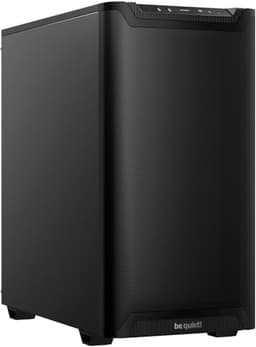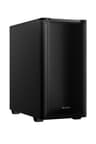
Most people agonise over their CPU and GPU, then pick a case almost as an afterthought. That's backwards. The case decides whether your 280mm radiator actually fits, whether your 420mm GPU clears the front intake, and whether you're still fighting cable routing at midnight. Get it wrong and a perfectly good set of components underperforms because the airflow is strangled or the build is so cramped you've stripped a standoff thread. The be quiet! Pure Base 501 review is a case that takes that seriously, and at the entry tier it's genuinely one of the more considered options on the market right now.
The verdict first, because that's what you're here for: the Pure Base 501 is a strong buy at this price. Two pre-installed Pure Wings 3 140mm PWM fans, a mesh front panel, 369mm GPU clearance, and support for 360mm radiators in the front make this competitive against the Corsair 4000D Airflow and the Fractal Design Pop Air, both of which cost more and don't always include fans. The 4.7-star average across 99 owner reviews backs that up. This isn't a case that got lucky with a few early reviewers; the consistent praise for build quality and quiet operation runs right through the feedback. There are niggles, and we'll get to them, but the headline is: be quiet! has built something genuinely good here.
Where things get interesting is in the details. The Pure Base 501 sits in a crowded bracket where a few pounds either way can land you in significantly worse territory. The Cooler Master MasterBox TD500 Mesh is a rival, and so is the DeepCool CH510 Mesh. Both have airflow credentials. But the Pure Wings 3 fans be quiet! includes are better than the generic fans most rivals bundle, and the noise-optimised design philosophy runs through the whole chassis. So let's get into the specifics and work out exactly who this case is for.
Core Specifications
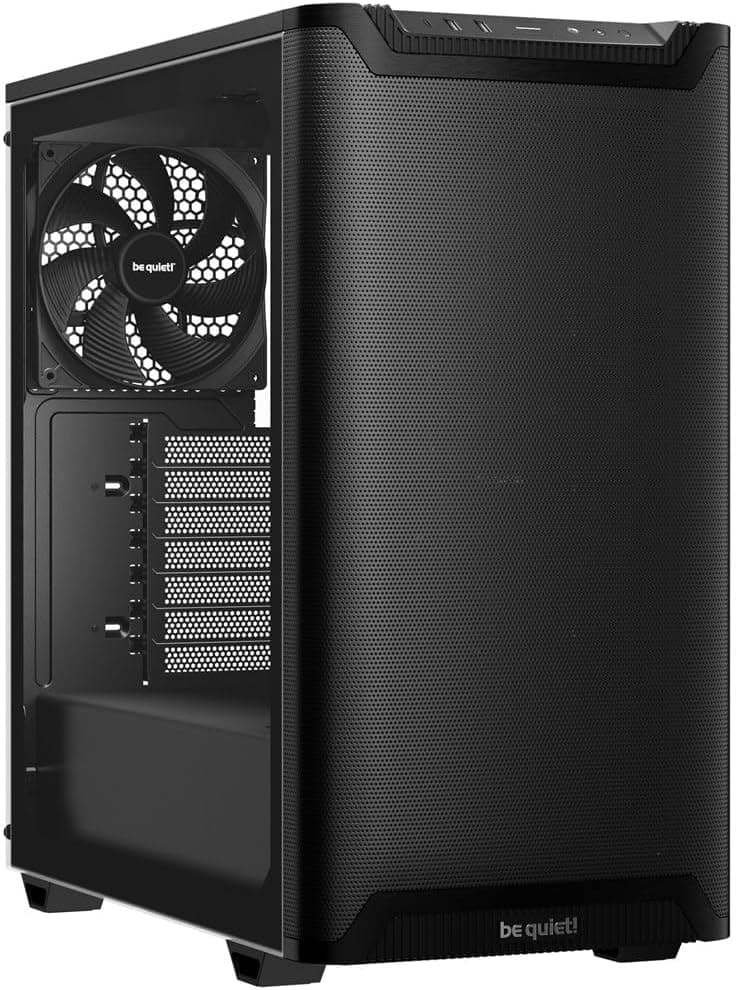
The Pure Base 501 is a mid-tower ATX case, and the spec sheet is more generous than you'd expect at this price tier. The two pre-installed fans are 140mm Pure Wings 3 PWM units, which is a proper step up from the generic 120mm fans that typically come bundled with entry-level cases. Pure Wings 3 fans are be quiet!'s current mainstream fan line, designed around a nine-blade impeller with optimised airflow-to-noise ratio. Getting two of them included out of the box is a genuine saving.
GPU clearance sits at 369mm, which is enough for current-generation flagships including triple-fan AIB cards based on the RTX 4080 Super and RX 7900 GRE. CPU cooler height clearance is 185mm, which covers most tower coolers including the Noctua NH-D15 at 165mm and the be quiet! Dark Rock Pro 5 at 162.8mm. Radiator support is front (up to 360mm), top (up to 240mm), and rear (120mm), which is a solid spread for a case at this price. The chassis takes ATX, mATX, and Mini-ITX motherboards, and the PSU shroud is present and full-length.
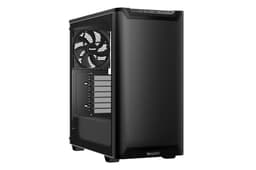
Materials are steel for the main chassis with a tempered glass side panel on the left and a solid steel panel on the right. The front panel is mesh, which is the correct call for airflow. Dust filters cover the front and bottom intakes. The case weighs around 6.5kg, which is on the lighter side for a mid-tower but not worryingly so. Drive support is two 3.5-inch bays and two 2.5-inch bays, which is reasonable but not exceptional. Front I/O includes two USB 3.0 Type-A ports and one USB 3.2 Gen 2 Type-C port, plus a combined audio jack. No RGB hub, no fan controller, which keeps the price down and the inside clean.
| Specification | Detail |
|---|---|
| Form Factor | Mid-Tower |
| Motherboard Support | ATX, mATX, Mini-ITX |
| Dimensions (H x W x D) | 464 x 220 x 455mm |
| Max GPU Length | 369mm |
| Max CPU Cooler Height | 185mm |
| Front Radiator Support | Up to 360mm |
| Top Radiator Support | Up to 240mm |
| Rear Radiator Support | 120mm |
| Included Fans | 2x Pure Wings 3 140mm PWM |
| Fan Mounts Total | Up to 6 (front x3, top x2, rear x1) |
| 3.5-inch Drive Bays | 2 |
| 2.5-inch Drive Bays | 2 |
| Front I/O | 2x USB 3.0 Type-A, 1x USB 3.2 Gen 2 Type-C, audio combo |
| Side Panel | Tempered Glass (left), Steel (right) |
| Front Panel | Mesh |
| PSU Shroud | Yes, full-length |
| Weight | approx. 6.5kg |
| Price | £70.08 |

Form Factor and Dimensions
At 464mm tall, 220mm wide, and 455mm deep, the Pure Base 501 is a proper mid-tower. Not a bloated one that won't fit under a desk, and not a cramped pseudo-mid-tower that makes large AIO installation a misery. The 220mm width is fairly standard for the class, and the 455mm depth gives you the internal volume to work with without the footprint becoming ridiculous. On a standard desk, this sits comfortably. On a shelf or in an enclosed desk unit you'll want to measure, but that's true of any mid-tower.
The 220mm width might feel a touch tight if you're used to wider cases like the Fractal Design Meshify 2 (232mm), but in practice it doesn't cause problems for the builds this case is aimed at. The rear cable management space, which we'll cover in more detail later, is adequate rather than generous, and that's partly a function of the overall chassis width. It's a trade-off be quiet! has made deliberately to keep the external footprint manageable, and most builders won't notice it unless they're running an unusually thick PSU cable harness.
The tempered glass left panel gives you a clear view of the internals, which matters if you're putting RGB components inside. The right panel is solid steel, which is fine. You only ever open the right side to route cables, and a solid panel there is actually more rigid and easier to reseat than a glass one. The overall silhouette is clean and relatively understated for a be quiet! product, which fits the brand's ethos. No aggressive angular styling, no fake vents. Just a tidy box that does what it says.
Motherboard Compatibility
The Pure Base 501 supports ATX, mATX, and Mini-ITX motherboards. The standoff layout is pre-installed for ATX, which is the sensible default given that's what most builders at this price tier are running. If you're dropping in an mATX board, you'll need to move a couple of standoffs, which is a five-minute job. Mini-ITX works fine but feels slightly wasteful given the internal volume; if you're building small, a dedicated ITX case will serve you better.
The ATX mounting area is well-positioned relative to the front fan mounts, which means a full-size ATX board doesn't restrict your front radiator options. Some cheaper cases compromise this by positioning the motherboard tray too far forward, which then forces you to choose between a 360mm front radiator and a full-size board. The Pure Base 501 doesn't have that problem. The top radiator support is 240mm maximum, which does limit you to a 240mm AIO for top-mounted cooling, but that's a reasonable constraint at this size and price.
E-ATX is not supported, which is expected at this price and chassis width. If you're running an E-ATX workstation board, you're in the wrong case category entirely. For the vast majority of consumer ATX builds, the Pure Base 501's motherboard compatibility is complete. One thing several owners note in their reviews is that the I/O cutout area is clean and well-finished, with no sharp edges around the rear I/O shield opening. That might sound minor, but a jagged I/O cutout on a budget case is one of those things that draws blood during a build and then irritates you every time you remember it.
GPU Clearance
369mm of GPU clearance is the headline number, and it's a good one. To put it in context: the RTX 4090 Founders Edition measures 336mm, and most triple-fan AIB cards for the RTX 4080 Super and RX 7900 XTX come in at 320mm to 360mm. So even the longest current-generation consumer GPUs fit with room to spare. The ASUS ROG Strix RTX 4090, one of the chunkiest cards on the market, is 357mm. That still clears the 369mm limit, though you're not left with much margin. If you're running something that long, double-check the specific card dimensions before committing.
There's no vertical GPU mount option out of the box, which is a common omission at this price. If you want to show off your GPU through the tempered glass, you'd need a third-party PCIe riser cable and bracket, which adds cost and complexity. For most builders this won't matter at all. The standard horizontal mount is perfectly functional, and the GPU sits well-supported in the PCIe slot without any visible sag on shorter cards. For longer, heavier triple-fan cards, a GPU support bracket is a sensible addition, and there's space in the case to fit one.
The 369mm clearance figure assumes no front-mounted radiator. If you're fitting a 360mm front radiator with thick fans, the effective GPU clearance shrinks depending on the radiator and fan combination you choose. Be quiet! doesn't publish a reduced clearance figure for that configuration, which is slightly frustrating, but it's a common omission across the industry. As a rough guide, a 360mm radiator plus 25mm fans takes up around 60mm of depth from the front, which still leaves well over 300mm for the GPU in most configurations. But measure your specific components if you're pushing the limits.
CPU Cooler Clearance
185mm of CPU cooler clearance is generous for a mid-tower. The Noctua NH-D15 sits at 165mm, the be quiet! Dark Rock Pro 5 at 162.8mm, the Thermalright Phantom Spirit 120 at 159mm. All of them fit with 20mm or more to spare. Even some of the taller single-tower coolers that push 170mm are fine here. The only air coolers that would genuinely struggle are some of the more exotic tall designs that go beyond 180mm, and those are rare enough that it's not a practical concern for the vast majority of builders.
AIO radiator support is front (up to 360mm), top (up to 240mm), and rear (120mm). The front is the primary location for a 360mm AIO, and the Pure Base 501 handles it properly. The top 240mm support is useful for 240mm AIOs if you want to keep the front clear for intake fans, or if you're pairing a 240mm AIO with three front intake fans for maximum airflow. The rear 120mm mount handles a single 120mm fan or a 120mm radiator, though fitting a radiator there alongside a 120mm exhaust fan is a tight squeeze and most builders just use the rear mount for a single exhaust fan.
One thing that comes up in owner reviews is RAM clearance with front-mounted radiators and push-pull fan configurations. With a 360mm radiator at the front in push-pull (so two sets of 120mm fans), the fans closest to the motherboard can potentially foul tall RAM with large heatspreaders depending on the exact mounting position. This is a known quirk with many mid-towers at this depth, not specific to the Pure Base 501, but it's something to check if you're running high-profile DDR5 sticks and planning a push-pull front radiator setup. Low-profile RAM eliminates the issue entirely.
Storage Bay Options
Two 3.5-inch bays and two 2.5-inch bays. That's the storage offering, and it's honest for the price tier. If you're building a pure NVMe system with no spinning rust, the 3.5-inch bays are irrelevant and you've got two 2.5-inch mounts for SSDs if you need them alongside your M.2 drives on the motherboard. Most modern ATX boards have two or three M.2 slots, so for a typical gaming build you might never use any of the drive bays at all. But if you're migrating from an older system and bringing HDDs with you, two 3.5-inch bays is enough for most people.
The 3.5-inch bays sit in a removable cage behind the PSU shroud, which keeps them out of the main airflow path. Tool-less mounting for 3.5-inch drives is present, using rubber-damped sleds that help with vibration isolation. That's a detail that cheaper cases skip, and it's the kind of thing you appreciate if you're running a drive that runs 24/7. The 2.5-inch mounts are on the back of the motherboard tray, which is the right place for them, keeping the front of the case uncluttered.
If you need more than two HDDs, this case isn't for you. But then a case at this price tier with four or six HDD bays would be making compromises elsewhere to fit them in. The Pure Base 501 has clearly been designed for the modern build pattern: a couple of M.2 SSDs on the motherboard, maybe one or two 2.5-inch SSDs for extra storage, and at most a couple of HDDs for bulk storage. That covers the majority of gaming and productivity builds. Serious NAS or media server builds need a different chassis entirely.

Cable Management
The PSU shroud runs the full length of the bottom of the case, which hides the PSU and the worst of the cable mess from view through the tempered glass. Behind the motherboard tray, be quiet! has included Velcro cable tie points at sensible intervals, which is the correct approach. Zip ties are a pain to remove when you need to swap a component; Velcro straps let you undo and redo cable runs without cutting anything. The cable routing channels have rubber grommets on the larger openings, which gives the build a tidier appearance and protects cables from the steel edges.
Rear panel clearance is where some owners note a slight frustration. The gap between the back of the motherboard tray and the right-side panel is around 18mm to 20mm, which is workable but not spacious. If you're running a modular PSU with flat cables it's fine. If you've got a non-modular PSU with a full harness of cables to tuck away, you'll need to be methodical about it. The panel will close, but you might need to give it a firm push. This is a common constraint at 220mm chassis width and it's not unique to the Pure Base 501, but it's honest to flag it.
The 24-pin ATX motherboard power routing is handled by a dedicated channel on the right side of the motherboard tray, which keeps it away from the front fan mounts. The CPU power cable routing hole is positioned high on the motherboard tray, which is correct for most ATX boards. Several owners specifically mention that cable management came together more easily than they expected for a case at this price, which suggests be quiet! has put genuine thought into the routing options rather than just drilling holes wherever was convenient. The full-length PSU shroud does a lot of heavy lifting aesthetically, hiding the bottom clutter even when the cable routing behind the tray isn't perfectly neat.
Airflow and Thermal Design
The mesh front panel is the most important single feature of the Pure Base 501's thermal design. A solid or glass front panel throttles intake airflow significantly, and at this price tier you still see cases shipping with glass fronts that look great in product photos and perform noticeably worse under load. Be quiet! has gone mesh, and the mesh coverage is generous across the front face. Combined with the two pre-installed 140mm fans pulling air in from the front, the intake setup is proper rather than token.
The Pure Wings 3 140mm PWM fans are the standout inclusion. Be quiet! rates them for quiet operation, and the PWM control means your motherboard can dial them back at idle and ramp them up under load without you having to manually adjust anything. Two 140mm fans move more air at lower RPM than two 120mm fans, which is part of why be quiet! uses 140mm as the default for this case. The front fan mounts support up to three 120mm or two 140mm fans, so you can add a third fan later if you want to push more air through. The rear mount takes a single 120mm fan, and there's no fan included there, which means you'll want to add one as part of your build to balance the intake and exhaust.
Dust filtration covers the front intake and the bottom PSU intake, both of which are the high-risk areas for dust accumulation. The filters are removable for cleaning, which matters more than people think. A dust filter you can't easily clean becomes a flow restrictor within a few months in a typical home environment. The top panel has no dust filter, which is fine if you're not mounting fans or a radiator there, but something to think about if you are. The overall airflow path is front-to-rear with the option to add top exhaust, which is the standard and effective approach. Owner feedback consistently mentions good temperatures relative to the noise level, which is exactly what you'd expect from a case designed around be quiet!'s noise-optimised fan lineup.
Front I/O and Connectivity
The front I/O panel sits at the top of the case, which is the right location for a desktop system. Two USB 3.0 Type-A ports, one USB 3.2 Gen 2 Type-C port, a combined audio jack, and the power button. That's a clean, functional set. The USB-C port is the headline here: USB 3.2 Gen 2 delivers up to 10Gbps, which is fast enough for an external SSD or a modern docking station. At this price tier, USB-C on the front panel is not guaranteed, and its inclusion is a genuine plus.
The two USB 3.0 Type-A ports connect to the motherboard via a standard 20-pin internal USB 3.0 header, and the USB-C connects via an internal USB 3.2 Gen 2 header. Most current mid-range and high-end ATX motherboards have both of these headers, but check your specific board if you're pairing this with an older or budget motherboard that might only have one internal USB 3.0 header. The combined audio jack handles headphone and microphone through a single 3.5mm TRRS connector, which works with most headsets. Separate headphone and microphone jacks would be preferable, but the combined approach is the standard for the price tier.
There's no RGB button, no fan speed controller, and no display on the front panel. Some people will miss a fan controller; most won't, because PWM control from the motherboard handles everything automatically if you set up a fan curve in your BIOS or a utility like fan control software. The power button has a clean, tactile feel according to owner feedback, with no wobble or mushiness. The reset button is smaller and recessed slightly, which reduces the chance of accidentally hitting it. Small detail, but a sensible one.
Build Quality and Materials
The steel chassis is solid for the price. Be quiet! doesn't publish the exact steel gauge, but owner feedback consistently describes the chassis as rigid with no panel flex during the build process. The PSU shroud doesn't wobble, the motherboard tray is flat, and the PCI-e slot covers are the removable type rather than the break-out type that you can never put back once removed. That last point matters if you're ever changing GPU bracket configurations. Break-out slot covers are a cost-cutting move that's common at this price, so having proper removable ones is a plus.
The tempered glass left panel is attached with a thumbscrew at the rear and swings open on a hinge at the front. Hinged glass panels are generally better than the slide-off type because they're less likely to drop and shatter, but a few owners note that the hinge feels slightly stiff on first use and benefits from a bit of working in. That's not unusual for a new case and it's not a quality defect, just something to be aware of when you're doing your first build. The glass itself is clear and thick enough to feel substantial without being excessively heavy.
The finish on the exterior is a matte black powder coat, which resists fingerprints better than a gloss finish and doesn't show minor scuffs. The interior is white on some variants, which makes it easier to see what you're doing during a build, particularly in the cable routing channels behind the motherboard tray. Sharp edges are largely absent according to owner feedback, which is a genuine quality indicator. Cheap cases often have burrs on punched-out holes and raw steel edges around cable routing cutouts. The Pure Base 501's owners don't mention this as an issue, which suggests the manufacturing quality control is decent. At 99 reviews averaging 4.7 stars, you'd expect at least a few complaints about sharp edges if they were a problem.
How It Compares
The two most direct rivals at this price tier are the Corsair 4000D Airflow and the Fractal Design Pop Air. Both are well-regarded mid-towers with mesh fronts and strong airflow credentials. Neither includes fans in the base configuration, which is an immediate practical difference: the Pure Base 501 comes with two quality 140mm PWM fans, so you're getting real value included in the box. Buying two comparable fans separately would add a meaningful amount to the cost of either rival.
The Corsair 4000D Airflow is slightly wider at 230mm, which gives it a bit more rear cable clearance. It also has a more established ecosystem of accessories and a longer track record of owner feedback. But it's typically priced higher than the Pure Base 501, and the fans you'd need to buy separately to match the Pure Base 501's out-of-box configuration push the total cost up further. The Fractal Design Pop Air is similarly priced to the 4000D Airflow, has a clean interior design, and Fractal's build quality is consistently good, but again, no fans included.
The DeepCool CH510 Mesh is a cheaper alternative that includes one 120mm fan. The fan quality isn't comparable to the Pure Wings 3, and the single 120mm is not a serious intake setup on its own. If you're genuinely budget-constrained it's an option, but the Pure Base 501 represents a better value proposition once you factor in the fan cost. The Cooler Master MasterBox TD500 Mesh is another rival with a distinctive mesh design and three included fans, though the fans are 120mm units rather than 140mm, and the TD500 Mesh's angular styling isn't to everyone's taste.
| Feature | be quiet! Pure Base 501 | Corsair 4000D Airflow | Fractal Design Pop Air |
|---|---|---|---|
| Form Factor | Mid-Tower | Mid-Tower | Mid-Tower |
| Included Fans | 2x 140mm PWM | None | None |
| Front Panel | Mesh | Mesh | Mesh |
| Max GPU Length | 369mm | 360mm | 467mm |
| Max CPU Cooler Height | 185mm | 170mm | 185mm |
| Front Radiator Support | 360mm | 360mm | 360mm |
| USB-C Front I/O | Yes (Gen 2) | Yes (Gen 1) | Yes (Gen 2) |
| Drive Bays (3.5-inch) | 2 | 2 | 2 |
| Price Tier | Entry | Entry/Mid | Entry/Mid |

Final Verdict
The be quiet! Pure Base 501 review conclusion is straightforward: this is one of the better-value mid-tower cases in the entry tier right now, and the included Pure Wings 3 fans tip the balance firmly in its favour against rivals that make you buy fans separately. The 369mm GPU clearance, 185mm CPU cooler clearance, and 360mm front radiator support cover virtually every consumer build scenario. The mesh front panel, proper dust filters, and sensible airflow path mean temperatures will be good. The 4.7-star average across 99 reviews suggests real owners agree.
The niggles are real but minor. Rear cable clearance is adequate rather than generous at 18mm to 20mm, so non-modular PSU owners will need to be tidy. There's no rear exhaust fan included, so you'll want to budget for a 120mm fan to balance the intake. The top radiator support is limited to 240mm, which rules out a 360mm top-mounted AIO if that's your plan. And there's no vertical GPU mount option for those who want to show off their card through the glass.
Who should buy this? Anyone building a mid-range gaming or productivity PC on a budget who wants a quiet, well-ventilated case without having to immediately spend more on fans. It's particularly good if you're pairing it with be quiet! cooling components, where the PWM ecosystem plays together nicely. Who should skip it? If you're building a high-end system where you'll be fitting a 360mm AIO at the top and a 360mm AIO at the front simultaneously, you need a bigger case. And if you genuinely don't care about noise and just want maximum airflow at the lowest possible cost, the DeepCool CH510 Mesh saves you a few pounds, though you'll spend that saving on fans within a month anyway.
The honest don't-overspend note: if you're building a modest system with a 240mm AIO or a mid-height air cooler and a single GPU, the be quiet! Pure Base 500, the predecessor to this model, sometimes appears at a lower price and covers the same use case adequately. Check current pricing on both before committing. But if the Pure Base 501 is at its normal entry-tier price, it's the better buy. The Pure Wings 3 fans alone justify the difference over most alternatives at this level.
What works. What doesn’t.
5 + 4What we liked5 reasons
- Two quality Pure Wings 3 140mm PWM fans included out of the box
- 369mm GPU clearance covers all current-generation consumer GPUs
- Mesh front panel with proper dust filters for genuine airflow
- USB 3.2 Gen 2 Type-C on the front I/O at this price tier
- Removable PCIe slot covers and rubber-damped HDD sleds show build quality thought
Where it falls4 reasons
- Rear cable clearance around 18-20mm is tight with non-modular PSUs
- No rear 120mm exhaust fan included, so budget for one
- Top radiator support limited to 240mm maximum
- No vertical GPU mount option out of the box
Full specifications
11 attributes| Form factor | Mid-Tower |
|---|---|
| CPU cooler clearance MM | 178 |
| Dimensions MM | 450 x 231 x 463 |
| Fans included | 2 |
| GPU clearance MM | 368 |
| MAX FAN count | 6 |
| MAX radiator MM | 360 |
| PSU support | ATX up to 250mm (without HDD cage), 180mm (with HDD cage) |
| Side panel | tempered glass |
| Supported motherboard | ATX, M-ATX, Mini-ITX |
| Weight KG | 7.2 |
Frequently asked
5 questions01Is the be quiet! Pure Base 501 PC Case, 2 Preinstalled Pure Wings 3 140mm PWM Fans good for airflow?+
Yes, genuinely. The mesh front panel allows unrestricted intake airflow, and the two included Pure Wings 3 140mm PWM fans are a proper step up from the generic 120mm fans bundled with most rivals at this price. The front mounts support up to three 120mm or two 140mm fans, and there's a rear 120mm mount for exhaust. Dust filters on the front and bottom PSU intake are removable for cleaning. Owner feedback consistently reports good temperatures relative to noise levels, which is the right outcome for a case built around be quiet!'s noise-optimised fan philosophy.
02What's the GPU clearance on the be quiet! Pure Base 501 PC Case, 2 Preinstalled Pure Wings 3 140mm PWM Fans?+
The maximum GPU length is 369mm with no front radiator installed. That covers all current-generation consumer GPUs including triple-fan AIB cards for the RTX 4080 Super, RX 7900 XTX, and even the ASUS ROG Strix RTX 4090 at 357mm. If you're fitting a 360mm front radiator with 25mm fans, the effective GPU clearance reduces by roughly 60mm depending on your specific radiator and fan combination, but you'll still have well over 300mm of clearance in most configurations. Check your specific component dimensions if you're running both a 360mm front radiator and a particularly long GPU simultaneously.
03Can the be quiet! Pure Base 501 PC Case, 2 Preinstalled Pure Wings 3 140mm PWM Fans fit a 360mm AIO?+
Yes, but only in the front mount. The front supports radiators up to 360mm, which is the primary location for a 360mm AIO. The top panel supports up to 240mm, so a 360mm top-mounted AIO is not an option. The rear mount takes a single 120mm fan or radiator. If you're planning a 360mm AIO, mount it at the front and use the top for additional 120mm or 140mm intake or exhaust fans. One thing to check: with a 360mm front radiator in push-pull configuration, tall RAM heatspreaders on some DDR5 kits can potentially conflict with the fans nearest the motherboard. Low-profile RAM avoids this entirely.
04Is the be quiet! Pure Base 501 PC Case, 2 Preinstalled Pure Wings 3 140mm PWM Fans easy to build in?+
Owner feedback is consistently positive on this. The hinged tempered glass left panel (stiff on first use but settles in) gives good access, the cable routing channels have rubber grommets, Velcro tie points are positioned sensibly behind the motherboard tray, and the PCIe slot covers are removable rather than break-out. The main challenge is rear cable clearance, which is around 18-20mm, adequate for modular PSU cables but tighter with a full non-modular harness. No significant reports of sharp edges in owner reviews, which is a real quality indicator at this price tier. Most builders report the build coming together more smoothly than expected.
05What warranty and returns apply to the be quiet! Pure Base 501 PC Case, 2 Preinstalled Pure Wings 3 140mm PWM Fans?+
Be quiet! products typically carry a manufacturer warranty; check the be quiet! website directly for the current warranty terms applicable to the Pure Base 501 in the UK. When purchased through Amazon UK, you also benefit from Amazon's standard 30-day returns policy and the A-to-Z Guarantee, which covers you if the item arrives damaged or not as described. Always retain your packaging during the initial period in case a return is needed.