Prebuilt reviews often read like someone copy-pasted the spec sheet and called it a day. You get the numbers, sure, but nobody tells you whether the parts are actually decent, whether Stormforce cut corners where it counts, or whether you'd be better off spending a Saturday afternoon building the same thing yourself. So that's what this titan pulse amd review is actually going to do: dig into what's inside, explain what each component means for your gaming life, and tell you honestly whether the premium price makes sense.
The short version? This is a genuinely well-specced machine. An AMD Ryzen 7 9850X3D paired with an RTX 5080 is not a combination you see in half-hearted prebuilts, and the supporting hardware, from the 850W Gold PSU to the 360mm AIO, suggests Stormforce weren't just throwing the cheapest parts they could find into a shiny case. But at this price tier, it needs to justify itself against a DIY build at equivalent spec. And that's where things get interesting, because right now, sourcing an RTX 5080 independently is its own adventure in frustration and inflated pricing. The convenience argument is stronger than usual here.
There are no owner reviews to draw from yet. This is a new listing. So the authority here comes from the spec sheet, component knowledge, and honest comparison with what a self-build at this level actually costs and involves. That's enough to give you a proper picture.
Core Specifications
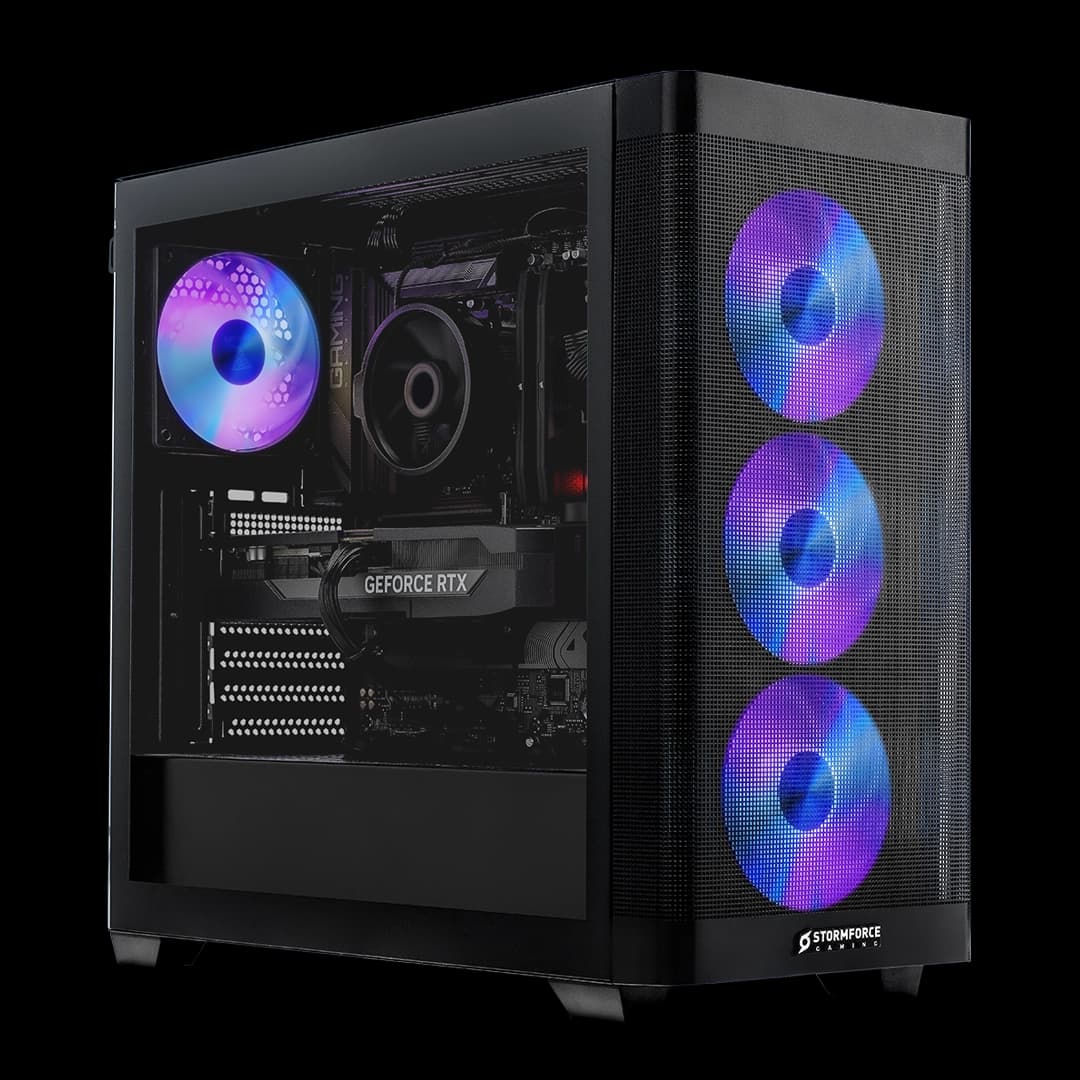
The headline components are an AMD Ryzen 7 9850X3D and an NVIDIA RTX 5080 with 16GB of GDDR6X. Those are both current-generation, top-tier parts. The 9850X3D is AMD's latest 3D V-Cache chip, and the RTX 5080 sits just below the flagship 5090 in NVIDIA's Blackwell lineup. Neither of these is a budget component dressed up with marketing language. They're the real thing.
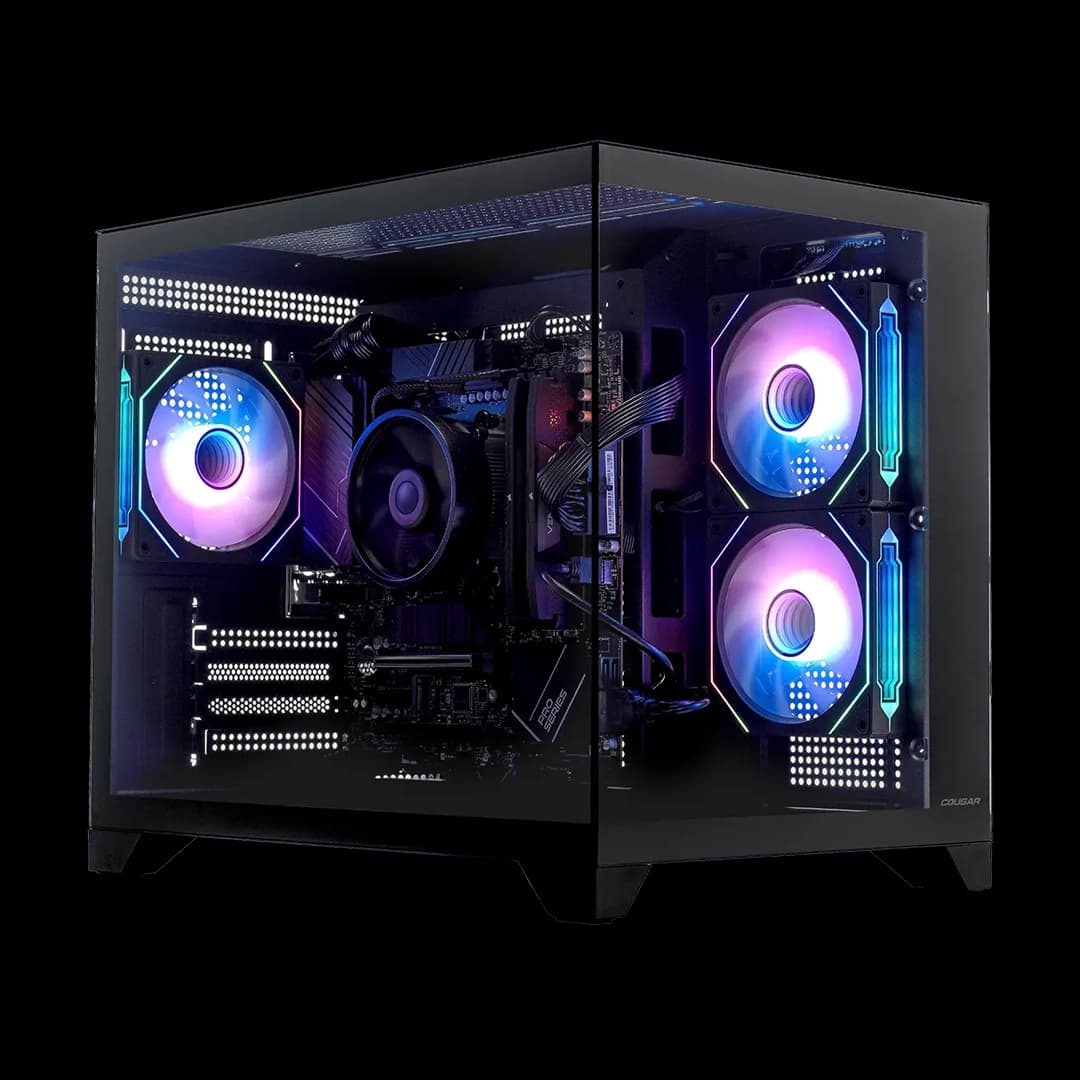
Supporting the headline duo, you've got 32GB of DDR5 running at 6000MHz, a 2TB Gen 4 M.2 NVMe SSD, and a B850 ATX motherboard. The PSU is an 850W 80+ Gold fully modular unit, which is proper headroom for this GPU. Cooling is handled by a 360mm AIO liquid cooler with a triple-fan radiator. The case is a Cougar FV270 RGB ATX with panoramic tempered glass. And the OS is Windows 11 Home. Connectivity includes WiFi 6 and Ethernet.
One thing clearly: the B850 chipset is a solid mid-to-high platform for Ryzen 9000 series chips. It's not the flagship X870E, but it supports DDR5 at 6000MHz natively and offers the kind of power delivery and storage support you need for a build like this. Stormforce aren't skimping on the motherboard in the way some prebuilt makers do by pairing a flagship CPU with a budget board. That matters more than most people realise, because a weak board is where thermal and stability problems often start.
| Component | Specification |
|---|---|
| CPU | AMD Ryzen 7 9850X3D |
| GPU | NVIDIA RTX 5080 16GB GDDR6X |
| RAM | 32GB DDR5 6000 |
| Storage | 2TB Gen 4 M.2 NVMe SSD |
| Motherboard | B850 ATX |
| Cooler | 360mm AIO Liquid Cooler |
| Case | Cougar FV270 RGB ATX |
| PSU | 850W 80+ Gold Fully Modular |
| OS | Windows 11 Home |
| Networking | WiFi 6, Ethernet |
| Price | £3,199.99 |

CPU & Performance
The AMD Ryzen 7 9850X3D is the chip AMD built specifically for gaming. Eight cores, 16 threads, and a boost clock of 5.6GHz, but the thing that actually sets it apart is the 3D V-Cache technology. AMD stacks extra cache directly on top of the processor die, dramatically increasing the L3 cache available to the CPU. In gaming terms, this matters because modern game engines are increasingly cache-hungry. More cache means less time waiting for data to arrive from system memory, which translates to smoother frame pacing and higher minimum frame rates, particularly in open-world titles and CPU-heavy games like strategy games or simulation titles.
Previous 3D V-Cache generations, like the 7800X3D, showed substantial gaming gains over their non-cache counterparts in published benchmarks from outlets like Digital Foundry and Eurogamer. The 9850X3D follows the same design philosophy but on AMD's newer Zen 5 architecture, which brings improved instructions-per-clock performance and better power efficiency compared to Zen 4. The 5.6GHz boost clock also means this chip isn't sacrificing raw single-threaded speed to achieve its cache advantages, which was a minor criticism of earlier V-Cache parts.
For productivity work alongside gaming, eight cores and 16 threads is genuinely capable. Video editing, streaming, 3D rendering, all of that runs well on this kind of core count. It's not a 16-core workstation chip, so if you're doing heavy multi-threaded rendering professionally you'd want more cores. But for the person who games hard, streams occasionally, and uses their PC for general creative work? This CPU is not a weak link in any meaningful way. It's the right chip for this use case.
GPU & Gaming Performance
The NVIDIA RTX 5080 with 16GB of GDDR6X is the second-fastest consumer GPU NVIDIA currently makes, sitting below the RTX 5090 in the Blackwell generation. At 1440p, this card is essentially unconstrained by anything a monitor can throw at it. At 4K, it handles demanding titles at high settings with ray tracing enabled without breaking a sweat, based on NVIDIA's published specifications and what the architecture is designed to deliver. This is a card built for 4K gaming, full stop.
The 16GB of GDDR6X VRAM is worth talking about. Some games at 4K with high texture settings are already pushing past 12GB of VRAM, and that figure will only grow. 16GB gives this build meaningful longevity. You're not going to hit a VRAM ceiling in the next few years the way you might with a 12GB card. NVIDIA's Blackwell architecture also brings improvements to real-time ray tracing and the latest version of DLSS, NVIDIA's AI-driven upscaling technology. DLSS 4 with Multi Frame Generation is a Blackwell exclusive feature, meaning this card can generate multiple frames between rendered frames using AI, which effectively multiplies perceived frame rates in supported titles.
The honest caveat here is that the RTX 5080 is expensive hardware and it's positioned for people who want the best gaming experience at 4K, or who want maximum frame rates at 1440p for high-refresh-rate competitive play. If your monitor is 1080p and you're not planning to upgrade it, this card is overkill. But if you're buying at this price tier, you presumably know what you're doing and you've got a screen to match. Or you're planning to get one. Either way, the GPU in this build is not a compromise.
Memory & Storage
Thirty-two gigabytes of DDR5 running at 6000MHz is the sweet spot for Ryzen 9000 series gaming builds right now. AMD's Zen 5 architecture and the B850 platform both support DDR5 natively, and 6000MHz sits at what AMD's own documentation identifies as the optimal frequency for the memory controller on these chips. Go much higher and you start hitting diminishing returns or potential instability without serious manual tuning. So Stormforce have hit the right number here, rather than just chasing a headline spec with 7200MHz RAM that might need dialling back anyway.
The 2TB Gen 4 M.2 NVMe SSD is the right choice for this build. Gen 4 NVMe drives offer read and write speeds that leave traditional SATA SSDs looking slow, and 2TB gives you room for a proper game library without immediately running into storage anxiety. You're looking at sequential read speeds in the region of 5,000 to 7,000 MB/s with a good Gen 4 drive, compared to around 550 MB/s for a SATA SSD. That gap matters for game loading and large file transfers. It's not a gimmick at this level.
The upgrade headroom question is worth thinking about. The B850 motherboard will have multiple M.2 slots, so adding a second NVMe drive later is straightforward. RAM expansion depends on whether Stormforce have populated all four DIMM slots or just two with a dual-channel 2x16GB kit. Two populated slots is the better scenario because it leaves room to double to 64GB later if you want it. Stormforce's spec listing doesn't detail slot configuration, but 32GB kits in prebuilts are typically dual-channel 2x16GB, which would leave two slots free. That's a reasonable assumption, though worth confirming with Stormforce directly if it matters to you.
Cooling Solution
A 360mm AIO liquid cooler with a triple-fan radiator is serious cooling hardware. This is not the budget 120mm single-fan cooler that cheaper prebuilts sometimes pair with powerful CPUs. A 360mm radiator gives you significantly more surface area for heat dissipation than a 240mm unit, which matters when you're cooling a chip that can pull serious power under sustained load. The Ryzen 7 9850X3D is a reasonably efficient chip by high-end standards, but it still needs proper cooling to maintain its boost clocks under sustained gaming or productivity workloads.
The Cougar FV270 case is designed with airflow in mind, and the panoramic tempered glass design typically means the front and side panels aren't solid metal blocking intake air. Good case airflow is what keeps the GPU cool, because the AIO only handles the CPU. The RTX 5080 is a power-hungry card and it generates heat. If the case has decent intake fans and clear airflow paths, the GPU's own cooler can do its job. If the case is restrictive, you'll see higher GPU temperatures and potentially throttling under sustained load.
Noise is always a consideration with AIO coolers. At idle and light loads, a 360mm AIO is generally quiet because the fans don't need to spin fast. Under full load, the three radiator fans and the GPU fans will all be audible. That's just physics. But a 360mm setup has enough surface area that it can maintain reasonable temperatures at moderate fan speeds, which keeps the noise tolerable. Stormforce haven't published specific noise figures, and we wouldn't invent them, but the hardware choice here is the right one for a system of this performance level.
Case & Build Quality
The Cougar FV270 RGB ATX is a proper mid-tower case with a panoramic tempered glass design. Cougar are a legitimate case manufacturer with a reasonable reputation in the enthusiast space, and the FV270 is built around showing off the internals. The panoramic glass means you get visibility into the build from multiple angles, which is either a feature or irrelevant depending on whether you care about that sort of thing. The RGB lighting from the case and the AIO fans will be visible through the glass, so if you want a light show, it's there. If you don't, you can usually dial it back in software.
The fully modular 850W PSU is genuinely good news for build quality. Modular PSUs mean only the cables you need are actually installed, which makes cable management dramatically cleaner. In a prebuilt context, this matters because a cluttered cable situation behind the motherboard tray restricts airflow and makes future upgrades more annoying. A fully modular PSU suggests Stormforce's builders can do a tidy job inside the case, though the actual cable routing quality depends on the individual build. This is one area where prebuilts vary, and without being able to look inside a specific unit, it's owner photos if any appear on Stormforce's product page.
The 80+ Gold certification on the PSU means it's rated for at least 87% efficiency at 50% load. That's meaningful in two ways: less energy wasted as heat inside the case, and a quality indicator. PSU manufacturers have to meet genuine electrical standards to earn the 80+ Gold rating, so it's not just marketing. An 850W unit at Gold efficiency is also appropriate headroom for the RTX 5080, which is a power-hungry card. You're not running this system on a PSU that's sweating at 95% capacity, which is where reliability problems tend to start.

Connectivity & Ports
The verified specs confirm WiFi 6 and Ethernet for networking. WiFi 6 is the current mainstream standard, offering improved throughput and better performance in congested wireless environments compared to WiFi 5. For most gaming use cases, a wired Ethernet connection is still preferable for latency reasons, and the fact that both are present means you're not forced into one or the other. That's the right setup for a desktop gaming PC.
The B850 ATX motherboard will include a rear IO panel with USB ports, video outputs from the GPU, and audio connections. The specific port count and configuration on the rear IO isn't detailed in the verified spec data, and we won't guess at it. Similarly, the Cougar FV270 case will have front panel USB and audio connections, but the exact specification of those front ports isn't listed. If you need specific ports for your peripherals, it's the full spec sheet on Stormforce's product page directly, or contacting their support team.
What is clear is that the GPU outputs are where your display connections live on a gaming desktop, and the RTX 5080 supports the latest display standards. NVIDIA's Blackwell cards support DisplayPort 2.1 and HDMI 2.1, which means this build is ready for 4K 144Hz monitors and beyond. If you're running a high-refresh 4K display or planning to, the connectivity on the GPU side won't be a bottleneck. That's the relevant port question for a gaming PC at this level.
Pre-installed Software & OS
Windows 11 Home comes pre-installed, which is the standard choice for a consumer gaming desktop. Home covers everything a gamer needs: DirectStorage for faster game loading on NVMe drives, Auto HDR for improved visuals in older titles, and Copilot AI integration if you want it. The only scenario where you'd want Windows 11 Pro instead is if you need domain joining for a business network or specific enterprise features. For gaming? Home is fine. Pro costs more and doesn't make games run faster.
DirectStorage is specifically because it's relevant to the Gen 4 NVMe SSD in this build. DirectStorage allows games to load assets directly to the GPU without routing through the CPU and system RAM, which reduces load times and allows for more detailed streaming of game world assets. It requires both a DirectStorage-compatible game and an NVMe SSD. This build has the SSD side covered. As more games adopt the standard, that Gen 4 NVMe becomes more valuable.
Stormforce's spec listing doesn't detail any additional bundled software beyond Windows 11 Home. Whether there's a Stormforce utility app or any RGB control software for the case and AIO isn't specified in the verified data. RGB control is typically handled by the component manufacturers' own software (Cougar's iCUE equivalent, or ASUS Armoury Crate if that AIO is ASUS-branded, for example). It's worth asking Stormforce what software comes pre-installed if you have strong feelings about bloatware, but this isn't an area where most prebuilt buyers run into serious problems at the enthusiast tier.
Upgrade Potential
The B850 ATX motherboard is a solid platform for future upgrades. The AM5 socket that the Ryzen 7 9850X3D uses is AMD's current-generation platform, and AMD has committed to AM5 longevity in the same way they supported AM4 for years. That means future Ryzen chips should drop into this motherboard with a BIOS update, giving you a CPU upgrade path without replacing the whole board. That's a genuine advantage over some competing platforms where the socket changes with every generation.
Storage expansion is straightforward. The B850 board will have multiple M.2 slots, so adding a second NVMe drive for more game storage is a simple job. The 850W Gold PSU also has headroom beyond what the current RTX 5080 needs, which matters if you ever want to upgrade to a future GPU. A PSU that's already at its limit is a problem when you want to put in a faster card. 850W is comfortable for the current build and leaves room for whatever comes next.
RAM is the one area where the upgrade path is slightly less clear without knowing the exact DIMM slot configuration. If the 32GB kit is two sticks in a dual-channel configuration, you've got two free slots for a future upgrade to 64GB. If Stormforce have used four sticks of 8GB each to hit 32GB, all four slots are occupied and upgrading means replacing all the RAM rather than just adding to it. Two sticks of 16GB is the more common and more sensible approach for a build like this, but it's worth confirming. The GPU is not really an upgrade candidate any time soon given it's a current flagship part, which is actually fine. You bought the right card for the job.
How It Compares
The honest comparison for any prebuilt at this price tier is a DIY build at the same spec. If you were to source a Ryzen 7 9850X3D, an RTX 5080 16GB, 32GB DDR5 6000, a 2TB Gen 4 NVMe, a B850 board, a 360mm AIO, a decent case, and an 850W Gold PSU separately right now, you'd face two problems. First, the RTX 5080 is in short supply and frequently selling above its recommended retail price. Second, you'd need to factor in your own time and the risk of incompatibility or DOA components. Stormforce handle all of that, and the machine comes with a warranty covering the whole system rather than individual component warranties you'd have to manage yourself.
Comparing against other prebuilt brands at this spec level, the key differentiators are usually the PSU quality, the cooler choice, and the motherboard tier. A 360mm AIO and a fully modular 850W Gold PSU are not corners being cut. Some prebuilts at similar price points use 240mm AIOs and semi-modular or even non-modular PSUs with lower efficiency ratings. The Cougar FV270 case is a legitimate enthusiast chassis rather than a generic white-label box. So on component quality, this build holds up well against the prebuilt competition.
The one comparison worth being direct about: if you don't need the RTX 5080 specifically, there are builds with RTX 5070 Ti or RTX 4080 Super hardware at meaningfully lower prices that still deliver excellent 1440p and capable 4K gaming. The 5080 is for people who want the best 4K experience available without going to 5090 money. If your gaming is primarily at 1440p, a less expensive build might be the smarter spend. But if 4K at maximum settings is the goal, the hardware in the Titan Pulse AMD is genuinely the right spec for it.
| Feature | Titan Pulse AMD (Stormforce) | Equivalent DIY Build | Lower-Tier Prebuilt (RTX 5070 Ti class) |
|---|---|---|---|
| CPU | Ryzen 7 9850X3D | Ryzen 7 9850X3D | Ryzen 7 9800X3D or similar |
| GPU | RTX 5080 16GB | RTX 5080 16GB (if available) | RTX 5070 Ti or RTX 4080 Super |
| RAM | 32GB DDR5 6000 | 32GB DDR5 6000 | 32GB DDR5 (varied speed) |
| Storage | 2TB Gen 4 NVMe | 2TB Gen 4 NVMe | 1TB or 2TB NVMe |
| Cooler | 360mm AIO | Your choice | 240mm AIO typical |
| PSU | 850W Gold Fully Modular | Your choice | 750W Gold semi-modular typical |
| Warranty | Stormforce system warranty | Individual component warranties | System warranty |
| GPU availability risk | None (pre-built) | High (RTX 5080 scarce) | Lower |
| Price | £3,199.99 | Comparable or higher currently | Meaningfully lower |

Final Verdict
The Titan Pulse AMD is a titan pulse amd review that ends with a clear recommendation for the right buyer. Stormforce have put together a build where the component choices are consistently sensible rather than mixed. The 9850X3D is the best gaming CPU AMD makes right now. The RTX 5080 is the second-fastest consumer GPU available. The 360mm AIO, 850W Gold fully modular PSU, and B850 board are all proper parts rather than the budget fillers you sometimes find propping up a flagship GPU in a cheaper prebuilt. This is a coherent, well-considered build.
The value proposition is stronger than it might look at first glance, specifically because of RTX 5080 availability. Building the equivalent yourself isn't just a matter of buying parts and assembling them right now. You'd likely be paying over the odds for the GPU, waiting for stock, and managing the process yourself. For someone who wants this spec and wants it working on their desk without the hassle, the Stormforce system warranty and the convenience of a complete, tested machine is genuinely worth something. That's not always true of prebuilts, but it is here.
Who should skip it? If your monitor is 1440p and you're not planning to upgrade to 4K, this build is more GPU than you need. An RTX 5070 Ti or even an RTX 4080 Super in a similarly well-built prebuilt would serve you just as well at 1440p and cost considerably less. The 9850X3D is excellent at any resolution, so the CPU is never the argument for skipping. It's the GPU spend that determines whether this price tier makes sense for your setup. Be honest with yourself about your display situation before committing.
For the person who wants a properly built, 4K-capable, current-generation gaming PC without spending a weekend sourcing parts and building it themselves, the Titan Pulse AMD is one of the better options on the market right now. The parts are right, the cooler is right, and the PSU is right. That's three things many prebuilts get wrong. Stormforce have got them right here.
What works. What doesn’t.
6 + 5What we liked6 reasons
- RTX 5080 and Ryzen 7 9850X3D are both current-generation flagship-tier components with no meaningful compromises
- 360mm AIO liquid cooler provides serious thermal headroom rather than the budget 120mm or 240mm units found in cheaper prebuilts
- 850W 80+ Gold fully modular PSU is appropriately sized, properly certified, and leaves headroom for future GPU upgrades
- 32GB DDR5 running at 6000MHz hits AMD's recommended sweet spot for Zen 5, avoiding the instability risks of chasing higher headline frequencies
- B850 motherboard on the AM5 platform provides a genuine CPU upgrade path, as AMD has committed to long-term socket compatibility
- 2TB Gen 4 NVMe SSD offers both the capacity and the sequential speeds needed for a library of modern titles
Where it falls5 reasons
- RTX 5080 is overkill for anyone gaming at 1080p or even 1440p without a high-refresh 4K display, making the price harder to justify for those users
- Exact DIMM slot configuration is unconfirmed, so whether the 32GB kit occupies two or four slots affects the RAM upgrade path
- Specific rear IO port count and front panel USB specification are not detailed in the verified spec data, requiring a direct check with Stormforce
- No owner reviews exist yet for this listing, so real-world thermal and noise data from buyers is not available
- RGB and AIO control software bundled with the system is unspecified, which could mean multiple manufacturer utilities running at once
Full specifications
12 attributes| CPU | AMD Ryzen 7 9850X3D |
|---|---|
| GPU | NVIDIA RTX 5080 16GB |
| RAM | 32GB DDR5 6000 |
| Storage | 2TB M.2 NVMe SSD |
| Case | Cougar FV270 RGB ATX |
| Connectivity | WiFi 6, Ethernet |
| Cooling | 360mm AIO Liquid Cooler |
| Launch year | 2026 |
| Motherboard | B850 ATX |
| Motherboard chipset | B850 |
| OS | Microsoft Windows 11 Home |
| Other | Bundle: Dual Monitor Bundle, Premium Bundle, Standalone PC, Ultimate Bundle |
If this isn’t right for you
2 options

Frequently asked
7 questions01Is the AMD Ryzen 7 9850X3D a good CPU for gaming?+
Yes. The Ryzen 7 9850X3D uses AMD's 3D V-Cache technology on the Zen 5 architecture, which stacks additional L3 cache directly onto the processor die. This significantly benefits gaming workloads because modern game engines frequently wait on data from memory, and a larger cache reduces that wait. The result is improved minimum frame rates and smoother frame pacing, particularly in open-world and CPU-heavy titles. It also boosts to 5.6GHz, so single-threaded performance is not sacrificed for the cache advantage.
02Is the RTX 5080 worth it over an RTX 5070 Ti for gaming?+
It depends on your display. At 4K with demanding settings and ray tracing enabled, the RTX 5080 provides a meaningful step up over the RTX 5070 Ti. At 1440p, the performance gap narrows considerably, and an RTX 5070 Ti will handle virtually any game at that resolution without issue. If your monitor is 1440p and you are not planning to move to 4K, the RTX 5070 Ti class of hardware represents better value. The RTX 5080 is the right choice specifically for 4K gaming at maximum settings, or for very high refresh rate 1440p competitive play where every frame counts.
03Why does the Titan Pulse AMD use a B850 motherboard rather than X870E?+
The B850 chipset fully supports DDR5 at 6000MHz natively, which is the optimal frequency for Ryzen 9000 series processors according to AMD's own guidance. It also provides solid power delivery for the Ryzen 7 9850X3D and supports multiple Gen 4 M.2 NVMe slots. The X870E platform offers additional features such as more PCIe lanes and enhanced overclocking headroom, but these extras are not necessary for a gaming-focused build at this specification. Using a B850 board allows Stormforce to allocate budget to components that have a more direct impact on gaming performance, such as the GPU and cooler.
04Can I upgrade the RAM in the Titan Pulse AMD later?+
This depends on the DIMM slot configuration Stormforce have used, which is not fully detailed in the published specification. A 32GB kit is most commonly configured as two sticks of 16GB in a dual-channel arrangement, which would leave two DIMM slots free for a future upgrade to 64GB. If Stormforce have instead used four sticks of 8GB, all four slots would already be occupied and upgrading would require replacing all four sticks rather than simply adding more. It is worth confirming the slot configuration directly with Stormforce before purchasing if future RAM expansion is important to you.
05What warranty does the Stormforce Titan Pulse AMD come with?+
The Titan Pulse AMD is covered by Stormforce's system warranty, which covers the complete built machine rather than requiring you to deal with individual component manufacturers separately. The specific duration and terms of the warranty should be confirmed on Stormforce's product page or by contacting their support team directly, as warranty terms can vary and may have changed since publication.
06Does the RTX 5080 support DisplayPort 2.1 and HDMI 2.1?+
Yes. NVIDIA's Blackwell generation cards, including the RTX 5080, support DisplayPort 2.1 and HDMI 2.1 outputs. This means the Titan Pulse AMD is compatible with 4K displays running at 144Hz and above, as well as high-refresh 1440p monitors. If you are planning to use a high-end display that requires DisplayPort 2.1 bandwidth, this build's GPU output supports it.
07How does the Titan Pulse AMD compare to building the same spec yourself?+
Sourcing an equivalent self-build right now involves two significant challenges. The RTX 5080 is in limited supply and frequently sells above its recommended retail price when it can be found at all. You would also need to budget time for assembly, testing, and managing individual component warranties if anything goes wrong. The Stormforce system comes assembled, tested, and covered by a single system warranty. Whether the prebuilt premium is worth it depends on how much you value your time and how comfortable you are managing a high-value self-build, but the current GPU market makes the convenience argument stronger than it typically would be.