GPU pricing in 2026 is a data problem as much as a shopping problem. New architectures land, old flagships get repriced, and a card that looked like good value six months ago is either a bargain or an embarrassment depending on which week you check. So before anything else: the Powercolor Radeon RX 6800 XT Red Dragon OC sits in the high-end bracket, and at that price point in 2026, you need a very specific reason to be here rather than looking at something newer. The 6800 XT is RDNA 2, not RDNA 3. That matters. But it also has 16GB of GDDR6, a factory overclock, and over 502 owner reviews averaging 4.5 stars. So it's not being dismissed out of hand.
The short verdict: this is a card that delivers genuine high-end 1440p performance and is perfectly capable at 4K in most titles, but it carries real compromises around ray tracing, AMD's upscaling story relative to NVIDIA's, and the fact that you're buying into a previous-generation architecture at a premium price. If the current price has dropped to something genuinely competitive with newer mid-range options, it could be a smart buy. If it's still commanding a full high-end premium, you need to think carefully. The rest of this review will tell you exactly why.
Core Specifications: Powercolor Radeon RX 6800 XT Red Dragon OC
The foundation here is AMD's Navi 21 GPU, built on TSMC's 7nm process under the RDNA 2 architecture. You get 4,608 stream processors, 72 compute units, and 72 Ray Accelerators. The memory configuration is genuinely impressive for a card of this generation: 16GB of GDDR6 on a 256-bit bus, delivering 512 GB/s of memory bandwidth. That's not a number to gloss over. It's the reason this card aged better than some of its contemporaries.
Powercolor's Red Dragon OC variant pushes the boost clock to 2310MHz, which is above AMD's reference spec of 2250MHz. The base clock sits at 1825MHz. Total Graphics Power (TGP) is rated at 300W, which is significant and needs proper PSU planning. The card connects via PCIe 4.0 x16, and display outputs cover two DisplayPort 1.4, one HDMI 2.1, and one USB-C. The HDMI 2.1 port is if you're gaming on a TV or planning 4K 120Hz output.
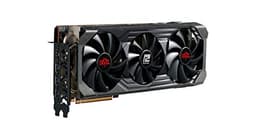
The Red Dragon cooler is a triple-fan design with a fairly substantial heatsink. Powercolor lists the card at around 330mm in length, which means case clearance is something you'll want to verify before ordering. It uses two 8-pin power connectors rather than the 12VHPWR connector found on newer NVIDIA cards, which is actually a point in its favour for anyone with an older PSU and cable setup. No adapter anxiety here.
| Specification | Detail |
|---|---|
| GPU Architecture | RDNA 2 (Navi 21) |
| Process Node | TSMC 7nm |
| Stream Processors | 4,608 |
| Compute Units | 72 |
| Ray Accelerators | 72 |
| Base Clock | 1825MHz |
| Boost Clock (OC) | 2310MHz |
| VRAM | 16GB GDDR6 |
| Memory Bus | 256-bit |
| Memory Bandwidth | 512 GB/s |
| Memory Speed | 16000MHz effective |
| TGP | 300W |
| PCIe Interface | PCIe 4.0 x16 |
| Display Outputs | 2x DisplayPort 1.4, 1x HDMI 2.1, 1x USB-C |
| Power Connectors | 2x 8-pin |
| Card Length | ~330mm |

Architecture and Cores: RDNA 2 in 2026
RDNA 2 was AMD's proper comeback architecture. When the 6800 XT launched, it genuinely competed with NVIDIA's RTX 3080 in rasterisation performance, and in some titles it came out ahead. The architecture introduced hardware-level ray tracing via those 72 Ray Accelerators (one per compute unit), Infinity Cache (128MB of on-die cache that dramatically increases effective memory bandwidth beyond what the raw 256-bit bus would suggest), and a significant IPC uplift over the previous RDNA 1 generation. All of that is still relevant today.
But RDNA 2 is two generations old now. RDNA 3 brought architectural refinements, improved ray tracing throughput, and a chiplet design. RDNA 2's ray tracing implementation, while functional, is noticeably behind both RDNA 3 and NVIDIA's Ampere and Ada Lovelace architectures in RT-heavy workloads. The Ray Accelerators here handle one BVH intersection per clock per CU, which was competitive in 2021 but doesn't hold up as well in 2026 titles that lean harder on RT. If ray tracing is a priority for you, this is the card's clearest weakness.
The 128MB Infinity Cache is the architecture's secret weapon for rasterisation. It acts as a massive L3 cache for the GPU, reducing how often the card has to reach out to the slower GDDR6 memory. In practice, this is why the 6800 XT often punches above what you'd expect from its 256-bit bus width alone. At 1440p, the cache hit rates are very good. At 4K, the working set gets larger and you start to see more cache misses, but the 16GB GDDR6 buffer means you're not starved for memory capacity. The architecture is genuinely clever, even if it's no longer cutting-edge.
Clock Speeds and Boost: What 2310MHz Actually Means
The Powercolor Red Dragon OC ships with a 2310MHz boost clock, compared to AMD's reference 6800 XT spec of 2250MHz. That's a 60MHz factory overclock, which on paper sounds modest. In practice, the difference between reference and OC variants at this level is rarely dramatic in gaming frame rates, typically a few percent at most. What matters more is how consistently the card sustains its boost clock under load, and that's where cooler design becomes the relevant variable.
AMD's RDNA 2 architecture was notably good at sustaining high clock speeds compared to the previous generation. The Navi 21 die tends to boost aggressively and hold those clocks reasonably well when thermals are managed. With the Red Dragon's triple-fan cooler, owner reviews consistently report that the card runs well within thermal limits under sustained gaming loads, which means the 2310MHz figure isn't just a peak that vanishes after 30 seconds. That's the right way to think about factory overclocks: not as raw numbers, but as a question of whether the cooler can sustain them.
Powercolor also provides overclocking headroom via their software, and a number of owners in the review pool mention pushing clocks further without much drama. AMD's Radeon Software includes an auto-overclock feature that's reasonably accessible for people who don't want to go manual. But honestly, at stock the card is already performing at the top of what RDNA 2 can do, so chasing extra MHz here is more of a hobby than a meaningful performance upgrade.
VRAM Analysis: 16GB in a World That's Starting to Need It
This is where the 6800 XT genuinely earns respect in 2026. Sixteen gigabytes of GDDR6 on a 256-bit bus with 512 GB/s of bandwidth is not a spec that's aged badly. At a time when the 8GB VRAM debate is very much alive (and a genuine concern for some competing cards in this price bracket), the 6800 XT sidesteps the whole argument. You are not going to hit a VRAM wall at 1440p on this card in 2026. You're very unlikely to hit one at 4K either, even with high-resolution texture packs loaded.
To put some context around this: published benchmark data for modern titles at 4K with ultra textures frequently shows VRAM usage climbing past 10GB in games like Hogwarts Legacy, The Last of Us Part I, and Cyberpunk 2077 with path tracing elements. Cards with 8GB or 10GB of VRAM in this performance bracket can and do stutter in these scenarios when VRAM fills and the card starts paging to system RAM. The 6800 XT's 16GB buffer means it handles these situations without complaint. That's a real, tangible advantage over some newer cards that cost similar money.
The memory speed of 16000MHz effective (16 Gbps) is the standard GDDR6 speed for this class of card. Combined with the 128MB Infinity Cache acting as a fast intermediary layer, the effective memory bandwidth in cache-friendly workloads is considerably higher than the raw 512 GB/s figure. At 1080p and 1440p, the cache hit rate is high enough that memory bandwidth is rarely the bottleneck. At 4K, you're working the GDDR6 harder, but 16GB capacity means you're at least not running out of space. The bandwidth is sufficient; the capacity is genuinely good.
Ray Tracing and Upscaling: Honest Assessment
AMD's ray tracing story with RDNA 2 is functional but not exciting. The 72 Ray Accelerators handle the workload, and in titles with moderate RT implementations (ambient occlusion, shadows, reflections at medium settings) the performance hit is manageable. But push into demanding RT scenarios, heavy reflections, global illumination, path tracing, and the 6800 XT takes a bigger relative hit than comparable NVIDIA cards. Published benchmark comparisons consistently show the RTX 3080 and RTX 3080 Ti pulling ahead more significantly when RT is enabled than when it's off. That gap has not narrowed with driver updates; it's architectural.
On the upscaling side, AMD offers FidelityFX Super Resolution (FSR), and the current FSR 3 with frame generation is genuinely good. It's also open-source and works on NVIDIA cards, which is both AMD's strength and a subtle acknowledgement that they can't match DLSS's hardware-accelerated approach. FSR 3 at Quality preset produces results that most people would find acceptable, though a direct comparison with DLSS 3 at equivalent settings still favours NVIDIA in image quality terms. FSR's advantage is broad game support and no hardware dependency.
The 6800 XT does not support DLSS in any form (that's NVIDIA-exclusive) and does not support XeSS at its best (that requires Intel's Xe Matrix Extensions). It supports FSR across all versions and AMD's older Radeon Super Resolution. In 2026, FSR 3 with frame generation is available in a decent library of titles and works well. If you're primarily playing games that support it, the upscaling situation is fine. If you're chasing the absolute best image quality from upscaling, NVIDIA's ecosystem still has the edge. That's just the honest position.
Video Encoding: Streaming and Content Creation
AMD's video encoding solution here is the VCN (Video Core Next) encoder included in the RDNA 2 architecture. The 6800 XT supports hardware H.264 and H.265 (HEVC) encoding and decoding. For streaming via OBS or similar software, AMD's encoder (AMF, the Advanced Media Framework) produces acceptable results at H.265. It's not going to embarrass you on a stream, and the hardware offload means your game performance doesn't tank while you're live.
Where it falls short relative to NVIDIA is AV1. The 6800 XT does not support AV1 hardware encoding. NVIDIA's Ada Lovelace cards (RTX 4000 series) introduced dual AV1 encoders that are genuinely excellent for streaming and content creation. AV1 encoding delivers better quality at lower bitrates, which matters for streaming platforms with bitrate caps. If video content creation is a serious part of your workflow, this is a real gap. For pure gaming with occasional streaming, H.265 AMF encoding is adequate.
Decode support is similarly limited compared to newer hardware. The 6800 XT handles AV1 decode in hardware, which is good for YouTube and streaming consumption. But the encode gap remains. For most gamers who occasionally hit "go live" on Twitch, this won't matter. For anyone building a production-focused machine that also games, it's worth factoring in. The card is primarily a gaming GPU, and evaluated on those terms, the encoding capability is a secondary feature that does the job without being class-leading.

Power Consumption: 300W Is Not a Suggestion
The 6800 XT Red Dragon OC has a rated TGP of 300W. That's a real 300W, not a conservative estimate. Published power consumption data for the reference 6800 XT consistently shows full-load draw in the 295W to 310W range at the wall for the GPU alone. Powercolor's OC variant, running slightly higher clocks, sits at the top of that range. Add your CPU, storage, RAM, and fans, and a complete gaming system with this card is comfortably pulling 450W to 500W under gaming load. You need a quality 750W PSU as a minimum, and 850W gives you proper headroom.
The two 8-pin power connectors are standard and well-supported by any modern PSU. This is actually a small practical advantage over cards requiring the 16-pin 12VHPWR connector, where adapter quality concerns have been a genuine issue. Plug in two solid 8-pin cables from your PSU (not daisy-chained from a single cable if you can avoid it), and you're sorted. Powercolor's own guidance and general best practice for 300W cards both point toward separate cables from the PSU for each connector.
Power efficiency is where RDNA 2 shows its age most clearly. RDNA 3 and NVIDIA's Ada Lovelace architecture both deliver significantly better performance per watt. A modern card achieving similar frame rates might do so at 200W to 220W rather than 300W. Over a year of regular gaming, that difference in electricity consumption adds up. It's not a dealbreaker, but if you're conscious of running costs or if your system is in a small, poorly ventilated space, the 300W TGP is worth taking seriously as a factor.
Thermal Performance: The Red Dragon Cooler Earns Its Keep
The Red Dragon cooler is a triple-fan design with a substantial aluminium fin stack and copper heatpipes. Powercolor has been making this cooler work across multiple GPU generations, and the general consensus from the 502-strong owner review pool is positive on thermals. Owners consistently report that the card runs cool under sustained gaming loads, with several reviews specifically noting that temperatures stay well within comfortable ranges even during extended sessions. The triple-fan configuration gives the heatsink enough airflow to handle the 300W TGP without the fans having to work at their limits.
The card does include a semi-passive mode where the fans stop at low loads and temperatures. This is standard for modern GPUs and means the card is silent when you're browsing or doing light work. Under gaming load, the fans spin up, and the behaviour here is where the cooler design matters: a well-tuned fan curve ramps gradually rather than suddenly, which avoids the jarring experience of fans jumping from silent to loud. Owner reviews suggest the Red Dragon behaves sensibly in this regard, though a handful of reviews mention the fans are audible under heavy load, which is expected at 300W.
Thermal longevity is a relevant consideration for any 300W card. Sustained high temperatures accelerate component aging, and a cooler that keeps the GPU die and VRMs within sensible ranges extends the card's working life. The Red Dragon's heatsink coverage extends across the VRM area as well as the GPU die, which is the right design approach for a high-TGP card. Based on the owner review pattern and the cooler specification, this is not a card that's going to cook itself in a well-ventilated case. Case airflow still matters though. Stick this in a sealed box and no cooler will save it.
Acoustic Performance: Loud Enough to Notice, Quiet Enough to Live With
Triple-fan coolers on 300W GPUs are not going to be silent. That's just physics. The Red Dragon OC is not marketed as a quiet card, and owner reviews reflect a realistic picture: at idle and light loads with the semi-passive mode active, you hear nothing from the GPU. Under gaming load, the fans spin up to manage the heat, and you will hear them. The character of the noise, based on owner descriptions, is a consistent whoosh rather than anything harsh or whining, which is the better outcome. A smooth fan noise blends into the background; a high-pitched whine does not.
Several owners in the review pool specifically mention that the card is quieter than they expected for a 300W GPU, which suggests Powercolor has tuned the fan curve conservatively enough to avoid unnecessary noise at moderate gaming loads. The flip side of a conservative fan curve is slightly higher temperatures, but given that owners report comfortable thermals, the balance appears to be well-judged. You're not getting a near-silent card, but you're also not getting a card that sounds like a small aircraft preparing for takeoff.
If acoustic performance is genuinely important to you (home theatre PC, shared living space, recording environment), then a 300W card with a triple-fan cooler is probably not your first choice regardless of brand. The Powercolor Red Dragon OC is better than average for its TGP class, but the fundamental constraint is the power draw. Lower-wattage alternatives will always have an acoustic advantage. Within the 300W bracket, though, the Red Dragon cooler is a competent solution and owners are generally satisfied with it. That's about as good as it gets at this power level.
Gaming Performance: What RDNA 2 Delivers in 2026
At 1440p, the Powercolor Radeon RX 6800 XT Red Dragon OC is a very capable card. Published benchmark data for the reference 6800 XT consistently places it in the upper tier of 1440p performance, trading blows with the RTX 3080 in rasterisation-heavy titles and occasionally beating it. At 1440p with high settings in demanding modern titles, the card delivers frame rates that support high-refresh-rate gaming. In less demanding titles, you're looking at frame rates well above what any standard 60Hz or 144Hz monitor needs. For 1440p gaming, this is a proper high-end experience in most games.
At 4K, the picture is more nuanced. The 6800 XT can handle 4K gaming in many titles at high settings, but you're more likely to need to dial back some settings to maintain smooth frame rates in the most demanding games. The 16GB VRAM means you're not memory-constrained, and the Infinity Cache helps with bandwidth, but raw compute throughput is the limiting factor at 4K in GPU-bound scenarios. Think of it as a card that can do 4K competently rather than effortlessly. With FSR 3 Quality mode enabled, 4K becomes a much more comfortable target, and the image quality at Quality preset is genuinely good.
At 1080p, this card is overkill in almost every title. You'll be CPU-limited before the GPU breaks a sweat in most games. That's not a complaint, but it does mean that if you're gaming at 1080p, even on a high-refresh monitor, you're not extracting the value this card offers. The 6800 XT's sweet spot is 1440p, ideally on a 144Hz or higher panel. That's where the spec sheet translates into a genuinely satisfying gaming experience, where frame rates are high, VRAM is never a concern, and the Infinity Cache is working at its most efficient.
How It Compares: The Competition in 2026
The two most relevant comparisons for the Powercolor Radeon RX 6800 XT Red Dragon OC in 2026 are the RTX 3080 (still available on the used and clearance market) and the RX 7800 XT (RDNA 3, newer architecture, typically available new). The RTX 3080 is the historical rival: similar rasterisation performance, better ray tracing, DLSS 2 support, but 10GB or 12GB of VRAM depending on variant. The RX 7800 XT is the more interesting comparison: it's RDNA 3, more power-efficient, has improved ray tracing, and supports FSR 3, but comes with 16GB GDDR6 as well and typically at a lower price point than the 6800 XT currently commands.
The RTX 3080 12GB is arguably the 6800 XT's closest performance peer. In rasterisation, they're within a few percent of each other across most titles. The 3080 pulls ahead with ray tracing and DLSS. The 6800 XT matches it on VRAM capacity (16GB vs 12GB). In 2026, with both cards on the used market, pricing becomes the deciding factor. If you can get a 6800 XT significantly cheaper, the VRAM advantage and rasterisation parity make it interesting. At the same price, the 3080 12GB's DLSS and RT advantages tip the balance for NVIDIA-ecosystem users.
The RX 7800 XT is the more direct threat. It's a newer architecture, runs cooler, draws less power, has better ray tracing than the 6800 XT, and supports the latest FSR 3 frame generation. Published benchmarks show the 7800 XT trading blows with the 6800 XT in rasterisation, sometimes ahead, sometimes behind depending on the title. If the 7800 XT is available at a lower or similar price, it's the more sensible buy for most people in 2026. The 6800 XT's argument rests primarily on finding it at a price that reflects its age.
| Feature | Powercolor RX 6800 XT Red Dragon OC | RTX 3080 12GB | RX 7800 XT |
|---|---|---|---|
| Architecture | RDNA 2 (7nm) | Ampere (8nm) | RDNA 3 (5nm) |
| VRAM | 16GB GDDR6 | 12GB GDDR6X | 16GB GDDR6 |
| Memory Bandwidth | 512 GB/s | 912 GB/s | 576 GB/s |
| TGP | 300W | 350W | 263W |
| Ray Tracing | Adequate | Good | Better than RDNA 2 |
| Upscaling | FSR 3 | DLSS 2 + FSR 3 | FSR 3 |
| AV1 Encode | No | No | Yes |
| 1440p Rasterisation | Excellent | Excellent | Excellent |
| Power Efficiency | Below average for 2026 | Below average for 2026 | Good |
| Generation | Previous (2020) | Previous (2020) | Current (2023) |

Final Verdict: Who Should Buy the Powercolor Radeon RX 6800 XT Red Dragon OC
Over 502 owners have rated this card 4.5 stars, and that's not a fluke. The Powercolor Radeon RX 6800 XT Red Dragon OC is a well-built card with a competent cooler, a sensible factory overclock, 16GB of VRAM that remains genuinely relevant in 2026, and rasterisation performance that still belongs in the high-end conversation at 1440p. The build quality draws consistent praise in the owner reviews, the triple-fan cooler manages 300W without drama, and the 16GB VRAM buffer is a real advantage over some newer cards that inexplicably ship with less.
But the case for buying it in 2026 is conditional. The architecture is RDNA 2, two generations old. Ray tracing performance is behind both RDNA 3 and NVIDIA's current offerings. Power consumption at 300W is high for the performance delivered, especially compared to the more efficient RDNA 3 alternatives. There's no AV1 encode support. And the upscaling ecosystem, while functional with FSR 3, doesn't match NVIDIA's DLSS 3 in image quality terms. None of these are catastrophic individually, but together they paint a picture of a card that needs a price advantage to justify itself over newer options.
The right buyer for this card is someone who prioritises VRAM capacity and raw 1440p rasterisation performance, has a quality 850W PSU already in the system, is gaming in a well-ventilated case, and has found this card at a price that undercuts the RX 7800 XT meaningfully. If all of those boxes are ticked, the 6800 XT Red Dragon OC is a proper high-end card that will serve you well. If you're buying at full high-end bracket pricing, the honest recommendation is to look at the RX 7800 XT instead: newer architecture, better efficiency, better ray tracing, AV1 encode, and typically cheaper. The 6800 XT needs a price discount to win the argument in 2026, and if it has one, it's still a very good card. If it doesn't, it's a harder sell.
One more thing plainly: if your gaming is primarily at 1440p and you're not fussed about ray tracing, the RX 7700 XT or even a well-priced RX 7800 XT at the mid-range bracket will cover most of what you need at lower cost and lower power draw. The 6800 XT's headline strength is its combination of 16GB VRAM and top-tier 1440p rasterisation performance. If you don't need both of those things simultaneously, there are smarter ways to spend the money. The ★★★★½ (4.5) rating and 503 reviews confirm this is a quality product. Whether it's the right product for your specific situation in 2026 depends almost entirely on what it costs you today versus the alternatives.
What works. What doesn’t.
6 + 6What we liked6 reasons
- 16GB of GDDR6 VRAM remains genuinely relevant in 2026, avoiding the VRAM-wall issues affecting some newer competing cards
- Excellent 1440p rasterisation performance that still competes in the high-end bracket across most modern titles
- Triple-fan Red Dragon cooler manages the 300W TGP competently, with owners reporting consistently comfortable temperatures
- Dual 8-pin power connectors avoid the adapter anxiety associated with 12VHPWR connectors on newer NVIDIA cards
- Factory overclock to 2310MHz is sustained reliably under load rather than being a fleeting peak figure
- 128MB Infinity Cache provides effective memory bandwidth well above what the 256-bit bus width alone would suggest
Where it falls6 reasons
- RDNA 2 ray tracing is noticeably behind both RDNA 3 and NVIDIA's Ampere and Ada Lovelace architectures in demanding RT workloads
- 300W TGP is high for the performance level delivered in 2026, with meaningfully worse performance per watt than RDNA 3 alternatives
- No AV1 hardware encode support, putting it behind NVIDIA Ada Lovelace and RDNA 3 cards for streaming and content creation workflows
- FSR 3 upscaling is functional but still trails DLSS 3 in image quality at equivalent presets
- Two-generation-old RDNA 2 architecture means the card needs a price advantage over newer options to justify the purchase
- At 4K the card is capable rather than effortless, requiring settings compromises in the most demanding titles without FSR assistance
Full specifications
10 attributes| Vram GB | 16 |
|---|---|
| Boost clock MHZ | 2310 |
| Chipset | RX 6800 XT |
| Core clock MHZ | 2065 |
| Generation | RX 6000 Series |
| Length MM | 332 |
| Memory BUS BIT | 256 |
| Memory type | GDDR6 |
| Power connectors | 2x 8-pin |
| Slot width | 2.5 |
Will it run on what you have?
Free toolFrequently asked
7 questions01Is the Powercolor Radeon RX 6800 XT Red Dragon OC good for 1440p gaming in 2026?+
Yes, 1440p is where this card performs best. Published benchmark data consistently places the RX 6800 XT in the upper tier of 1440p rasterisation performance, and the 16GB GDDR6 buffer means VRAM is never a limiting factor at this resolution. In most demanding modern titles at high settings, the card delivers frame rates that suit 144Hz and higher refresh-rate panels. The caveat is ray tracing: with heavy RT enabled, the performance advantage shrinks relative to RDNA 3 and NVIDIA alternatives.
02How does the RX 6800 XT compare to the RX 7800 XT in 2026?+
The RX 7800 XT is the more compelling purchase for most buyers in 2026. It uses the newer RDNA 3 architecture, runs at around 263W versus 300W, has better ray tracing performance, supports AV1 hardware encoding, and typically costs less than the 6800 XT. In rasterisation the two cards trade blows depending on the title. The 6800 XT's only clear advantages are the factory overclock headroom and the fact that some used-market pricing can make it cheaper than a new 7800 XT. If both cards are similarly priced, the 7800 XT is the better buy for most people.
03What PSU do I need for the Powercolor Radeon RX 6800 XT Red Dragon OC?+
A quality 750W PSU is the minimum, and 850W is the recommended target to give proper headroom. The card draws a genuine 300W under load, and a complete gaming system with CPU, storage, and cooling will typically pull 450W to 500W at the wall during gaming. Use two separate 8-pin cables from the PSU rather than daisy-chaining both connectors from a single cable. The dual 8-pin configuration is standard and well-supported by any modern PSU, so there are no adapter concerns unlike the 16-pin 12VHPWR connectors found on some newer NVIDIA cards.
04Does the RX 6800 XT support DLSS or FSR 3?+
The RX 6800 XT does not support DLSS in any form; that is exclusive to NVIDIA hardware. It does support AMD FidelityFX Super Resolution, including FSR 3 with frame generation in titles that have implemented it. FSR 3 at Quality preset produces results that most people find acceptable, and the open-source nature of FSR means it has broad game support. However, direct comparisons with DLSS 3 at equivalent settings still favour NVIDIA in image quality terms. If upscaling image quality is a priority, NVIDIA's ecosystem has the advantage.
05Is the Powercolor Red Dragon cooler adequate for the 6800 XT's 300W power draw?+
Based on the 502-strong owner review pool and the card's specification, yes. The triple-fan design with an aluminium fin stack and copper heatpipes keeps the GPU within comfortable thermal limits during extended gaming sessions according to consistent owner reports. The fans operate in semi-passive mode at low loads, spinning up under gaming load. The character of the noise is described as a smooth, consistent airflow sound rather than anything harsh or high-pitched. You will hear the fans under heavy load, which is expected for any 300W GPU, but owner satisfaction with the thermal and acoustic balance is generally high.
06Does the RX 6800 XT have enough VRAM for modern games in 2026?+
Yes, 16GB is one of the card's strongest arguments in 2026. Games such as Hogwarts Legacy, The Last of Us Part I, and Cyberpunk 2077 with path tracing elements can push VRAM usage past 10GB at 4K with ultra texture settings. Cards with 8GB or 10GB in this performance bracket can stutter when VRAM fills and the card pages to system RAM. The 6800 XT's 16GB buffer avoids that problem entirely at both 1440p and 4K. This is a genuine, tangible advantage over some newer cards at similar price points that ship with less VRAM.
07Is the RX 6800 XT suitable for video editing and content creation?+
It handles H.264 and H.265 hardware encoding and decoding via AMD's VCN encoder and AMF software, which is adequate for occasional streaming and light video work. However, it does not support AV1 hardware encoding, which is a real gap compared to NVIDIA RTX 4000 series cards and RDNA 3 cards such as the RX 7800 XT. AV1 encoding delivers better quality at lower bitrates, which matters for platforms with bitrate caps. For primarily gaming use with occasional Twitch streaming, H.265 AMF encoding is sufficient. For a production-focused workflow that also requires gaming performance, the lack of AV1 encode is worth factoring into the decision.