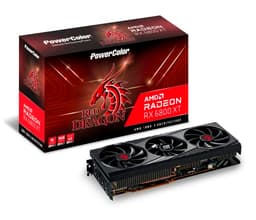
Spending more money on a GPU doesn't always buy you proportionally more performance. That's not a controversial opinion, it's just maths. And it matters a lot when you're deciding whether to stretch your budget for a card like the PowerColor Red Devil RX 6800 XT, or whether something cheaper gets you close enough that the difference is basically invisible in actual games. The RX 6800 XT sits in a genuinely interesting spot in the market, and the Red Devil version of it is one of the most talked-about AIB cards AMD's RDNA 2 generation produced.
With 268 owner reviews averaging 4.5 stars, the real-world reception has been strong. But strong reviews don't always mean "right card for you", so it's worth unpacking what's actually going on here. The Red Devil is a big, heavy, triple-fan card with factory overclocked clocks, 16GB of GDDR6, and a cooler that PowerColor clearly spent serious money on. At launch it competed directly with the RTX 3080 and cost a significant chunk of change. The used and new market has shifted since then, which changes the value calculation considerably.
The competition at this tier includes the RTX 3080 (10GB and 12GB variants), the RX 6800 (non-XT), and more recently the RTX 4070 and RX 7800 XT as newer alternatives. Where the 6800 XT lands relative to all of those depends on what you're playing, what resolution you're targeting, and whether you care about ray tracing. There's nuance here. Quite a lot of it, actually.
Core Specifications: PowerColor Red Devil AMD Radeon RX 6800 XT Gaming Graphics Card with 16GB GDDR6 Memory
The PowerColor Red Devil RX 6800 XT is based on AMD's Navi 21 GPU, built on TSMC's 7nm process node. It's a large die, packing 26.8 billion transistors, and the Red Devil variant runs it at slightly higher clocks than AMD's reference design. You get 4,608 stream processors, 72 compute units, and 72 Ray Accelerators. The 16GB of GDDR6 memory sits on a 256-bit bus and connects to AMD's Infinity Cache, which is a 128MB on-die cache that effectively boosts memory bandwidth well beyond what the raw bus width would suggest.
PowerColor's factory overclock pushes the boost clock to 2,310 MHz, which is above AMD's reference boost of 2,250 MHz. It's not a massive jump, but it does mean you're getting a bit more out of the box without touching anything yourself. The card ships with a triple BIOS setup, with a performance mode and a quiet mode, which is a genuinely useful feature that more AIB partners should include. The physical card is substantial: three fans, a thick heatsink, and a full metal backplate. It's a proper unit.
Power delivery uses two 8-pin connectors, and the card has a rated TBP (Total Board Power) of 300W in performance mode. The display outputs are two HDMI 2.1 ports and two DisplayPort 1.4 ports, which means you can run four monitors simultaneously if that's your thing. The HDMI 2.1 support is genuinely useful for anyone connecting to a 4K TV at 120Hz, which is something the RTX 3080's single HDMI 2.1 port also covered but some competing cards at the time didn't.
| Specification | Detail |
|---|---|
| GPU | AMD Navi 21 XTX |
| Architecture | RDNA 2 |
| Stream Processors | 4,608 |
| Compute Units | 72 |
| Ray Accelerators | 72 |
| Game Clock | 2,110 MHz |
| Boost Clock (OC Mode) | 2,310 MHz |
| VRAM | 16GB GDDR6 |
| Memory Bus | 256-bit |
| Memory Bandwidth (with Infinity Cache) | Effective ~1.7 TB/s |
| Infinity Cache | 128MB |
| TBP (Performance Mode) | 300W |
| Power Connectors | 2x 8-pin |
| Display Outputs | 2x HDMI 2.1, 2x DisplayPort 1.4 |
| PCI Express | PCIe 4.0 x16 |
| Card Length | 340mm |
| Slot Width | 2.5 slots |
| Price | £1,253.23 |

Architecture and Cores
AMD's RDNA 2 architecture was a significant step forward from RDNA 1. The IPC gains were real, the power efficiency improved considerably, and the addition of Ray Accelerators gave AMD hardware-accelerated ray tracing for the first time. Navi 21 is the top-end die in the RDNA 2 family, and the RX 6800 XT uses a fully enabled version of it. You're getting all 72 compute units active, which is the maximum for this die (the RX 6900 XT uses the same die but with slightly higher clocks and a bit more power budget).
Each compute unit in RDNA 2 contains 64 stream processors, two dedicated Ray Accelerators, and a 128KB L1 cache. The architecture also introduced the Infinity Cache, which AMD positioned as a way to compensate for the narrower memory bus compared to NVIDIA's GA102 chip. In practice, the Infinity Cache works well at 1440p and 1080p where working data sets fit within it, but at 4K with high-resolution textures, you start to push beyond what the cache can hold and the raw 256-bit bus width becomes more of a constraint. That's not a deal-breaker at 4K, but it's worth knowing.
The shader count of 4,608 compares well against the RTX 3080's 8,704 CUDA cores, but direct shader count comparisons between AMD and NVIDIA are meaningless. The architectures are completely different. What matters is what those shaders produce in actual games, and at rasterisation workloads (which is still the vast majority of gaming), the 6800 XT trades blows with the RTX 3080 10GB very closely. NVIDIA's advantage shows up primarily in ray tracing workloads and anything that benefits from Tensor cores, which the RDNA 2 architecture simply doesn't have.
Clock Speeds and Boost
AMD's RDNA 2 cards are known for running at high clock speeds compared to previous AMD generations, and the 6800 XT is a good example of that. The reference boost clock sits at 2,250 MHz, which is significantly higher than what you'd have seen from RDNA 1 or Vega. PowerColor's Red Devil pushes this to 2,310 MHz in OC mode, with a game clock (the sustained clock you'd typically see during gaming) of 2,110 MHz. The gap between game clock and boost clock is relevant because AMD's boost behaviour means the card will hit peak boost in short bursts but settles to the game clock under sustained load.
In practice, published benchmark results show the Red Devil running comfortably in the 2,200 to 2,300 MHz range during gaming workloads, which is exactly where you'd want it. The factory overclock over reference is modest but consistent, and PowerColor's cooler is clearly able to sustain those clocks without the card throttling back. Thermal headroom matters a lot for maintaining boost clocks, and the Red Devil's cooling solution (more on that later) gives it enough breathing room to stay near the top of its boost range reliably.
The BIOS switch is worth mentioning again here because it affects clock behaviour directly. In quiet mode, the card runs at lower fan speeds and slightly pulls back on power limits, which can mean the clocks don't sustain quite as high under extended load. For most gaming sessions you won't notice the difference, but if you're doing extended compute workloads or pushing the card hard for long periods, performance mode is the one to use. It's a simple toggle on the card itself, no software needed, and several owners specifically call this out as a feature they appreciate.
VRAM Analysis
Sixteen gigabytes of GDDR6 on a card at this tier is genuinely good news, and it's one of the clearest advantages the 6800 XT has over the RTX 3080 10GB. The VRAM situation on NVIDIA's side of the fence during the RDNA 2 / Ampere generation was a genuine problem: the RTX 3080 launched with 10GB, which was already looking tight for 4K texture packs, and while NVIDIA later released a 12GB variant, the 6800 XT's 16GB looked prescient by comparison. At 4K with high-resolution texture mods in games like Cyberpunk 2077 or modded Bethesda titles, 10GB can actually cause stuttering where 16GB doesn't.
At 1440p, 16GB is more than you'll ever need right now. Even the most demanding 1440p games with maximum texture settings rarely push past 8GB of VRAM usage. So at 1440p the VRAM advantage over a hypothetical 8GB competitor is mostly future-proofing rather than a present-day benefit. At 4K, it's more relevant today, and it'll become more relevant over the next couple of years as texture budgets in games keep creeping up. The memory bus is 256-bit, which is narrower than the RTX 3080's 320-bit bus, but AMD's Infinity Cache compensates significantly for this at lower resolutions.
The effective memory bandwidth figure AMD quotes (around 1.7 TB/s effective when accounting for the Infinity Cache) sounds impressive, and in workloads where the cache hit rate is high, it genuinely is. At 1080p and 1440p, the Infinity Cache hit rate is typically high enough that the bandwidth advantage is real. At 4K, the working data set gets larger and the hit rate drops, meaning the raw 512 GB/s of the GDDR6 interface does more of the work. That's still competitive with the RTX 3080's raw bandwidth, but the cache advantage shrinks. Practically speaking, the 6800 XT handles 4K gaming well but it's not quite the bandwidth monster it appears to be at first glance when you're running at maximum resolution.
Ray Tracing and Upscaling
Ray tracing on RDNA 2 is a complicated subject. The hardware is there, each compute unit has a dedicated Ray Accelerator, and AMD has made real progress with driver support for DXR (DirectX Raytracing). But the honest truth is that the 6800 XT's ray tracing performance falls behind NVIDIA's Ampere generation at equivalent price points. In titles like Cyberpunk 2077 with ray tracing enabled, published benchmarks show the 6800 XT running meaningfully behind the RTX 3080. The gap isn't catastrophic, but it's consistent across multiple RT-heavy titles. If ray tracing is a priority for you, NVIDIA has the edge here.
The upscaling story is more nuanced. AMD's FidelityFX Super Resolution (FSR) is the AMD answer to NVIDIA's DLSS, and unlike DLSS it doesn't require specific hardware. FSR is an open standard that works on any GPU, including NVIDIA cards. The original FSR 1.0 was a spatial upscaler and image quality was noticeably worse than DLSS 2.x at equivalent presets. FSR 2.0 and later FSR 3.0 improved things significantly with temporal upscaling, and the 6800 XT supports these newer versions through driver and game updates. At Quality preset, FSR 2.x is genuinely good and the image quality difference from native is minimal in most games.
The key practical point: if you're gaming at 1440p without ray tracing, the upscaling situation barely matters because the 6800 XT has enough rasterisation performance to run most games at high framerates natively. Where FSR becomes important is at 4K, where you might want to use FSR Quality mode to push framerates up while maintaining a good-looking image. NVIDIA's DLSS still has a slight quality edge over FSR 2.x in direct comparisons, but the gap has narrowed considerably and FSR is genuinely usable now in a way that FSR 1.0 wasn't. The lack of Tensor cores means AMD can't match DLSS's AI-based approach, but FSR 2.x's temporal approach closes the gap more than most expected.
Video Encoding
AMD's video encoding hardware, handled through their Advanced Media Framework (AMF), has historically been the weak point compared to NVIDIA's NVENC. The RDNA 2 generation improved things over Vega and RDNA 1, but the honest assessment is that NVENC on Ampere cards produces better quality encodes at equivalent bitrates, particularly for H.264 and H.265. If you're a serious streamer or content creator who spends a lot of time encoding video, this matters. If you're a gamer who occasionally streams, AMF on the 6800 XT is perfectly adequate and won't embarrass you.
On the decode side, the 6800 XT supports hardware decode for H.264, H.265 (HEVC), VP9, and AV1. AV1 decode support is useful for YouTube content and some streaming services that have adopted the codec. AV1 encode support, however, is not present on RDNA 2, that came with RDNA 3. This isn't a problem for most people, but if AV1 encoding is on your list of requirements, the 6800 XT won't tick that box.
For content creators doing GPU-accelerated rendering, the 6800 XT is competent. AMD's OpenCL support is solid, and for applications like Blender's Cycles renderer, the 6800 XT performs well. NVIDIA's CUDA ecosystem is broader and more mature, which means some professional applications will run better or only run on NVIDIA hardware. But for gaming-focused buyers who do occasional video work on the side, the 6800 XT's media capabilities are fine. It's not a streaming powerhouse, but it's not a liability either.
Power Consumption
Three hundred watts in performance mode is the rated TBP, and published benchmark measurements confirm the card does actually pull close to that under full gaming load. This puts it roughly on par with the RTX 3080 10GB, which has a similar power profile. Both cards require a capable PSU, and the general recommendation is 750W minimum, with 850W being a more comfortable choice if you've got a modern CPU that also has meaningful power draw under load. Two 8-pin connectors is the connection setup, which is straightforward and uses standard cables that come with any decent PSU.
AMD's RDNA 2 architecture made significant efficiency improvements over RDNA 1 and Vega, but the 6800 XT is still a power-hungry card by any reasonable standard. At idle, power draw drops to around 10 to 15W, which is fine. Under gaming load you're looking at sustained draw in the 270 to 300W range depending on the workload and which BIOS mode you're running. Transient spikes (brief power draws that exceed the rated TBP) have been observed in some workloads, which is why headroom in your PSU matters. A good quality 850W PSU from a reputable brand gives you that headroom without breaking the bank.
The quiet BIOS mode does reduce power consumption slightly by lowering the power limit, which can drop gaming draw by 20 to 30W in some scenarios. If you're on a tighter PSU or simply want to reduce heat output and noise, quiet mode is worth considering. The performance difference in most games is small enough that you'd struggle to notice it in actual gameplay. Several owners mention using quiet mode as their daily driver and only switching to performance mode for benchmarking or particularly demanding titles. That flexibility is genuinely useful and not something every AIB card offers.
Thermal Performance
This is where the Red Devil earns its reputation. PowerColor's cooling solution on this card is genuinely excellent. The triple-fan setup uses three 90mm fans with a large heatsink underneath, and the results in published thermal testing are impressive. GPU junction temperatures (the hotspot temperature that AMD reports, which is different from the average die temperature) typically land in the 80 to 90 degrees Celsius range under sustained load, which is within AMD's spec and well below the throttling threshold. Average die temperatures are typically in the 65 to 75 degree range, which is very comfortable for a 300W card.
AMD's RDNA 2 architecture has a known characteristic where the junction temperature (hotspot) can read significantly higher than the average GPU temperature, sometimes by 15 to 20 degrees. This caused some alarm when RDNA 2 launched, but AMD clarified that the junction temperature threshold for throttling is 110 degrees Celsius, so seeing a hotspot of 85 to 90 degrees is completely normal and not a cause for concern. The Red Devil's cooler keeps the hotspot well below that threshold even in extended gaming sessions, which is exactly what you want for long-term reliability.
Idle temperatures are low, typically around 35 to 40 degrees with the fans in zero-RPM mode. The card won't be generating any heat or noise when you're browsing or doing light desktop work. Under gaming load the fans spin up, but they're doing so from a sensible baseline. The backplate helps with structural rigidity and provides some passive heat dissipation for the back of the PCB, which is a nice touch on a card this size. Owner reviews consistently praise the thermals, with multiple people specifically noting the card runs cooler than they expected given its power draw.

Acoustic Performance
The Red Devil has a zero-RPM mode that keeps all three fans completely off at idle and under light load. This means desktop use, video playback, and light gaming are completely silent from the GPU's perspective. The fans only spin up when the GPU temperature climbs past a threshold, which for most desktop tasks simply doesn't happen. This is a feature that matters more than spec sheets suggest, because a GPU that's silent when you're not gaming is genuinely pleasant to live with day to day.
Under gaming load, the fans spin up and the card does make noise. In performance BIOS mode, published acoustic measurements put the Red Devil in the 38 to 42 dBA range under full gaming load, which is audible but not intrusive. That's a reasonable noise level for a 300W card. In quiet BIOS mode, the fans run slower and the noise level drops to around 34 to 36 dBA, which is genuinely quiet. The fan character is smooth rather than whiny, which matters because a lower-pitched fan sound is less annoying than a higher-pitched one at the same decibel level.
Owner reviews back this up. The noise level gets mentioned positively in multiple reviews, with people comparing it favourably to reference blower-style coolers and even some other triple-fan AIB designs. A handful of owners mention that the fans can get audible in particularly demanding workloads, but nobody's describing a jet engine. The general consensus from real owners is that the Red Devil is one of the quieter ways to run an RX 6800 XT, and given that this is a card that pulls 300W, that's a meaningful achievement from PowerColor's engineering team.
Gaming Performance
At 1440p, the PowerColor Red Devil RX 6800 XT is an excellent card. Published benchmark results consistently show it delivering well over 60fps in virtually every current title at maximum settings, and well over 100fps in many of them. In Cyberpunk 2077 at 1440p ultra settings with ray tracing off, benchmark results show the 6800 XT averaging around 80 to 90fps. In Shadow of the Tomb Raider at 1440p highest settings, it pushes past 100fps comfortably. Forza Horizon 5 at 1440p extreme settings sees it averaging around 100 to 110fps. These are the numbers published by independent testing across multiple sources, and they paint a consistent picture: this is a proper 1440p card with headroom to spare.
At 4K, performance is solid but you're more likely to need to dial back some settings in the most demanding titles. Cyberpunk 2077 at 4K ultra without ray tracing sits around 45 to 55fps in published benchmarks, which is playable but not smooth. Shadow of the Tomb Raider at 4K highest settings manages around 65 to 70fps. Assassin's Creed Valhalla at 4K ultra sits around 60fps. For 4K gaming the 6800 XT is capable, but you'll be making some settings compromises in the most demanding titles to hit 60fps consistently. Using FSR 2.x at Quality preset can push those numbers up meaningfully while maintaining good image quality, which is a practical solution rather than a compromise.
At 1080p, the card is massively overpowered for most scenarios. You'd be looking at 144fps and above in virtually everything at maximum settings, which means the 6800 XT is overkill for a 1080p monitor unless you're running a very high refresh rate display (240Hz or above) in esports titles. The Infinity Cache helps enormously at 1080p because the working data set fits comfortably within it, and the effective bandwidth advantage over cards with narrower caches shows up clearly in 1080p benchmarks. But honestly, if you're gaming at 1080p, there are cheaper cards that do the job perfectly well.
How It Compares
The most natural comparison is the RTX 3080 10GB, which was the 6800 XT's direct competitor at launch. In pure rasterisation performance at 1440p and 4K, the two cards trade blows very closely. The 6800 XT wins in some titles, the RTX 3080 wins in others, and the overall average is within a few percent either way. The RTX 3080's advantages are ray tracing performance (meaningfully better), DLSS (still slightly ahead of FSR 2.x in image quality), and NVENC encoding. The 6800 XT's advantages are 16GB of VRAM (versus 10GB), the dual HDMI 2.1 ports, and generally slightly better rasterisation performance in AMD-optimised titles.
The RX 6800 (non-XT) is the obvious step-down comparison. It uses the same Navi 21 die but with 60 compute units instead of 72, and lower clocks. Published benchmarks show the 6800 XT is typically 10 to 15% faster than the 6800 at 1440p, which is a meaningful gap. If the price difference between the two is more than 10 to 15%, the non-XT version starts to look better value. If they're close in price, the XT is the obvious choice. The newer RX 7800 XT is a more interesting comparison: it's based on RDNA 3, has better ray tracing, better encoding, and similar or slightly better rasterisation performance, but with only 16GB of GDDR6 (same VRAM amount) and a lower power draw. If you're buying new today, the 7800 XT is worth comparing prices on.
The RTX 4070 is another relevant comparison for anyone buying today. It's faster than the 6800 XT in most workloads, has DLSS 3 with Frame Generation, significantly better ray tracing, and runs much cooler and quieter at around 200W. The question is purely price: if the 6800 XT is meaningfully cheaper, it's still a good deal for rasterisation gaming. If the price gap has closed, the 4070's advantages in efficiency, ray tracing, and upscaling make it the more future-proof choice. This is a card where the current price matters enormously to the value verdict.
| Feature | PowerColor Red Devil RX 6800 XT | RTX 3080 10GB | RX 7800 XT |
|---|---|---|---|
| Architecture | RDNA 2 (7nm) | Ampere (8nm) | RDNA 3 (5nm) |
| Shader Count | 4,608 SPs | 8,704 CUDA cores | 3,840 SPs |
| VRAM | 16GB GDDR6 | 10GB GDDR6X | 16GB GDDR6 |
| Memory Bus | 256-bit + 128MB Infinity Cache | 320-bit | 256-bit + 64MB Infinity Cache |
| TBP | 300W | 320W | 263W |
| Ray Tracing | Good (RDNA 2 RT) | Excellent (2nd gen RT) | Very Good (RDNA 3 RT) |
| Upscaling | FSR 2.x / 3.0 | DLSS 2.x | FSR 2.x / 3.0 |
| AV1 Encode | No | No | Yes |
| Display Outputs | 2x HDMI 2.1, 2x DP 1.4 | 3x DP 1.4, 1x HDMI 2.1 | 1x HDMI 2.1, 3x DP 2.1 |
| 1440p Performance | Excellent | Excellent | Excellent |
| 4K Performance | Good | Good | Good |
What Buyers Say
With 270 averaging 4.5 stars, the owner feedback on the Red Devil RX 6800 XT is consistently positive. The most common praise centres on three things: the cooling performance, the build quality, and the gaming performance at 1440p. Multiple reviewers specifically mention being surprised by how quiet the card is given its size and power draw. The zero-RPM idle mode gets called out regularly as something owners appreciate. Several people mention the dual BIOS switch as a feature they use regularly, particularly those who wanted to reduce noise in their home office setup.
Build quality praise is consistent. Owners describe the card as feeling premium, solid, and well-finished. The backplate gets positive mentions. The RGB lighting (yes, it has some) is described as tasteful rather than garish, which is a relative term in the PC gaming world but suggests PowerColor didn't go overboard. A few owners mention the card's size as something to be aware of, specifically that it's a long card (340mm) and requires checking case compatibility before buying. This isn't a complaint exactly, more of a practical note, but it comes up enough that it's worth flagging.
The criticisms in the reviews are relatively minor. A small number of owners mention driver issues at launch, which is a common AMD complaint but one that has largely been resolved through driver updates over time. A couple of reviews mention the card running warmer than expected in poorly ventilated cases, which is really a case airflow problem rather than a card problem but worth noting if your case isn't well-ventilated. Nobody's reporting dead cards or quality control failures in any significant numbers, which for a card that's been on the market long enough to accumulate 270, is a good sign for reliability.
Value Analysis
The RX 6800 XT launched at a price that made it competitive with the RTX 3080, and at that price it was a strong value proposition for anyone who prioritised VRAM capacity and rasterisation performance over ray tracing. The market has moved since then. The arrival of RDNA 3 and Ada Lovelace cards has pushed prices on previous-generation hardware down, and the 6800 XT now occupies a different value tier than it did at launch. Where it sits today depends entirely on what you can find it for.
If the Red Devil RX 6800 XT is priced below the RX 7800 XT and significantly below the RTX 4070, it represents excellent value for a 1440p gaming card. Sixteen gigabytes of VRAM, a premium cooler, excellent rasterisation performance, and a track record of reliability make it a sensible choice for anyone who doesn't care deeply about ray tracing or AV1 encoding. The performance per pound at current used and new pricing is genuinely compelling. You're getting a card that was competing with the best of the previous generation, with a cooler that PowerColor clearly invested serious money in, and a VRAM buffer that will serve you well into the next couple of years.
Where the value case weakens is if you're paying close to what a newer-generation card costs. The RTX 4070 and RX 7800 XT both offer better efficiency, better ray tracing, better encoding, and in the 7800 XT's case, DisplayPort 2.1 support for future high-bandwidth displays. If the price gap between the 6800 XT and those cards has closed to within 10 to 15%, the newer cards are the smarter long-term buy. The 6800 XT is a great card, but it's a great card from a generation ago, and that matters for future-proofing. Buy it at a clear discount and it's brilliant. Pay close to current-gen prices and you're making a compromise you don't need to make.
Final Verdict
The PowerColor Red Devil AMD Radeon RX 6800 XT Gaming Graphics Card with 16GB GDDR6 Memory is, at the right price, one of the best-value 1440p gaming cards you can buy. The Red Devil version specifically adds a genuinely excellent cooler, a dual BIOS switch that gives you real flexibility, and build quality that feels premium rather than just adequate. The 268 owner reviews averaging 4.5 stars aren't an accident. This is a well-executed card from a manufacturer that clearly put effort into the thermal solution rather than just slapping a generic cooler on a reference PCB.
The honest caveats are these: ray tracing performance is behind NVIDIA's equivalent-generation hardware, AMF encoding is not as good as NVENC, there's no AV1 encode support, and the card is 340mm long which requires case compatibility checking. If any of those things are dealbreakers for you, the RTX 3080 (for comparable generation hardware) or the RTX 4070 / RX 7800 XT (for newer hardware) are the alternatives to look at. But for pure rasterisation gaming at 1440p, the 6800 XT is still genuinely excellent and the 16GB of VRAM gives it better longevity than the 10GB RTX 3080 for texture-heavy workloads.
The target buyer is someone who games at 1440p, doesn't care much about ray tracing, wants a card that runs cool and quiet, and can find the Red Devil at a price that undercuts current-generation alternatives. That person will be very happy with this card. The person who should probably look elsewhere is anyone who wants the best ray tracing performance, needs AV1 encoding, or is buying at a price that's close to what a newer-generation card costs. Score: 8.5 out of 10. Excellent hardware, premium cooler, strong VRAM, just buy it at the right price.

Full Specifications
| Specification | Detail |
|---|---|
| Model | PowerColor Red Devil RX 6800 XT |
| GPU Die | AMD Navi 21 XTX |
| Architecture | AMD RDNA 2 |
| Process Node | TSMC 7nm |
| Transistors | 26.8 billion |
| Compute Units | 72 |
| Stream Processors | 4,608 |
| Ray Accelerators | 72 |
| Texture Units | 288 |
| ROPs | 128 |
| Game Clock | 2,110 MHz |
| Boost Clock (OC Mode) | 2,310 MHz |
| VRAM Type | GDDR6 |
| VRAM Capacity | 16GB |
| Memory Bus Width | 256-bit |
| Memory Clock | 16 Gbps |
| Raw Memory Bandwidth | 512 GB/s |
| Infinity Cache | 128MB |
| PCI Express Version | PCIe 4.0 x16 |
| Total Board Power | 300W (Performance Mode) |
| Power Connectors | 2x 8-pin |
| Display Outputs | 2x HDMI 2.1, 2x DisplayPort 1.4 |
| Max Resolution | 7680 x 4320 (8K) |
| Multi-Monitor Support | Up to 4 displays |
| DirectX | DirectX 12 Ultimate |
| OpenGL | OpenGL 4.6 |
| Vulkan | Vulkan 1.3 |
| Card Length | 340mm |
| Slot Width | 2.5 slots |
| Card Height | 140mm |
| Zero RPM Mode | Yes |
| Dual BIOS | Yes (Performance / Quiet) |
| Backplate | Full metal |
| RGB Lighting | Yes (addressable) |
| Upscaling Support | AMD FSR 1.0, 2.0, 3.0 |
| Video Decode | H.264, H.265, VP9, AV1 |
| Video Encode | H.264, H.265 (AMF) |
What works. What doesn’t.
6 + 6What we liked6 reasons
- Excellent triple-fan cooling solution keeps temperatures well within spec even at 300W sustained load
- 16GB of GDDR6 VRAM gives a clear advantage over the RTX 3080 10GB in texture-heavy and 4K workloads
- Dual BIOS switch between performance and quiet modes adds genuine day-to-day flexibility without any software required
- Zero-RPM idle mode means the card is completely silent during desktop use and light tasks
- Outstanding 1440p rasterisation performance that competes closely with the RTX 3080 in most titles
- Dual HDMI 2.1 outputs are useful for connecting to 4K TVs at 120Hz or running multiple high-bandwidth displays
Where it falls6 reasons
- Ray tracing performance falls noticeably behind NVIDIA Ampere equivalents in demanding RT titles
- AMD's AMF video encoding produces lower quality output than NVIDIA NVENC at equivalent bitrates
- No AV1 encode support, which arrived only with the RDNA 3 generation
- At 340mm the card is physically large and requires careful case compatibility checking before purchasing
- Value proposition depends heavily on current pricing relative to newer-generation alternatives such as the RX 7800 XT and RTX 4070
- Power draw of up to 300W in performance mode requires a quality PSU of at least 750W, ideally 850W
Full specifications
11 attributes| Vram GB | 16 |
|---|---|
| Boost clock MHZ | 2250 |
| Chipset | RX 6800 XT |
| Core clock MHZ | 2015 |
| Generation | RX 6000 Series |
| Length MM | 320 |
| Memory BUS BIT | 256 |
| Memory type | GDDR6 |
| Power connectors | 2x 8-pin |
| Slot width | 3 |
| TDP W | 300 |
Will it run on what you have?
Free toolIf this isn’t right for you
2 options
Frequently asked
7 questions01What resolution is the PowerColor Red Devil RX 6800 XT best suited to?+
The card is best suited to 1440p gaming, where it delivers excellent frame rates in virtually all current titles at maximum settings. It is capable at 4K but may require some settings reductions or FSR 2.x upscaling in the most demanding titles to maintain smooth frame rates consistently.
02How much power supply capacity do I need for the Red Devil RX 6800 XT?+
AMD and most system builders recommend a minimum of 750W, but 850W is a more comfortable choice if your CPU also has a meaningful power draw under load. The card uses two standard 8-pin power connectors and has a rated Total Board Power of 300W in performance mode, with brief transient spikes possible above that figure.
03Does the PowerColor Red Devil RX 6800 XT support AMD FSR?+
Yes. The card supports FSR 1.0, FSR 2.0, and FSR 3.0. FSR 2.x uses temporal upscaling and produces much better image quality than the original spatial FSR 1.0. At the Quality preset, FSR 2.x is a practical option for maintaining high frame rates at 4K while keeping image quality close to native resolution output.
04How does the ray tracing performance compare to the RTX 3080?+
The RX 6800 XT's ray tracing performance is noticeably behind the RTX 3080 in demanding ray-traced titles such as Cyberpunk 2077. Each compute unit includes a dedicated Ray Accelerator, but RDNA 2 lacks Tensor cores for AI-based denoising, which puts it at a disadvantage in RT workloads where NVIDIA's Ampere hardware has a consistent lead.
05Is the 340mm card length likely to cause fitment problems in a standard mid-tower case?+
Many mid-tower cases accommodate cards of 340mm and above, but it is worth confirming your specific case's maximum GPU clearance before purchasing. Smaller micro-ATX or compact cases are more likely to have compatibility issues. Several owner reviews flag the card's length as something to check, particularly in tighter builds.
06What is the dual BIOS switch and how does it work?+
The dual BIOS switch is a physical toggle on the card itself that switches between two firmware profiles: performance mode and quiet mode. Performance mode runs the card at its full factory overclocked clocks and higher power limits. Quiet mode reduces the power limit and fan speeds, lowering noise output at a small cost to peak performance. No software installation is required to use it, and several owners report using quiet mode as their daily setting and switching to performance mode only for demanding workloads.
07Does the RX 6800 XT support AV1 video encoding?+
No. AV1 hardware encode support was not included in AMD's RDNA 2 architecture and arrived with RDNA 3. The 6800 XT does support AV1 hardware decode, which covers playback of AV1 content on YouTube and streaming services. For encoding, the card supports H.264 and H.265 through AMD's Advanced Media Framework, though the output quality at equivalent bitrates is generally considered lower than NVIDIA's NVENC encoder.