Spending more money on a GPU doesn't always buy you proportionally more performance. Sometimes the gap between a card at one price point and the next tier up is genuinely small in practice, while the price gap is anything but. That's the lens you need when looking at the PNY NVIDIA Quadro P2000 4x DP 5 GB GDDR5. This is not a gaming card. It never was. It's a professional workstation GPU, built for CAD, 3D modelling, video editing, and OpenGL-heavy applications where certified drivers and ECC memory support matter far more than raw frame rates in Call of Duty. If you're shopping for a gaming card and landed here by accident, scroll down to the verdict now and save yourself some time.
For the people who actually need this thing, though, the picture is more interesting. At £170.00 in the entry-level bracket, the Quadro P2000 sits in a genuinely useful position: more capable than the P1000 for complex 3D scenes, and significantly cheaper than the P4000 or anything from the RTX A-series. With 357 owner reviews averaging ★★★★☆ (4.3), it's clearly landing well with the people buying it. The question is whether it's the right choice for your specific workload, or whether a cheaper or more modern alternative makes more sense.
Core Specifications
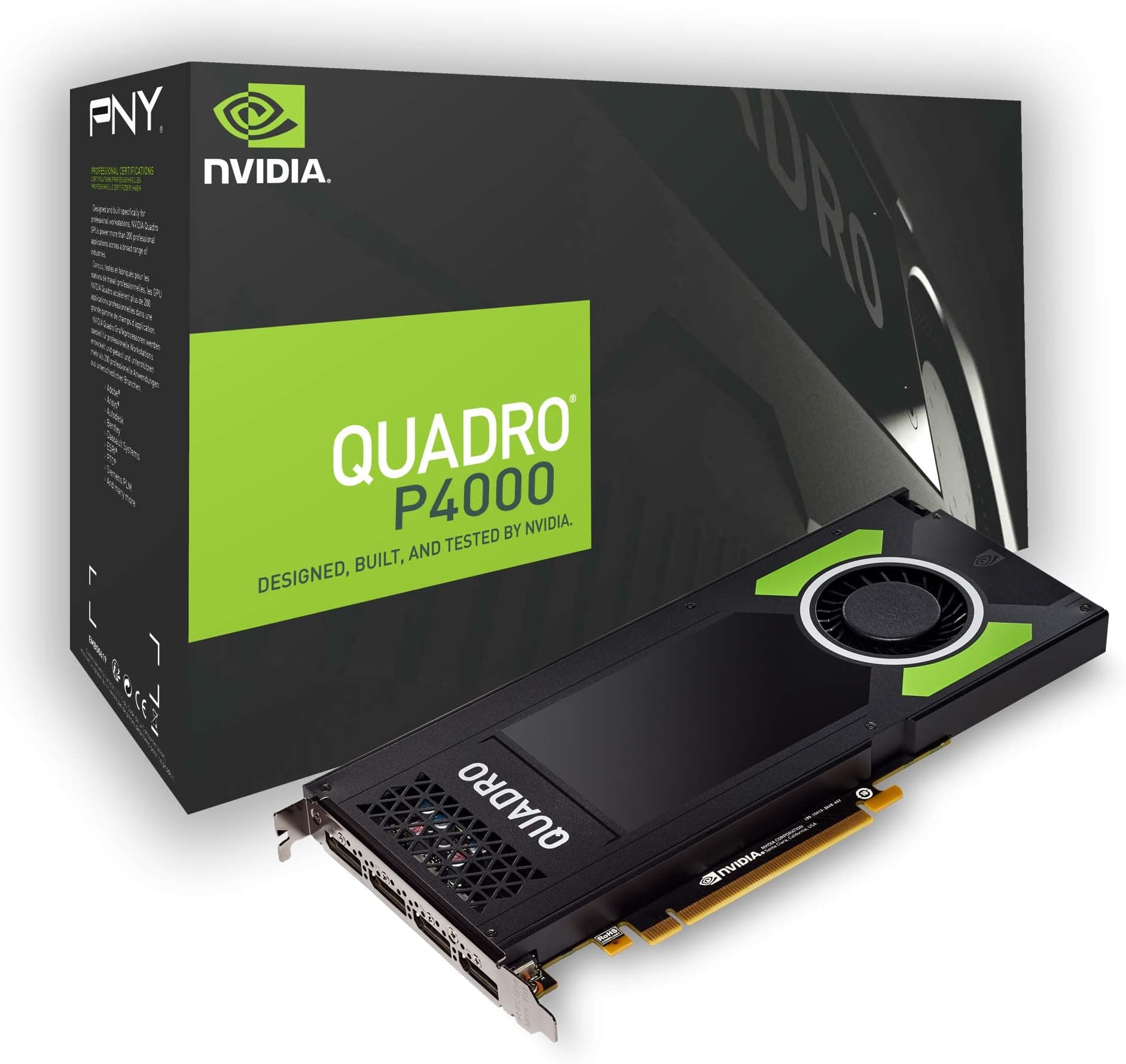
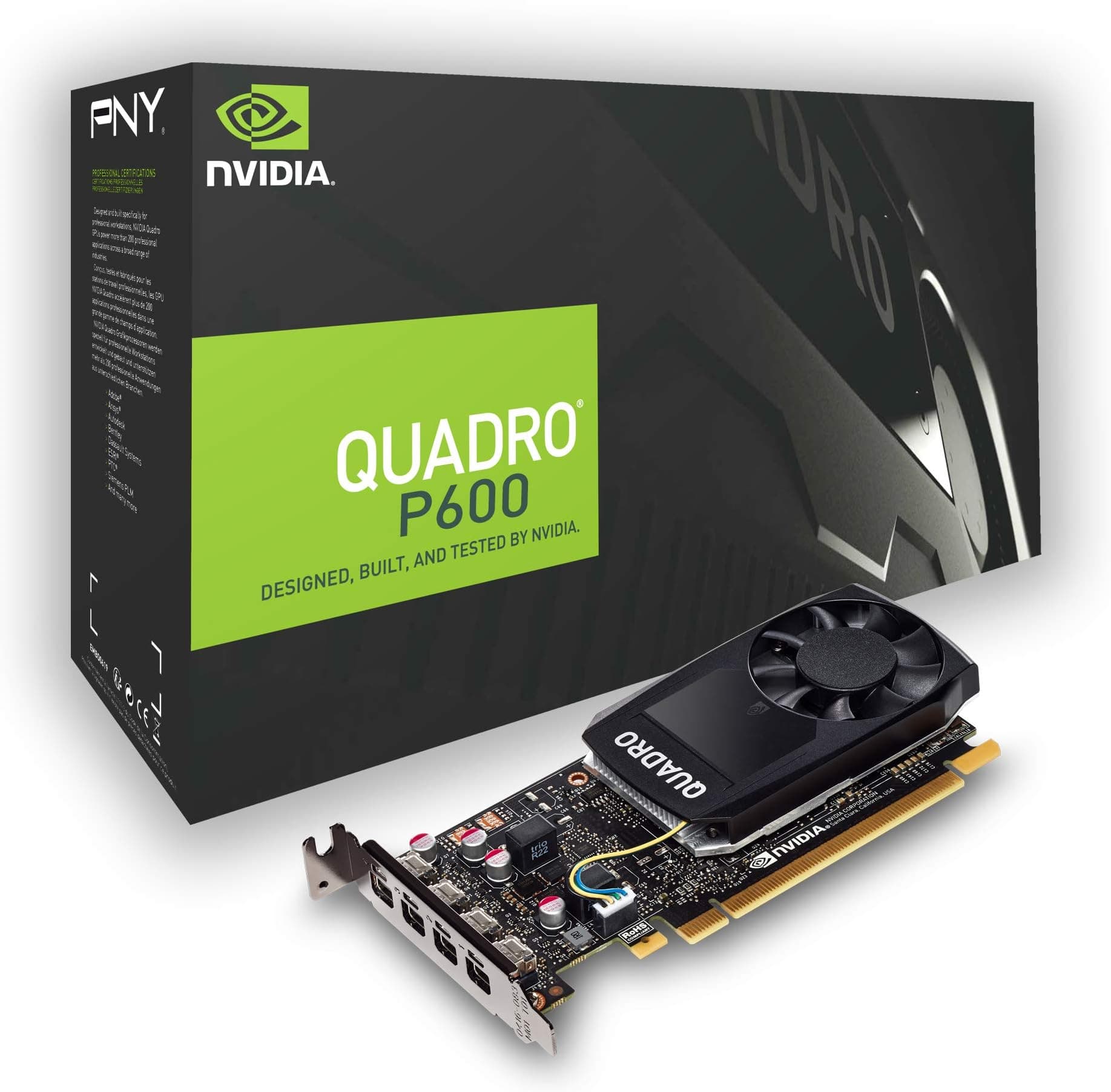
The Quadro P2000 is built on NVIDIA's Pascal architecture, which launched back in 2016. Yes, that makes this a card with some years on the clock. But professional GPU buyers operate differently from gamers. The workstation market cares about driver stability, ISV certifications (from the likes of Autodesk, Dassault Systemes, and Siemens), and long product lifecycles. A card that's been in production for years often means mature, rock-solid drivers rather than something to worry about. PNY ships this with their own factory configuration on top of NVIDIA's reference design, and the card uses a single-slot cooler with a blower-style fan, which matters a lot in workstation environments with multiple cards or limited airflow.
The headline spec here is 5 GB of GDDR5 VRAM on a 160-bit memory bus. That's an unusual capacity, sitting between the 4 GB P1000 and the 8 GB P4000. For viewport performance in applications like Autodesk Maya or SolidWorks, 5 GB is genuinely useful headroom. You're not going to run out of VRAM on moderately complex assemblies or scenes the way you might on a 4 GB card. The GPU itself packs 1,024 CUDA cores, and the card has a TDP of 75 watts, meaning it draws power entirely from the PCIe slot with no external power connector required. That's a significant practical advantage in workstations that weren't designed with high-power GPUs in mind.
The display output configuration is the other thing immediately: four Mini DisplayPort outputs. No HDMI, no full-size DisplayPort. If you need HDMI, you'll need an active adapter. For a card aimed at multi-monitor professional setups, four outputs is genuinely useful, and Mini DP to DP cables are cheap and widely available. But it's before you order.
| Specification | Detail |
|---|---|
| GPU Architecture | NVIDIA Pascal (GP106) |
| CUDA Cores | 1,024 |
| VRAM | 5 GB GDDR5 |
| Memory Bus Width | 160-bit |
| Memory Bandwidth | 140 GB/s |
| Base Clock | 1,076 MHz |
| Boost Clock | 1,342 MHz |
| TDP | 75W |
| Power Connector | None (slot-powered) |
| Display Outputs | 4x Mini DisplayPort 1.4 |
| Max Resolution | 5,120 x 3,200 |
| PCIe Interface | PCIe 3.0 x16 |
| Form Factor | Single-slot, low-profile compatible |
| ECC Memory Support | Yes |
| Current Price | £170.00 |
| Owner Rating | ★★★★☆ (4.3) (55 reviews) |

Architecture and Cores
Pascal. That's the architecture here, and it's important to understand what that means in 2026. NVIDIA's Pascal microarchitecture was a proper generational leap when it launched, bringing significant efficiency improvements over Maxwell. The GP106 die used in the P2000 is the same silicon family that underpins the GeForce GTX 1060, though the Quadro variant is tuned and certified differently. The 1,024 CUDA cores are arranged in 16 Streaming Multiprocessors, each with 64 cores. This is a compute-capable configuration that handles parallelised workloads like rendering and simulation well for its class.
What Pascal doesn't have is hardware ray tracing cores or Tensor cores. Those arrived with Turing in 2018. So if your workflow relies on AI-accelerated features, DLSS, or hardware-accelerated ray tracing in applications like Chaos V-Ray or Blender's Cycles renderer, the P2000 simply can't do any of that in hardware. It'll fall back to software or CUDA-based computation, which is slower. For traditional rasterised 3D workflows, OpenGL performance, and viewport responsiveness in CAD tools, Pascal still holds up reasonably well. But for anyone whose work has shifted toward GPU-accelerated AI tools or path-traced rendering, this architecture is showing its age.
The card is manufactured on TSMC's 16nm FinFET process node. That's not cutting-edge by any stretch, but it's mature and stable, which is exactly what you want in a professional card that might be running 24/7 in a workstation or rendering farm. PNY's implementation follows NVIDIA's reference design closely, which is standard practice for Quadro cards where consistency and certification matter more than flashy cooler designs or factory overclocks. The ISV certifications that come with Quadro branding, including support from Dassault Systemes SolidWorks, are tied to this reference-aligned design and the specific driver stack NVIDIA provides for professional cards.
Clock Speeds and Boost
The base clock sits at 1,076 MHz and the boost clock at 1,342 MHz. These are modest numbers by modern standards, but they're appropriate for a 75W card and consistent with what the Pascal architecture delivers at this power envelope. The boost behaviour on Quadro cards is generally more conservative than on their GeForce equivalents. Where a gaming card might boost aggressively and then throttle under sustained load, the Quadro P2000 is tuned for sustained, stable performance rather than peak burst speed. That's the right trade-off for professional workloads that run for hours rather than minutes.
There's no factory overclock here. PNY ships this at NVIDIA's reference clocks, which is completely standard for Quadro cards. Overclocking a professional GPU is generally a bad idea anyway: it can invalidate ISV certifications, introduce instability in precision-dependent applications, and the thermal headroom on a 75W blower design isn't exactly generous. The clocks you see on the spec sheet are the clocks you'll get, and they'll stay there consistently across long rendering sessions or sustained CAD use.
In practical terms, the boost clock of 1,342 MHz means the P2000 sits comfortably above the P1000 (which boosts to around 1,519 MHz but with only 512 CUDA cores, making the P2000 the faster card overall for parallelised work) and noticeably below the P4000 at 1,480 MHz boost with 1,792 CUDA cores. The clock speed difference between the P2000 and P4000 is less important than the core count difference, so don't get distracted by the MHz numbers in isolation. What matters for viewport performance and rendering throughput is the combination of core count, clock speed, and memory bandwidth together.
VRAM Analysis
Five gigabytes of GDDR5 is the P2000's most distinctive spec. It's an odd number that doesn't appear on many cards, and it exists specifically to give the P2000 a practical advantage over the 4 GB P1000 without cannibalising the 8 GB P4000. In professional use, VRAM capacity directly affects how complex a scene or assembly you can work with comfortably in the viewport. Run out of VRAM and you're either looking at stuttering, reduced texture resolution, or your application falling back to system RAM, which is dramatically slower.
The 160-bit memory bus delivers around 140 GB/s of memory bandwidth. That's reasonable for the card's class and workload type, though notably, that the P4000 offers 243 GB/s on a 256-bit bus, so there's a meaningful bandwidth gap as you move up the stack. For most CAD and 3D modelling workflows at typical scene complexities, 140 GB/s is fine. Where you might notice the limitation is in very high-polygon scenes or when working with large textures in applications like Substance Painter or Unreal Engine. The 5 GB capacity helps delay the point where you hit the wall, but the bandwidth ceiling will be felt before the capacity ceiling in some workloads.
ECC (Error-Correcting Code) memory support is available on the P2000, which is a proper professional feature. ECC memory detects and corrects single-bit memory errors, which matters enormously in applications where data integrity is critical, like scientific computing, financial modelling, or any engineering simulation where a corrupted calculation could have real consequences. Enabling ECC does reduce effective memory bandwidth slightly, but for the workloads where it matters, that's an acceptable trade-off. No consumer gaming card at this price offers ECC. That alone justifies the Quadro premium for certain buyers.
Ray Tracing and Upscaling
No hardware ray tracing. No Tensor cores. No DLSS. That's the complete picture for the P2000 on these fronts, and there's no point dressing it up. Pascal predates all of these features, and the P2000 simply doesn't have the silicon for any of them. If you're a 3D artist using a renderer that relies on hardware RT acceleration, like the OptiX-based rendering in Blender or hardware-accelerated ray tracing in V-Ray, you won't get those benefits here. The card will use CUDA cores for any rendering work, which is functional but slower than what an RTX A2000 or even a used RTX 3060 can deliver.
DLSS is irrelevant for professional workstation use anyway, since it's a gaming-focused upscaling technology. But the lack of Tensor cores does affect AI-accelerated features in some professional applications. Adobe's AI-powered tools in Premiere Pro and After Effects, for example, can leverage Tensor cores for faster processing. On the P2000, those workloads run on standard CUDA cores instead. It works, but it's slower. If your day-to-day involves heavy use of AI-accelerated creative tools, this is worth factoring into your decision.
For traditional rasterised rendering and OpenGL viewport work, none of this matters. The P2000's strength is in stable, certified OpenGL performance for CAD and 3D modelling applications. That's where it earns its keep, and where the Quadro driver stack genuinely makes a difference compared to a consumer GeForce card with the same underlying hardware. NVIDIA's professional drivers prioritise OpenGL correctness and stability over the gaming optimisations baked into GeForce drivers. For architects, engineers, and product designers, that distinction is real and meaningful.
Video Encoding
The P2000 includes NVIDIA's NVENC hardware video encoder, which is the Pascal generation of the encoder. It handles H.264 and H.265 (HEVC) encoding in hardware, which is useful for anyone exporting video from their workstation or doing any light streaming work. Pascal's NVENC is capable and well-supported, though it predates the significant quality improvements that came with Turing's seventh-generation encoder and the AV1 encoding support that arrived with Ada Lovelace. So if you're comparing this to a modern RTX card for video production work specifically, the encoding quality and format support is behind current hardware.
AV1 encoding is not supported. AV1 decoding support is also absent at the hardware level on Pascal. For 2026, that's a real limitation if you're working with AV1 content or delivering to platforms that prefer it. YouTube, for example, increasingly serves AV1 streams. Decoding AV1 without hardware acceleration falls to the CPU, which works but adds load. For a workstation that's also doing CPU-intensive tasks like simulation or compilation, that additional CPU load isn't ideal.
For the core audience of this card, which is CAD and 3D modelling professionals, video encoding is often a secondary concern. They're more likely to be exporting renders than encoding live video. In that context, the Pascal NVENC is perfectly adequate for occasional H.264 or H.265 exports. Owner reviews don't flag encoding as a pain point, which suggests it's meeting expectations for the actual use cases people are buying this for. If video production is your primary workload rather than a secondary one, though, a more modern GPU with a better encoder is worth the extra spend.
Power Consumption
Seventy-five watts TDP. No external power connector. This is genuinely one of the P2000's most practical advantages. The card draws everything it needs from the PCIe slot itself, which means it works in workstations with modest PSUs, in systems where the power supply doesn't have spare GPU power connectors, and in small form factor machines where routing additional cables is awkward or impossible. For IT departments deploying these in existing workstations as an upgrade, not needing to worry about PSU compatibility is a real operational benefit.
In practice, real-world power draw under sustained professional workloads sits close to the 75W TDP, sometimes slightly under. The blower fan design is tuned to match this thermal envelope, and the card doesn't exhibit the kind of transient power spikes you see on gaming GPUs that briefly spike well above their rated TDP during load transitions. Professional workloads tend to be more sustained and predictable, and the P2000's power delivery is matched to that pattern. A 300W PSU is comfortably sufficient for a system running this card alongside a mid-range CPU. You don't need anything exotic.
The 75W ceiling also means the card runs cool enough that it won't significantly affect the thermals of other components in a densely packed workstation. Multi-GPU workstation setups (for display output across many monitors, for example) are feasible without worrying about one card cooking the one next to it. Owner reviews consistently mention the card running quietly and without generating problematic heat in their systems, which aligns with what you'd expect from a 75W blower design in a professional workstation context. It's a sensible, mature thermal design.
Thermal Performance
The P2000 uses a single-slot blower cooler. This is a deliberate design choice for workstation cards, not a cost-cutting measure. Blower coolers exhaust hot air directly out of the back of the case through the PCIe bracket, rather than recirculating it inside the chassis the way open-air gaming coolers do. In a workstation with multiple cards, limited airflow, or a rack-mounted form factor, this matters a lot. The heat from the GPU goes out the back of the machine, not into the system.
Under sustained professional workloads, the P2000 runs warm but within expected parameters for its class. Owner reviews are generally positive about thermals, with few complaints about throttling or excessive heat. The 75W TDP gives the blower cooler a manageable job, and NVIDIA's thermal design for Quadro cards is conservative by nature. The card is built to run for extended periods without thermal issues, which is exactly what a workstation GPU needs to do. You're not going to be running this at 100% load for eight hours and finding it throttled down to protect itself.
The single-slot design also has implications for case compatibility. This card will fit in almost any system, including small form factor workstations and machines with tight PCIe slot spacing. The low-profile bracket compatibility (a bracket is included according to the product listing) means it can go into compact cases where a full-height card won't fit. For businesses deploying this in a mix of workstation form factors, that flexibility is genuinely useful. Gaming GPU coolers with triple fans and massive heatsinks simply can't offer this kind of versatility.
Acoustic Performance
Blower fans have a reputation. They're louder than open-air coolers at equivalent temperatures, and they can produce a higher-pitched whine under load that some people find irritating. The P2000's blower is no exception to this general pattern. Owner reviews mention that the fan is audible under load, particularly in quiet office environments. It's not described as unbearable, but it's definitely present. If you're used to the near-silent operation of a modern gaming GPU with a large multi-fan cooler, the P2000 will sound busier.
At idle and light loads, the fan spins down to a low, unobtrusive speed. The card doesn't have a zero-RPM mode like some gaming GPUs, which means there's always some fan noise present when the system is on. For an office workstation that's running all day. In a noisy open-plan office it won't matter at all. In a quiet home office or a studio environment, some people will notice it. None of the owner reviews describe it as a deal-breaker, and several specifically mention being pleasantly surprised by how quiet it is compared to older workstation cards they've used.
The acoustic profile is the trade-off you accept for the thermal benefits of the blower design. Professional users making this choice understand that. The alternative, a gaming card with a quiet open-air cooler, gives up the directed exhaust airflow, the ISV certifications, the ECC support, and the Quadro driver stack. For the target audience, the acoustic compromise is an easy one to make. And realistically, if you're rendering complex scenes or running simulations, the CPU cooler and case fans are probably making more noise than the P2000 anyway.
Gaming Performance
This is where honesty is important. The Quadro P2000 is not a gaming card and was never designed to be one. That said, people do occasionally use workstation GPUs for gaming in a pinch, and the underlying hardware is related to the GeForce GTX 1060 6 GB, which was a capable 1080p gaming card in its day. At 1080p in older or less demanding titles, the P2000 can deliver playable frame rates. Modern titles at 1080p on medium to high settings are a more mixed picture, with performance that ranges from adequate to frustrating depending on the game.
At 1440p or 4K, gaming performance is poor. The combination of Pascal's age, the 5 GB VRAM (which sounds reasonable but is on a 160-bit bus with limited bandwidth), and the Quadro driver stack, which isn't optimised for gaming, means this card is genuinely not suited to anything beyond casual gaming at 1080p. Games released in the last two or three years will often struggle to hit smooth frame rates even at 1080p on higher settings. If gaming is any part of your use case, this is the wrong card. A used GeForce RTX 3060 or even a GTX 1660 Super will outperform it in games for less money.
The owner reviews don't really discuss gaming performance, which tells you something about who's actually buying this. The ★★★★☆ (4.3) average rating from 55 reflects satisfaction from professional users getting exactly what they need: stable OpenGL performance, multi-monitor support, and a card that works reliably in their workstation software. Gaming performance is simply not on their radar. If it's on yours, look elsewhere. This card earns its rating from people who need what it's actually designed for, not from gamers who stumbled into the wrong product category.
How It Compares
The two most natural comparisons for the PNY NVIDIA Quadro P2000 4x are the NVIDIA Quadro P1000 below it and the NVIDIA RTX A2000 above it. The P1000 has 512 CUDA cores and 4 GB of GDDR5, making it clearly the weaker card for complex 3D work. The P2000's doubled core count and extra gigabyte of VRAM translate to noticeably better viewport performance in scenes that stress the GPU, and the step up is worth it for anyone working with moderately complex assemblies or multi-body CAD files. The P1000 makes sense for light 2D drafting and basic 3D; the P2000 is the right tool for anything more demanding.
The RTX A2000 is the more interesting comparison. It's a significantly newer card, built on Ampere architecture with 3,328 CUDA cores, 6 GB of GDDR6 (or 12 GB in the larger variant), hardware ray tracing, Tensor cores, and DLSS support. It also supports NVIDIA's RTX professional features for AI-accelerated workflows. The A2000 is a meaningfully better card for rendering, AI-assisted creative work, and any workflow that benefits from modern architecture. The trade-off is price: the A2000 costs considerably more. If budget is the constraint and your workflow is primarily traditional CAD or OpenGL-based 3D modelling without a need for RT or AI features, the P2000 at entry-level pricing is a defensible choice. If you can stretch to the A2000, you should.
There's also the question of used RTX cards from the consumer side. A used RTX 3060 or 3070 will outperform the P2000 in raw compute and rendering throughput, often for similar or less money. But you lose the ISV certifications, the ECC support, and the professional driver stack. For some users, those things don't matter. For others, particularly in regulated industries or where software vendors require certified hardware for support, they're non-negotiable. Know which camp you're in before you decide.
| Feature | PNY Quadro P2000 | NVIDIA Quadro P1000 | NVIDIA RTX A2000 |
|---|---|---|---|
| Architecture | Pascal (GP106) | Pascal (GP107) | Ampere (GA106) |
| CUDA Cores | 1,024 | 512 | 3,328 |
| VRAM | 5 GB GDDR5 | 4 GB GDDR5 | 6 GB / 12 GB GDDR6 |
| Memory Bandwidth | 140 GB/s | 80 GB/s | 288 GB/s |
| TDP | 75W (no connector) | 47W (no connector) | 70W (no connector) |
| RT Cores | No | No | Yes (2nd gen) |
| Tensor Cores | No | No | Yes (3rd gen) |
| ECC Memory | Yes | Yes | Yes |
| Display Outputs | 4x Mini DP | 4x Mini DP | 4x Mini DP |
| ISV Certifications | Yes (Quadro) | Yes (Quadro) | Yes (RTX Pro) |
| AV1 Encode | No | No | No (Ada onwards) |
| Price Tier | Entry-level | Entry-level (lower) | Mid-range (higher) |

Final Verdict
The PNY NVIDIA Quadro P2000 4x DP 5 GB is a card that does exactly what it's designed to do, and does it reliably. The ★★★★☆ (4.3) average from 357 owners isn't a fluke. These are professional users getting stable, certified OpenGL performance for CAD, 3D modelling, and visualisation work, with four display outputs, ECC memory support, and a slot-powered design that fits into almost any workstation without a PSU upgrade. For that specific audience, this card earns its place.
The honest limitations are real, though. Pascal architecture means no hardware ray tracing, no Tensor cores, no DLSS, and no AV1 support. In 2026, those omissions matter more than they did when this card launched. If your workload is shifting toward AI-accelerated tools, GPU-accelerated path tracing, or modern video workflows, the P2000 is already behind the curve. The blower fan is audible under load, which is if you work in a quiet environment. And for gaming, it's simply the wrong card, full stop.
Value assessment: at £170.00 in the entry-level bracket, the P2000 is a reasonable buy for its target use case. But if your workload is primarily traditional CAD or OpenGL 3D modelling and you don't need RT or AI features, the Quadro P1000 is worth a look first. It's cheaper, still slot-powered, and for lighter workloads the core count difference won't matter. Only step up to the P2000 if you're genuinely pushing scene complexity or VRAM limits on the P1000. And if budget allows, the RTX A2000 is the smarter long-term investment for anyone whose work is evolving toward modern GPU-accelerated workflows. The P2000 is a solid, dependable professional tool. It's just not the newest one on the shelf.
Editorial score: 7 out of 10. Reliable, well-suited to its purpose, let down by its age and the architecture's limitations in a world that's moved on to RT and AI acceleration.
What works. What doesn’t.
5 + 4What we liked5 reasons
- Slot-powered at 75W, no external connector needed
- Four Mini DisplayPort outputs for multi-monitor setups
- ECC memory support for data-critical professional workloads
- ISV certifications for major CAD and 3D applications
- Single-slot blower design fits almost any workstation
Where it falls4 reasons
- Pascal architecture: no hardware RT, no Tensor cores, no DLSS
- No AV1 encode or decode support
- Blower fan is audible under sustained load
- Poor gaming performance despite similar silicon to GTX 1060
Full specifications
11 attributes| Vram GB | 5 |
|---|---|
| Boost clock MHZ | 1480 |
| Chipset | Quadro P2000 |
| Core clock MHZ | 1076 |
| Generation | Quadro P Series |
| Length MM | 200 |
| Memory BUS BIT | 160 |
| Memory type | GDDR5 |
| Power connectors | None (75W via PCIe slot) |
| Slot width | 1 |
| TDP W | 75 |
If this isn’t right for you
2 options

Frequently asked
5 questions01Is the PNY NVIDIA Quadro P2000 4x DP 5 GB GDDR5 good for 1440p gaming?+
No, not really. The Quadro P2000 is a professional workstation GPU, not a gaming card. At 1440p, gaming performance is poor. The Pascal architecture, 160-bit memory bus, and Quadro driver stack are not optimised for gaming. At 1080p in older or less demanding titles you might get playable frame rates, but for actual gaming at 1440p you'd be much better served by a used GeForce RTX 3060 or GTX 1660 Super at a similar or lower price.
02What PSU do I need for the PNY NVIDIA Quadro P2000 4x DP 5 GB GDDR5?+
The Quadro P2000 has a 75W TDP and draws all its power from the PCIe slot. There is no external power connector. A 300W PSU is comfortably sufficient for a complete system with this card and a mid-range CPU. This is one of the card's genuine practical advantages for workstation upgrades where the existing PSU may not have spare GPU power cables.
03Is 5 GB VRAM enough in 2026?+
For the professional workloads this card is designed for, such as CAD, product design, and moderate 3D modelling, 5 GB is adequate for most typical workflows. It gives you more headroom than the 4 GB Quadro P1000 for complex assemblies. For gaming, 5 GB is tight in modern titles at 1080p and insufficient at higher resolutions. For AI-accelerated creative work or large-scene rendering, you'll want the 6 GB or 12 GB RTX A2000 instead.
04How does the PNY NVIDIA Quadro P2000 4x compare to AMD alternatives?+
AMD's professional GPU line, the Radeon Pro series, offers competing products in this bracket. However, the Quadro P2000's ISV certifications for major CAD and 3D software like SolidWorks, CATIA, and Maya are specifically tied to NVIDIA's Quadro driver stack. For workflows where those certifications are required or where software vendors specify NVIDIA Quadro for support purposes, there is no direct AMD equivalent. For workflows where certifications are less critical, AMD Radeon Pro cards can offer competitive performance, but the Quadro ecosystem is the safer choice for certified professional applications.
05What warranty and returns apply to the PNY NVIDIA Quadro P2000 4x DP 5 GB GDDR5?+
Specific warranty terms are not confirmed in the product listing data we have available. PNY typically offers a limited warranty on their professional GPU products, so it is directly with PNY or the seller before purchasing. When buying through Amazon, you are covered by Amazon's standard 30-day return policy and the A-to-Z Guarantee, which provides a baseline level of purchase protection regardless of manufacturer warranty terms.