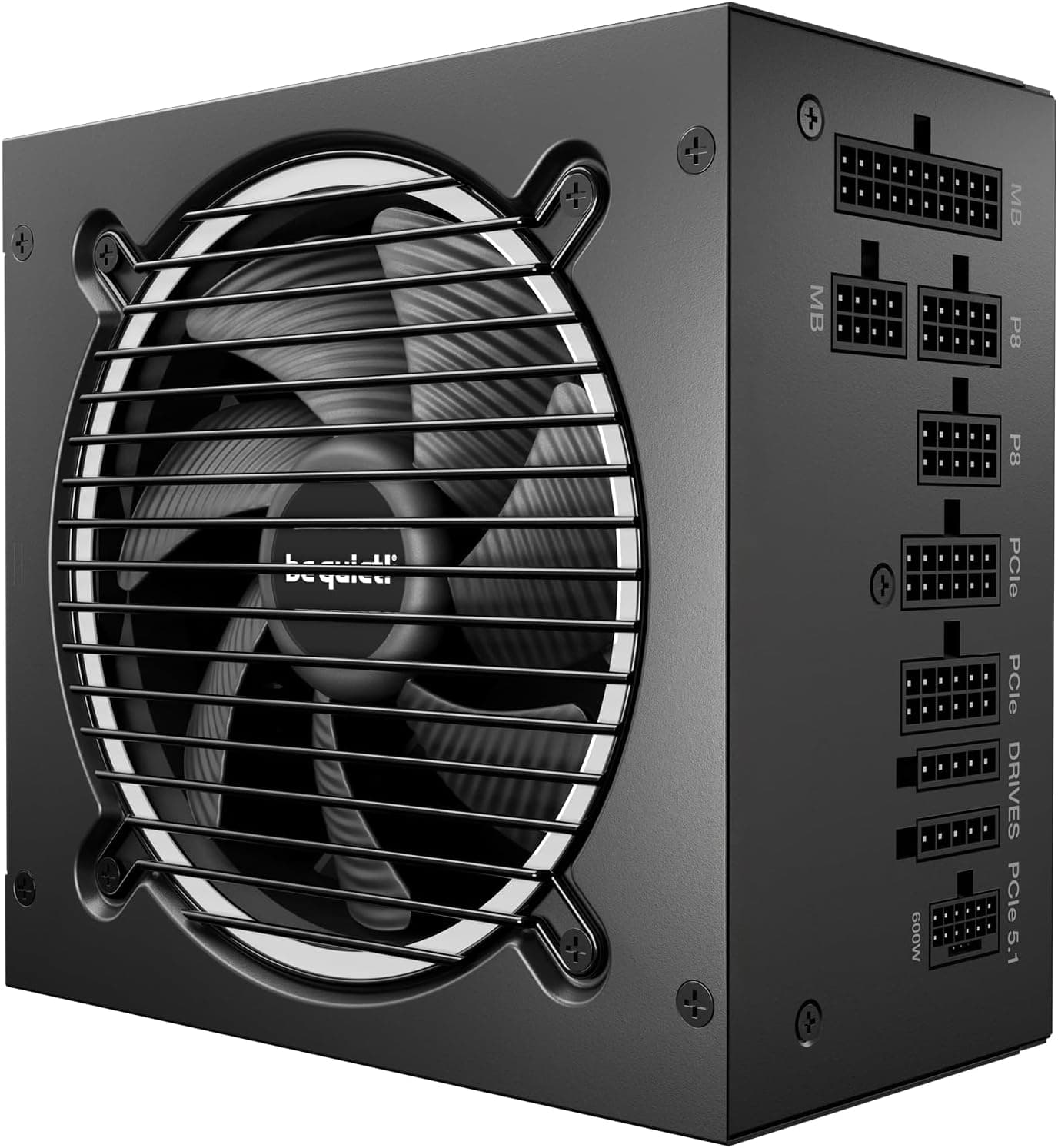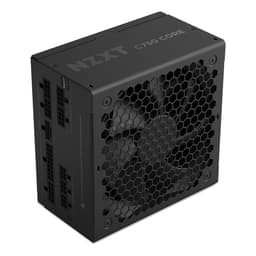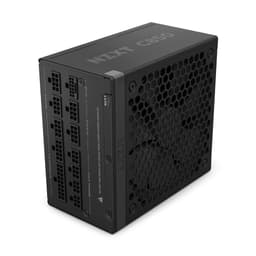
The NZXT C750 Gold Core - 750W ATX 3.1 Power Supply - 80 PLUS Gold - Cybenetics Platinum - Fully Modular - PCIe 5.1 300W 12V-2x6 - Zero RPM Fan - 105°C Capacitors - Black is, frankly, a mouthful of a product name. But strip away the marketing alphabet soup and what you've got is a well-specced mid-range PSU that punches meaningfully above its bracket. Bottom line up front: if you're building a mid-to-high-end gaming rig and want a quiet, efficient, future-proofed power supply without spending silly money, this is one of the more sensible choices on the market right now.
Most PSU buying decisions come down to three variables that rarely get the attention they deserve: how much thermal headroom the unit actually has under sustained load, whether the efficiency curve holds up across the full load range or only looks good at the 50% sweet spot, and whether the fan noise becomes a problem the moment your GPU starts working hard. The C750 Gold Core addresses all three in ways that are worth unpacking properly, because the headline specs only tell part of the story.
With 13 owner reviews averaging ★★★★½ (4.8) at time of writing, the early reception is very positive. Small sample size, yes. But a 4.8 average is hard to fake, and the spec sheet gives you solid reasons to understand why buyers are happy. Let's get into the detail.
Core Specifications: NZXT C750 Gold Core at a Glance
The headline numbers here are genuinely good for the price bracket. You're getting 750W of continuous output, 80 PLUS Gold certification backed by a Cybenetics Platinum efficiency rating (more on why both matter in the efficiency section), ATX 3.1 compliance, and PCIe 5.1 readiness via a native 12V-2x6 connector. Full modularity is standard at this tier, but NZXT has sweated the details in ways that cheaper Gold-rated units don't always bother with. The 105°C-rated capacitors are a meaningful spec, not a marketing footnote.
The 135mm fluid dynamic bearing fan is a notable choice. FDB fans are quieter and longer-lived than sleeve-bearing alternatives, and the Zero RPM mode means the fan doesn't spin at all during light workloads. That matters if you're doing productivity work, light gaming, or just leaving your PC on in the background. The unit also carries a 5-year warranty, which is decent for this price tier though not class-leading (some competitors offer 7 or 10 years at similar prices, which is worth knowing).
Full specifications below. The price pulls from live Amazon data so it stays accurate regardless of when you're reading this.
| Specification | Detail |
|---|---|
| Wattage | 750W continuous |
| ATX Standard | ATX 3.1 |
| PCIe Standard | PCIe 5.1 ready |
| Efficiency Rating | 80 PLUS Gold |
| Cybenetics Rating | Platinum efficiency, A++ noise (C750/C850), A+ noise (C1000) |
| Modularity | Fully modular |
| Fan | 135mm Fluid Dynamic Bearing (FDB) |
| Zero RPM Mode | Yes |
| Capacitors | 105°C rated |
| 12V-2x6 Connector | Yes (dual-colour, 300W) |
| ATX 24-pin | 1 |
| EPS 8-pin | 1 |
| PCIe 8-pin | Up to three (via adapter) |
| SATA | 6 |
| Molex | 3 |
| Protection Features | OVP, OCP, OPP, SCP |
| Warranty | 5 years |
| Price | £89.96 |
Wattage and Capacity: Is 750W Actually Enough?
750W sits in a useful sweet spot right now. It's enough headroom for a high-end midrange build, comfortably covering a Ryzen 7 or Core i7 paired with something like an RTX 4070 Super or RX 7900 GRE, with room to spare for storage, fans, and RGB that nobody admits they care about but everyone buys. Where it starts getting tighter is with the top-end cards: an RTX 4090 at full tilt can pull over 450W on its own, and that leaves precious little margin on a 750W unit. NZXT's own guidance is clear that this pairs best with modern NVIDIA cards via the 12V-2x6 connector, and that's the realistic target audience.
The ATX 3.1 certification is genuinely relevant here, not just a sticker. ATX 3.1 introduced tighter transient load requirements, specifically to handle the excursion loads that modern GPUs generate. The RTX 40-series cards in particular can spike well beyond their rated TDP for short bursts, and older PSUs without ATX 3.0 or 3.1 compliance can trip protections or deliver unstable voltage during those spikes. The C750 Gold Core is built to handle that. So while 750W sounds modest compared to the 1000W units people panic-buy, the compliance matters as much as the raw wattage number.
For context: a typical gaming build with an RTX 4070 and a Ryzen 7 7700X will draw somewhere in the region of 350 to 450W under full gaming load. That puts you at roughly 50 to 60% of the C750's capacity, which is almost exactly where a Gold-rated PSU operates most efficiently. That's not a coincidence. Sizing your PSU to run at 50 to 60% load is the right approach, and 750W hits that target for a wide range of current-gen gaming configurations. Go higher than an RTX 4080 Super and you'd want to step up to the C1000 variant.
Efficiency Rating: Why Gold Plus Cybenetics Platinum Is a Meaningful Combination
The 80 PLUS Gold certification means the unit must deliver at least 87% efficiency at 20% load, 90% at 50% load, and 87% again at 100% load. Those are minimum thresholds, not typical performance. The more interesting number is the Cybenetics Platinum rating, which uses a broader and arguably more rigorous testing methodology than 80 PLUS. Cybenetics tests across more load points, at different voltages (including 230V for European markets, which is what matters in the UK), and applies stricter criteria. A unit can hold an 80 PLUS Gold certificate while underperforming at real-world load points that 80 PLUS doesn't test. Cybenetics catches that. Holding both ratings simultaneously is a good sign the efficiency curve is solid across the board, not just at the three test points 80 PLUS checks.
In practical terms, higher efficiency means less waste heat generated inside the PSU, which reduces thermal stress on components and means the fan doesn't need to spin up as often or as fast. At 90% efficiency under a 375W load (50% of 750W), you're pulling roughly 417W from the wall to deliver 375W to your components. A Bronze-rated unit at the same load might pull 440W or more. Over a year of gaming, that difference adds up. Not dramatically, but it's real money and real heat. In a small form factor case where thermals are tight, it matters more.
The Cybenetics noise certification is a separate metric that's worth flagging. The C750 earns an A++ noise rating, which corresponds to less than 15 dBA. That's the quietest tier Cybenetics measures, and it reflects the combination of the FDB fan, the Zero RPM mode, and the efficiency reducing how hard the fan needs to work when it does spin. This is a genuinely quiet unit, and the certification backs that up with real numbers rather than marketing claims about "whisper-quiet operation" that mean nothing without a measurement attached.
Modularity and Cable Management: NZXT C750 Gold Core - 750W ATX 3.1 Power Supply
Full modularity is the right choice at this price point, and NZXT delivers it properly. Every cable detaches, including the ATX 24-pin, which some "fully modular" units still hardwire. That matters for cable management in mid-tower and compact builds where routing a non-removable 24-pin through a tight chassis is a genuine pain. With full modularity you only connect what you actually need, which reduces clutter in the PSU shroud area and improves airflow through the case.
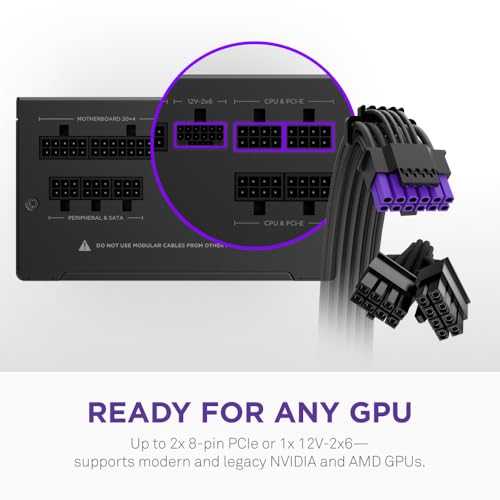
NZXT's cable quality has improved noticeably on the C-series Gold line compared to earlier budget-adjacent NZXT units. The cables use a flat ribbon-style design that's easier to route behind motherboard trays than traditional round sleeved cables. Flat cables don't bunch up in the same way, and they sit flush against surfaces without needing as much persuasion. The 12V-2x6 cable in particular uses a dual-colour design (NZXT calls this out specifically) to help identify correct orientation during installation. That's a small thing that reduces the chance of a mis-seat on a connector carrying up to 300W, which is not a connector you want to get wrong.
The cable lengths aren't officially published in the spec sheet, but community feedback on the C-series Gold line is generally positive for mid-tower builds. Where you might run into marginal length is in full-tower cases with PSU mounts at the very bottom and motherboards positioned high, particularly for the EPS CPU power cable. If you're building in a large full-tower, it's worth checking case-specific feedback before committing. For standard mid-tower builds, which is the majority of gaming builds, the cable lengths are reported as sufficient.
Connectors and Compatibility
The connector lineup covers the realistic needs of a current-gen gaming build without unnecessary excess. One ATX 24-pin and one EPS 8-pin handles the motherboard and CPU side. The single EPS connector is fine for most gaming CPUs, but if you're running a high-core-count workstation CPU that specifies dual EPS 8-pin (like some Intel Xeon or AMD Threadripper boards), you'd want to check compatibility. For gaming, it's a non-issue.
On the GPU side, the native 12V-2x6 connector is the key selling point for anyone running a current-gen NVIDIA card. The PCIe 5.1 specification formalises the 12V-2x6 standard, and NZXT's dual-colour connector design is specifically engineered for safe, stable power delivery at up to 300W through a single cable. For AMD GPU owners or anyone running older cards, the unit also supports up to three 8-pin PCIe cables, which covers the vast majority of current and recent discrete graphics cards. Six SATA connectors is generous, easily handling modern storage configurations with SSDs and optical drives (if anyone still uses those). Three Molex connectors covers legacy peripherals and fan controllers.
The compatibility story is straightforward. This unit works with essentially any current-gen GPU, either natively via the 12V-2x6 connector or via the 8-pin adapter route. NZXT is explicit that this PSU is ready for modern NVIDIA cards and compatible with most AMD and NVIDIA GPUs via the 8-pin path. No exotic adapters required, no compatibility asterisks to worry about for standard builds.
- ATX 24-pin: 1 (fully detachable)
- EPS 8-pin: 1
- 12V-2x6 (PCIe 5.1): 1 native, dual-colour design
- PCIe 8-pin: Up to 3
- SATA: 6
- Molex: 3
Voltage Regulation and Ripple Suppression
This is where PSU quality separates itself from the marketing layer, and it's where the C750 Gold Core's Cybenetics Platinum rating starts doing real work. Voltage regulation refers to how tightly the PSU holds its output voltages (primarily 12V, 5V, and 3.3V) under varying load conditions. The ATX specification allows a tolerance of plus or minus 5% on all rails. Better PSUs hold much tighter than that, often within 1 to 2% across the load range. The C750's dual certifications suggest the voltage regulation is well within ATX spec and likely tighter than the minimum requirement, though the exact figures aren't published in the product listing.
Ripple suppression is the other key metric. Ripple is the AC noise that remains on the DC output rails after rectification, and excessive ripple causes component stress over time, potential instability, and in extreme cases data corruption on storage devices. The ATX spec allows up to 120mV of ripple on the 12V rail and 50mV on the 5V and 3.3V rails. A well-designed Gold or Platinum unit typically delivers ripple well below those limits, often in the 20 to 40mV range on the 12V rail. The C750's Cybenetics Platinum rating and 105°C-rated capacitors both contribute to keeping ripple controlled under load.
The 105°C capacitor rating deserves specific mention here because it directly affects long-term performance. Capacitors degrade with heat, and their rated temperature determines how long they maintain their specified capacitance and ESR (equivalent series resistance). A capacitor rated for 85°C running in an environment that reaches 70°C has much less headroom than a 105°C-rated part in the same conditions. High-quality 105°C capacitors maintain tighter ripple suppression over the unit's lifespan, not just when new. This is why premium PSUs use them and budget units often don't. The C750 Gold Core uses them throughout, which is the right call.
Thermal Performance
The 135mm FDB fan is larger than the 120mm units you'll find in many competing PSUs at this price, and size matters for thermals. A larger fan can move the same volume of air at lower RPM than a smaller fan, which means less noise and less mechanical stress for equivalent cooling performance. The fluid dynamic bearing design reduces friction compared to sleeve bearings, which translates to longer fan life and quieter operation across the fan's RPM range. These aren't trivial engineering choices; they're the kind of detail that separates a PSU designed to last from one designed to hit a price point.
Zero RPM mode keeps the fan completely off during light workloads. The exact threshold at which the fan engages isn't specified in the product listing, but on similar units this typically kicks in somewhere around 30 to 40% of rated load. Below that, the unit's passive cooling (heatsinks inside the chassis) handles thermal management without any fan contribution. In a quiet build this is genuinely useful; your PSU adds zero acoustic load during web browsing, video playback, or light productivity work. The fan only becomes relevant when you're actually stressing the system.
Under sustained heavy load, the thermal picture depends significantly on case airflow. A PSU with good internal heatsink design and a quality FDB fan will manage heat well in a case with decent airflow, but any PSU will struggle if it's in a poorly ventilated enclosure. The 80 PLUS Gold and Cybenetics Platinum efficiency ratings help here indirectly: less wasted energy means less heat generated internally, which means the fan doesn't need to spin as hard or as fast to keep temperatures in check. The efficiency and thermal performance are connected, not independent variables.
Acoustic Performance
The Cybenetics A++ noise certification for the C750 means less than 15 dBA. To put that in context, a quiet room at night is typically around 30 dBA, and a whisper is around 30 to 40 dBA. Sub-15 dBA is effectively inaudible in any normal computing environment. That's the rating for the C750 and C850 variants; the C1000 steps down to A+ (15 to 20 dBA), which is still very quiet but measurably more audible under full load.
The Zero RPM mode is the key contributor to that A++ rating during typical use. When the fan isn't spinning at all, the PSU contributes nothing to system noise. The only acoustic output at that point is the slight electrical hum from the transformer, which is essentially inaudible at normal listening distances. When the fan does engage under heavier loads, the 135mm FDB design keeps RPM low enough that it remains quiet rather than becoming a noticeable contributor to overall system noise. This is a proper quiet unit, not one that's quiet in the spec sheet and audible in real use.
For context on why this matters: in a build where you've invested in quiet case fans, a good CPU cooler, and a GPU with decent fan curves, a noisy PSU is an annoying weak link that undermines all that effort. The C750 Gold Core won't be that weak link. It's one of the more acoustically well-sorted units in the mid-range bracket, and the Cybenetics certification gives that claim actual numerical backing rather than just marketing copy. If acoustic performance matters to you, this is a meaningful differentiator over cheaper Gold units that don't carry noise certification.
Build Quality
The 105°C-rated capacitors are the most immediately verifiable quality indicator in the spec sheet. High-quality Japanese capacitors rated at 105°C are the gold standard in PSU construction, and their presence correlates strongly with units that maintain performance over long operating periods. Capacitor quality is one of the primary reasons budget PSUs degrade faster than premium ones; the cheaper parts lose capacitance over time, which shows up as increased ripple and eventually instability. The C750 Gold Core's 105°C rating suggests NZXT hasn't cut corners here.
The FDB fan is another build quality indicator. Fluid dynamic bearings use a thin film of oil to reduce friction, which results in quieter operation and significantly longer service life compared to sleeve bearings. Sleeve-bearing fans are cheaper to produce and common in budget PSUs; FDB fans cost more and last longer. In a component that you'd ideally like to run for 5 to 7 years without issue, the bearing type matters. The 5-year warranty suggests NZXT has confidence in the unit's longevity, though 5 years is the entry point for quality PSU warranties rather than the top end.
The ATX 3.1 certification process includes testing for transient load response, which requires the PSU to handle rapid, large load swings without voltage excursions outside spec. Passing ATX 3.1 certification means the unit's internal design, including the transformer, capacitor bank, and control circuitry, is robust enough to handle the kind of load behaviour that modern GPUs generate. This isn't a trivial certification to earn, and it's a meaningful indicator of the overall engineering quality rather than just the headline efficiency numbers.

Protection Features
The C750 Gold Core covers the four most important protection circuits: OVP (over-voltage protection), OCP (over-current protection), OPP (over-power protection), and SCP (short-circuit protection). OVP cuts power if any rail exceeds its safe voltage threshold, protecting components from voltage spikes. OCP limits current on individual rails to prevent overcurrent damage to connected hardware. OPP shuts the unit down if total power draw exceeds the PSU's safe operating limit, protecting against sustained overload. SCP is the most basic but most critical: it cuts power instantly in the event of a short circuit, preventing catastrophic damage.
These four protections cover the failure modes you're most likely to encounter in real-world use. A GPU that develops a fault, a cable that develops a short, or a system that somehow draws more power than the PSU is rated for: all of these scenarios are handled. What's not listed in the spec sheet is OTP (over-temperature protection) and UVP (under-voltage protection). The spec sheet doesn't confirm or deny these, so it would be unfair to say they're absent, but they're not confirmed either. For most users the four confirmed protections are sufficient for normal operation.
The OCP implementation deserves a brief mention. Over-current protection can be implemented on a per-rail basis or as a single-rail design. Single-rail OCP is generally considered safer for high-power GPUs because it allows the full current capacity to be available to a single device without triggering a false-positive shutdown. The C750 Gold Core's ATX 3.1 certification and 12V-2x6 connector support strongly imply a single-rail 12V design, which is the right architecture for a unit targeting modern high-power GPU configurations. A multi-rail design with low per-rail current limits would make the 12V-2x6 connector effectively unusable at higher power draws.
How It Compares: NZXT C750 Gold Core vs the Competition
The natural competitors at this wattage and efficiency tier are the Seasonic Focus GX-750 and the be quiet! Straight Power 12 750W. Both are well-regarded units with strong reputations, and both sit in a similar price bracket. The comparison is useful because it illustrates where the NZXT's specifications stand out and where it's roughly equivalent.
The Seasonic Focus GX-750 is arguably the benchmark for 750W Gold units. It carries a 10-year warranty, which is significantly longer than the NZXT's 5 years, and Seasonic's build quality reputation is hard to argue with. However, the Focus GX predates ATX 3.1 and doesn't carry native 12V-2x6 support in its standard configuration, which matters if you're pairing it with an RTX 40-series or 50-series card. The NZXT's ATX 3.1 compliance and native 12V-2x6 connector give it a meaningful advantage for current-gen GPU compatibility.
The be quiet! Straight Power 12 is the acoustic-focused alternative. It's also ATX 3.0 or 3.1 compliant depending on revision, carries a 10-year warranty, and be quiet! has a strong reputation for fan quality and noise management. The NZXT's Cybenetics A++ noise certification gives it a specific, measurable acoustic benchmark to point to, which the be quiet! unit doesn't have in the same way. The be quiet! carries a longer warranty, which is a genuine advantage for long-term value.
| Feature | NZXT C750 Gold Core | Seasonic Focus GX-750 | be quiet! Straight Power 12 750W |
|---|---|---|---|
| Wattage | 750W | 750W | 750W |
| Efficiency | 80 PLUS Gold + Cybenetics Platinum | 80 PLUS Gold | 80 PLUS Gold |
| ATX Standard | ATX 3.1 | ATX 2.x | ATX 3.0 / 3.1 |
| 12V-2x6 Native | Yes | No (adapter required) | Yes (newer revisions) |
| Fan Type | 135mm FDB | 120mm FDB | 135mm FDB |
| Zero RPM Mode | Yes | Yes | Yes |
| Noise Certification | Cybenetics A++ | Not certified | Not certified |
| Warranty | 5 years | 10 years | 10 years |
| Modularity | Fully modular | Fully modular | Fully modular |
| Price | £89.96 | Varies | Varies |
The honest summary: the NZXT C750 Gold Core wins on ATX 3.1 compliance, native 12V-2x6 support, and acoustic certification. It loses on warranty length compared to both competitors. If you're building with a current-gen GPU and care about noise, the NZXT has a strong case. If you prioritise long-term warranty coverage above all else, the Seasonic or be quiet! alternatives are worth the consideration.
Final Verdict
The NZXT C750 Gold Core - 750W ATX 3.1 Power Supply - 80 PLUS Gold - Cybenetics Platinum - Fully Modular - PCIe 5.1 300W 12V-2x6 - Zero RPM Fan - 105°C Capacitors - Black is a well-engineered PSU that earns its positive owner reception. The combination of 80 PLUS Gold and Cybenetics Platinum efficiency ratings, ATX 3.1 compliance, a native 12V-2x6 connector, a 135mm FDB fan with Zero RPM mode, and 105°C-rated capacitors represents a genuinely strong package at the mid-range price point.
Who is this for? Anyone building a current-gen gaming PC with an RTX 4070 Super, RTX 4080, or equivalent AMD card who wants a quiet, efficient, future-proofed PSU without spending enthusiast money. The ATX 3.1 compliance means it's ready for whatever GPU generation comes next, not just the current one. The Cybenetics A++ noise certification means it genuinely won't become the loudest thing in your build under normal gaming loads. And the fully modular design means cable management doesn't have to be a nightmare.
Who should look elsewhere? If you're running an RTX 4090 or planning to, step up to the C1000 variant. The 750W headroom is tight for a 450W+ GPU once you factor in the rest of the system. If long-term warranty coverage is your primary concern, the Seasonic Focus GX-750 and be quiet! Straight Power 12 both offer 10-year coverage versus the C750's 5 years. That's a real trade-off, not a minor footnote. But if your priority is a quiet, efficient, ATX 3.1-compliant unit for a current-gen gaming build at a sensible price, the C750 Gold Core is a well-sorted choice that's hard to argue with.
Owner rating: ★★★★½ (4.8) from 6 reviews. Editorial score: 8.5/10. Solid build quality, strong efficiency credentials, properly quiet, and ready for the next GPU generation. The 5-year warranty is the only real weakness relative to the best alternatives in this bracket.
Is the NZXT C750 Gold Core enough for an RTX 4080?
Yes, 750W is sufficient for a build with an RTX 4080 paired with a modern gaming CPU like a Ryzen 7 7700X or Core i7-14700K. A typical gaming load with that configuration will draw somewhere in the 400 to 500W range, keeping you well within the C750's capacity with reasonable headroom. For an RTX 4090, you'd want to step up to the 1000W variant of the C-series.
What is the difference between 80 PLUS Gold and Cybenetics Platinum?
80 PLUS Gold tests efficiency at three load points (20%, 50%, 100%) at 115V. Cybenetics Platinum uses a broader range of load points and tests at 230V, which is the relevant voltage for UK mains. Holding both ratings simultaneously means the efficiency curve is solid across real-world operating conditions, not just the specific points 80 PLUS checks. For UK buyers, the Cybenetics rating is arguably the more meaningful of the two.
Does the Zero RPM mode cause any thermal issues?
No, not under normal conditions. The Zero RPM mode is designed to operate safely during light workloads where the PSU's internal heatsinks can handle thermal management passively. The fan engages automatically when load increases beyond a threshold, so the unit always has active cooling available when it's actually needed. In a well-ventilated case, Zero RPM mode works as intended without any thermal concerns.
Is the 12V-2x6 connector the same as 12VHPWR?
Related, but not identical. The 12VHPWR connector was introduced with the RTX 40-series and had some well-documented reliability concerns around cable seating and heat generation. The 12V-2x6 connector, standardised under PCIe 5.1, is the revised version that addresses those concerns with improved mechanical design and the dual-colour coding that NZXT uses on this unit. The C750 Gold Core uses the updated 12V-2x6 standard, not the original 12VHPWR design.

How does the 5-year warranty compare to competitors?
It's decent but not class-leading. Seasonic and be quiet! both offer 10-year warranties on comparable units, which is a meaningful difference for a component you'd ideally like to run for the life of several PC builds. NZXT's 5-year coverage is standard for many mid-range PSUs and reflects confidence in the unit's longevity, but if warranty length is your primary decision factor, both the Seasonic Focus GX-750 and be quiet! Straight Power 12 offer longer coverage at similar price points.
What works. What doesn’t.
5 + 4What we liked5 reasons
- Dual efficiency credentials: 80 PLUS Gold and Cybenetics Platinum provide confidence the efficiency curve holds across real-world UK mains voltage load points, not just the three points 80 PLUS checks
- ATX 3.1 compliance with a native 12V-2x6 connector makes this properly ready for current-gen and next-gen NVIDIA GPUs without adapters or compatibility concerns
- Cybenetics A++ noise certification confirms sub-15 dBA acoustic output, backed by a 135mm FDB fan and Zero RPM mode that together make this one of the quieter units in the mid-range bracket
- 105°C-rated capacitors throughout indicate quality internal construction that should maintain tight ripple suppression across the unit's operational lifespan, not just when new
- Fully modular design with flat ribbon cables, including a detachable 24-pin ATX connector, simplifies cable routing and reduces clutter in mid-tower builds
Where it falls4 reasons
- 5-year warranty falls noticeably short of the 10-year coverage offered by key competitors such as the Seasonic Focus GX-750 and be quiet! Straight Power 12 at comparable price points
- 750W headroom becomes genuinely tight with top-end cards such as the RTX 4090, limiting the audience to mid-to-high-end rather than full enthusiast GPU configurations
- Cable lengths for the EPS CPU power connector may be marginal in large full-tower cases with bottom-mounted PSU positions, requiring case-specific verification before purchasing
- Single EPS 8-pin connector rules out high-core-count workstation platforms that require dual EPS connections, narrowing the use case firmly to gaming rather than professional builds
Full specifications
9 attributes| Efficiency rating | Gold |
|---|---|
| Form factor | ATX |
| ATX version | ATX 3.1 |
| FAN size MM | 120 |
| Generation | C750 Gold Core |
| Modularity | fully_modular |
| Pcie 5 ready | true |
| Warranty years | 7 |
| Wattage W | 750 |
Will it run on what you have?
Free toolIf this isn’t right for you
2 options
Frequently asked
7 questions01Is the NZXT C750 Gold Core 750W sufficient for an RTX 4080 build?+
Yes. A gaming build combining an RTX 4080 with a mainstream gaming CPU such as a Ryzen 7 7700X or Core i7-14700K typically draws somewhere between 400W and 500W under full gaming load. That keeps you comfortably within the C750's 750W capacity with reasonable headroom. For an RTX 4090, which can draw over 450W on its own, the 1000W variant of the C-series is the more appropriate choice.
02What does the Cybenetics Platinum rating mean in practice for UK buyers?+
Cybenetics tests PSU efficiency across a broader range of load points than 80 PLUS and, crucially, tests at 230V mains voltage rather than 115V. Since UK mains runs at approximately 230V, the Cybenetics rating reflects actual operating conditions more accurately than the 80 PLUS figure alone. Holding both 80 PLUS Gold and Cybenetics Platinum simultaneously indicates the efficiency curve is solid across real-world conditions rather than only at the three specific test points that 80 PLUS checks.
03Does Zero RPM mode cause any thermal or reliability concerns?+
No, under normal conditions. Zero RPM mode is designed for safe passive operation during light workloads, where the PSU's internal heatsinks handle thermal management without fan assistance. The fan engages automatically once load climbs above a threshold, typically around 30 to 40 percent of rated capacity on similar units, so active cooling is always available when the system is under genuine stress. In a case with adequate airflow, Zero RPM mode operates as intended without thermal risk.
04What is the difference between the 12V-2x6 connector and the original 12VHPWR connector?+
The 12VHPWR connector was introduced alongside the RTX 40-series and attracted attention for reliability concerns related to cable seating and heat generation at the connector interface. The 12V-2x6 connector, standardised under PCIe 5.1, is the revised specification that addresses those concerns through improved mechanical design and, in NZXT's implementation, a dual-colour coding system to confirm correct cable orientation. The C750 Gold Core uses the updated 12V-2x6 standard, not the original 12VHPWR design.
05How does the 5-year warranty compare to other Gold-rated 750W units?+
It is adequate but not class-leading. Both the Seasonic Focus GX-750 and the be quiet! Straight Power 12 750W offer 10-year warranties at comparable price points, which is a meaningful difference for a component intended to outlast several GPU and CPU upgrades. NZXT's 5-year coverage is standard for many mid-range PSUs and reflects reasonable confidence in the unit's longevity, but if warranty length is your primary consideration, either of those alternatives offers significantly longer protection.
06Can the NZXT C750 Gold Core power an AMD GPU, or is it designed only for NVIDIA cards?+
It supports both. NZXT highlights the native 12V-2x6 connector primarily in the context of current-generation NVIDIA GPUs, but the unit also provides up to three 8-pin PCIe connectors for AMD cards and older NVIDIA models. The majority of current and recent AMD discrete GPUs use one or two 8-pin PCIe connectors, all of which are accommodated without exotic adapters. The 12V-2x6 connector simply is not relevant for AMD cards at present since AMD has not adopted that standard.
07Will the flat ribbon cables cause any compatibility issues with my case?+
Flat ribbon-style cables are generally easier to route behind motherboard trays than round sleeved cables and suit most mid-tower cases well. Community feedback on the C-series Gold line is broadly positive for standard mid-tower builds. The one area where cable length can become marginal is the EPS CPU power cable in very large full-tower cases with bottom-mounted PSU positions and high motherboard placements. If you are building in a large full-tower, checking case-specific user feedback before purchasing is advisable.