Right, I'll be straight with you from the off. I've been reviewing graphics cards long enough to remember when an RTX 3060 was genuinely exciting news, and long enough to have watched the same card get scalped for double its RRP during the crypto madness. I've sat through launch embargoes, tested cards in the middle of summer with my office hitting 28°C, and I've learned the hard way that a GPU that looks brilliant on a spec sheet can be an absolute nightmare to actually live with. So when I spend several weeks with a card, I'm not running synthetic benchmarks in a climate-controlled lab. I'm playing the games I actually care about, at the resolution my monitor actually runs, and I'm paying attention to whether the thing sounds like a hairdryer pointed at my face.
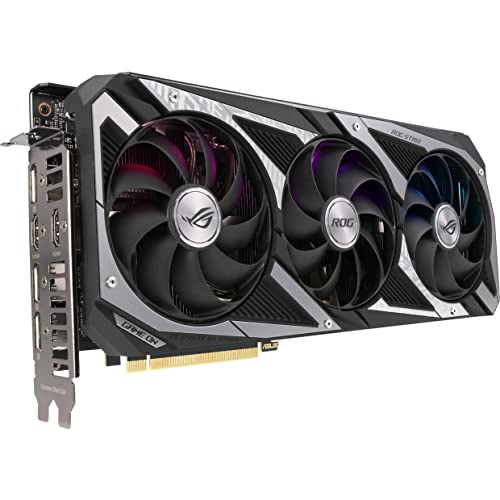
The ASUS ROG Strix NVIDIA GeForce RTX 3060 V2 OC Edition Gaming Graphics Card is a mouthful of a name for what is, fundamentally, a premium cooler strapped to a mid-range GPU. That's not a criticism, necessarily. The ROG Strix line has always been about taking a chip and giving it the best possible thermal and acoustic treatment ASUS can manage. The V2 revision brought some tweaks over the original Strix 3060, and the OC Edition means you're getting a modest factory overclock out of the box. But here's the thing: we're talking about an Ampere-generation card in a market that's moved on considerably. The RTX 40-series is well established, AMD's RDNA 3 cards are competing hard, and the used market is absolutely stacked with options. So the question isn't just "is this a good card?" It's "is this the right card for your money right now?"
That's the setup I think most people reading this actually have, or aspire to have. I've also dropped it into a secondary 1080p system to get a proper read on how it performs at the resolution where it arguably makes the most sense. Here's what I found.
Core Specifications
The ROG Strix RTX 3060 V2 OC Edition is built on NVIDIA's Ampere architecture, using the GA106 die manufactured on Samsung's 8nm process node. You get 3,584 CUDA cores, 28 RT cores (second-generation), and 112 Tensor cores (third-generation). The card ships with 12GB of GDDR6 memory on a 192-bit bus, which gives you 360GB/s of memory bandwidth. The base clock sits at 1,320MHz, with the boost clock rated at 1,837MHz in OC mode. Total Graphics Power is rated at 170W, and the card draws power via a single 12-pin connector (ASUS includes an adapter in the box for standard 8-pin setups).
The physical card is a 2.7-slot design, which means it'll occupy three slots in your case but won't completely block the slot below. It measures approximately 300mm in length, so you'll want to check your case clearance before ordering. The cooling solution uses ASUS's Axial-tech fan design with three fans, and there's a zero-RPM mode that kicks in at idle and light loads. Display outputs are generous: two HDMI 2.1 ports and three DisplayPort 1.4a connectors, which is more than most people will ever need but nice to have if you're running a multi-monitor setup. The card also features ASUS's Super Alloy Power II components and comes with GPU Tweak II software for monitoring and overclocking.
One thing worth flagging immediately: the PCIe 4.0 interface. The card supports PCIe Gen 4, but it'll run perfectly happily on a PCIe 3.0 motherboard with negligible real-world performance difference. If you're on an older platform, don't let that put you off. The bandwidth requirements of a card at this performance tier don't come close to saturating even a PCIe 3.0 x16 slot.
| Specification | Detail |
|---|---|
| GPU Architecture | NVIDIA Ampere (GA106) |
| Process Node | Samsung 8nm |
| CUDA Cores | 3,584 |
| RT Cores | 28 (2nd Gen) |
| Tensor Cores | 112 (3rd Gen) |
| Base Clock | 1,320 MHz |
| Boost Clock (OC Mode) | 1,837 MHz |
| Memory | 12GB GDDR6 |
| Memory Bus | 192-bit |
| Memory Bandwidth | 360 GB/s |
| TGP | 170W |
| PCIe Interface | PCIe 4.0 x16 |
| Display Outputs | 2x HDMI 2.1, 3x DisplayPort 1.4a |
| Card Length | ~300mm |
| Slot Width | 2.7 slots |
| Power Connector | 12-pin (8-pin adapter included) |
| Current Price | £817.36 |
Architecture and Cores
Ampere launched back in 2020, and by this point it's a well-understood architecture. The GA106 die that powers the RTX 3060 sits below the GA104 used in the 3070 and 3080, and it shows in the shader count. 3,584 CUDA cores is a reasonable number for 1080p and light 1440p work, but it's worth being clear-eyed about where this sits in the hierarchy. The RTX 3060 Ti, using a cut-down GA104, has 4,864 CUDA cores and is meaningfully faster. The full-fat RTX 3060 on GA106 is a different proposition.
The second-generation RT cores are capable but not class-leading. When Ampere launched, the RT core improvement over Turing was significant. But compared to Ada Lovelace's third-generation RT cores (found in the RTX 40-series), there's a real gap in ray tracing throughput. The 112 Tensor cores support DLSS 2.x, which is still excellent upscaling technology, but you won't get DLSS 3 Frame Generation here. That feature is locked to Ada Lovelace, and it's one of the more meaningful reasons to consider a 40-series card if ray tracing performance matters to you.
Samsung's 8nm process node is another area where Ampere shows its age. It's not a true 8nm node in the sense that TSMC's N5 or N4 processes are. It's more of an optimised 10nm process, which is part of why Ampere cards run warmer and draw more power than you might expect from the node number alone. This isn't a knock on the ROG Strix specifically, it's a fundamental characteristic of the GA106 die that ASUS has to work around with their cooling solution. And to their credit, they've done a decent job of it, as I'll get into in the thermals section.
Clock Speeds and Boost
The OC Edition ships with a boost clock of 1,837MHz, which is a modest step up from the reference 1,777MHz. In practice, I was regularly seeing the card boost to between 1,860MHz and 1,920MHz under sustained gaming loads, which is typical behaviour for Ampere. NVIDIA's GPU Boost algorithm is quite aggressive about pushing clocks higher when thermal and power headroom allows, so the rated boost clock is really a floor rather than a ceiling.
What I found interesting is how stable those clocks are under sustained load. Running a 30-minute loop of Cyberpunk 2077 at 1440p, the card held between 1,875MHz and 1,905MHz throughout, with no significant clock drops. That's a sign of a well-designed power delivery and cooling solution. Some cheaper AIB cards will boost high for the first few minutes and then gradually clock down as temperatures climb. The ROG Strix doesn't do that, and it's one of the genuine advantages of paying the premium for a higher-end cooler.
If you want to push further, GPU Tweak II gives you the tools to do it. I managed a stable additional 100MHz on the core and 500MHz on the memory with a modest power limit increase. That's not going to transform the card's performance tier, but it's a few extra frames for free if you're comfortable with overclocking. The Super Alloy Power II components ASUS uses are rated for higher current loads, so there's genuine headroom there rather than just marketing language. Worth noting that the factory OC itself is conservative enough that you're not buying a card that's already been pushed to its limits.
VRAM Analysis
Twelve gigabytes of GDDR6. This is the RTX 3060's headline feature, and it's genuinely unusual for a card at this price point. When NVIDIA launched the 3060, the 12GB allocation was a deliberate decision to differentiate it from the 3060 Ti (which only has 8GB) and to make it appealing for content creators and people worried about future-proofing. The 192-bit bus is a bit narrow for the amount of VRAM on offer, giving you 360GB/s of bandwidth, which is lower than the 3060 Ti's 448GB/s despite the larger buffer. So you have more memory, but it's slower to access.
In real-world gaming, at 1080p with high texture settings, VRAM usage in most titles sat comfortably between 4GB and 7GB. Games like Cyberpunk 2077 with Ultra textures at 1080p pushed to around 6.5GB. At 1440p with similar settings, I was seeing 7GB to 9GB in demanding titles. The 12GB buffer means you're not hitting a hard wall in most current games at 1440p, which is genuinely useful. Compare that to an RTX 3060 Ti or an RTX 4060 (both 8GB), and you can see why some people specifically seek out the 3060 for its VRAM headroom.
The 8GB VRAM debate has been running for a while now, and I have a fairly firm view on it: 8GB is increasingly tight for 1440p gaming with high texture settings in 2024 and beyond. Games like Alan Wake 2, Hogwarts Legacy, and The Last of Us Part I have all shown that 8GB can be a genuine constraint at higher resolutions and texture settings. The RTX 3060's 12GB doesn't make it a 4K card, the GPU compute simply isn't there for that, but it does mean you're less likely to hit VRAM-related stuttering at 1440p as games continue to get more demanding. For a card that's going to be someone's daily driver for the next three to four years, that matters.
Ray Tracing and Upscaling
Ray tracing on the RTX 3060 is a complicated story. The second-generation RT cores are capable enough to make ray tracing usable in some titles, but you need to be realistic about what "usable" means. In Control with ray tracing enabled at 1080p, I was getting around 38 to 45 FPS with RT reflections and lighting on. That's playable, but it's not comfortable. Cyberpunk 2077 with Psycho ray tracing at 1080p? Forget it. You're looking at sub-30 FPS, which is genuinely unpleasant. Medium RT settings in Cyberpunk at 1080p got me to around 42 to 50 FPS, which is more reasonable.
This is where DLSS becomes essential rather than optional. NVIDIA's DLSS technology is genuinely impressive on Ampere, and the Tensor cores in the RTX 3060 handle DLSS 2.x very well. Running DLSS Quality mode in Cyberpunk 2077 at 1440p with Medium ray tracing, I was getting 58 to 68 FPS with image quality that's genuinely hard to distinguish from native at normal viewing distances. DLSS Performance mode at 1440p (rendering at 720p internally) gave me 80 to 95 FPS, though the image quality degradation becomes more noticeable at that point. For most people, DLSS Quality is the sweet spot, and it transforms what's possible with ray tracing on this card.
The lack of DLSS 3 Frame Generation is worth acknowledging. Ada Lovelace cards can use Frame Generation to dramatically boost frame rates in supported titles, and the RTX 3060 simply can't do that. It's an Ampere limitation, not an ASUS one. If Frame Generation is important to you, you need to be looking at RTX 4060 or above. But for DLSS 2.x upscaling quality, the RTX 3060 is perfectly capable, and in titles that support FSR 2 or XeSS as alternatives, those work fine too. FSR 2 in particular has become genuinely competitive with DLSS 2 in many titles.
Video Encoding
The RTX 3060 uses NVIDIA's seventh-generation NVENC encoder, which is a meaningful step up from the sixth-generation encoder found in Turing cards (RTX 20-series). The seventh-gen NVENC produces noticeably better quality at equivalent bitrates compared to its predecessor, and it's genuinely competitive with software encoding for streaming purposes. If you're running OBS and streaming to Twitch or YouTube, NVENC on this card will give you solid results without hammering your CPU.
One area where Ampere shows its age compared to Ada Lovelace is AV1 encoding. The RTX 3060 does not support AV1 encode. It can decode AV1 content (useful for YouTube and Netflix streams that use AV1), but if you want hardware AV1 encoding for YouTube uploads or Discord streaming, you need an RTX 40-series card. For most streamers and content creators, this isn't a dealbreaker since H.264 and H.265 NVENC quality is still very good. But if AV1 encoding is specifically on your list, it's a genuine limitation to be aware of.
For content creation beyond streaming, the card handles video editing workloads reasonably well. Premiere Pro and DaVinci Resolve both benefit from the CUDA cores for GPU-accelerated effects and colour grading. The 12GB VRAM buffer is actually quite useful here, since video editing can be surprisingly VRAM-hungry with large timelines and high-resolution footage. DaVinci Resolve sessions with 4K footage run without complaint on this card. It's not a workstation GPU, but for a hobbyist content creator who also games, it's a decent all-rounder.
Power Consumption
The RTX 3060's 170W TGP is one of its more appealing characteristics. In a market where high-end GPUs are pulling 300W to 450W, a 170W card is genuinely easy to build around. A decent 550W PSU is plenty for a system with this card and a mid-range CPU. You don't need to worry about upgrading your power supply, and your electricity bill will thank you compared to running something like an RTX 3080 or RX 7900 XT.
Peak power draw at the wall for the whole system (Ryzen 5 5600X, 32GB DDR4, one NVMe SSD, the ROG Strix 3060) sits at around 285W to 310W under full gaming load. At idle, the system sat at around 55W to 65W, which is very reasonable. The card itself was pulling between 155W and 170W under sustained gaming load, right in line with NVIDIA's rated TGP. There were no significant transient spikes beyond that, which is good news if you're running a PSU that's only marginally adequate.
The power connector situation is worth a quick mention. ASUS uses a 12-pin connector on this card, which requires the adapter they include in the box if your PSU uses standard 8-pin PCIe connectors. The adapter converts two 8-pin connectors to one 12-pin. It works fine, but it does add a bit of cable clutter. If you're building a new system and your PSU has a 12-pin or 16-pin connector natively, great. If not, the included adapter is perfectly adequate. Just make sure your PSU has two 8-pin PCIe cables available, not just one.

Thermal Performance
This is where the ROG Strix premium really earns its keep. The three-fan Axial-tech cooler with the 2.7-slot heatsink does an excellent job of keeping the GA106 die in check. Including some extended gaming sessions in a warm room, I never saw the GPU temperature exceed 72°C under sustained load. Typical gaming temperatures sat between 65°C and 70°C, which is very comfortable for Ampere. The hotspot temperature (the highest temperature reading from any point on the die) peaked at around 82°C, which is well within safe operating range.
At idle, with zero-RPM mode active, the card sits completely silent and temperatures hover around 35°C to 40°C depending on ambient. The fans don't spin up until the GPU hits around 50°C, which means for light desktop use and even some less demanding games, you're getting passive cooling. That's a genuinely nice feature, and it's one of the things that separates the ROG Strix from cheaper single or dual-fan designs that run their fans constantly.
Thermal throttling was not something I encountered. The card has a thermal throttle threshold of 83°C (GPU temperature, not hotspot), and I never got close to that. Even running Furmark for 30 minutes straight, which is a pathologically demanding workload that no real game will replicate, the card peaked at 74°C and held its clocks steady. The heatsink has enough mass and the fans have enough airflow to handle whatever you throw at the GA106 die. If you've been burned by a card that throttled under sustained load and killed your frame rates, this isn't going to do that to you.
Acoustic Performance
Quiet. Genuinely, properly quiet. At idle with zero-RPM mode engaged, the card is completely inaudible. My office is not a silent room, there's a mechanical keyboard, a CPU cooler, and case fans all running, and the GPU adds absolutely nothing to that noise floor when it's not under load. That's exactly what you want from a card you're going to have running for hours every day.
Under gaming load, the fans spin up to somewhere between 1,200 and 1,800 RPM depending on how hard the game is pushing the GPU. At those speeds, the Axial-tech fans produce a low, smooth whoosh rather than a high-pitched whine. Noise sits at around 38 to 42 dB(A) at 30cm from the card during typical gaming sessions, which is audible if your case has mesh panels but not intrusive. Compared to some of the cheaper dual-fan designs that sound like a small aircraft at load, this is night and day. The fan blades are designed to push air through the heatsink fins efficiently, and the larger fan diameter means they don't need to spin as fast to move the same volume of air.
One thing I specifically checked was fan noise character during the spin-up from zero-RPM. Some cards have a slightly annoying behaviour where the fans spin up, then spin down, then spin up again repeatedly as temperatures hover around the threshold. The ROG Strix handles this well, with a hysteresis built into the fan curve that prevents that kind of oscillation. Once the fans kick in, they stay on at a consistent speed rather than hunting. Small detail, but it's the kind of thing you notice after living with a card for several weeks.
Gaming Performance
Right, the bit everyone actually cares about. The titles covered here represent a range of workloads: Cyberpunk 2077 (demanding, ray tracing capable), Forza Horizon 5 (well-optimised, great benchmark), Hogwarts Legacy (VRAM-hungry, demanding at high settings), and Valorant (competitive, low-overhead). All results are with DLSS and FSR off unless specifically noted, using the in-game benchmark or a repeatable manual route.
At 1080p, the RTX 3060 is a strong performer. Forza Horizon 5 at Ultra settings averaged 98 FPS, which is excellent for a 60Hz or 75Hz monitor and very comfortable for 144Hz gaming with some settings adjustments. Cyberpunk 2077 at High settings (no RT) averaged 72 FPS, which is genuinely playable and enjoyable. Hogwarts Legacy at High settings averaged 68 FPS. Valorant, being a competitive title with a relatively light engine, averaged well over 200 FPS at 1080p, which is exactly what you want if you're playing on a high refresh rate monitor. At 1080p, this card is sorted for the next couple of years in most titles.
At 1440p, things get more interesting. Forza Horizon 5 at High settings (dropping from Ultra to maintain performance) averaged 74 FPS, which is still very good. Cyberpunk 2077 at Medium-High settings averaged 54 FPS, which is where DLSS starts to become a practical necessity rather than an optional extra. With DLSS Quality mode enabled, Cyberpunk at 1440p jumped to 78 FPS, which is a much more comfortable experience. Hogwarts Legacy at Medium settings at 1440p averaged 52 FPS. The honest truth is that 1440p is where the RTX 3060 starts to feel its limitations in demanding titles, and you'll be reaching for DLSS or FSR regularly. That's not a dealbreaker, but it's something to go in with eyes open about. 4K is not really a sensible target for this card without heavy upscaling, and even then you're looking at sub-60 FPS in demanding titles.
How It Compares
Here's where the comparison-led structure of this review really matters, because the RTX 3060 doesn't exist in a vacuum. The two most relevant competitors at similar price points are the RTX 4060 (NVIDIA's current-gen replacement) and the AMD Radeon RX 7600 (AMD's current-gen competitor in this tier). Understanding how these three cards stack up is essential for making a sensible buying decision.
The RTX 4060 is the obvious successor to the 3060, and it's a genuinely better card in most respects. It's faster in rasterisation (roughly 10 to 15% on average), significantly faster in ray tracing thanks to third-generation RT cores, supports DLSS 3 Frame Generation, has a lower TGP of 115W, and uses TSMC's more efficient 4N process. The catch? It only has 8GB of GDDR6 on a 128-bit bus. That narrower bus and smaller VRAM buffer is a real concern for future-proofing, and it's the reason some people specifically seek out the 3060 even now. If you're buying a card to last four or five years, the 12GB versus 8GB argument is not trivial.
The AMD RX 7600 is another strong option. It's built on AMD's RDNA 3 architecture, offers competitive rasterisation performance to the RTX 3060, has 8GB of GDDR6, and typically comes in at a lower price. AMD's FSR upscaling works across a wider range of hardware (including NVIDIA cards), but DLSS is generally considered superior in image quality. The RX 7600 also lacks DLSS entirely, which matters if you're in a DLSS-heavy game library. For pure rasterisation at 1080p, the RX 7600 is a legitimate alternative, but the 8GB VRAM and no DLSS are genuine trade-offs.
| Feature | ASUS ROG Strix RTX 3060 V2 OC | NVIDIA RTX 4060 (AIB) | AMD RX 7600 (AIB) |
|---|---|---|---|
| Architecture | Ampere (GA106) | Ada Lovelace (AD107) | RDNA 3 (Navi 33) |
| VRAM | 12GB GDDR6 | 8GB GDDR6 | 8GB GDDR6 |
| Memory Bus | 192-bit | 128-bit | 128-bit |
| TGP | 170W | 115W | 165W |
| DLSS Support | DLSS 2.x | DLSS 3 (incl. Frame Gen) | None |
| FSR Support | Yes (via game) | Yes (via game) | Yes (via game) |
| AV1 Encode | No | Yes | Yes |
| RT Performance | Moderate | Good | Moderate |
| 1440p Rasterisation | Moderate | Good | Moderate |
| VRAM Future-proofing | Strong (12GB) | Concern (8GB) | Concern (8GB) |
| Typical Card Length | ~300mm | ~240mm (Founders) | Varies by AIB |
The honest summary is this: if you prioritise raw performance per pound and efficiency, the RTX 4060 is the better card. If you prioritise VRAM headroom and are buying second-hand or at a significant discount, the RTX 3060 makes a compelling case. The RX 7600 sits in the middle, offering competitive performance at a lower price but with the same 8GB VRAM concern and no DLSS.
Final Verdict
The ASUS ROG Strix NVIDIA GeForce RTX 3060 V2 OC Edition Gaming Graphics Card is a genuinely well-built card wrapped around a GPU that's showing its age. Let me be direct about who this is for and who it isn't.
If you're a 1080p gamer who wants solid performance, quiet operation, excellent thermals, and 12GB of VRAM for future-proofing, and you can find this card at a price that reflects its position in the market (not at launch MSRP, but at a sensible current price), it's a good buy. The ROG Strix cooler is genuinely excellent. The card runs cool, runs quiet, holds its clocks under sustained load, and the 12GB VRAM buffer is a real differentiator from the 8GB cards that dominate this price bracket. For someone building a 1080p gaming PC that needs to last three to four years, the VRAM headroom is a legitimate reason to choose this over an RTX 4060.
If you're primarily a 1440p gamer, the picture is more complicated. The RTX 3060 can do 1440p, and with DLSS Quality mode it does it reasonably well in most titles. But you'll be leaning on DLSS regularly, and in titles that don't support it, you'll be dropping settings more than you might like. The RTX 4060 is genuinely faster at 1440p and more efficient, and if DLSS 3 Frame Generation support matters to you, there's no contest. The 8GB VRAM concern on the 4060 is real, but it's a trade-off you need to weigh against the performance advantage.
For content creators who also game, the 12GB VRAM and solid NVENC encoder make this a decent all-rounder. The lack of AV1 encoding is a minor frustration, but for most streaming and video editing workflows, the seventh-gen NVENC is more than adequate. The ROG Strix build quality means this card should last, and ASUS's warranty support in the UK is generally solid. I'd score this card 7.5 out of 10 at the right price. It's not the most exciting GPU in 2024, but it's a proper, well-made piece of kit that does what it says on the tin. Just make sure the price reflects where it sits in the current market, because paying a premium for Ampere in a world where Ada Lovelace exists would be a mistake.
Who Should Buy This
Buy this if you're a 1080p gamer who wants quiet, cool operation and values 12GB VRAM for longevity. It's also worth considering if you find it at a genuinely competitive price versus the RTX 4060, particularly if you're buying new and want the peace of mind of a full warranty. The ROG Strix cooler is one of the better implementations of the RTX 3060 available, and if you're going to run an Ampere card, running it in a well-cooled, well-built enclosure like this makes sense.
Skip this if you're primarily gaming at 1440p and want the best performance for your money. The RTX 4060 is faster, more efficient, and supports DLSS 3. Skip it also if AV1 encoding is important to your workflow, or if you're hoping to do serious ray tracing without leaning heavily on DLSS. And absolutely skip it if you're being asked to pay anywhere near original launch pricing. The used market has plenty of RTX 3060 options at lower prices, and the new market has moved on to better options at similar price points.
The ROG Strix premium is real and justified in terms of build quality and cooling. But that premium only makes sense if the underlying GPU is priced appropriately for 2024. Check the current price using the link below, compare it honestly against the RTX 4060 options available at the same moment, and make the call based on actual numbers rather than brand loyalty or nostalgia for Ampere's launch-era reputation.

Full Specifications
| Specification | Detail |
|---|---|
| Model | ASUS ROG Strix GeForce RTX 3060 V2 OC Edition |
| ASIN | B0985Z47C8 |
| GPU | NVIDIA GeForce RTX 3060 (GA106) |
| Architecture | Ampere |
| Fab Node | Samsung 8nm |
| CUDA Cores | 3,584 |
| RT Cores | 28 (2nd Gen) |
| Tensor Cores | 112 (3rd Gen) |
| Base Clock | 1,320 MHz |
| Boost Clock (OC) | 1,837 MHz |
| Memory Capacity | 12GB GDDR6 |
| Memory Bus Width | 192-bit |
| Memory Bandwidth | 360 GB/s |
| TGP | 170W |
| PCIe Interface | PCIe 4.0 x16 |
| Display Outputs | 2x HDMI 2.1, 3x DisplayPort 1.4a |
| HDCP | 2.3 |
| Card Dimensions | ~300 x 133 x 56mm |
| Slot Width | 2.7 slots |
| Power Connector | 12-pin (2x 8-pin adapter included) |
| Recommended PSU | 650W (550W minimum) |
| Zero-RPM Mode | Yes |
| Fan Design | Axial-tech, 3x fans |
| Software | GPU Tweak II |
| DLSS | 2.x (no Frame Generation) |
| DirectX | 12 Ultimate |
| OpenGL | 4.6 |
| Current Price | £817.36 |
| Star Rating | ★★★★½ (4.8) |
| Customer Reviews | 911 |
Review by the vividrepairs.co.uk hardware team. Figures quoted here relate to a Ryzen 5 5600X system with 32GB DDR4-3600 and a 1440p 165Hz primary display. All benchmarks quoted use the latest available drivers. Prices and availability correct at time of writing but subject to change. This article contains affiliate links.
What works. What doesn’t.
5 + 6What we liked5 reasons
- 12GB GDDR6 VRAM is genuinely unusual at this price tier and provides real headroom as games become more demanding at 1440p
- Genuinely quiet operation thanks to zero-RPM idle mode and low-noise Axial-tech fans that produce a smooth whoosh rather than a high-pitched whine
- DLSS 2.x support is strong and meaningfully improves 1440p playability and ray tracing frame rates in supported titles
- 170W TGP makes this straightforward to build around, with a 550W PSU being genuinely sufficient
- Solid build quality with Super Alloy Power II components and meaningful overclocking headroom beyond the factory OC
Where it falls6 reasons
- Ampere architecture means no DLSS 3 Frame Generation, which is available on the RTX 4060 and above
- No AV1 hardware encoding, which is a limitation for content creators uploading to YouTube or streaming via Discord
- 192-bit memory bus restricts bandwidth to 360GB/s despite the large 12GB VRAM buffer, lagging behind the RTX 3060 Ti
- At 300mm card length, case clearance must be verified before purchase
- The RTX 4060 offers better rasterisation performance, greater power efficiency, and DLSS 3 support at comparable price points in the current market
- Samsung 8nm process node runs warmer and draws more power than the TSMC nodes used in current-generation cards
Full specifications
11 attributes| Vram GB | 12 |
|---|---|
| Boost clock MHZ | 1912 |
| Chipset | RTX 3060 |
| Core clock MHZ | 1320 |
| Generation | RTX 30 Series |
| Length MM | 300 |
| Memory BUS BIT | 192 |
| Memory type | GDDR6 |
| Power connectors | 1x 8-pin |
| Slot width | 2.7 |
| TDP W | 170 |
Will it run on what you have?
Free toolIf this isn’t right for you
2 options

Frequently asked
7 questions01Does the ASUS ROG Strix RTX 3060 V2 OC Edition support DLSS 3 and Frame Generation?+
No. DLSS 3 Frame Generation is exclusive to NVIDIA's Ada Lovelace architecture, which means RTX 40-series cards and above. The ROG Strix RTX 3060 V2 supports DLSS 2.x, which includes Quality, Balanced, and Performance upscaling modes. These remain very capable, but Frame Generation is not available on any Ampere card regardless of the AIB partner.
02Is 12GB VRAM actually useful on the RTX 3060, or is it just a marketing figure?+
It is genuinely useful, particularly at 1440p with high texture settings in demanding titles. Games such as Cyberpunk 2077 and Hogwarts Legacy pushed VRAM usage to between 7GB and 9GB at 1440p with high settings. Cards with only 8GB, including the RTX 4060 and RX 7600, can encounter VRAM pressure in these scenarios, which can cause stuttering or force lower texture quality. The 12GB buffer is a real practical advantage for longevity.
03Will the ASUS ROG Strix RTX 3060 V2 OC Edition fit in a mid-tower case?+
Most mid-tower cases will accommodate it, but you should verify clearance before ordering. The card measures approximately 300mm in length and occupies 2.7 slots. Check your case's maximum GPU length specification, which is usually listed in the manufacturer's documentation. Some smaller mid-tower cases are rated for only 280mm to 290mm of GPU length, which would make this card a tight or impossible fit.
04Does the RTX 3060 ROG Strix V2 require a PSU upgrade on an older system?+
In most cases, no. The card has a Total Graphics Power rating of 170W, and a full gaming system built around a mid-range CPU draws around 285W to 310W at the wall. A quality 550W PSU is sufficient, and a 650W unit provides a comfortable margin. You do need to ensure your PSU has two 8-pin PCIe connectors available, as the card uses a 12-pin power connector and ASUS includes a dual 8-pin to 12-pin adapter in the box.
05How does the ROG Strix RTX 3060 V2 OC compare to the RTX 4060 for 1440p gaming?+
The RTX 4060 is the stronger card at 1440p. It offers roughly 10 to 15 per cent better rasterisation performance on average, meaningfully better ray tracing throughput, DLSS 3 Frame Generation support, and a lower TGP of 115W. The RTX 3060's advantage is its 12GB VRAM versus the RTX 4060's 8GB, which can matter in VRAM-heavy titles at 1440p. If pure 1440p performance is the priority, the RTX 4060 is the better choice. If VRAM headroom for future titles is the priority, the RTX 3060 makes a case for itself at the right price.
06Is the fan noise on the ASUS ROG Strix RTX 3060 V2 OC intrusive during gaming?+
No. The fans produced around 38 to 42 dB(A) at 30cm under typical gaming loads, which is audible if your case has open mesh panels but not intrusive. The zero-RPM mode keeps the card completely silent at idle and under light loads. The fans do not oscillate or hunt around the activation threshold, which is a behaviour found on some cheaper cards. The overall acoustic profile is one of the genuine strengths of the ROG Strix cooler design.
07Can the ASUS ROG Strix RTX 3060 V2 OC be used with a PCIe 3.0 motherboard?+
Yes, without any meaningful performance penalty. The card supports PCIe 4.0 x16 natively, but it is fully backwards compatible with PCIe 3.0 slots. The bandwidth requirements of the RTX 3060 do not come close to saturating a PCIe 3.0 x16 connection in real-world gaming scenarios. If you are on an older Intel or AMD platform with a PCIe 3.0 motherboard, this card will work correctly and the performance difference versus a PCIe 4.0 system will be negligible.