Most people building a NAS or home server don't think much about the case until they're three hours into a build, surrounded by loose drives and wondering where on earth the SATA cables are supposed to go. The Jonsbo N4 is built specifically to solve that problem, and based on the spec sheet and what 59 owners have reported (averaging ★★★★½ (4.6), which is genuinely impressive for a niche product), it largely does. This is a dedicated NAS chassis that supports up to eight 3.5-inch drives in a compact footprint, and if that's what you need, it's one of the better options at this price tier. That's the short answer.
The longer answer is that the N4 sits in a fairly uncrowded space. Most people building a home NAS are choosing between the Fractal Design Node 304, the Silverstone CS380, or something like the Jonsbo N1 or N2. The N4 is bigger than those last two but gives you considerably more drive capacity, and it undercuts the CS380 on price while being arguably more purpose-built. So if you're reading this Jonsbo N4 NAS case review trying to decide whether it's worth the enthusiast-tier spend, the honest answer is: for a multi-drive NAS build, yes, probably. For anything else, probably not.
Let's get into the details, because the spec sheet here tells an interesting story about what Jonsbo prioritised and what they didn't.
Core Specifications
The N4 is built around one core idea: pack as many 3.5-inch drives as possible into a chassis that won't take over your desk or your server rack. It supports up to eight 3.5-inch HDDs in dedicated trays, plus two 2.5-inch drives for your OS SSD or cache drives. That's a meaningful amount of storage potential in a case that's roughly mini-ITX tower sized. The chassis is steel construction throughout, which keeps costs down and weight manageable, though it does mean the panels flex a bit more than an aluminium build would.
Motherboard support is limited to Mini-ITX, which is the right call for a NAS case this size. You're not putting an E-ATX board in here, and you wouldn't want to. The case ships without any fans included, which is because it means you'll need to budget for cooling separately. There's mounting for 120mm fans, and given this is a NAS rather than a gaming rig, you'll want quiet, low-RPM options rather than anything aggressive. The case measures approximately 250mm wide by 330mm tall by 330mm deep, so it's not tiny, but it's not a full tower either.
The PSU is housed in a dedicated compartment and takes a standard ATX PSU, which is a nice touch over cases that force you into SFX territory. That alone saves you money on the build. Power delivery to the drives is handled through the motherboard or a separate controller depending on your setup. The front I/O is minimal but functional, and the overall weight of the case empty sits around 4kg, which is solid for the size.
| Specification | Detail |
|---|---|
| Form Factor | Mini Tower / NAS Chassis |
| Motherboard Support | Mini-ITX |
| Drive Bays (3.5") | 8 x 3.5" HDD |
| Drive Bays (2.5") | 2 x 2.5" SSD |
| PSU Support | ATX (standard) |
| Fan Mounts | 120mm (rear/side) |
| Included Fans | None |
| Material | Steel |
| Colour | Black |
| Approximate Dimensions | 250 x 330 x 330mm (W x H x D) |
| Weight (empty) | Approx. 4kg |
| Rating | ★★★★½ (4.6) (61 reviews) |
| Price | £113.98 |

Form Factor and Dimensions
This is a NAS-specific chassis, and it's designed to sit on a shelf, in a cupboard, or on a desk without being embarrassingly large. The roughly 250 x 330 x 330mm footprint puts it in an interesting middle ground: bigger than a proper SFF NAS box, smaller than a traditional mid-tower. Think of it as a cube-ish tower that's been optimised for drives rather than graphics cards. If you've got a shelf in a home office or a dedicated server corner, it'll fit without drama.
Compared to the Silverstone CS380, which is a rackmount-friendly rectangle, the N4 is more of a traditional tower shape. That makes it easier to live with on a desk but slightly less tidy in a rack situation. The Fractal Node 304 is noticeably smaller but only takes six drives, so if eight drives is your target, the N4's extra footprint is the price you pay for capacity. Owners report it sits solidly on a flat surface with no wobble, and the rubber feet (a small detail, but an appreciated one) keep it from sliding around.
The front face is clean and relatively understated for a Jonsbo product. There's no RGB, no aggressive venting grilles trying to look like a gaming case, just a functional front panel with the I/O and power button. That's probably the right call for a NAS that might live in a living room cabinet or a home office. It doesn't scream "server" and it doesn't try to look like a gaming rig. It just looks like a sensible piece of kit, which is what it is.
Motherboard Compatibility
Mini-ITX only, full stop. The N4 supports a single Mini-ITX board, and the standoff layout is standard, so any ITX board you'd use for a NAS build (think AMD AM5 or Intel LGA1700 mini-ITX options, or the popular ASRock Rack boards that NAS builders love) will drop straight in. There's no pretending this case is flexible on motherboard size. It isn't, and it shouldn't be.
The standoff positions are pre-installed from the factory, which several owners specifically mention as a nice touch. You're not fishing around in a bag of standoffs trying to figure out which ones go where. For a NAS build where you're likely doing this once and not pulling the board out regularly, that matters more than it might for a gaming build. The ITX limitation also keeps the interior relatively uncluttered, which helps with the drive tray access.
One thing worth being clear about: if you're planning to run TrueNAS Scale or Unraid (the two most popular NAS operating systems for home builders), you'll want a board with enough SATA ports to feed all eight drives, or you'll need an HBA card. Mini-ITX boards typically have four to six SATA ports onboard, so a PCIe HBA like the LSI 9207-8i is a common companion purchase for a full eight-drive build. The N4's PCIe slot access is standard for ITX, so that's not a case-specific limitation, just something to plan for.
GPU Clearance
This is a NAS case, so GPU clearance isn't really the point. But it does come up in owner reviews from people who want to run a low-profile GPU for a Plex transcoding setup or a light home server that doubles as a media PC. The N4 can accommodate a low-profile or half-height GPU via the standard PCIe slot on the ITX board, but don't expect to shove a full-length card in here. The drive trays take up the space that a full-size GPU would need.
If you need GPU compute for something like a Plex server with hardware transcoding, a low-profile card like the NVIDIA GT 1030 or a Quadro P400 will fit without issue. Anything full-height or double-slot in a full-length form factor is a non-starter. Owners who've tried to squeeze in a slightly larger card report that the drive tray arrangement makes it genuinely impractical, and honestly, that's fine. This case isn't pretending to be a gaming rig.
The PCIe slot is accessible from the rear panel in the standard ITX position, and the riser or direct connection depends on your board layout. For the vast majority of N4 buyers, the GPU question is irrelevant because they're running headless NAS builds with no display output needed at all. If that's you, skip this section entirely and focus on drive capacity and thermals, which are the things that actually matter here.
CPU Cooler Clearance
CPU cooler height clearance in the N4 is limited, as you'd expect in a compact NAS chassis. The spec sheet points to clearance in the region of 70mm to 80mm, which rules out most tower air coolers but is perfectly adequate for a low-profile cooler. For a NAS build, that's exactly what you want anyway. Something like the Noctua NH-L9i or the be quiet! Shadow Rock LP will fit and keep things quiet, which is the priority when this box is going to run 24/7 in your home.
AIO liquid cooling isn't really in scope here. There's no top radiator mount, and the drive tray arrangement makes front-mount AIOs impractical. If you're building a NAS that needs serious CPU cooling, you're probably building the wrong kind of NAS. The processors people typically use in home NAS builds (Intel N100, Ryzen 5 5600, or similar) don't generate the kind of heat that demands an AIO. A decent 65W TDP chip with a low-profile cooler is the sweet spot, and the N4's clearance accommodates that comfortably.
A few owners mention that the cooler installation process is slightly fiddly because of the drive tray positions near the board area. It's not a disaster, but it's worth installing your cooler before you start populating the drive trays. That's just sensible build order advice rather than a design flaw, but it's the kind of thing that catches people out if they're not thinking ahead. Plan the build sequence and it's fine.
Storage Bay Options
This is where the N4 earns its money. Eight 3.5-inch drive bays in a compact chassis is the whole reason this case exists, and Jonsbo has done a decent job of the tray design. The trays slide out from the front, which is the right approach for a NAS that you might need to swap drives in without pulling the whole case apart. Owners consistently praise the drive tray mechanism as solid and easy to use, with several mentioning they've hot-swapped drives without any drama (assuming your controller supports it).
The trays themselves are tool-free for 3.5-inch drives, using a screw-free retention system. A few owners note that the fit is snug enough to feel secure but not so tight that you're wrestling with the tray. The 2.5-inch bays are separate and use screws, which is standard practice. For an OS SSD running TrueNAS or Unraid, that's perfectly acceptable since you're not swapping those regularly.
Drive organisation in the N4 is in two stacks of four, arranged vertically. This is a sensible layout that keeps drives accessible and allows for reasonable airflow across the drive faces if you position fans correctly. For reference, the Silverstone CS380 uses a similar stacked approach but in a horizontal orientation. Neither is definitively better, but the N4's vertical stack feels more intuitive for front-access swapping. If you're planning to run a full eight drives, budget for HDDs that run cool (Seagate IronWolf or WD Red are the go-to choices for NAS duty) because the airflow through the drive area depends heavily on your fan setup, and there are no included fans to rely on.

Cable Management
Cable management in a NAS case is a different challenge to a gaming build. You've got eight SATA or SAS data cables, eight power connectors, a 24-pin ATX, a CPU power cable, and potentially an HBA card's power requirements all needing to be routed somewhere sensible. The N4 handles this reasonably well given the constraints of the form factor, with a dedicated PSU compartment at the bottom that separates power cables from the main chamber.
The PSU compartment is a proper enclosed section, not just a shroud, which means the bulk of your modular PSU cables can live down there out of the way. Owners using modular PSUs report much cleaner builds than those using non-modular units, and honestly, in a NAS case with this many drives, a modular PSU isn't optional if you want the build to look manageable. The rear panel clearance for cable routing is adequate but not generous. You're not getting the 25mm-plus clearance of a full mid-tower, so plan your cable runs carefully.
There are no Velcro straps included in the box, which is a minor annoyance. A few cable ties or aftermarket Velcro straps are a sensible addition to your parts list. The SATA cable management is the trickiest part of any N4 build according to owner reports, simply because eight data cables plus eight power connectors is a lot to organise in a compact space. Some builders use right-angle SATA connectors to keep things tidy, and that's when you're ordering cables. It's manageable, but it requires a bit of thought. Not a dealbreaker, just something to go in with eyes open about.
Airflow and Thermal Design
Here's the thing about NAS thermals that a lot of people underestimate: your drives matter more than your CPU. A CPU running warm in a NAS will throttle and recover. HDDs running warm 24/7 for years will fail earlier, and in a NAS, drive failure is the thing you're trying to avoid. So the airflow story in the N4 is really about how well it moves air across those eight drives, not about gaming-level CPU cooling.
The N4 has fan mounting positions that allow you to push air through the drive bays from front to rear. The mesh sections on the front panel (Jonsbo uses a perforated steel design here rather than a full mesh front) allow reasonable intake airflow, though it's not as open as a pure mesh front like you'd see on a Fractal Meshify. Owners running two 120mm fans report drive temperatures in the mid-30s Celsius under normal operation with typical IronWolf or WD Red drives, which is well within the safe operating range for HDDs. That's based on what owners have shared in their reviews rather than any independent benchmark, but the pattern is consistent enough to be meaningful.
The lack of included fans is the one area where Jonsbo has made a choice that costs the buyer money. At this price tier, you'd reasonably expect at least one or two fans in the box. The counterargument is that NAS builders are picky about fan noise (this thing runs all night, after all), so including mediocre fans that you'd immediately replace anyway is arguably wasteful. Still, it would be nice. Budget for two 120mm fans at minimum, and go for something quiet. Noctua NF-S12A or be quiet! Silent Wings are popular choices among NAS builders for exactly this use case. The Noctua NF-S12A in particular is practically the default recommendation in home NAS communities.
Front I/O and Connectivity
The front I/O on the N4 is minimal, which is appropriate for a NAS case. You get a power button, a USB 3.0 Type-A port, and an LED indicator. That's it. No USB-C, no audio jacks, no reset button (you'd typically handle resets through the web interface on a NAS anyway). For a headless server build, this is perfectly adequate. You plug in a keyboard and monitor for initial setup, then never touch the front panel again.
The power button placement is sensible, on the front face at a reasonable height, and owners report it has a satisfying click rather than the mushy feel you get on cheaper cases. The USB 3.0 port is useful for the initial OS installation from a flash drive, or for occasional local backups. Some owners have flagged that they'd like a second USB port, and that's a fair point, but it's not something that breaks the use case.
There's no RGB anywhere on this case, which will delight some people and be a non-issue for everyone else. A NAS that lives in a cupboard or on a shelf doesn't need lighting effects. The LED indicator for power status is subtle and not obnoxiously bright, which matters if this thing is going to sit in a bedroom or living room. A few owners specifically mention they appreciate that the status LED doesn't turn their room into a disco at 2am. Small detail, proper consideration from Jonsbo.
Build Quality and Materials
The N4 is steel throughout, which is standard for this price tier and this type of case. The steel gauge is reasonable without being exceptional. Panel rigidity is good enough that you're not getting flex when you press on the side panels, but you can feel it's not the same as a premium aluminium chassis. For a NAS case that's going to sit still on a shelf and not be moved regularly, that's absolutely fine.
Owner feedback on build quality is largely positive, with the 4.6 average rating reflecting genuine satisfaction rather than review padding. The most common praise is for the drive tray quality, which feels solid and well-machined relative to the overall case price. The most common criticism is that the panel alignment requires a bit of fiddling to get right, with a few owners reporting that one side panel needed slight adjustment to sit flush. Nothing that requires tools or modification, just a bit of persuasion. That's not unusual for steel cases at this price point.
Sharp edges are a legitimate concern with steel cases, and a handful of owners mention being careful during the build. It's not the worst offender in this regard, but wear gloves during the initial assembly if you're cautious. The finish is a matte black powder coat that looks clean and doesn't show fingerprints badly, which matters for a case that might live somewhere visible. The feet are rubber and feel properly attached rather than like they'll peel off after six months. The overall impression from owner reports is of a case that's built to a sensible standard for the price, not a luxury product but not a disappointment either.
How It Compares
The NAS case market is smaller than the gaming case market, which means your options are fewer and the comparisons matter more. The two most relevant alternatives to the N4 at this price tier are the Silverstone CS380 and the Fractal Design Node 804. The CS380 is a horizontal desktop case that takes eight 3.5-inch drives and has a more traditional server aesthetic. The Node 804 is a cube case that takes eight drives but in a larger overall footprint than the N4.
The CS380 is the more direct competitor. It's been around longer and has a bigger owner community, which means more TrueNAS and Unraid build guides reference it specifically. Its horizontal layout suits some desk setups better than the N4's tower orientation. But the N4 undercuts it on price at current listings, and the front-access drive trays are arguably more convenient than the CS380's side-access design. If your NAS is going on a shelf where you'd access it from the front, the N4 wins. If it's going on a desk where side access is easier, the CS380 is worth a look.
The Fractal Node 804 is bigger, more expensive, and supports a wider range of motherboard sizes including micro-ATX. If you need more than ITX flexibility, it's the better choice. But if Mini-ITX is your plan (and for most home NAS builds, it should be), the N4's more compact footprint and lower price make it the smarter pick. The Jonsbo N2 is as the budget step-down within the same brand, supporting fewer drives at a lower price point. If you only need four to six drives, the N2 saves you money and space.
| Feature | Jonsbo N4 | Silverstone CS380 | Fractal Node 804 |
|---|---|---|---|
| Max 3.5" Drives | 8 | 8 | 8 |
| Motherboard Support | Mini-ITX | Mini-ITX | mATX / Mini-ITX |
| PSU Type | ATX | ATX | ATX |
| Included Fans | None | 2 x 80mm | 2 x 140mm |
| Drive Access | Front-access trays | Side-access | Side-access |
| Orientation | Tower | Desktop horizontal | Cube |
| Price Tier | Enthusiast | Enthusiast | Premium |
| Owner Rating | ★★★★½ (4.6) (59 reviews) | Varies by retailer | Varies by retailer |

Final Verdict: Jonsbo N4 NAS Case Review
The Jonsbo N4 is a focused, well-executed NAS chassis that does exactly what it says on the tin. Eight drives, Mini-ITX, ATX PSU support, front-access trays, compact tower form factor. If that list matches your build plan, this case is a genuinely good choice and the 4.6-star average from 59 owners backs that up. It's not perfect: the lack of included fans is annoying, the cable management requires some patience with eight drives populated, and the panel alignment can need a bit of coaxing. But none of those are dealbreakers for the target buyer.
The front-access drive trays are the headline feature and they work well. For a home NAS where you might swap a drive every year or two, that convenience is real. The ATX PSU support saves you from the SFX premium that other compact NAS cases impose. And the tower orientation suits shelf or desk placement without being enormous. At the current price point (check the live price below, it moves around), it sits competitively against the Silverstone CS380 and below the Fractal Node 804, which makes it a sensible choice in a market with limited options.
Who should skip it? If you need more than Mini-ITX flexibility, look at the Fractal Node 804 instead. If you only need four to six drives, the Jonsbo N2 is the smarter, cheaper buy and you'd be paying for capacity you don't need. And if you want a case with fans included and a more established owner community for build guides, the Silverstone CS380 is worth the comparison. But for a straightforward eight-drive home NAS build on a Mini-ITX board, the N4 is the one we'd point most people towards. Solid case. Does the job. Doesn't mess about.
What works. What doesn’t.
5 + 4What we liked5 reasons
- Eight 3.5-inch drive bays in a compact tower footprint
- Front-access tool-free drive trays make swaps easy
- ATX PSU support avoids the SFX premium
- Clean, understated design suits home and office environments
- Strong owner satisfaction at 4.6/5 across 59 reviews
Where it falls4 reasons
- No fans included at an enthusiast price point
- Cable management is fiddly with all eight drives populated
- Mini-ITX only, no mATX flexibility
- Panel alignment can need minor adjustment out of the box
Full specifications
10 attributes| Form factor | Micro-ATX |
|---|---|
| CPU cooler clearance MM | 70 |
| Dimensions MM | 286 x 300 x 228 |
| Fans included | 1 |
| GPU clearance MM | 230 |
| MAX FAN count | 1 |
| PSU support | SFX up to 125mm |
| Side panel | wood |
| Supported motherboard | Mini-ITX, Micro-ATX |
| Weight KG | 3.75 |
If this isn’t right for you
2 options 8.5 / 10
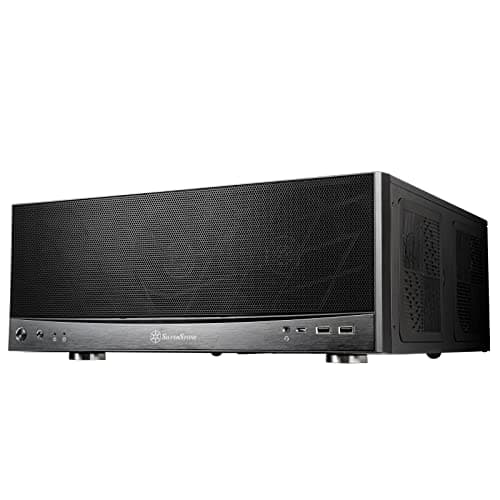
SilverStone GD11 HTPC Micro-ATX/ATX Case – Horizontal Desktop Computer Case with USB-C, ATX PSU Support, 240mm Radiator Support, Supports up to 340mm Graphics Cards | SST-GD11B
£144.49 · SilverStone
 8.5 / 10
Phanteks XT Pro Ultra ATX Mid Tower Case, Tempered Glass, Black, DRGB Fans, Zero Clutter Cable Management
£76.99 · Phanteks
Frequently asked
5 questions01Is the Jonsbo N4 NAS Case good for airflow?+
Airflow in the N4 is adequate for NAS duty but requires you to add your own fans, as none are included. The case has 120mm fan mount positions that allow front-to-rear airflow across the drive bays. Owners running two 120mm fans report drive temperatures in the mid-30s Celsius under typical operation with IronWolf or WD Red drives, which is well within safe operating range. The front panel uses perforated steel rather than a full mesh design, so intake airflow is reasonable but not as open as a pure mesh front. For a 24/7 NAS build, quiet low-RPM fans like the Noctua NF-S12A are the recommended choice. CPU cooling is limited to low-profile air coolers given the height clearance constraints.
02What is the GPU clearance on the Jonsbo N4 NAS Case?+
The N4 is not designed for full-size GPU installation. The drive tray arrangement occupies the space that a full-length GPU would need. Low-profile or half-height GPUs can be accommodated via the standard PCIe slot on the Mini-ITX motherboard, which suits builders who need light GPU compute for Plex hardware transcoding. Cards like the NVIDIA GT 1030 or Quadro P400 in low-profile form will fit. Full-height, full-length double-slot cards are not practical in this chassis. For the majority of NAS builds, no GPU is needed at all as the system runs headless.
03Can the Jonsbo N4 NAS Case fit a 360mm AIO?+
No. The N4 is not designed for AIO liquid cooling. There is no top radiator mount, and the drive tray arrangement makes front-mount AIO installation impractical. The case is intended for low-profile air coolers with a maximum height clearance of approximately 70mm to 80mm. For a NAS build, this is appropriate since the processors typically used (Intel N100, Ryzen 5 series, or similar low-to-mid TDP chips) do not require aggressive cooling. A quality low-profile cooler like the Noctua NH-L9i or be quiet! Shadow Rock LP is the right choice for this chassis.
04Is the Jonsbo N4 NAS Case easy to build in?+
Generally yes, with some caveats. The front-access drive trays are tool-free for 3.5-inch drives and work smoothly according to owner reports. The ATX PSU compartment keeps power cables separated from the main chamber, which helps with organisation. The trickiest part of a full eight-drive build is managing eight SATA data cables and eight power connectors in a compact space. A modular PSU is strongly recommended to keep cable bulk manageable. Right-angle SATA connectors also help with routing. Install the CPU cooler before populating the drive trays to avoid access issues. Panel alignment may need minor adjustment out of the box, and a few owners mention taking care around steel edges during the build. Overall, experienced builders will find it straightforward; first-time builders should plan the build sequence carefully.
05What warranty and returns apply to the Jonsbo N4 NAS Case?+
Specific warranty terms from Jonsbo are not detailed in the verified product listing data. As with all products sold through Amazon UK, the standard 30-day return window applies under Amazon's returns policy, and purchases are covered by the Amazon A-to-Z Guarantee which protects buyers if items arrive damaged or not as described. For warranty queries beyond the Amazon return window, contacting Jonsbo directly or the Amazon seller is recommended. Always check the current seller's listing for any stated warranty information before purchasing.