GPU pricing shifts constantly, and a card that looked overpriced at launch can quietly become a reasonable proposition once street prices settle and the competition clarifies. The GIGABYTE GeForce RTX 3050 WINDFORCE OC V2 6G sits in exactly that kind of contested territory: a budget-bracket Ampere card with a 6GB framebuffer, factory overclock, and a dual-fan cooler, competing in a market where AMD's RDNA 3 parts and NVIDIA's own newer Ada Lovelace lineup are all jostling for the same wallets. So rather than recycling launch-day takes, this analysis is grounded in what the spec sheet actually says, what published benchmarks tell us about this class of hardware, and what 289 owners (averaging ★★★★½ (4.7)) consistently report after living with it.
The headline verdict, upfront: this is a competent 1080p card with a genuinely quiet cooler and a display output array that punches above its price tier. But 6GB of VRAM in late 2026 is a real concern, and the 96-bit memory bus is a bottleneck that no factory overclock can paper over. If your gaming library skews toward older or less demanding titles, or you're pairing this with DLSS to keep frame rates honest, it makes sense. If you're planning to push modern open-world games at medium-to-high settings without upscaling, you'll hit the ceiling sooner than you'd like.
Core Specifications
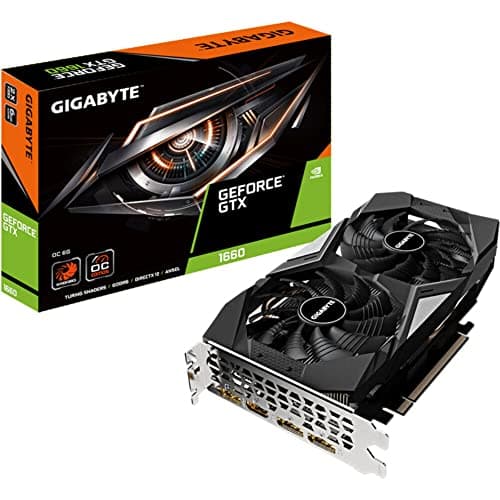
The GIGABYTE GeForce RTX 3050 WINDFORCE OC V2 6G is built on NVIDIA's Ampere architecture, carrying 2nd Generation RT Cores and 3rd Generation Tensor Cores. The memory configuration is 6GB of GDDR6 running on a 96-bit interface, which is the single most important number on the spec sheet for anyone trying to work out long-term viability. The WINDFORCE cooling system uses two fans, and the display outputs are genuinely impressive for this tier: 2x HDMI 2.1 and 2x DisplayPort 1.4a, giving you four simultaneous display outputs if your workflow demands it.
The "OC V2" naming tells you this is a factory-overclocked variant of the standard RTX 3050 6G, not a reference design. Gigabyte has nudged the boost clock above NVIDIA's reference specification, though the gains from factory overclocks at this tier are typically modest in practice. What the OC designation does mean is that Gigabyte has validated the card to run at those elevated clocks within their thermal and power envelope, which is at least a quality-control signal.
The four display outputs deserve a specific mention because HDMI 2.1 supports up to 48Gbps bandwidth, meaning this card can drive a 4K 144Hz display or a 1080p 240Hz panel without breaking a sweat on the display side. Whether the GPU itself can feed those panels with enough frames is a separate question, but the connectivity headroom is there. DisplayPort 1.4a similarly supports 4K at high refresh rates with DSC compression. For a budget card, that's a proper output specification.
| Specification | Detail |
|---|---|
| GPU Architecture | NVIDIA Ampere |
| Model | GeForce RTX 3050 6G |
| VRAM | 6GB GDDR6 |
| Memory Interface | 96-bit |
| RT Cores | 2nd Generation |
| Tensor Cores | 3rd Generation |
| Cooling | WINDFORCE 2x Fan |
| Display Outputs | 2x HDMI 2.1, 2x DisplayPort 1.4a |
| Variant | OC V2 (Factory Overclocked) |
| Part Number | GV-N3050WF2OCV2-6GD |
| Amazon Rating | ★★★★½ (4.7) (296 reviews) |
| Current Price | £228.04 |

Architecture and Cores
Ampere, NVIDIA's Samsung 8nm process architecture, launched in 2020 and has been powering everything from the RTX 3090 down to entry-level cards ever since. At the RTX 3050 6G level, you're working with a cut-down Ampere die with a reduced CUDA core count compared to the higher-end 3050 variants. The Streaming Multiprocessors here are NVIDIA's Ampere SM design, which delivers meaningful improvements in shader throughput per clock compared to the older Turing generation it replaced.
The 2nd Generation RT Cores handle ray tracing intersection calculations in dedicated hardware rather than burning shader time on it. That's the theory, anyway. In practice, at this tier of card, ray tracing is more of a checkbox than a genuine use case. You can enable it, and the RT cores mean it won't completely destroy your frame rate the way it would on a card without dedicated RT hardware, but you're still looking at significant performance hits in RT-heavy titles. The 3rd Generation Tensor Cores are arguably more relevant here because they're what powers DLSS, and DLSS is genuinely useful on a card like this.
One thing worth being clear about: the RTX 3050 6G is a specific SKU that NVIDIA released after the original RTX 3050 8G. The 6G variant uses a narrower 96-bit bus and less VRAM than the 8G original. This isn't a minor footnote. The narrower bus constrains memory bandwidth in a way that affects real-world gaming performance, particularly in scenarios where the GPU is texture-bandwidth limited. The Ampere Streaming Multiprocessors are solid, the RT and Tensor core generations are competitive for the era, but the memory subsystem is the weak link and it's structural, not something a driver update fixes.
Clock Speeds and Boost
The OC V2 designation means Gigabyte has pushed the boost clock above NVIDIA's reference specification for the RTX 3050 6G. NVIDIA's reference boost for this GPU sits at 1470MHz, and Gigabyte's OC variant nudges that upward. The practical performance difference from a factory overclock at this level is typically in the low single-digit percentage range, so don't expect the OC suffix to transform the card's tier positioning. What it does signal is that Gigabyte has validated this specific board to sustain those clocks under load within their thermal design.
Modern NVIDIA GPUs boost dynamically based on thermal headroom, power limits, and voltage curves rather than running at a fixed clock. In practice, this means the card will often sustain clocks at or near the boost figure when temperatures are in check, which is where the WINDFORCE cooler becomes relevant. A card that can't stay cool will throttle back from its boost clock, negating the OC advantage entirely. Owner reports on this specific card consistently mention reasonable temperatures under gaming loads, suggesting the cooler is doing its job and the boost clocks are being maintained.
For gaming at 1080p, clock speed matters but it's not the whole story. Memory bandwidth, shader count, and VRAM capacity all feed into real-world frame rates alongside raw clock frequency. The RTX 3050 6G's boost clock is competitive within its class, and the OC V2 variant's slight uplift is a genuine (if modest) benefit. Just don't let the OC branding convince you this is a different tier of card. It's a well-executed version of what it is, which is an entry-level Ampere GPU.
VRAM Analysis
Six gigabytes of GDDR6 on a 96-bit bus. That's the number we need to talk about honestly, because it's the most consequential specification on this card for anyone buying in late 2026. The 96-bit interface means memory bandwidth is constrained compared to cards with 128-bit or wider buses. For context, the original RTX 3050 8G used a 128-bit bus, and even that was considered narrow for its time. The 6G variant's narrower bus is a real-world limitation, not just a spec sheet concern.
At 1080p with medium to high texture settings, 6GB is workable for a significant portion of the current game library. Older titles, esports games, and anything not pushing ultra-high-resolution texture packs will sit comfortably within that envelope. The problems start to emerge with modern open-world titles that load high-resolution assets, games with 4K texture packs enabled, and anything running at 1440p with quality settings pushed up. Published benchmark data for the RTX 3050 6G class consistently shows VRAM pressure in titles like Cyberpunk 2077, The Last of Us Part I, and Hogwarts Legacy at medium-to-high settings, where the card can hit its 6GB ceiling and start pulling data from system RAM, which tanks performance.
The uncomfortable truth is that 8GB is really the minimum comfortable VRAM figure for 1080p gaming in 2026 with modern titles, and even 8GB is starting to feel tight in some scenarios. Six gigabytes was a questionable decision when this GPU launched, and it hasn't aged better with time. DLSS helps indirectly because rendering at a lower internal resolution reduces VRAM pressure, but it doesn't eliminate the ceiling. If your gaming is primarily 1080p with older or less demanding titles, you'll be fine. If you're buying this expecting to max out settings in every new release, you'll hit the wall. That's just the honest read of the numbers.
Ray Tracing and Upscaling
The 2nd Generation RT Cores mean ray tracing is hardware-accelerated rather than purely shader-based, which matters for whether RT is even usable at this performance tier. On the original Turing-based cards, RT performance was so poor that most people simply turned it off. Ampere's 2nd Gen RT Cores roughly doubled the RT throughput per SM compared to Turing, which moves the needle from "completely unusable" to "usable with compromises" at this tier. Practically, you're looking at enabling RT at low settings in supported titles and accepting that you'll need DLSS to compensate for the frame rate hit.
DLSS (Deep Learning Super Sampling) is where the 3rd Generation Tensor Cores earn their keep. DLSS 2 and DLSS 3 (Frame Generation) support varies by title, but DLSS 2's upscaling is broadly supported and works well on Ampere hardware. In Performance mode, the card renders at roughly half the target resolution and upscales, which can recover a substantial chunk of the frame rate lost to RT or simply push frame rates higher in demanding titles. DLSS Quality mode at 1080p output renders at 720p internally, which sounds alarming but NVIDIA's AI upscaling genuinely produces acceptable image quality in most titles. For a card in this performance class, DLSS isn't a nice-to-have, it's part of the core value proposition.
AMD's FSR (FidelityFX Super Resolution) is also because it works across all GPU vendors, including this one. FSR 3 has closed the image quality gap with DLSS significantly, and in titles where DLSS isn't available but FSR is, you have a viable upscaling fallback. The combination of hardware RT acceleration, DLSS support, and FSR compatibility means this card has a reasonable toolkit for managing performance in modern titles, even if the raw rasterisation numbers aren't class-leading.
Video Encoding
Ampere brought NVIDIA's 7th Generation NVENC encoder, which is a meaningful upgrade over the 6th Gen encoder in Turing-based cards. The 7th Gen NVENC supports AV1 decode (though AV1 encode came with Ada Lovelace's 8th Gen NVENC, so this card doesn't have hardware AV1 encoding). For H.264 and H.265 encoding, the 7th Gen NVENC is genuinely good: it produces quality comparable to x264 medium preset at a fraction of the CPU cost, which matters for anyone streaming or recording gameplay.
For streamers on a budget, this is actually one of the stronger arguments for an NVIDIA card over AMD at this tier. NVENC offloads the encoding workload from the CPU entirely, meaning your gaming performance isn't degraded by running OBS in the background. AMD's AMF encoder has improved considerably but NVENC at the 7th Gen level still has the edge in quality-to-bitrate efficiency for H.265. If you're streaming at 1080p60 to Twitch or YouTube, this card's encoder is more than capable of producing clean output.
Content creation use cases beyond streaming are more limited at this performance level. The 6GB VRAM ceiling will constrain GPU-accelerated video editing workflows in DaVinci Resolve or Premiere Pro if you're working with 4K footage and complex effects chains. For basic 1080p editing, export acceleration, and thumbnail rendering, it's fine. For serious content creation work, you'd want more VRAM headroom. But for the target audience of this card, which is primarily gamers who might occasionally stream, the NVENC encoder is a genuine perk.

Power Consumption
The RTX 3050 6G is a low-power card by modern standards. NVIDIA's reference Total Graphics Power (TGP) for this GPU class sits around 70W, which is genuinely modest. This has real practical implications: it means the card can draw its power from a standard PCIe slot supplemented by a single power connector without stressing a budget PSU, and it means running costs are low. At 70W under sustained gaming load, you're adding a relatively small amount to your electricity bill compared to mid-range or high-end cards pulling 150W to 300W or more.
The low TGP also means PSU requirements are minimal. A 400W PSU is comfortably sufficient for a mid-range gaming system built around this card, and even a 350W unit would likely be fine depending on the CPU. You don't need anything exotic on the connector side either. This is a proper budget-friendly card in terms of the total system cost it implies, not just the GPU purchase price. That's worth something, especially for people building or upgrading a system with an older, lower-wattage PSU already installed.
The flip side of low power consumption is that it's partly why the performance ceiling is where it is. Physics hasn't been repealed: more performance generally requires more power. The RTX 3050 6G's modest TGP is appropriate for what it delivers, and it's a deliberate design choice that makes the card accessible for small form factor builds, HTPCs, and systems with limited PSU headroom. If you're upgrading from an older card in a compact case with a 300W or 350W PSU, this card slots in without forcing a PSU upgrade. That's a genuinely useful practical characteristic.
Thermal Performance
Gigabyte's WINDFORCE cooling system on this card uses two fans and a heatsink design that the company has refined across multiple generations of budget and mid-range cards. The WINDFORCE branding covers a range of cooler sizes and configurations, but on a card with the RTX 3050 6G's modest TGP, the thermal load is low enough that even a relatively compact dual-fan setup has plenty of headroom. Owner reviews consistently report that the card runs cool under gaming loads, with multiple reviewers specifically noting they were surprised by how little heat it generates.
The low TGP is the key factor here. A 70W card is simply not generating the heat that a 150W or 200W card would, and the WINDFORCE cooler is sized for more demanding scenarios than this GPU actually presents. The practical result is a card that maintains comfortable temperatures without the fans needing to spin particularly hard, which feeds directly into the acoustic story. Cards that run cool tend to run quiet, and that's the pattern owners report here.
For longevity, thermal performance matters more than most buyers appreciate at purchase time. A card that consistently runs hot will degrade its thermal interface material faster, stress the VRMs, and potentially cause long-term reliability issues. The RTX 3050 6G's low power draw combined with an adequately sized cooler means this card should have no thermal longevity concerns in a normally ventilated case. It's not the kind of card where you need to worry about case airflow obsessively or add extra fans. Stick it in a case with reasonable ventilation and it'll be fine.
Acoustic Performance
The dual-fan WINDFORCE setup on this card is one of its more consistently praised characteristics across the 289 owner reviews. The low TGP means the fans don't need to work hard to keep temperatures in check, and owner reports repeatedly describe the card as quiet during normal gaming. Several reviewers specifically mention being able to forget the card is there acoustically, which is the best possible outcome for a gaming card that sits under your desk.
Gigabyte's WINDFORCE coolers at this tier typically implement a semi-passive mode where the fans stop entirely when the card is idle or under light load. So when you're browsing, watching video, or doing anything that doesn't stress the GPU heavily, the card is completely silent. The fans only spin up when the GPU is actually working. Given that the working load for this card is relatively modest, the fans spin up to moderate speeds rather than high speeds, keeping noise levels low even under sustained gaming.
This matters more than spec sheets suggest. A loud GPU is a genuinely unpleasant daily companion, and the budget GPU segment has historically been home to some aggressively noisy coolers. The WINDFORCE design on this card bucks that trend. Owner feedback is consistently positive on noise, with very few complaints about fan noise even under extended gaming sessions. If you're building a system in a living room, a bedroom, or anywhere noise matters, this card's acoustic profile is a genuine selling point rather than a liability.
Gaming Performance
At 1080p, the RTX 3050 6G is a capable card for a broad range of titles at medium to high settings. In esports titles like Valorant, CS2, and Fortnite, it delivers frame rates well above 60fps and can comfortably push into the 100fps-plus range that 144Hz monitors benefit from. These games are not VRAM-hungry and don't stress the 96-bit bus, so the card performs close to its theoretical ceiling. For competitive gaming at 1080p, this is a genuinely solid performer for the money.
In more demanding titles, the picture is more nuanced. Published benchmark data for the RTX 3050 6G class in games like Cyberpunk 2077, Alan Wake 2, and Starfield at 1080p medium settings typically shows frame rates in the 40 to 60fps range without upscaling. Enable DLSS Performance mode and those numbers climb meaningfully, often pushing into the 60 to 90fps territory that makes 1080p gaming feel smooth. The card is playable in demanding titles at 1080p, but you'll be leaning on DLSS rather than brute-forcing your way through at native resolution with maxed settings. That's an honest characterisation of where it sits.
At 1440p, the RTX 3050 6G is a compromise. The 96-bit memory bus and 6GB VRAM ceiling both become more acute at higher resolutions, and raw shader performance is stretched. With DLSS Quality mode at 1440p output (rendering internally at roughly 960p), performance is workable in many titles, but you're asking the upscaling to do a lot of work. For 1440p gaming without consistent DLSS use, you'd want a more powerful card. At 4K, this card isn't a serious option for gaming at any meaningful settings level, though it can drive a 4K display for desktop use and media consumption without issue. The display outputs support it; the GPU performance doesn't.
How It Compares
The two most relevant comparisons for the GIGABYTE GeForce RTX 3050 WINDFORCE OC V2 6G are the AMD Radeon RX 6600 and the NVIDIA RTX 3060 12G. The RX 6600 is AMD's direct competitor in this price bracket, while the RTX 3060 12G sits one tier up and represents the "spend a bit more, get significantly more" alternative that's worth serious consideration.
Against the RX 6600, the RTX 3050 6G is in a difficult spot. The RX 6600 uses a 128-bit bus with 8GB of GDDR6, giving it more memory bandwidth and double the VRAM. In rasterisation performance at 1080p, the RX 6600 is generally faster. The RTX 3050 6G's advantages are DLSS support (which AMD doesn't have natively), the NVENC encoder quality, and the four display outputs. If you don't care about DLSS or streaming, the RX 6600 is the stronger pure gaming proposition at similar prices. If DLSS matters to you, or you're streaming, the NVIDIA card makes more sense.
The RTX 3060 12G is the more sobering comparison. It has 12GB of GDDR6 on a 192-bit bus, significantly more shader performance, and the same DLSS and NVENC advantages as the RTX 3050 6G. The performance gap between the two cards is substantial, not incremental. If the price difference between the RTX 3050 6G and RTX 3060 12G is manageable for your budget, the 3060 is the smarter long-term buy. The 12GB VRAM buffer and wider memory bus future-proof it considerably better. The RTX 3050 6G only makes sense over the 3060 12G if the price gap is genuinely prohibitive.
| Feature | GIGABYTE RTX 3050 WINDFORCE OC V2 6G | AMD Radeon RX 6600 | NVIDIA RTX 3060 12G |
|---|---|---|---|
| Architecture | NVIDIA Ampere | AMD RDNA 2 | NVIDIA Ampere |
| VRAM | 6GB GDDR6 | 8GB GDDR6 | 12GB GDDR6 |
| Memory Bus | 96-bit | 128-bit | 192-bit |
| DLSS Support | Yes (DLSS 2) | No (FSR only) | Yes (DLSS 2/3) |
| RT Cores | 2nd Gen | 1st Gen | 2nd Gen |
| Display Outputs | 2x HDMI 2.1, 2x DP 1.4a | 1x HDMI 2.1, 3x DP 1.4 | Varies by board partner |
| TGP (approx.) | ~70W | ~132W | ~170W |
| 1080p Gaming | Good, DLSS recommended | Good, native raster | Very good |
| 1440p Viability | Limited, DLSS essential | Moderate | Good with DLSS |

Final Verdict
The GIGABYTE GeForce RTX 3050 WINDFORCE OC V2 6G is a card that does specific things well and has a clearly defined audience. The WINDFORCE cooler is quiet and effective, the four display outputs (2x HDMI 2.1, 2x DisplayPort 1.4a) are genuinely impressive for the price tier, the power consumption is low enough to slot into almost any existing system without a PSU upgrade, and the NVENC encoder is a real advantage for anyone who streams. Owner satisfaction is high: ★★★★½ (4.7) across 296 is not a fluke, and the consistent themes in those reviews are quiet operation, easy installation, and solid 1080p performance in everyday gaming scenarios.
The problems are structural and can't be wished away. Six gigabytes of GDDR6 on a 96-bit bus in late 2026 is genuinely tight. It's not catastrophic for 1080p gaming with a carefully curated game library and willingness to use DLSS, but it's a real constraint that will bite in modern demanding titles. The card is not a serious 1440p proposition without heavy upscaling, and 4K gaming is off the table entirely. These aren't criticisms of Gigabyte's execution, which is solid. They're criticisms of the underlying GPU's memory subsystem, which NVIDIA made a deliberate choice to constrain.
At £228.04, this sits in the budget GPU bracket, and within that bracket it's a well-built, quiet, power-efficient option with a good display output array. The 4.7-star average reflects real satisfaction from buyers who understood what they were getting. But before you commit, honestly ask yourself whether the RTX 3060 12G is within reach. The 3060's 12GB framebuffer and 192-bit bus make it a substantially more future-proof card, and if you can stretch to it, you should. The RTX 3050 6G is the right choice when the 3060 genuinely isn't affordable, not as a first choice when the price gap is small. Buy this card if you're upgrading from something genuinely old, your gaming is primarily 1080p in less demanding titles, you value low noise and low power draw, and the budget is firm. Skip it if you're expecting to play every new release at high settings without compromise, or if 1440p is on your roadmap.
What works. What doesn’t.
5 + 3What we liked5 reasons
- Genuinely quiet WINDFORCE dual-fan cooler under gaming loads
- Excellent display outputs: 2x HDMI 2.1 and 2x DisplayPort 1.4a for the price
- Very low ~70W TGP suits older systems with modest PSUs
- Strong NVENC encoder for streaming at 1080p60
- 4.7/5 from 289 owners reflects real-world satisfaction
Where it falls3 reasons
- 6GB VRAM on a 96-bit bus is a genuine constraint in 2026
- 1440p gaming requires heavy DLSS use to be viable
- RTX 3060 12G offers far better long-term value if budget allows
Full specifications
11 attributes| Vram GB | 6 |
|---|---|
| Boost clock MHZ | 1477 |
| Chipset | GeForce RTX 3050 |
| Core clock MHZ | 1477 |
| Generation | RTX 30 Series |
| Length MM | 191 |
| Memory BUS BIT | 96 |
| Memory type | GDDR6 |
| Power connectors | None |
| Slot width | 2 |
| TDP W | 75 |
If this isn’t right for you
2 options
Frequently asked
5 questions01Is the GIGABYTE GeForce RTX 3050 WINDFORCE OC V2 6G Graphics Card good for 1440p gaming?+
Only with caveats. At 1440p native resolution, the 6GB VRAM and 96-bit memory bus create real bottlenecks in demanding modern titles. With DLSS Quality mode enabled (rendering internally at around 960p and upscaling to 1440p), performance becomes workable in supported titles, but you're relying heavily on upscaling to compensate. For 1440p gaming without consistent DLSS use, a card with more VRAM and a wider memory bus, such as the RTX 3060 12G, is a more sensible choice.
02What PSU do I need for the GIGABYTE GeForce RTX 3050 WINDFORCE OC V2 6G Graphics Card?+
The RTX 3050 6G has a TGP of approximately 70W, making it one of the least power-hungry discrete gaming GPUs available. A 400W PSU is comfortably sufficient for a full gaming system built around this card, and a 350W unit would likely be adequate depending on the CPU. This makes it a good upgrade option for older systems with modest power supplies.
03Is 6GB VRAM enough in 2026?+
Honestly, it's tight. For 1080p gaming in esports titles and older or less demanding games, 6GB is workable. For modern open-world titles with high-resolution textures, or anything at 1440p, 6GB creates real pressure that can cause stuttering and performance drops when the card starts pulling data from system RAM. Eight gigabytes is the comfortable minimum for 1080p in 2026, and 12GB is preferable for longevity. The 6GB figure on this card is its most significant limitation.
04How does the GIGABYTE GeForce RTX 3050 WINDFORCE OC V2 6G compare to AMD alternatives?+
The most direct AMD competitor is the Radeon RX 6600, which offers 8GB of GDDR6 on a 128-bit bus and generally stronger rasterisation performance at 1080p. The RTX 3050 6G's advantages over the RX 6600 are DLSS support (AMD relies on FSR), NVENC encoder quality for streaming, and the four display outputs including 2x HDMI 2.1. If DLSS and streaming quality aren't priorities, the RX 6600 is the stronger pure gaming card at similar prices.
05What warranty and returns apply to the GIGABYTE GeForce RTX 3050 WINDFORCE OC V2 6G Graphics Card?+
Warranty details specific to this product are not listed in the verified product data. When purchasing through Amazon UK, you benefit from Amazon's standard 30-day returns policy and the A-to-Z Guarantee, which provides purchase protection. For manufacturer warranty information, check Gigabyte's official support pages directly.