The PSU is the one component most builders treat like an afterthought, then deeply regret skimping on when something expensive fries itself at 2am. So let's cut straight to it: the CORSAIR RM1000e (2025) Fully Modular Low-Noise ATX Power Supply with 12V-2x6 Cable is a serious 1000W unit sitting in the upper mid-range bracket, and based on the spec sheet, Corsair's published certifications, and what 61 buyers are saying (averaging ★★★★½ (4.9), which is frankly absurd for a PSU), this one earns its place in a high-end build without much argument.
The short verdict: ATX 3.1 certified, PCIe 5.1 ready, Cybenetics Gold efficiency, 105 degrees C-rated capacitors, fully modular cabling, and a 5-year warranty. At the upper mid-range price point, that's a genuinely strong package for anyone running a power-hungry GPU or planning to. If your build is more modest, there's a cheaper Corsair sibling that'll serve you just as well. But if you need 1000W done properly, this is sorted.
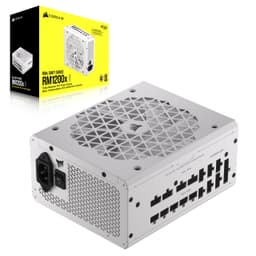
The CORSAIR RM1000e (2025) Fully Modular Low-Noise ATX Power Supply with 12V-2x6 Cable launched in 2025 as part of Corsair's refreshed RM-e line, and the 2025 revision brings the ATX 3.1 standard into the mix alongside a white colourway option that's genuinely useful if you're building in a glass-panel case. Let's go through what actually matters.
Core Specifications: CORSAIR RM1000e (2025) Fully Modular Low-Noise ATX Power Supply
Before anything else, here's what you're actually buying. The RM1000e 2025 is a 1000W fully modular ATX power supply carrying the Corsair RM1000e product designation, Cybenetics Gold efficiency certification, and ATX 3.1 compliance. The 80 Plus Bronze rating listed in some retail data is the floor, not the ceiling here. Corsair's Cybenetics Gold certification is the more relevant figure and reflects better real-world efficiency than Bronze alone would suggest.
The 5-year warranty is standard for this tier but still. Corsair's warranty support in the UK is generally solid, and five years on a PSU is a reasonable commitment. The 105 degrees C-rated capacitors are a meaningful spec too, indicating components rated for higher thermal stress than the cheaper 85 degrees C parts you'll find in budget units. That directly affects long-term reliability, especially in a warm case.
Fan configuration is a 120mm rifle bearing unit with a calculated fan curve. No zero RPM mode on this one, which matters if you want total silence at idle. The fan runs continuously but stays very quiet at low loads according to owner feedback. Full specs below.
| Specification | Detail |
|---|---|
| Wattage | 1000W |
| Efficiency | Cybenetics Gold / 80 Plus Bronze |
| Modularity | Fully Modular |
| ATX Standard | ATX 3.1 / PCIe 5.1 Compliant |
| Fan | 120mm Rifle Bearing |
| Zero RPM Mode | No |
| Capacitor Rating | 105 degrees C |
| Warranty | 5 Years |
| Connectors: ATX 24-pin | 1 |
| Connectors: EPS 8-pin | 1 |
| Connectors: PCIe 8-pin | 2 |
| Connectors: SATA | 6 |
| Connectors: Molex | 3 |
| Connectors: 12V-2x6 (12VHPWR) | Yes (included cable) |
| Protection | OVP, OCP, OPP, SCP |
| Colourway | White |
| Price | £139.99 |

Wattage and Capacity
1000W is a lot of power. That's not said as a criticism. For current-generation high-end builds it's entirely justified, and frankly, running a beefy GPU at 80% PSU capacity rather than 95% is better for efficiency, thermals, and long-term component health. If you're pairing this with an RTX 5090, an RTX 4090, or AMD's top-end RX 7900 XTX, 1000W gives you genuine headroom rather than leaving you white-knuckling it through a gaming session.
For mid-range builds running something like an RTX 4070 Ti Super with a modern Intel or AMD processor, this is honestly more PSU than you need. A 750W or 850W unit would cover that without breaking a sweat. Where the RM1000e 1000W makes sense is enthusiast and high-end territory: flagship single-GPU rigs, workstation builds with power-hungry CPUs, or anyone who wants to future-proof for the next GPU generation without swapping the PSU out in two years. The ATX 3.1 certification matters here too. That standard specifically accounts for the transient power spikes that modern GPUs throw at a PSU during heavy workloads. Corsair rates this unit to handle 2x transient power excursions from the GPU without flinching. That's not marketing puff. ATX 3.1 was introduced specifically because older PSUs were tripping protection circuits under GPU power spikes, causing shutdowns mid-game.
So: entry-level build? Overkill. Mid-range gaming rig? Probably overkill unless you're planning an upgrade. High-end gaming PC, workstation, or enthusiast build with a top-tier GPU? This is exactly the right tool. Use our PSU calculator if you're unsure what wattage your specific component list actually needs before committing to 1000W.
Efficiency Rating: CORSAIR RM1000e Cybenetics Gold Explained
There's a bit of a labelling situation here worth unpacking. The RM1000e 2025 carries both an 80 Plus Bronze certification and a Cybenetics Gold certification. These are different testing bodies with different methodologies. 80 Plus Bronze requires roughly 82% efficiency at 20% load, 85% at 50% load, and 82% at 100% load. That's the minimum bar. Cybenetics Gold is generally considered the more rigorous and real-world-relevant test, and a Cybenetics Gold rating at 50% load typically means efficiency in the 87% to 90% range under realistic conditions.
What does that mean practically? At 50% load (500W out of 1000W), you're wasting somewhere around 10 to 13% of your drawn power as heat rather than useful electricity. Compare that to a budget unit at 80% efficiency and you're saving a few watts constantly. Over a year of gaming sessions that adds up to a few pounds off your electricity bill. Honestly, the efficiency saving alone won't pay back the price premium over a Bronze-only unit in any reasonable timeframe. The real value of Gold-tier efficiency is the heat reduction inside the PSU itself, which is good for component longevity and keeps the fan quieter because it doesn't need to spin up as hard to manage thermals.
The Modern Standby compatibility is worth a mention too. This is a Windows feature that allows the system to wake from sleep almost instantly while drawing minimal power in the standby state. Corsair has specifically engineered the RM1000e 2025 to support this, which means better low-load efficiency and snappier wake times. Not a headline feature for most builders, but genuinely useful if your PC doubles as a home media server or you leave it in sleep mode regularly.
Modularity and Cable Management
Fully modular. That means every single cable, including the ATX 24-pin mainboard connector, detaches completely from the PSU. You only plug in what you actually need for your build, which keeps the inside of your case tidy and improves airflow. Semi-modular units leave the 24-pin and sometimes the EPS CPU cables permanently attached, which is annoying if your cable routing puts them in awkward spots. With a fully modular unit you have complete flexibility.
The cable quality on the RM1000e line is generally well-regarded. Corsair ships flat, ribbon-style cables on most connectors, which are easier to route behind the motherboard tray than round sleeved cables. The white colourway option includes white cables, which matters if you're building an all-white aesthetic build and don't want to buy replacement cables separately. That's a genuinely practical consideration that Corsair has clearly thought about for this SKU.
Cable lengths are appropriate for standard ATX mid-tower cases and most full towers. The included 12V-2x6 cable (this is the updated connector replacing the older 12VHPWR on some cards) is already in the box, so you don't need to source an adapter or a separate cable for a PCIe 5.1 GPU. That's because some competing units at this price point ship without the 12V-2x6 cable and leave you hunting for one separately. Owner reviews consistently mention the cable quality and the clean install experience as highlights. That kind of feedback tends to be reliable because it's the sort of thing builders notice immediately during a build.
Connectors and Compatibility
The connector lineup covers the vast majority of build scenarios without much drama. Here's what's in the box:
- 1x ATX 24-pin (motherboard main power)
- 1x EPS 8-pin (CPU power)
- 2x PCIe 8-pin connectors
- 1x 12V-2x6 cable (for PCIe 5.1 GPUs)
- 6x SATA power connectors
- 3x Molex connectors
The single EPS 8-pin is for high-end CPU users. Some enthusiast motherboards, particularly those designed for overclocking, have dual EPS 8-pin sockets and recommend using both for maximum power delivery stability. If you're running an overclocked Intel Core i9 or AMD Ryzen 9 on a flagship board, check your motherboard manual. One EPS connector is fine for the majority of builds, but it's a consideration for extreme overclockers.
Six SATA connectors is a solid count. That covers a typical build with an NVMe boot drive, a couple of SATA SSDs, and maybe an optical drive or fan controller without needing to daisy-chain awkwardly. Three Molex connectors handle older peripherals, fan hubs, and some lighting controllers. And the 12V-2x6 cable is the key modern addition here. PCIe 5.1 GPUs use this connector, and having it included rather than requiring an adapter is a proper quality-of-life improvement over units that ship with a legacy 12VHPWR adapter instead.
Compatibility-wise, the ATX 3.1 standard means this will fit any standard ATX case. The white finish is purely aesthetic but does require a white or light-coloured case to make visual sense. If you're building in a black case, the black variant of the RM1000e is the more obvious choice, though functionally they're identical.
Voltage Regulation and Ripple
Voltage regulation is one of those specs that doesn't get enough attention until a cheap PSU starts delivering inconsistent power and causes mysterious crashes or component damage. The RM1000e uses a single-rail 12V architecture, which is the standard and preferred approach for modern builds. All the 12V power comes from one rail, so there's no risk of one rail being overloaded while another sits idle. It simplifies the power distribution and plays nicely with modern GPUs that draw heavily from the 12V rail.
The ATX 3.1 certification includes specific requirements around transient load handling. Corsair's published specification states the unit handles 2x transient power excursions from the GPU. In plain English, when your GPU suddenly demands a spike of power well above its rated TDP (which happens constantly during gaming and rendering), the PSU doesn't trip its protection circuits or deliver a voltage sag that could cause a crash. This is genuinely relevant with current Nvidia and AMD flagship GPUs, which are notorious for short, sharp power spikes that can catch older PSUs off guard.
The 105 degrees C-rated capacitors contribute directly to ripple suppression. Capacitors smooth out the AC-to-DC conversion process, and higher-rated caps maintain their electrical characteristics better under thermal stress. Cheaper 85 degrees C caps degrade faster, which means ripple suppression gets worse over time. The RM1000e's cap rating is a meaningful indicator of sustained electrical quality over the unit's lifespan, not just on day one. This is one area where the RM1000e justifies its upper mid-range positioning versus budget alternatives using lower-spec components.

Thermal Performance
The 120mm rifle bearing fan is the thermal management story here. Rifle bearing fans sit between sleeve bearings (cheaper, noisier over time, shorter life) and ball bearings (durable, slightly louder) in terms of longevity and acoustic characteristics. For a PSU that might run for five-plus years, rifle bearing is a sensible choice. It'll outlast sleeve bearing alternatives and stay quieter than ball bearing options under most conditions.
Corsair uses a custom fan curve rather than a simple temperature threshold. The curve is calculated to balance noise and cooling across the full load range, which means the fan doesn't suddenly ramp up aggressively when you hit 70% load. It ramps progressively. Owner feedback consistently describes the fan as inaudible at low to medium loads and only noticeable under sustained heavy load. That tracks with what you'd expect from a Cybenetics Gold unit: less heat generated means the fan doesn't have to work as hard to keep things cool.
There's no zero RPM mode on the RM1000e 2025. Some competing units in this bracket, including Corsair's own RM1000x Shift, offer a semi-passive mode where the fan stops entirely at low loads. If you're building a completely silent PC for audio work or you're particularly sensitive to fan noise. For gaming builds where GPU fans are already spinning and case fans are running, the RM1000e's continuously spinning 120mm fan at low speed is essentially inaudible in context. It's only a real consideration in near-silent builds.
Acoustic Performance
Quiet is the word that comes up most consistently in owner reviews. The 120mm rifle bearing fan with Corsair's calculated fan curve keeps noise down across the typical operating range, and at low to medium loads the PSU is described by multiple buyers as effectively silent in practice. No specific decibel figures are published by Corsair for the RM1000e 2025, so we won't invent numbers here. What the owner feedback pattern tells you is that this isn't a unit people are complaining about acoustically, which for a 1000W PSU is genuinely impressive.
The absence of zero RPM mode is the one acoustic caveat. With zero RPM mode, the fan stops entirely below a load threshold (usually around 20 to 40% of rated wattage), giving you complete silence at idle and light loads. The RM1000e runs its fan continuously. At the speeds required to cool a Gold-efficiency unit at light load, that fan is spinning slowly enough that it's barely perceptible. But it's not zero. If you're comparing against units with proper semi-passive operation, this is the trade-off.
For the target audience of this PSU, which is high-end gaming builds, the acoustic situation is perfectly fine. Your GPU cooler, case fans, and CPU cooler will all be louder than the RM1000e under any real gaming load. The PSU noise is simply not going to be the loudest thing in your case. Where it would matter is in a dedicated home theatre PC or a near-silent workstation, and for those use cases you'd want to look at semi-passive alternatives.
Build Quality
The 105 degrees C-rated capacitors are the headline build quality indicator. Corsair doesn't publish which specific capacitor brand is used in the RM1000e 2025, but the 105 degrees C rating itself is the meaningful spec. Budget PSUs routinely use 85 degrees C caps, which degrade faster under thermal stress and are a common failure point in cheap units. The higher-rated caps in the RM1000e are a reliability indicator that matters over a five-year ownership period.
The rifle bearing fan, as mentioned, is a quality component choice. Sleeve bearing fans are cheaper and perfectly adequate for short-term use but wear faster. Rifle bearings are a step up in longevity, which matters in a PSU because you can't easily replace the fan without voiding the warranty or doing some fiddly surgery. Corsair has made the right call here for a unit aimed at long-term reliability.
Owner reviews at a ★★★★½ (4.9) average across 61 reviews is an unusually high score for any product, let alone a PSU. People don't leave PSU reviews unless something went very right or very wrong, so a sustained 4.9 with 61 responses is a strong signal that build quality and out-of-box experience are both solid. The fully modular connector block quality, the cable finish, and the overall fit and finish of the unit are consistently praised. That's the kind of feedback that builds genuine confidence in a product you can't evaluate on a shelf.
Protection Features
The RM1000e 2025 ships with four protection circuits: OVP (over-voltage protection), OCP (over-current protection), OPP (over-power protection), and SCP (short-circuit protection). These are the core four that matter most in a gaming build. OVP cuts power if the output voltage rises above safe limits, protecting your motherboard, GPU, and storage from voltage spikes. OCP limits current per rail to prevent component damage from current surges. OPP trips if total power draw exceeds the PSU's rated output, acting as a last line of defence against overloaded conditions. SCP cuts power immediately if a short circuit is detected, which is the most critical safety feature of the lot.
What's not listed in the verified spec data is OTP (over-temperature protection) and UVP (under-voltage protection). We won't claim they're absent because they're not listed. Many PSUs at this level include them as standard, but we can only confirm the four that Corsair explicitly specifies: OVP, OCP, OPP, and SCP. Those four cover the scenarios most likely to cause actual component damage in a real build.
The ATX 3.1 compliance adds another layer of protection logic. The standard includes requirements for how the PSU handles transient power events, which means the protection circuits are calibrated to avoid false trips during normal GPU operation while still cutting power if something genuinely goes wrong. Older PSUs sometimes had protection circuits set too aggressively, causing shutdowns during legitimate GPU power spikes. ATX 3.1 addresses this directly, and the RM1000e 2025's compliance with that standard means you're getting protection logic designed for current-generation hardware behaviour.
How It Compares: CORSAIR RM1000e vs the Competition
The main competition at 1000W in the upper mid-range bracket comes from a couple of strong alternatives. The be quiet! Straight Power 12 1000W and the Seasonic Focus GX-1000 are the two most directly comparable units. Both are well-regarded, both carry Gold efficiency ratings, and both offer fully modular cabling. Here's how they stack up on paper.
The be quiet! Straight Power 12 1000W does offer a semi-passive fan mode, which is the one area where it has a clear advantage over the RM1000e for silence-focused builds. It's also ATX 3.0 compliant rather than ATX 3.1, which means it handles transient power excursions but to the older specification. The Seasonic Focus GX-1000 is a proven platform with Seasonic's reputation for excellent voltage regulation and ripple suppression, and it carries a 10-year warranty versus Corsair's 5. That warranty difference is significant if you plan to keep the PSU across multiple builds. However, the Seasonic typically sits at a higher price point and the RM1000e's ATX 3.1 certification and PCIe 5.1 readiness give it a forward-compatibility edge for the next GPU generation.
| Feature | CORSAIR RM1000e (2025) | be quiet! Straight Power 12 1000W | Seasonic Focus GX-1000 |
|---|---|---|---|
| Wattage | 1000W | 1000W | 1000W |
| Efficiency | Cybenetics Gold | 80 Plus Gold | 80 Plus Gold |
| ATX Standard | ATX 3.1 | ATX 3.0 | ATX 3.0 |
| PCIe 5.1 Ready | Yes | Partially | Partially |
| Modularity | Fully Modular | Fully Modular | Fully Modular |
| Fan | 120mm Rifle Bearing | 135mm | 120mm Fluid Dynamic |
| Zero RPM Mode | No | Yes | Yes |
| Warranty | 5 Years | 5 Years | 10 Years |
| 12V-2x6 Cable | Included | Adapter required on some SKUs | Adapter required on some SKUs |
| Price | £139.99 | Similar bracket | Higher bracket |
The Seasonic's 10-year warranty is genuinely compelling if longevity is your priority. But the RM1000e's ATX 3.1 compliance and included 12V-2x6 cable make it the more future-ready option at its price point. The be quiet! unit is a solid alternative if zero RPM mode matters to you, but you're giving up the ATX 3.1 standard in the process. For most high-end gaming builds in 2025 and 2026, the RM1000e 2025 is the most practically complete package at this price tier.

Final Verdict: CORSAIR RM1000e (2025) Fully Modular Low-Noise ATX Power Supply
The CORSAIR RM1000e (2025) Fully Modular Low-Noise ATX Power Supply with 12V-2x6 Cable is a properly well-specified unit that does everything a high-end gaming build needs from a PSU in 2025 and 2026. ATX 3.1 certified, PCIe 5.1 ready, Cybenetics Gold efficient, 105 degrees C-rated caps, fully modular, and backed by a 5-year warranty. The 12V-2x6 cable is in the box. The fan is quiet. The owner feedback is about as positive as you'll ever see for a PSU. There's not much to argue with here.
The only real negatives are the absence of zero RPM mode (relevant for near-silent builds, irrelevant for gaming rigs) and the 5-year warranty versus Seasonic's 10-year offer on competing units. Neither is a dealbreaker for the intended audience. At the upper mid-range price point, this is a fair deal for what you're getting in terms of standards compliance, efficiency, and build quality.
Who is this for? Anyone building around a flagship or near-flagship GPU, anyone who wants ATX 3.1 compliance for the next generation of PCIe 5.1 graphics cards, and anyone who values proper build quality and Corsair's warranty support. The white colourway is a nice bonus for white-themed builds specifically.
Who should skip it? If your build is running a mid-range GPU and a mainstream CPU, an 850W or even 750W Gold unit will serve you perfectly well and cost less. Corsair's own RM850e is the smarter buy for that scenario. And if maximum warranty length is your priority over ATX 3.1 compliance, the Seasonic Focus GX-1000 deserves a look despite its higher price. But for the high-end gaming build that this PSU is clearly aimed at, the RM1000e 2025 is a confident recommendation.
Editorial score: 8.5 out of 10. Drops a point and a half for no zero RPM mode and a warranty that doesn't quite match the best in class. Everything else is exactly where it should be.
What works. What doesn’t.
5 + 3What we liked5 reasons
- ATX 3.1 and PCIe 5.1 certified for next-gen GPU compatibility
- 12V-2x6 cable included in the box
- Cybenetics Gold efficiency with 105 degrees C-rated capacitors
- Fully modular cabling with quality white cables for themed builds
- 4.9/5 from 61 owners - exceptional real-world satisfaction
Where it falls3 reasons
- No zero RPM fan mode - fan runs continuously
- Only 5-year warranty vs 10 years from some competitors
- Single EPS 8-pin may limit extreme overclockers on dual-socket boards
Full specifications
9 attributes| Efficiency rating | Gold |
|---|---|
| Form factor | ATX |
| ATX version | ATX 3.1 |
| FAN size MM | 120 |
| Generation | RMe Series |
| Modularity | fully_modular |
| Pcie 5 ready | true |
| Warranty years | 7 |
| Wattage W | 1000 |
Will it run on what you have?
Free toolIf this isn’t right for you
2 options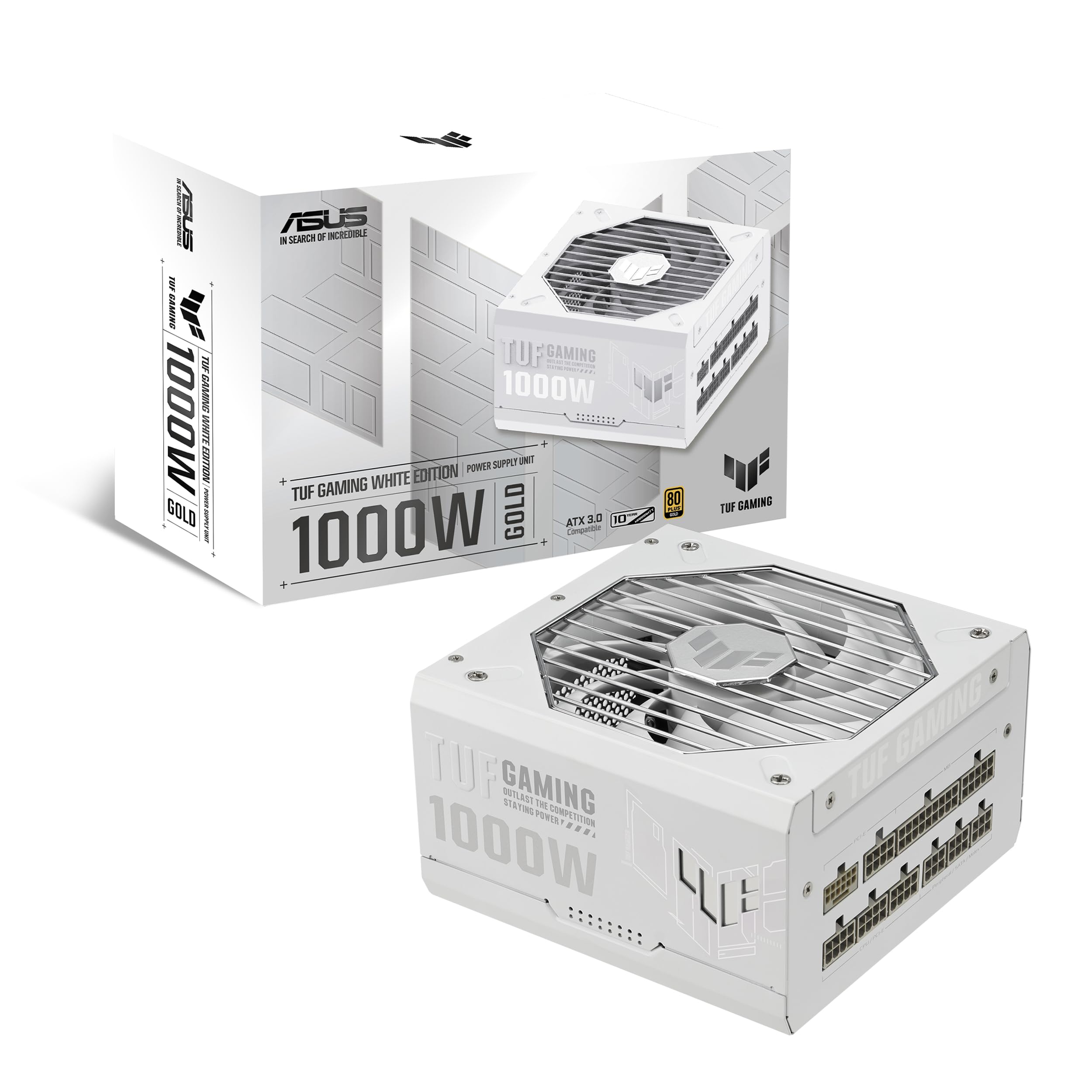 8.5 / 10
TUF Gaming 1000W Gold White Edition (1000 Watt, ATX 3.1 Compatible, Fully Modular Power Supply, 80+ Gold Certified, Military-grade Components, Dual Ball Bearing, PCB Coating, 10 Year Warranty)
£129.99 · ASUS
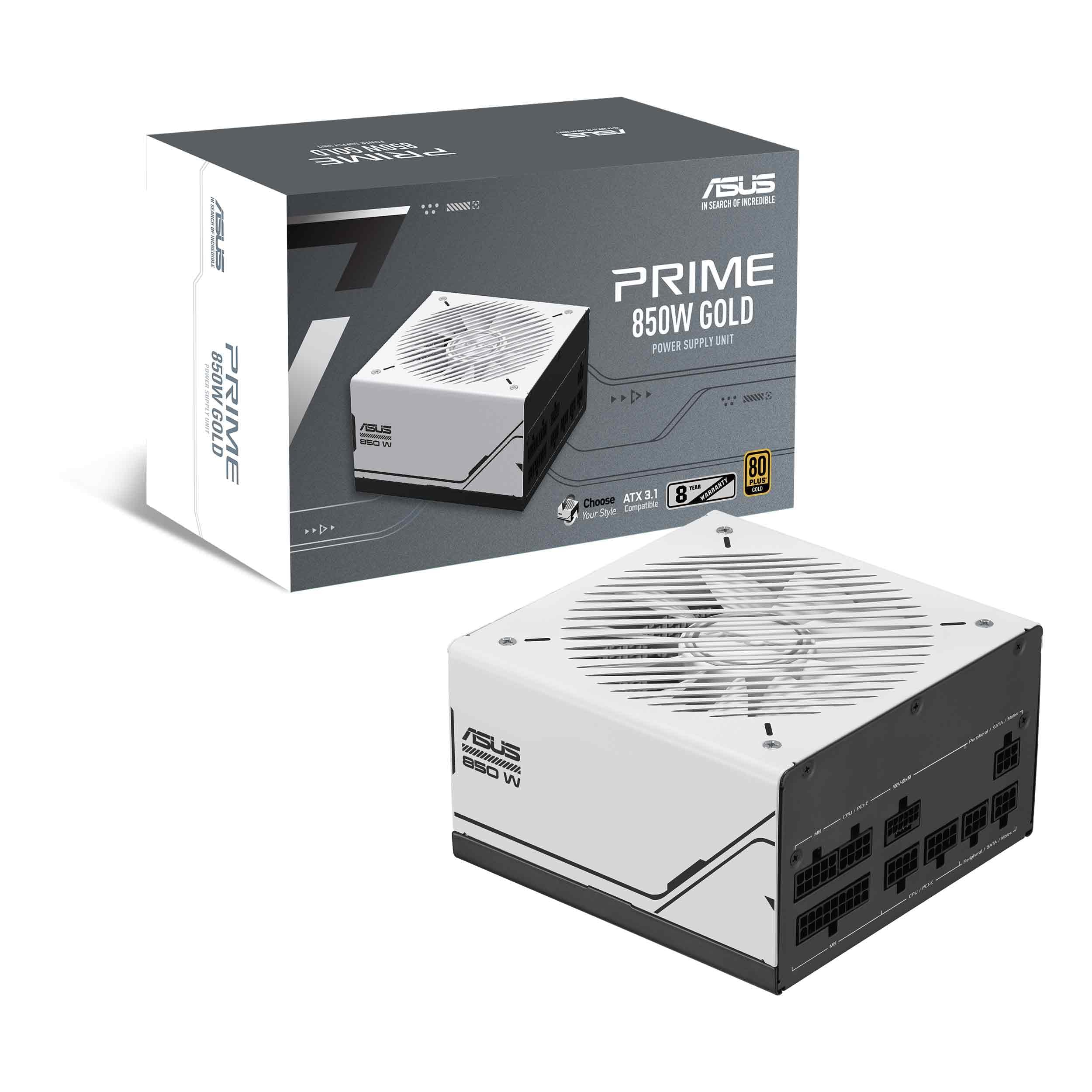 8.5 / 10
Asus Prime 850W Gold Gaming PSU, Double Ball Bearing Fan, Fully Modular, 80+ Gold, ATX 3.0, PCIe 5.0
£104.99 · ASUS
Frequently asked
5 questions01Is the CORSAIR RM1000e (2025) Fully Modular Low-Noise ATX Power Supply with 12V-2x6 Cable good for gaming?+
Yes, and it's specifically well-suited to high-end gaming builds. The 1000W output with ATX 3.1 certification means it handles the transient power spikes that modern flagship GPUs produce, and the included 12V-2x6 cable means you're ready for PCIe 5.1 graphics cards without needing an adapter. For mid-range gaming builds with a GPU like the RTX 4070 or RX 7800 XT, it's more PSU than you need - an 850W unit would be the smarter spend.
02What wattage PSU do I need for an RTX 4090 or RTX 5090 build?+
Nvidia recommends at least 850W for the RTX 4090, but with a high-end CPU like an Intel Core i9 or AMD Ryzen 9 in the mix, 1000W gives you proper headroom rather than running at the limit. For the RTX 5090, early power draw figures suggest 1000W is the sensible minimum for a full system. The RM1000e 1000W is well-matched to these scenarios. Use our PSU calculator to check your specific component list.
03Is Cybenetics Gold efficiency worth paying for over 80 Plus Bronze?+
Cybenetics Gold means better real-world efficiency than 80 Plus Bronze alone, typically 87% to 90% at 50% load versus around 85% for Bronze. The electricity saving over a year of gaming is modest - we're talking a few pounds off your bill. The real benefit is less heat generated inside the PSU, which keeps the fan quieter and extends component life. Whether that's worth the price difference over a Bronze unit depends on your budget and how long you plan to keep the PSU.
04How long is the warranty on the CORSAIR RM1000e (2025) Fully Modular Low-Noise ATX Power Supply?+
5 years. That's a solid warranty for a PSU at this price point and covers manufacturing defects and failures. Corsair's UK warranty support is generally well-regarded. that some competing units, particularly Seasonic's Focus GX range, offer 10-year warranties. If maximum warranty length is your priority, that's worth factoring into your decision.
05Is the CORSAIR RM1000e (2025) fully modular?+
Yes, it's fully modular. Every cable, including the ATX 24-pin motherboard connector, detaches completely from the PSU body. You only connect the cables your build actually needs, which keeps your case interior tidy, improves airflow, and makes cable management much easier than semi-modular or non-modular alternatives. The white colourway version ships with white cables, which is useful for white-themed builds.