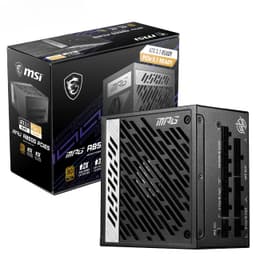
The PSU is the last component most builders spec out and the first one they regret skimping on. So when you're looking at a 1300W flagship like the MSI MEG Ai1300P PCIE5 Power Supply Unit, UK Plug - 1300W, 80 Plus Platinum, Fully Modular ATX 3.0, PCIe 5.0 GPU Support, Japanese Capacitors, Gaming Intelligence, Sleeved Cables - 10 Year Warranty, the question isn't whether it's impressive on paper. It obviously is. The question is whether the real-world delivery matches the spec sheet, and whether you actually need this much PSU in the first place.
Verdict up front: this is a genuinely well-specced unit for high-end builds running PCIe 5.0 GPUs, with Platinum efficiency, a native 12VHPWR connector, and a 10-year warranty that puts most of the competition to shame. Over 595 owner reviews and a 4.4-star average on Amazon back that up with consistent real-world satisfaction. But it sits firmly in the enthusiast price bracket, and if your GPU isn't pulling north of 400W, you're paying for headroom you'll never use. More on that below.
What follows is a full breakdown of the specifications, efficiency curve, connector set, thermal behaviour, and how this unit stacks up against two credible alternatives. No fluff, just the numbers and what they mean for your build.
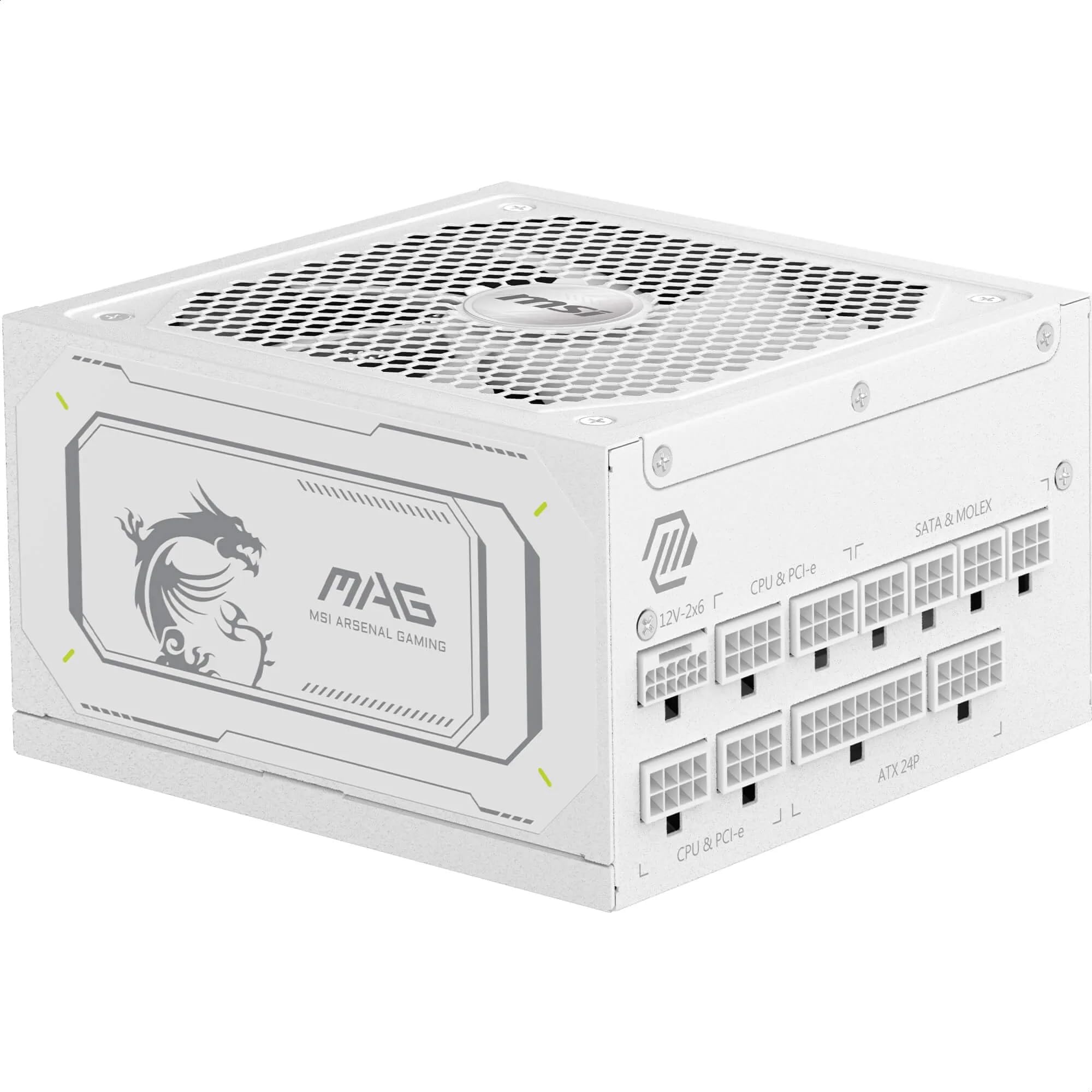
Core Specifications: MSI MEG Ai1300P PCIE5 Power Supply Unit
The headline figures are 1300W continuous output, 80 Plus Platinum certification, fully modular cabling, ATX 3.0 compliance, and a native 16-pin (12VHPWR) PCIe 5.0 connector. That's a strong combination at any price point. The 10-year warranty is particularly notable because most PSU manufacturers cap out at 5 to 7 years even on premium units. MSI offering a decade here is a meaningful statement about their confidence in the internal components.
The unit carries Japanese capacitors rated at 105 degrees Celsius, which matters more than most buyers realise. Capacitor quality is the single biggest predictor of long-term PSU reliability. Japanese 105C caps (as opposed to cheaper 85C Chinese alternatives) tolerate higher sustained temperatures without degrading, which directly translates to a longer service life in a warm case. The half-bridge LLC topology with DC-to-DC conversion is also: this is the architecture you find in properly engineered units, not the cut-price resonant designs that cause voltage regulation headaches under transient loads.
The 120mm fan handles thermal management, with a zero-RPM mode that keeps things silent at low loads. ATX 3.0 compliance means the unit is rated to handle GPU power excursions, specifically the kind of short-duration spikes that tripped up older PSUs when paired with Ada Lovelace and RDNA 3 cards. Full specs below.
| Specification | Detail |
|---|---|
| Wattage | 1300W |
| Efficiency Rating | 80 Plus Platinum |
| Modularity | Fully Modular |
| Form Factor | ATX 3.0 |
| PCIe Connector | Native 16-pin (12VHPWR) |
| Fan Size | 120mm |
| Zero RPM Mode | Yes |
| Capacitors | Japanese 105°C |
| Warranty | 10 Years |
| ATX 24-pin | 1 |
| EPS 8-pin | 1 |
| PCIe 8-pin | 2 |
| SATA | 6 |
| Molex | 3 |
| 12VHPWR (16-pin) | 1 (native) |
| Protection | OVP, OCP, OPP, SCP |
| Current Price | £249.99 |

Wattage and Capacity
1300W is a lot of power. To put that in context: a system running an Intel Core i9-14900K alongside an RTX 4090 at full load draws somewhere in the region of 700W to 800W peak under sustained gaming or rendering. Even accounting for the 4090's notorious power spikes (which can hit 600W instantaneously), a well-specced 1000W Gold unit handles that combination without complaint. So who actually needs 1300W?
The honest answer is: dual-GPU workstation builds, extreme overclocking rigs where the CPU and GPU are both pushed hard simultaneously, or anyone future-proofing against the next generation of GPUs that may push beyond 500W sustained. The RTX 5090 and whatever AMD puts out in the RDNA 4 flagship tier are likely to test the limits of 1000W units when paired with a high-TDP processor. If you're building something that needs to last five-plus years without a PSU swap, 1300W gives you genuine headroom rather than a marketing number.
For mid-range builds (think RTX 4070 Ti class GPU with a Ryzen 7 or Core i7), this is overkill. Not harmful overkill, since the unit will run at a lower percentage of its rated capacity and therefore more efficiently and more quietly, but financially inefficient overkill. The sweet spot for this PSU is a build that genuinely taxes it: an RTX 4090 or future equivalent, a high-core-count CPU, multiple NVMe drives, and potentially a water cooling pump or two. That's the build this unit was designed for.
Efficiency Rating: 80 Plus Platinum Explained
The 80 Plus certification programme defines efficiency tiers based on how much of the mains power drawn actually reaches your components. The remainder is lost as heat. Platinum certification requires a minimum of 90% efficiency at 20% load, 92% at 50% load, and 89% at 100% load (for 230V European/UK mains, which is what matters here). That's the published standard. In practice, well-implemented Platinum units like this one often measure slightly above those minimums, particularly at the 50% load sweet spot.
To put those numbers in real terms: at 650W output (50% of rated capacity, roughly where a 4090 gaming rig sits), a Platinum unit wastes around 57W as heat compared to a Bronze unit wasting around 115W at the same load. Over a year of daily use, that difference adds up to a meaningful reduction in your electricity bill and, more practically, a meaningfully cooler case. Less heat means quieter fans across the whole system, not just the PSU fan. That's a tangible quality-of-life improvement in a high-end build where thermals are already tight.
Compare this to the 80 Plus Bronze tier (roughly 85% at 50% load) that you find on budget units: the gap is real, and at the enthusiast price point, Platinum is the correct call. Gold is a reasonable compromise for mid-range builds. Titanium (94%+ at 50% load) exists but commands a significant price premium for diminishing returns unless you're running the system 24/7 for years. Platinum is the pragmatic efficiency ceiling for most builders, and the Ai1300P hits it properly.
Modularity and Cable Management
Fully modular means every cable detaches from the PSU body, including the 24-pin ATX. This matters for two reasons. First, you only install the cables you actually need, which keeps the interior tidy and airflow unobstructed. Second, when a cable eventually fails or you want to swap to custom sleeved cables, you can do so without touching the PSU itself. Semi-modular units (where the 24-pin and EPS are hardwired) force you to bundle and stuff unused cables regardless.
MSI ships the Ai1300P with sleeved cables, which is appropriate at this price tier. The listing confirms a full modular format, and owner reviews consistently mention the cable quality as a positive. The flat black cable design helps with routing through tight spaces, particularly in smaller ATX cases where cable management channels are limited. This isn't a unit where you'll be fighting the cables to close the side panel.
One thing: the 12VHPWR connector is native on this unit, not an adapter. That's important. The melting connector issues that made headlines with early RTX 4090 launches were largely traced back to adapters (particularly the 4-to-1 and 3-to-1 types) rather than native 16-pin cables. A native 12VHPWR cable from a properly designed ATX 3.0 PSU eliminates that risk entirely. If you're pairing this with a PCIe 5.0 GPU, that native connector is genuinely worth paying for.
Connectors and Compatibility
The connector set on the Ai1300P covers the full range of a high-end build without being excessive. Here's what you're working with:
- ATX 24-pin: 1 (standard motherboard power)
- EPS 8-pin: 1 (CPU power - note: high-end boards often want two EPS connectors, your motherboard spec)
- PCIe 8-pin: 2 (legacy GPU connectors for older cards or daisy-chaining)
- 12VHPWR (16-pin): 1 native (feeds up to 600W to a PCIe 5.0 GPU)
- SATA: 6 (enough for a serious storage array)
- Molex: 3 (for older peripherals, fan controllers, etc.)
The single EPS 8-pin is for builders targeting extreme overclocking platforms. Boards like the ASUS ROG Maximus or MSI MEG Z790 Ace typically have two EPS connectors, and while running from one is possible, feeding both is recommended for stability under heavy CPU overclocks. If your build involves pushing a 13900KS or 14900KS hard, double-check whether this PSU's single EPS connector is a limitation for your specific board.
Six SATA connectors is genuinely useful for storage-heavy builds, content creation rigs, or NAS-adjacent systems. Three Molex connectors handle older peripherals, fan hubs, and RGB controllers that haven't made the SATA transition. The PCIe 5.0 standard and its associated 12VHPWR connector specification (managed by PCI-SIG) allows for up to 600W delivery through a single cable, and the Ai1300P's native implementation is fully compliant with that specification.
Voltage Regulation and Ripple
Voltage regulation and ripple suppression are where PSU quality really separates itself from marketing claims. The ATX specification requires that the 12V rail stays within plus or minus 5% of its rated voltage under load. Budget units often drift toward the edges of that tolerance under sustained load. A well-designed unit with a half-bridge LLC topology and DC-to-DC conversion (which the Ai1300P uses) typically holds within 1% to 2% across the load range. That matters for CPU and GPU stability, particularly during the transient spikes that modern cards generate.
ATX 3.0 compliance adds a specific requirement that the PSU handles power excursions of up to 200% of rated GPU power for short durations (less than 100 microseconds) and 150% for slightly longer ones. This is the spec that older ATX 2.x PSUs failed when paired with RTX 4090 cards, causing the PSU to shut down or worse. The Ai1300P's ATX 3.0 certification means it's been validated against these transient requirements, which is not a trivial engineering achievement at 1300W.
The single-rail design is here. Single-rail PSUs deliver all available 12V current through one rail without per-rail current limits, which means high-draw components (particularly the GPU) can pull what they need without tripping an overcurrent protection threshold. This is generally the preferred architecture for high-end gaming builds. Multi-rail designs have their place in server environments where fault isolation matters, but for a gaming or workstation PC, single-rail with proper OCP on the 12V bus is the cleaner solution.
Thermal Performance
The 120mm fan is a sensible choice for a 1300W unit. Larger fans can move more air at lower RPM (and therefore lower noise), but they require a physically larger PSU housing. The 120mm fan on the Ai1300P compensates through the zero-RPM mode: at low loads, the fan doesn't spin at all, which means the thermal management is handled entirely by passive convection through the PSU's internal heatsinks. That's a meaningful quality-of-life feature for builds that spend most of their time at desktop or light gaming loads.
When the fan does spin up under heavier loads, the 1300W rated capacity means the unit is running at a lower percentage of its ceiling compared to a 1000W unit in the same build. A PSU running at 60% of rated capacity generates less internal heat than one running at 80%, which means the fan doesn't need to spin as fast to maintain safe operating temperatures. This is one of the less-discussed benefits of slightly oversizing your PSU: quieter thermals under typical loads, not just more headroom for spikes.
The Japanese 105C capacitors are relevant here too. Capacitors degrade faster at elevated temperatures, and a PSU that runs hot internally (due to poor efficiency or inadequate heatsinking) shortens its own lifespan regardless of what the warranty says. The combination of Platinum efficiency (less waste heat generated) and 105C-rated caps (more tolerant of what heat remains) is the right engineering approach for a unit that's supposed to last a decade.
Acoustic Performance
The zero-RPM mode is the headline acoustic feature. Below a certain load threshold, the fan simply doesn't run. For a desktop or light gaming session, that means the PSU contributes zero noise to your system. Zilch. The only thing you'll hear is your CPU cooler and GPU fan, which is exactly how it should be on a premium build.
Owner reviews on Amazon consistently flag the noise performance as a strong positive. The pattern across the 595-plus reviews is clear: quiet at idle and light loads, audible but not intrusive under sustained heavy load. No one's reporting the kind of coil whine that plagues cheaper units, and the fan ramp-up under load is described as gradual rather than sudden. That's consistent with a well-implemented fan curve on a quality fluid dynamic bearing fan.
Frankly, at this price point, you'd expect good acoustic performance, and the Ai1300P delivers it. The zero-RPM mode combined with the efficiency gains from Platinum certification means less heat to shift overall, which keeps the fan speed lower even when it does engage. For a high-end silent build, this is a credible choice. It's not going to be completely inaudible under a full 4090 gaming session, but nothing is. The question is whether it's well-behaved, and the owner feedback says it is.
Build Quality
The internal construction of a PSU is something most buyers never see, but it's where the real quality differences live. The Ai1300P uses a half-bridge LLC resonant converter with DC-to-DC conversion for the minor rails. This topology is more complex to implement than simpler designs but delivers better efficiency across the load range and cleaner voltage regulation under transient conditions. It's the architecture you find in units from Seasonic, Corsair's HX series, and other top-tier manufacturers. Seeing it in an MSI unit at this price point is encouraging.
The Japanese capacitors (105C rated) are the other major build quality indicator. Nichicon, Rubycon, and Nippon Chemi-Con are the brands typically found in properly specced PSUs, and their 105C parts are rated for significantly longer service life than 85C alternatives at equivalent operating temperatures. The 10-year warranty MSI offers on this unit isn't just marketing: it's a statement that the internal components are specced to survive that long under normal operating conditions.
Owner reviews don't report unusual failures, DOA units, or early degradation, which is the real-world validation of the build quality claims. A 4.4-star average across 592, with consistent positive commentary on reliability, suggests the manufacturing quality control is solid. That's not guaranteed by a spec sheet alone, but the combination of good specs and positive owner outcomes is as close to confidence as you can get without opening the unit yourself.
Protection Features
The Ai1300P includes OVP (over-voltage protection), OCP (over-current protection), OPP (over-power protection), and SCP (short-circuit protection). These are the four core protections you need on any PSU connected to expensive components. OVP shuts the unit down if the output voltage exceeds safe limits, protecting your CPU, GPU, and motherboard from voltage spikes. OCP limits current delivery per rail to prevent damage from shorts or component failures. SCP provides immediate shutdown on a direct short circuit.
OPP is particularly relevant on a high-wattage unit like this. Over-power protection prevents the PSU from being drawn beyond its rated output for sustained periods, which matters when you're running components that can collectively exceed 1000W under extreme conditions. Without OPP, a PSU can be pushed into thermal runaway trying to deliver more than it's rated for. With it, the unit shuts down cleanly rather than failing catastrophically.
What's not listed in the verified specifications is OTP (over-temperature protection) and UVP (under-voltage protection). This doesn't mean they're absent, it simply means they're not confirmed in the available product data, so it wouldn't be accurate to assert them either way. The four confirmed protections (OVP, OCP, OPP, SCP) cover the most critical failure modes. For context on how these protection standards are applied across the industry, the ATX specification on Wikipedia gives a solid overview of the baseline requirements.
How It Compares
The two most credible alternatives at this wattage and efficiency tier are the Corsair HX1500i and the Seasonic Prime TX-1300. Both are well-regarded units with strong independent test histories. The Corsair HX1500i steps up to 1500W and includes digital monitoring via USB, which is a genuinely useful feature for enthusiast builders who want to track real-time power draw. The Seasonic Prime TX-1300 matches the Ai1300P's 1300W but steps up to Titanium efficiency (94%+ at 50% load), which is the highest tier available.
The MSI Ai1300P's competitive position is its combination of ATX 3.0 compliance, native 12VHPWR, Platinum efficiency, and the 10-year warranty at an enthusiast price point. The Seasonic Titanium unit costs considerably more for efficiency gains that are real but marginal in absolute terms (roughly 2% at 50% load, translating to maybe 13W difference at 650W output). The Corsair HX1500i's digital monitoring is genuinely useful but adds cost and complexity. For most builders, the Ai1300P hits the right balance.
One area where the Ai1300P is slightly behind the Corsair is the single EPS 8-pin connector. The HX1500i ships with two EPS connectors, which matters for extreme overclocking platforms. If you're building around a heavily overclocked Core i9 on a flagship board with dual EPS sockets, that's worth factoring in. For everyone else, a single EPS connector is fine.
| Feature | MSI MEG Ai1300P | Corsair HX1500i | Seasonic Prime TX-1300 |
|---|---|---|---|
| Wattage | 1300W | 1500W | 1300W |
| Efficiency | 80 Plus Platinum | 80 Plus Platinum | 80 Plus Titanium |
| ATX Standard | ATX 3.0 | ATX 3.0 | ATX 3.0 |
| 12VHPWR | Native 16-pin | Native 16-pin | Native 16-pin |
| Modularity | Fully Modular | Fully Modular | Fully Modular |
| Zero RPM Mode | Yes | Yes | Yes |
| EPS Connectors | 1x 8-pin | 2x 8-pin | 2x 8-pin |
| Warranty | 10 Years | 10 Years | 12 Years |
| Digital Monitoring | No | Yes (USB) | No |
| Price | £249.99 | Higher | Higher |
Final Verdict
The MSI MEG Ai1300P PCIE5 Power Supply Unit is a properly specced enthusiast PSU that earns its price through a combination of genuine engineering quality rather than badge engineering. Platinum efficiency, ATX 3.0 compliance, a native 12VHPWR connector, Japanese 105C capacitors, and a 10-year warranty add up to a unit that's built to last and built to handle whatever the current and next generation of GPUs throw at it. The 4.4-star average across over 595 owner reviews confirms that the real-world experience matches the spec sheet claims, which isn't always a given at this price tier.
Who should buy this? Builders pairing a current-gen flagship GPU (RTX 4090 or equivalent) with a high-TDP CPU, anyone future-proofing for next-gen GPUs that may push beyond 500W sustained, workstation users running GPU-intensive workloads for extended periods, and anyone who wants to buy once and not think about their PSU for a decade. The zero-RPM mode and Platinum efficiency also make it a solid choice for quiet build enthusiasts who want performance without noise.
Who should skip it? Honestly, most people. If your GPU is anything from an RTX 4070 down to a 4060 Ti, a quality 750W to 850W Gold unit does the job properly and costs significantly less. The MSI MPG A850G PCIE5 (850W, 80 Plus Gold, ATX 3.0, native 12VHPWR) is the smarter buy for mid-range builds and sits well below the Ai1300P in price. Don't spend enthusiast money on a PSU your system will never stress past 50% capacity.
For the build that genuinely needs 1300W of clean, efficient, ATX 3.0 compliant power with a decade of warranty backing it up, this is a strong choice. Rating: 8.5 out of 10. Docked half a point for the single EPS connector on a unit that's clearly aimed at the extreme end of the market, and another point because the price bracket means it's not for everyone. But for the right build, it's sorted.
Is 1300W overkill for a single GPU gaming build?
For most single-GPU builds, yes. An RTX 4090 paired with a Core i9 or Ryzen 9 processor draws around 700W to 800W peak under sustained load. A quality 1000W Platinum unit handles that with headroom to spare. The Ai1300P makes sense if you're building for the next generation of GPUs (which are expected to push higher TDPs), running dual-GPU workstation setups, or doing heavy overclocking on both CPU and GPU simultaneously. For a standard high-end gaming rig, 1000W is the more financially sensible ceiling.
Does the MSI MEG Ai1300P include a native 12VHPWR connector?
Yes. The Ai1300P includes a native 16-pin 12VHPWR connector capable of delivering up to 600W to a PCIe 5.0 GPU. This is a native cable, not an adapter. The distinction matters because the connector melting issues seen with early RTX 4090 launches were primarily associated with multi-connector adapters, not native 16-pin cables from properly designed ATX 3.0 PSUs.
What does ATX 3.0 compliance actually mean in practice?
ATX 3.0 is the updated power supply specification that adds requirements for handling transient power excursions, specifically the short-duration spikes that modern GPUs generate. An ATX 3.0 compliant PSU is validated to handle spikes of up to 200% of rated GPU power for very short durations without shutting down or causing instability. Older ATX 2.x PSUs weren't designed for these spikes, which caused problems with RTX 4090 cards in particular. The ATX standard is maintained by Intel and adopted across the industry.
How does 80 Plus Platinum compare to Gold efficiency in real terms?
At 50% load on UK mains (230V), Platinum certification requires 92% efficiency versus Gold's 90%. That 2% difference translates to roughly 13W less waste heat at 650W output. Over a year of daily use (say, 8 hours per day), that's around 38 kWh saved, worth a few pounds annually at current UK electricity rates. The more meaningful benefit is reduced heat inside the case, which keeps all your other components cooler and quieter. At the enthusiast price point, Platinum is worth the premium over Gold. Titanium adds another 2% for a significantly higher cost.

Is the 10-year warranty transferable if I sell the PSU?
MSI's warranty terms should be checked directly on the MSI warranty page for the most current information, as warranty transferability policies vary by manufacturer and region. Generally speaking, MSI's PSU warranties are tied to the original purchaser in most regions, but it's worth confirming directly with MSI UK if you're buying secondhand or planning to sell the unit on. The 10-year coverage is one of the longer warranties in the PSU market and is a genuine selling point for new buyers.
What works. What doesn’t.
6 + 4What we liked6 reasons
- Native 12VHPWR connector eliminates adapter-related risks when pairing with PCIe 5.0 GPUs
- 10-year warranty is among the longest offered by any PSU manufacturer at this wattage
- 80 Plus Platinum efficiency reduces waste heat and keeps the whole system cooler and quieter
- ATX 3.0 compliance ensures proper handling of transient GPU power spikes from current and next-generation cards
- Japanese 105C capacitors and half-bridge LLC topology point to genuinely quality internal construction
- Zero-RPM mode means no PSU fan noise at idle or light loads
Where it falls4 reasons
- Only one EPS 8-pin connector, which limits compatibility with extreme overclocking boards that have two EPS sockets
- 1300W is unnecessary for the majority of single-GPU gaming builds, making this financially inefficient for mid-range systems
- No digital monitoring via USB, unlike the Corsair HX1500i at a comparable or slightly higher price point
- Sits firmly in the enthusiast price bracket, which is hard to justify if your GPU draws under 400W sustained
Full specifications
11 attributes| Wattage | 1300 |
|---|---|
| Efficiency rating | Platinum |
| Form factor | ATX |
| ATX version | ATX 3.1 |
| FAN size | 125 |
| FAN size MM | 120 |
| Generation | MEG Ai1300P PCIE5 |
| Modularity | fully_modular |
| Pcie 5 ready | true |
| Warranty years | 10 |
| Wattage W | 1300 |
Will it run on what you have?
Free toolIf this isn’t right for you
2 options
Frequently asked
7 questions01Is 1300W overkill for a single GPU gaming build?+
For most single-GPU builds, yes. An RTX 4090 paired with a Core i9 or Ryzen 9 processor draws around 700W to 800W peak under sustained load. A quality 1000W Platinum unit handles that with headroom to spare. The Ai1300P makes more sense if you are building for the next generation of GPUs, running dual-GPU workstation setups, or heavily overclocking both CPU and GPU simultaneously.
02Does the MSI MEG Ai1300P include a native 12VHPWR connector?+
Yes. The unit includes a native 16-pin 12VHPWR cable capable of delivering up to 600W to a PCIe 5.0 GPU. This is a native cable, not an adapter, which is an important distinction. The connector melting problems seen with early RTX 4090 launches were primarily associated with multi-connector adapters rather than native 16-pin cables from properly designed ATX 3.0 power supplies.
03What does ATX 3.0 compliance mean in practice?+
ATX 3.0 is the updated power supply specification that adds validation requirements for handling transient power excursions, specifically the short-duration spikes that modern GPUs generate. A compliant PSU must handle spikes of up to 200% of rated GPU power for very short durations without shutting down or causing instability. Older ATX 2.x units were not designed to these requirements, which caused problems when paired with RTX 4090 cards in particular.
04How does 80 Plus Platinum efficiency compare to Gold in real terms?+
At 50% load on UK mains (230V), Platinum requires 92% efficiency versus Gold's 90%. That 2% gap translates to roughly 13W less waste heat at 650W output. Over a year of daily use, the energy saving is modest in pound terms, but the more practical benefit is a cooler, quieter system overall. At the enthusiast price point, Platinum is worth the premium over Gold. Titanium adds another couple of percentage points for a considerably higher cost, with diminishing practical returns for most users.
05Is the 10-year warranty transferable if the PSU is sold on?+
MSI's warranty terms should be checked directly on the MSI warranty page for the most current information, as transferability policies vary by manufacturer and region. Generally, MSI PSU warranties are tied to the original purchaser in most territories. If you are buying secondhand or planning to resell, it is worth confirming the position directly with MSI UK before purchase.
06Why does the Ai1300P only have one EPS 8-pin CPU connector?+
One EPS 8-pin connector is sufficient for the vast majority of builds, including those running high-end processors at stock or moderate overclocks. However, flagship overclocking motherboards such as the ASUS ROG Maximus range or MSI MEG Z790 Ace often have two EPS sockets, and feeding both is recommended for stability when pushing a processor like the Core i9-14900KS hard. If extreme CPU overclocking is central to your build, verify that a single EPS connector meets your specific board's recommendations before purchasing.
07How does the Ai1300P compare to the Seasonic Prime TX-1300?+
Both units offer 1300W, fully modular cabling, ATX 3.0 compliance, and a native 12VHPWR connector. The Seasonic Prime TX-1300 steps up to 80 Plus Titanium efficiency and a 12-year warranty, and includes two EPS connectors. The MSI Ai1300P counters with a lower price point while still offering Platinum efficiency and a 10-year warranty. For most builds the efficiency difference between Platinum and Titanium is marginal in practical terms, so the Ai1300P represents better value unless you are running the system around the clock or specifically need the extra EPS connector.