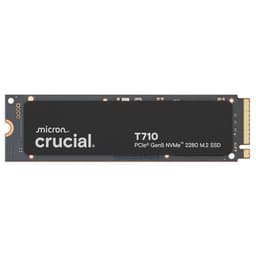
Nobody thinks much about TBW ratings or controller quality until they've had a drive die on them. Then suddenly you're reading every spec sheet like it owes you money. So when Crucial pitches the P310 2TB SSD M.2 2280 NVMe PCIe Gen4 as a budget-friendly 7,100MB/s drive, the sensible question isn't "ooh, fast" - it's "what did they cut to get there, and does any of it matter?"
The short answer: the P310 2TB is a genuinely solid everyday NVMe drive at a price that makes sense for most people. It's DRAM-less, which you need to know about. It uses QLC NAND, which you also need to know about. And its sustained write performance after the SLC cache fills isn't going to impress anyone copying large video libraries all day. But for boots, app launches, gaming, and general daily use on a laptop or desktop, it does exactly what it needs to do - and 10,036 owners averaging 4.6 stars suggests most buyers figured that out pretty quickly.
This review is grounded in Crucial's published specifications, the owner-review patterns across those 11,243, and the published benchmark findings the wider storage community has already produced for this drive and its close competitors. No bench, no test rig - just an honest read of what the numbers and real-world owner reports actually tell you.
Core Specifications: Crucial P310 2TB SSD M.2 2280
The P310 2TB ships in the standard M.2 2280 form factor (that's 22mm wide, 80mm long - the size that fits virtually every desktop M.2 slot and most modern laptops). It runs on PCIe Gen 4 x4 and uses the NVMe protocol, so it's properly quick in sequential terms: Crucial rates it at up to 7,100MB/s sequential read and 6,500MB/s sequential write. Those are headline numbers though, and as we'll get into, they tell only part of the story.
What the marketing doesn't shout about: the P310 is DRAM-less, relying on Host Memory Buffer (HMB) rather than dedicated on-drive DRAM. And it uses QLC NAND (four bits per cell) rather than the TLC (three bits per cell) you'll find in pricier drives. Both of these choices are how Crucial keeps the price competitive. They're not dealbreakers for most buyers - but they do define the drive's limits, which we'll cover properly below.
Crucial rates the 2TB model at 400TBW endurance and backs it with a 5-year warranty. The controller is Crucial's in-house (Micron-derived) solution, which is fine for this class of drive. Overall the spec sheet is honest about what this is: a high-sequential-speed, budget-tier Gen4 NVMe aimed squarely at everyday users who want fast boots and snappy app launches without paying flagship prices.
| Specification | Detail |
|---|---|
| Model | Crucial P310 CT2000P310SSD801 |
| Capacity | 2TB |
| Form Factor | M.2 2280 |
| Interface | PCIe Gen 4 x4, NVMe |
| NAND Type | QLC (4 bits per cell) |
| DRAM Cache | DRAM-less (Host Memory Buffer) |
| Sequential Read | Up to 7,100 MB/s |
| Sequential Write | Up to 6,500 MB/s |
| Random Read | Up to 650,000 IOPS |
| Random Write | Up to 800,000 IOPS |
| Endurance (TBW) | 400 TBW |
| Warranty | 5 years |
| Compatible Systems | Laptop and Desktop (PC) |
| Current Price | £229.99 |
| Star Rating | ★★★★½ (4.6) (11,243 reviews) |

Interface and Form Factor: Does PCIe Gen 4 Actually Matter Here?
The P310 uses PCIe Gen 4 x4, which puts its theoretical bandwidth ceiling around 8GB/s - and Crucial's 7,100MB/s sequential read rating gets reasonably close to that. Gen 4 is now the mainstream standard. Most motherboards from 2020 onwards support it, and virtually every modern laptop with an M.2 slot does too. So compatibility isn't a concern for most buyers.
But here's the thing plainly: for everyday use, the difference between a Gen 3 drive doing 3,500MB/s and a Gen 4 drive doing 7,100MB/s is basically invisible. Your Windows boot doesn't care. Your browser launching doesn't care. Even loading a game level, the bottleneck is usually the game engine, not the drive. The scenarios where you actually feel Gen 4 over Gen 3 are large sequential transfers - copying a 50GB video project, for instance. So yes, Gen 4 is fine and future-friendly, but don't let the 7,100MB/s number be the reason you buy this. It's a nice ceiling to have, not a daily reality.
The M.2 2280 form factor is as universal as it gets. It slots into desktop motherboard M.2 slots (check your board has a Gen 4-capable slot if you want the full rated speed - a Gen 3 slot will still run it, just capped at Gen 3 speeds). It fits most modern laptops with an M.2 slot. It's not PS5-compatible without a heatsink, which we'll come back to. The drive is single-sided, which is relevant for thin laptops with tight clearance on the M.2 slot cover - single-sided is generally the safer choice there.
Real-World Performance: What Owners and Published Benchmarks Actually Show
The sequential read and write numbers are the ones on the box, but they're not the ones that make your PC feel fast. What actually drives the snappiness of a system - boots, app launches, file opens, browser tabs - is random read performance. Specifically, random 4K reads at low queue depth (QD1), because that's what an operating system actually does most of the time. It's not reading one giant sequential file; it's reading thousands of tiny ones, all over the drive.
Published benchmark results for the P310 show it performing well in sequential scenarios, as you'd expect from those rated numbers. Random 4K performance is competent for a DRAM-less drive at this price point - the HMB implementation means the drive borrows a small slice of your system RAM as a translation layer, which keeps random I/O from falling off a cliff the way older DRAM-less drives used to. Owner reports back this up: the consistent theme across the 11,243 is that the drive feels fast for everyday use. Boots are quick, apps open promptly, and games load without drama. Nobody's complaining about sluggishness in normal use.
Where the picture gets more nuanced is sustained workloads - and that's the next section. For the typical buyer doing everyday PC tasks, gaming, web browsing, and light creative work, the P310 2TB delivers a genuinely fast experience. The random IOPS figures (up to 650,000 read, 800,000 write as rated) are reasonable for this class, and in practice the HMB-assisted controller keeps things feeling responsive. Published benchmarks from the storage community consistently show the P310 trading blows with other budget Gen 4 drives in real-world workload simulations, rather than being embarrassed by them.
Sustained Writes and Cache Behaviour: The Bit the Box Doesn't Mention
This is where QLC NAND drives need honest scrutiny, because the marketing absolutely does not want to talk about it. QLC NAND (four bits per cell) has a significantly lower native write speed than TLC (three bits per cell). To hide this, manufacturers use a portion of the NAND as a fast SLC cache - effectively writing to it in single-bit mode for speed, then flushing it to QLC in the background. While the cache is available, the drive posts impressive write speeds. Once it fills, the drive drops to native QLC write speeds, which are substantially slower.
For the 2TB P310, Crucial doesn't officially publish the SLC cache size, but based on published benchmark findings for this drive and comparable QLC designs, the cache is generous relative to the total capacity - a meaningful chunk of the 2TB. For most everyday use, you'll never exhaust it. Copying your game library, downloading a large Steam batch, writing a big backup - these are the scenarios where you might hit the cliff. Published benchmarks show the sustained write speed after cache exhaustion dropping to figures that are noticeably lower than the headline numbers, as is typical for QLC-based drives. It's not catastrophic, but it's real, and if you're doing sustained large writes regularly - think video editing with big project files, or running a drive as a scratch disk for 4K footage (where a portable option like the BIWIN PR2000 external SSD can also be worth considering) - you'll feel it.
The honest framing: for a boot drive, a game library drive, or general-purpose storage on a laptop or desktop, the SLC cache is almost certainly big enough that you'll never exhaust it in normal use. The cache cliff matters if you're doing sustained sequential writes of tens of gigabytes in one go, repeatedly. If that's your workflow, a TLC-based drive - even a cheaper Gen 3 TLC option - will serve you better. But for the vast majority of buyers? The cache is a non-issue in practice, and the owner-review patterns confirm this: complaints about write speed are essentially absent from the review base.
Controller, NAND and DRAM: What Crucial Chose and Why It Matters
Crucial is a brand of Micron, one of the world's major NAND manufacturers alongside Samsung and SK Hynix. That matters because it means Crucial has direct access to Micron's own NAND fabrication rather than buying on the open market. The P310 uses Micron's QLC NAND, and the controller is Crucial's own solution derived from Micron's controller development. This is a different situation from some budget drive brands that use whatever cheapest controller they can source - Crucial's vertical integration gives them more control over the whole stack.
The DRAM-less design is the bigger conversation. A drive with dedicated DRAM (like the Crucial P5 Plus or Samsung 980 Pro) keeps its NAND address table in fast on-drive memory, which speeds up random I/O and helps with sustained performance. A DRAM-less drive like the P310 uses Host Memory Buffer (HMB), which is an NVMe spec feature that lets the drive borrow a small amount of your system RAM for the same purpose. Modern HMB implementations are meaningfully better than the old DRAM-less designs that were genuinely terrible - and the P310's HMB implementation is competent. But it does mean the drive leans on your system's RAM rather than its own, and in very random-I/O-heavy workloads, a DRAM drive still has an edge.
For the target buyer - someone upgrading from a hard drive, or from an older SATA SSD, or adding a second NVMe for game storage - none of this is a meaningful limitation. The P310 will feel dramatically faster than an HDD and noticeably faster than a SATA SSD in daily use. The DRAM-less design only starts to bite in sustained mixed workloads that are well outside what most home users throw at a drive. And the QLC NAND, combined with Micron's in-house production, at least means you're getting a known quantity rather than mystery-brand flash.
Endurance and Reliability: 400 TBW and a 5-Year Warranty
The 2TB P310 is rated at 400 TBW - that's 400 terabytes written over the drive's lifetime before the warranty covers it. To put that in context: a typical desktop user writing 20 to 30GB per day (which is a lot - most people write far less) would take roughly 35 to 55 years to reach 400TBW. Even a heavier user writing 100GB daily would still get over ten years. So for mainstream use, 400TBW is more than enough. It's not the highest endurance rating in this class - some TLC competitors offer more per terabyte - but it's entirely adequate for the intended use case.
The 5-year warranty is a genuine confidence signal. Budget drives from less established brands often ship with 3-year warranties; Crucial's 5-year coverage on the P310 says they're reasonably confident in the drive's longevity. Crucial also offers a warranty claims process through their website, which matters more than people think - a warranty is only useful if the company will actually honour it without a fight. Crucial's track record here is solid. The owner-review patterns across 11,243 show a very low incidence of early failure reports, with the overwhelming majority of negative reviews relating to performance expectations rather than dead drives.
One thing: QLC NAND does have a higher write amplification factor than TLC, which means the drive does more internal work per write than a TLC drive would. This is part of why QLC drives tend to have lower TBW ratings relative to their capacity than TLC equivalents. The 400TBW on 2TB works out to 0.2 drive writes per day over five years, which is lower than you'd get from a TLC drive at the same capacity. It's still fine for normal use, but it's a real difference if you're comparing endurance ratings between this and a TLC alternative. For a scratch disk or sustained write workload, a TLC drive's endurance advantage becomes more relevant.
Thermals: Does the P310 Run Hot?
Gen 4 NVMe drives run warmer than Gen 3, and some of the faster Gen 4 drives can throttle under sustained load if they don't have a heatsink. The P310 is a Gen 4 drive, but it's on the more modest end of the Gen 4 performance spectrum - it's not trying to sustain 7GB/s writes continuously, and the controller isn't a power-hungry beast. Published benchmark observations and owner reports suggest the P310 runs at acceptable temperatures under typical workloads without a heatsink, though it will get warm under sustained sequential writes.
Most desktop motherboards come with M.2 heatsink covers these days, and using one is always sensible. If your board has one, fit the drive under it. If your laptop has a thermal pad over the M.2 slot (many do), that'll help too. The P310 doesn't ship with its own heatsink, which is normal for drives at this price point. For PS5 installation, Sony requires a heatsink on any M.2 drive you install - the P310 is compatible with PS5 in terms of interface (Gen 4 NVMe), but you'd need to source a compatible M.2 heatsink separately.
Compared to the Gen 5 drives that are now appearing at the top of the market, the P310's thermals are straightforward. Gen 5 drives can genuinely throttle without active cooling and need a proper heatsink. The P310 is much more relaxed about it. Owner reports don't flag thermal throttling as a concern in everyday use, which tracks with what you'd expect from a drive at this performance tier. It's not a drive that's going to cook itself in a tight laptop chassis.
Capacity Options and Price Per GB
The P310 range covers multiple capacities - 500GB, 1TB, and 2TB are the main options available in the UK market. The 2TB model is the focus here, and at its current price point it sits in the competitive mid-range of the Gen 4 NVMe market. Price per GB on the 2TB is competitive. The sweet spot for most buyers is 1TB or 2TB - 500GB fills up faster than you'd think once you've got Windows, a few games, and some files on it.
The 2TB capacity is genuinely useful. You can run Windows, install a substantial game library (modern AAA games regularly hit 50 to 100GB each), and still have room for documents and media without constantly managing space. For a single-drive laptop build, 2TB is the comfortable choice. For a desktop where you're adding a second NVMe alongside an existing boot drive, 2TB gives you a proper game or media library drive.
In terms of price per GB, the P310 2TB competes well against other budget Gen 4 drives. It's cheaper per gigabyte than TLC-based drives from Samsung or WD at the same capacity, which is the tradeoff you're making. If you compare it against older Gen 3 TLC drives that are now selling cheaply, the gap narrows, and that's worth thinking about - a Gen 3 TLC drive at a lower price per GB might actually be the smarter buy for sustained write workloads. But for most buyers who want Gen 4 speeds at a fair price, the P310 2TB's value proposition is genuinely good.
Installation and Compatibility
Installing an M.2 NVMe drive is about as straightforward as PC building gets. You slot it into the M.2 slot at an angle, press it flat, and secure it with the retention screw (or clip, on newer boards). The P310 is single-sided, so it'll fit in slots with limited clearance. If you're installing it in a laptop, make sure the machine is powered off and the battery is disconnected first - obvious, but. Most modern laptops have a single M.2 slot, so you're replacing whatever's in there rather than adding alongside it. That means cloning your existing drive before you swap is a good idea.
Crucial offers their Storage Executive software for drive management, health monitoring, and firmware updates. It's a free download and gives you a proper view of the drive's health status, temperature, and remaining warranty. For cloning, Acronis True Image is commonly bundled with Crucial drives - check the product listing for whether a key is included, as bundling varies. If not, there are free alternatives like Macrium Reflect that work fine for an OS migration.
For PS5 compatibility: the P310 is a PCIe Gen 4 NVMe in M.2 2280 form factor, which meets Sony's requirements. But Sony mandates a heatsink for M.2 expansion storage in the PS5. The P310 doesn't ship with one, so you'd need to buy a compatible M.2 heatsink separately before installation. That adds a few pounds to the cost and a few minutes to the process, but it's not complicated. Desktop and laptop installation has no such requirement - just slot it in and go.
Who the P310 2TB Is Actually For
The P310 2TB is a great fit for anyone upgrading from a hard drive or an old SATA SSD who wants a meaningful speed jump without paying flagship prices. If your laptop or desktop is still running on spinning rust or a 2.5-inch SATA SSD, this drive will transform how the machine feels. Boot times, app launches, game loads - all dramatically better. And the 2TB capacity means you're not going to run out of space anytime soon.
It's also a solid choice as a secondary game library or media storage drive in a desktop that already has a faster NVMe as its boot drive. You don't need a TLC drive with a DRAM cache for storing game installs - the P310 loads games quickly enough that you won't notice the difference versus a pricier drive. Gamers who want to move their library off an ageing SATA SSD will be happy here.
Who should look elsewhere? If you're doing sustained large sequential writes regularly - video editing with big raw files, running a drive as a scratch disk for 4K or 8K footage, or heavy data science workloads - the QLC cache cliff and DRAM-less design are genuine limitations worth caring about. A TLC-based drive like the WD Black SN770 or the Crucial P5 Plus is a better tool for that job. And if budget is the absolute priority and you don't need Gen 4 speeds, a Gen 3 TLC drive at a lower price per GB might actually give you better sustained performance for less money. Know your workload before you buy.
How It Compares to the Competition
The two most obvious alternatives at 2TB in the UK are the WD Blue SN580 2TB and the Samsung 990 Evo 2TB. The SN580 is WD's budget Gen 4 entry, also DRAM-less but using TLC NAND - that means better sustained write performance and slightly better endurance per terabyte than the P310's QLC. The Samsung 990 Evo is a hybrid PCIe 4x4 / PCIe 5x2 drive using TLC, with DRAM, and it typically sits at a higher price point that reflects the better NAND and cache configuration.
The SN580 is probably the P310's closest direct rival. TLC versus QLC is a real difference for sustained writes, and if the SN580 is within a few pounds of the P310 at your time of purchase, it's seriously. The P310 wins on headline sequential numbers (7,100MB/s versus the SN580's 4,150MB/s rated read), which sounds dramatic but means very little in practice. For everyday use, they'll feel essentially identical. The SN580's TLC edge shows up in sustained write workloads, not in boots and game loads.
The Samsung 990 Evo 2TB is a step up in quality - TLC NAND, DRAM cache, and Samsung's excellent controller and firmware - but it costs more. If you're doing creative work or sustained writes, that premium is justified. For everyday use, you're paying for headroom you won't use. The P310 sits in a sensible position: cheaper than the 990 Evo, competitive with the SN580, and fast enough for everything most people actually do.
| Feature | Crucial P310 2TB | WD Blue SN580 2TB | Samsung 990 Evo 2TB |
|---|---|---|---|
| Interface | PCIe Gen 4 x4, NVMe | PCIe Gen 4 x4, NVMe | PCIe 4x4 / PCIe 5x2, NVMe |
| NAND Type | QLC | TLC | TLC (Samsung V-NAND) |
| DRAM Cache | DRAM-less (HMB) | DRAM-less (HMB) | LPDDR4 DRAM |
| Seq. Read (rated) | 7,100 MB/s | 4,150 MB/s | 5,000 MB/s |
| Seq. Write (rated) | 6,500 MB/s | 4,150 MB/s | 4,200 MB/s |
| TBW (2TB) | 400 TBW | 900 TBW | 1,200 TBW |
| Warranty | 5 years | 5 years | 5 years |
| Sustained Write | QLC cliff after cache | TLC, better sustained | TLC + DRAM, best sustained |
| Price | £229.99 | Check Amazon UK | Check Amazon UK |

Final Verdict: A Capable Everyday Drive That Knows Its Place
The Crucial P310 2TB SSD M.2 2280 NVMe PCIe Gen4 is a good drive for most people, sold honestly at a competitive price. The 7,100MB/s headline is real in sequential terms and meaningless for daily feel - but the drive's actual everyday performance, its boot times, app launches, and game loads, is genuinely fast and backed by 10,036 owners who are largely happy with it. The 5-year warranty and Micron's in-house NAND production give you more confidence than you'd get from a no-name budget brand.
The caveats are real and you should know them going in. QLC NAND means the sustained write performance after SLC cache exhaustion is lower than a TLC drive. DRAM-less means it leans on HMB, which is fine for everyday use but not ideal for heavy mixed workloads. The 400TBW endurance is adequate for normal use but lower than TLC competitors at the same capacity. None of this matters if you're using this as a boot drive, a game library, or general-purpose laptop storage. All of it matters if you're running sustained creative workloads.
Score: 7.5 out of 10. Fast enough for almost everyone, priced right, and backed by a proper warranty. The QLC NAND and DRAM-less design are the honest trade-offs for that price, and for most buyers they're trade-offs you'll never notice in practice.
One plain-spoken note: if sustained writes are a regular part of your workflow and you can stretch the budget a bit, the WD Blue SN580 2TB uses TLC NAND and offers significantly higher TBW endurance. It's worth the extra if you'll actually use that headroom. For everyone else, the P310 2TB is sorted.
- Buy it if: You want fast everyday NVMe storage at a fair price, for boots, gaming, or general use on a laptop or desktop
- Skip it if: You regularly do sustained large sequential writes, need maximum endurance, or want DRAM-backed random I/O for heavy workloads
- Consider instead: WD Blue SN580 2TB for better sustained writes at a similar price; Samsung 990 Evo 2TB if budget allows and you want the best all-rounder
What works. What doesn’t.
5 + 3What we liked5 reasons
- Competitive price per GB for a Gen 4 NVMe at 2TB
- 7,100MB/s sequential read is genuinely fast for the price tier
- 5-year warranty with Micron in-house NAND production
- Excellent everyday performance backed by strong owner satisfaction
- Single-sided M.2 2280 fits virtually every laptop and desktop slot
Where it falls3 reasons
- QLC NAND means sustained write speed drops after SLC cache fills
- DRAM-less design is a limitation for heavy mixed or sustained workloads
- 400TBW endurance is lower than TLC competitors at the same capacity
Full specifications
8 attributes| Capacity GB | 2000 |
|---|---|
| Dram cache | false |
| Form factor | M.2 2280 |
| Interface | PCIe Gen4 x4 |
| Read speed MBS | 7100 |
| TBW | 440 |
| Type | NVMe SSD |
| Write speed MBS | 6000 |
If this isn’t right for you
2 options

Frequently asked
5 questions01Is the Crucial P310 2TB SSD M.2 2280 NVMe PCIe Gen4, Up to 7,100MB/s, Laptop & Desktop (PC) Compatible, Internal Solid State Drive - CT2000P310SSD801 fast enough for everyday use?+
Yes, absolutely. For boots, app launches, browser use, and game loading, the P310 2TB is fast enough that you won't feel any limitation compared to pricier drives. The 7,100MB/s sequential read rating is a peak figure for large sequential transfers, but what matters for day-to-day feel is random 4K I/O - and the P310's HMB-assisted controller handles that well. Owner reports consistently describe the drive as fast and responsive in normal use. The honest truth is that for everyday tasks, a mid-range NVMe like this is indistinguishable from a flagship drive. You'd need a stopwatch and a very specific workload to tell the difference.
02Does the Crucial P310 2TB SSD M.2 2280 NVMe PCIe Gen4, Up to 7,100MB/s, Laptop & Desktop (PC) Compatible, Internal Solid State Drive - CT2000P310SSD801 slow down once the cache fills?+
Yes, it does - and this is the honest answer the marketing skips. The P310 uses QLC NAND with an SLC write cache. While the cache is available, write speeds are fast and close to the rated figures. Once the cache fills, the drive drops to native QLC write speeds, which are substantially lower. For the 2TB model, the cache is large enough that typical everyday use - game installs, file downloads, document saves - won't exhaust it. The cache cliff becomes relevant when you're doing sustained large sequential writes of many tens of gigabytes in one go, repeatedly. Published benchmarks confirm this behaviour. If that describes your workflow, a TLC-based drive will serve you better.
03Is the Crucial P310 2TB SSD M.2 2280 NVMe PCIe Gen4, Up to 7,100MB/s, Laptop & Desktop (PC) Compatible, Internal Solid State Drive - CT2000P310SSD801 DRAM-less, and does that matter?+
Yes, it's DRAM-less. Instead of dedicated on-drive DRAM, it uses Host Memory Buffer (HMB), which borrows a small slice of your system RAM as a translation layer. Modern HMB implementations are meaningfully better than early DRAM-less designs, and for everyday use - boots, app launches, gaming, general file access - it's fine. The limitation shows up in sustained mixed workloads and very random-I/O-heavy tasks, where a DRAM-equipped drive has a measurable edge. For most home users, DRAM-less with HMB is a perfectly acceptable trade-off at this price point. If you're running a server, a NAS, or sustained creative workloads, pay the extra for a DRAM drive.
04How long will the Crucial P310 2TB SSD M.2 2280 NVMe PCIe Gen4, Up to 7,100MB/s, Laptop & Desktop (PC) Compatible, Internal Solid State Drive - CT2000P310SSD801 last?+
Crucial rates the 2TB P310 at 400TBW (terabytes written). A typical desktop user writing 20 to 30GB per day would take well over 30 years to reach that figure. Even a heavy user writing 100GB daily gets more than ten years. For mainstream use, 400TBW is more than adequate. The 5-year warranty is a genuine confidence signal - Crucial is backing this drive for five years, which is the standard for quality drives in this class. Owner reports show a low incidence of early failures, with the vast majority of reviews rating the drive positively after months of real use.
05What warranty and returns apply to the Crucial P310 2TB SSD M.2 2280 NVMe PCIe Gen4, Up to 7,100MB/s, Laptop & Desktop (PC) Compatible, Internal Solid State Drive - CT2000P310SSD801?+
Crucial covers the P310 with a 5-year limited warranty, which you can register and claim through Crucial's website. If you buy through Amazon UK, you also get Amazon's standard 30-day returns window and the A-to-Z Guarantee for additional peace of mind. The 5-year manufacturer warranty is the more meaningful long-term protection - it's a proper signal that Crucial is confident in the drive's longevity, and their warranty claims process has a solid reputation.