Manufacturers love slapping a big "up to" figure on the box and calling it a day. But here's what actually matters with portable storage: what does the drive do when you're copying your entire photo library across, or backing up a big video project? That's when the real character shows. The Transcend 2TB StoreJet 25M3 Rugged Portable HDD is not an SSD pretending to be something it isn't. It's a spinning hard drive in a ruggedised shell, and the honest answer to "is it any good?" is: yes, for exactly the right person. And no, if you're expecting SSD-style snappiness.
The Transcend 2TB StoreJet 25M3 Rugged Portable HDD sits in a specific lane. It's aimed at people who need a decent chunk of storage they can chuck in a bag without babying it, want a one-touch backup button that actually works without fussing about software, and don't want to spend silly money doing it. Over 13,000 Amazon owners have rated it at ★★★★½ (4.6), which for a portable hard drive is genuinely impressive. That's not a fluke. But there are real caveats, and this review is going to spell them out clearly so you can decide whether this is the right tool for your situation.
Core Specifications: Transcend 2TB StoreJet 25M3 Rugged Portable HDD
This is a 2.5-inch portable hard drive, not an SSD. That distinction matters enormously and we'll talk about it throughout this review. Inside the rubberised casing sits a traditional spinning platter drive connected via USB 3.1 Gen 1 (which is effectively USB 3.0, capped at 5Gbps theoretical bandwidth). The interface connects over a USB Micro-B connector, which is because it's not USB-C. If you're buying this in 2025 or beyond, that's a mild inconvenience but not a dealbreaker given what the drive is for.
Sequential read and write speeds are rated at up to 130MB/s, which is about as fast as a 5400RPM laptop hard drive will go over USB 3.0. That's the ceiling, not the average. In practice, sustained large-file transfers will sit somewhere in the 100 to 120MB/s range depending on file types and your USB controller. Random read and write performance is, as with any spinning drive, nowhere near SSD territory. We're talking single-digit to low double-digit MB/s for small random files, which is just the physics of a spinning platter. No SLC cache, no DRAM cache, no NAND. This is mechanical storage, full stop.
The one-touch backup button is a genuine feature, not a gimmick. It uses Transcend's Elite software (downloadable, not pre-installed on the drive itself according to owner reports) to trigger an automatic backup of a pre-configured folder. Owners consistently report it works reliably once set up, though a handful note the initial software configuration takes a few minutes to get right. The drive ships formatted as NTFS for Windows compatibility out of the box.
| Specification | Detail |
|---|---|
| Capacity | 2TB |
| Drive Type | 2.5-inch portable HDD (spinning platter) |
| Interface | USB 3.1 Gen 1 (USB 3.0, 5Gbps) |
| Connector | USB Micro-B |
| Max Sequential Read | Up to 130MB/s |
| Max Sequential Write | Up to 130MB/s |
| Random I/O | Mechanical HDD (low IOPS, not SSD-comparable) |
| NAND / Storage Medium | Spinning magnetic platter (no NAND) |
| DRAM Cache | N/A (mechanical drive) |
| Shock Resistance | 1000G / 1ms (non-operating) |
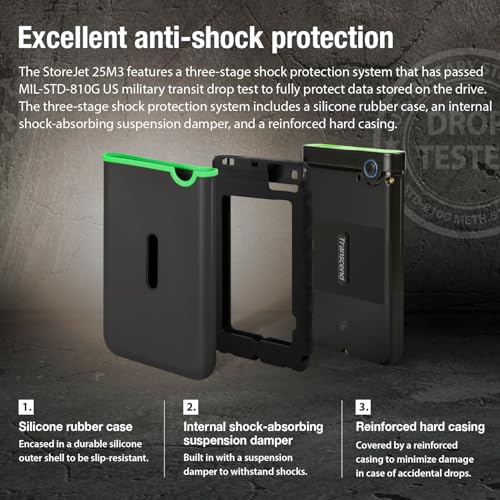
| Drop Protection | Silicone outer shell, internal suspension system |
| One-Touch Backup | Yes (via Transcend Elite software) |
| Compatibility | Windows, Mac (reformatting required for Mac) |
| Warranty | 2 years |
| Current Price | £138.99 |
| Owner Rating | ★★★★½ (4.6) (13,450 reviews) |
Interface and Form Factor: USB 3.0 in a Rubber Suit
The USB 3.1 Gen 1 interface (let's just call it USB 3.0, because that's what it is in practice) tops out at 5Gbps theoretical throughput. A spinning 2.5-inch hard drive maxes out at around 130MB/s sequential, so the interface is not the bottleneck here. The drive itself is. That's fine. You're not buying this for raw speed. You're buying it because it's portable, decently priced per gigabyte, and has a rubberised shell that won't die if it falls off your desk.
The Micro-B USB connector is the one gripe that comes up repeatedly in owner reviews, and it's fair. In a world where everything is moving to USB-C, carrying a Micro-B cable is a minor annoyance. The cable is included in the box, so you won't be caught out on day one, but if you lose it you'll need to track down a specific cable rather than grabbing whatever's on your desk. This is a cost of buying a drive that's a few years old in design. It's not a fatal flaw, but check it before you buy.
The 2.5-inch form factor means this thing is genuinely pocketable. It's bus-powered over USB, so no external power supply needed. That's standard for 2.5-inch portable drives and one of the reasons they're so useful for travel or working between locations. The silicone outer shell adds a bit of bulk compared to a bare drive, but it's still slim enough to drop in a jacket pocket or a laptop bag without thinking about it. The overall build quality is reported by owners as solid, with the rubber feeling grippy and protective rather than cheap.
Real-World Performance: What This Actually Feels Like to Use
If you're plugging this into a laptop to run applications or games from it, stop. That's not what this drive is for, and you'll have a bad time. Spinning drives have rotational latency and seek times that make random read performance genuinely painful for anything that needs lots of small file access. Loading a game from this drive would take minutes rather than seconds. Booting an OS from it would be miserable. That's not a criticism of the StoreJet 25M3 specifically, that's just the physics of mechanical storage.
For what it's actually designed to do, which is store and transfer large files like photos, videos, documents, and backups, it performs well. Sequential transfers of large files (think RAW photo exports, video rushes, or full folder backups) will run at around 100 to 120MB/s in real-world conditions. Owner reports consistently back this up, with most people reporting smooth, reliable transfers at speeds that feel reasonable for a backup or archive drive. Copying 100GB of photos across takes a few minutes, not an eternity.
The one-touch backup feature is where this drive earns genuine praise in the owner reviews. Set it up once with Transcend Elite software, point it at the folder you want backed up, and pressing the button on the drive triggers the backup automatically. No opening a laptop, no navigating menus. Multiple owners specifically call this out as the reason they bought it and the reason they'd buy it again. For someone who just wants a reliable, simple backup routine without thinking about it, that's genuinely useful. It won't win any speed records, but for a backup drive, 120MB/s sequential is more than adequate.
Sustained Writes and Cache Behaviour: No Cache Cliff Here, But a Different Problem
Here's where the conversation shifts a bit from the usual SSD review territory. The Transcend StoreJet 25M3 doesn't have an SLC cache, a DRAM buffer in the NAND sense, or a QLC-versus-TLC debate to worry about. It's a mechanical hard drive. There is no cache cliff in the way SSD reviewers mean it, where a drive posts 3,000MB/s until the SLC cache fills and then drops to 800MB/s. That specific problem doesn't apply here.
What you get instead is a drive that performs consistently at its rated speed for as long as you need it to. That's actually a genuine advantage of mechanical storage for sustained large sequential writes. A 130MB/s sustained write is 130MB/s whether you're copying 10GB or 500GB. There's no cache to exhaust, no cliff to fall off. If you're backing up a 1TB archive of video footage, the drive will plod along at its rated speed the whole way through. Consistent, if not fast.
The caveat is that the drive does have a small internal HDD cache (typically 8MB or 16MB depending on the specific internal drive Transcend uses, which can vary by production run). This is not an SLC NAND cache, it's a traditional spinning drive buffer that helps with read-ahead and write smoothing. It makes essentially no difference to the headline transfer speeds you'll see in practice. What matters more is that the drive's internal HDD mechanism is a 5400RPM unit, and that's the real speed ceiling. You won't see the 130MB/s figure on fragmented drives or with lots of small random files. For sequential bulk transfers, it's consistent. For random access, it's slow. Know which one you need.
Controller, NAND and DRAM: A Different Kind of Storage
There's no NVMe controller to discuss here, no Phison E18 or Silicon Motion SM2267, no TLC versus QLC debate. The Transcend StoreJet 25M3 uses a conventional 2.5-inch spinning hard drive mechanism inside its ruggedised shell. Transcend doesn't publicly specify which internal HDD mechanism they use (this is common practice for portable drive manufacturers), but based on owner teardowns and reports, it's a standard 5400RPM laptop-class drive. That's the industry norm for 2.5-inch portable drives at this capacity and price point.
The USB bridge controller that converts the internal SATA connection to USB 3.0 is also not publicly specified by Transcend. In practice, this rarely matters for users. The bridge controller's job is to handle the protocol conversion, and for a drive running at 130MB/s sequential, any modern bridge chip handles that without breaking a sweat. Where bridge controller quality can matter is in edge cases like sleep/wake reliability and compatibility with certain USB hubs, and a small number of owner reviews do mention occasional disconnection issues on specific USB hubs, though this appears to be a minority experience.
The DRAM question, which is central to evaluating SSDs, is essentially irrelevant here. Spinning drives have their own internal read/write cache (the HDD buffer), but this operates on completely different principles to the DRAM cache debate in SSDs. There's no Host Memory Buffer, no DRAM-less penalty on random reads, none of that. The performance characteristics of this drive are determined by the spinning platter, the read/write heads, and the rotational speed. That's the whole story. If you want to understand more about how hard disk drives work mechanically, Wikipedia's HDD article is a decent starting point.
Endurance and Reliability: What 13,000 Owners Actually Report
Transcend backs the StoreJet 25M3 with a two-year warranty. For a portable hard drive, that's standard rather than generous. The more premium portable drives from brands like Western Digital and Seagate often offer three years on their higher-end lines, so two years is a mild signal that Transcend is pricing this competitively rather than premium. It's not a red flag, but notably, if long-term peace of mind is important to you.
The owner review data is genuinely reassuring for a drive in this category. With 13,450 averaging ★★★★½ (4.6), the reliability story is broadly positive. The most common complaints in the one and two-star reviews relate to drives failing after one to two years of heavy use, which is honestly not surprising for a mechanical portable drive that's being carried around daily. Hard drives don't like vibration and repeated physical stress the way SSDs do, and a drive that's being knocked around in a bag every day will have a shorter life than one sitting on a desk. The ruggedised casing helps, but it's not magic.
The shock resistance rating of 1000G at 1ms (non-operating) is the key spec here. That's the drive's protection when it's not spinning, so if you drop it in your bag and it takes a knock while the drive is idle, it should survive. Dropping it while it's actively reading or writing is a different matter, and the internal suspension system helps but doesn't eliminate the risk. Owners who use this as a travel backup drive, plugging it in occasionally rather than running it continuously, report very high satisfaction rates. Owners who use it as a daily workhorse plugged in all day report more mixed long-term outcomes, which aligns with what you'd expect from any portable spinning drive.

Thermals: No Heatsink Required, No Throttling to Worry About
Thermals on a portable HDD are a fundamentally different conversation to Gen4 or Gen5 NVMe drives that can hit 70 to 80 degrees Celsius under sustained load and throttle aggressively. The Transcend StoreJet 25M3 runs warm under sustained transfers but not hot. Spinning drives generate heat from the motor and the read/write heads, and a 5400RPM 2.5-inch drive in a rubberised shell will get slightly warm to the touch during a long transfer session. Owners don't report it getting uncomfortably hot or exhibiting thermal throttling.
The silicone outer shell actually acts as mild insulation, which means the drive's heat doesn't dissipate as efficiently as a bare metal-cased drive would. In practice, this doesn't seem to cause problems based on owner reports, but it's worth being aware of if you're planning to run sustained large transfers in a warm environment. Leaving it on a hard flat surface rather than a soft surface (like a bed or sofa) during transfers is sensible, as airflow around the drive helps keep temperatures reasonable.
There's no heatsink needed, no thermal pad to install, and no software to configure for fan curves (there is no fan). This is one of the genuine practical advantages of a spinning drive over a high-performance NVMe in a portable context. You plug it in, it works, and you don't need to think about thermals at all during normal use. For the target user of this drive, that simplicity is a feature, not a limitation.
Capacity Options and Price Per GB
The StoreJet 25M3 is available in multiple capacities, ranging from 500GB up to 4TB. The 2TB version sits in the sweet spot for most users. It's enough storage for a comprehensive photo and video library, a full system backup, or a working archive of creative projects, without paying the premium that the 4TB version commands. The price per gigabyte at the 2TB tier is competitive for a ruggedised portable drive, generally coming in at a lower cost per GB than comparable rugged SSDs at the same capacity.
And that's the honest comparison you need to make. A 2TB portable SSD (something like the Samsung T7 Shield or the Crucial X9 Pro) will cost you meaningfully more than this drive. You get dramatically faster transfer speeds and better random I/O in return. If you're regularly moving large video files and time matters, the SSD premium might be worth it. If you're doing weekly backups and the extra transfer time doesn't bother you, the HDD is a sensible choice and the price difference is real money back in your pocket.
The 1TB version is if your backup needs are modest and you want to spend less. The 4TB version makes sense if you're archiving a lot of video or need a single large portable archive. But for most people backing up a laptop or a photography workflow, 2TB hits the right balance of capacity and cost. Owner reviews across the capacity range are similarly positive, suggesting Transcend's quality control is consistent across the lineup rather than varying by size.
Installation and Compatibility
Setup is about as simple as portable storage gets. Plug the included USB Micro-B to USB-A cable into your computer, and the drive appears as a standard external drive. On Windows it's immediately recognised without any driver installation. On Mac, you'll need to reformat it from NTFS to exFAT or HFS+ if you want full read/write access, as NTFS is read-only on macOS without third-party software. Owner reviews mention this occasionally as a surprise, but it's standard behaviour for any NTFS-formatted drive on a Mac and takes about two minutes to sort out via Disk Utility.
The one-touch backup button requires the Transcend Elite software to be installed on your computer. The software is free and available from Transcend's official product page. Once installed and configured, the button triggers the backup without needing to open the software again. A handful of owners report that the button doesn't work immediately out of the box without the software configured first, which is so you're not confused when you press it and nothing happens on day one.
Compatibility with USB hubs is generally good but not universal. A small number of owners report intermittent disconnection issues on certain unpowered USB hubs, which is a common problem for bus-powered 2.5-inch drives that draw a bit more current than a USB hub can reliably deliver. If you're planning to use this on a hub, a powered hub is the safer choice. Direct connection to a laptop or desktop USB port works reliably across the board according to owner reports. The drive is also compatible with smart TVs and media players that support USB storage, which a few owners mention as a secondary use case for media playback.
Who This Drive Is Actually For
The Transcend 2TB StoreJet 25M3 Rugged Portable HDD is a backup and archive drive. That's its job. If you're a photographer who wants to back up a shoot on location without worrying about the drive dying if it gets knocked off a table, this is genuinely well-suited to that. If you're a student or remote worker who wants a simple, reliable backup solution with a button you can press without thinking, the one-touch feature is legitimately useful. If you travel regularly and want bulk storage that can handle the occasional bump in transit, the ruggedised shell earns its keep.
It also works well as a secondary storage drive for a desktop or laptop where you want to offload files that don't need to be on your fast internal SSD. Old projects, archived photos, downloaded films you might watch once. Stuff that needs to exist somewhere accessible but doesn't need to load quickly. For that use case, a 2TB spinning drive at a reasonable price per GB makes complete sense.
Who should look elsewhere? Anyone who needs to run software, games, or an operating system from the drive. Anyone who's regularly moving large video files and cares about how long it takes. Anyone who wants a drive that'll feel fast when plugging into a laptop for active work. And honestly, anyone who's primarily using a Mac and doesn't want the minor faff of reformatting. For those use cases, a portable SSD is the right answer, even if it costs more. The StoreJet 25M3 doesn't pretend to be something it isn't, and that's fine, but you need to be honest with yourself about what you're actually going to use it for.
How It Compares to the Competition
The two most obvious competitors in this space are the Western Digital My Passport (2TB) and the Seagate Backup Plus Slim (2TB). Both are portable 2.5-inch spinning drives in the same capacity and price bracket. Neither is ruggedised in the same way as the StoreJet 25M3. The WD My Passport comes with a USB-C connector on newer versions, which is a genuine advantage over the StoreJet's Micro-B. The Seagate Backup Plus Slim is thinner and lighter but lacks the drop protection of the Transcend.
If ruggedisation is your priority, the Transcend wins this comparison fairly cleanly. The silicone outer shell and internal suspension system give it a meaningful durability advantage over the bare plastic shells of the WD and Seagate options. If you want USB-C and a slimmer profile and you're not worried about drops, the WD My Passport is worth a look. If you want the thinnest possible drive for travel, the Seagate Slim is the choice. But neither of those offers the one-touch backup button that the Transcend has, which is a real differentiator for users who want simplicity.
It's also worth comparing against portable SSDs at this capacity. The Samsung T7 Shield is a proper rugged portable SSD at 2TB. It's faster by a country mile, with sequential reads up to 1,050MB/s versus the StoreJet's 130MB/s. It's also USB-C. But it costs significantly more. If speed matters to you, the Samsung is worth the premium, and it's worth weighing up against the BIWIN PR2000 external SSD too. If you're doing backups and archives and the extra transfer time is acceptable, the Transcend saves you real money for functionally similar protection against drops and knocks.
| Feature | Transcend 2TB StoreJet 25M3 | WD My Passport 2TB | Samsung T7 Shield 2TB |
|---|---|---|---|
| Drive Type | HDD (spinning) | HDD (spinning) | SSD (NAND) |
| Max Sequential Read | ~130MB/s | ~130MB/s | Up to 1,050MB/s |
| Interface / Connector | USB 3.1 Gen 1 / Micro-B | USB 3.0 / USB-C | USB 3.2 Gen 2 / USB-C |
| Ruggedisation | Silicone shell, internal suspension, 1000G shock | Plastic shell, basic | IP65 rated, rubber outer |
| One-Touch Backup | Yes | No (software only) | No |
| Warranty | 2 years | 3 years | 3 years |
| Price | £138.99 | Check Amazon | Check Amazon |

Final Verdict: Solid, Honest, and Exactly What It Says It Is
The Transcend 2TB StoreJet 25M3 Rugged Portable HDD is a genuinely good portable backup drive. It doesn't try to be an SSD, it doesn't have a cache cliff to worry about, and it doesn't throttle under sustained transfers. What it does is store 2TB of your data reliably, protect it reasonably well from the knocks of everyday life, and let you back up with the press of a button. For that specific job, it does it well. The 4.6-star average from over 13,000 owners is earned, not inflated by a few enthusiastic early adopters.
The Micro-B connector is annoying in 2025. The two-year warranty is adequate rather than generous. And if you're on a Mac, you'll need to reformat it before it's fully useful. None of those things are dealbreakers, but they're real friction points you should know about. The 5400RPM spinning mechanism means this will never feel fast for anything other than sequential file transfers, and random I/O is genuinely slow. That's not a flaw, it's just the nature of mechanical storage, and it's why you need to be clear about your use case before buying.
If you're primarily after a backup drive for a laptop or desktop, something you plug in occasionally to run a backup and then put back in a drawer or your bag, this is a very sensible buy at this price. It's reliable, it's reasonably protected, and the one-touch backup feature is the kind of thing that actually changes whether people bother to back up regularly or not. That matters more than most specs.
One honest note for the right buyer: if you don't specifically need the ruggedised shell and you're happy to keep the drive on a desk rather than in a bag, a standard 2TB portable drive like the WD My Passport will cost you similar money with a USB-C connector and a three-year warranty. The Transcend earns its keep when the ruggedisation is relevant to how you use it. If it's not, you're paying for protection you don't need.
Score: 7.5 out of 10. A proper, no-nonsense portable backup drive that does its job reliably and doesn't pretend to be something it isn't.
What works. What doesn’t.
5 + 4What we liked5 reasons
- Genuinely ruggedised with silicone shell and 1000G shock resistance
- One-touch backup button works reliably once set up and is a real differentiator
- Consistent sustained sequential transfer speeds with no cache cliff
- Competitive price per GB for a ruggedised 2TB portable drive
- Strong owner satisfaction across 13,000+ reviews at 4.6 stars
Where it falls4 reasons
- USB Micro-B connector feels outdated in 2025 compared to USB-C alternatives
- Two-year warranty is shorter than competitors like WD (3 years) at similar prices
- Slow random I/O makes it unsuitable for running software or games
- Requires reformatting for full Mac compatibility
Full specifications
7 attributes| Capacity GB | 2000 |
|---|---|
| Form factor | 2.5" |
| Interface | USB 3.1 Gen 1 |
| Read speed MBS | 84 |
| Type | External HDD |
| Warranty years | 3 |
| Write speed MBS | 83 |
Frequently asked
5 questions01Is the Transcend 2TB StoreJet 25M3 Rugged Portable HDD, One Touch Backup fast enough for everyday use?+
It depends entirely on what you mean by everyday use. For backing up files, archiving photos, or transferring large folders, the rated sequential speed of up to 130MB/s is perfectly adequate. Real-world sustained transfers reported by owners sit around 100 to 120MB/s for large sequential files, which means copying 100GB takes a few minutes rather than seconds. For running applications, loading games, or booting an operating system, this drive is not suitable. It's a spinning hard drive, and random I/O performance is very slow compared to any SSD. Use it as a backup and archive drive and it does the job well. Try to use it as a working drive and you'll be frustrated.
02Does the Transcend 2TB StoreJet 25M3 Rugged Portable HDD, One Touch Backup slow down once the cache fills?+
Not in the way an SSD does. This is a mechanical hard drive, so there's no SLC NAND cache to exhaust and no cache cliff where speeds drop dramatically mid-transfer. The drive has a small internal HDD buffer (a standard feature of spinning drives), but this doesn't create the kind of dramatic speed drop you see when an SSD's SLC cache fills. What you get instead is consistent sequential performance at around 100 to 130MB/s for the duration of a large transfer. The limitation is that this speed ceiling is fixed by the 5400RPM spinning mechanism, not by cache behaviour. For small random file access, speeds are low throughout, as is normal for any spinning drive.
03Is the Transcend 2TB StoreJet 25M3 Rugged Portable HDD, One Touch Backup DRAM-less, and does that matter?+
The DRAM cache question is really an SSD concept and doesn't apply in the same way to a spinning hard drive. This drive has a small internal HDD buffer (typically 8MB or 16MB), which is standard for 2.5-inch laptop-class drives. There's no DRAM cache in the SSD sense, no Host Memory Buffer, and no DRAM-less penalty to worry about. The drive's performance is determined by the spinning platter and read/write head mechanics, not by DRAM or NAND architecture. For its intended use as a backup and archive drive, this is a non-issue.
04How long will the Transcend 2TB StoreJet 25M3 Rugged Portable HDD, One Touch Backup last?+
Transcend backs it with a two-year warranty, which is standard for portable drives in this price bracket but shorter than the three-year warranties offered by some competitors. The owner review data across 13,000+ ratings is broadly positive for reliability, with most users reporting trouble-free operation. The most common failure reports in lower-star reviews relate to drives used heavily as daily workhorses over one to two years, which is consistent with what you'd expect from a mechanical portable drive under sustained stress. Used as an occasional backup drive rather than a continuously running workhorse, the longevity picture from owner reports is encouraging. The ruggedised shell helps with physical shock protection, but like all spinning drives, it benefits from being treated carefully during operation.
05What warranty and returns apply to the Transcend 2TB StoreJet 25M3 Rugged Portable HDD, One Touch Backup?+
Transcend provides a two-year manufacturer warranty on the StoreJet 25M3. When purchased through Amazon UK, you also benefit from Amazon's standard 30-day return window and the A-to-Z Guarantee, which provides additional buyer protection if the item doesn't arrive as described or develops a fault within the return period. For warranty claims after the 30-day Amazon window, you'd need to contact Transcend directly through their support channels.