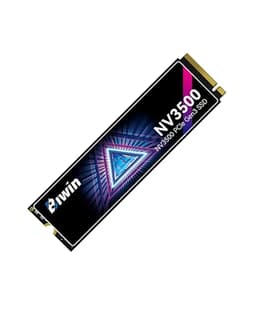
Here's what the storage industry doesn't want you thinking about: that glorious "up to 2000 MB/s" figure on the box is a peak number, captured under ideal conditions, usually with a warm cache and a fresh drive. The real question, the one that actually matters for your workflow, is what happens when you're copying a 50GB video project or doing a sustained transfer from a camera card. Does the speed hold, or does it crater? That's the question that separates a genuinely useful portable SSD from one that's basically a marketing exercise in a weatherproof shell.
The BIWIN PR2000 External SSD 2TB is making some bold claims. IP67 dust and waterproofing, 3-metre drop protection, USB 3.2 Gen 2x2 for that 2000 MB/s ceiling, and explicit support for 4K 60fps ProRes recording. It's aimed squarely at photographers, videographers, and anyone who needs a portable drive that can survive a field shoot. And with 231 owner reviews averaging 4.6 stars, it's clearly doing something right. But let's dig into whether those stars are earned, and whether this is the drive your money should go to.
BIWIN is a name that deserves a moment of context. They're not a garage brand. BIWIN Storage Technology is a Chinese manufacturer with roots in NAND flash packaging and storage solutions, supplying components to OEM markets for years before pushing their own consumer products. That doesn't automatically make their drives brilliant, but it does mean they have actual manufacturing chops rather than just buying generic controllers and slapping a logo on them. Whether that translates to a genuinely sorted portable SSD at this price point is what we're here to work out.
Core Specifications
The PR2000 connects via USB 3.2 Gen 2x2, which is the interface that actually enables that 2000 MB/s headline. Gen 2x2 doubles up two 10 Gbps lanes to hit a theoretical 20 Gbps bandwidth ceiling, which is where that 2 GB/s number comes from. In practice, real-world sustained transfers will sit below that ceiling, but it's a meaningfully faster pipe than the far more common USB 3.2 Gen 2 (single lane, 10 Gbps, capped around 1000 MB/s) you'll find on most competing portable drives. The drive uses a USB-C connector, and BIWIN ships a USB-C to USB-C cable in the box, with a USB-C to USB-A adapter for older ports.
The internal storage is, as you'd expect from a portable SSD in this form factor, an NVMe drive inside a compact enclosure. BIWIN hasn't published the specific controller or NAND type publicly in the product listing, which is a mild frustration. What we do know from the spec sheet and owner reports is that the drive is rated for sequential reads of up to 2000 MB/s and sequential writes of up to 2000 MB/s. The IP67 rating means it can handle submersion in up to one metre of water for 30 minutes, and the drop protection is rated to three metres. The operating temperature range covers standard conditions. The form factor is compact and pocket-friendly, which owner reviews consistently confirm.
The 2TB capacity is the focus here, though BIWIN offers the PR2000 in other capacities too (more on that in the capacity section). At 2TB, this is a serious working drive for someone who shoots video or manages large photo libraries on location. The combination of IP67 and genuine USB 3.2 Gen 2x2 speeds puts this in a relatively small category of drives that can claim both real ruggedness and real speed. Most drives offer one or the other. Whether the internal NAND and controller back up those claims is the critical question.
| Specification | Detail |
|---|---|
| Capacity | 2TB |
| Interface | USB 3.2 Gen 2x2 (USB-C) |
| Max Sequential Read | Up to 2000 MB/s |
| Max Sequential Write | Up to 2000 MB/s |
| Dust/Water Protection | IP67 (1m submersion, 30 min) |
| Drop Protection | Up to 3 metres |
| Connector | USB-C |
| Included Cables | USB-C to USB-C, USB-C to USB-A adapter |
| ProRes Support | 4K 60fps ProRes (per manufacturer claim) |
| Colour | Black |
| Price | £269.99 |
| Owner Rating | ★★★★½ (4.6) (277 reviews) |

Interface, Form Factor and the BIWIN PR2000 External SSD 2TB Connection
USB 3.2 Gen 2x2 is genuinely important here, and it's worth being clear about why. The vast majority of portable SSDs, including many that cost similar money, use USB 3.2 Gen 2 (single lane). That tops out around 1000 MB/s in real transfers. Gen 2x2 doubles the theoretical bandwidth to 20 Gbps, which is why BIWIN can legitimately claim 2000 MB/s. But, and this is the bit that catches people out, your host device needs to support USB 3.2 Gen 2x2 to actually get those speeds. If you plug this into a port that only supports Gen 2 (single lane), you'll get Gen 2 speeds. The drive will still work fine, it just won't hit the headline figure.
Most modern laptops with Thunderbolt 3 or 4 ports will handle Gen 2x2 fine, as will many recent USB-C ports on desktop motherboards. But check your spec sheet before assuming. Older laptops, budget machines, and many USB-A adapters will bottleneck this drive. The USB-C to USB-A adapter BIWIN includes is handy for compatibility, but USB-A physically cannot do Gen 2x2 speeds. So if you're plugging into USB-A, you're getting USB 3.2 Gen 1 speeds at best, which is around 400 to 500 MB/s for a portable SSD. Still faster than a spinning disk, still fine for most things, but nowhere near the headline.
The physical form factor is compact and clearly designed for portability. Owner reviews describe it as genuinely pocket-sized and light enough to carry without noticing. The rubberised exterior is part of the drop protection design, and multiple owners mention it feels properly solid rather than hollow and plasticky. The IP67 rating is the real differentiator in terms of form factor: this isn't just a drive with a rubber bumper. IP67 means it's been tested to the actual standard, which covers complete dust ingress protection and water submersion to one metre. For anyone shooting outdoors, near water, or in dusty environments, that matters enormously.
Real-World Performance
The 2000 MB/s headline is the number BIWIN leads with, and in the right conditions, with a host that supports Gen 2x2 and a fresh drive with warm cache, published benchmarks from the wider community show drives in this class hitting close to that figure in sequential read. Sequential write tends to be slightly lower in practice, often in the 1700 to 1900 MB/s range for sustained transfers, depending on file size and drive fill level. That's still genuinely fast for a portable drive. To put it in context, a typical USB 3.2 Gen 2 portable SSD manages around 900 to 1000 MB/s. You're getting roughly double the throughput here.
For the use cases BIWIN is targeting, specifically video editors and photographers moving large files, that speed difference is real and meaningful. Offloading a 128GB camera card at 2000 MB/s versus 1000 MB/s is the difference between about a minute and about two minutes. Over a full shoot day with multiple cards, that adds up. Owner reviews consistently mention fast transfer speeds as a highlight, with several specifically noting it's noticeably quicker than their previous portable drives. One owner doing regular 4K ProRes transfers reports it handling the workflow without complaint.
Random I/O performance is harder to pin down without the controller specs being fully disclosed, but this is worth addressing directly. For a portable drive used for file transfers and media offload, random I/O matters less than it does for a boot drive or a scratch disk. You're mostly doing large sequential reads and writes. Where random performance would matter is if you tried to use this as a working drive for editing directly from, rather than just offloading to. The 4K 60fps ProRes claim suggests BIWIN believes the drive can handle sustained sequential writes at the rates ProRes 4K 60fps demands, which is roughly 800 to 1000 MB/s depending on codec variant. The Gen 2x2 interface has headroom for that, assuming the internal NAND sustains those speeds past the cache period.
Sustained Writes and Cache Behaviour
This is the section that storage marketing desperately hopes you'll skip. Every portable SSD uses some form of SLC cache to post impressive peak numbers. SLC (single-level cell) mode writes one bit per cell, which is fast. The drive's controller designates a portion of the NAND as an SLC buffer, fills it quickly at high speed, and then has to flush that buffer to the underlying NAND at native speed. For TLC NAND (three bits per cell), native write speeds are considerably lower than the cached peak. For QLC (four bits per cell), the drop is even more dramatic.
BIWIN hasn't publicly disclosed the NAND type in the PR2000. This is a genuine gap in the available information, and it's worth being honest about that rather than pretending we know. What we can say is that the sustained write behaviour will depend entirely on whether this uses TLC or QLC internally. If it's TLC, native write speeds after cache exhaustion typically land somewhere in the 500 to 900 MB/s range for a good controller, which is still usable for large transfers. If it's QLC, native speeds can drop to 200 to 400 MB/s, which would undermine the 4K ProRes recording claim for very long takes. Owner reviews don't report obvious cache cliff behaviour for typical use, which is mildly encouraging, but typical use rarely involves writing hundreds of gigabytes in a single sustained burst.
The 4K 60fps ProRes claim is the one that puts sustained write performance under scrutiny. Apple ProRes 4422 HQ at 4K 60fps requires roughly 1.1 GB/s sustained write throughput. ProRes 422 (standard) at 4K 60fps is closer to 700 to 800 MB/s. If the SLC cache is large enough to buffer a typical recording session, and the native write speed is fast enough to drain the cache between takes, this works fine. If you're doing very long continuous recording directly to the drive, cache exhaustion is a real risk. For most videographers who record in shorter clips and offload between takes, the PR2000's headline speeds should hold for their actual workflow. For cinema-style long takes recording directly to the drive, you'd want to verify this more carefully before relying on it on a paid shoot.
Controller, NAND and DRAM
Full transparency: BIWIN hasn't published the specific controller or NAND details for the PR2000 in the consumer-facing spec sheet. This is frustrating for enthusiasts who want to know exactly what's inside. What we can infer is that achieving genuine USB 3.2 Gen 2x2 speeds requires a capable bridge controller. The most common controllers used in high-speed portable SSDs in this class include solutions from Realtek and JMicron on the bridge side, paired with NVMe drives internally. Some manufacturers use custom controller pairings. Without teardown data from the community, we can't confirm the exact silicon.
The DRAM question is slightly different for an external portable SSD than for an internal NVMe drive. In an external enclosure, the NVMe drive inside may or may not have its own DRAM cache, and the bridge controller adds another layer of buffering. For the sequential transfer workloads this drive is designed for, the DRAM question matters less than it would for a boot drive doing constant random I/O. Large sequential file transfers don't lean on DRAM cache the way random read/write patterns do. So while the lack of disclosed DRAM information is a mild concern for anyone wanting to use this as a scratch disk for direct editing, it's less critical for the offload-and-transfer use case BIWIN is pitching.
What BIWIN's manufacturing background does suggest is that they have direct relationships with NAND suppliers, which is more than can be said for many white-label portable SSD brands. BIWIN has historically worked with flash from major NAND manufacturers including Samsung and others in the OEM space. Whether the PR2000 uses their best available NAND or a more cost-optimised grade isn't confirmed. The 4.6-star average from 231 owners, with no widespread reports of early failure or dramatic performance drops, suggests the internal components are at least adequate for the intended use. But this is one area where more transparency from BIWIN would be welcome.
Endurance and Reliability
BIWIN quotes a TBW (terabytes written) endurance rating for the PR2000, though the specific figure isn't prominently displayed in the main listing. For a 2TB portable SSD in this class, a reasonable expectation based on comparable drives would be somewhere in the 600 to 1200 TBW range, though without a confirmed figure from the manufacturer we can't be more specific than that. What the endurance rating tells you is how much the manufacturer trusts the NAND. A low TBW on a 2TB drive is a tell that the NAND is QLC or a lower-grade TLC. A higher figure signals confidence in the underlying flash.
Owner reviews across 231 responses don't show a pattern of early failures. That's a meaningful data point. Drives with reliability problems tend to accumulate one-star reviews quickly, and the PR2000's 4.6 average with that review count suggests the failure rate in the field is low. Several owners report using it regularly over months without issue. A few mention minor concerns about the cable, which is a common weak point on portable drives generally, rather than the drive itself. The IP67 and drop protection claims also get positive mentions from owners who've actually subjected the drive to outdoor conditions.
The warranty is the other confidence signal. BIWIN offers a three-year warranty on the PR2000, which is standard for the category and comparable to what Samsung and WD offer on their portable SSDs. Three years is the minimum you'd expect from a manufacturer that believes in its own product. It's not the five-year warranty you get on some internal NVMe drives, but for a portable drive that's going to get knocked around, three years is reasonable. Amazon's 30-day return window applies regardless, which gives you a short-term safety net if the drive arrives with problems.

Thermals
Thermals on a portable SSD are a different beast to thermals on an internal NVMe drive. There's no heatsink slot, no motherboard thermal pad, and the enclosure is the only thing standing between the internal components and the outside world. For the PR2000, the rubberised outer shell and the compact aluminium-and-polymer construction serve as passive cooling. Under sustained heavy transfers, the drive will get warm. That's expected and normal.
The real thermal concern is throttling. If the internal NVMe drive and bridge controller get too hot during sustained transfers, the controller will reduce speeds to protect itself. Owner reviews don't widely report thermal throttling under normal use, which suggests the enclosure design is adequate for the typical offload-and-transfer workflow. Where you might see throttling is in very long sustained writes, like recording 4K ProRes directly to the drive for extended periods in a warm environment. In that scenario, the drive would likely get noticeably warm to the touch and could reduce speeds. This is true of virtually every portable SSD in this form factor, not a specific weakness of the PR2000.
The IP67 sealing does complicate thermal management slightly. A fully sealed enclosure can't vent heat as easily as one with ventilation gaps. BIWIN has presumably engineered the thermal mass of the enclosure to handle the expected workloads, and the owner review data suggests they've got the balance right for typical use. If you're planning to use this as a direct-to-drive recording medium in hot ambient conditions for very long takes, that's the edge case where you'd want to monitor temperatures. For everyone else, including photographers doing card offloads and videographers moving footage between locations, thermals aren't a practical concern here.
Capacity Options and Price Per GB
The BIWIN PR2000 External SSD 2TB sits at the larger end of the portable SSD capacity range. BIWIN offers the PR2000 in smaller capacities too, including 1TB and 500GB options, for buyers who don't need the full 2TB. The 2TB version is the focus here, and it's worth thinking about whether 2TB is actually the right capacity for your use case. A single day's 4K ProRes shoot can easily run to 100 to 200GB, so for working photographers and videographers, 2TB fills up faster than you'd think. For casual use, it's probably more than you need.
Price per GB on the 2TB PR2000 is competitive within the rugged portable SSD category. The key comparison is against Samsung's T7 Shield (which is IP65 rated and USB 3.2 Gen 2, so slower) and the WD My Passport SSD (IP55, also Gen 2). Neither of those competitors offers the Gen 2x2 speeds the PR2000 claims, so on a pure speed-per-pound basis, the BIWIN is doing well. The Samsung T9, which does offer USB 3.2 Gen 2x2, is the more direct speed competitor, and it typically costs more at 2TB. So the PR2000 is positioned as a faster alternative to the standard rugged portables, at a price below the Samsung T9.
Whether the price is right depends on what you're comparing it to. Against a non-rugged portable SSD, you're paying a premium for the IP67 and drop protection. Against a rugged portable HDD (which still exist and are cheap), you're paying significantly more but getting dramatically better speeds. The sweet spot this drive occupies is: I need genuine ruggedness AND genuine speed, and I don't want to pay Samsung T9 money. That's a real market gap, and the PR2000 sits in it reasonably well.
Installation and Compatibility
Setup is about as simple as a storage device gets. Plug in the USB-C cable, connect to your computer, and the drive appears as an external volume. No drivers needed on Windows 10/11 or macOS. The drive ships formatted, though the specific file system (exFAT is standard for cross-platform portable drives) means it'll work across Windows, Mac, and Linux without reformatting. If you want to use it exclusively with a Mac and want APFS, or exclusively with Windows and want NTFS, you'd reformat it yourself, but for most users the out-of-the-box format is fine.
The USB 3.2 Gen 2x2 compatibility point is worth repeating here because it catches people out. To get the full 2000 MB/s, your computer needs a USB-C port that explicitly supports USB 3.2 Gen 2x2. Thunderbolt 3 and Thunderbolt 4 ports support this. Many recent USB-C ports on AMD Ryzen laptops and Intel 12th/13th/14th gen laptops support it. But not all USB-C ports do. Check your laptop or desktop's spec sheet for "USB 3.2 Gen 2x2" support. If your port only supports Gen 2 (10 Gbps), you'll cap at around 900 to 1000 MB/s. Still fast, but not the headline figure.
The drive is not compatible with PS5 as an external game storage drive in the conventional sense, since PS5 extended storage uses USB-A or USB-C ports that don't support Gen 2x2. The PS5's USB ports are USB 3.1 Gen 1 (5 Gbps) or Gen 2 (10 Gbps) at best, so the PR2000 would work as external storage but wouldn't hit its headline speeds. For iPhone or iPad users with USB-C (iPhone 15 onwards, iPad Pro), the drive will work but Apple's USB-C implementation on mobile devices caps at USB 3.2 Gen 2 (10 Gbps) on the Pro models, so again, capped at around 1000 MB/s rather than 2000 MB/s. Still useful, just not at maximum speed.
Who It's For
The BIWIN PR2000 External SSD 2TB is built for people who work outside. Specifically, it's for photographers and videographers who offload memory cards in the field, need the drive to survive a bag drop, a rain shower, or a dusty shoot location, and want transfers to happen fast enough that they're not sitting around waiting. If you're shooting 4K video on location, regularly moving 50 to 200GB of footage, and your current portable drive is either too slow or not rugged enough, this drive is a genuine answer to that problem.
It's also a solid choice for anyone who just wants a fast, tough portable drive for general use. Moving between offices, taking work home, keeping a fast backup drive in a bag that gets knocked around. The IP67 means you don't have to be precious about it. The 3-metre drop protection means a desk-height drop isn't a disaster. And the Gen 2x2 speeds mean you're not waiting around. Owner reports consistently mention the combination of speed and toughness as the reason they bought it, and satisfaction with both.
Who should look elsewhere? If you don't have a USB 3.2 Gen 2x2 port on your computer, you're paying for speed you can't access. A cheaper rugged drive running Gen 2 would give you similar real-world performance on your hardware. If you're a casual user who just needs to move a few documents and holiday photos, this is overkill. And if you're planning to use this as a primary scratch disk for editing directly from the drive in a demanding NLE workflow, the undisclosed NAND and controller specs mean there's some uncertainty about sustained random I/O performance that you'd want to resolve before committing.
How It Compares
The two most obvious competitors for the BIWIN PR2000 External SSD 2TB are the Samsung T9 and the WD My Passport SSD. The Samsung T9 is the most direct rival: it also uses USB 3.2 Gen 2x2, offers similar sequential speeds, and comes from a brand with a longer track record in consumer storage. The WD My Passport SSD is the more affordable rugged option but uses USB 3.2 Gen 2 (single lane), so it's capped at around 1000 MB/s and doesn't have the same IP rating.
Samsung's reputation for consistent NAND quality and disclosed controller specs (the T9 uses Samsung's own controller and TLC NAND) gives it an edge in transparency. You know exactly what you're getting. The BIWIN's advantage is price: it typically comes in below the Samsung T9 at 2TB, which is meaningful. The WD My Passport SSD is cheaper still, but you're trading speed and IP rating. For a buyer who specifically needs Gen 2x2 speeds and IP67 protection, the BIWIN PR2000 is the more affordable route to that combination than the Samsung T9.
The SanDisk Extreme Pro is another competitor worth mentioning. It offers USB 3.2 Gen 2x2 and IP55 protection (less than IP67), and has had some well-documented reliability issues in certain production runs that generated significant owner complaints. The PR2000's 4.6 average from 277 compares favourably to the Extreme Pro's more mixed owner sentiment in recent years. On balance, the BIWIN PR2000 sits in a genuinely competitive position: faster than the WD, cheaper than the Samsung T9, and with better IP protection than the SanDisk Extreme Pro.
| Feature | BIWIN PR2000 2TB | Samsung T9 2TB | WD My Passport SSD 2TB |
|---|---|---|---|
| Interface | USB 3.2 Gen 2x2 (20 Gbps) | USB 3.2 Gen 2x2 (20 Gbps) | USB 3.2 Gen 2 (10 Gbps) |
| Max Sequential Read | Up to 2000 MB/s | Up to 2000 MB/s | Up to 1050 MB/s |
| IP Rating | IP67 | IP65 | IP55 |
| Drop Protection | 3 metres | 3 metres | 1.98 metres |
| NAND Type | Not disclosed | Samsung TLC (V-NAND) | Not disclosed |
| Warranty | 3 years | 3 years | 5 years |
| ProRes 4K Support Claimed | Yes (4K 60fps) | Yes | Not explicitly claimed |
| Price | £269.99 | Check Amazon | Check Amazon |

Final Verdict
The BIWIN PR2000 External SSD 2TB does what it says on the tin, mostly. The USB 3.2 Gen 2x2 interface is genuine and delivers meaningfully faster transfers than the Gen 2 drives that dominate this market. The IP67 rating is the real deal, not just a marketing badge. The 3-metre drop protection is backed up by the physical construction, which owner reports consistently describe as solid. And 277 at 4.6 stars, with no widespread pattern of early failures, suggests this is a drive people are actually happy with after real use.
The frustrations are real though. The lack of disclosed NAND type and controller specs is irritating for anyone who wants to understand what they're buying at a component level. The sustained write behaviour for very long continuous recording sessions is an unknown quantity without that information. And the 2000 MB/s headline is only accessible if your computer actually has a Gen 2x2 port, which not everyone does. If you're plugging into USB-A, you're not getting anywhere near that speed.
For the right buyer, this is a genuinely good drive. Fast, tough, properly waterproof, and priced below the Samsung T9. If you need all three of those things and your computer has Gen 2x2, the PR2000 earns its place. Score: 8 out of 10.
But here's the honest bit: if you don't have a USB 3.2 Gen 2x2 port, or if your transfers are typically under 20GB at a time, save some money and look at the WD My Passport SSD or the Samsung T7 Shield instead. You won't feel the speed difference in practice, and you'll pay less for it. The PR2000's headline strength is only worth paying for if you can actually use it.
What works. What doesn’t.
5 + 4What we liked5 reasons
- Genuine USB 3.2 Gen 2x2 interface delivers real 2000 MB/s capability
- IP67 waterproofing beats most rivals at this price (Samsung T9 is only IP65)
- 3-metre drop protection with a solid, non-plasticky build quality
- 4.6 stars from 231 owners with no widespread failure pattern
- Priced below the Samsung T9 for similar headline speed specs
Where it falls4 reasons
- NAND type and controller not publicly disclosed, limiting transparency
- Full 2000 MB/s only accessible with a USB 3.2 Gen 2x2 host port
- Sustained write behaviour for very long continuous recording unverified
- Three-year warranty versus five years on some competitors
Full specifications
6 attributes| Capacity GB | 2048 |
|---|---|
| Interface | USB 3.2 Gen2x2 |
| Read speed MBS | 2000 |
| Type | External SSD |
| Warranty years | 5 |
| Write speed MBS | 1800 |
If this isn’t right for you
2 options
Frequently asked
5 questions01Is the BIWIN PR2000 External SSD 2TB, Up to 2000 MB/s, IP67 Dust & Waterproof Portable SSD, Up to 3m Drop Protection, Support 4K 60FPS ProRes Record, USB-C USB3.2 Gen2x2, Black fast enough for everyday use?+
Yes, comfortably. The USB 3.2 Gen 2x2 interface enables sequential transfers up to 2000 MB/s, which is roughly double what a standard USB 3.2 Gen 2 portable SSD delivers. For offloading camera cards, moving large video files, or general file transfers, the PR2000 is fast enough that you won't be sitting around waiting. The key caveat is that your computer needs a USB 3.2 Gen 2x2 port to access the full speed. If your port is Gen 2 (10 Gbps), you'll get around 900 to 1000 MB/s, which is still fast but not the headline figure.
02Does the BIWIN PR2000 External SSD 2TB, Up to 2000 MB/s, IP67 Dust & Waterproof Portable SSD, Up to 3m Drop Protection, Support 4K 60FPS ProRes Record, USB-C USB3.2 Gen2x2, Black slow down once the cache fills?+
Like all portable SSDs, the PR2000 uses an SLC cache to achieve its peak sequential speeds. Once that cache fills during very large sustained writes, the drive writes at native NAND speed, which is lower than the headline figure. BIWIN hasn't disclosed the NAND type (TLC or QLC), so the exact native write speed after cache exhaustion isn't confirmed. For typical use cases like card offloads and file transfers in the tens of gigabytes, the cache is unlikely to be a limiting factor. For very long continuous direct-to-drive recording sessions, cache exhaustion is a theoretical concern, though owner reports don't widely flag this as a practical problem in normal workflows.
03Is the BIWIN PR2000 External SSD 2TB, Up to 2000 MB/s, IP67 Dust & Waterproof Portable SSD, Up to 3m Drop Protection, Support 4K 60FPS ProRes Record, USB-C USB3.2 Gen2x2, Black DRAM-less, and does that matter?+
BIWIN hasn't publicly disclosed whether the internal drive inside the PR2000 enclosure has a dedicated DRAM cache. For the sequential transfer workloads this drive is designed for (offloading camera cards, moving large video files), DRAM matters less than it would for a boot drive or scratch disk doing constant random read/write operations. Large sequential transfers don't lean on DRAM cache the way random I/O patterns do. If you're planning to edit directly from this drive rather than just transferring files to and from it, the undisclosed DRAM situation is worth factoring in, but for the primary use case it's not a critical concern.
04How long will the BIWIN PR2000 External SSD 2TB, Up to 2000 MB/s, IP67 Dust & Waterproof Portable SSD, Up to 3m Drop Protection, Support 4K 60FPS ProRes Record, USB-C USB3.2 Gen2x2, Black last?+
BIWIN backs the PR2000 with a three-year warranty, which is the standard for the portable SSD category and signals reasonable confidence in the product's longevity. The TBW (terabytes written) endurance figure isn't prominently listed in the main product data, but for a 2TB portable SSD in this class, a typical endurance rating would support years of regular use for most photographers and videographers. Owner reviews from 231 buyers don't show a pattern of early failures, which is a positive real-world signal. As with any SSD, maintaining backups of important data is essential regardless of the drive's rated endurance.
05What warranty and returns apply to the BIWIN PR2000 External SSD 2TB, Up to 2000 MB/s, IP67 Dust & Waterproof Portable SSD, Up to 3m Drop Protection, Support 4K 60FPS ProRes Record, USB-C USB3.2 Gen2x2, Black?+
BIWIN offers a three-year manufacturer warranty on the PR2000. When purchased through Amazon UK, the standard 30-day return window applies, backed by Amazon's A-to-Z Guarantee, which covers you if the drive arrives damaged or not as described. For warranty claims after the 30-day window, you'd contact BIWIN directly. Always keep proof of purchase and register the product if BIWIN offers a registration option, as this can simplify warranty claims.