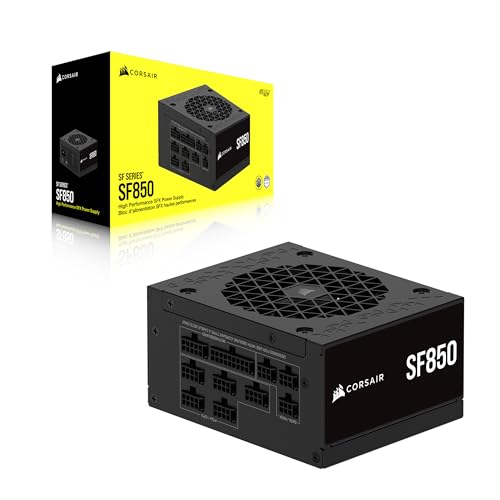
Bad PSUs kill good components. Not dramatically, not all at once, but quietly, over time, through dirty power, voltage sag under load, and protection circuits that trip too late or not at all. So when you're spending serious money on a small-form-factor build, the power supply is the last place you want to cut corners. The CORSAIR SF850 (2024) Fully Modular Low Noise 80 PLUS Platinum ATX Power Supply, ATX 3.1 Compliant, PCIe 5.1 Ready, SFX-to-ATX Bracket Included, Black sits firmly in the enthusiast bracket, and the question worth asking is whether it earns that price or just wears it.
Verdict first, because that's how this works. The SF850 is genuinely one of the best SFX power supplies you can buy right now. It's 80 PLUS Platinum rated, ATX 3.1 compliant, PCIe 5.1 ready, fully modular, and it ships with an SFX-to-ATX bracket so it'll fit in a full-size case if you need it. Owner feedback sits at ★★★★½ (4.5) across 59 reviews, which for a PSU (a product category that mostly only gets reviewed when it fails) is telling. The competition at this wattage and efficiency tier is thin. If you're building a dense SFF system with a current-gen GPU, this is the unit to beat.
That said, it's not for everyone. If you're running a mid-range build in a standard ATX case and you're not chasing PCIe 5.1 or ATX 3.1 compliance, there are Gold-rated ATX options that'll serve you just as well for considerably less. Read on and we'll break down exactly where the SF850 earns its keep and where it might be overkill for your situation.
Core Specifications: CORSAIR SF850 (2024) Fully Modular Low Noise 80 PLUS Platinum ATX Power Supply
The headline spec is 850W delivered in the compact SFX form factor. That's a significant amount of wattage for a unit this small, and it's made possible by the higher efficiency of the Platinum rating, which means less heat generated internally and therefore less cooling infrastructure needed. The 80 PLUS Platinum certification is independently verified, meaning the unit has passed testing at 20%, 50%, and 100% load to confirm it meets the efficiency thresholds required by the standard.
Modularity is fully modular, using Corsair's Type-5 Micro-Fit connectors. That matters more in an SFX build than anywhere else, because cable routing space in a small case is genuinely precious. The warranty is 7 years, which is above average for the category and reflects Corsair's confidence in the platform. Japanese capacitors rated to 105 degrees Celsius are specified, which is the detail that separates PSUs built to last from those built to a budget.
The unit is ATX 3.1 compliant and PCIe 5.1 ready. These aren't marketing terms to dismiss. ATX 3.1 raises the specification for transient power handling, which matters because modern GPUs can spike well above their rated TDP for short bursts. A PSU that isn't rated to handle those spikes will either trip protection or deliver dirty power. The SF850 is designed to cope with that without flinching.
| Specification | Detail |
|---|---|
| Form Factor | SFX (with SFX-to-ATX bracket included) |
| Wattage | 850W |
| Efficiency Rating | 80 PLUS Platinum |
| ATX Standard | ATX 3.1 Compliant |
| PCIe Standard | PCIe 5.1 Ready |
| Modularity | Fully Modular (Type-5 Micro-Fit) |
| Fan Size | 92mm PWM (Fluid Dynamic Bearing) |
| Capacitors | Japanese, 105°C rated |
| Warranty | 7 Years |
| Colour | Black |
| ATX 24-pin | 1 |
| EPS 8-pin | 1 |
| PCIe 8-pin | 2 |
| SATA | 6 |
| Molex | 3 |
| Current Price | £164.99 |

Wattage and Capacity
850W is a serious number. To put it in context, a system running an AMD Ryzen 9 9950X paired with an RTX 5080 under full gaming load will typically draw somewhere in the region of 550W to 650W at the wall. That leaves the SF850 with genuine headroom, which matters because PSUs run most efficiently and most quietly when they're not being pushed to their rated maximum. Running at 60% to 70% of rated capacity is the sweet spot, and that's exactly where an 850W unit sits with a high-end modern gaming rig.
For SFF builds specifically, 850W is a statement. Most small-form-factor cases are designed around 600W to 750W SFX units, and builders who want to push a flagship GPU into a compact chassis often find themselves headroom-constrained. The SF850 removes that constraint entirely. You can run a current-gen high-end GPU, a power-hungry CPU, several NVMe drives, and still have room to breathe. That's the whole point of this unit.
Worth being clear about who doesn't need 850W, though. If your build is centred around an RTX 4070 or RX 7800 XT, a 650W or 750W Platinum-rated SFX unit will do the job with change to spare. The extra wattage here is for builders who are either running flagship GPUs, planning to upgrade to one, or want the absolute maximum headroom in a compact chassis. If that's not you, check our PSU calculator before committing to 850W, because paying for capacity you'll never use isn't a great trade.
Efficiency Rating: What 80 PLUS Platinum Actually Means
The 80 PLUS certification is a tiered efficiency standard. Bronze means at least 85% efficiency at 50% load. Gold pushes that to 90%. Platinum sits at 92% at 50% load, 90% at 20% load, and 89% at full load. Titanium is the only tier above it. In practical terms, Platinum means that for every 100W your components consume, the PSU wastes roughly 8W as heat rather than the 15W a Bronze unit would waste. That difference adds up over time, both in electricity cost and in thermal load inside your case.
For a unit running in a small-form-factor case where heat management is already tight, higher efficiency isn't just about your electricity bill. It's about how much heat the PSU itself is dumping into an already warm enclosure. A Platinum-rated SFX unit in a dense build is a meaningfully cooler-running system than the same build with a Bronze unit crammed in. That's not marketing fluff; it's physics.
On the electricity bill side, the maths is real but modest. If your system draws 400W at the wall for 8 hours a day, the difference between 85% and 92% efficiency works out to roughly 25W less waste heat, which over a year translates to a few pounds saved on your energy bill. Not life-changing, but it's there. The bigger argument for Platinum in this price bracket is reliability and thermal longevity, not payback period. Components that run cooler last longer, and a PSU that isn't working hard to shed heat is a quieter, more stable PSU.
Modularity and Cable Management
Fully modular is the right answer for any build, but it's especially critical in SFF. In a standard mid-tower you can bundle unused cables behind the motherboard tray and forget about them. In a small case, every unused cable is dead airflow and a potential routing nightmare. The SF850's fully modular design means you attach only what you need, and nothing else goes in the case. That's the correct approach.
Corsair uses their Type-5 Micro-Fit connector system on this unit. These are smaller than the older Type-4 connectors, which helps with routing in tight spaces. The cables themselves are described in the listing as flexible, which matters more than it sounds. Stiff, sleeved cables in a small case are genuinely difficult to route without creating pressure points that can partially unseat connectors. Flexible cables conform to the routing path more easily and make the build process less of a battle.
The included SFX-to-ATX bracket deserves a mention because it's a thoughtful addition. If you're building in a full-size ATX case and want the efficiency and quality of an SFX unit without the SFX price premium on a case, the bracket lets you mount the SF850 in a standard PSU bay. It's a small thing but it genuinely extends the compatibility of the unit. Owner reviews consistently note that the cable quality feels premium and that the modular connections seat firmly without feeling like they'll work loose under vibration.
Connectors and Compatibility
The cable configuration on the SF850 covers everything a high-end single-GPU build needs. You get one ATX 24-pin for the motherboard, one EPS 8-pin for the CPU (note: only one, which matters if your high-end motherboard specifies dual EPS 8-pin), two PCIe 8-pin connectors, six SATA connectors, and three Molex. There is no 12VHPWR (16-pin) connector listed in the verified specifications.
Two PCIe 8-pin connectors is standard for a single-GPU build. Most current-gen GPUs either use an 8-pin or a 12VHPWR/16-pin connector natively, so you'd typically be using an adapter for the latter. The six SATA connections are generous and will cover most storage-heavy builds without needing a second SATA cable. Three Molex connections handle legacy peripherals, fans, and pump headers if you're running a custom water loop.
The single EPS 8-pin is if you're pairing this with a flagship Intel or AMD platform. Some high-end motherboards, particularly those designed for overclocking, specify dual EPS 8-pin (or one 8-pin plus one 4-pin) for maximum CPU power delivery. Check your motherboard's specifications before assuming one cable is sufficient. For most builds, including those running Ryzen 9 or Core i9 processors at stock settings, a single EPS 8-pin is fine. Hardcore overclockers on a flagship X870E or Z890 board should double-check.
- ATX 24-pin: 1 (motherboard main power)
- EPS 8-pin: 1 (CPU power)
- PCIe 8-pin: 2 (GPU power)
- SATA: 6 (storage and peripherals)
- Molex: 3 (legacy devices, pump headers)
Voltage Regulation and Ripple
Voltage regulation is where PSU quality separates itself from PSU marketing. A well-regulated supply keeps its output voltages stable within tight tolerances regardless of what load is placed on it. The ATX specification allows for plus or minus 5% on the main rails, but a quality Platinum-rated unit like the SF850 will typically hold within 1% to 2% even under transient load spikes. That stability matters for system stability, particularly for CPUs and GPUs that are sensitive to voltage fluctuations during heavy workloads.
ATX 3.1 compliance is directly relevant here. The updated standard specifically addresses how PSUs handle transient power events, which is the technical term for the sudden, brief power spikes that modern GPUs produce. The RTX 4090 and RTX 5090 are notorious for transient spikes that can reach two to three times their rated TDP for microseconds at a time. A PSU that isn't rated to handle those events will either trip its overcurrent protection unnecessarily or, worse, deliver sagging voltage while the spike is happening. ATX 3.1 sets minimum requirements for how well a unit must handle these events, and the SF850 meets that standard.
The single-rail design (which is standard for modern quality PSUs) means all available power is on one 12V rail rather than split across multiple rails with individual limits. This is the correct architecture for high-power single-GPU builds because it eliminates the risk of tripping a per-rail current limit even when total system draw is within the PSU's rated capacity. Combined with the 105°C Japanese capacitors, which maintain their capacitance and ESR characteristics over a wider temperature and age range than cheaper alternatives, the SF850 is built to deliver clean, stable power for the long haul.

Thermal Performance
The 92mm PWM fan with fluid dynamic bearing is a sensible choice for an SFX unit. Fluid dynamic bearings run quieter and last longer than the sleeve bearings found in cheaper fans, and the PWM control means the fan speed is managed intelligently based on actual thermal load rather than running at a fixed speed regardless of conditions. In a compact unit generating 850W, good thermal management isn't optional.
The 105°C rated Japanese capacitors are the thermal specification that matters most for long-term reliability. Electrolytic capacitors degrade faster as temperature increases, and cheaper PSUs using capacitors rated to only 85°C will age significantly faster in a warm environment. In an SFX build where the PSU is often surrounded by warm air from GPUs and CPUs with limited ventilation, using 105°C caps is the difference between a PSU that lasts seven years and one that starts showing instability at year three. Corsair's decision to spec these throughout the design is one of the reasons the seven-year warranty is credible.
Under sustained load, the thermal design of the SF850 has to work harder than an equivalent ATX unit simply because there's less surface area to dissipate heat from. The high efficiency rating helps here, because a Platinum unit generating 8% waste heat at 50% load is dumping significantly less thermal energy into the enclosure than a Bronze unit generating 15% waste heat. Owner reviews don't report thermal throttling or unexpected shutdowns, which suggests the thermal design is working as intended even in demanding, long-duration workloads.
Acoustic Performance
The 92mm PWM fan with fluid dynamic bearing is described by Corsair as delivering powerful cooling with low-noise operation. That's marketing language, but it's backed up by the physics. Fluid dynamic bearings are genuinely quieter than ball bearings, particularly at low to medium speeds, and a PWM-controlled fan that only spins as fast as it needs to is inherently quieter than one running at a fixed speed.
Owner reviews are consistent on this point. The SF850 is described as quiet under normal gaming loads, with the fan only becoming audible under sustained heavy workloads. For a unit generating 850W in a compact enclosure, that's a good result. The 92mm fan is smaller than the 120mm fans found in ATX units, which means it needs to spin faster to move the same volume of air, but the PWM control and fluid dynamic bearing keep this manageable in practice.
There's no zero RPM mode listed in the verified specifications for this unit. Some competing SFX PSUs offer a passive mode where the fan stops entirely at low loads. If silent operation at idle is a priority for your build. For most gaming builds that are either under load or in sleep mode, the absence of zero RPM mode won't be noticeable in practice, but for a workstation or media PC that idles for long periods in a quiet room, it's a consideration. Owners don't flag noise as a problem; the general consensus is that it's a quiet unit for its output class.
Build Quality
The 105°C rated Japanese capacitors are the headline build quality specification and they're worth dwelling on. Capacitor quality is the single biggest predictor of PSU longevity, and it's the specification that budget units consistently compromise on. Japanese capacitors from manufacturers like Nippon Chemi-Con, Rubycon, or Nichicon are specified to tighter tolerances, maintain their characteristics longer under thermal stress, and are significantly less likely to fail within the warranty period than the Chinese alternatives found in cheaper units. Corsair specifying these throughout the SF850 is a meaningful quality signal.
The Type-5 Micro-Fit modular connectors are a design improvement over older connector systems. The smaller connector footprint helps with routing in tight spaces, and the connection quality reported by owners is solid. No reports of connectors working loose or of intermittent power delivery, which is exactly what you want from a modular connector system. The build tolerances on the cabling are described as premium by owners, which aligns with what you'd expect from a unit in this price bracket.
The fluid dynamic bearing fan is another quality indicator. FDB fans have a longer rated lifespan than sleeve bearing alternatives, run quieter, and maintain their performance characteristics over a wider temperature range. In a PSU that's warranted for seven years, using a fan rated to last that long is the correct decision. Cheaper PSUs often use sleeve bearing fans that become noisy or fail before the PSU's electronic components would otherwise have given up. The SF850 avoids that failure mode.
Protection Features
The SF850 ships with OVP (over-voltage protection), OCP (over-current protection), OPP (over-power protection), and SCP (short-circuit protection). These four cover the main failure scenarios that can damage components. OVP trips if the output voltage exceeds safe limits, protecting your motherboard, CPU, and GPU from voltage spikes. OCP limits the current on each rail to prevent damage from faults or unexpected load spikes. SCP provides immediate shutdown if a short circuit is detected, which is the protection you really want if a cable comes loose or a component fails catastrophically.
OPP is particularly relevant for ATX 3.1 compliance. It limits total output power to prevent the PSU from being driven beyond its rated capacity, but in an ATX 3.1 compliant unit, the trip points are calibrated to allow for the transient spikes that modern GPUs produce without falsely tripping during normal operation. Earlier PSUs with tighter OPP thresholds would sometimes shut down during GPU transient events even when total average power was well within rated limits. The SF850's ATX 3.1 compliance means the protection is tuned to work with modern GPU behaviour rather than against it.
The protection suite here is comprehensive for a unit in this class. What's not listed in the verified specifications is UVP (under-voltage protection) or OTP (over-temperature protection). That doesn't mean they're absent; PSU manufacturers don't always list every protection feature in their marketing materials, and a Platinum-rated unit from Corsair at this price point would be unusual without thermal protection. But we can only speak to what's confirmed, and the four listed protections cover the scenarios most likely to cause component damage in a real-world build.
How It Compares: CORSAIR SF850 (2024) Fully Modular Low Noise 80 PLUS Platinum ATX Power Supply vs the Competition
The SFX PSU market at 850W and Platinum efficiency is not crowded. The main competitors are the Seasonic FOCUS SGX-850 and the be quiet! SFX-L Power 850W. Both are solid units from reputable manufacturers, and both deserve consideration before you commit to the SF850. The Seasonic SGX-850 is also 80 PLUS Gold rated (not Platinum), fully modular, and comes with a 10-year warranty, which is longer than Corsair's seven years. The be quiet! SFX-L 850W is 80 PLUS Gold rated, semi-passive (it does offer a zero RPM mode), and uses a 120mm fan for quieter operation at the cost of a slightly larger footprint.
The SF850's advantages over both are the Platinum efficiency rating and ATX 3.1 / PCIe 5.1 compliance. If you're building around a current-gen or next-gen flagship GPU, ATX 3.1 compliance is worth having. It's not just a checkbox; it's a specification that affects how the PSU behaves during the transient load events that modern GPUs produce. The Seasonic SGX-850 and be quiet! SFX-L 850W are both excellent PSUs, but neither is ATX 3.1 compliant at the time of writing, which puts the SF850 ahead for future-proofing in a high-end build.
Honestly, if you're not running a current-gen flagship GPU or you're not specifically constrained to SFX form factor, a Gold-rated ATX 850W unit from Seasonic, Corsair's own RM850x, or the be quiet! Straight Power 12 will deliver similar real-world performance for less money. The SF850's premium is justified by the combination of SFX form factor, Platinum efficiency, and ATX 3.1 compliance. Remove any one of those requirements from your build and the value proposition softens.
| Feature | CORSAIR SF850 (2024) | Seasonic FOCUS SGX-850 | be quiet! SFX-L 850W |
|---|---|---|---|
| Wattage | 850W | 850W | 850W |
| Efficiency | 80 PLUS Platinum | 80 PLUS Gold | 80 PLUS Gold |
| ATX Standard | ATX 3.1 | ATX 2.x | ATX 2.x |
| PCIe Standard | PCIe 5.1 Ready | PCIe 5.0 | PCIe 5.0 |
| Modularity | Fully Modular | Fully Modular | Fully Modular |
| Fan | 92mm FDB PWM | 92mm FDB | 120mm FDB |
| Zero RPM Mode | Not specified | Yes | Yes |
| Warranty | 7 Years | 10 Years | 5 Years |
| Capacitors | Japanese 105°C | Japanese 105°C | Japanese 105°C |
| Price | £164.99 | Varies | Varies |
Final Verdict
The CORSAIR SF850 (2024) Fully Modular Low Noise 80 PLUS Platinum ATX Power Supply, ATX 3.1 Compliant, PCIe 5.1 Ready, SFX-to-ATX Bracket Included, Black is a properly sorted PSU for a specific kind of builder. If you're putting together a high-end SFF system, or a full-size build where you want maximum efficiency and ATX 3.1 compliance, this is one of the best options available right now. The Platinum efficiency, ATX 3.1 compliance, PCIe 5.1 readiness, fully modular design, 105°C Japanese capacitors, and seven-year warranty add up to a unit that's built to last and built to handle whatever current and near-future hardware throws at it.
The ★★★★½ (4.5) rating across 59 owner reviews is consistent with what the specifications suggest. This isn't a unit that's generating complaints about noise, instability, or build quality. Owners are happy, and the spec sheet explains why. The Type-5 Micro-Fit connectors, flexible cabling, and included SFX-to-ATX bracket show that Corsair has thought about the real-world installation experience, not just the benchmark numbers.
But. If your build is running a mid-range GPU in a standard ATX case and you're not specifically chasing PCIe 5.1 or ATX 3.1 compliance, the Corsair RM850x or a Gold-rated Seasonic Focus GX-850 will do the job for noticeably less money. Platinum over Gold is a real efficiency improvement, but the payback period in electricity savings alone is long. The SF850's price premium makes sense when you need SFX form factor plus Platinum efficiency plus ATX 3.1. If you only need one or two of those things, you can save money without meaningfully compromising your build. Use our PSU wattage calculator to confirm what you actually need before spending enthusiast money on a PSU for a mid-range build.
Editorial score: 9 out of 10. It's an excellent unit. The only things keeping it from a perfect score are the absence of a confirmed zero RPM mode and the single EPS 8-pin, which is a minor limitation for the most demanding CPU platforms. For the SFF enthusiast building around current-gen hardware, it's the one to get.
What works. What doesn’t.
5 + 3What we liked5 reasons
- 80 PLUS Platinum efficiency in a compact SFX form factor
- ATX 3.1 compliant and PCIe 5.1 ready for current and future GPUs
- Fully modular with flexible Type-5 Micro-Fit cables for tight builds
- 105 degree Celsius rated Japanese capacitors for long-term reliability
- SFX-to-ATX bracket included for full-size case compatibility
Where it falls3 reasons
- No confirmed zero RPM passive mode
- Single EPS 8-pin may limit some flagship overclocking boards
- Enthusiast pricing is hard to justify if you don't need SFX or ATX 3.1
Full specifications
7 attributes| Efficiency rating | Platinum |
|---|---|
| Form factor | SFX |
| ATX version | ATX 3.1 |
| Generation | SF Series |
| Modularity | fully_modular |
| Pcie 5 ready | true |
| Wattage W | 850 |
Will it run on what you have?
Free toolIf this isn’t right for you
2 options 9.0 / 10
Asus ROG Strix 1000W Platinum White PSU, Fully Modular, 80+ Platinum, ATX 3.1, PCIe 5.0, GaN MOSFET, Intelligent Voltage Stabilizer
£209.99 · ASUS
 8.5 / 10
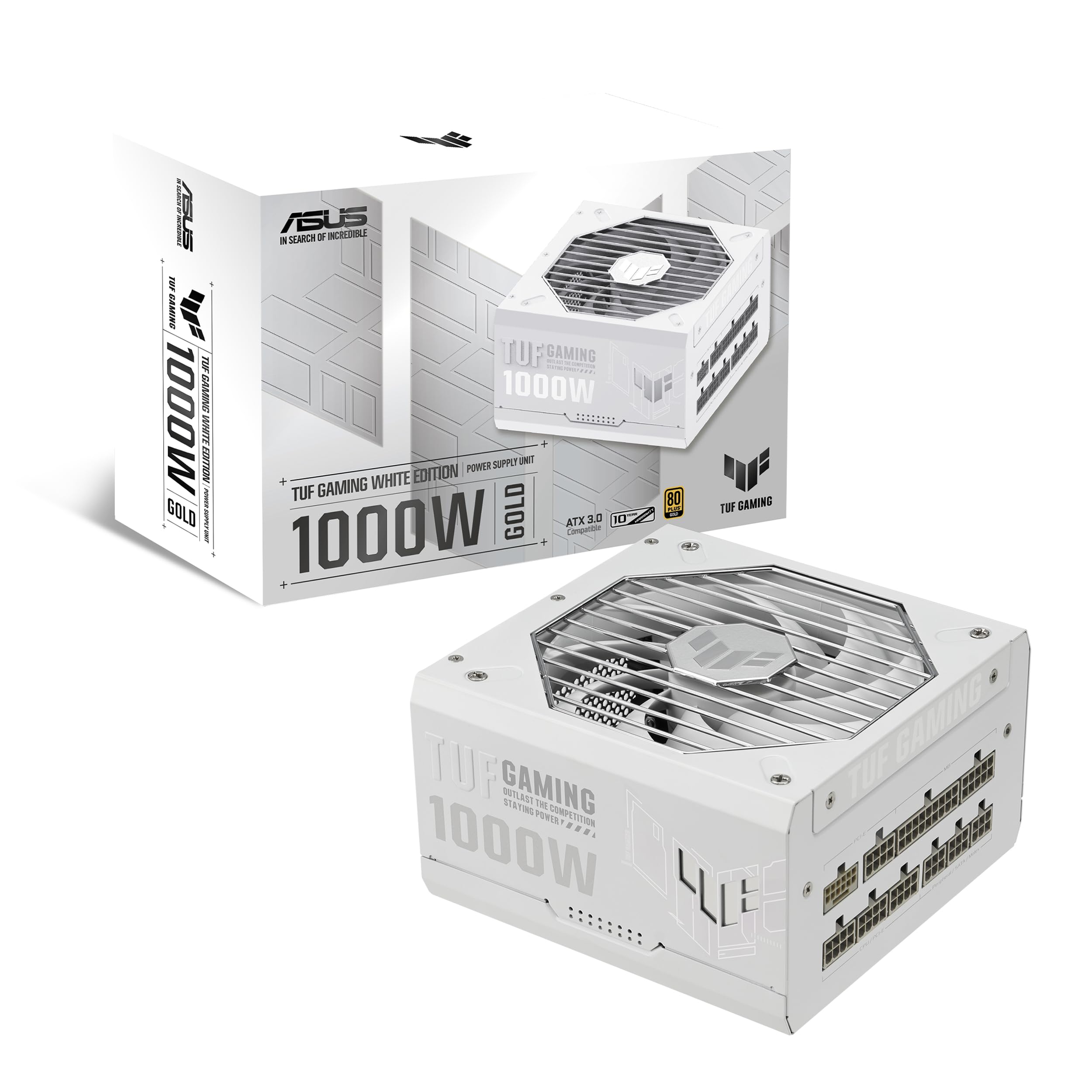
TUF Gaming 1000W Gold White Edition (1000 Watt, ATX 3.1 Compatible, Fully Modular Power Supply, 80+ Gold Certified, Military-grade Components, Dual Ball Bearing, PCB Coating, 10 Year Warranty)
£132.07 · ASUS
Frequently asked
6 questions01Is the CORSAIR SF850 (2024) Fully Modular Low Noise 80 PLUS Platinum ATX Power Supply good for gaming?+
Yes, absolutely. 850W with Platinum efficiency and ATX 3.1 compliance is more than sufficient for any current gaming build, including systems running flagship GPUs like the RTX 5090 or RX 9900 XTX. The ATX 3.1 compliance means it handles the transient power spikes modern GPUs produce without tripping protection or delivering unstable voltage.
02What wattage PSU do I need for a high-end gaming PC?+
For a system with a flagship GPU (RTX 5080, RTX 5090, RX 9900 XTX) and a high-end CPU (Ryzen 9 9950X, Core i9-14900K), 850W is a comfortable choice with good headroom. Mid-range builds with an RTX 4070 or RX 7800 XT can get away with 650W to 750W. Use a PSU calculator to confirm based on your specific components before buying.
03Is 80 PLUS Platinum worth it over Gold for a PSU?+
In a standard ATX build, the efficiency difference between Gold (90% at 50% load) and Platinum (92% at 50% load) saves a modest amount on electricity annually. The stronger argument for Platinum is thermal: less waste heat inside a compact case means lower temperatures, quieter fans, and longer component life. In an SFX build where heat management is already challenging, Platinum is worth the premium.
04How long is the warranty on the CORSAIR SF850 (2024)?+
The SF850 (2024) carries a 7-year warranty. That's above average for the PSU category and reflects Corsair's confidence in the 105 degree Celsius rated Japanese capacitors and overall build quality. A 7-year warranty on a PSU is a meaningful commitment from the manufacturer.
05Is the CORSAIR SF850 (2024) fully modular?+
Yes, it's fully modular using Corsair's Type-5 Micro-Fit connectors. This means no cables are permanently attached to the unit. You connect only the cables your build needs, which is especially valuable in small-form-factor cases where unused cables have nowhere to go and can obstruct airflow.
06Will the CORSAIR SF850 fit in a standard ATX case?+
Yes. The SF850 is an SFX form factor unit, which is smaller than standard ATX. Corsair includes an SFX-to-ATX bracket in the box, which allows the SF850 to mount in a standard ATX PSU bay. This makes it compatible with both SFX cases and full-size ATX mid-towers.