Cryptocurrency mining places unique demands on a graphics card: sustained compute throughput, low power draw relative to hashrate, and the ability to run flat-out for months without throttling. The landscape shifted considerably in 2024 and into 2025, with NVIDIA's Blackwell (RTX 50-series) and AMD's RDNA 4 (RX 9000-series) cards arriving with dramatically improved memory bandwidth and compute efficiency. At the same time, Ethereum's move to proof-of-stake removed the world's most popular GPU-mining coin from the equation, pushing miners toward Ethereum Classic, Kaspa, Ergo, Ravencoin, and a growing list of ASIC-resistant altcoins. This roundup is aimed at UK-based miners who want to build or upgrade a rig in 2025, whether that means a single card for part-time mining or a multi-GPU rack. We cover cards from entry-level to high-end, weighing hashrate, power efficiency, upfront cost, and resale value so you can make an informed decision. For a broader overview of best graphics cards available in the UK market beyond mining-specific use cases, see our complete buyer's guide.
Quick Verdict
Best Overall: PowerColor Hellhound AMD Radeon RX 9070 16GB. It delivers class-leading memory bandwidth on RDNA 4 at a price that makes the maths work, with excellent thermal management for 24/7 operation.
Best Value: MSI GeForce RTX 5070 12G Gaming Trio OC. The RTX 5070 punches above its price bracket in compute efficiency, and MSI's triple-fan cooler keeps temperatures stable during long mining sessions.
Spec Comparison
The PowerColor Hellhound RX 9070 is the card that makes the most sense for a UK miner in 2025. AMD's RDNA 4 architecture brings a substantial leap in compute-per-watt compared to RDNA 3, and the RX 9070 sits at the sweet spot in the product stack: enough VRAM and memory bandwidth to handle demanding DAG files and memory-hard algorithms, without the premium pricing of the XT variant.
At its core, the RX 9070 uses the Navi 48 die with 3,584 stream processors, 16 GB of GDDR6 on a 256-bit bus, and a peak memory bandwidth of around 576 GB/s. For Kaspa (using the kHeavyHash algorithm), early community benchmarks put the RX 9070 in the region of 800-900 MH/s at around 130-150 W of actual board power when undervolted, giving it one of the best efficiency ratios currently available in this price bracket. On Ergo (Autolykos v2) and Ravencoin (KawPow), the wide memory bus and large L3 cache help maintain high throughput.
PowerColor's Hellhound cooler uses a triple-fan, dual-BIOS design. The secondary BIOS runs quieter fan curves, which is ideal for a mining rig that needs to operate continuously without annoying noise or thermal throttling. The card's PCB is rated for sustained loads, and PowerColor has a solid reputation for build quality in the mining community.
From a practical standpoint, the 16 GB frame buffer means the card will not be obsolete as DAG sizes grow on surviving proof-of-work coins. PCIe 4.0 compatibility ensures it works in both older and newer motherboards, which matters when you are building a multi-GPU rig on a budget platform.
The main drawback is that AMD's mining drivers and overclocking tools (AMD Software: Adrenalin) are less mature than NVIDIA's ecosystem for mining-specific tuning. Tools like MSI Afterburner work with AMD cards, but memory timing adjustments are less granular than on NVIDIA hardware. That said, for most miners the out-of-the-box efficiency gains of RDNA 4 outweigh the software friction.
Verdict: The best all-round mining card in the UK market right now, combining generous VRAM, excellent efficiency, and a price that gives a realistic payback period on popular altcoins.
Pros
- 16 GB GDDR6 on a 256-bit bus gives strong performance on memory-hard algorithms
- RDNA 4 architecture delivers significantly better compute-per-watt than previous AMD generations
- Dual-BIOS design allows quiet, thermally stable 24/7 operation
Cons
- AMD mining driver ecosystem less mature than NVIDIA's for fine-grained memory tuning
- PCIe 4.0 only, so no future-proofing benefit from PCIe 5.0 platforms
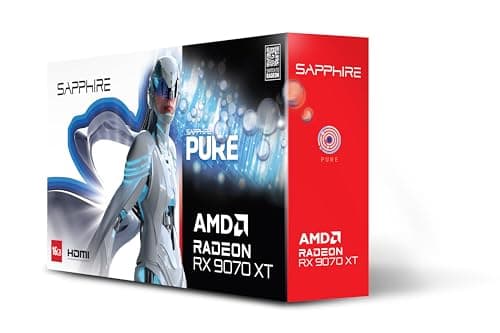
The RX 9070 XT steps up from the standard RX 9070 with a fully enabled Navi 48 XT die, offering 4,096 stream processors versus the RX 9070's 3,584. The memory configuration is identical, 16 GB GDDR6 on a 256-bit bus, but the higher shader count and boosted clock speeds translate to meaningfully higher hashrates on compute-intensive algorithms.
XFX's Mercury cooler uses a distinctive magnetic air design that allows the fans to be removed for cleaning, which is a practical feature for mining rigs that accumulate dust rapidly. The RGB lighting can be disabled entirely through XFX's software, which is useful for minimising power draw and avoiding unnecessary components that could fail over time in a continuous-use environment.
On Kaspa, the RX 9070 XT typically benchmarks around 10-15% higher than the standard RX 9070 in raw MH/s terms, though it also draws more power. The efficiency gap narrows when both cards are undervolted aggressively, so the choice between the two often comes down to whether you want maximum hashrate or maximum efficiency per watt. For a single-card setup or a small rig, the XT's extra performance may justify the price premium. For a large rack where electricity costs dominate, the standard RX 9070 often wins on economics.
The OC variant from XFX arrives with factory overclocked memory and core clocks, which gives a small out-of-the-box performance advantage. However, miners typically apply their own undervolts and clock adjustments anyway, so the factory OC is less relevant than the card's thermal and power delivery headroom, both of which are generous on this model.
PCIe 4.0 x16 connectivity is standard, and the card uses a single 16-pin (12VHPWR) power connector, which simplifies cabling in a mining rig. The 260 W TDP at stock settings means you will want a quality PSU with adequate headroom, particularly in a multi-GPU configuration.
At the price point, the RX 9070 XT is positioned above the standard RX 9070 but below the RTX 5070 Ti, making it a strong option for miners who want AMD's RDNA 4 efficiency gains with the extra compute headroom of the fully enabled die.
Verdict: A strong performer for miners who want the maximum RDNA 4 hashrate without paying RTX 5070 Ti prices, particularly suited to compute-heavy altcoin algorithms.
Pros
- Fully enabled Navi 48 XT die provides 10-15% higher hashrate than standard RX 9070 on Kaspa
- Removable fans on the Mercury cooler make dust maintenance practical in a mining environment
- 16 GB GDDR6 ensures compatibility with growing DAG files on current proof-of-work coins
Cons
- Higher power draw than standard RX 9070 reduces efficiency advantage when undervolted
- Price premium over RX 9070 takes longer to recoup through mining revenue
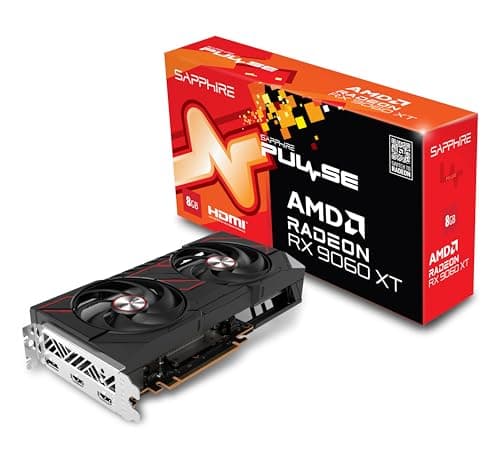
The RX 9060 XT is AMD's entry into the mainstream segment of the RDNA 4 lineup, using the smaller Navi 44 die. It is the most affordable card in this roundup and is aimed at miners who are just starting out, those with limited electricity budgets, or those building a large rack where per-card cost is the primary constraint.
The headline specification for miners is the 16 GB GDDR6 configuration on a 128-bit bus. The narrower bus is the card's main limitation: memory bandwidth is significantly lower than the RX 9070 or RX 9070 XT, which means it falls behind on bandwidth-hungry algorithms. However, on compute-focused algorithms like Kaspa's kHeavyHash, the Navi 44 die's RDNA 4 compute units are surprisingly competitive, and the 150 W TDP makes it one of the most power-efficient cards available for mining.
Sapphire's Pulse cooler is a dual-fan design that is compact and quiet. It is well-suited to mining rigs where space and airflow are at a premium, and the lower TDP means it does not need aggressive fan speeds to maintain safe temperatures. Sapphire has a long history of producing reliable AMD cards for mining, and the Pulse line is known for good build quality at a competitive price.
The 16 GB VRAM on a budget card is genuinely useful for mining, as it ensures compatibility with current and near-future DAG sizes without requiring an upgrade. This is one of the few areas where the RX 9060 XT outspecifies more expensive NVIDIA alternatives like the RTX 5070.
For UK miners on a tight budget, the RX 9060 XT offers a low barrier to entry with RDNA 4 efficiency gains. The payback period at current UK electricity prices and altcoin values will depend heavily on which coin you mine and the current difficulty, but the low power draw keeps running costs manageable. It is not the fastest card in this roundup, but it is the most accessible.
The main caveat is that the 128-bit memory bus limits performance on memory-intensive algorithms. If your preferred mining coin relies heavily on memory bandwidth, the RX 9070 is worth the extra investment.
Verdict: The best entry-level mining card in this roundup, offering RDNA 4 efficiency and 16 GB VRAM at a price that makes it accessible to new miners or those building large, low-cost rigs.
Pros
- 150 W TDP is among the lowest in this roundup, keeping electricity costs minimal for 24/7 operation
- 16 GB GDDR6 frame buffer ensures DAG compatibility despite the budget price point
- Sapphire Pulse build quality is proven reliable in long-term mining deployments
Cons
- 128-bit memory bus significantly limits performance on bandwidth-sensitive algorithms like Ergo
- Lower raw hashrate means longer payback periods compared to higher-tier cards
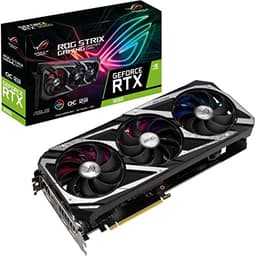
4. ASUS ROG Strix GeForce RTX 3060 V2 OC Edition
The RTX 3060 is an older card now, based on NVIDIA's Ampere architecture from 2021, but it retains a place in this roundup for a specific reason: it was one of the most popular mining cards of the Ethereum era, and it remains relevant for miners who are buying second-hand hardware or who already own one and want to know whether it is worth running in 2025.
The RTX 3060 uses the GA106 die with 3,584 CUDA cores and 12 GB of GDDR6 on a 192-bit bus. NVIDIA famously introduced a hash rate limiter on the RTX 3060 targeting Ethereum mining, but that limiter is irrelevant now that Ethereum has moved to proof-of-stake. On current proof-of-work coins, the RTX 3060 performs without restriction, and its 12 GB VRAM remains adequate for most current DAG sizes.
ASUS's ROG Strix cooler is a triple-fan, three-slot design that is significantly over-engineered for the card's 170 W TDP. This over-engineering is actually an advantage for mining: the card runs cool and quiet even under sustained load, and the thermal headroom means it can maintain boost clocks without throttling. The ROG Strix build quality is excellent, with a reinforced PCIe slot and high-quality capacitors that are suited to long-term continuous operation.
On Kaspa, the RTX 3060 achieves reasonable hashrates, though it trails the RDNA 4 and Blackwell cards significantly in efficiency. When undervolted to around 100-120 W, the efficiency ratio improves, but it still cannot match the newer architectures. The card's main appeal in 2025 is its lower entry cost on the second-hand market, though the new price on this listing is higher than many newer alternatives, which limits its appeal as a new purchase.
For miners who already own an RTX 3060 and are wondering whether to keep running it or upgrade, the answer depends on your electricity costs. At UK average electricity prices, the RTX 3060 is marginal for profitability on most coins, but in a setup with low electricity costs or where the card is already paid off, it can still generate a small return.
As a new purchase at the listed price, the RTX 3060 V2 is difficult to recommend over the RX 9060 XT or RTX 5070, both of which offer better efficiency and more modern architectures. Its inclusion here is for completeness and for miners evaluating existing hardware.
Verdict: A solid card for miners who already own one, but difficult to justify as a new purchase in 2025 when newer, more efficient options are available at competitive prices.
Pros
- ROG Strix triple-fan cooler runs the card cool and quiet under sustained mining loads
- 12 GB GDDR6 VRAM remains sufficient for current proof-of-work DAG file sizes
Cons
- Ampere architecture is significantly less efficient than RDNA 4 or Blackwell on a per-watt basis
- Listed new price is higher than more capable modern alternatives, making it poor value as a fresh purchase
- Limited future-proofing as mining algorithms continue to favour newer compute architectures
Buying Guide
Which algorithm are you mining?
The single most important factor in choosing a mining GPU is the algorithm used by your target coin. Kaspa (kHeavyHash) is currently the most popular GPU-minable coin and favours raw compute throughput, making it well-suited to both AMD RDNA 4 and NVIDIA Blackwell cards. Ergo (Autolykos v2) and Ravencoin (KawPow) are more memory-bandwidth sensitive, favouring cards with wide memory buses and fast VRAM. Ethereum Classic (Etchash) uses a DAG file that requires at least 4 GB of VRAM and grows over time. Always check the current DAG size against your card's VRAM before purchasing.
Power efficiency matters more than raw hashrate
In the UK, electricity costs are among the highest in Europe. At current average rates, a card drawing 300 W costs significantly more to run annually than one drawing 150 W. A card with a 20% lower hashrate but 40% lower power draw will often be more profitable in the long run. Always calculate your expected profit using a mining profitability calculator with your actual electricity tariff before committing to a purchase.
VRAM: how much do you need?
For most current proof-of-work coins, 8 GB of VRAM is the practical minimum, and 12 GB is comfortable. Cards with 16 GB provide the most future-proofing as DAG files grow. The memory bus width is equally important: a 256-bit bus moves more data per clock cycle than a 128-bit bus, which matters on bandwidth-sensitive algorithms.
Cooling and build quality for 24/7 use
Mining runs a GPU at sustained load continuously, which is far more demanding than gaming. Look for cards with robust VRM designs, high-quality capacitors, and coolers that maintain safe temperatures without running fans at maximum speed constantly. Triple-fan designs generally handle sustained loads better than dual-fan designs at the same TDP.
What about Bitcoin mining?
It is important to address a common misconception: Bitcoin cannot be profitably mined with a consumer GPU. Bitcoin uses the SHA-256 algorithm, which is dominated by dedicated ASIC miners that are orders of magnitude more efficient than any GPU. A single modern ASIC miner outperforms thousands of GPUs for Bitcoin mining. To answer the common question directly: mining 1 BTC with a single GPU would take thousands of years at current network difficulty. GPUs are only viable for ASIC-resistant proof-of-work coins.
New versus second-hand
Second-hand mining cards can offer good value, but check for signs of heavy use: fan wear, thermal paste degradation, and capacitor stress. Cards from the Ethereum mining era (pre-2022) have often been run hard for years. Newer cards bought new carry manufacturer warranties that are voided by some but not all manufacturers for mining use, so check the terms carefully.
Multi-GPU rigs
Building a multi-GPU rig requires a compatible motherboard with multiple PCIe slots, powered PCIe risers, a high-quality PSU with sufficient wattage headroom (add 20% above calculated load), and adequate airflow. Six to eight mid-range cards often outperform two or three high-end cards at the same total cost due to better efficiency ratios at lower power limits.
The PowerColor Hellhound RX 9070 16GB is the overall winner for UK cryptocurrency miners in 2025. It combines AMD's RDNA 4 compute efficiency with 16 GB of GDDR6 on a 256-bit bus, a proven cooling solution for 24/7 operation, and a price that gives a realistic payback period on current altcoin mining revenues. The 16 GB VRAM provides meaningful future-proofing, and the dual-BIOS design allows quiet, stable long-term operation. For miners who prefer NVIDIA's more mature software ecosystem, the MSI RTX 5070 12G Gaming Trio OC is the best alternative, offering Blackwell efficiency gains and excellent driver support at a competitive price. Budget-conscious miners should look at the Sapphire Pulse RX 9060 XT, which delivers RDNA 4 efficiency at the lowest entry price in this roundup. Avoid purchasing the RTX 3060 new in 2025: it is outclassed by modern alternatives at its current asking price, though it remains a reasonable option if you already own one and are evaluating whether to continue running it.