ASUS produces some of the most well-regarded graphics cards on the market, spanning budget-friendly Dual series boards all the way up to flagship ROG Strix designs with triple-fan cooling and factory overclocks. Whether you are building a compact home-theatre PC, a capable 1080p gaming rig, or a high-end 1440p powerhouse, ASUS has a card bearing its name. Since last year, the arrival of NVIDIA's RTX 50-series has shaken up the landscape considerably: GDDR7 memory, PCIe 5.0 interfaces, and significantly improved power efficiency per frame have made some older-generation cards harder to recommend at their current street prices. This comparison covers five ASUS graphics cards available in the UK right now, ranging from an entry-level 6 GB card to a next-generation RTX 5070, so you can weigh up performance, features, and real-world value before spending your money. We have been honest about pricing anomalies where they exist, because buying an older card at an inflated price rarely makes sense when newer alternatives exist at similar or lower cost.
Quick Verdict
Best Overall: ASUS DUAL RTX 5070 OC. The RTX 5070 is a genuinely current-generation card with 12 GB of GDDR7, PCIe 5.0, and excellent 1440p credentials. It is our pick of the ASUS cards here for 1440p gaming.
Best Value: ASUS GeForce RTX 5060 LP BRK 8GB GDDR7. The low-profile RTX 5060 brings next-generation memory and a compact form factor at a price that makes it accessible for budget builders and small-form-factor enthusiasts alike.
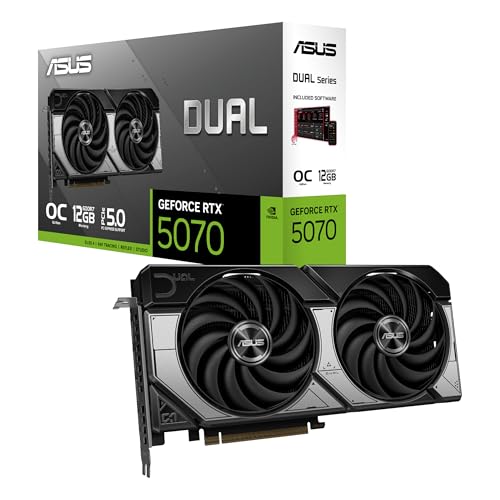
The ASUS DUAL RTX 5070 OC is the headline act in this roundup and the card most buyers with a serious gaming budget should be looking at in 2025. Built on NVIDIA's Blackwell architecture and equipped with 12 GB of GDDR7 memory over a 192-bit bus, it represents a genuine generational step forward from the RTX 40-series and a massive leap over anything Ampere or Turing-era in this catalogue.
The Dual series sits below the ROG Strix in ASUS's hierarchy, but that does not mean it is a stripped-down product. The dual-fan Axial-Tech cooling system uses 0 dB technology, meaning the fans remain completely off under light loads, which is a welcome feature for anyone who uses their PC for productivity or media consumption as well as gaming. The factory overclock pushes the boost clock to 2572 MHz, slightly above NVIDIA's reference specification, and ASUS includes its GPU Tweak III software for those who want to push things further or monitor temperatures in real time.
In terms of real-world performance, the RTX 5070 comfortably handles 1440p gaming at high to ultra settings across modern titles. With DLSS 4 and Multi Frame Generation support baked into Blackwell, frame rates in supported titles can be pushed well beyond what raw rasterisation alone would suggest, making 4K gaming at medium settings a realistic proposition for some users. The card also benefits from NVIDIA's improved AV1 encoder, which is a meaningful advantage for content creators who stream or record gameplay.
Connectivity includes HDMI 2.1 and three DisplayPort 2.1 outputs, supporting high-refresh-rate monitors and multi-display setups without compromise. The PCIe 5.0 interface future-proofs the card for next-generation motherboards, though it remains fully backwards compatible with PCIe 4.0 and 3.0 slots. ASUS recommends a 750 W power supply for this card.
The DUAL RTX 5070 OC is expensive, but its performance makes the price easier to justify. If you are building or upgrading a gaming PC and want a card that will remain relevant for several years, this is the one to buy.
Verdict: The best all-round ASUS graphics card in this lineup, offering next-generation performance, modern connectivity, and sensible pricing for what it delivers.
Pros
- Blackwell architecture with DLSS 4 and Multi Frame Generation support
- 12 GB GDDR7 over a 192-bit bus keeps it relevant at 1440p and beyond
- 0 dB fan mode makes it near-silent under light workloads
- Three DisplayPort 2.1 outputs support high-refresh multi-monitor setups
The ASUS GeForce RTX 5060 LP BRK is a genuinely interesting product that serves a niche most GPU manufacturers ignore: the low-profile market. Designed to fit into slim desktop cases, mini-ITX chassis, and small-form-factor builds where a full-height card simply will not fit, it brings NVIDIA's Blackwell architecture and GDDR7 memory into a compact bracket that measures just half the height of a standard card.
With 8 GB of GDDR7 memory, the RTX 5060 LP BRK is meaningfully better equipped than many of its low-profile predecessors, which often shipped with slower GDDR6 and smaller frame buffers. GDDR7 brings higher bandwidth per pin, which helps offset the narrower memory bus that low-profile designs typically impose. The result is a card that punches above its physical size in memory-intensive workloads and modern titles that lean heavily on texture streaming.
Performance sits comfortably in the 1080p high-settings bracket, with 1440p medium settings achievable in many titles. DLSS 4 support, including Frame Generation on compatible games, allows the RTX 5060 to produce smooth frame rates that raw rasterisation numbers alone would not suggest. For a living-room PC, a home-office build that doubles as a gaming machine, or a compact LAN party rig, this card makes a compelling case.
The PCIe 5.0 interface is present, though the practical benefit is minimal at this performance tier since even PCIe 3.0 x16 bandwidth is rarely a bottleneck for a card of this class. Connectivity includes HDMI and DisplayPort outputs, which covers the vast majority of monitor configurations. Power draw is low enough that a quality 450 W to 550 W PSU is sufficient, making it an easy fit into compact builds with smaller power supplies.
The RTX 5060 LP BRK costs more than the RTX 3050 6G DUAL OC but much less than the DUAL RTX 5070 OC, and it is the most affordable Blackwell card in this pool. For anyone constrained by case size, it is the obvious starting point.
Verdict: The best value pick in this roundup for a slim case that requires a low-profile card. Check its dimensions before buying.
Pros
- Low-profile form factor opens up slim and compact case compatibility
- GDDR7 memory brings next-generation bandwidth to an entry-level price point
- DLSS 4 and Frame Generation support improve effective frame rates significantly
Cons
- 8 GB VRAM may feel limiting in heavily modded games or future AAA titles at 1440p
- Compact cooling solution means higher operating temperatures under sustained load compared to full-size cards
- Low-profile bracket limits display output options compared to full-height designs
The ASUS GeForce RTX 3050 6G DUAL OC occupies the entry-level end of the Ampere generation, and it is a card that requires careful consideration before purchase in 2025. The 6 GB frame buffer is the defining characteristic here, and it is both the card's main selling point in terms of keeping the price low and its most significant limitation in terms of longevity.
Built on NVIDIA's Ampere architecture with a 96-bit memory bus and GDDR6 memory, the RTX 3050 6G is a step down from the more common 8 GB RTX 3050 variant. ASUS has applied a modest factory overclock, pushing the boost clock to 1537 MHz, and the Dual Axial-Tech fan setup keeps temperatures reasonable in a compact dual-slot design. The card is physically small and light, making it suitable for micro-ATX and mini-ITX builds where space is at a premium.
At 1080p with medium to high settings, the RTX 3050 6G delivers playable frame rates in most titles released up to 2024. DLSS 2 support is present, which helps in titles that support it, though the older DLSS version lacks the quality improvements of DLSS 4 found on Blackwell cards. Ray tracing is technically supported but practically limited given the card's rasterisation performance baseline.
The 6 GB VRAM is a genuine concern. Several modern titles already exceed 6 GB VRAM usage at high settings, and this figure is only likely to grow. Buyers should be realistic: this card is suited to 1080p gaming at medium settings in 2025 titles, and its longevity at that resolution is uncertain beyond 2026 or 2027. It is best suited to casual gamers, older titles, or esports-focused players who prioritise high frame rates in less demanding games over visual fidelity in cutting-edge releases.
The RTX 3050 6G DUAL OC is the cheapest card in this pool. However, prospective buyers should compare it carefully against the RTX 5060 LP BRK, which costs more but offers a considerably more capable and future-proof platform.
Verdict: A workable entry-level card for 1080p gaming on a tight budget, but the 6 GB VRAM limit and ageing architecture mean it will struggle to keep pace with demanding titles over the next few years.
Pros
- Lowest price in the pool, making it accessible for very tight budgets
- Compact dual-slot design fits easily into small cases
- Low power draw suits builds with modest PSUs
Cons
- 6 GB VRAM is already a limitation in some 2024 and 2025 titles at high settings
- Ampere architecture lacks DLSS 4 and Frame Generation, reducing effective performance uplift
- 96-bit memory bus creates a bandwidth bottleneck compared to wider-bus alternatives
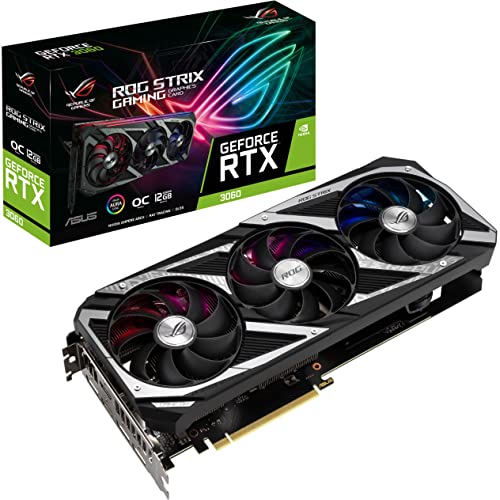
The ASUS ROG Strix GeForce RTX 3060 V2 OC Edition is one of the most premium board partner designs ever produced for the RTX 3060, featuring a triple-fan Axial-Tech cooling system, a reinforced PCIe connector, and ASUS's full ROG ecosystem integration including Aura Sync RGB lighting. As a piece of hardware engineering, it is genuinely impressive for its class.
The RTX 3060 itself uses NVIDIA's Ampere architecture with 12 GB of GDDR6 memory over a 192-bit bus. The 12 GB frame buffer was a standout feature when this card launched, providing more VRAM than many higher-tier cards of its era and making it particularly attractive for content creators working with large textures or running AI-assisted applications. The factory overclock on the V2 revision pushes clocks modestly above reference, and the ROG Strix cooling system keeps the GPU well within thermal limits even under sustained load.
At 1080p, the RTX 3060 delivers strong performance in virtually all titles. At 1440p, it manages high settings in many games, though frame rates in the most demanding 2024 and 2025 releases can dip below 60 fps without DLSS assistance. The card supports DLSS 2, which helps, but again lacks the newer DLSS 4 capabilities of Blackwell cards.
The ROG Strix RTX 3060 V2 OC costs far more here than the other RTX 3060 12GB cards we track. We are not displaying the price and do not recommend this offer. The DUAL RTX 5070 OC is much faster.
Verdict: An excellent board partner design on a capable GPU, but the current UK listing price makes it extremely poor value compared to newer alternatives in this very catalogue.
Pros
- 12 GB GDDR6 frame buffer remains generous for 1080p and 1440p workloads
- Triple-fan ROG Strix cooling keeps temperatures very low under sustained gaming loads
- RGB lighting works with ASUS Aura Sync
Cons
- The current listing is extremely poor value next to other RTX 3060 12GB cards
- Ampere architecture and DLSS 2 are outclassed by Blackwell cards at similar or lower prices
- PCIe 4.0 interface is not a dealbreaker but is one generation behind current standards
The ASUS ROG Strix GeForce RTX 2070 Super Advanced OC is a card from NVIDIA's Turing generation, which launched in 2019. At the time of its release, it was one of the finest mid-to-high-end graphics cards available, and ASUS's ROG Strix treatment gave it a triple-fan cooling solution, a factory overclock pushing the boost clock to around 1845 MHz, and the full ROG aesthetic package including Aura Sync RGB and a reinforced PCIe slot.
The RTX 2070 Super uses 8 GB of GDDR6 memory over a 256-bit bus, which was a strong configuration in 2019 and 2020. The card supports NVIDIA's first-generation ray tracing cores and DLSS 1.0 and 2.0, though it lacks the more refined DLSS 3 and DLSS 4 implementations found on newer architectures. At 1080p, the RTX 2070 Super still delivers solid performance in many titles, and at 1440p it remains playable in less demanding games.
However, the RTX 2070 Super is now a six-year-old card, and its limitations are increasingly apparent in 2025. Driver support, while still active, will eventually be wound down. The card's ray tracing performance is noticeably slower than even mid-range Ampere cards, and it lacks the efficiency improvements of later architectures, consuming more power for equivalent output. DLSS support is limited to older versions, and there is no Frame Generation capability whatsoever.
The pricing situation is even more problematic than the RTX 3060 V2 OC. The ROG Strix RTX 2070 Super is listed at RTX 5070 money or more, and the DUAL RTX 5070 OC is a card from a completely different performance era. The RTX 5070 is faster in virtually every metric, consumes power more efficiently, supports modern features, and has a multi-year relevance advantage. There is no scenario in which the RTX 2070 Super at this price makes sense as a new purchase.
We have included it here for completeness, as it is part of ASUS's available catalogue, but buyers should approach this listing with extreme caution and seek out the current price before considering any purchase.
Verdict: A historically significant card with excellent build quality, but its current listing price makes it one of the worst-value graphics card purchases available in the UK market today.
Pros
- 256-bit memory bus provides strong bandwidth for a card of this era
- ROG Strix triple-fan cooling is exceptionally effective and keeps noise levels low
Cons
- Listed at RTX 5070 money or more despite being six years older and far slower
- Turing architecture lacks DLSS 3 and DLSS 4, limiting effective frame rate uplift in modern titles
- No Frame Generation support and ageing driver lifecycle reduce long-term usability
Buying Guide
Resolution and Refresh Rate Targets
The single most important factor when choosing a graphics card is knowing your target resolution and refresh rate. For 1080p gaming at 60 fps in mainstream titles, an entry-level card like the RTX 3050 6G or RTX 5060 LP is entirely adequate. If you want 1080p at 144 fps or higher in competitive games, a mid-range card becomes necessary. For 1440p gaming at high settings and 60-plus fps, you need something in the RTX 5070 class or equivalent. Buying more GPU than your monitor can use is wasteful; buying less than your monitor demands leads to frustration.
VRAM: How Much Do You Actually Need?
VRAM requirements have been climbing steadily. In 2025, 8 GB is the practical minimum for comfortable 1080p gaming in demanding titles, and 12 GB is increasingly recommended for 1440p. The RTX 3050 6G's 6 GB frame buffer is already a constraint in some titles, while the RTX 3060's 12 GB and the RTX 5070's 12 GB GDDR7 offer considerably more headroom. Content creators, those running AI workloads locally, or anyone using high-resolution texture packs should prioritise VRAM capacity above almost everything else.
Memory Technology: GDDR6 vs GDDR7
GDDR7, found on the RTX 5060 LP BRK and the DUAL RTX 5070 OC, offers roughly double the bandwidth per pin compared to GDDR6. This translates to better performance in memory-bandwidth-limited scenarios, which includes many modern open-world games and AI-assisted rendering tasks. If you are buying a card today and plan to keep it for three or more years, GDDR7 is a meaningful advantage.
Form Factor Considerations
Most graphics cards are designed for standard ATX cases and will not fit in slim or low-profile enclosures. If your slim case needs a low-profile card, consider the RTX 5060 LP BRK. Always check your case's maximum GPU length and slot height before purchasing, and verify that your PSU has the appropriate power connectors for your chosen card.
PCIe Generation
PCIe 5.0 cards like the RTX 5060 LP BRK and DUAL RTX 5070 OC are fully backwards compatible with PCIe 4.0 and 3.0 motherboards. The bandwidth difference between PCIe generations is rarely a bottleneck for current graphics cards, so do not worry about needing to upgrade your motherboard to benefit from a PCIe 5.0 GPU.
Power Supply Requirements
Always check the TDP of your chosen card and ensure your PSU has sufficient headroom. A general rule is to have a PSU rated at least 150 W above the card's TDP, accounting for the rest of your system. For the RTX 5070, a 750 W PSU is the recommended minimum. For the RTX 5060 LP, 450 W to 550 W is sufficient. For the RTX 3050 6G, a quality 450 W unit is adequate.
Pricing Sanity Checks
As demonstrated by some of the listings in this roundup, older graphics cards can sometimes be listed at prices that bear no rational relationship to their performance. Always compare the price of any card you are considering against current-generation alternatives before committing. A newer card at the same price will almost always offer better performance, better feature support, and longer relevance.
The ASUS DUAL RTX 5070 OC is the clear overall winner in this roundup. It combines a current-generation architecture, next-generation memory technology, modern feature support including DLSS 4 and Multi Frame Generation, and a price that, while high in absolute terms, is defensible given what it delivers. For anyone building or upgrading a gaming PC for 1440p, this is the card to buy from this pool.
For those with tighter budgets or compact build requirements, the ASUS GeForce RTX 5060 LP BRK is the best value pick. It brings Blackwell architecture and GDDR7 memory into a low-profile form factor, making it the most accessible next-generation option available here.
The RTX 3050 6G DUAL OC is a workable entry-level option at its price point, though its 6 GB VRAM limit is a genuine concern for longevity. The ROG Strix RTX 3060 V2 OC and ROG Strix RTX 2070 Super Advanced OC are both excellent pieces of hardware engineering, but their current UK listing prices are extremely difficult to justify in a market where newer, faster, more efficient cards are available for comparable or lower cost. Approach those two listings with caution and always verify the current price before purchasing.